
Life, 1892-05-05 · page 4 of 18
Life — May 5, 1892 — page 4: what you’re looking at
What you’re looking at
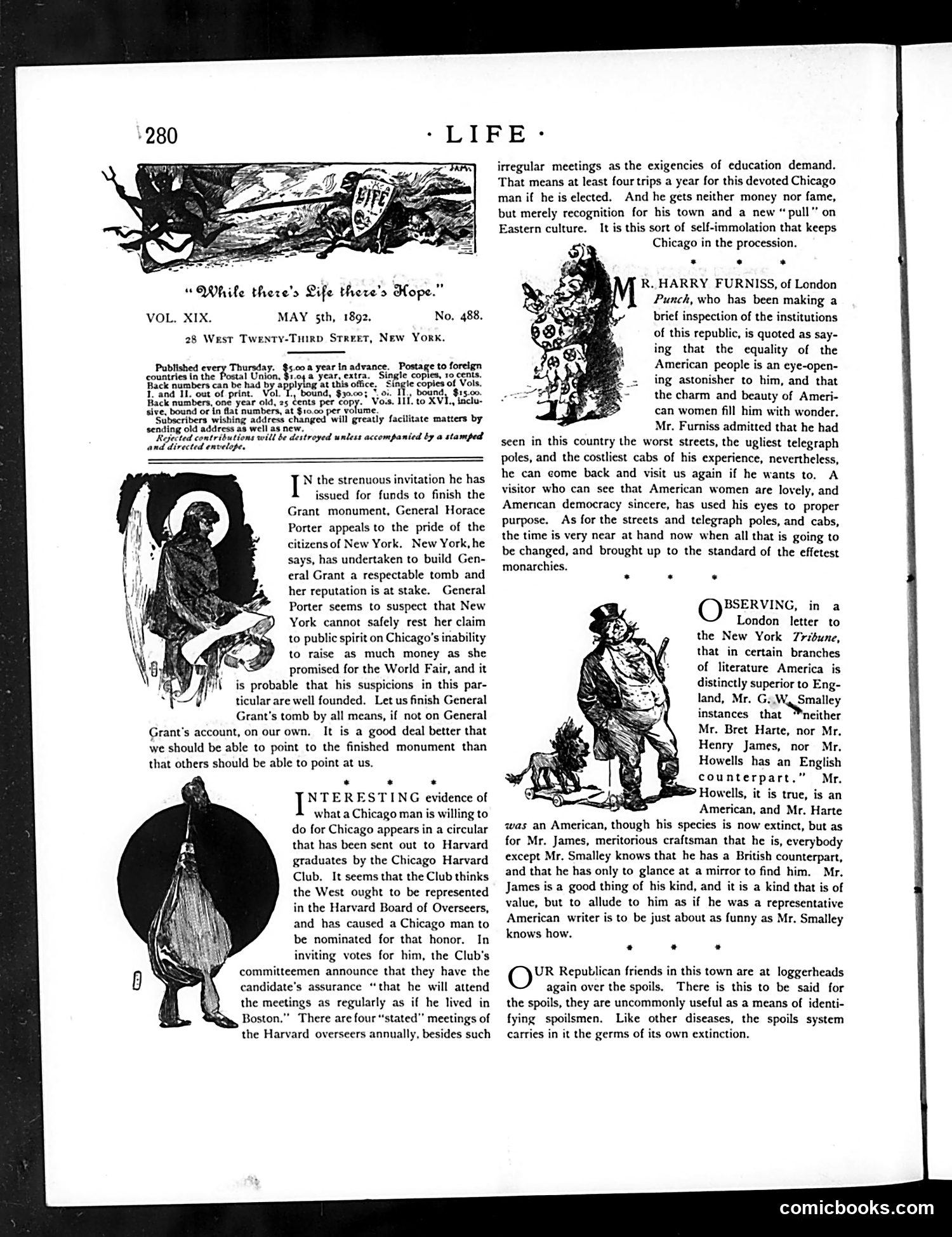
**Top Cartoon:** "While there's Life there's Hope" - appears to be a generic commentary on perseverance, using a skeletal or death-like figure. **Main Content:** The page discusses General Horace Porter and efforts to finish his Grant Monument in New York. The text expresses concern that New York cannot raise sufficient funds, suggesting Chicago's superior fundraising ability for the World's Fair. This is satirical commentary on inter-city rivalry between New York and Chicago. **Lower Section:** Discusses a Chicago man nominated for Harvard's Board of Overseers, with humor about his attendance at Boston meetings. Also includes observations comparing American and English literature figures (Bret Harte, Henry James, W.D. Howells), and criticism of Republican political spoils system as a disease-like problem. The satire targets civic pride, partisan politics, and cultural pretensions of the Gilded Age.
📄 Transcribed text from this page (OCR, searchable)
Machine-transcribed from the original scan — historical spelling and the odd misread are preserved.
“While there's Life there's Hope.” VOL. XIX. MAY sth, 1892, No, 488. 28 West Twenty-Tiirp Street, New York. Published every Thursday. $s.coa year in advance. Postage to foreign countries in the Postal Union, $.04 a year, extra. Single copies, ro cents, ack numbers can be had by appiying at this office, $1 ragte copies of Vols. I. and IL. out of print. Vol. I, bound, $30.00; T1., bound, $15.00. Back numbers, one year old, 25 Cents per copy.” Vos. Ill. to XVI, inclu- sive, bound or in flat numbers, at $10.00 per volume. Subscribers wishing address changed will greatly facilitate matters by sending old address as well as new. Rejected contributions will be destroyed untess accompanied by a stamped and directed envelope. N the strenuous invitation he has issued for funds to finish the Grant monument, General Horace Porter appeals to the pride of the citizens of New York. New York,he says, has undertaken to build Gen- eral Grant a respectable tomb and her reputation is at stake. General Porter seems to suspect that New York cannot safely rest her claim to public spirit on Chicago's inability to raise as much money as she promised for the World Fair, and it is probable that his suspicions in this par- ticular are well founded. Let us finish General Grant's tomb by all means, if not on General Grant's account, on our own. It is a good deal better that we should be able to point to the finished monument than that others should be able to point at us. . . * NTERESTING evidence of what a Chicago man is willing to do for Chicago appears in a circular that has been sent out to Harvard graduates by the Chicago Harvard Club. It seems that the Club thinks the West ought to be represented in the Harvard Board of Overseers, and has caused a Chicago man to be nominated for that honor. In inviting votes for him, the Club's committeemen announce that they have the candidate’s assurance “that he will attend the meetings as regularly as if he lived in Boston.” There are four “stated” meetings of the Harvard overseers annually, besides such - LIFE: irregular meetings as the exigencies of education demand. That means at least four trips a year for this devoted Chicago man if he is elected. And he gets neither money nor fame, but merely recognition for his town and a new “pull” on Eastern culture. It is this sort of self-immolation that keeps Chicago in the procession. . . * R. HARRY FURNISS, of London Punch, who has been making a brief inspection of the institutions of this republic, is quoted as say- ing that the equality of the American people is an eye-open- ing astonisher to him, and that the charm and beauty of Ameri- can women fill him with wonder. Mr. Furniss admitted that he had seen in this country the worst streets, the ugliest telegraph poles, and the costliest cabs of his experience, nevertheless, he can come back and visit us again if he wants to. A visitor who can see that American women are lovely, and Amencan democracy sincere, has used his eyes to proper purpose. As for the streets and telegraph poles, and cabs, the time is very near at hand now when all that is going to be changed, and brought up to the standard of the effetest monarchies. BSERVING, in a London letter to the New York 7Zrzbune, that in certain branches of literature America is distinctly superior to Eng- land, Mr. G. Wa Smalley instances that “neither Mr. Bret Harte, nor Mr. Henry James, nor Mr. Howells has an English counterpart.” Mr. > Howells, it is true, is an American, and Mr. Harte was an American, though his species is now extinct, but as for Mr. James, meritorious craftsman that he is, everybody except Mr. Smalley knows that he has a British counterpart, and that he has only to glance at a mirror to find him. Mr. James is a good thing of his kind, and it is a kind that is of value, but to allude to him as if he was a representative American writer is to be just about as funny as Mr. Smalley knows how. * . * UR Republican friends in this town are at loggerheads again over the spoils. There is this to be said for the spoils, they are uncommonly useful as a means of identi- fying spoilsmen. Like other diseases, the spoils system carries in it the germs of its own extinction. comicbooks.com