
Life, 1892-05-05 · page 7 of 18
Life — May 5, 1892 — page 7: what you’re looking at
What you’re looking at
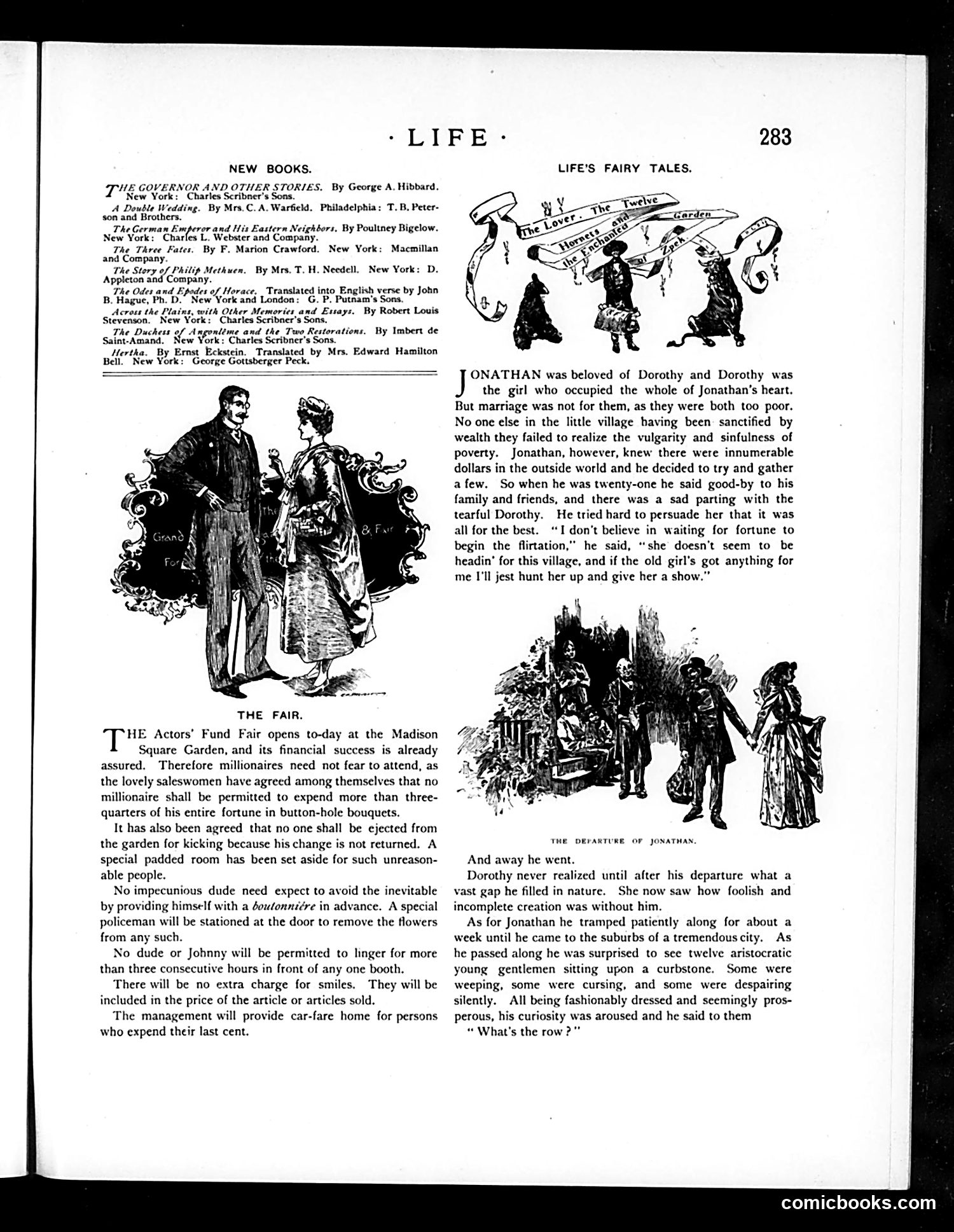
This page contains two distinct sections: **"The Fair"** (top): A satirical piece about the Actors' Fund Fair at Madison Square Garden. The humor relies on practical jokes about attendance—millionaires needn't fear spending money since saleswomen agreed to limit button-hole bouquet expenses to three-quarters of proceeds. The satire mocks wealthy attendees' penny-pinching despite their wealth, and pokes fun at various social types ("No impecunious dude," "No Sudie or Johnny"). It's typical early-20th-century Life magazine humor targeting the pretensions of the rich. **"Life's Fairy Tales"** (bottom): A serialized story titled "Jonathan" about a poor young man leaving his village sweetheart Dorothy to seek fortune. The accompanying illustrations show his departure. This appears to be sentimental fiction rather than satirical content, contrasting with the cynical social commentary above.
📄 Transcribed text from this page (OCR, searchable)
Machine-transcribed from the original scan — historical spelling and the odd misread are preserved.
-LIFE- NEW BOOKS. THE GOVERNOR AND OTHER STORIES. By George A, Hibbard. New York: Charles Scribner's Sons. A Double Wedding. By Mrs.C. A. Warfield, Philadelphia: T.B, Peter- son and Brothers. The German Emperor and His Eastern Neighbors. By Poultney Bigelow. New York: Charles L. Webster and Company. The Three Fates. By F, Marion Crawford. New York: and Company. The Story of Philip Methuen. Appleton and Company. The Odes and Epodes of Horace, Translated into English verse by John B, Hague, Ph. D. New York and London: G. P. Putnam's Sons, Across the Plains, with Other Memories and Essays. Stevenson. New York: Charles Scribner's Sons. The Duchess of Angonléme and the Two Restorations. SaintcAmand. New York: Charles Scribner's Sons. Hertha. By Ernst Eckstein. Translated by Mrs. Edward Hamilton Bell. New York: George Gottsberger Peck. Macmillan By Mrs. T. H. Needell. New York: D. By Robert Louis By Imbert de THE FAIR. HE Actors’ Fund Fair opens to-day at the Madison Square Garden, and its financial success is already assured, Therefore millionaires need not fear to attend, as the lovely saleswomen have agreed among themselves that no millionaire shall be permitted to expend more than three- quarters of his entire fortune in button-hole bouquets. It has also been agreed that no one shall be ejected from the garden for kicking because his change is not returned. A special padded room has been set aside for such unreason- able people. No impecunious dude need expect to avoid the inevitable by providing himself with a dou/onnzére in advance. A special policeman will be stationed at the door to remove the flowers from any such. No dude or Johnny will be permitted to linger for more than three consecutive hours in front of any one booth, There will be no extra charge for smiles. They will be included in the price of the article or articles sold. The management will provide car-fare home for persons who expend their last cent. LIFE’S FAIRY TALES. ONATHAN was beloved of Dorothy and Dorothy was J the girl who occupied the whole of Jonathan's heart. But marriage was not for them, as they were both too poor. No one else in the little village having been sanctified by wealth they failed to realize the vulgarity and sinfulness of poverty. Jonathan, however, knew there were innumerable dollars in the outside world and he decided to try and gather afew. So when he was twenty-one he said good-by to his family and friends, and there was a sad parting with the tearful Dorothy. He tried hard to persuade her that it was all for the best. “I don’t believe in waiting for fortune to begin the flirtation,” he said, “she doesn't seem to be headin’ for this village, and if the old girl's got anything for me I'll jest hunt her up and give her a show.” THE DEPARTURE OF JONATHAN. And away he went. Dorothy never realized until after his departure what a vast gap he filled in nature. She now saw how foolish and incomplete creation was without him. As for Jonathan he tramped patiently along for about a week until he came to the suburbs of a tremendouscity. As he passed along he was surprised to see twelve aristocratic young gentlemen sitting upon a curbstone. Some were weeping, some were cursing, and some were despairing silently. All being fashionably dressed and seemingly pros- perous, his curiosity was aroused and he said to them “ What's the row 2?" comicbooks.com