
Life, 1892-05-05 · page 6 of 18
Life — May 5, 1892 — page 6: what you’re looking at
What you’re looking at
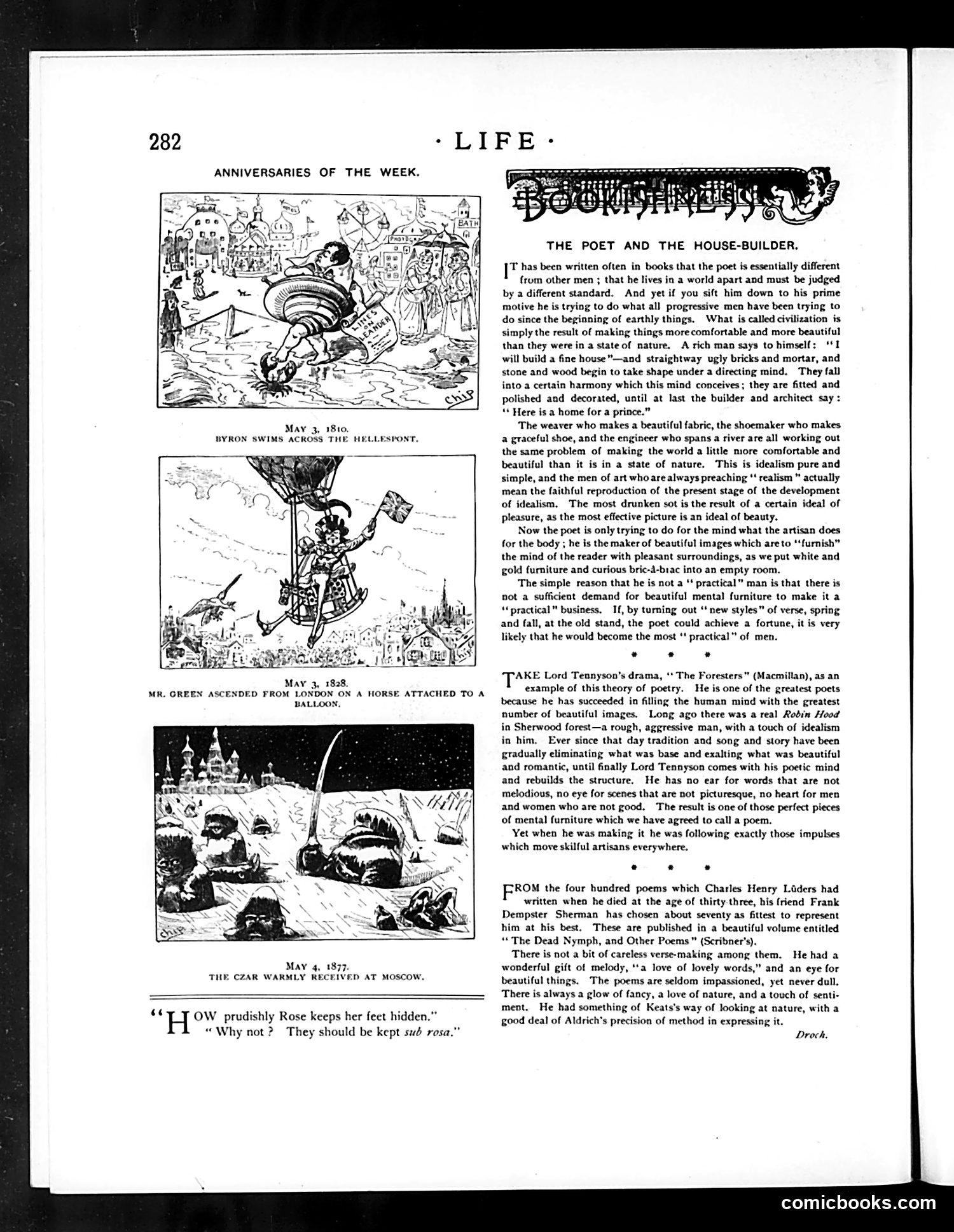
This page features **"Anniversaries of the Week"** — historical commemorative cartoons with captions: 1. **May 3, 1810**: Byron swimming across the Hellespont (a famous romantic exploit by poet Lord Byron) 2. **May 3, 1828**: Mr. Green ascending from London in a hot air balloon 3. **May 4, 1877**: The Czar warmly received at Moscow (likely celebrating Russian imperial relations) The main article, **"The Poet and the House-Builder,"** argues that poets aren't impractical dreamers but practical creators like engineers or architects—both shape the world beautifully. It cites Lord Tennyson's drama "The Foresters" as proof poets can create meaningful "mental furniture" for readers, making them neither purely idealistic nor merely commercial. A closing quote about Rose keeping her feet hidden suggests period social commentary about modesty.
📄 Transcribed text from this page (OCR, searchable)
Machine-transcribed from the original scan — historical spelling and the odd misread are preserved.
THE POET AND THE HOUSE-BUILDER. [7 bas been written often in books that the poet is essentially different from other men ; that he lives in a world apart and must be judged by a different standard. And yet if you sift him down to his prime motive he is trying to do what all progressive men have been trying to do since the beginning of earthly things. What is called civilization is simply the result of making things more comfortable and more beautiful than they were ina stateof nature, A rich man says to himself: ‘1 will build a fine house"—and straightway ugly bricks and mortar, and stone and wood begin to take shape under a directing mind, They fall into a certain harmony which this mind conceives; they are fitted and polished and decorated, until at last the builder and architect say : “ Here is a home for a prince.” MA's, i810. ‘The weaver who makes a beautiful fabric, the shoemaker who makes BYRON SWIMS ACROSS THE HELLESPONT, a graceful shoe, and the engineer who spans a river are all working out the same problem of making the world a little more comfortable and beautiful than it is in a state of nature. This is idealism pure and simple, and the men of art who are always preaching “' realism " actually mean the faithful reproduction of the present stage of the development of idealism. The most drunken sot is the result of a certain ideal of pleasure, as the most effective picture is an ideal of beauty. Now the poet is only trying to do for the mind what the artisan does for the body ; he is the maker of beautiful images which areto “furnish” the mind of the reader with pleasant surroundings, as we put white and gold furniture and curious bric-a-brac into an empty room. ‘The simple reason that he is not a ‘* practical” man is that there is not a sufficient demand for beautiful mental furniture to make it a “practical” business. If, by turning out “new styles” of verse, spring and fall, at the old stand, the poet could achieve a fortune, it is very likely that he would become the most “' practical” of men. * . * Z ia TAKE Lord Tennyson's drama, “* The Foresters” (Macmillan), as an BALLOOH, because he has succeeded in filling the human mind with the greatest number of beautiful images. Long ago there was a real Robin Hood in Sherwood forest—a rough, aggressive man, with a touch of idealism in him. Ever since that day tradition and song and story have been gradually eliminating what was base and exalting what was beautiful and romantic, until finally Lord Tennyson comes with his poetic mind and rebuilds the structure. He has no ear for words that are not melodious, no eye for scenes that are not picturesque, no heart for men and women who are not good. The result is one of those perfect pieces of mental furniture which we have agreed to call a poem. Yet when he was making it he was following exactly those impulses which move skilful artisans everywhere. FFROM the four hundred poems which Charles Henry Laders had written when he died at the age of thirty-three, bis friend Frank Dempster Sherman has chosen about seventy as fittest to represent him at his best. These are published in a beautiful volume entitled “The Dead Nymph, and Other Poems" (Scribner's), There is not a bit of careless verse-making among them. He had a May 4, 1877. wonderful gift of melody, ‘a love of lovely words,” and an eye for THE CZAR WARMLY RECEIVED AT MOSCOW. beautiful things. The poems are seldom impassioned, yet never dull. There is always a glow of fancy, a love of nature, and a touch of senti- : . ment. He had something of Keats's way of looking at nature, with a es OW prudishly Rose keeps her feet hidde: good deal of Aldrich’s precision of ronihod in exprealog it. “Why not ? They should be kept swé rosa.” Droch. comicbooks.com