
A complete issue · 26 pages · 1892
Life — April 14, 1892
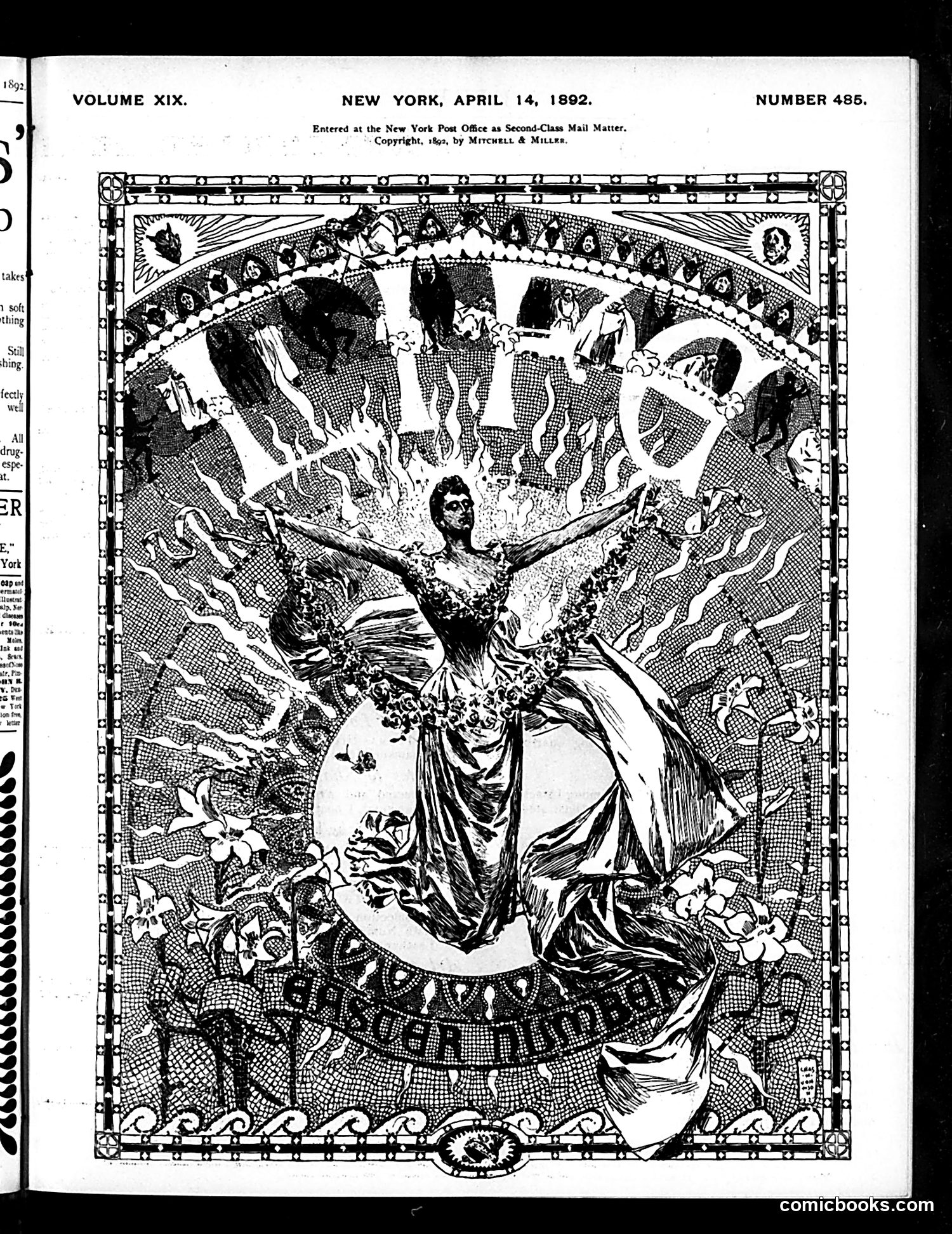
This is the cover of *Life* magazine from April 14, 1892 (Volume XIX, Number 485). The central illustration depicts a classical female allegorical figure—likely representing Liberty, America, or Progress—floating above a theater or amphitheater filled with spectators. She wears flowing robes and has her arms raised triumphantly. The theatrical setting with the crowd suggests this celebrates a performance, event, or cultural moment of 1892. The ornate decorative border and classical styling were typical of *Life*'s artistic approach to satire. Without additional text visible on this page, the specific event being satirized remains unclear. The image appears celebratory rather than critical, though *Life* magazine typically employed sophisticated visual satire. The context—whether this references theater, politics, or another 1892 event—cannot be determined from the image alone.
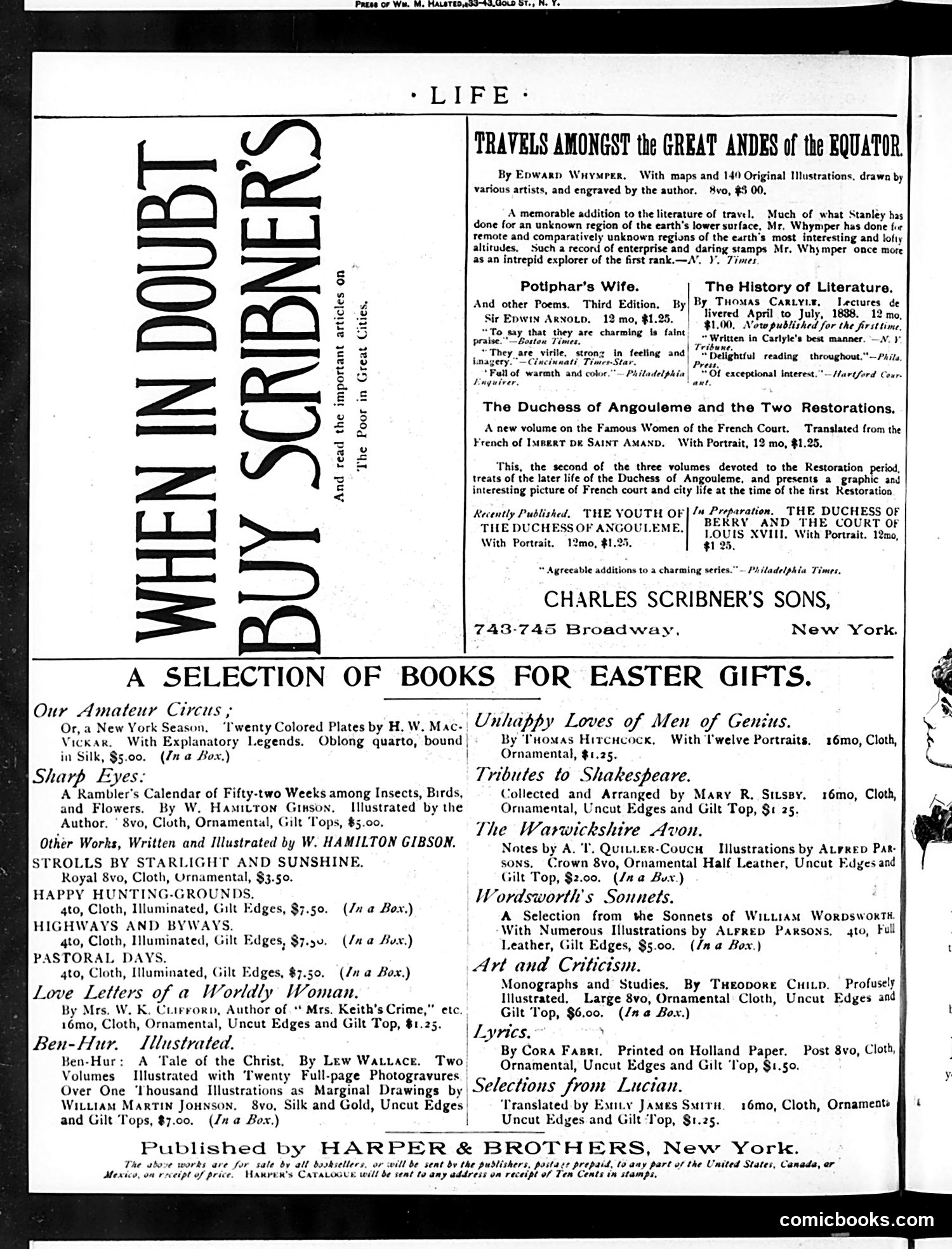
This page is primarily **advertising for books**, not political satire. The left side features a large ad for "When in Doubt Buy Scrubners" — apparently a humorous book title playing on consumer indecision. The right side advertises travel and literary works from Charles Scribner's Sons, including Edward Whymper's "Travels Amongst the Great Andes of the Equator" and books about French court history. Below is "A Selection of Books for Easter Gifts," listing illustrated works on nature, Shakespeare, poetry, and criticism — typical Victorian/Edwardian gift suggestions. The page reflects Life magazine's dual function: satirical commentary mixed with upscale consumer advertising targeting educated, affluent readers. No political cartoons or social satire appear here; it's a straightforward book promotion page.
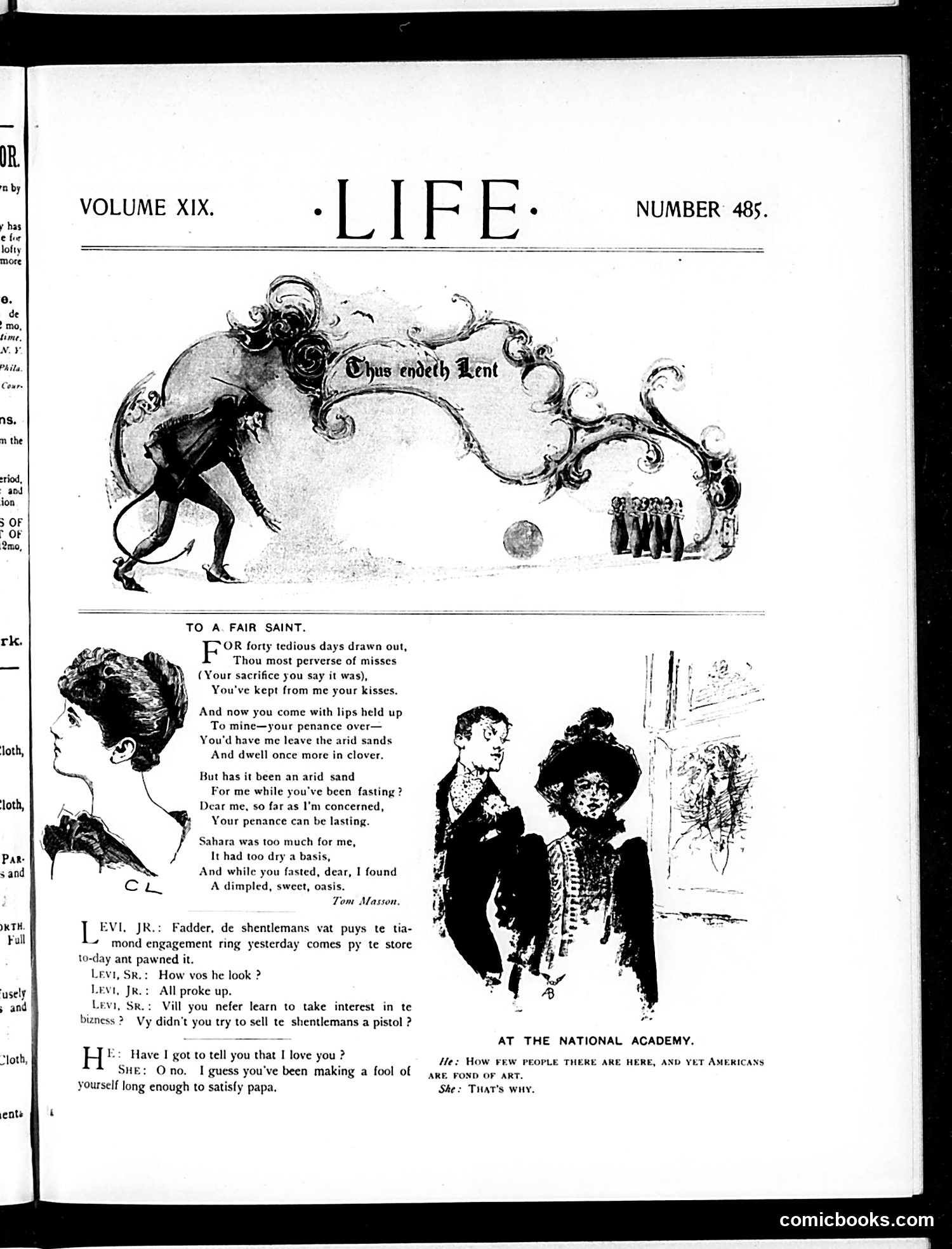
This page contains Lenten-themed satirical content. The top cartoon "Thus endeth Lent" depicts a figure struggling with a large ornamental burden, mocking religious observance of Lenten sacrifice. "To a Fair Saint" by Tom Marson is a poem addressing someone who abstained from kissing and other pleasures during Lent's "forty tedious days," now seeking reconciliation. Below are dialogue snippets and a sketch titled "At the National Academy" about American art funding. The humor appears to critique both religious hypocrisy (abandoned sacrifices) and American cultural pretensions regarding art appreciation. The specific identities of figures are unclear, but the satire targets conventional religious practice and American attitudes toward European artistic culture—common Life magazine subjects of this era.
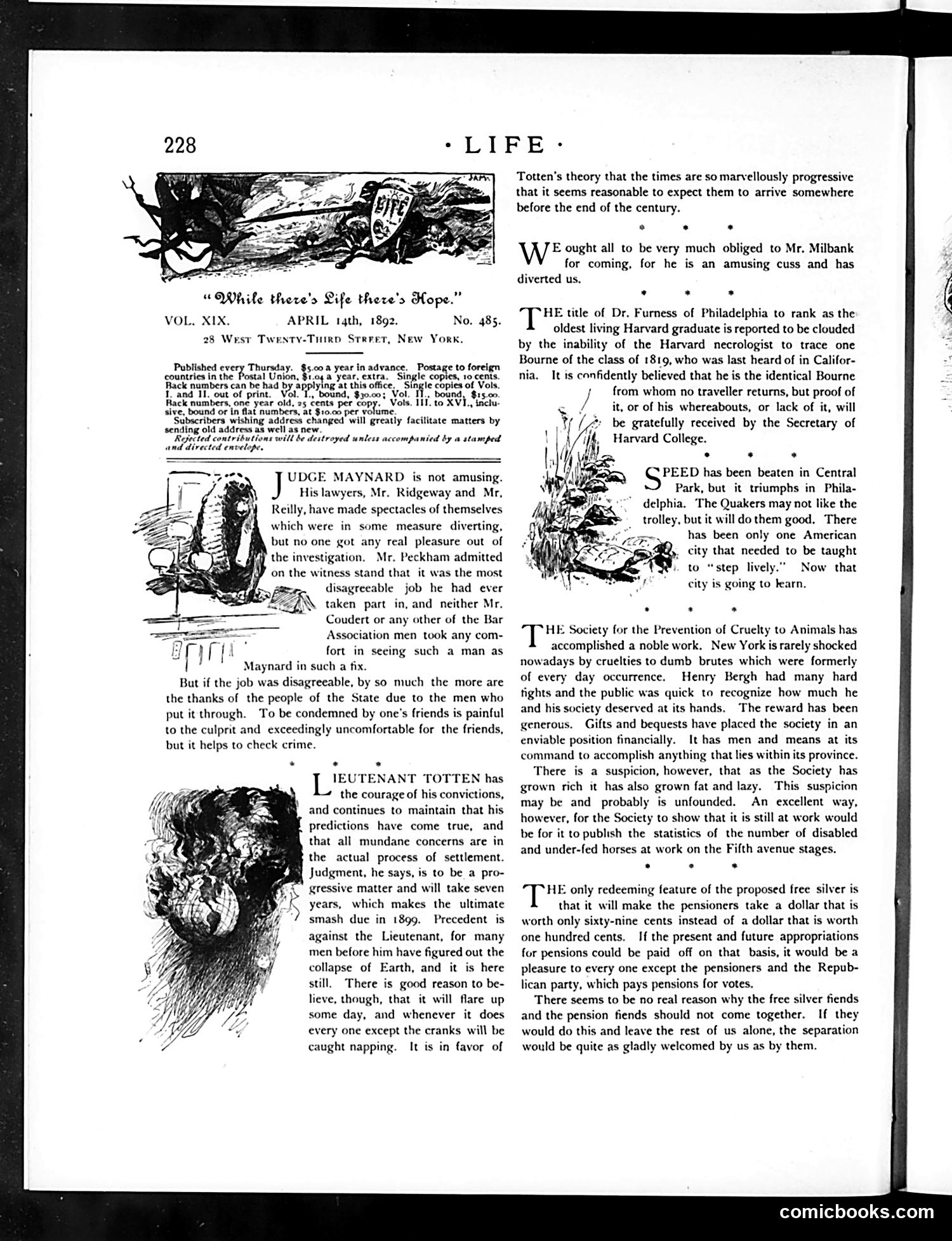
This page contains several editorial pieces rather than a single cartoon. The illustrations depict: 1. **Judge Maynard** (left cartoon): A figure shown in an unflattering caricature, criticized for being part of an investigation involving other men (Messrs. Ridgeway, Reilly, Peckham, and Coudert) into unspecified misconduct. The text suggests the investigation itself was unpleasant, but the public appreciates that these officials faced accountability for poor judgment. 2. **Lieutenant Totten** (right cartoon): A figure shown among cattails, referenced regarding predictions about social progress and the century's future. The remaining text discusses the Harvard neurologist Dr. Furness, Philadelphia's trolley system, and animal cruelty prevention—typical 1890s civic concerns. The page functions as political and social commentary rather than joke-based humor.
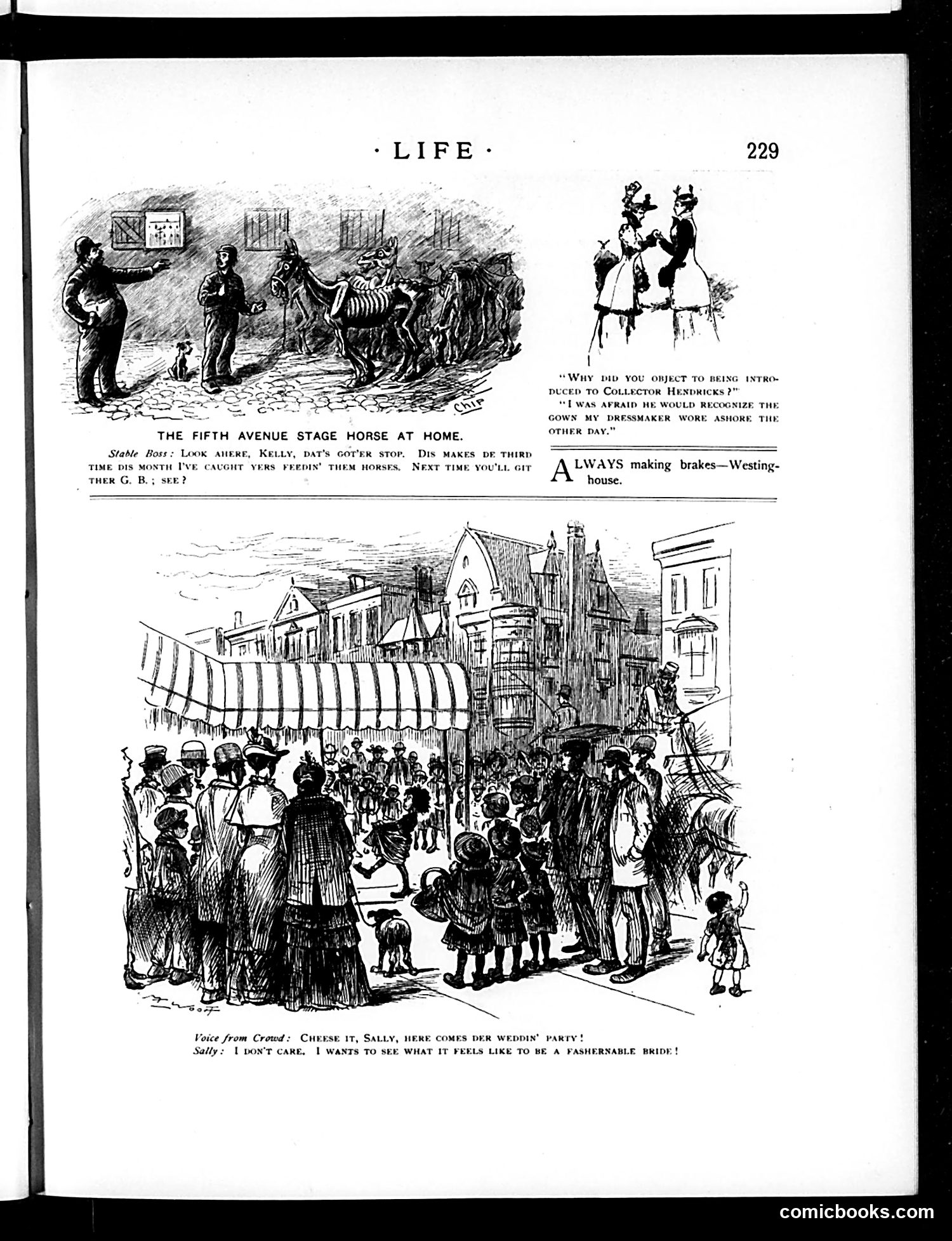
This page contains two satirical illustrations from Life magazine (page 229). **Top cartoon**: "The Fifth Avenue Stage Horse at Home" mocks a working horse's shabby home conditions contrasted with its fancy public role pulling wealthy passengers on Fifth Avenue. The joke: a workhorse that appears well-maintained for the wealthy is actually neglected at home. **Bottom cartoon**: Depicts a street fair or "weddin' party" celebration, where a character named Sally expresses desire to see what it's like to be a "fashionable bride." The satire appears to mock working-class aspirations to genteel status—suggesting Sally fantasizes about wealth and fashion beyond her social station. Both cartoons use humor to critique class disparities and the gap between public appearance and private reality in Gilded Age New York.
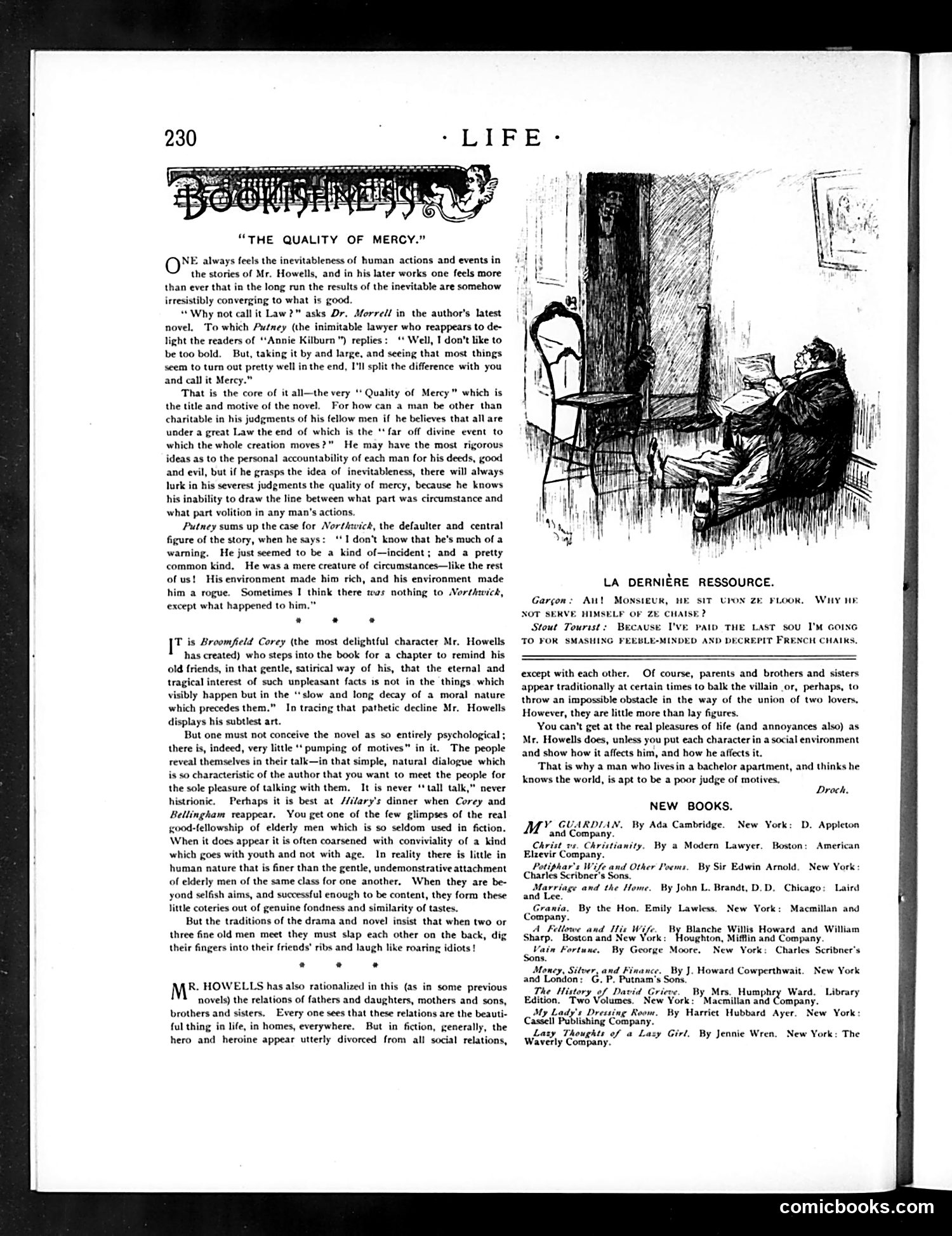
This page contains a literary essay titled "The Quality of Mercy," discussing W.D. Howells' novel "Annie Kilburn." The accompanying illustration ("La Dernière Ressource" / "The Last Resort") depicts two men in what appears to be a modest interior—one seated, one standing—engaged in conversation about financial hardship. Their dialogue references unpaid debts and "smashing" French chairs, suggesting economic struggle and desperation. The illustration satirizes the genteel poor—educated men maintaining dignity despite financial ruin. The essay argues that Howells realistically portrays human nature and moral complexity rather than idealizing characters, positioning this as a strength of his fiction. The page includes a "New Books" section listing contemporary publications, making this primarily a book review and literary criticism column rather than political satire.
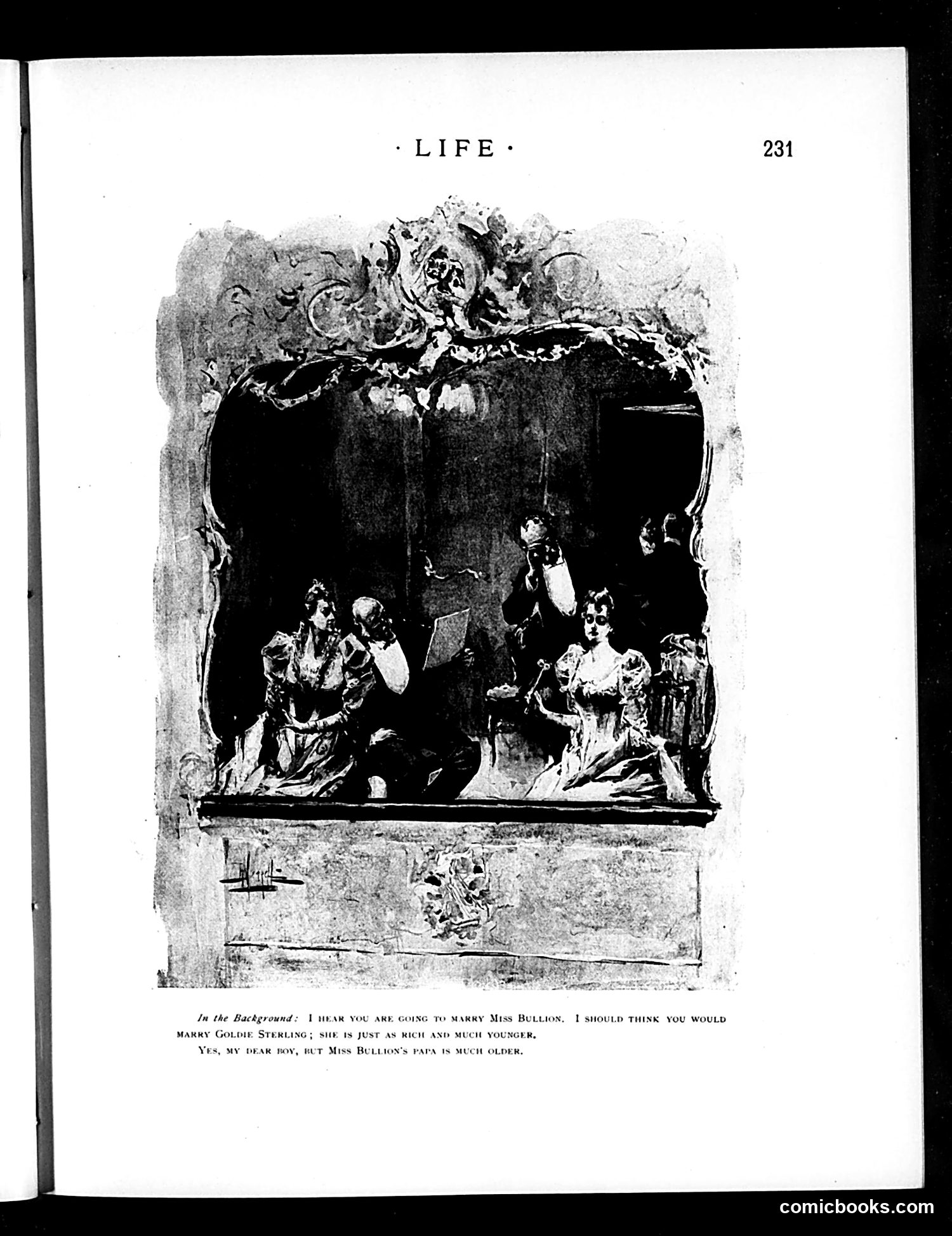
This page contains a single illustration depicting an interior scene with elaborately dressed figures in what appears to be a formal drawing room. The ornate frame and decorative elements suggest a wealthy household. The caption references a conversation about marriage prospects, specifically mentioning "Miss Bullion" and "Goldie Sterling," with commentary that Miss Bullion's father is "much older." The joke appears to satirize wealthy families' marriage arrangements based on financial considerations rather than age compatibility or genuine affection. The names "Bullion" and "Sterling" are transparently symbolic of wealth and precious metals, suggesting the satire targets mercenary marriage practices among the affluent classes. The humor hinges on the absurdity of the age disparity being presented as acceptable due to financial status.
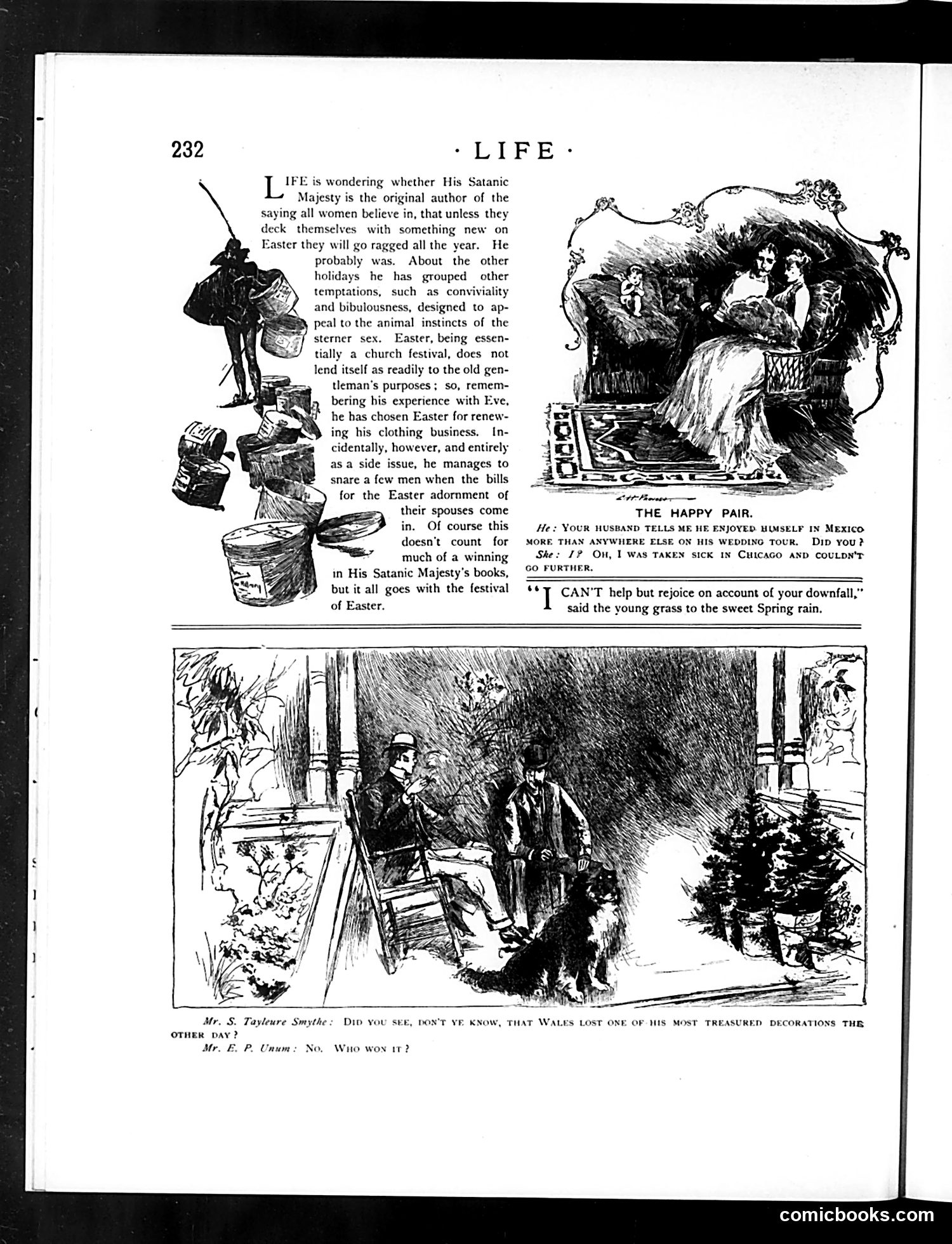
This page contains satirical content about Easter and gender relations. The top article mocks "His Satanic Majesty" (the Devil) as the supposed author of women's beliefs, suggesting Easter celebrations lack novelty unless women adopt new fashions. It jokes that men profit from Easter spending when wives' clothing bills arrive. The middle illustration titled "The Happy Pair" satirizes honeymoon tourism, with a wife complaining about her husband's preference for Mexico over other destinations, mentioning he took ill in Chicago. The bottom cartoon features dialogue between "Mr. S. Tayleure Smythe" and "Mr. E. P. Dum" about Wales losing "treasured decorations," with the punchline implying one character won the lost items—likely a gambling or card-game reference.
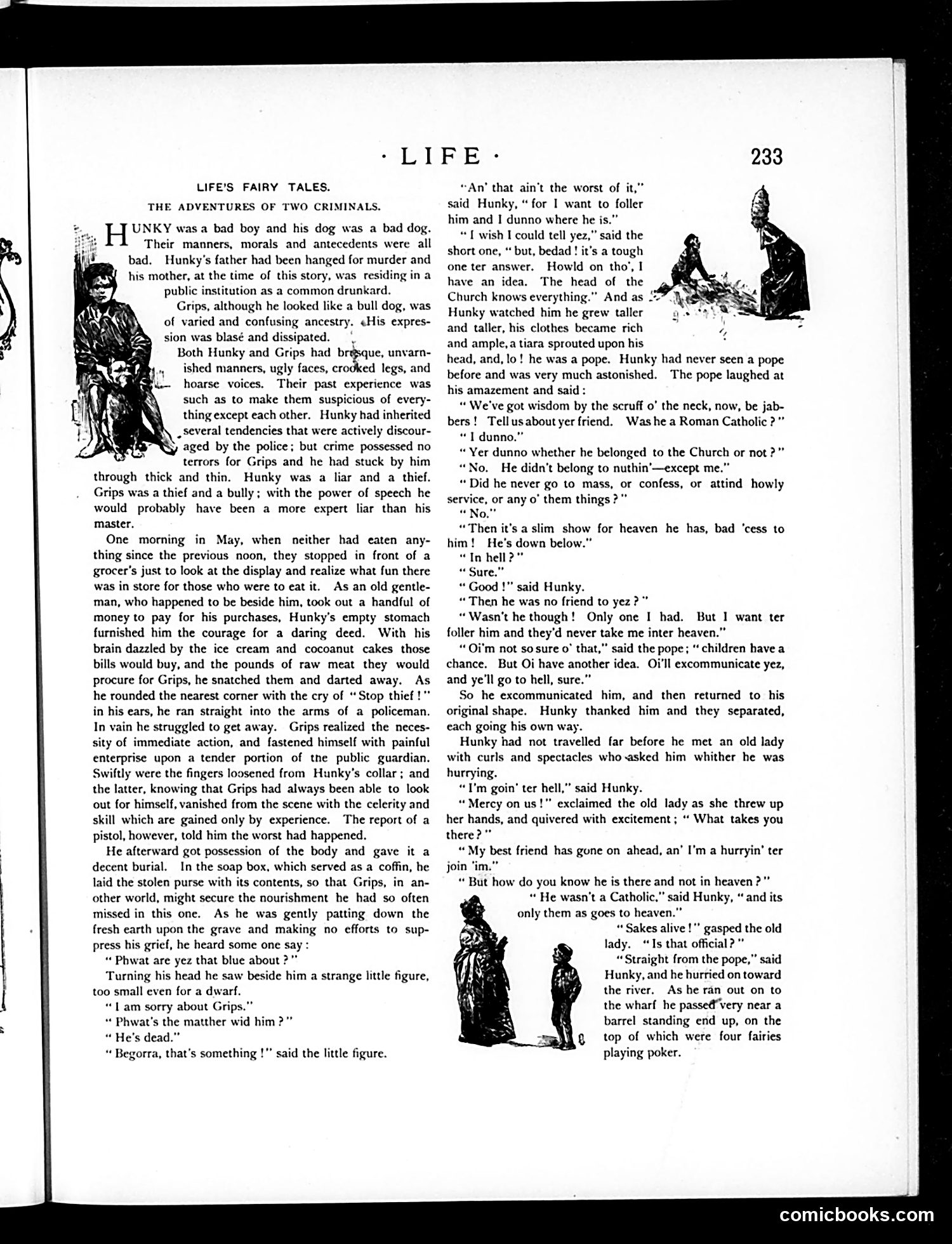
This is a satirical fairy tale about two criminals named Hunky and Grips. The story uses dark humor to mock Victorian morality tales and sentimental narratives about redemption. The illustrations show rough, working-class street characters in period dress. The narrative follows their criminal exploits—stealing from a grocer—and Hunky's eventual encounter with a Pope figure who offers vague religious absolution ("children have a chance...you'll go to hell, sure"). The satire critiques both the criminals' amorality and the Church's hollow spiritual comfort. By framing criminal deeds as a "fairy tale," the author mocks both sentimental redemption narratives and suggests that religion offers criminals little real moral transformation. The working-class characters and cynical dialogue suggest social commentary on poverty and crime's relationship to institutional hypocrisy.
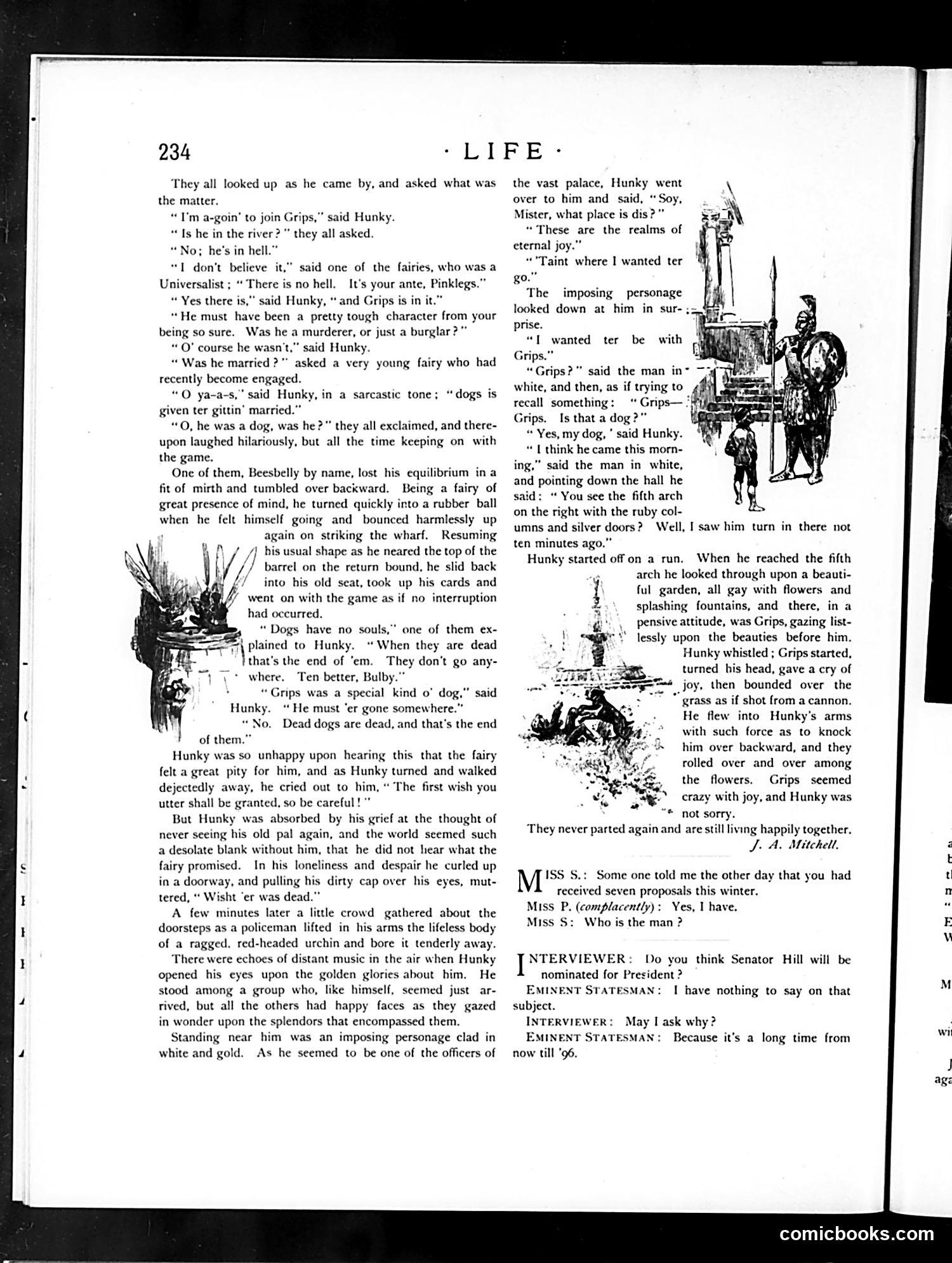
This page contains a serialized fiction story titled "Life" (page 234) featuring illustrated scenes of a character named Hunky and his dog Grips in what appears to be a fantastical or allegorical setting—"the realms of eternal joy." The bottom section shifts to an interview segment where an "Eminent Statesman" is asked about Senator Hill's potential presidential nomination. The statesman declines comment, citing that it's "a long time from now till '96." **What a modern reader should know:** The reference to "'96" (presumably 1896) dates this publication to the mid-1890s. The interview format and Senator Hill reference suggest this is satirizing contemporary political speculation, though the specific Senator Hill mentioned is unclear without additional context. The fictional narrative above appears unrelated to the political content below.
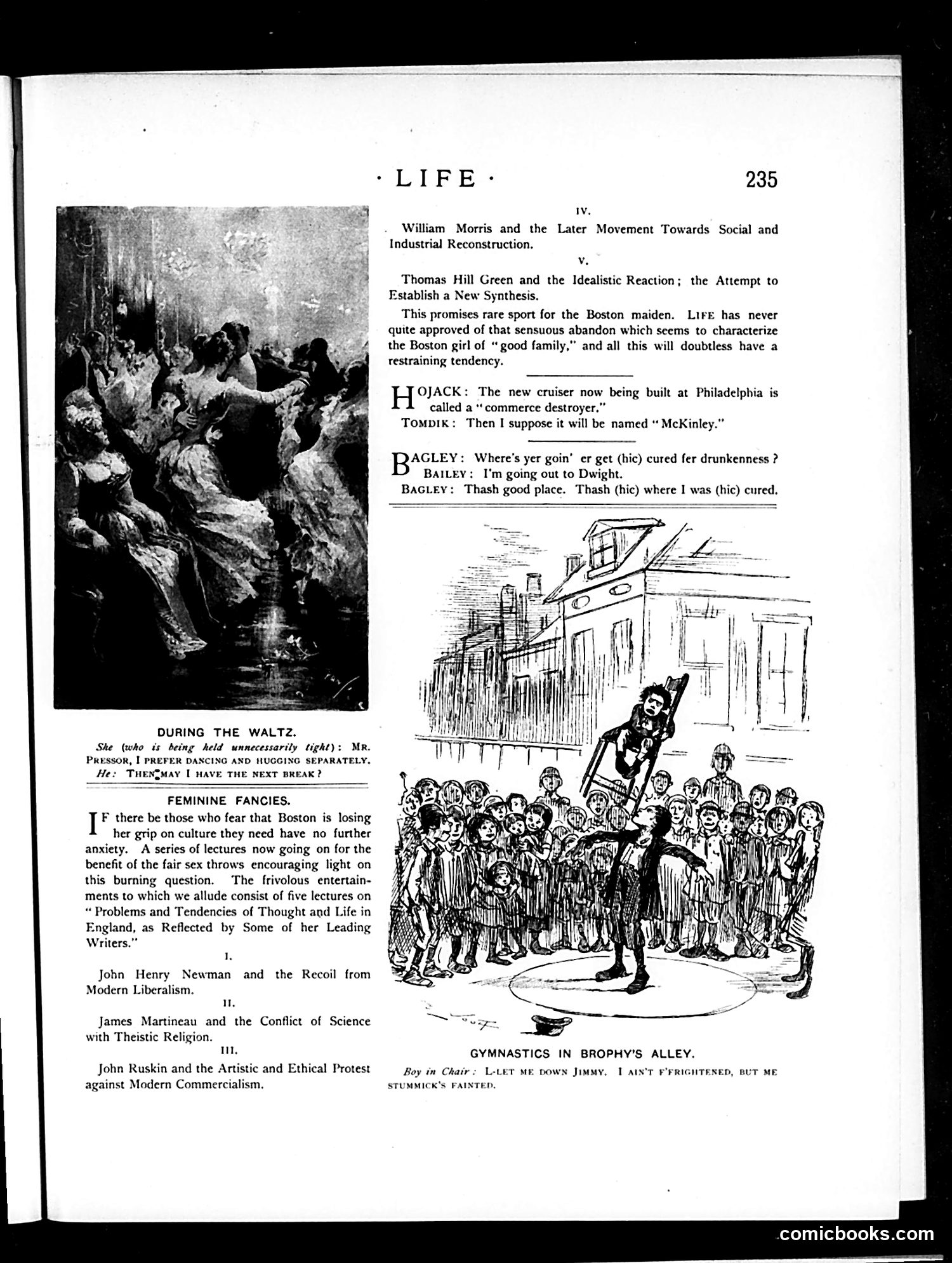
This page contains two distinct satirical pieces: **"During the Waltz"** (left image): A chaotic scene depicting couple dancing where the woman is being "held unnecessarily tight" and the man is "the best bread" — apparently mocking overly intimate or improper dancing behavior and its social implications. **"Gymnastics in Brophy's Alley"** (right cartoon): Children performing acrobatics in an urban alley. The boy in chair says "Let me down Jimmy, I ain't frightened, but me stomach's fainted" — humor derived from working-class dialect and a child's physical discomfort during stunts. The page also previews upcoming lecture series on cultural decline in Boston, suggesting period anxieties about American values. The overall tone is satirical commentary on social behavior, class differences, and urban life.
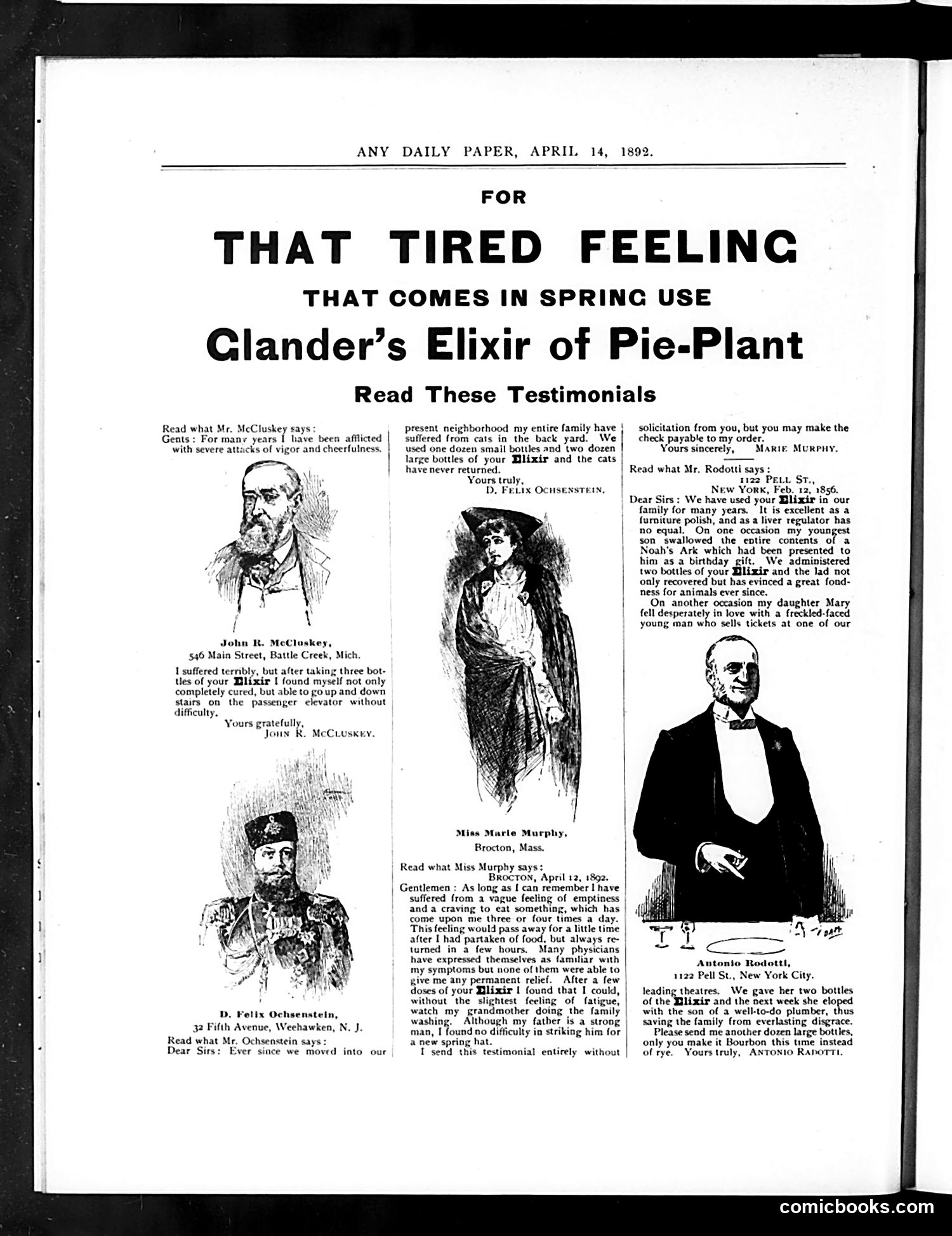
This is a **fake advertisement** satirizing patent medicines and their dubious testimonials. The page mocks "Glander's Elixir of Pie-Plant"—a fictional spring tonic—through obviously absurd testimonials that expose the era's medical fraud. The satire works by presenting claims so ridiculous they're clearly intentional jokes: - **McClusky's testimony**: Claims the elixir cured his "attacks of vigor and cheerfulness"—a non-ailment - **Ochsenstein's testimonial**: The elixir repelled neighborhood cats (not a medical use) - **Murphy's account**: She could "watch grandmother doing laundry" and strike her father for a hat—trivial "benefits" - **Rodotti's letter**: The elixir works as furniture polish and somehow saved his daughter from an unsuitable romance The accompanying portraits of respectable-looking men and women lend false credibility, mimicking real patent medicine ads of the 1890s. The joke targets the gullibility of consumers and the unregulated pharmaceutical industry's deceptive marketing practices—a social problem Life magazine frequently satirized.
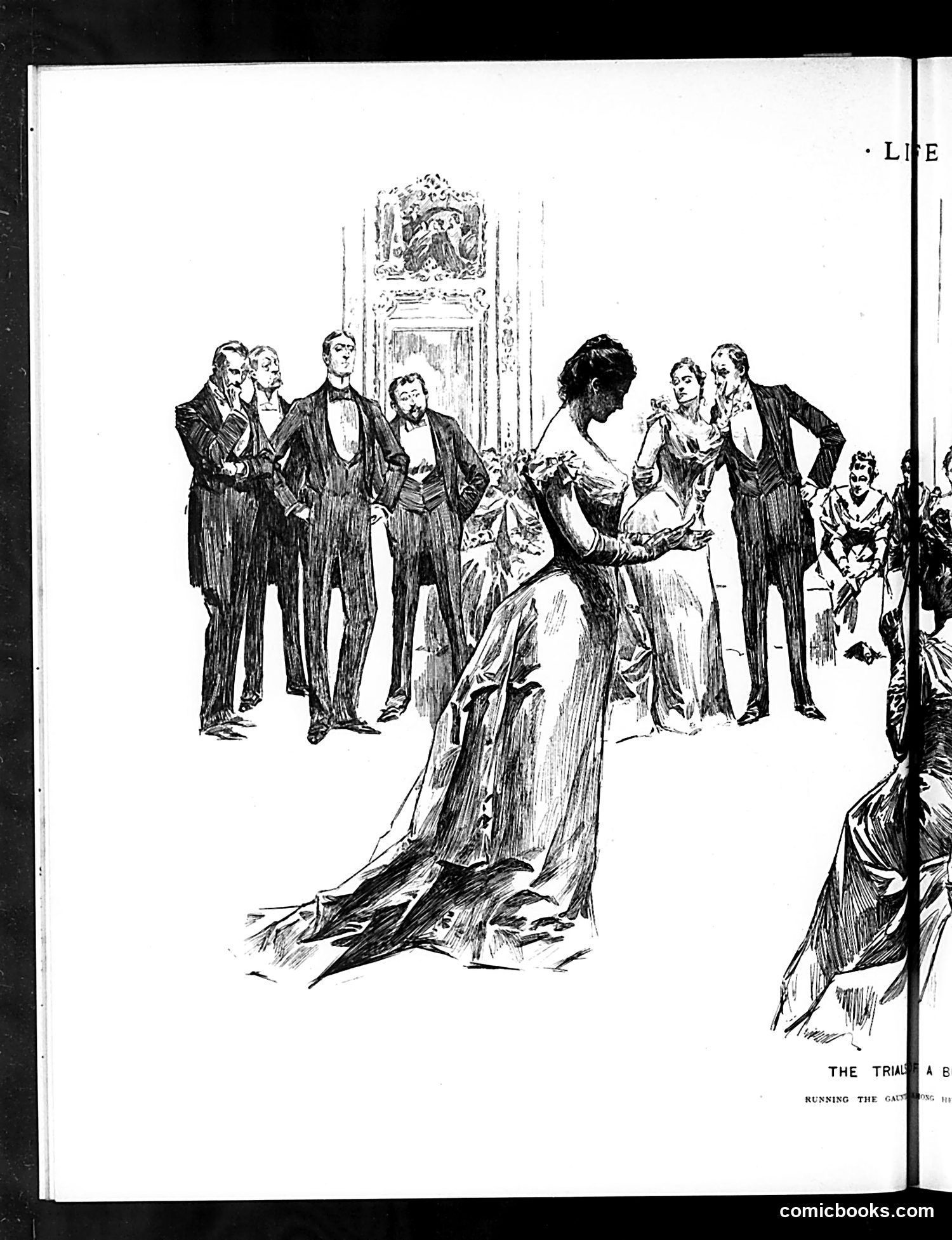
This appears to be an illustration from Life magazine titled "The Trial" with a subtitle beginning "Running the Gat..." (text unclear due to OCR limitations). The image depicts a formal social scene—likely a courtroom or official proceeding—with a woman in an elaborate white gown kneeling or sitting prominently in the center, while several men in formal attire (tuxedos) observe from behind. The ornate architectural backdrop suggests an official or prestigious venue. Without clearer OCR text or additional context, the specific satirical target remains unclear. However, the composition suggests commentary on female social standing, legal proceedings, or public judgment of a woman's conduct—common themes in Life magazine's satirical content during the late 19th/early 20th century. The exact historical reference and intended satirical point cannot be determined from the image alone.
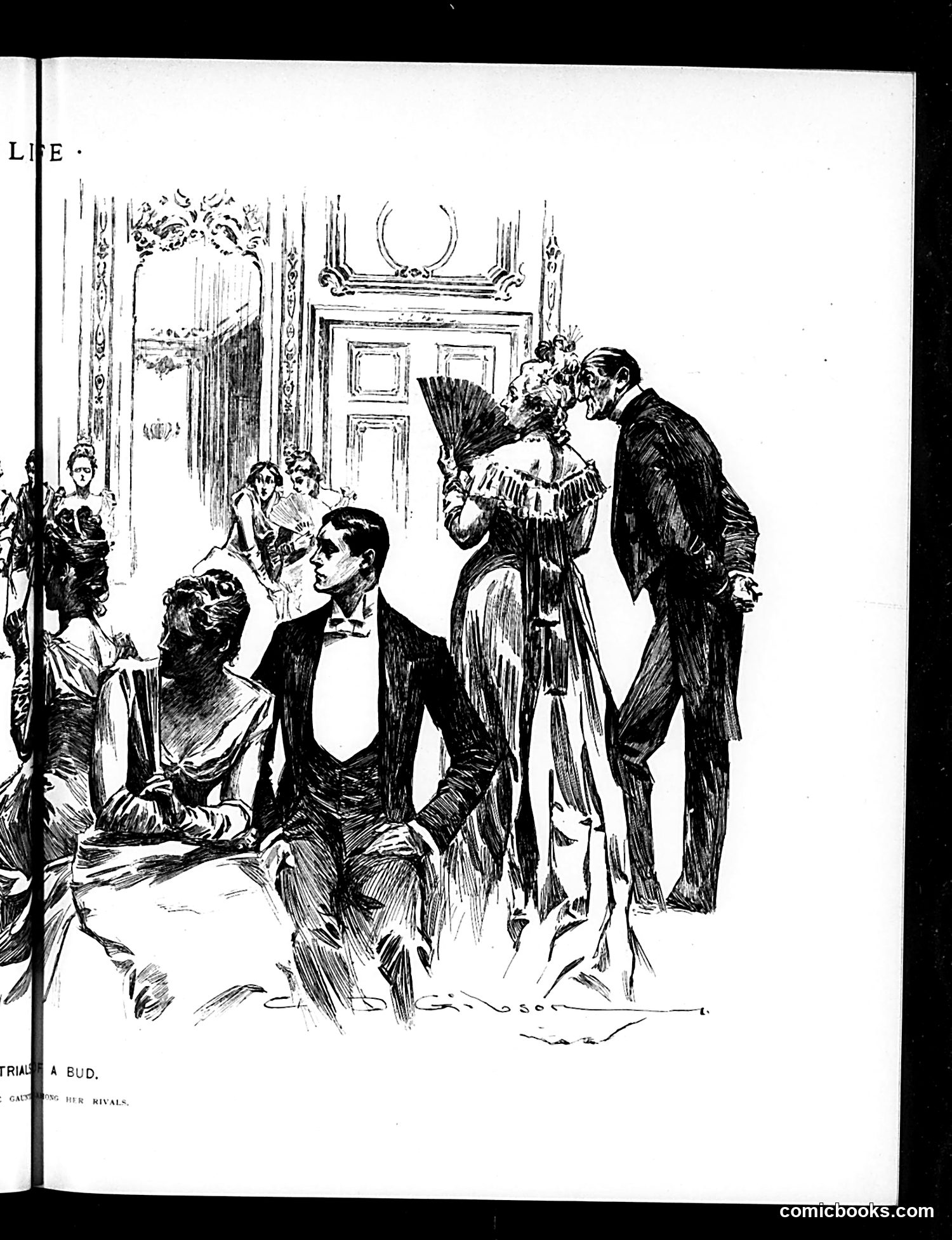
This Life magazine cartoon depicts a formal social scene—likely a diplomatic or high-society gathering in an ornate interior. The sketch shows elegantly dressed figures in conversation, with a seated man in formal attire (tuxedo) as a focal point, while others stand nearby including a woman with a large fan. The caption "A Bud, Gauging Our Rivals" suggests social or romantic rivalry, though the specific political or social context is unclear from the image alone. The formal setting and OCR text mentioning "RIVALS" implies commentary on interpersonal competition within elite circles. Without additional context about Life's publication date or surrounding articles, the precise targets of this satire cannot be definitively identified.
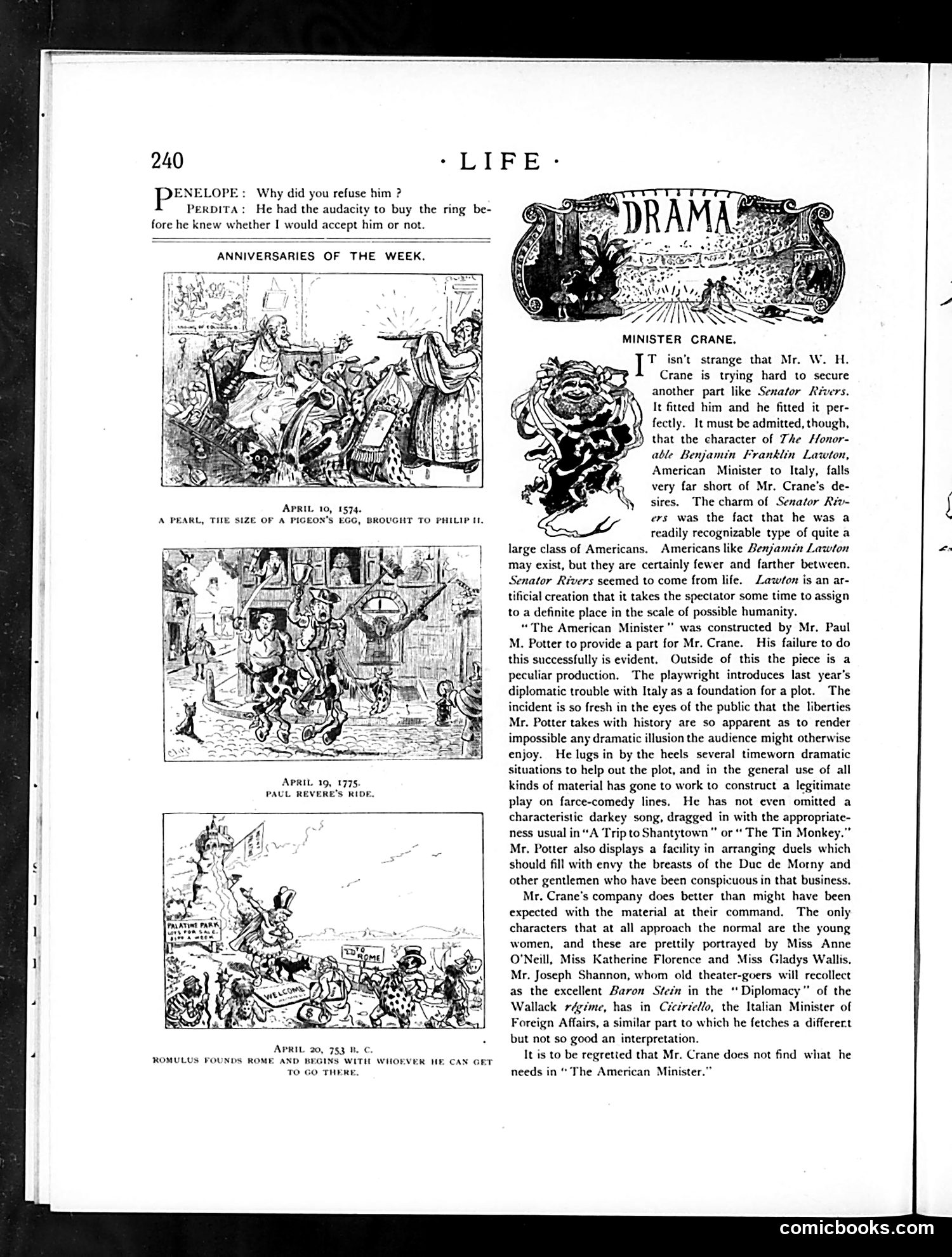
This page contains a theater review of "The American Minister," starring W.H. Crane. The critic argues that Crane's new role as Benjamin Franklin Lawton—an American Minister to Italy—fails to match his previous success as Senator Rivers. **The Key Critique:** Senator Rivers worked because he was a recognizable American type; Lawton is an artificial, unconvincing character that audiences struggle to place. **Production Problems:** Playwright Paul M. Potter recycled recent diplomatic tensions with Italy as plot foundation, making the drama implausible. The show relies on tired farce-comedy conventions, including an incongruous "darkey song." **Cast Assessment:** Supporting actresses (O'Neill, Florence, Wallis) perform adequately; Joseph Shannon gives a serviceable but uninspired turn as Ciciriello, the Italian Foreign Minister. **Verdict:** Despite Crane's company's efforts, the material itself is fundamentally flawed—neither legitimately dramatic nor successfully comedic.
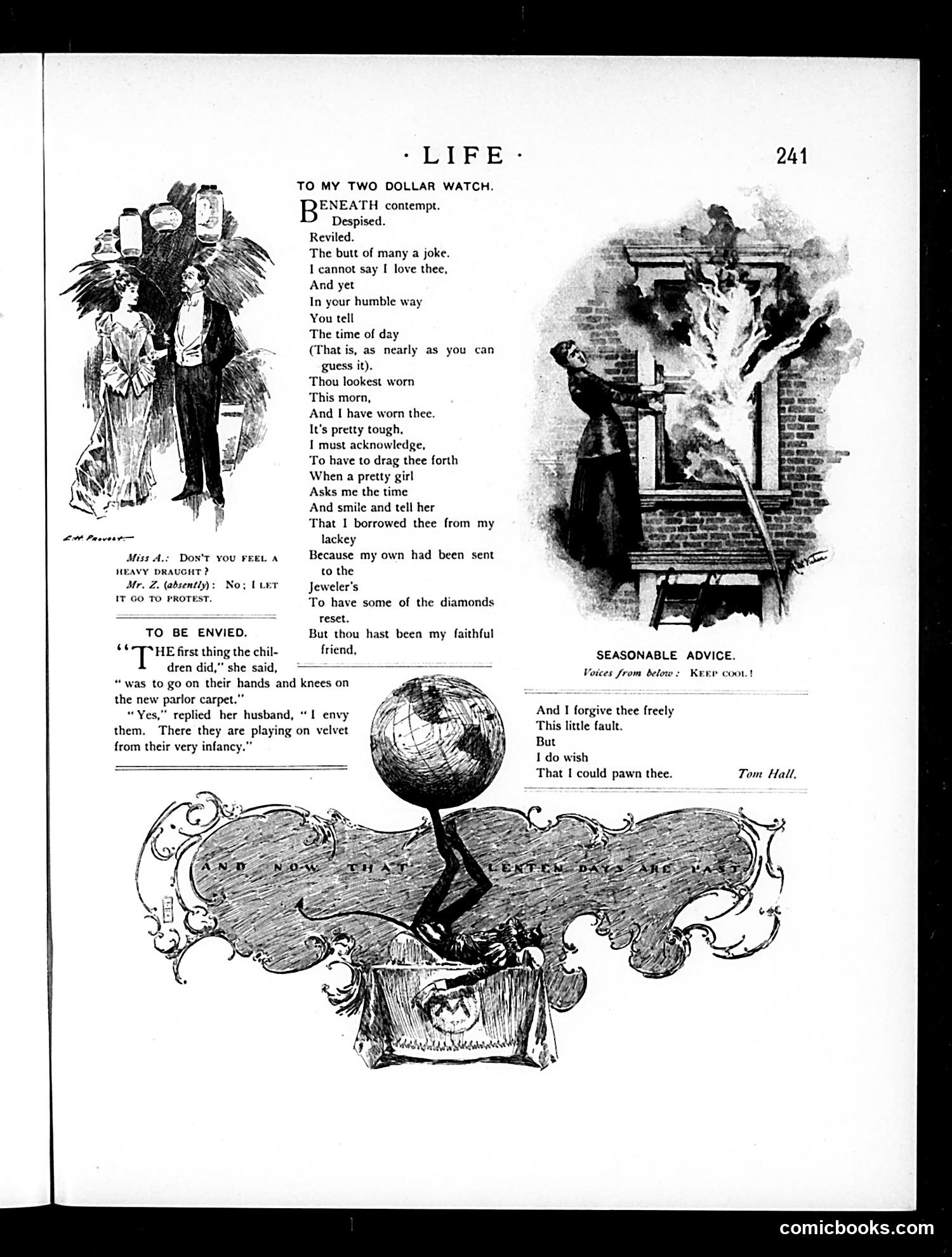
This page contains several satirical pieces mocking social pretension and economic anxiety in early 20th-century America. **"To My Two Dollar Watch"** is a humorous poem personifying a cheap timepiece, presenting it as a faithful but embarrassing companion. The joke centers on class consciousness: the speaker is ashamed to consult his humble two-dollar watch in front of attractive women, instead pretending to borrow his servant's timepiece. The poem satirizes both the owner's vanity and the desperation of someone financially struggling enough to consider pawning his only watch. **"To Be Envied"** offers a brief anecdote about children playing on expensive new carpeting—mocking wealthy parents' conspicuous consumption and their obliviousness to their children's simple joys. **"Seasonable Advice"** (illustrated with a figure struggling against wind) offers the cryptic reminder to "keep cool," likely generic moral platitudes typical of the era. The overall theme critiques materialism, class anxiety, and the humiliation of poverty among the aspiring middle class.
This page contains primarily **humorous anecdotes and advertisements** rather than political cartoons. The humor relies on wordplay and situational irony typical of late-19th-century magazines. **Key Content:** The main joke sections mock human folly: a railway manager insists his train arrived exactly on time, so an accident must have occurred *because* it was punctual (ironic reversal). Another piece describes a boy whose wealth comes from marrying off his widowed mother to a rich man—the boy fabricated illness to secure the marriage. A third mocks a hotel guest (Miss Amanda) who carries small shoes to deceive about her foot size. These represent gentle social satire about dishonesty, greed, and vanity rather than political commentary. **Advertisements** dominate the page: breakfast cereal, hats, luggage, tobacco cessation products ("Corroceo" tablets), and beef extract. One ad warns that smoking deposits dangerous nicotine levels—surprisingly health-conscious messaging for the era. The content reflects turn-of-the-century middle-class concerns: proper etiquette, social climbing, health anxieties, and commercial consumption.
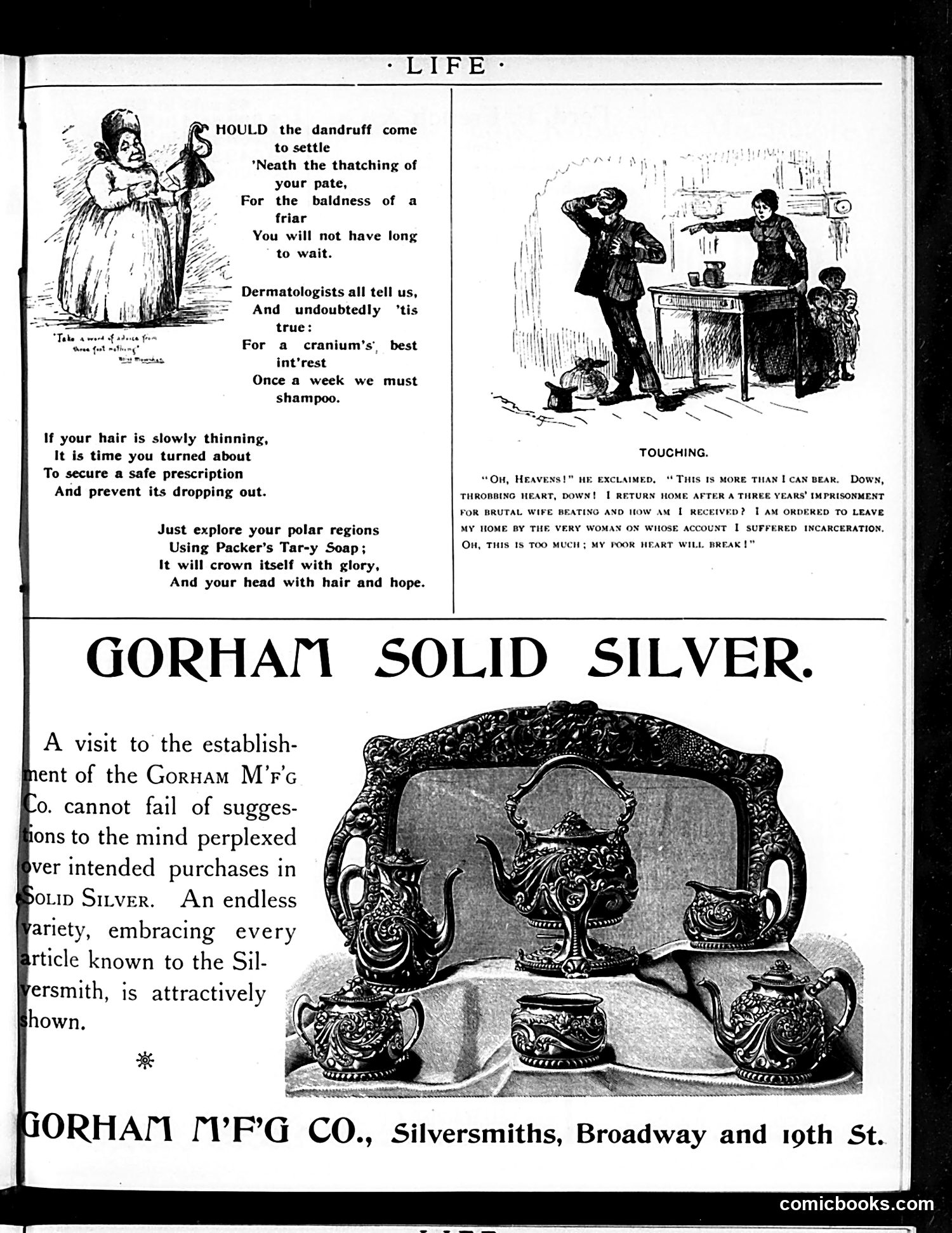
This page combines advertisements with a satirical cartoon mocking domestic abuse. **The Cartoon "Touching":** depicts a man dramatically distressed, claiming victimhood. His internal monologue reveals he's just returned from imprisonment for wife-beating, yet he's outraged that his wife has ordered him from their home. The satire is savage: the title "Touching" is ironic—the cartoon ridicules his self-pitying performance and exposes the absurdity of a perpetrator playing the wounded party. The wife (shown with children) is the actual victim, but he frames *himself* as wronged. **The Context:** This reflects early-20th-century critique of men who committed domestic violence yet demanded sympathy. The cartoon suggests such men were manipulative and delusional about their own culpability. It's hostile social commentary against domestic abusers who positioned themselves as victims. **Other Content:** The page includes advertisements for hair-loss remedies and Gorham silverware—typical commercial content.
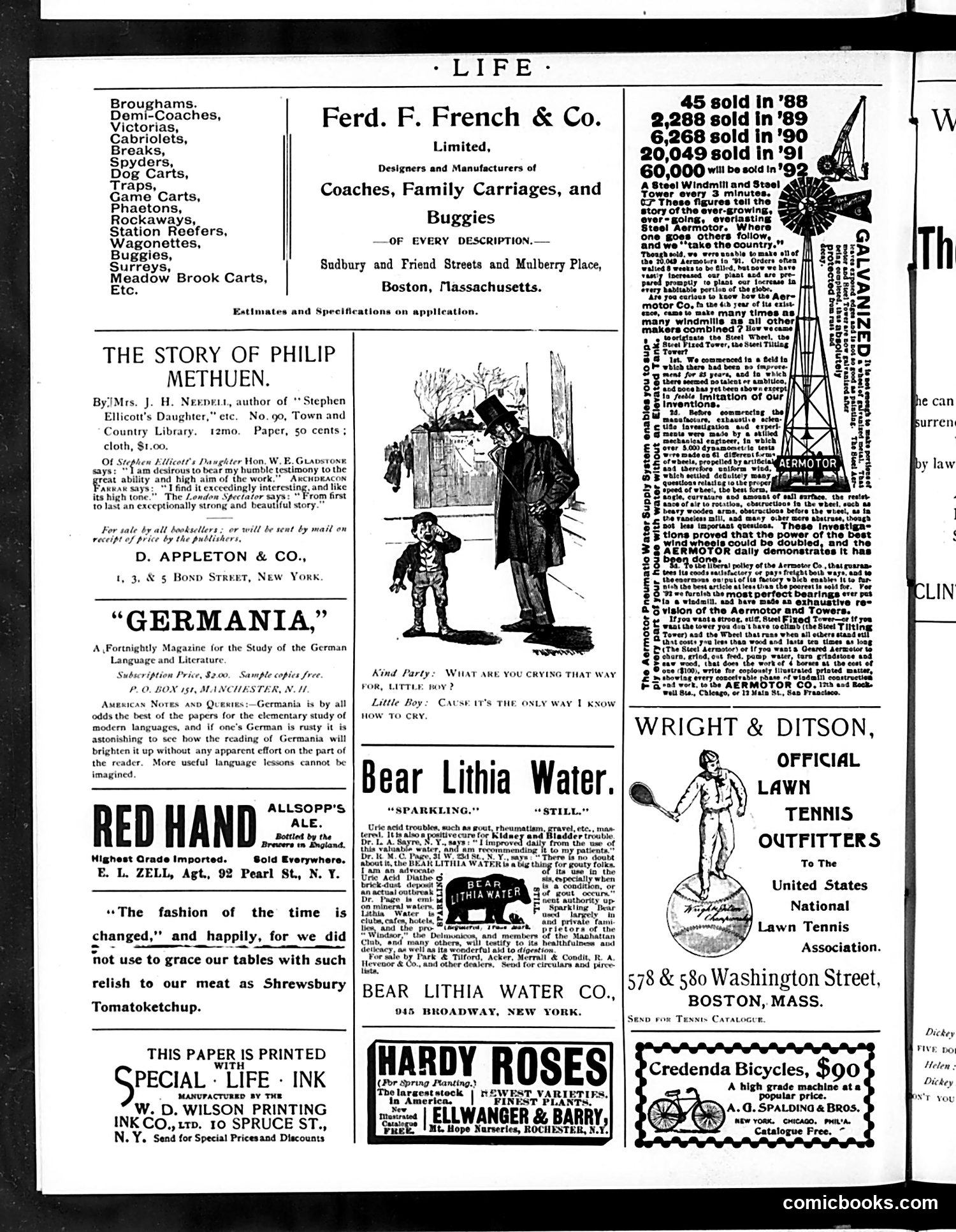
This page is primarily **advertising and announcements** rather than political satire. The one cartoon present depicts a generic "Kind Party" asking a crying "Little Boy" why he's upset. The boy's response—"'Cause it's THE ONLY way I KNOW how to CRY"—is a simple, sentimental humor joke with no political meaning. The page is dominated by **Victorian-era commercial advertisements** for carriages (Ferd. F. French & Co.), books, German language magazines, medicinal products (Bear Lithia Water for rheumatism), bicycles, and nurseries. Notable is the **Aermotor water pump advertisement**, which includes sales figures (45 sold in 1888, climbing to 60,000 projected for 1892), showcasing industrial growth during the Gilded Age. The printing itself is advertised as using "Special Life Ink," indicating the magazine's own manufacturing capabilities. This reflects **late 19th-century American consumer culture** more than political commentary.
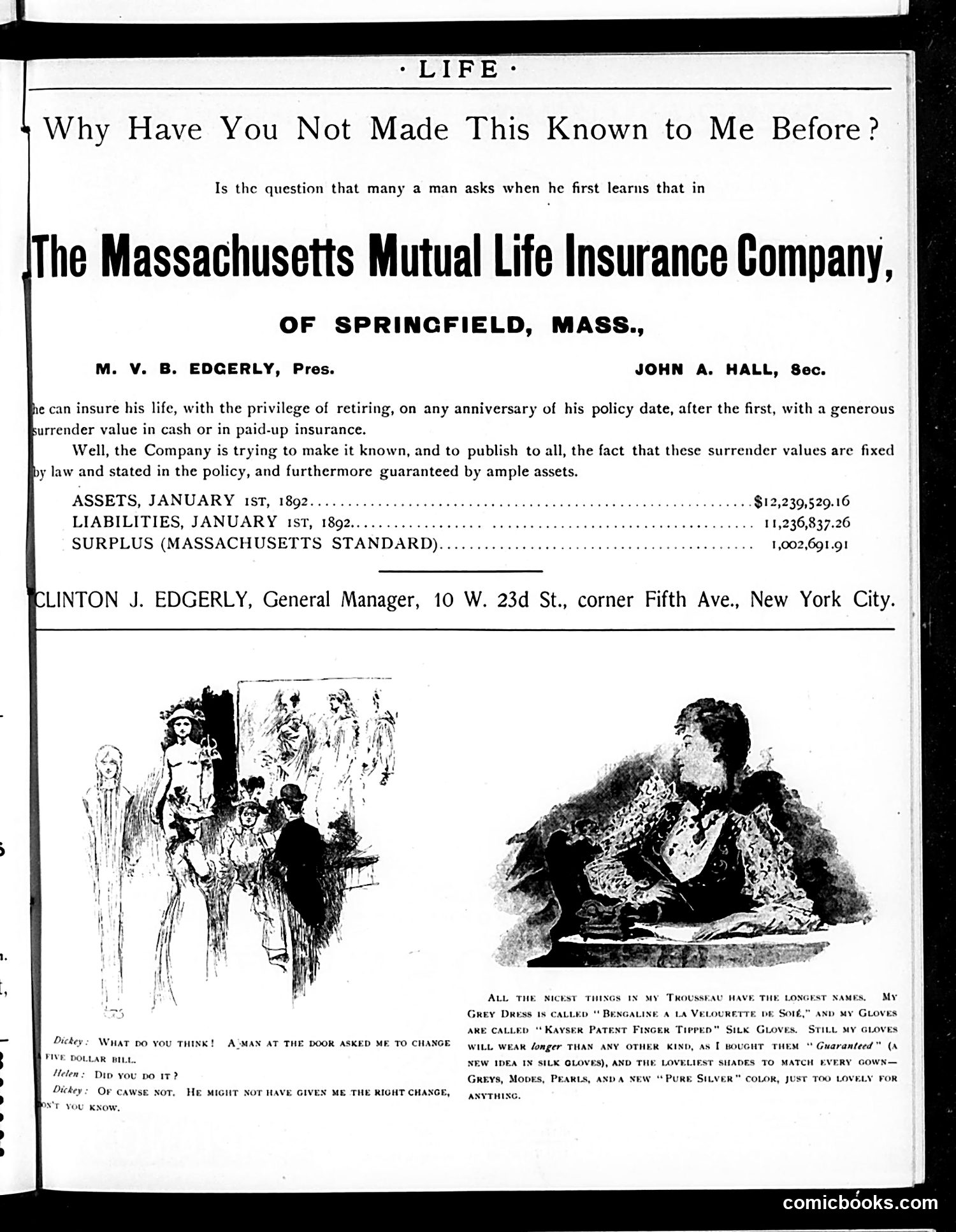
This page is primarily **insurance advertising** for Massachusetts Mutual Life Insurance Company, disguised as editorial content in Life magazine. The top section argues that policyholders can retire early with guaranteed cash surrender values—a selling point presented as surprising news ("Why Have You Not Made This Known to Me Before?"). Below are two **satirical cartoons** mocking contemporary fashion and consumer culture: 1. **Left cartoon**: A dialogue between "Dickey" and "Helen" about a man asking to change a five-dollar bill. Dickey refuses, fearing he'd give wrong change—a joke about consumer paranoia or distrust. 2. **Right cartoon**: A woman boasting about her trousseau items having elaborate French names ("Bengaline à la Velourette de Soie," "Kayser Patent Finger Tipped" silk gloves). The satire mocks upper-class women's pretentious obsession with brand names and fancy nomenclature for ordinary goods—yet ironically, these "guaranteed" gloves supposedly outlast cheaper alternatives. The juxtaposition suggests both insurance and luxury goods are sold through naming and guarantee rhetoric.
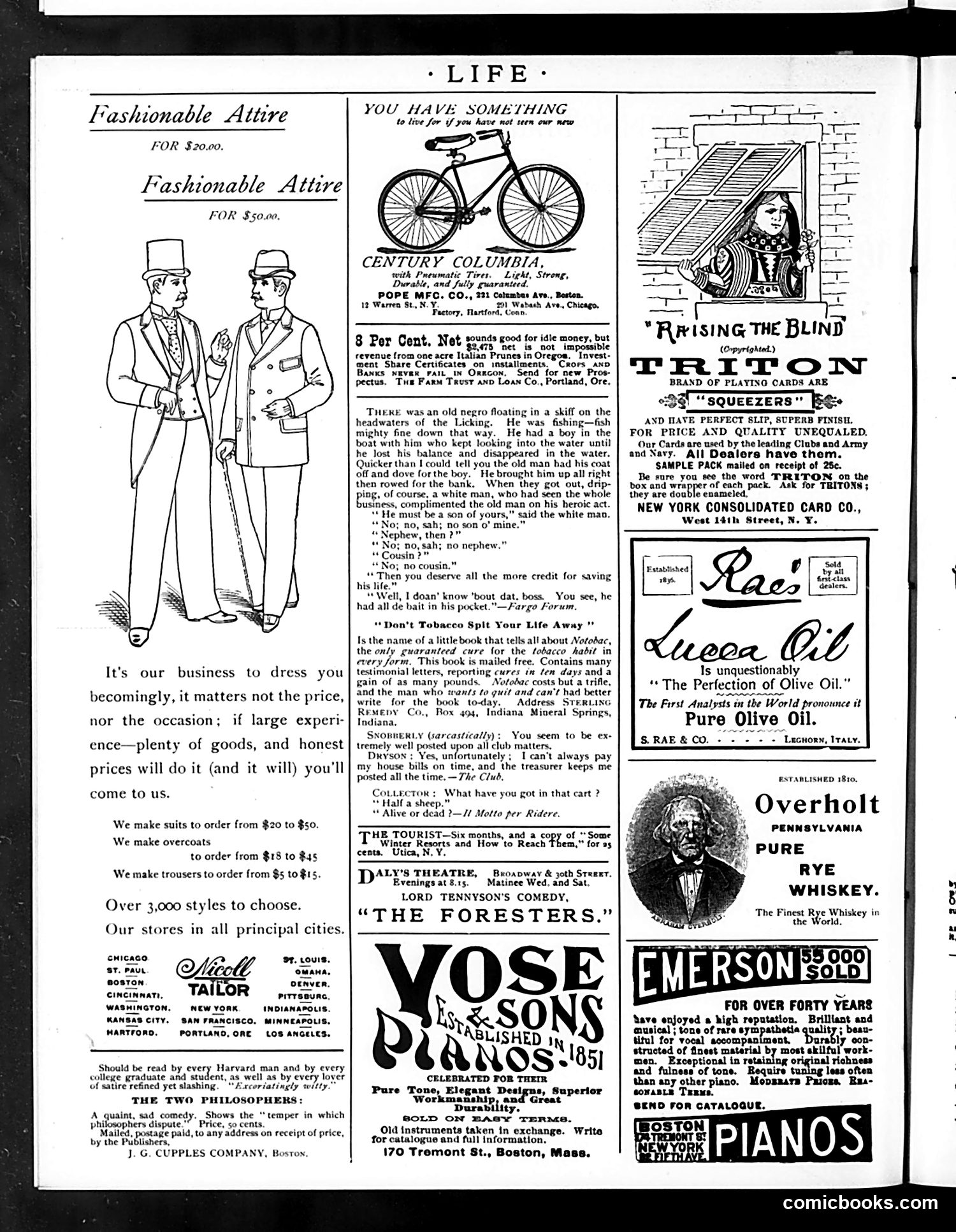
This page is primarily **advertising** with some satirical content interspersed. The main items are: **"Fashionable Attire"**: A tailor shop advertisement featuring two men in suits, promoting custom clothing at various price points ($20-$50). The accompanying text jokes that the tailor serves all classes regardless of price. **"Raising the Blind"**: A small cartoon (appears to be a domestic scene) with copyright notice—likely a humorous domestic vignette, though details are unclear from this reproduction. **Anecdote about an old man**: A brief story about a Black man heroically rescuing a drowning boy, with a punchline suggesting the old man had ulterior motives (he'd noticed the boy had fish bait). This reflects period racial stereotypes. **Various satirical snippets**: Including "The Two Philosophers" (a book advertisement) and club humor about unpaid bills. The rest consists of product advertisements: bicycles, pianos, whiskey, oil products, and theater notices. This was typical Life magazine content of the era—mixing humor with commercial advertisements.
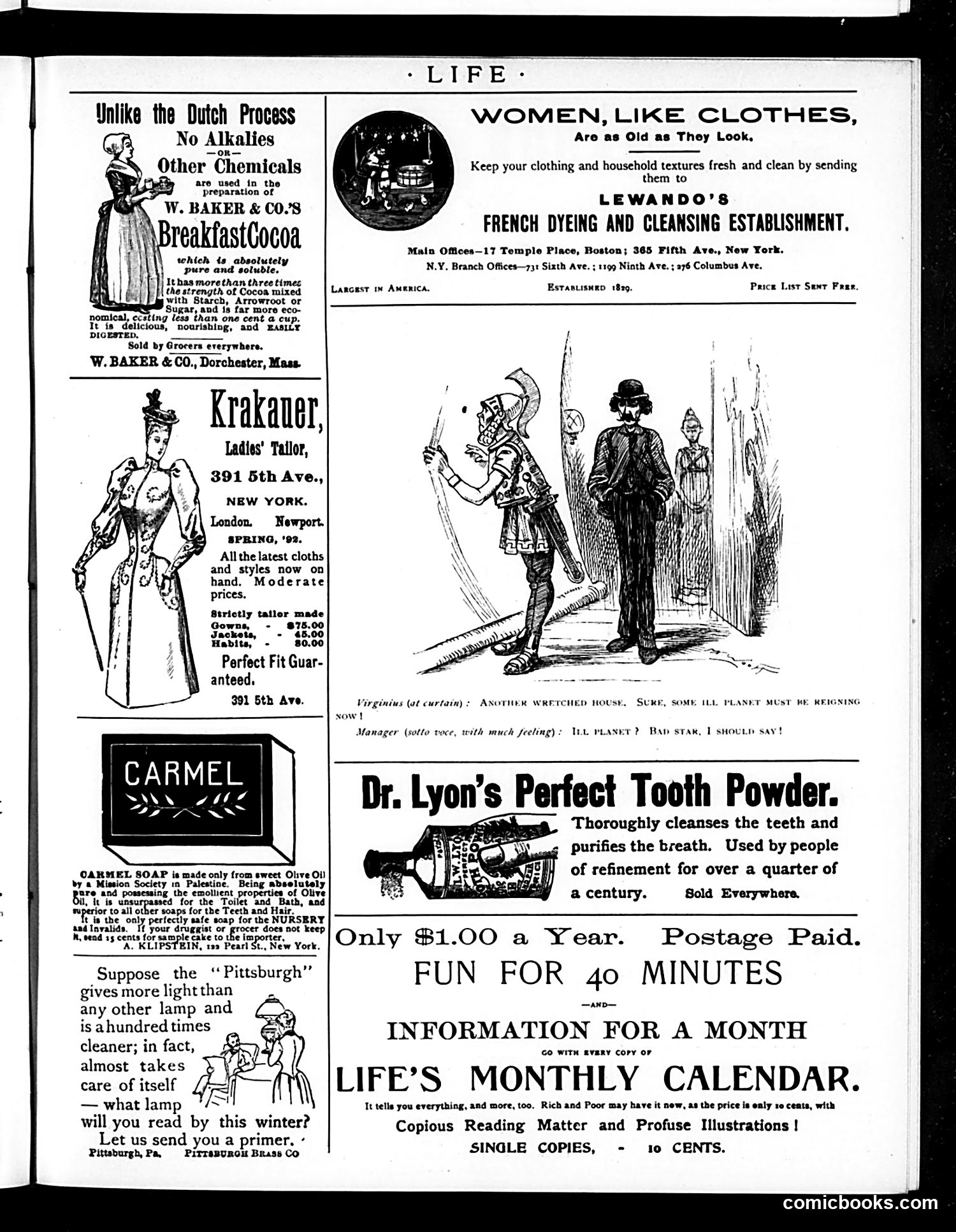
This is primarily an **advertising page** from Life magazine (circa 1892, based on the Krakauer tailor's "Spring '92" notation). The only satirical cartoon appears center-right: a theatrical scene captioned with dialogue between "Virginius" (a character onstage) and a theater manager. The manager, observing another "wretched house" (poor attendance), mutters with resignation that "some ill planet must be reigning now." The joke mocks theatrical failures and bad luck in show business—the manager's comment about planetary influence suggests desperation in explaining poor box office returns. The page otherwise features period advertisements for cocoa, tailoring services, soap, lamps, dyeing services, tooth powder, and Life's monthly calendar subscription. These ads are typical of 1890s American magazines, targeting middle and upper-class consumers with products emphasizing cleanliness, refinement, and proper appearance—values central to Victorian culture.
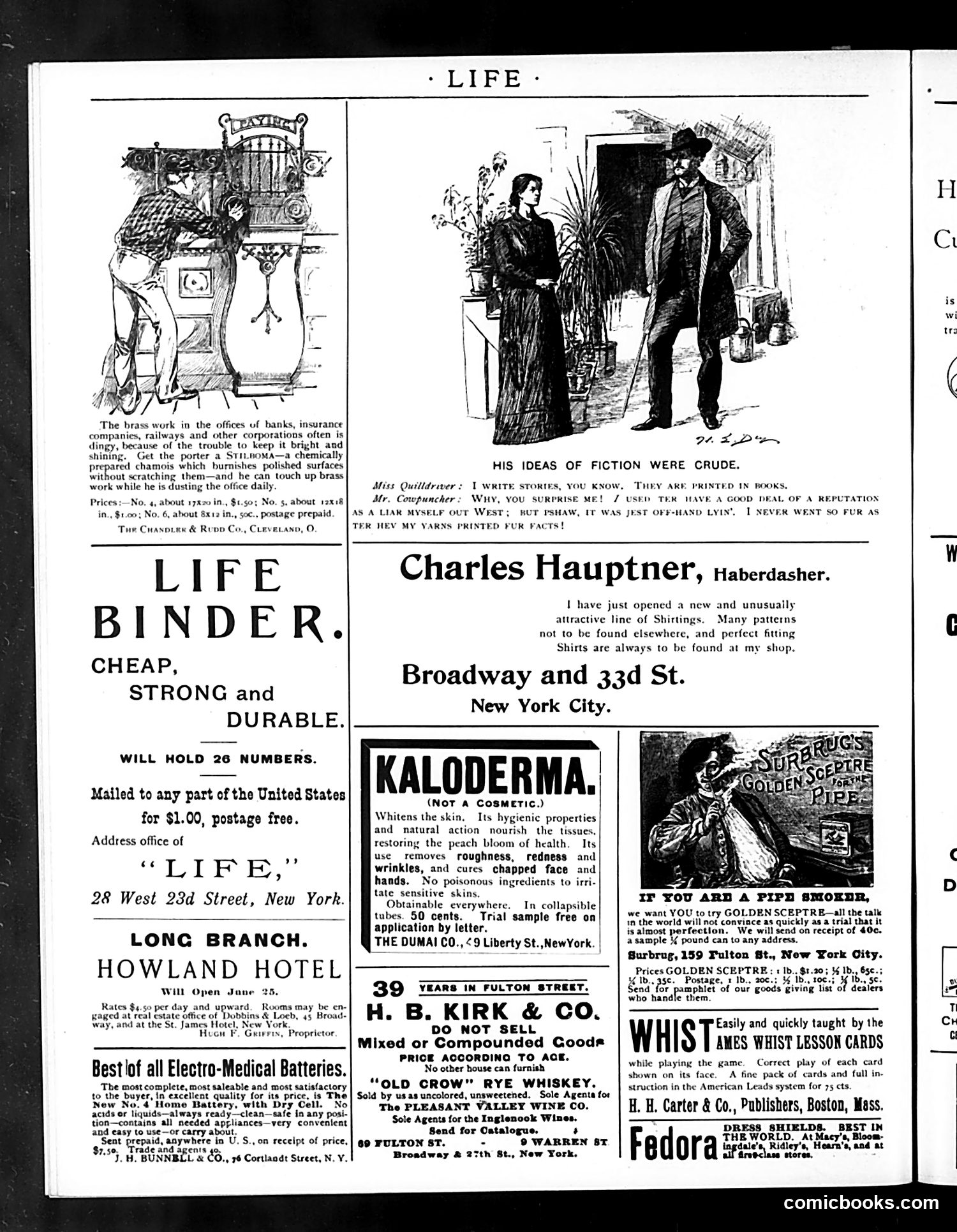
This cartoon satirizes the gap between literary culture and frontier practicality. A cowpuncher (working cowboy) meets Miss Quilldriver, a female writer. She explains that stories are "printed in books"—as if educating him on how literature works. His response mocks both her pretension and literary authenticity: he claims he was himself "a good deal of a reputation as a liar" out West, but his lying was "jest off-hand"—spontaneous and oral. The joke is that he never took his fabrications seriously enough to *publish* them as facts, implying that printed fiction claims a false authority that mere spoken tall tales don't. The satire cuts two ways: the cowpuncher seems unsophisticated, yet he's also suggesting that writers who present invented stories as factual are simply liars with better marketing. It reflects period anxieties about the truth-claims of fiction itself.
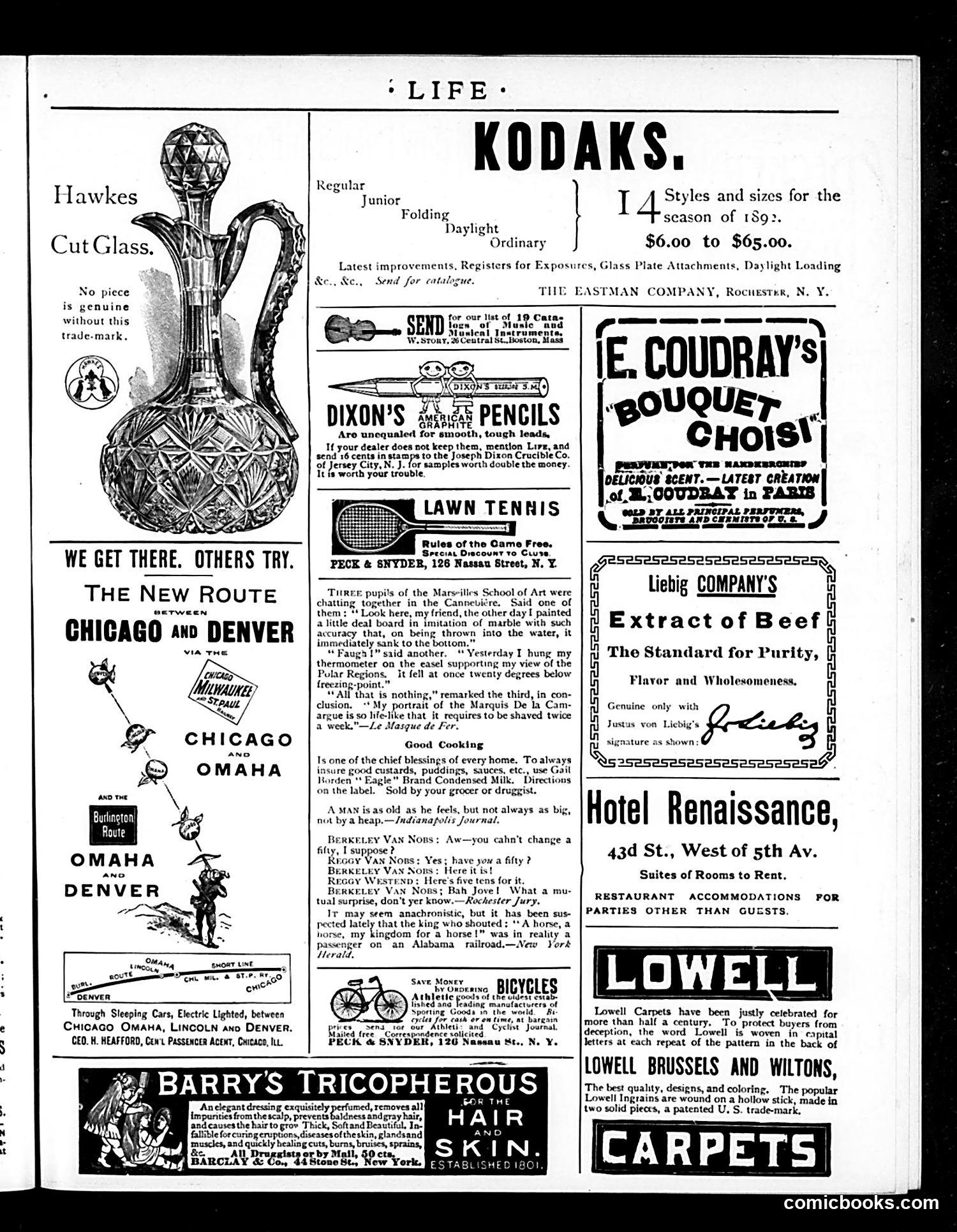
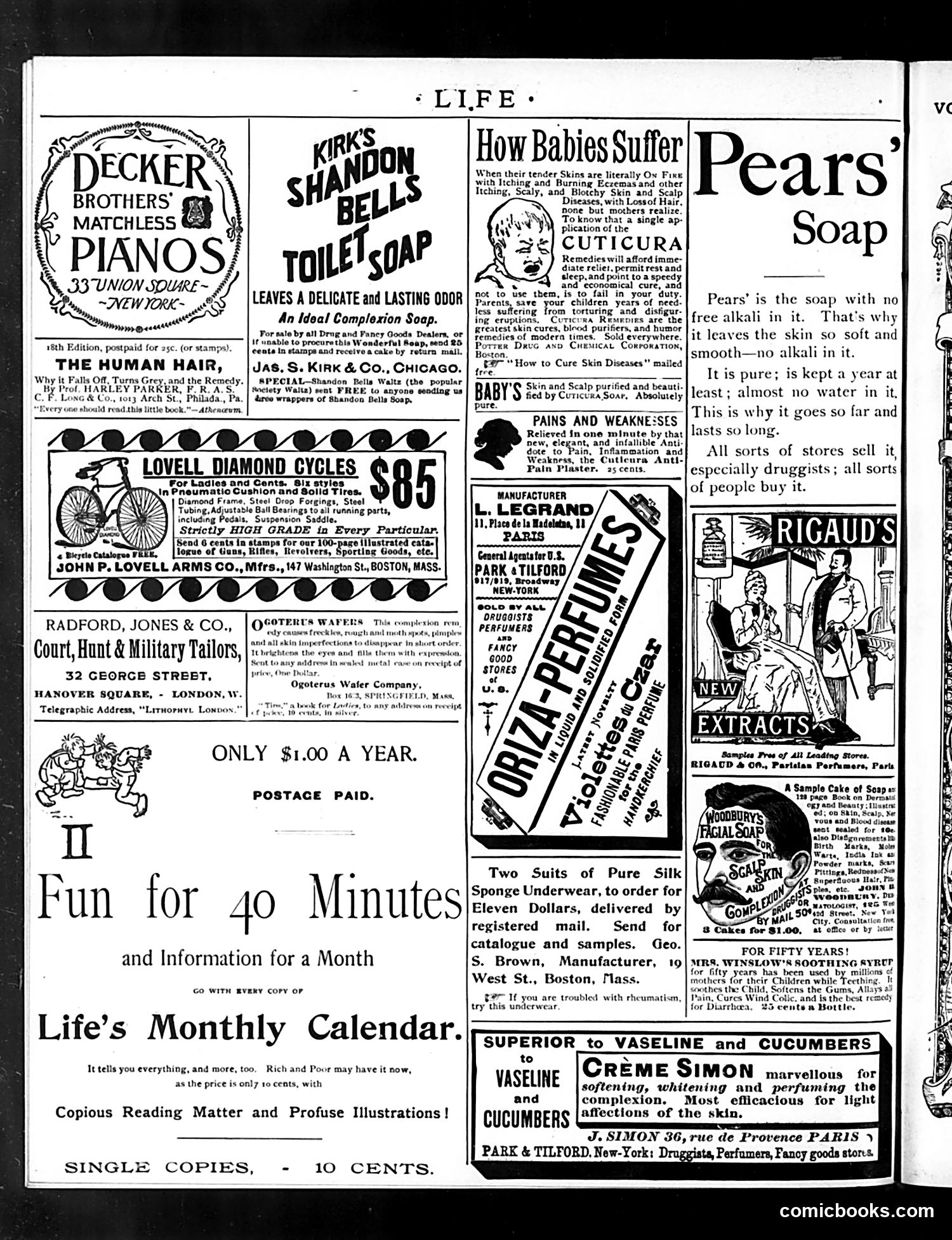
This is primarily an **advertising page** from Life magazine, not a satirical cartoon page. It contains numerous product advertisements typical of late 19th-century American publications. The ads showcase goods marketed primarily to middle and upper-class consumers: Decker Brothers pianos, Lovell Diamond bicycles, Kirk's Shandon Bells toilet soap, and Pears' Soap. Several ads target mothers and infants, promoting remedies for skin conditions (Cuticura products, Mrs. Winslow's Soothing Syrup). Notable is the **gendered marketing**: ads for silk underwear, complexion soaps, and beauty products emphasize women's appearance and domestic duties. The Cuticura ads exploit parental anxieties about children's health—a common advertising tactic of the era. The page also advertises Life's own **monthly calendar** subscription (10 cents), competing for reader attention. There are **no visible political cartoons or satirical commentary** on this particular page—it functions as commercial space rather than editorial content.