
Life, 1892-04-14 · page 4 of 26
Life — April 14, 1892 — page 4: what you’re looking at
What you’re looking at
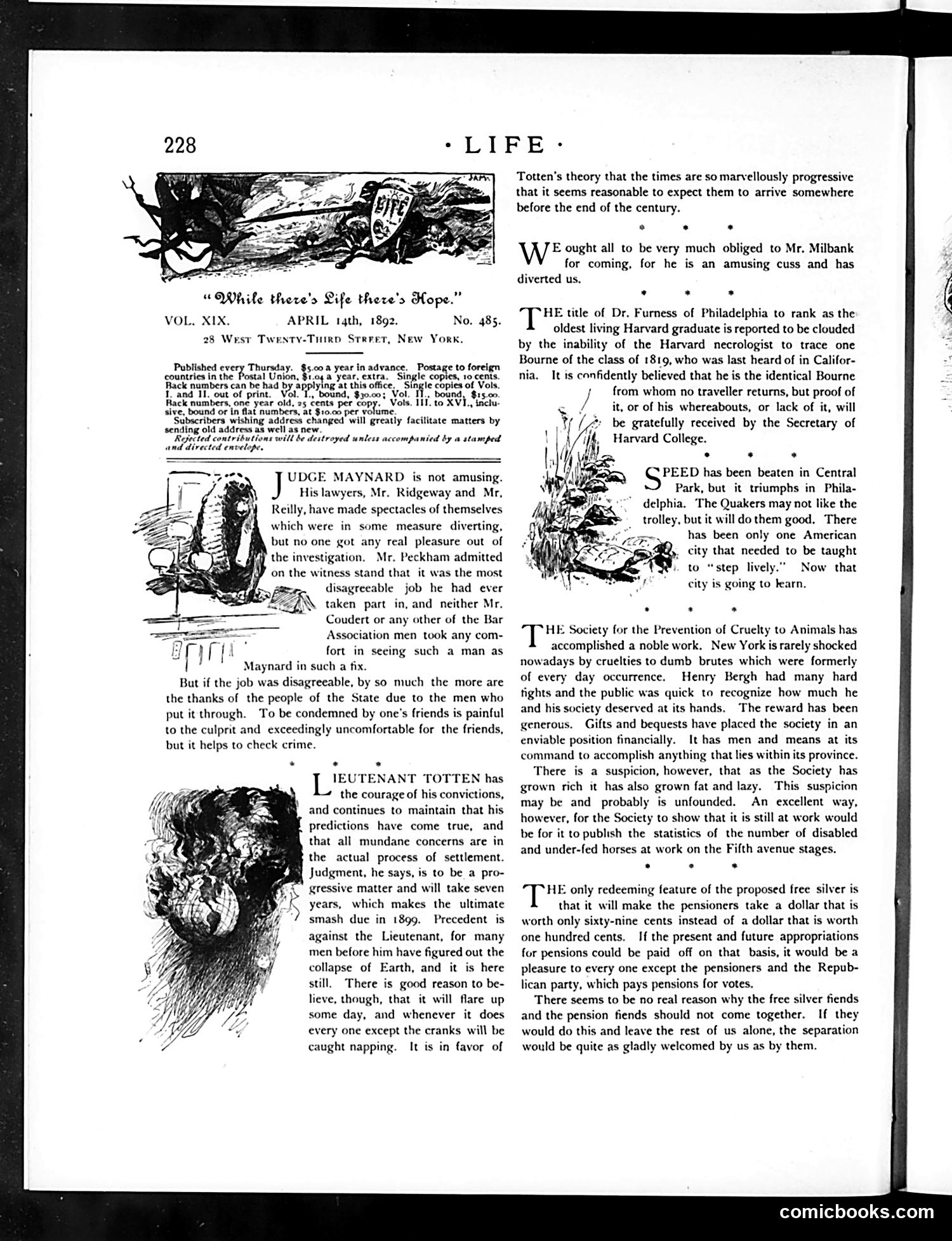
This page contains several editorial pieces rather than a single cartoon. The illustrations depict: 1. **Judge Maynard** (left cartoon): A figure shown in an unflattering caricature, criticized for being part of an investigation involving other men (Messrs. Ridgeway, Reilly, Peckham, and Coudert) into unspecified misconduct. The text suggests the investigation itself was unpleasant, but the public appreciates that these officials faced accountability for poor judgment. 2. **Lieutenant Totten** (right cartoon): A figure shown among cattails, referenced regarding predictions about social progress and the century's future. The remaining text discusses the Harvard neurologist Dr. Furness, Philadelphia's trolley system, and animal cruelty prevention—typical 1890s civic concerns. The page functions as political and social commentary rather than joke-based humor.
📄 Transcribed text from this page (OCR, searchable)
Machine-transcribed from the original scan — historical spelling and the odd misread are preserved.
“LIFE: “While there's Life there's Hope.” VOL. XIX, APRIL 14th, 1892. No. 485. 28 West Twenty-Tirp Street, New York, Published every Thursday. $5.00 year in advance. Postage to foreign countries in the Postal Union, $1.04 a year, extra. Single copi 10 cents. Rack numbers can be had by ‘appiylng ‘at this office. Single copies of Vols. I. and 11. out of print. Vol. I., bound, $30.00; Vol. IT. bou 15.00. Rack numbers, one year old, 25 cents per copy.’ Vols. IIT. to XVI, inclu- sive, bound of in flat numbers, at $10.00 per volume. Subscribers wishing address changed will greatly facilitate matters by sending old address as well as new. Rejected contributions will be destroyed untess accompanied by a stamped and directed envelope, UDGE MAYNARD is not amusing. His lawyers, Mr. Ridgeway and Mr, Reilly, have made spectacles of themselves which were in some measure diverting, but no one got any real pleasure out of the investigation. Mr. Peckham admitted on the witness stand that it was the most disagreeable job he had ever taken part in, and neither Mr, Coudert or any other of the Bar Association men took any com- fort in seeing such a man as Maynard in such a fix. But if the job was disagreeable, by so much the more are the thanks of the people of the State due to the men who put it through. To be condemned by one’s friends is painful to the culprit and exceedingly uncomfortable for the friends, but it helps to check crime. . . . IEUTENANT TOTTEN has the courage of his conviction: and continues to maintain that h predictions have come true, and that all mundane concerns are in the actual process of settlement. Judgment, he says, is to be a pro- gressive matter and will take seven years, which makes the ultimate smash due in 1899. Precedent is against the Lieutenant, for many men before him have figured out the collapse of Earth, and it is here still, There is good reason to be- lieve, though, that it will flare up some day, and whenever it does every one except the cranks will be caught napping. It is in favor of Totten’s theory that the times are so marvellously progressive that it seems reasonable to expect them to arrive somewhere before the end of the century. WE ought all to be very much obliged to Mr. Milbank for coming, for he is an amusing cuss and has diverted us, . . . HE title of Dr. Furness of Philadelphia to rank as the oldest living Harvard graduate is reported to be clouded by the inability of the Harvard necrologist to trace one Bourne of the class of 1819, who was last heard of in Califor- nia. It is confidently believed that he is the identical Bourne from whom no traveller returns, but proof of it, or of his whereabouts, or lack of it, will be gratefully received by the Secretary of Harvard College. . . * PEED has been beaten in Central Park, but it triumphs in Phila- __ trolley, but it will do them good. There ws has been only one American GR, city that needed to be taught to “step lively.” Now that city is going to learn. . * Society for the Prevention of Cruelty to Animals has accomplished a noble work. New York is rarely shocked nowadays by cruelties to dumb brutes which were formerly of every day occurrence. Henry Bergh had many hard fights and the public was quick to recognize how much he and his society deserved at its hands. The reward has been generous. Gifts and bequests have placed the society in an enviable position financially. It has men and means at its command to accomplish anything that lies within its province. There is a suspicion, however, that as the Society has grown rich it has also grown fat and lazy. This suspicion may be and probably is unfounded. An excellent way, however, for the Society to show that it is still at work would be for it to publish the statistics of the number of disabled and under-fed horses at work on the Fifth avenue stages. . . . HE only redeeming feature of the proposed free silver is that it will make the pensioners take a dollar that is worth only sixty-nine cents instead of a dollar that is worth one hundred cents. If the present and future appropriations for pensions could be paid off on that basis, it would be a pleasure to every one except the pensioners and the Repub- lican party, which pays pensions for votes. There seems to be no real reason why the free silver fiends and the pension fiends should not come together. If they would do this and leave the rest of us alone, the separation would be quite as gladly welcomed by us as by them. comicbooks.com