
Life, 1892-04-14 · page 6 of 26
Life — April 14, 1892 — page 6: what you’re looking at
What you’re looking at
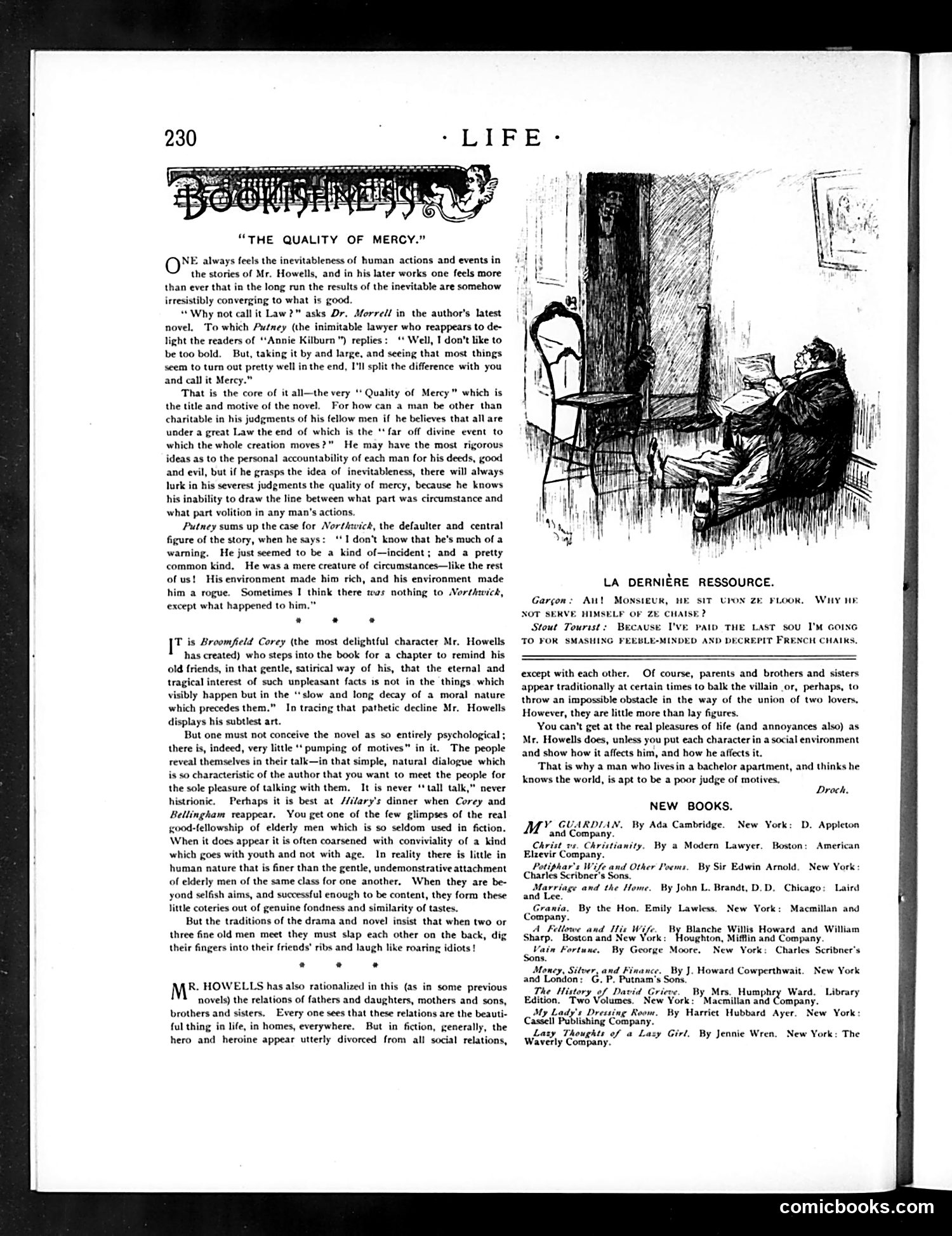
This page contains a literary essay titled "The Quality of Mercy," discussing W.D. Howells' novel "Annie Kilburn." The accompanying illustration ("La Dernière Ressource" / "The Last Resort") depicts two men in what appears to be a modest interior—one seated, one standing—engaged in conversation about financial hardship. Their dialogue references unpaid debts and "smashing" French chairs, suggesting economic struggle and desperation. The illustration satirizes the genteel poor—educated men maintaining dignity despite financial ruin. The essay argues that Howells realistically portrays human nature and moral complexity rather than idealizing characters, positioning this as a strength of his fiction. The page includes a "New Books" section listing contemporary publications, making this primarily a book review and literary criticism column rather than political satire.
📄 Transcribed text from this page (OCR, searchable)
Machine-transcribed from the original scan — historical spelling and the odd misread are preserved.
“THE QUALITY OF MERCY.” Gee always feels the inevitableness of human actions and events in the stories of Mr. Howells, and in his later works one feels more than ever that in the long run the results of the inevitable are somehow irresistibly converging to what is good. “ Why not call it Law?” asks Dr. Morre/l in the author's latest novel. To which Putney (the inimitable lawyer who reappears to de- light the readers of ‘Annie Kilburn") replies: ‘* Well, I don’t like to be too bold. But, taking it by and large, and seeing that most things seem to turn out pretty well in the end, I'll split the difference with you and call it Mercy.” That is the core of it all—the very ‘ Quality of Mercy” which is the title and motive of the novel, For how can a man be other than charitable in his judgments of his fellow men if he believes that all are under a great Law the end of which is the ‘far off divine event to which the whole creation moves?" He may have the most rigorous ideas as to the personal accountability of each man for his deeds, good and evil, but if he grasps the idea of inevitableness, there will always lurk in his severest judgments the quality of mercy, because he knows his inability to draw the line between what part was circumstance and what part volition in any man's actions. Putney sums up the case for Northwick, the defaulter and central figure of the story, when he says: ‘I don’t know that he's much of a warning. He just seemed to be a kind of—incident; and a pretty common kind, He was a mere creature of circumstances—like the rest of us! His environment made him rich, and his environment made him a rogue. Sometimes I think there was nothing to Northwick, except what happened to him.” * * ° [Tis Broomfetd Corey (the most delightful character Mr. Howells has created) who steps into the book for a chapter to remind his old friends, in that gentle, satirical way of his, that the eternal and tragical interest of such unpleasant facts is not in the things which visibly happen but in the ‘slow and long decay of a moral nature which precedes them.” In tracing that pathetic decline Mr. Howells displays his subtlest art. But one must not conceive the novel as so entirely psychological ; there is, indeed, very little "* pumping of motives" in it. The people reveal themselves in their talk—in that simple, natural dialogue which is so characteristic of the author that you want to meet the people for the sole pleasure of talking with them. It is never ‘tall talk," never histrionic. Perhaps it is best at //i/ary's dinner when Corey and Bellingham reappear. You get one of the few glimpses of the real good-fellowship of elderly men which is so seldom used in fiction. When it does appear it is often coarsened with conviviality of a kind which goes with youth and not with age. In reality there is little in human nature that is finer than the gentle, undemonstrative attachment of elderly men of the same class for one another. When they are be- yond selfish aims, and successful enough to be content, they form these little coteries out of genuine fondness and similarity of tastes. But the traditions of the drama and novel insist that when two or three fine old men meet they must slap each other on the back, dig their fingers into their friends’ ribs and laugh like roaring idiots ! ° ° . R. HOWELLS has also rationalized in this (as in some previous novels) the relations of fathers and daughters, mothers and sons, brothers and sisters, Every one sees that these relations are the beauti- ful thing in life, in homes, everywhere. But in fiction, generally, the hero and heroine appear utterly divorced from all social relations, A LA DERNIERE RESSOURCE. Gargon: Aut Monsieur, ME SIT NOT SERVE HIMSELF OF ZE CHAISE? Stout Tourist: Because I've paib THE Last sou I'M GOING TO FORK SMASHING FEEBLE-MINDED AND DECREPIT FRENCH CHAIKS, UPon Ze FLOOR, Why He except with each other. Of course, parents and brothers and sisters appear traditionally at certain times to balk the villain or, perhaps, to throw an impossible obstacle in the way of the union of two lovers, However, they are little more than lay figures. You can't get at the real pleasures of life (and annoyances also) as Mr. Howells does, unless you put each character in a social environment and show how it affects him, and how he affects it. That is why a man who livesin a bachelor apartment, and thinks he knows the world, is apt to be a poor judge of motives. Droch. NEW BOOKS. Y GUARDIA? By Ada Cambridge. and Company. Christ vs. Christ: Elzevir Compan; Potiphar’s Wife and Other loems. Charles Scribner's Sons. Marriage and the Home. By John L. Brandt, D.D, Chicago: Laird and Lee. New York: D. Appleton nity. By a Modern Lawyer. Boston: American By Sir Edwin Arnold. New York: By the Hon. Emily Lawless. New York: Macmillan and A Fellowe and His Wife. By Blanche Willis Howard and William Sharp. Boston and New York troughton, Mig ‘Company. _ Vain Fortune, By George Moore, Charles Scribner's ‘Sons. Money, Silver, and Finance. By J. Howard Cowperthwait. New York and London: G. P, Putnam's Sons. The History of David Grieve. By Edition. Two Volumes. New York: My Lady's Dressing Room. Cassell Publishing Company. Laty Thoughts of a Lasy Girl. By Jennie Wren. Waverly Company. New York Mrs. Humphry Ward. Library Macmillan and Company. By Harriet Hubbard Ayer. New York: New York: The comicbooks.com