
A complete issue · 14 pages · 1892
Life — March 3, 1892
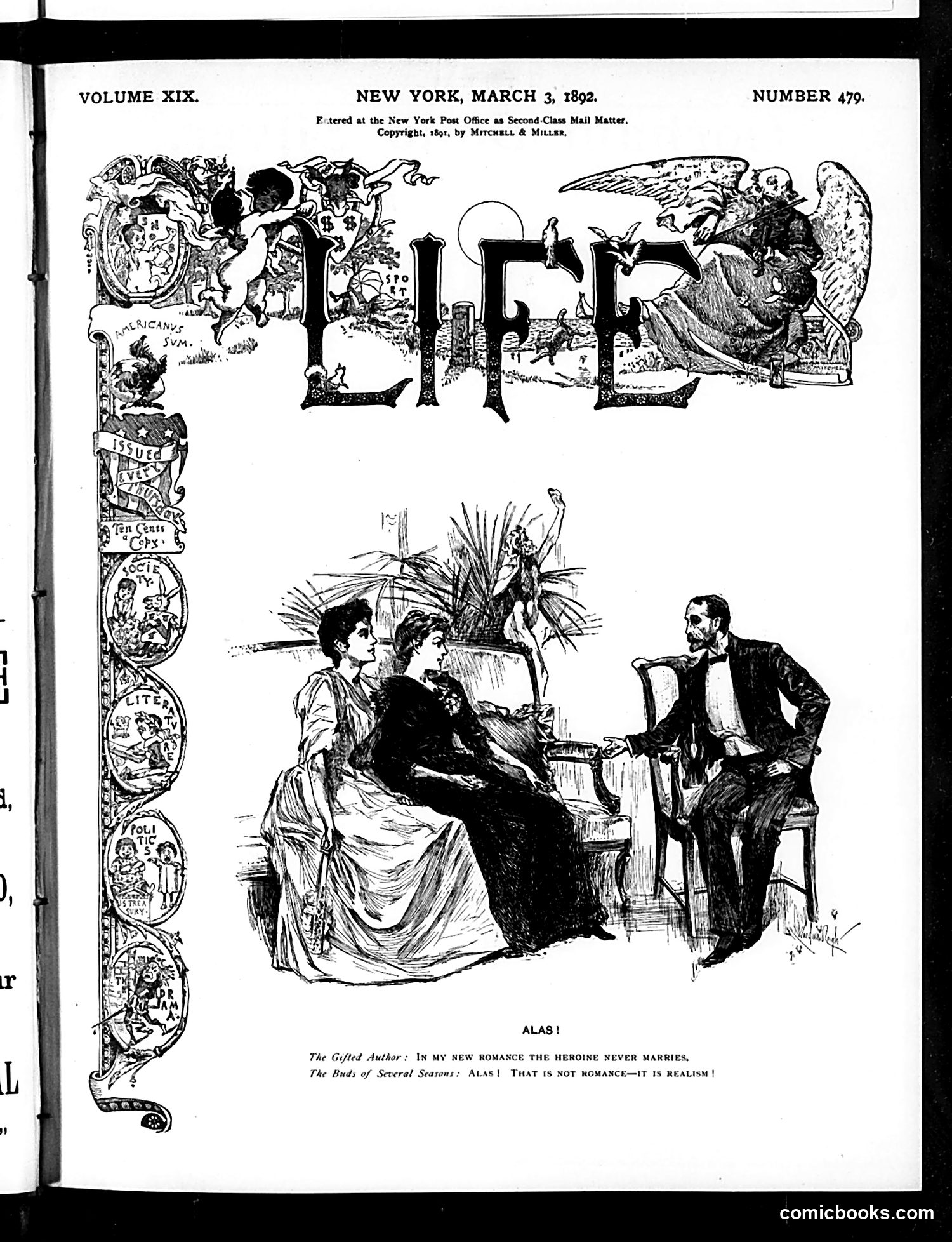
This page satirizes literary realism versus romance conventions. The caption shows a dialogue between "The Gifted Author" and "The Bard of Several Seasons": **The satire:** An established author criticizes a new romance novel, stating the heroine never marries. The veteran writer retorts that this isn't romance—it's realism, implying that realistic fiction (a growing literary movement in the 1890s) violated reader expectations for happy romantic endings. **The joke:** By 1892, literary realism was gaining prominence, challenging sentimental Victorian romance traditions. The cartoon mocks this tension: conventional authors saw unmarried heroines as depressingly realistic rather than properly romantic. The illustration depicts an intellectual discussion between well-dressed men and women, emphasizing how literary debate occurred in educated, bourgeois circles.
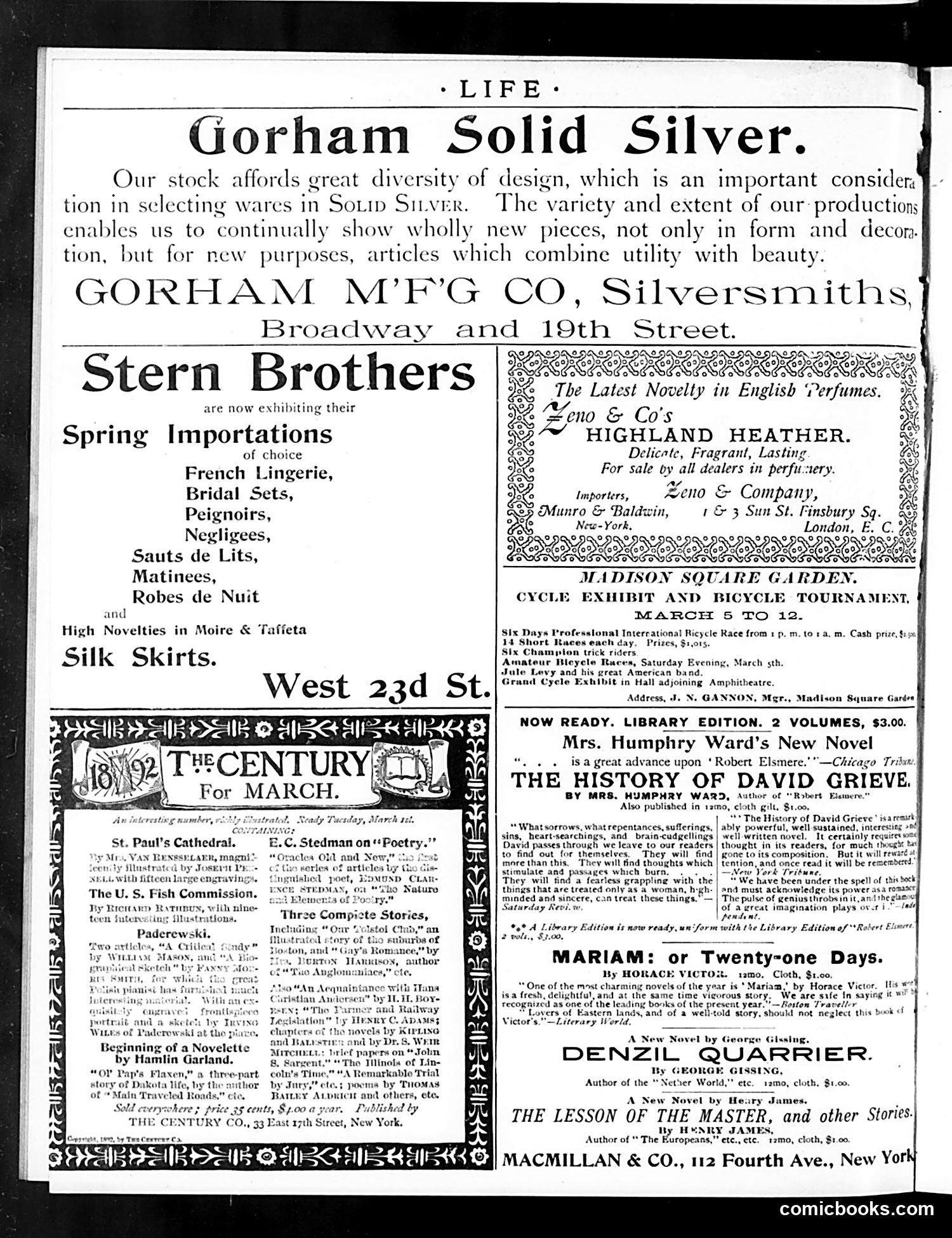
This page is **primarily advertising** with no discernible political cartoon or satirical content. The advertisements include: - Gorham Manufacturing Company promoting solid silver goods - Stern Brothers advertising spring importations (French lingerie, silk skirts) - Zeno & Co.'s perfume ("Highland Heather") - Madison Square Garden's cycle exhibit and bicycle tournament - The Century Magazine's March issue - Book advertisements from Macmillan & Co., promoting novels including Mrs. Humphry Ward's *The History of David Grieve* and works by George Gissing and Henry James The page represents turn-of-the-century consumer advertising aimed at affluent readers, reflecting contemporary luxury goods and literary culture. No satirical commentary or caricatures are evident.
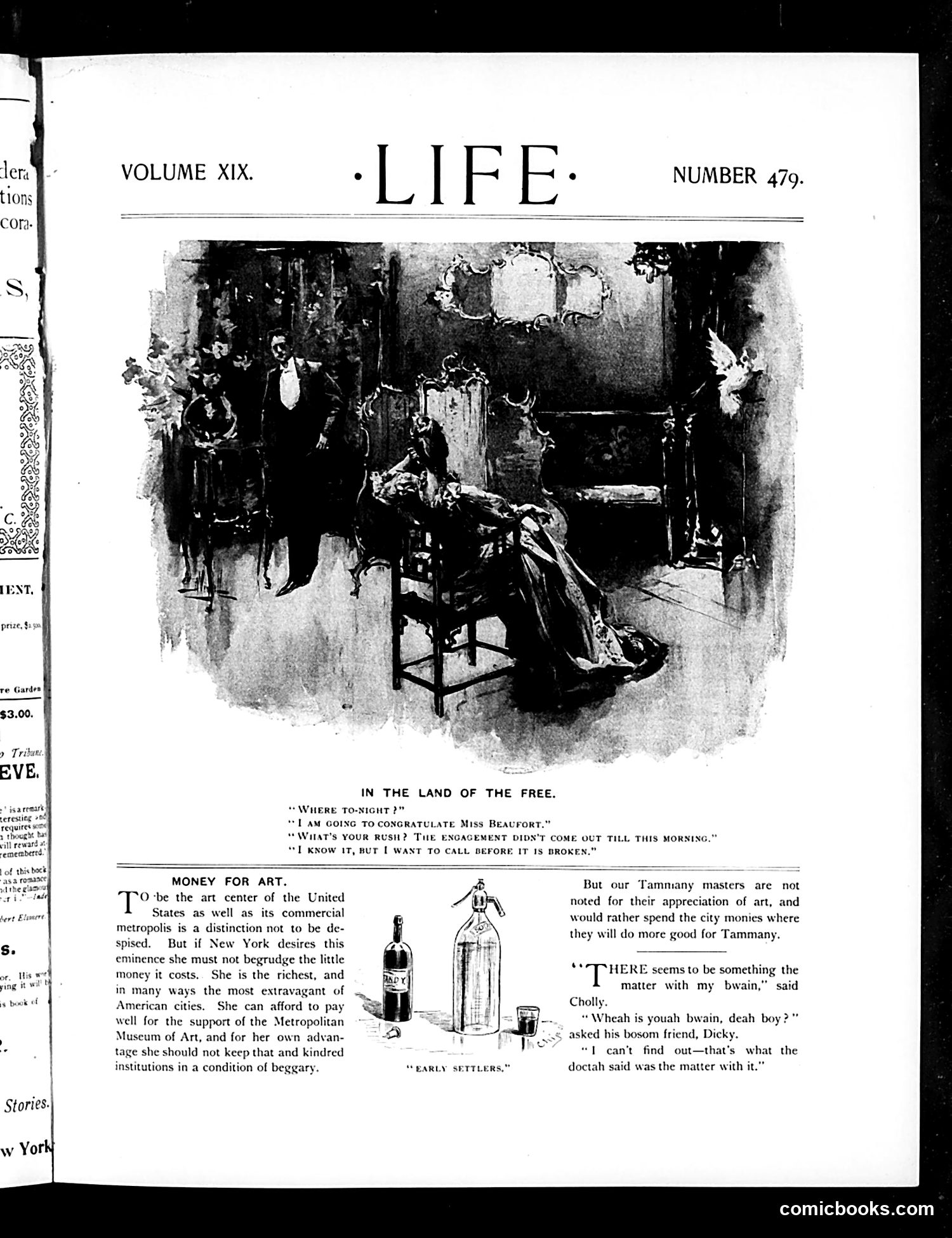
**Main Illustration ("In the Land of the Free"):** This sketch depicts an engagement announcement scene in what appears to be a formal Victorian-era parlor. The caption quotes suggest social awkwardness around announcing an engagement—the bride-to-be wants to congratulate Miss Beaufort, but the announcement hasn't been publicly disclosed yet. The satire mocks the rigid social protocols and timing conventions of upper-class engagement announcements. **"Money for Art" Section:** This article critiques New York's failure to adequately fund the Metropolitan Museum of Art compared to its wealth. It argues that while wealthy enough to support grand institutions, the city relies on "kindred institutions in a condition of beggary." The accompanying "Early Settlers" illustration appears to mock frontier-era commercialism. The page satirizes both social pretension and urban priorities.
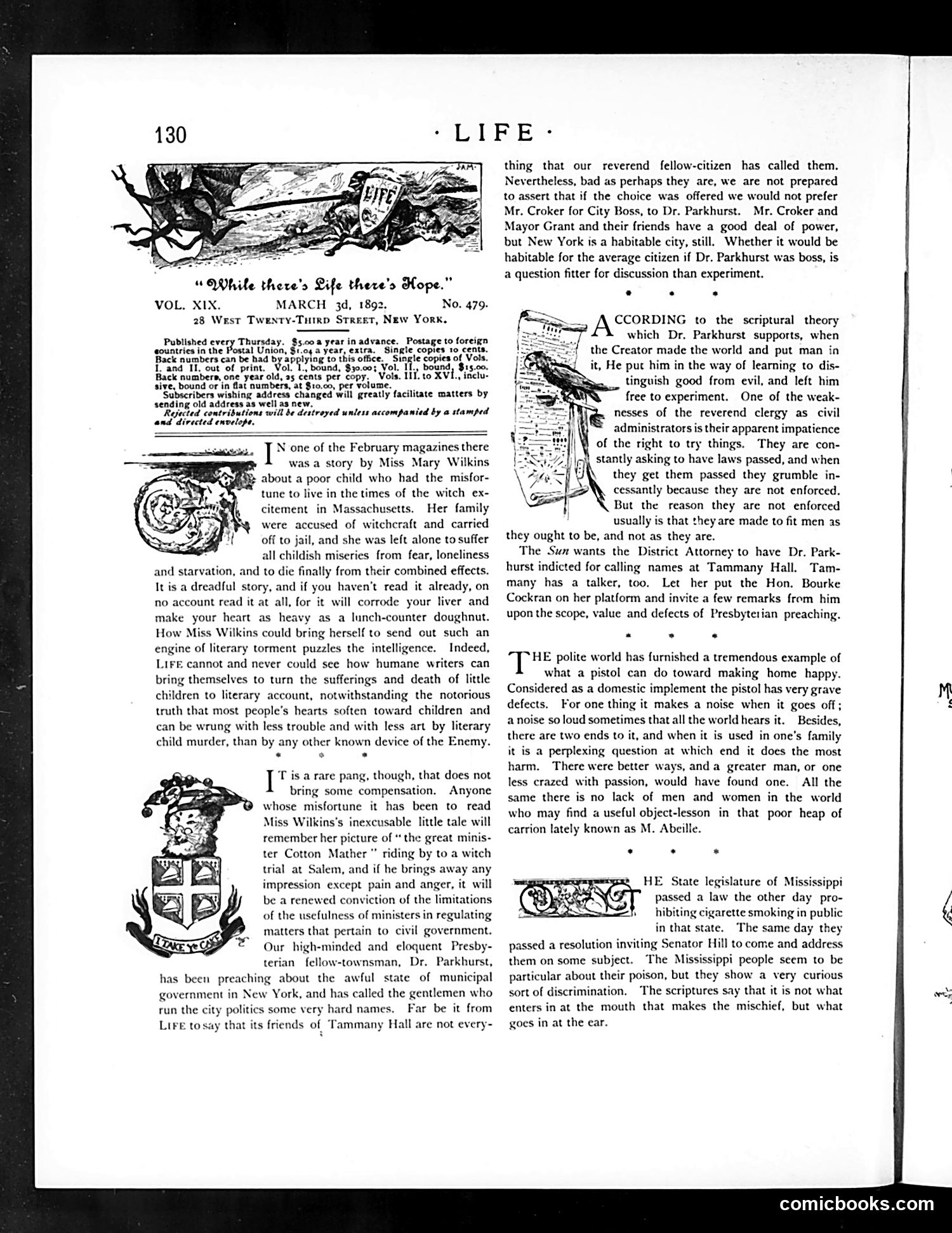
This page contains satirical commentary rather than a single cartoon. The main targets are: 1. **Dr. Parkhurst's municipal reform campaign** - The text criticizes his moral crusade against New York City corruption, suggesting his prescriptive approach is impractical for average citizens. 2. **The Mary Wilkins story reference** - Discussing a literary tale about a poor child accused of witchcraft, the writer uses it to critique how literature sensationalizes suffering, particularly child suffering, as entertainment. 3. **Mississippi's cigarette legislation** - Mocking the state legislature for prohibiting cigarette smoking publicly while inviting Senator Hill to address them—highlighting the hypocrisy of selective moral enforcement. The page's cartoons (visible but small) appear to illustrate these critiques of selective moral outrage and governmental inconsistency.
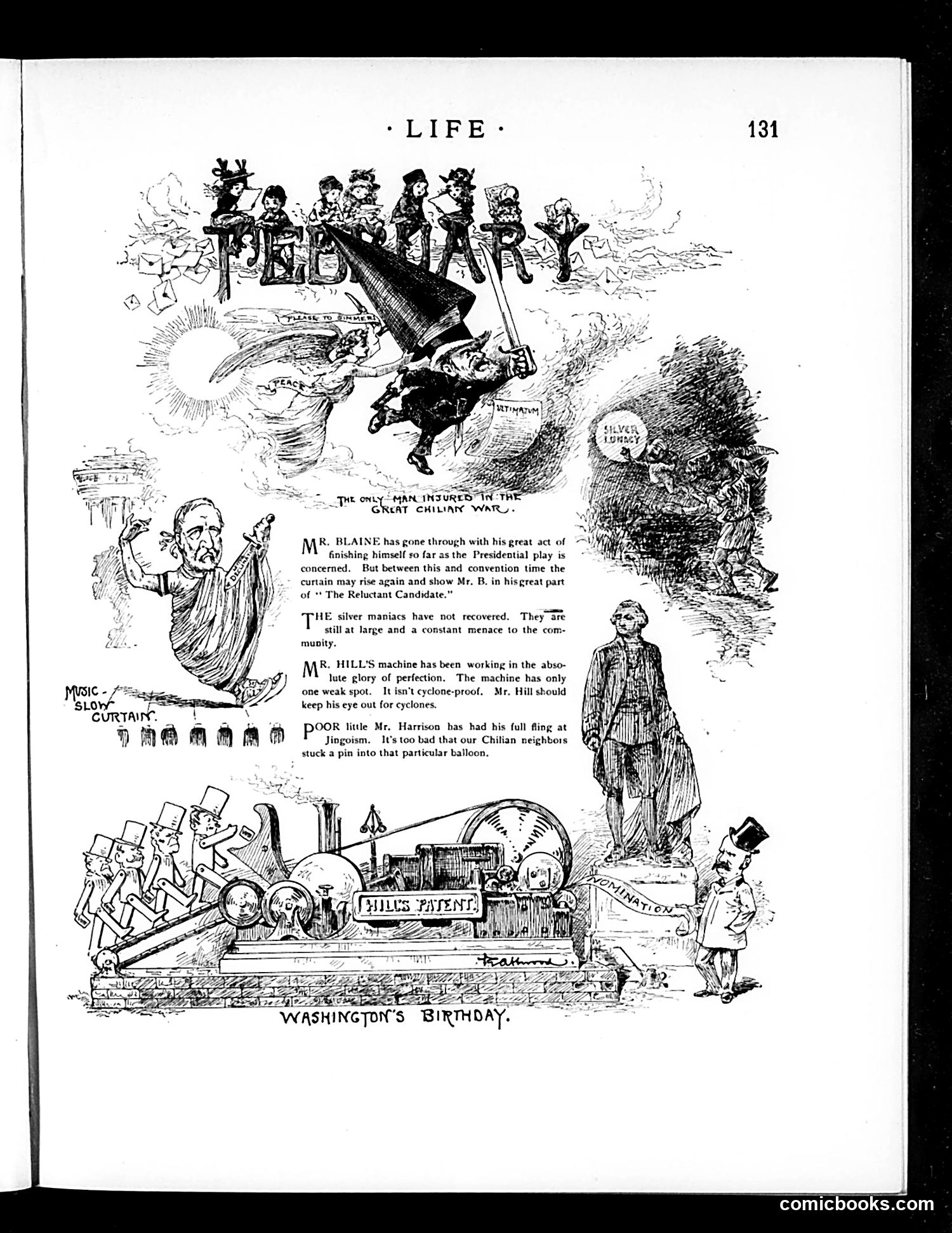
This page contains three satirical cartoons commenting on early 20th-century political figures and events: **Top cartoon**: "The Only Man Injured in the Great Civilian War" depicts a man being struck by a large hammer labeled "PEACE," suggesting satire about political conflict masquerading as a "great civilian war." **Left cartoon**: Shows a figure labeled "MUSIC - SLOW CURTAIN" with text referencing Mr. Blaine and "The Reluctant Candidate," likely mocking political reluctance about presidential candidacy. **Bottom cartoon**: "Washington's Birthday" features "HILL'S PATENT" machinery with political figures, satirizing mechanical politics and technological claims. The text mentions Mr. Hill's machine and concerns about cyclones, while also referencing silver maniacs and Mr. Harriman's jingoist rhetoric about "Civilian neighbors" and balloons. The overall tone mocks political pretension and mechanical approaches to governance.
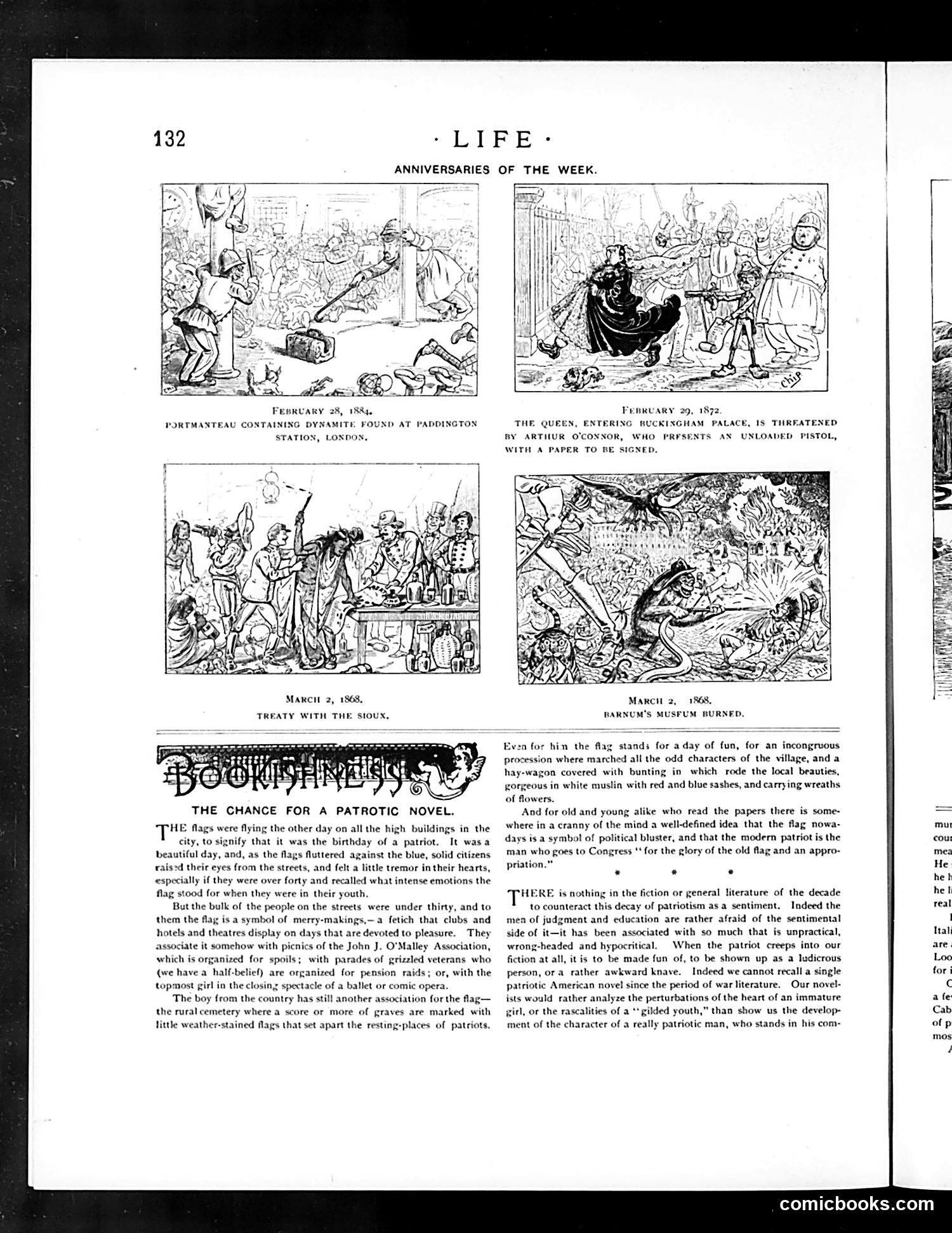
This page presents historical "Anniversaries of the Week" with four satirical engravings commemorating events from prior years: 1. **February 28, 1884**: A "Portmanteau containing dynamite" discovered at Paddington Station—likely referencing Irish nationalist bomb threats during this era. 2. **February 29, 1872**: Queen Victoria threatened at Buckingham Palace by Arthur O'Connor presenting an unloaded pistol—a real assassination attempt. 3. **March 2, 1868**: "Treaty with the Sioux"—depicting U.S. government relations with Native Americans. 4. **March 2, 1868**: "Barnum's Museum burned"—P.T. Barnum's famous New York attraction destroyed by fire. The article below discusses creating patriotic American novels, dismissing contemporary "gilded youth" fiction as insufficiently morally serious compared to genuinely patriotic literature.
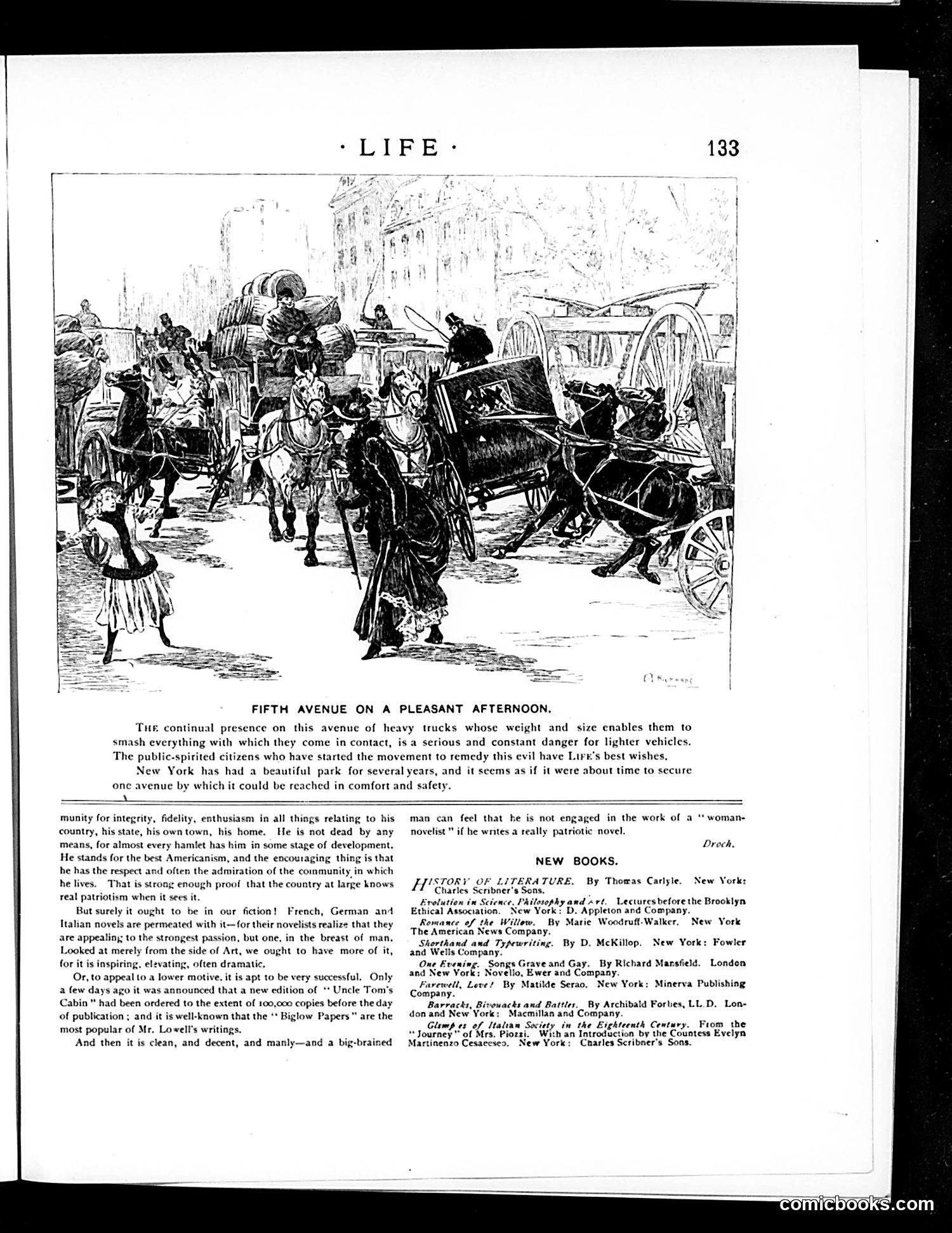
This illustration depicts a chaotic street scene on Fifth Avenue in New York City, showing heavy trucks amid lighter vehicles and pedestrians. The accompanying text criticizes the "continual presence" of large trucks whose "weight and size" create "serious and constant danger for lighter vehicles." The satire targets a public safety crisis: heavy commercial trucks shared Fifth Avenue with carriages and pedestrians, causing accidents and congestion. Citizens had launched a movement to remedy this problem. The text notes that New York had discussed creating a beautiful park for "several years" and suggests securing "one avenue by which it could be reached in comfort and safety." This reflects early 20th-century urban congestion and the tension between commercial transportation and public welfare in rapidly industrializing cities.
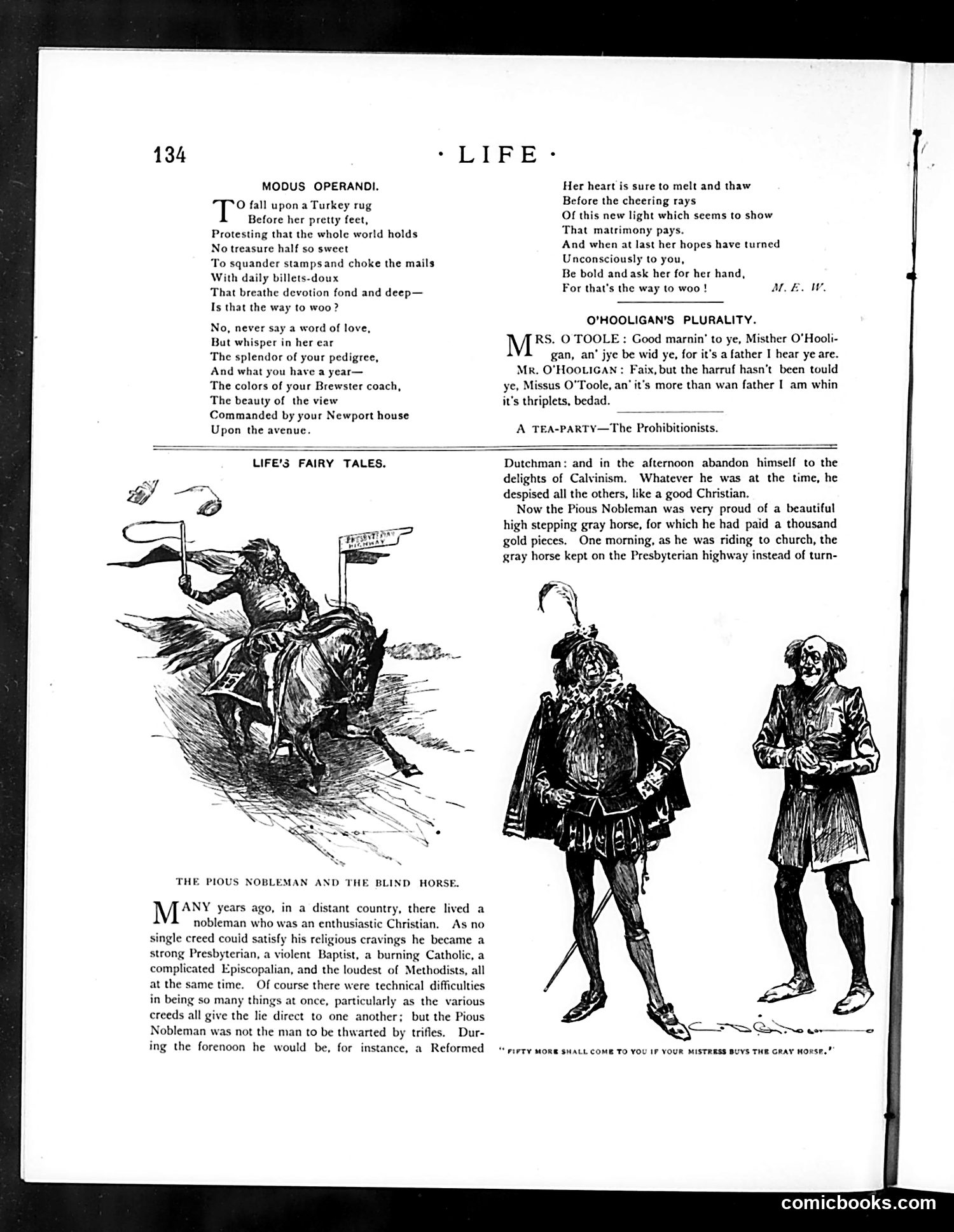
This page from *Life* magazine contains satirical poetry and a short story rather than political cartoons. **"Modus Operandi"** mocks romantic courtship rituals—the poem advises lying on a Turkish rug, protesting one's devotion loudly, and using flowery language about "Brewster coach" colors to seduce a woman. It's satire about insincere male wooing techniques. **"O'Hooligan's Plurality"** is a brief comedic dialogue where Mr. O'Hooligan claims his mistress is superior to his wife, and she retorts it's worse than having "a father I am when it's thriplets, bedad"—Irish dialect humor about a pregnant mistress. **"The Pious Nobleman and the Blind Horse"** begins a fairy tale about a religiously confused nobleman whose gray horse strays from the Presbyterian path—likely satirizing religious hypocrisy or confusion.
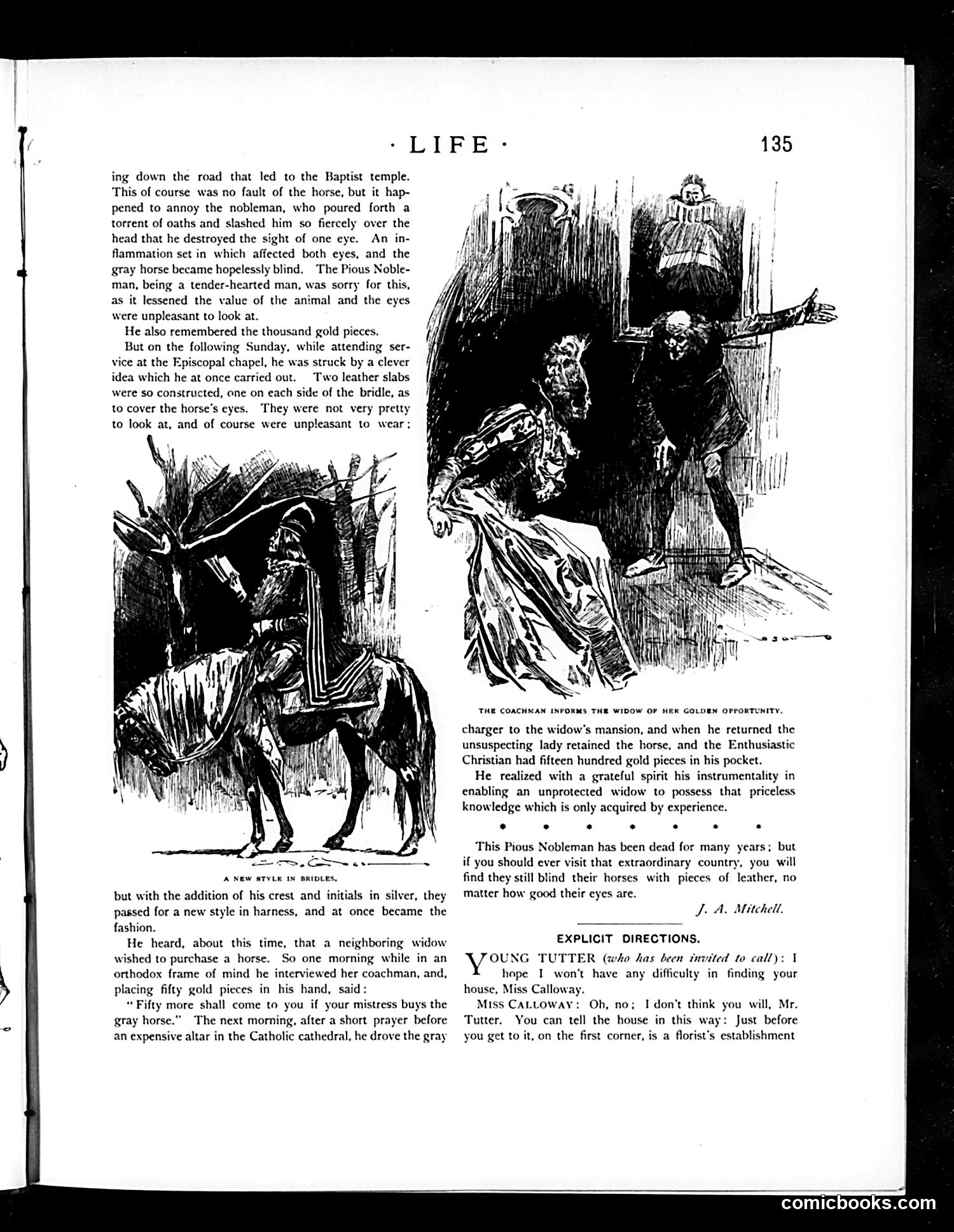
This page contains a satirical story titled "A New Style in Bridles" accompanying two illustrations. The narrative mocks a wealthy nobleman who blindfolds his horse with leather slabs to hide its scarred eyes after a servant's violent attack. The satirical point appears to be **social hypocrisy**: the nobleman can afford expensive repairs (gold pieces, silver crest) but chooses instead to merely conceal the animal's injuries rather than genuinely remedy them. The cartoon critiques upper-class vanity and superficiality—prioritizing appearance over substance or genuine care. The accompanying illustration labeled "The Coachman Informs the Widow of Her Golden Opportunity" continues this theme of deception and material self-interest among the wealthy. The final section "Explicit Directions" shifts to a humorous vignette about finding an address, typical of Life's miscellaneous satirical content.
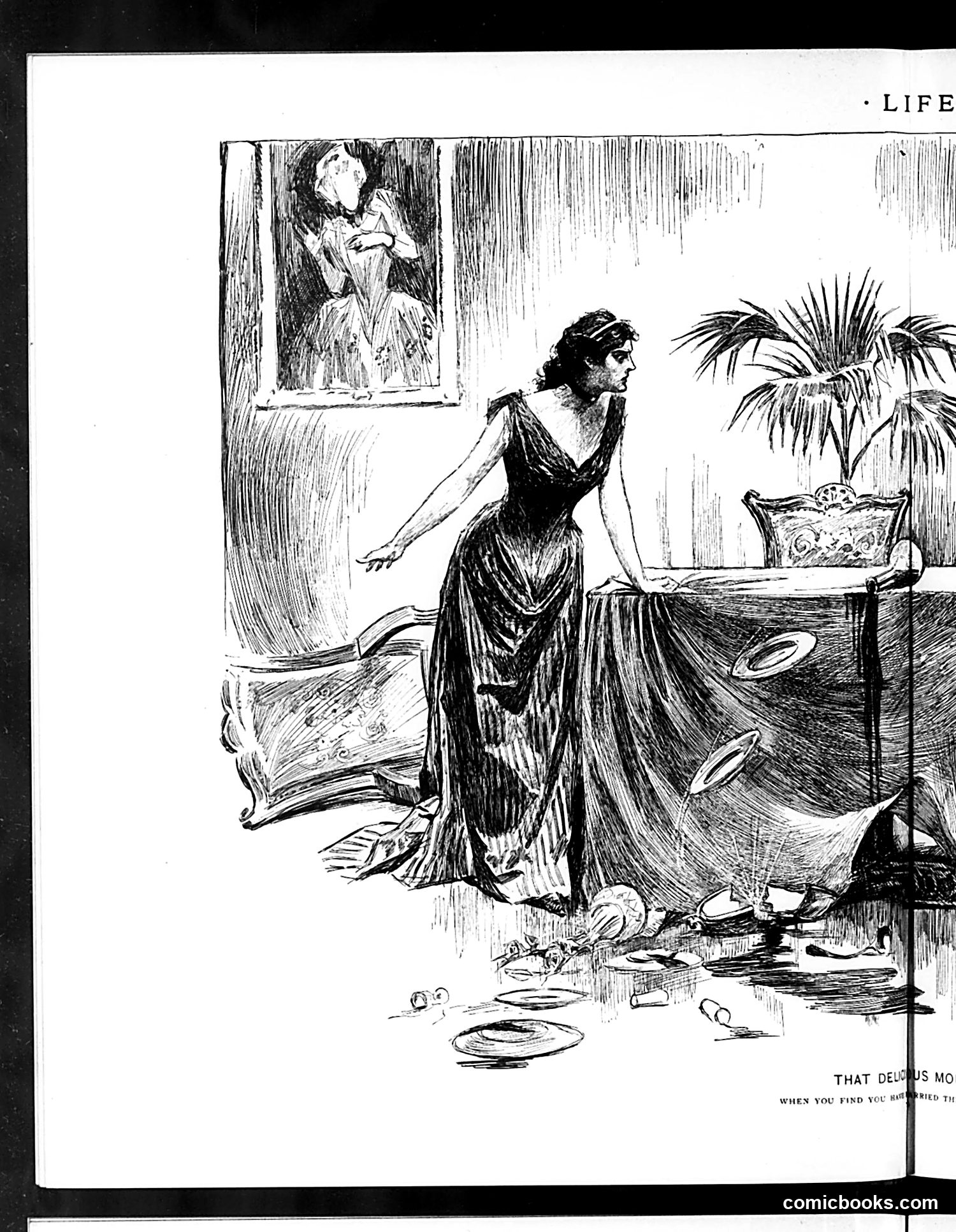
This appears to be an illustration from *Life* magazine depicting a domestic scene. A woman in an elegant, draped dress stands in what looks like a bedroom or dressing room, gesturing expressively. Behind her is a portrait on the wall showing another woman's face. The room contains period furniture including a decorative chair and potted plant, with various items scattered on the floor. The partially visible caption at bottom reads "THAT DELUS[ION] MO[...]" and mentions "WHEN YOU FIND YOU HA[VE] MARRIED TH[E]..." Without the complete text, the precise satirical point remains unclear, though it likely comments on marital disappointment or disillusionment—a common theme in early 20th-century satirical magazines. The contrast between the woman's composed appearance and the scattered surroundings may underscore the joke.
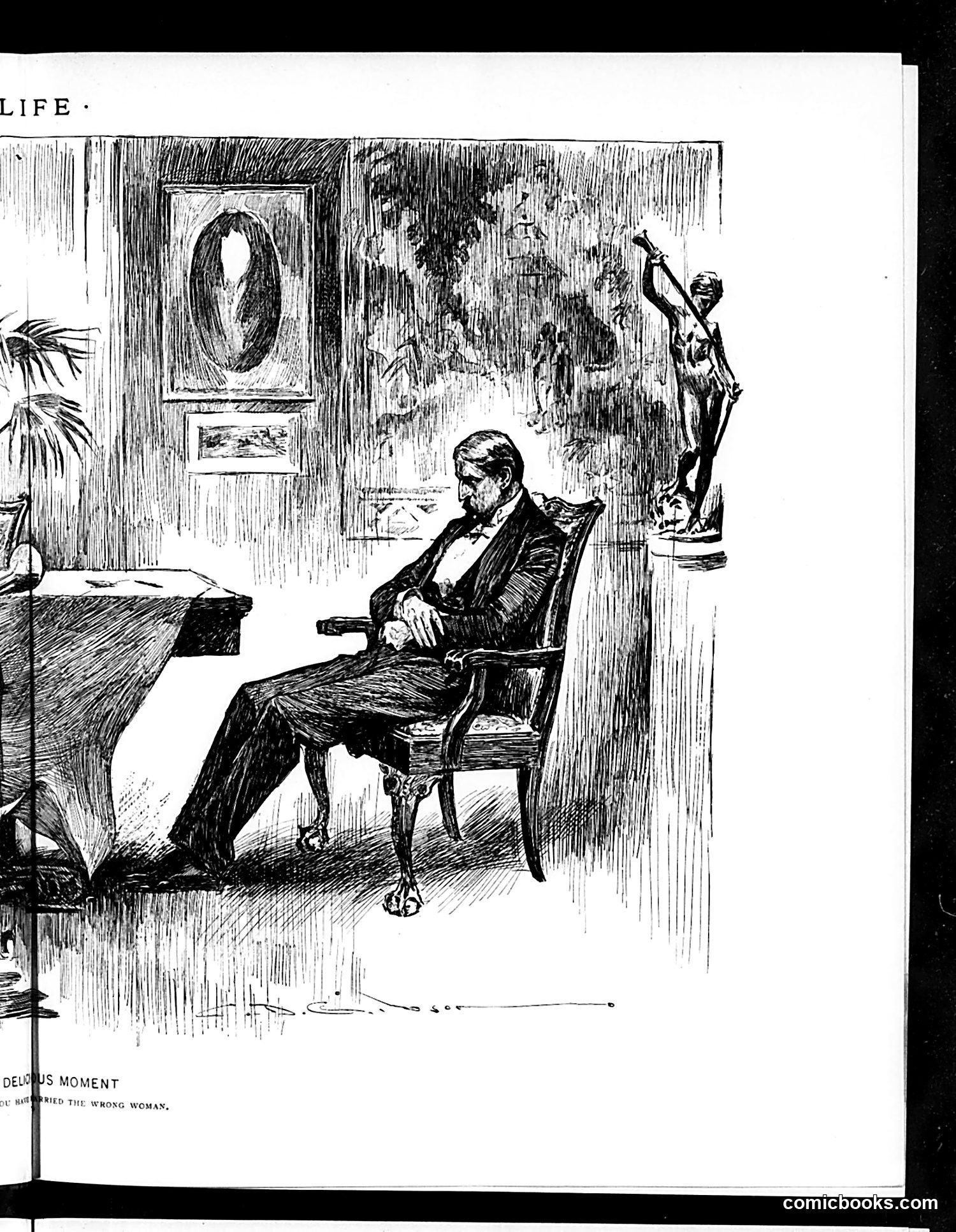
This sketch depicts a well-dressed man seated in an elegant interior, appearing contemplative or troubled. The caption reads "He had married the wrong woman," suggesting domestic regret or marital discord. The satire likely comments on marriage as a binding, inescapable institution—the man is trapped in his comfortable drawing room with his mistake. The formal dress and furnishings emphasize his social respectability, yet he appears isolated and melancholic despite material comfort. This reflects turn-of-the-century satirical humor about marriage's complications, particularly the notion that even privileged men could find themselves in unhappy unions they cannot easily escape. The "delicious" irony of the title underscores the cruel humor: his predicament, while sympathetic, is presented as entertainment for readers.
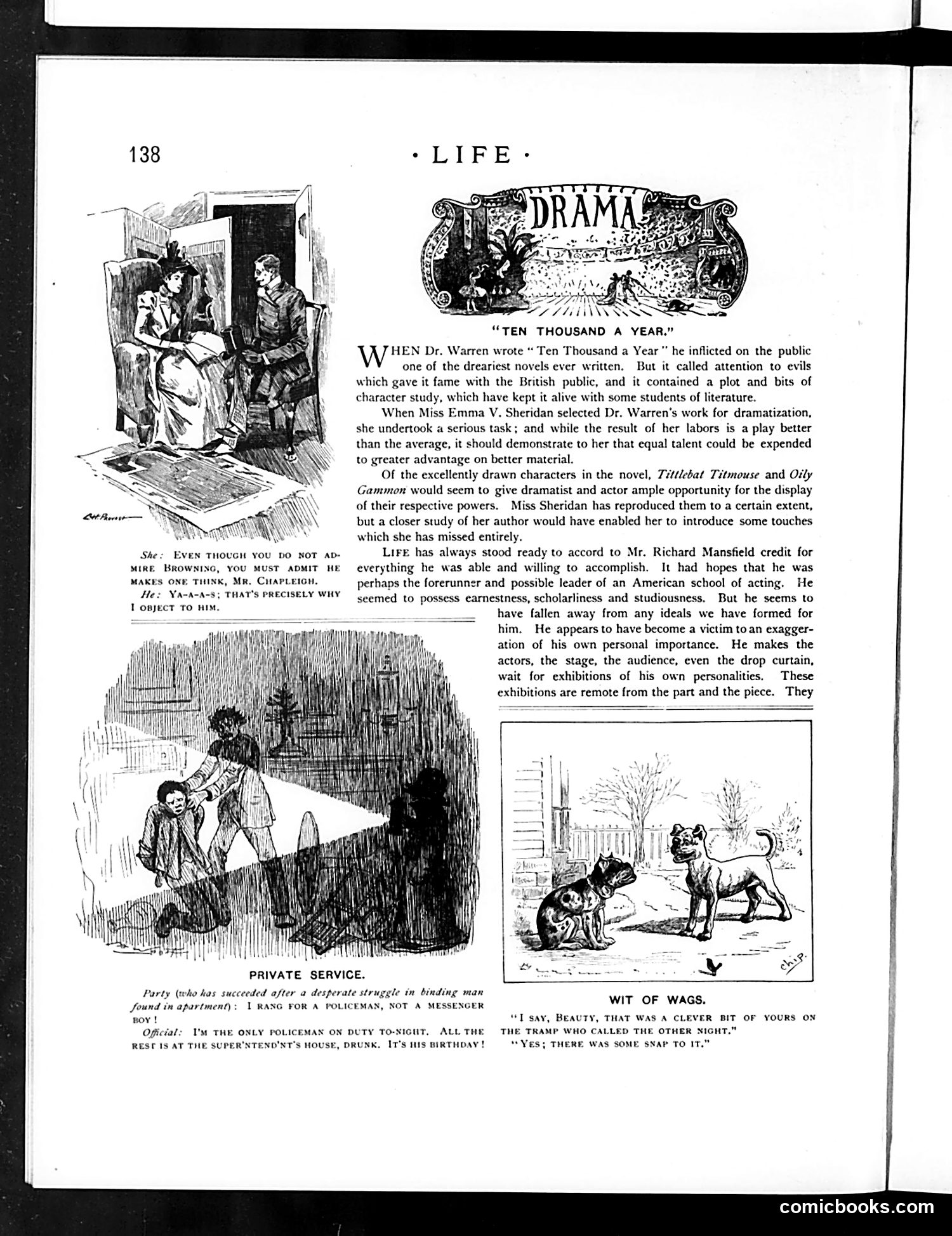
This page reviews Miss Emma V. Sheridan's stage adaptation of Dr. Warren's novel "Ten Thousand a Year." The critic praises the play as competent but argues it wastes talent on mediocre source material. Better characters existed in the original novel—particularly *Tittlebat Titmouse* and *Oily Gammon*—that could have showcased the actors' abilities more effectively. The page also criticizes actor **Richard Mansfield**, suggesting he once showed promise as a leader of American theater but has become self-absorbed, prioritizing personal showmanship over serving the play itself. He demands the entire production (actors, audience, even scenery) accommodate his ego rather than advance the dramatic work. The cartoons are unrelated satirical humor: one depicts a domestic dispute; another jokes about dogs and social etiquette.
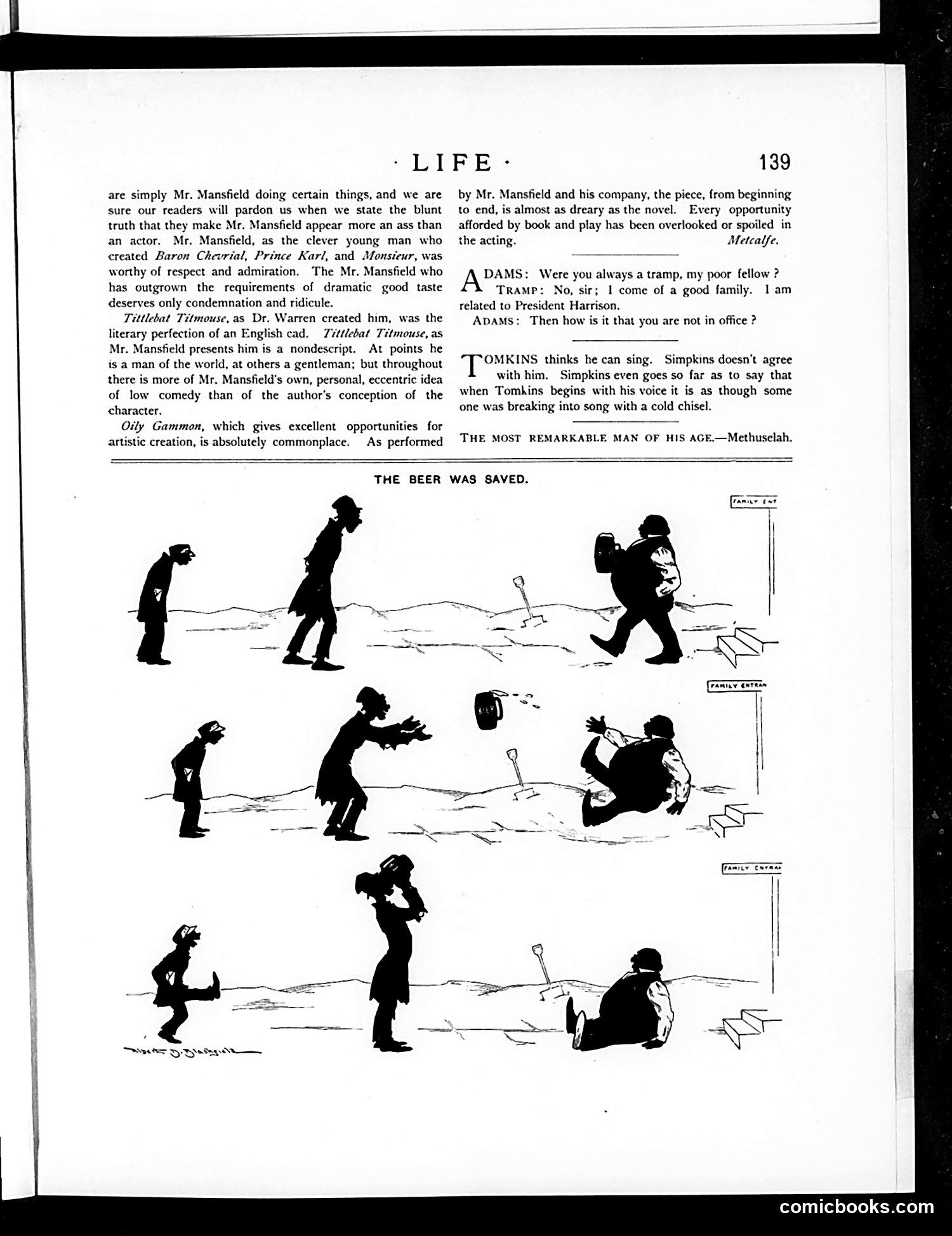
This is a slapstick comic sequence titled "The Beer Was Saved," depicting men desperately rescuing a barrel of beer from what appears to be a frozen pond or icy ground. The silhouetted figures show escalating chaos: men slipping, falling, and straining to retrieve the barrel using tools and their bodies, culminating in someone tumbling into snow while clutching the prize. The humor relies on the exaggeration of effort devoted to saving alcohol—treating beer rescue as a life-or-death mission worthy of elaborate teamwork. This likely satirizes either working-class priorities or the desperation during Prohibition (or anticipation of it). The joke's appeal depends on recognizing that viewers would find men's frantic dedication to preserving beer inherently ridiculous and comedic.
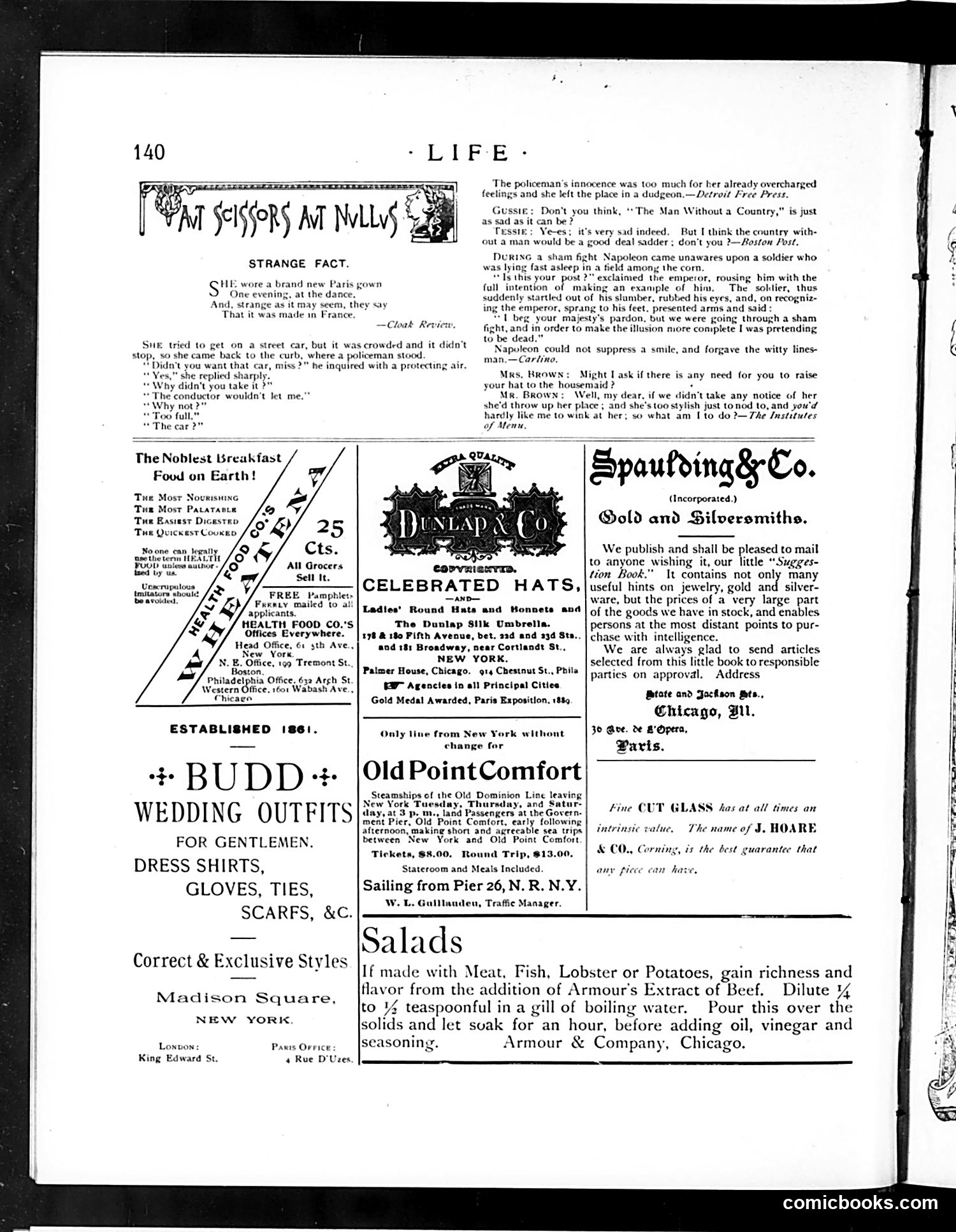
This page is primarily **advertisements and humorous anecdotes**, not political cartoons. The humor pieces include: - A woman wearing a new Paris gown to a dance, leaving angry over some slight - A discussion comparing sad situations ("The Man Without a Country" vs. losing a man) - A street-car scene where a woman demands entry but the conductor won't let her board - A Napoleon anecdote where a sleeping soldier excuses himself by claiming they're conducting a "sham fight" - A domestic exchange about whether a husband must tip his hat to the housemaid These are gentle, observational jokes about **social etiquette, gender relations, and everyday frustrations** of the period—typical of Life's satirical but not overtly political humor style. The rest consists of **period advertisements**: breakfast cereal, wedding outfits, hats, steamship travel, jewelry, and salad condiments. This reflects Life's business model as a commercial magazine mixing editorial content with paid ads.