
Life, 1892-03-03 · page 4 of 14
Life — March 3, 1892 — page 4: what you’re looking at
What you’re looking at
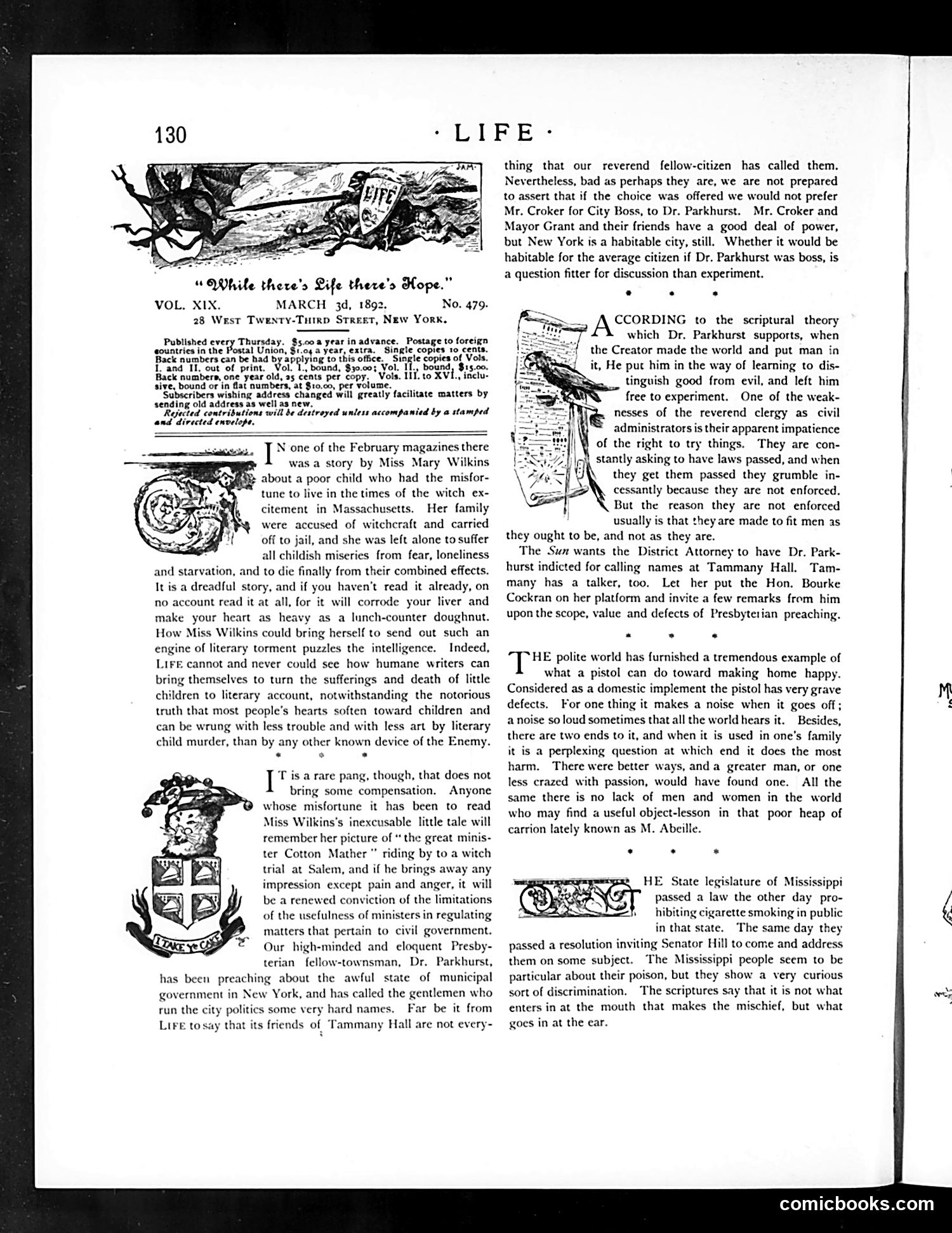
This page contains satirical commentary rather than a single cartoon. The main targets are: 1. **Dr. Parkhurst's municipal reform campaign** - The text criticizes his moral crusade against New York City corruption, suggesting his prescriptive approach is impractical for average citizens. 2. **The Mary Wilkins story reference** - Discussing a literary tale about a poor child accused of witchcraft, the writer uses it to critique how literature sensationalizes suffering, particularly child suffering, as entertainment. 3. **Mississippi's cigarette legislation** - Mocking the state legislature for prohibiting cigarette smoking publicly while inviting Senator Hill to address them—highlighting the hypocrisy of selective moral enforcement. The page's cartoons (visible but small) appear to illustrate these critiques of selective moral outrage and governmental inconsistency.
📄 Transcribed text from this page (OCR, searchable)
Machine-transcribed from the original scan — historical spelling and the odd misread are preserved.
* LIFE : “OWMhile there's Life there's Hope.” VOL. XIX. MARCH 34d, 1892. No. 479. 28 West Twenty-Tuirp Street, New York. Published every Thursday. $3.00 year in advance. Postage to foreign ‘ountries in the Postal Union, $1.04 a year, extra. Single copies to cents, Back numbers can be had by applying to this office. Single copies of Vols. 4 Th, bound, $13.00. a3 Uf. to XVI. inclu: I, and II, out of print. Vol. 1., bound, $30.00; Vo Back numbers, one year old, a5 cents per copy. Vol sive, bound or in flat numbers, at $10.00, per volume. Subscribers wishing address changed will greatly facilitate matters by sending old address as well as new. Rejected contributions will be destroyed untess accompanied by a stamped and directed envelope, I N one of the February magazines there was a story by Miss Mary Wilkins about a poor child who had the misfor- tune to live in the times of the witch ex- citement in Massachusetts. Her family were accused of witchcraft and carried off to jail, and she was left alone to suffer all childish miseries from fear, loneliness and starvation, and to die finally from their combined effects. It is a dreadful story, and if you haven't read it already, on no account read it at all, for it will corrode your liver and make your heart as heavy as a lunch-counter doughnut. How Miss Wilkins could bring herself to send out such an engine of literary torment puzzles the intelligence. Indeed, LiFe cannot and never could see how humane writers can bring themselves to turn the sufferings and death of little children to literary account, notwithstanding the notorious truth that most people's hearts soften toward children and can be wrung with less trouble and with less art by literary child murder, than by any other known device of the Enemy. T is a rare pang, though, that does not bring some compensation. Anyone whose misfortune it has been to read Miss Wilkins's inexcusable little tale will remember her picture of “ the great minis- ter Cotton Mather " riding by to a witch trial at Salem, and if he brings away any impression except pain and anger, it will be a renewed conviction of the limitations of the usefulness of ministers in regulating matters that pertain to civil government. Our high-minded and eloquent Presby- terian fellow-townsman, Dr. Parkhurst, has been preaching about the awful state of municipal government in New York, and has called the gentlemen who some very hard names. Far be it from all are not every- thing that our reverend fellow-citizen has called them. Nevertheless, bad as perhaps they are, we are not prepared to assert that if the choice was offered we would not prefer Mr. Croker for City Boss, to Dr. Parkhurst. Mr. Croker and Mayor Grant and their friends have a good deal of power, but New York is a habitable city, still. Whether it would be habitable for the average citizen if Dr. Parkhurst was boss, is a question fitter for discussion than experiment. . . . CCORDING to the scriptural theory which Dr, Parkhurst supports, when 4 the Creator made the world and put man in it, He put him in the way of learning to di ES tinguish good from evil, and left him free to experiment. One of the weak- nesses of the reverend clergy as civil administrators is their apparent impatience of the right to try things. They are con- stantly asking to have laws passed, and when they get them passed they grumble in- cessantly because they are not enforced. But the reason they are not enforced usually is that they are made to fit men as they ought to be, and not as they are. The Sun wants the District Attorney to have Dr. Park- hurst indicted for calling names at Tammany Hall. Tam- many has a talker, too. Let her put the Hon. Bourke Cockran on her platform and invite a few remarks from him upon the scope, value and defects of Presbyterian preaching. . . . HE polite world has furnished a tremendous example of what a pistol can do toward making home happy. Considered as a domestic implement the pistol has very grave defects. For one thing it makes a noise when it goes off; anoise so loud sometimes that all the world hears it. Besides, there are two ends to it, and when it is used in one’s family it is a perplexing question at which end it does the most harm. There were better ways, and a greater man, or one less crazed with passion, would have found one. All the same there is no lack of men and women in the world who may find a useful object-lesson in that poor heap of carrion lately known as M. Abcille. . . HE State legislature of Mississippi passed a law the other day pro- hibiting cigarette smoking in public in that state, The same day they passed a resolution inviting Senator Hill to come and address them on some subject. The Mississippi people seem to be particular about their poison, but they show a very curious sort of discrimination. The scriptures say that it is not what enters in at the mouth that makes the mischief, but what goes in at the ear. comicbooks.com