
Life, 1892-03-03 · page 6 of 14
Life — March 3, 1892 — page 6: what you’re looking at
What you’re looking at
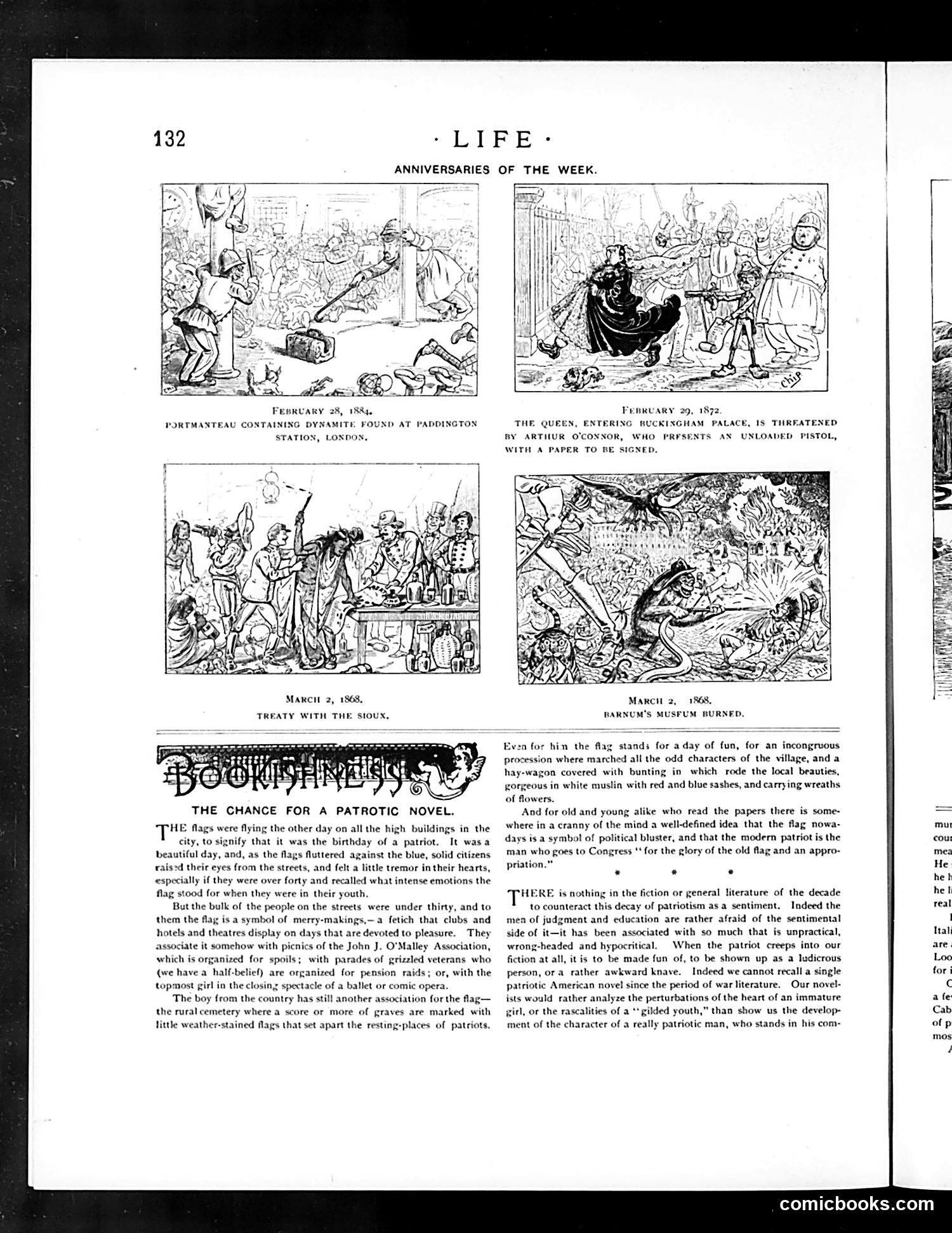
This page presents historical "Anniversaries of the Week" with four satirical engravings commemorating events from prior years: 1. **February 28, 1884**: A "Portmanteau containing dynamite" discovered at Paddington Station—likely referencing Irish nationalist bomb threats during this era. 2. **February 29, 1872**: Queen Victoria threatened at Buckingham Palace by Arthur O'Connor presenting an unloaded pistol—a real assassination attempt. 3. **March 2, 1868**: "Treaty with the Sioux"—depicting U.S. government relations with Native Americans. 4. **March 2, 1868**: "Barnum's Museum burned"—P.T. Barnum's famous New York attraction destroyed by fire. The article below discusses creating patriotic American novels, dismissing contemporary "gilded youth" fiction as insufficiently morally serious compared to genuinely patriotic literature.
📄 Transcribed text from this page (OCR, searchable)
Machine-transcribed from the original scan — historical spelling and the odd misread are preserved.
» LIFE - ANNIVERSARIES OF THE WEEK. Feercary PORTMANTEAU CONTAINING DYNAMITE FOUND AT PADDINGTON STATION, LONDON, MaRcit 2, 1868, TREATY WITH THE Stoux, THE CHANCE FOR A PATROTIC NOVEL. HE flags were flying the other day on all the high buildings in the city, to signify that it was the birthday of a patriot. It was a beautiful day, and, as the flags fluttered against the blue, solid citizens raised their eyes from the streets, and felt a little tremor in their hearts, especially if they were over forty and recalled what intense emotions the flag stood for when they were in their youth. But the bulk of the people on the streets. were under thirty, and to them the flag is a symbol of merry-makings,—a fetich that clubs and hotels and theatres display on days that are devoted to pleasure. They associate it somehow with picnics of the John J. O'Malley Association, which is organized for spoils; with parades of grizzled veterans who (we have a half-belief) are organized for pension raids; or, with the topmost girl in the closing spectacle of a ballet or comic opera. The boy from the country has still another association for the flag— the rural cemetery where a score or more of graves are marked with little weather-stained flags that set apart the resting-places of patriots. Frarvary 29, 1872 THE QUEEN, ENTERING BUCKINGHAM PALACE, 1S THREATENED BY ARTHUR O'CONNOR, WHO PRFSENTS AN UNLOADED PISTOL, WITH A PAPER TO BE SIGNED. Marci 2, 1868, RARNUM'S MUSFUM BURNED, Eva for hin the flag stands for a day of fun, for an incongruous procession where marched all the odd characters of the village, and a hay-wagon covered with bunting in which rode the local beauties, gorgeous in white muslin with red and blue sashes, and carrying wreaths of flowers. And for old and young alike who read the papers there is some- where in a cranny of the mind a well-defined idea that the flag nowa- days is a symbol of political bluster, and that the modern patriot is the man who goes to Congress for the glory of the old flag and an appro- priation, . . . HERE is nothing in the fiction or general literature of the decade to counteract this decay of patriotism asa sentiment. Indeed the men of judgment and education are rather afraid of the sentimental side of it—it has been associated with so much that is unpractical, wrong-headed and hypocritical. When the patriot creeps into our fiction at all, it is to be made fun of, to be shown up as a ludicrous person, or a rather awkward knave. Indeed we cannot recall a single patriotic American novel since the period of war literature. Our novel- ists would rather analyze the perturbations of the heart of an immature girl, or the rascalities of a ‘*gilded youth,” than show us the develop- ment of the character of a really patriotic man, who stands in his com- comicbooks.com