
Life, 1892-03-03 · page 7 of 14
Life — March 3, 1892 — page 7: what you’re looking at
What you’re looking at
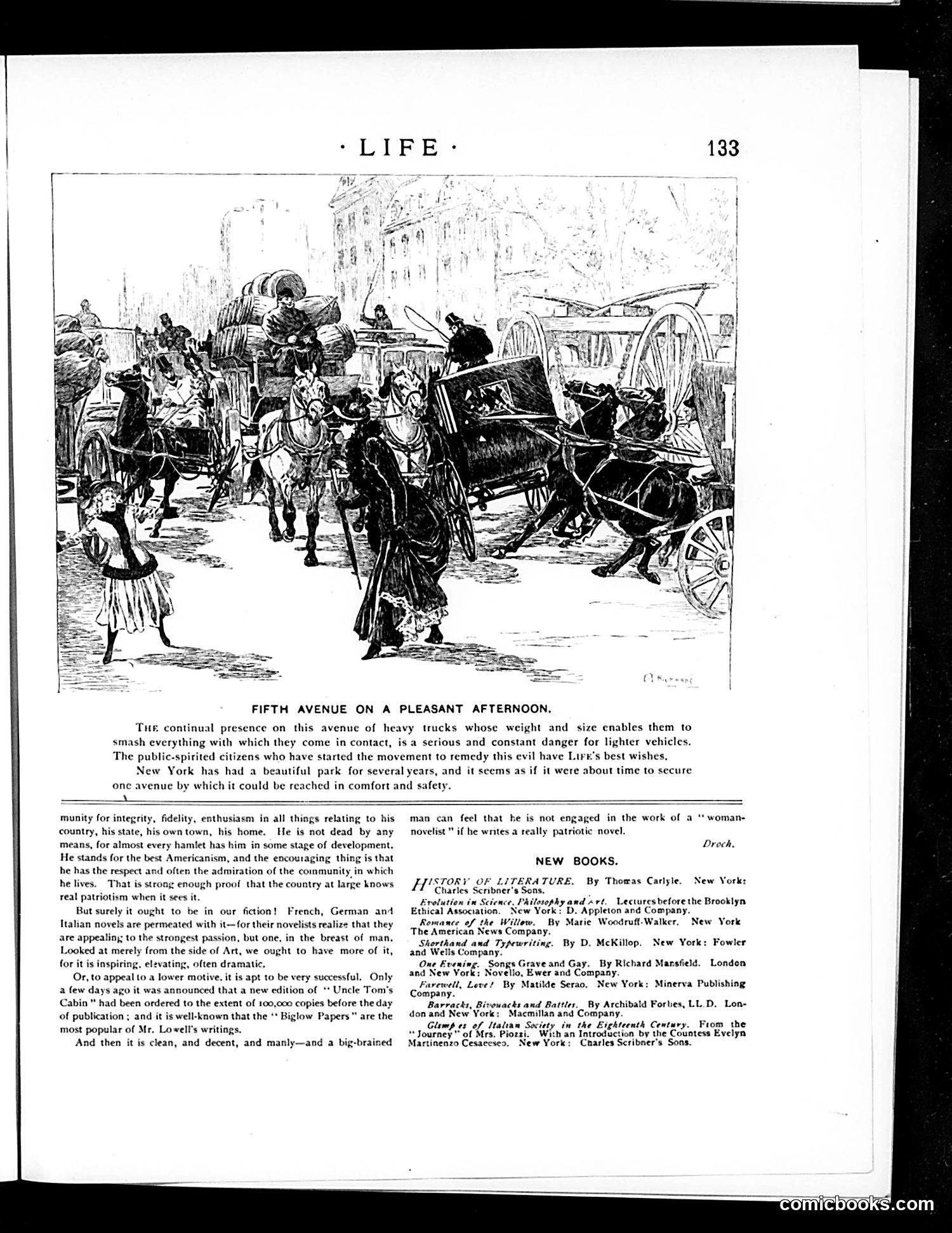
This illustration depicts a chaotic street scene on Fifth Avenue in New York City, showing heavy trucks amid lighter vehicles and pedestrians. The accompanying text criticizes the "continual presence" of large trucks whose "weight and size" create "serious and constant danger for lighter vehicles." The satire targets a public safety crisis: heavy commercial trucks shared Fifth Avenue with carriages and pedestrians, causing accidents and congestion. Citizens had launched a movement to remedy this problem. The text notes that New York had discussed creating a beautiful park for "several years" and suggests securing "one avenue by which it could be reached in comfort and safety." This reflects early 20th-century urban congestion and the tension between commercial transportation and public welfare in rapidly industrializing cities.
📄 Transcribed text from this page (OCR, searchable)
Machine-transcribed from the original scan — historical spelling and the odd misread are preserved.
FIFTH AVENUE ON A PLEASANT AFTERNOON. Tuk. continual presence on this avenue of heavy trucks whose weight and size enables them to a serious and constant danger for lighter vehicles. The public-spirited citizens who have started the movement to remedy this evil have Lire’s best wishes, New York has had a beautiful park for several years, and it scems as if it were about time to secure smash everything with which they come in contact, i one avenue by which it could be reached in comfort and safety. ‘a . munity for integrity, fidelity, enthusiasm in all things relating to his country, his state, his own town, his home. He is not dead by any means, for almost every hamlet has him in some stage of development. He stands for the best Americanism, and the encouraging thing is that he has the respect and often the admiration of the coinmunity in which That is strong enough proof that the country at large knows real patriotism when it sees it. But surely it ought to be in our fiction! French, German and Italian novels are permeated with it—for their novelists realize that they are appealing to the strongest passion, but one, in the breast of man. Looked at merely from the side of Art, we ought to have more of it, for it is inspiring, elevating, often dramatic. Or, to appeal to a lower motive. it is apt to be very successful. Only a few days ago it was announced that a new edition of * Uncle Tom's Cabin ” had been ordered to the extent of 100,000 copies before the day of publication ; and it is well-known that the ‘* Biglow Papers” are the most popular of Mr, Lowell's writings. And then it is clean, and decent, and manly—and a big-brained he lives. man can feel that he is not engaged in the work of a ‘ woman- novelist ” if he writes a really patriotic novel. Droch. NEW BOOKS. L{'STORY OF LITERATURE, By Thomas Carlyle. New Vork: Charles Scribner's Sons. Evolution in Science, Philovophy and art. Lecwuresbefore the Brooklyn Ethical Association. New York: D. Appleton and Company. Romance of the Willow. By Marie Woodruff-Walker, The American News Company. Shorthand and Typewriting. By D. McKillop. and Wells Company: One Evening. Songs Grave and Gay. By Richard Marsfield. London and New York: Novello, Ewer and Company. Farewell, Leve? By Matilde Serao, New York: Minerva Publishing Company. Barracks, Bivouacks and Battles, By Archibald Fortes, LL.D. Lon- don and New York: Macmillan and Company. Glamp ez of Malian Society in the Eighteenth Century. From the “Journey” of Mrs. Piozzi.. With an Introduction by the Couotess Evelyn Martinenzo Cesaceseo. New York: Charles Scribner's Sons. New York New York: Fowler