
A complete issue · 14 pages · 1891
Life — April 23, 1891
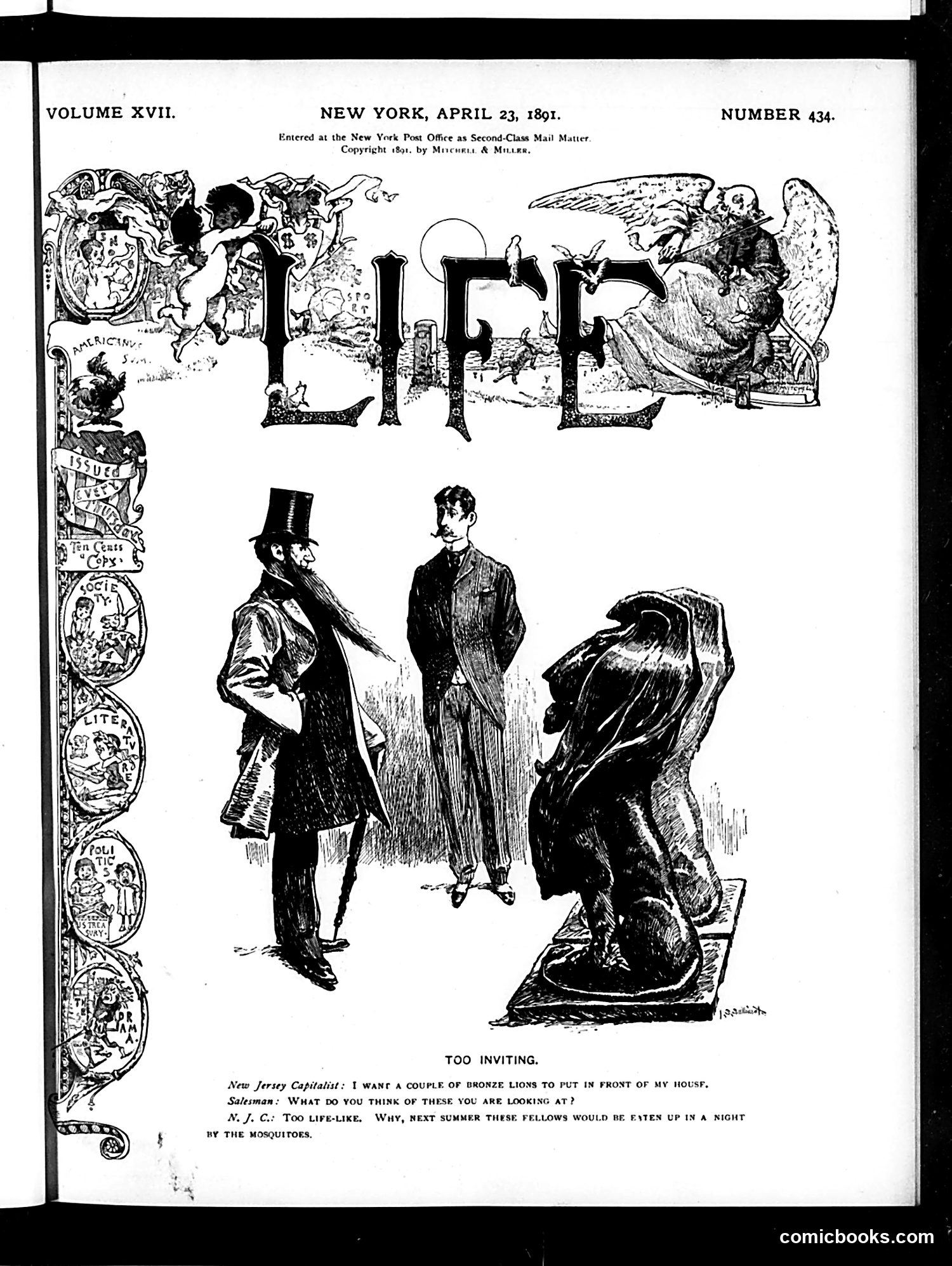
This satirical cartoon mocks a wealthy New Jersey capitalist's aesthetic taste. The "New Jersey Capitalist" wants bronze lions as house decorations—a status symbol of the era. The "Salesman" questions their appeal, while the "N.J.C." (New Jersey Capitalist) dismissively responds that they're "too life-like," worrying that mosquitoes might eat them overnight. The joke targets two things: the pretentious materialism of the nouveau-riche businessman, and the genuine plague of disease-carrying mosquitoes in New Jersey at that time. By suggesting the lions are "too lifelike" to survive local mosquitoes, the cartoon ridicules both the man's artistic sensibility and implicitly comments on the region's notorious mosquito problem.
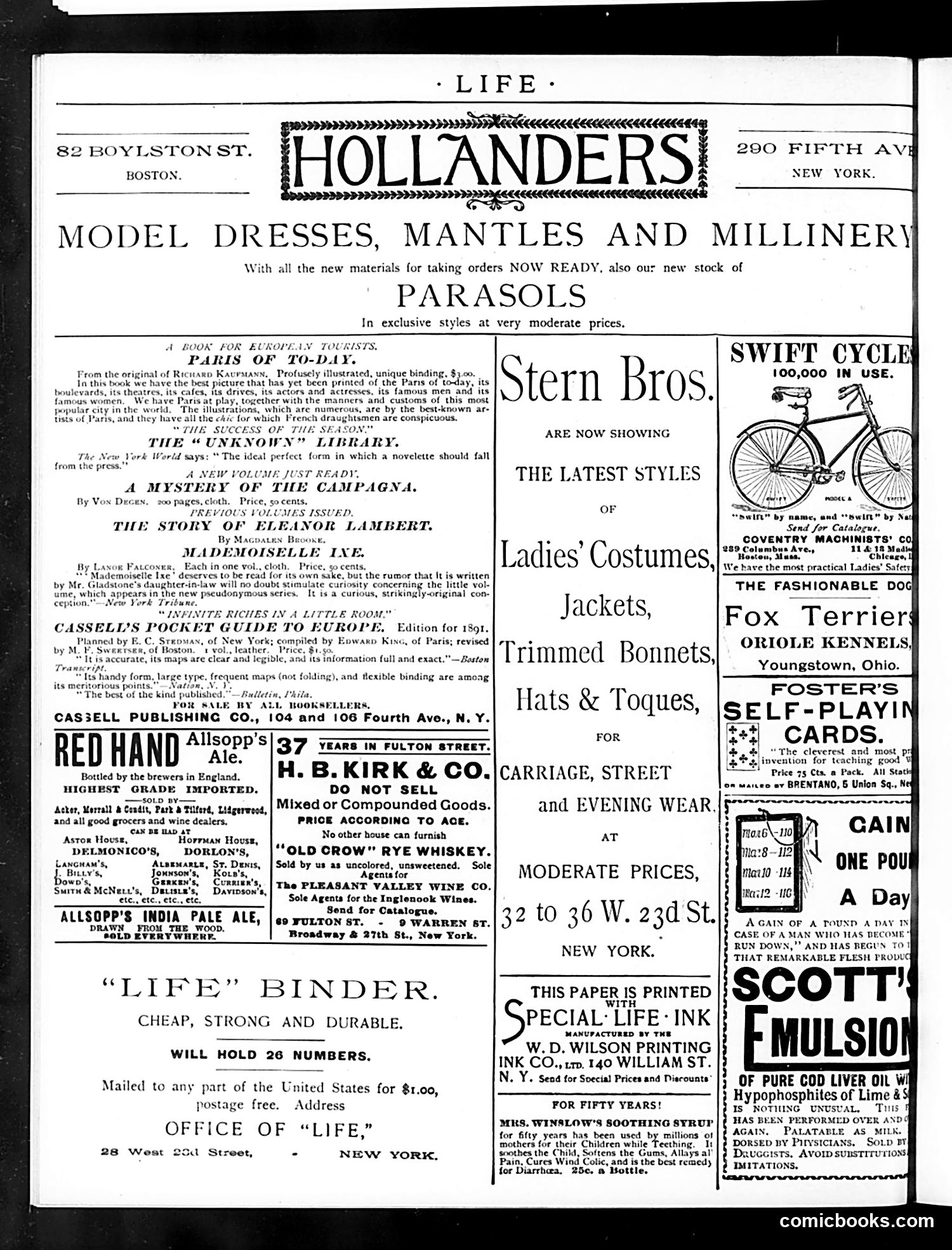
This page is primarily **advertising**, not satirical content. It's a typical late 19th-century *Life* magazine page mixing editorial and commercial notices. The advertisements include: - **Hollanders** (Boston/New York): women's fashion and parasols - **Stern Bros.**: ladies' costumes and accessories at 32-36 W. 23rd St., New York - **Swift Cycle**: bicycles (100,000 in use) - **Red Hand Ale** and **H.B. Kirk & Co.** whiskey - **Scott's Emulsion**: cod liver oil supplement - Various other products (cards, binders, soothing syrup) The only potentially satirical element is the small **Fox Terrier** dog advertisement under "The Fashionable Dog" heading, possibly poking fun at upper-class pet ownership trends. No political cartoons or social satire are clearly present on this page—it's primarily a commercial showcase typical of *Life's* mixed content model.
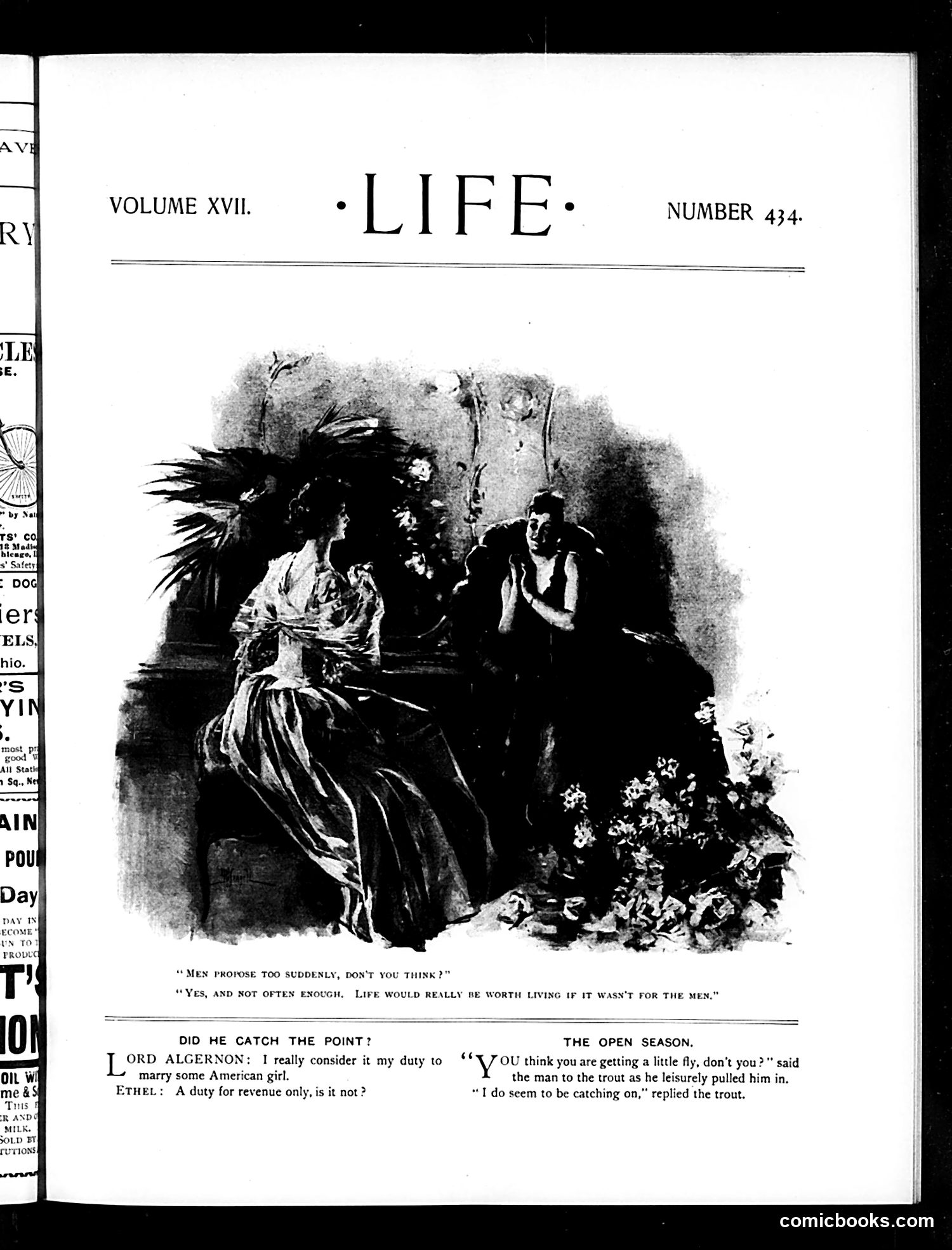
This page from *Life* magazine (Volume XVII, Number 434) contains two distinct pieces: **Main Illustration**: A dramatic sketch shows a woman with distinctive feathered headwear confronting what appears to be men in formal dress. The caption reads: "MEN PROPOSE TO SUDDENLY, DON'T YOU THINK?" with a response: "YES, AND NOT OFTEN ENOUGH. LIFE WOULD REALLY BE WORTH LIVING IF IT WAS'N'T FOR THE MEN." This satirizes gender relations and marriage proposals, suggesting women find men's behavior frustrating while paradoxically valuing their romantic attention. **Text Sections Below**: - "DID HE CATCH THE POINT?" discusses marrying American girls as a duty for revenue - "THE OPEN SEASON" presents a fishing dialogue, likely metaphorically referencing romantic "catching" and courtship The page employs satirical commentary on courtship customs and gender dynamics typical of early-20th-century *Life* magazine's social humor.
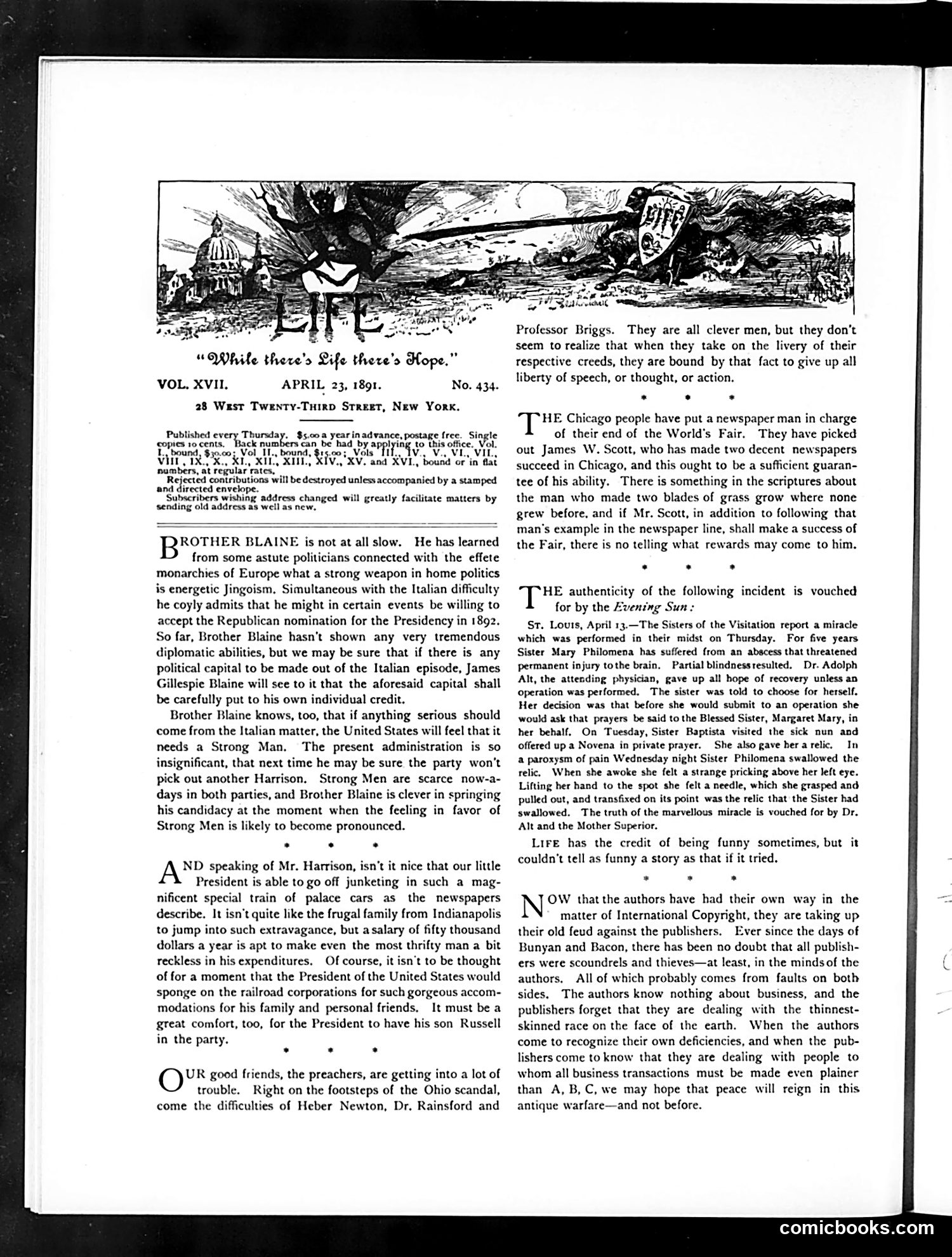
The main cartoon depicts a figure labeled "While there's Life there's Hope," showing what appears to be a skeletal or death-like figure amid architectural ruins and turmoil. This likely refers to political instability or crisis of the period. The text discusses Brother Blaine's potential candidacy for the 1892 U.S. presidency, suggesting he's maneuvering within Republican politics despite scandal. It also comments on President Harrison's extravagant spending on palace cars and railroad accommodations—a critique of his lavish use of public resources. The final section addresses conflicts between magazine authors and publishers over international copyright issues, describing publishers as "scoundrels and thieves." The overall tone is satirical commentary on political corruption, excessive presidential spending, and publishing industry disputes.
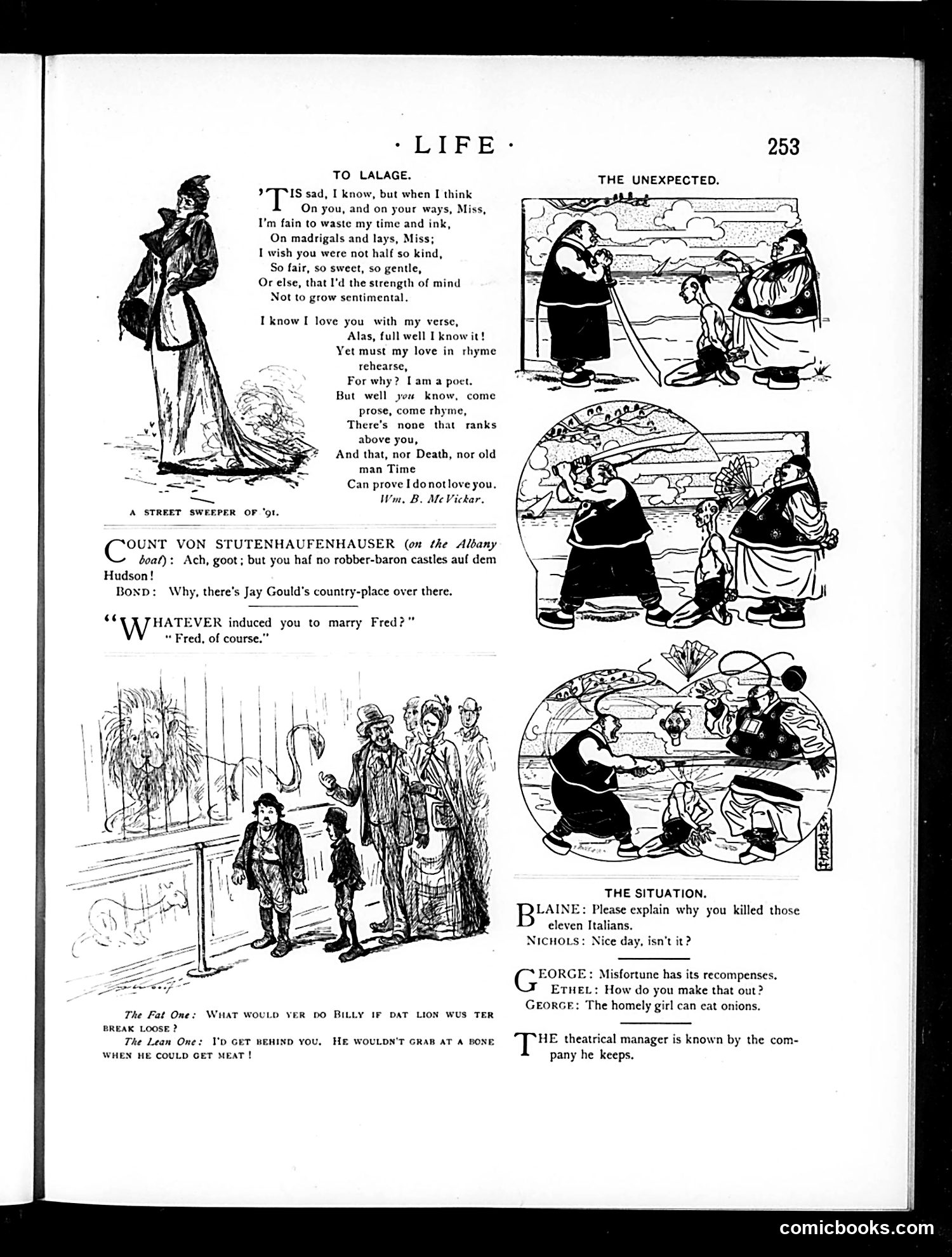
This page from *Life* magazine contains several humor pieces typical of early 20th-century American satire: **"To Lalage"** is a romantic poem mocking overly sentimental verse, with an illustration of a street sweeper of 1751—suggesting ironic contrast between the poem's flowery language and mundane reality. **Count von Stutenhaufenhauser** sketch mocks pretentious German nobility with exaggerated dialect humor ("Ach, goot"). **"Whatever induced you to marry Fred?"** presents a brief domestic joke. The remaining cartoons illustrate various humorous anecdotes about unexpected situations and comic misunderstandings, including dialogue between characters named Blaine, Nichols, George, and Ethel. The final item jokes about theatrical managers being "known by the company he keeps." The overall tone emphasizes gentle social satire and wordplay typical of *Life*'s editorial approach.
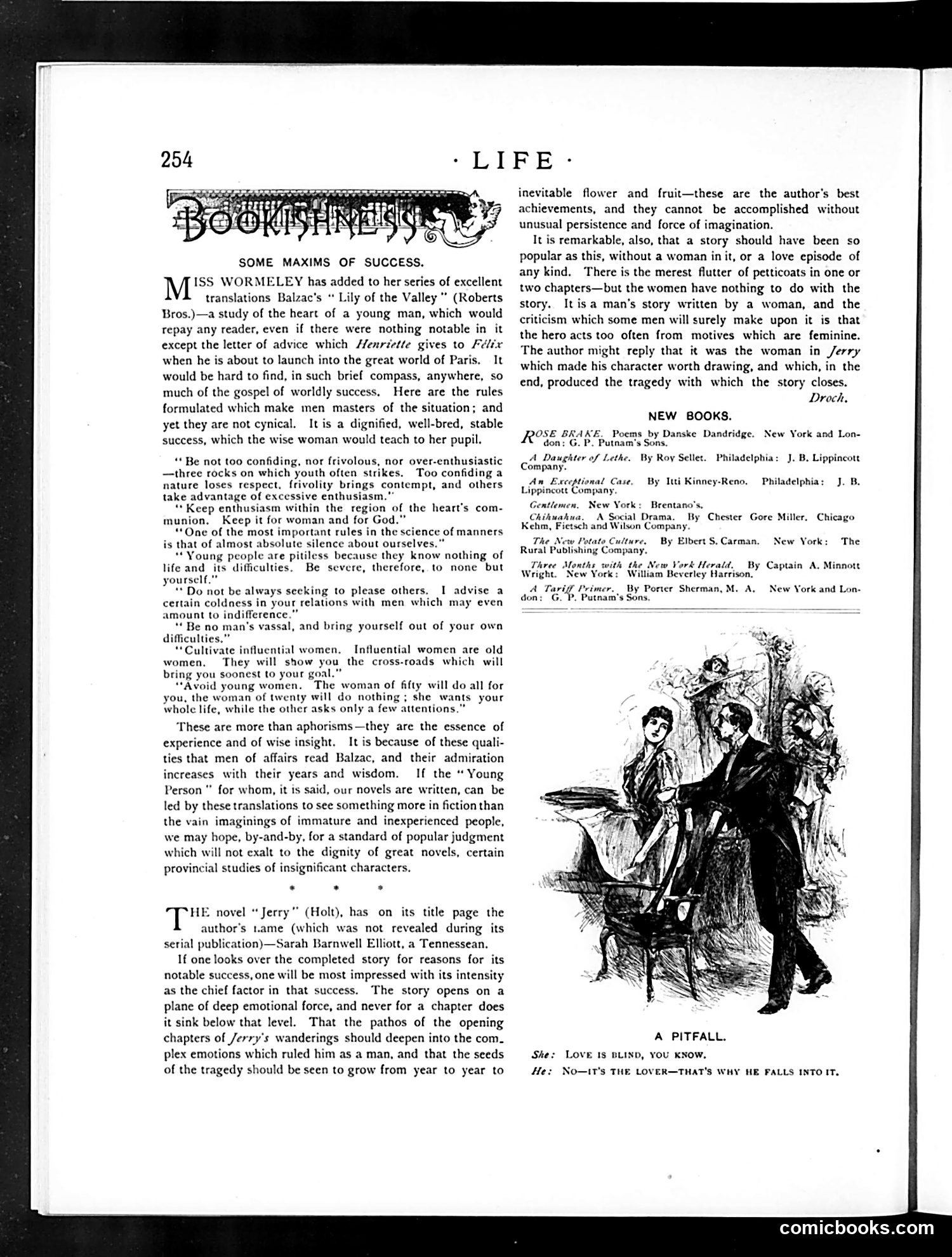
This cartoon illustrates a romantic cautionary tale with the caption: "Love is blind, you know. / He:—It's the lover—that's why he falls into it." The image shows a man tumbling or falling into a pit while a woman watches from above. The joke plays on the phrase "love is blind"—suggesting that lovers cannot see obvious dangers or problems in their romantic pursuits. The "pitfall" is literal (a physical hole) but metaphorically represents the blindness and poor judgment that romantic love causes. This reflects early-20th-century satirical commentary on courtship and marriage, presenting romantic love as something that causes men to act foolishly and ignore practical concerns. The cartoon is part of a broader literary discussion on the page about character development and human nature in fiction.
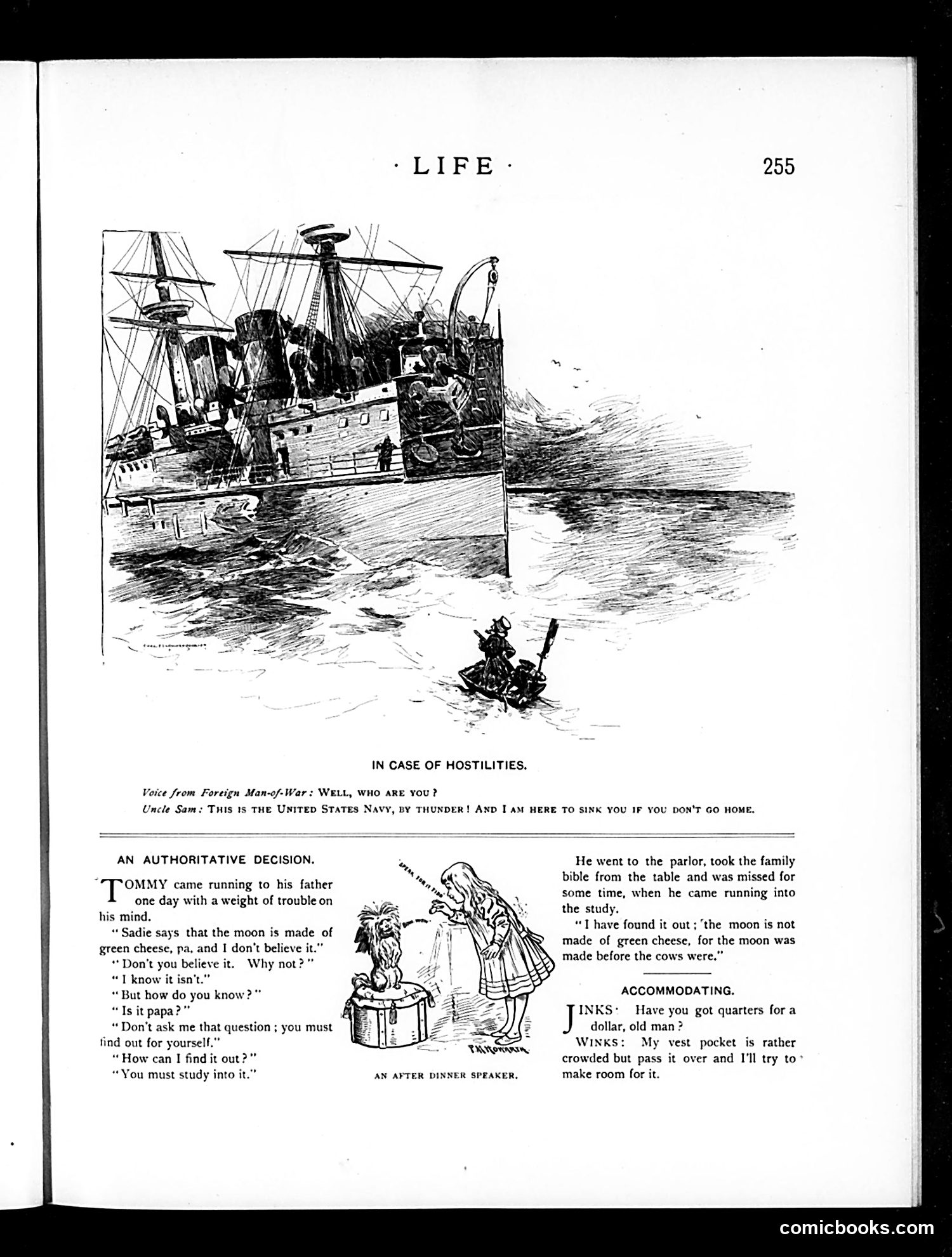
**Top Illustration - "In Case of Hostilities":** A naval warfare scene depicting a U.S. Navy warship confronting a foreign adversary. The caption presents a dramatic exchange where Uncle Sam threatens to sink an enemy vessel. This reflects early 20th-century American naval power anxieties and the nation's growing military confidence. **Lower Section - Three Humorous Sketches:** 1. "An Authoritative Decision" - A father settles a child's argument about moon composition through paternal authority rather than evidence 2. "An After Dinner Speaker" - A girl listens to an adult lecture 3. "Accommodating" - A dialogue about lodging between characters named Jinks and Winks These domestic vignettes use gentle humor about everyday situations and social interactions typical of Life's satirical approach.
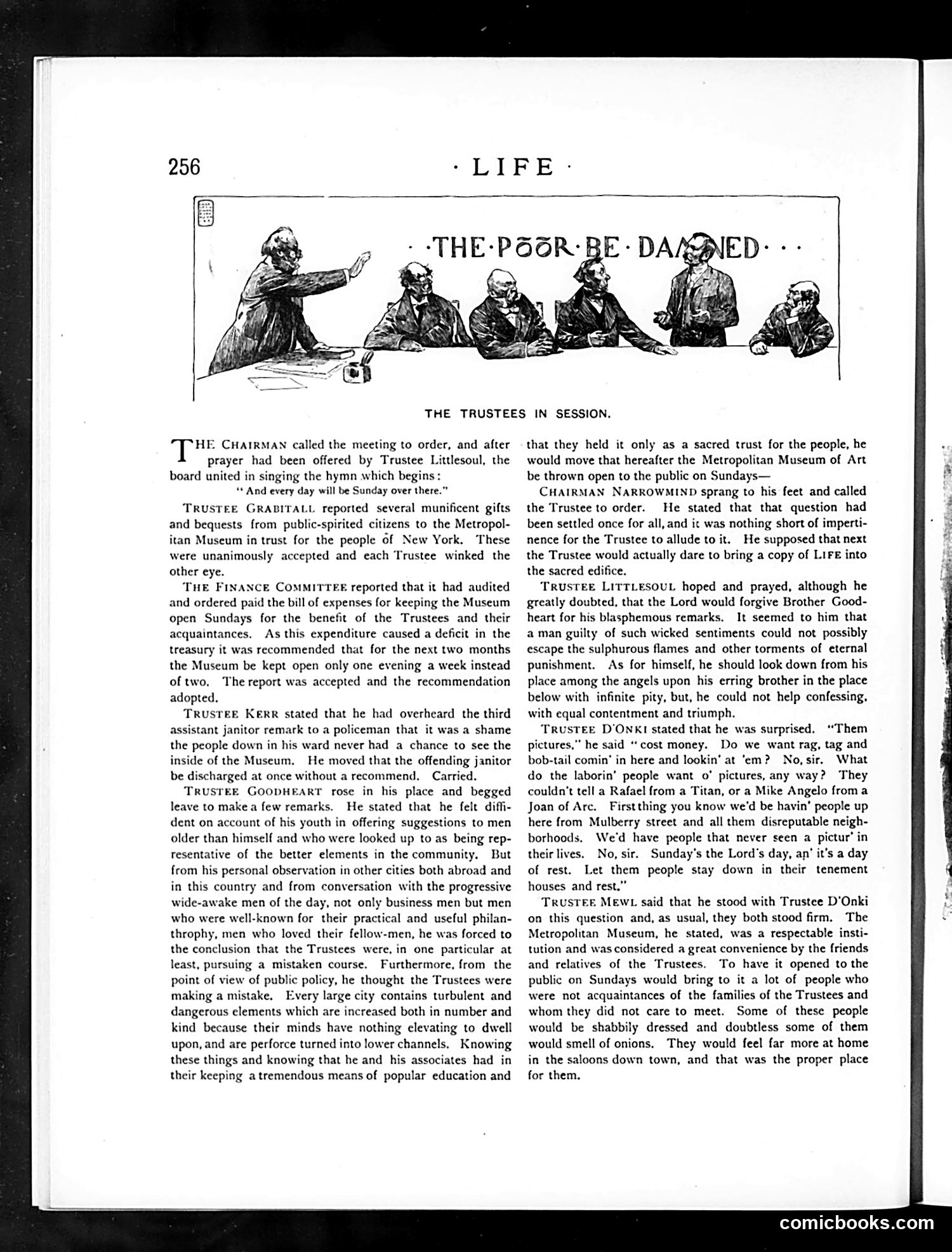
This satirical cartoon depicts a board meeting of museum trustees discussing whether to open the Metropolitan Museum of Art to the public on Sundays. The cartoon's title suggests the trustees' indifference to working-class access. The accompanying article details trustee debates, with several opposing Sunday opening. Trustee D'Onki argues that poor visitors would be unsuitably dressed, smell of onions, and belong in saloons instead. Trustee Mewl agrees, claiming such crowds would lower the institution's character. The satire targets wealthy elite gatekeeping of culture—their transparent classism and assumptions that poor people lack refinement or deserve cultural access. The cartoon visually emphasizes the trustees' self-satisfied expressions while debating whether to exclude the poor from "public" institutions funded partly by taxpayers.
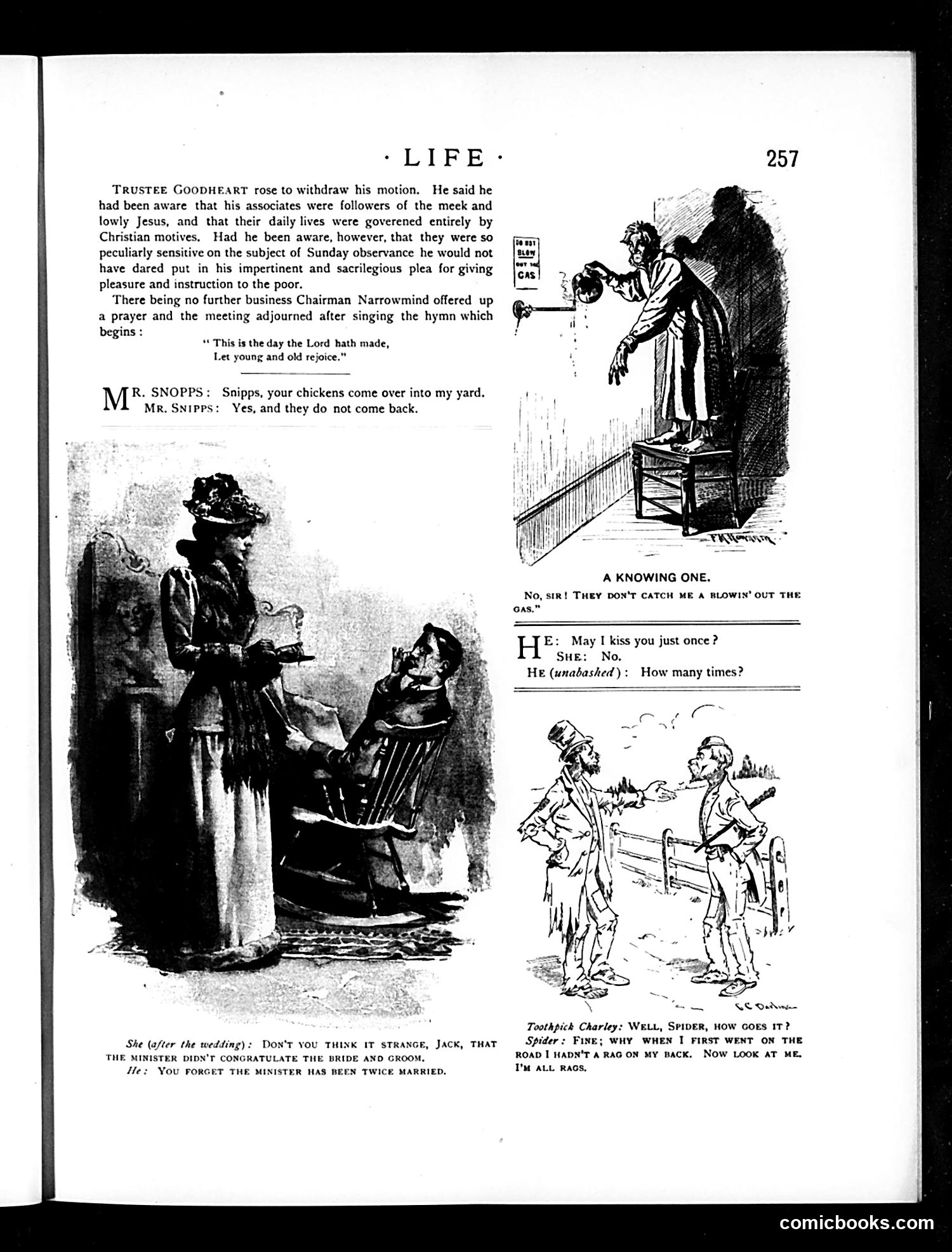
This page contains several unrelated humorous sketches typical of early Life magazine's satirical content: 1. **Top narrative**: Trustee Goodheart withdraws a motion at a meeting, citing his associates' Christian values and sensitivity regarding Sunday observance—satirizing religious hypocrisy about charitable works. 2. **"Mr. Snopps" dialogue**: A joke about chickens trespassing between neighbors' yards, playing on class differences and property disputes. 3. **"A Knowing One"**: Street-level humor about avoiding gas explosions—likely referencing gas lighting hazards common in urban areas. 4. **Marriage/kissing jokes**: Brief comedic exchanges about courtship and marriage. 5. **"Toothpick Charley/Spider"**: A ragged vagrant's boastful account of his deteriorated condition, using humor to comment on poverty or homelessness. The sketches reflect early 20th-century American urban social commentary through working-class and domestic scenarios.
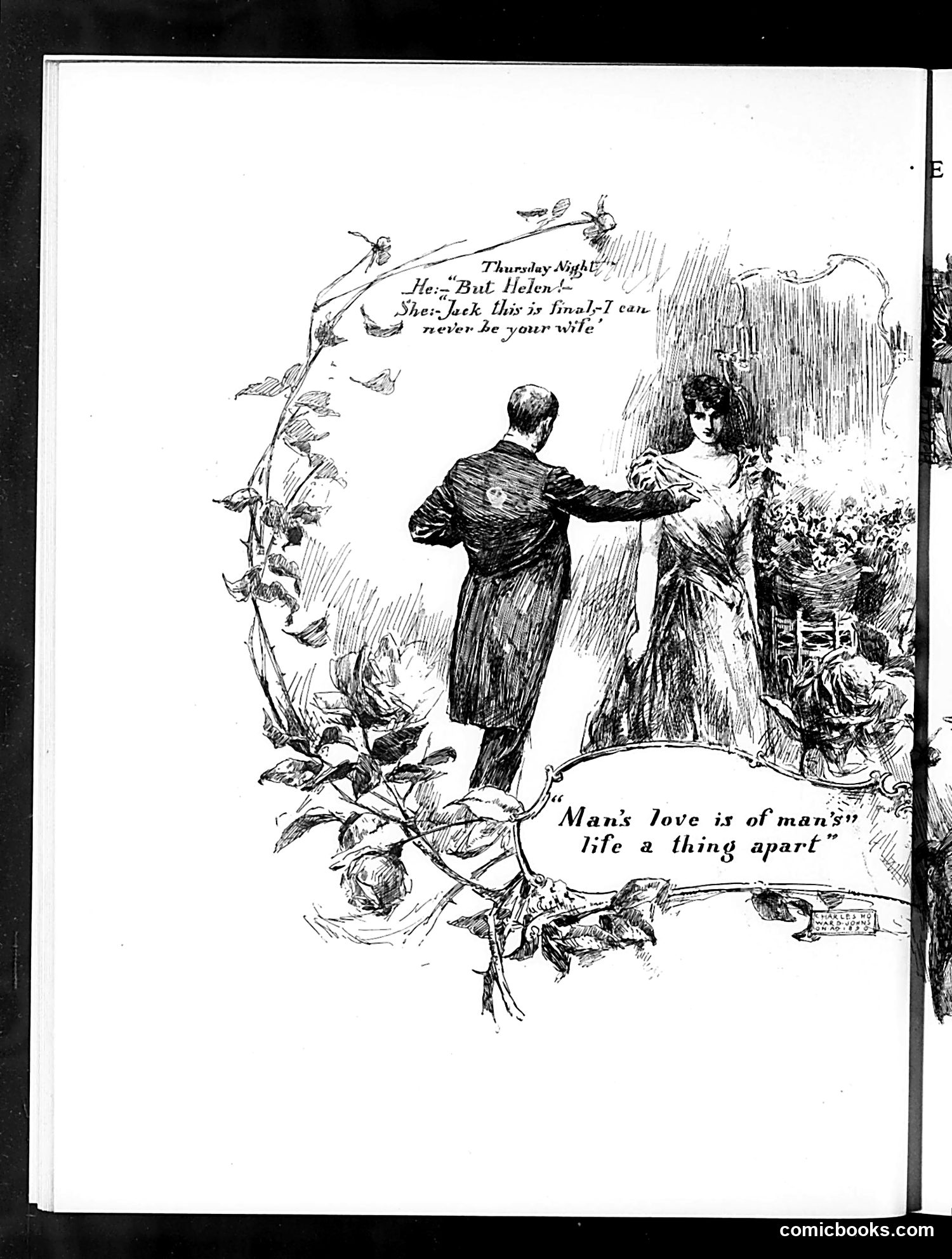
This illustration depicts a romantic scene with social commentary. The dialogue reads: "Thursday Night / He: But Helen!- / She: Jack this is final.-I can never be your wife" at the top, and "Man's love is of man's 'life a thing apart" at the bottom. The cartoon satirizes romantic relationships and marital commitment, likely mocking the melodramatic nature of romantic rejection. The quoted phrase "Man's love is of man's life a thing apart" is a literary reference (from Lord Byron), suggesting the artist is critiquing how men treat love as separate from life's serious matters, while women demand genuine commitment. The decorative floral elements frame this as a sentimental scene, while the text undercuts that sentimentality with cynical observation about gender differences in attitudes toward marriage and devotion.
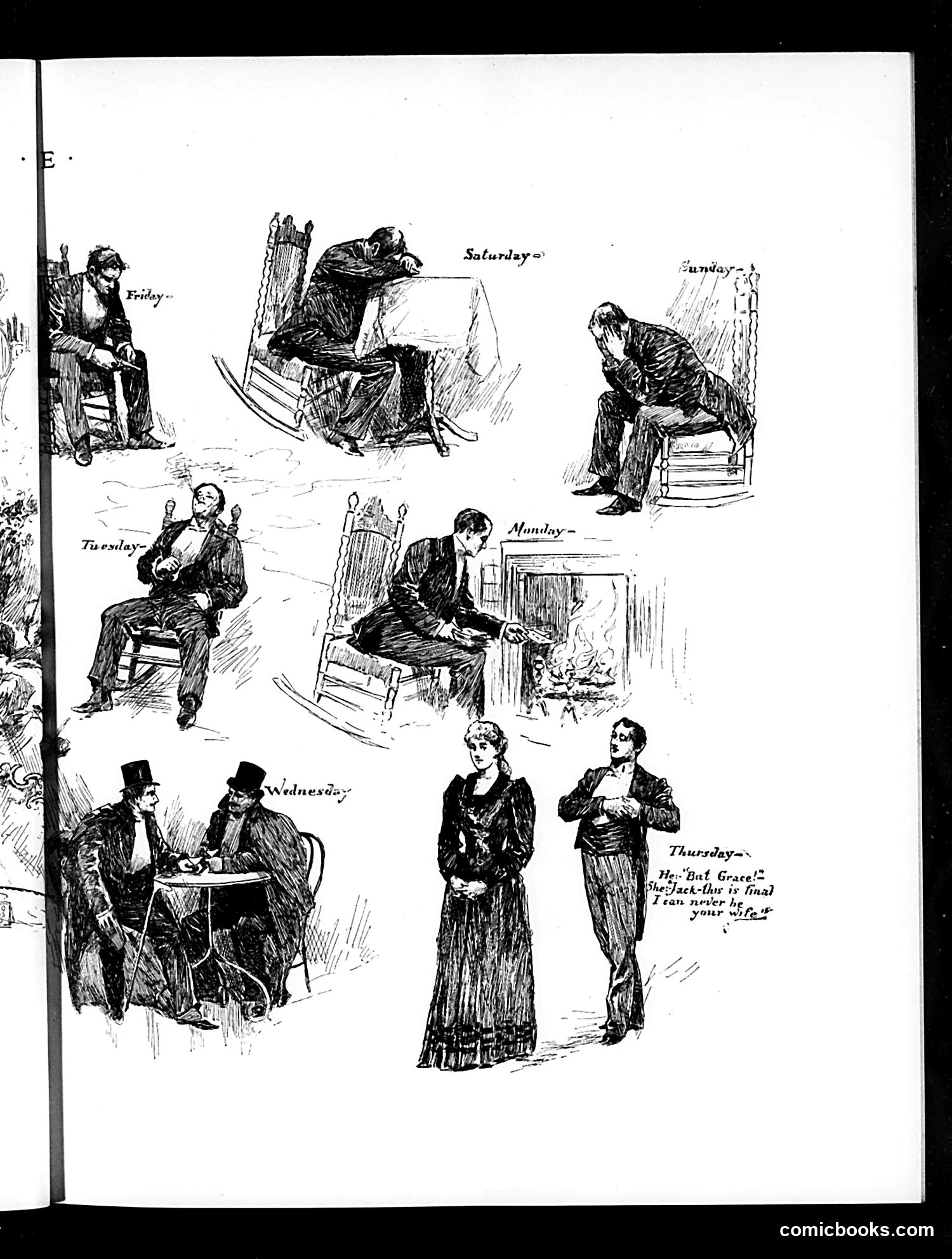
This appears to be a satirical seven-day sequence showing a gentleman's emotional states throughout the week. Each day is labeled (Friday through Thursday), depicting the same figure in different moods while seated in chairs. The progression suggests the cyclical nature of weekly melancholy or romantic disappointment—he appears progressively more dejected as the week advances. Thursday's caption reads "But Grace—She said 'Jack I hope I can never be your wife'" (partially visible), revealing this depicts romantic rejection and its emotional aftermath. The cartoons mock Victorian sentimentality and the exaggerated emotional turmoil caused by romantic disappointment. By showing the same scenario across seven days, the satire suggests how men of this era dwelt obsessively on romantic troubles, creating a comedic commentary on masculine emotional vulnerability and social propriety.
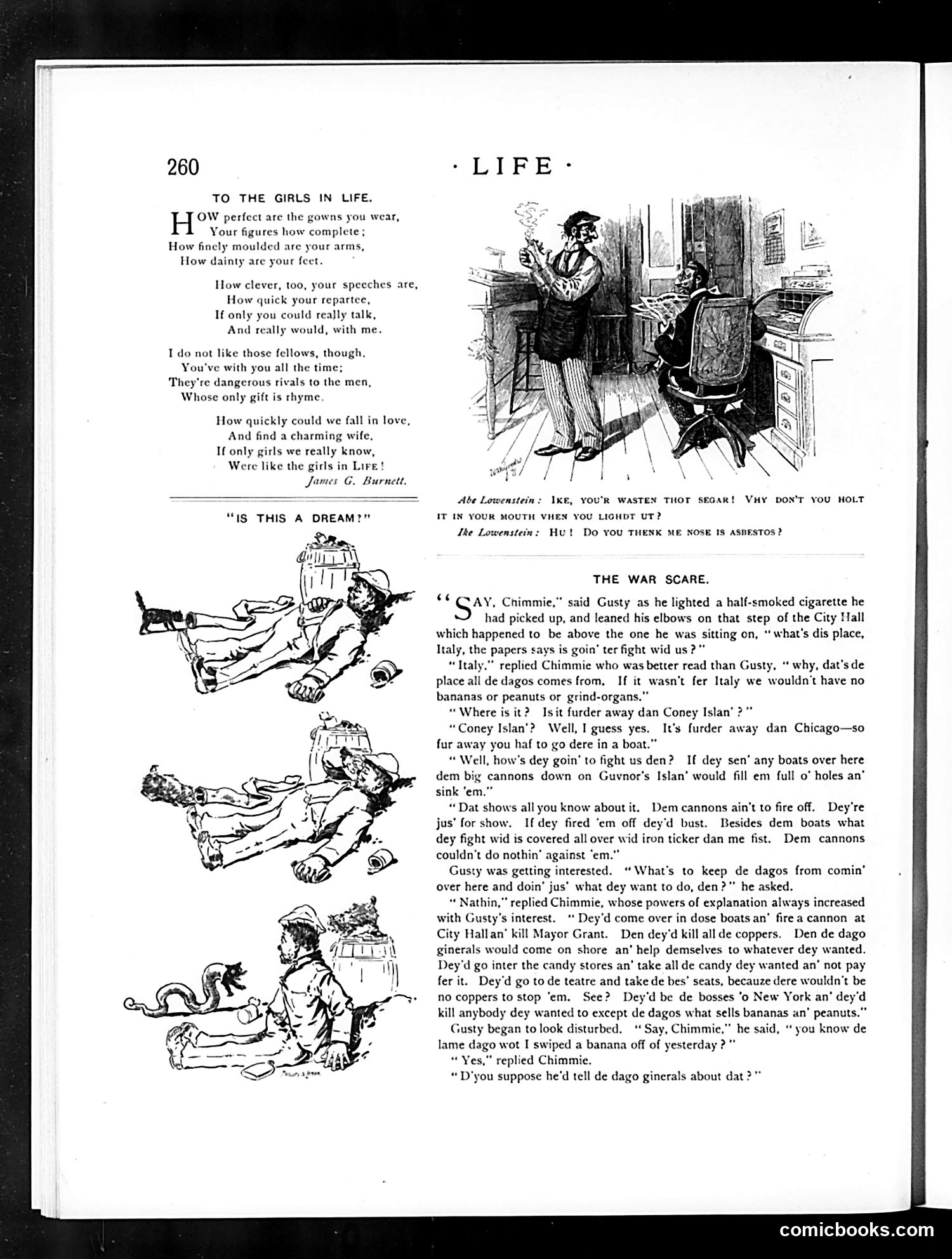
This page features a humorous dialogue between two working-class New York characters—Gusty and Chimmie—discussing potential Italian military aggression. The satire targets public anxiety about foreign threats and the characters' limited understanding of geopolitics. The joke relies on ethnic stereotyping: "dagos" (a derogatory term for Italians) are portrayed as banana and peanut vendors. Chimmie's explanation of Italian military capability is absurdly backward—he notes that Governor's Island cannons "ain't to fire off" because they'd "bust," and assumes Italian warships are merely covered with "iron ticker." The humor culminates when Gusty's only concern is whether a banana vendor he wronged might report him to Italian generals during an invasion—reducing international conflict to petty local theft. The piece reflects early 20th-century American nativism and xenophobia, treating Italian immigrants as comic subjects while expressing vague anxieties about foreign military threats.
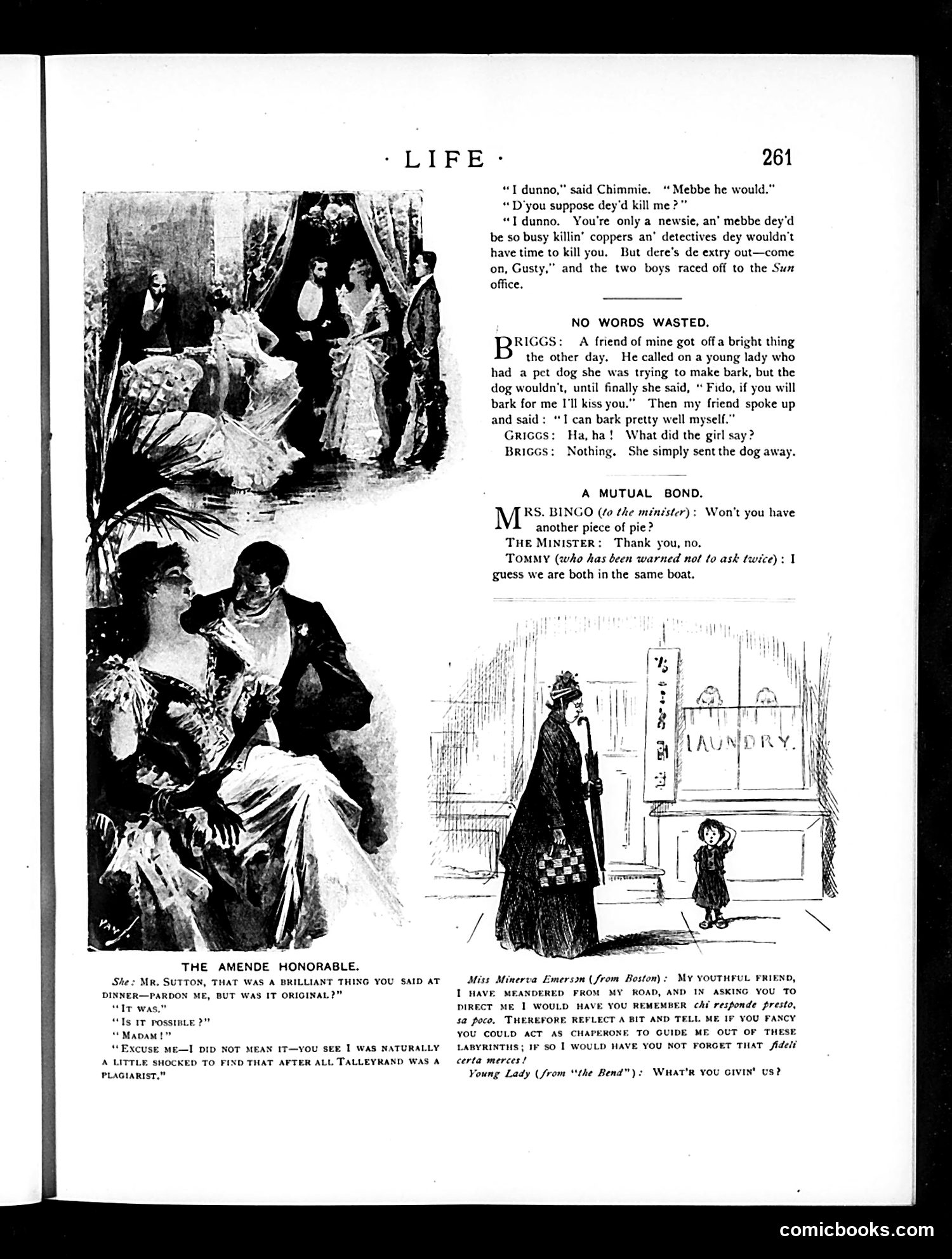
This page contains three separate humorous anecdotes typical of *Life* magazine's satirical format: **"The Amende Honorable"** mocks plagiarism and intellectual dishonesty. A woman confronts Mr. Sutton about whether his clever dinner remark was original. When he admits it was, she's shocked—implying the famous diplomat Talleyrand (18th-19th century French statesman) was himself a plagiarist. The joke turns on the irony of accusing a historical figure of stealing ideas. **"No Words Wasted"** presents a flirtation joke: a man tells a young woman's dog "I can bark pretty well myself" as a pickup line. She responds by dismissing the dog—a cutting rejection of his advances. **"A Mutual Bond"** is a family joke where young Tommy notes that both he and the minister are in the same situation: both have been warned against asking for seconds of pie. These pieces represent genteel, drawing-room humor typical of early 20th-century American magazines aimed at educated, middle-class readers.
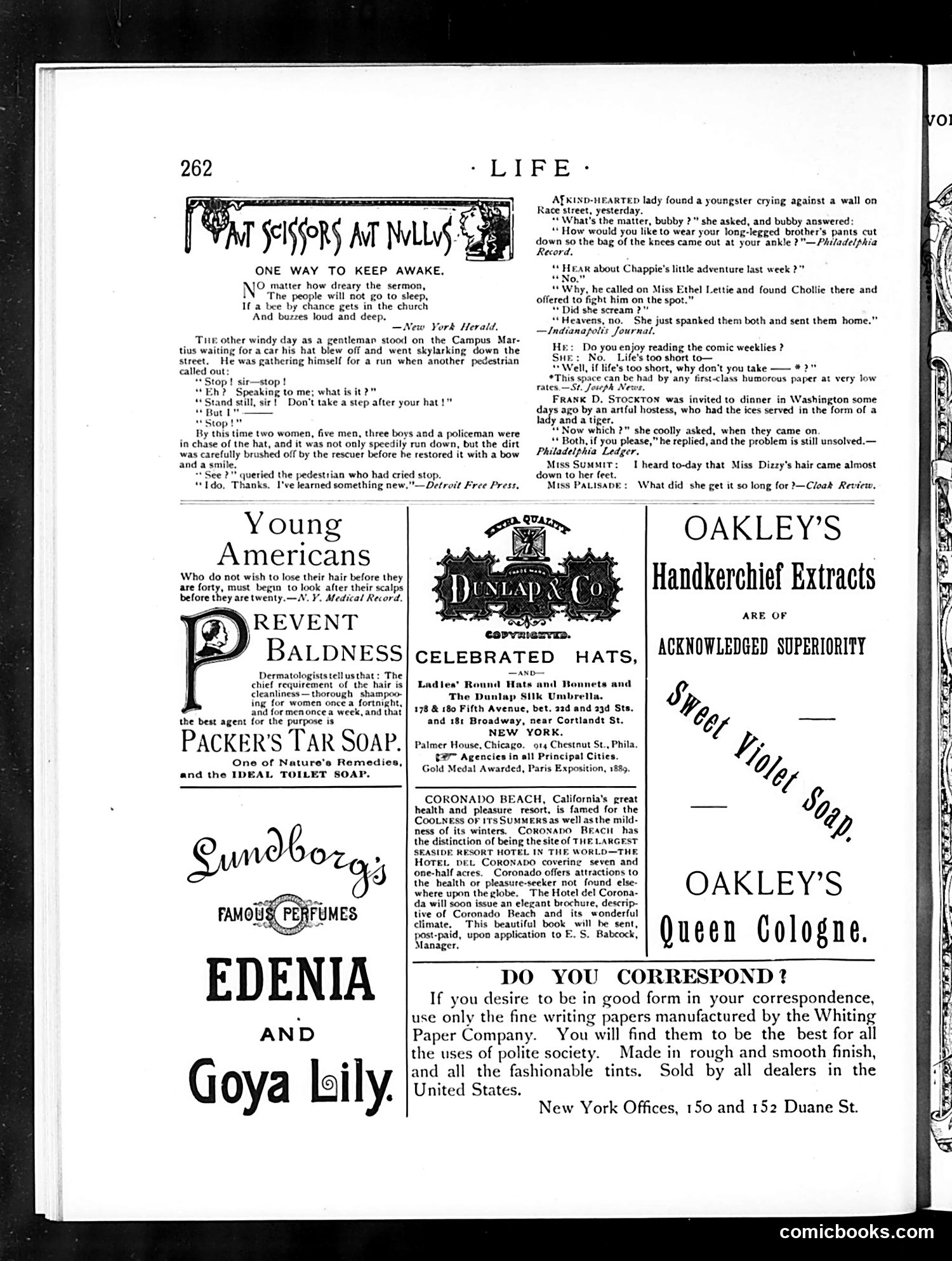
This page is primarily **advertising with humorous anecdotes**, not a political cartoon. The "One Way to Keep Awake" section contains three short jokes: 1. **The sermon joke**: A bee in church keeps the congregation alert—a mild jab at boring sermons. 2. **The hat-chasing story**: A man's blown-off hat attracts helpful strangers who retrieve it. The point appears to be commentary on social courtesy or the unexpected kindness of city dwellers. 3. **The pants complaint**: A child resents wearing hand-me-downs cut down from an older brother—relatable working-class humor about poverty. The remaining anecdotes mock courtship (a woman spanks two suitors), reading habits ("Life's too short"), and a Frank Stockton reference to his famous "Lady or the Tiger?" story. The bulk of the page consists of **period advertisements** for Packer's Tar Soap, Dunlap hats, Coronado Beach resort, and Oakley's perfume—typical content filler for *Life* magazine of this era.