
Life, 1891-04-23 · page 6 of 14
Life — April 23, 1891 — page 6: what you’re looking at
What you’re looking at
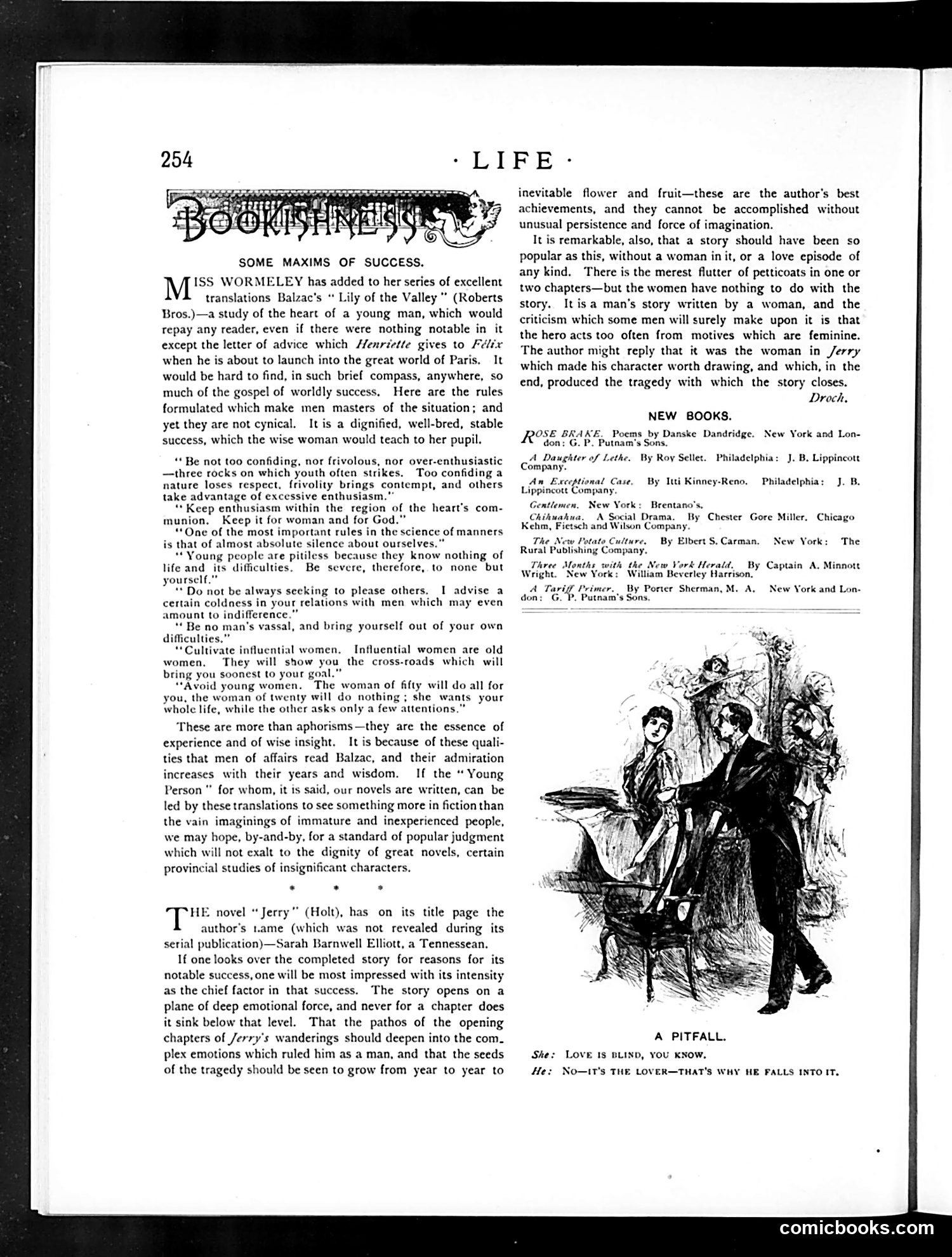
This cartoon illustrates a romantic cautionary tale with the caption: "Love is blind, you know. / He:—It's the lover—that's why he falls into it." The image shows a man tumbling or falling into a pit while a woman watches from above. The joke plays on the phrase "love is blind"—suggesting that lovers cannot see obvious dangers or problems in their romantic pursuits. The "pitfall" is literal (a physical hole) but metaphorically represents the blindness and poor judgment that romantic love causes. This reflects early-20th-century satirical commentary on courtship and marriage, presenting romantic love as something that causes men to act foolishly and ignore practical concerns. The cartoon is part of a broader literary discussion on the page about character development and human nature in fiction.
📄 Transcribed text from this page (OCR, searchable)
Machine-transcribed from the original scan — historical spelling and the odd misread are preserved.
-LIFE-: SOME MAXIMS OF SUCCESS. ISS WORMELEY has added to her series of excellent translations Balzac's “ Lily of the Valley” (Roberts Bros.)—a study of the heart of a young man, which would repay any reader, even if there were nothing notable in it except the letter of advice which Henriette gives to Félix when he is about to launch into the great world of Paris. It would be hard to find, in such brief compass, anywhere, so much of the gospel of worldly success, Here are the rules formulated which make men masters of the situation; and yet they are not cynical. It is a dignified, well-bred, stable success, which the wise woman would teach to her pupil. ** Be not too confiding, nor frivolous, nor over-enthusiastic —three rocks on which youth often strikes. Too confiding a nature loses respect, frivolity brings contempt, and others take advantage of excessive enthusiasm.” *Keep enthusiasm within the region of the heart's com- munion. Keep it for woman and for God.” “One of the most important rules in the science of manners is that of almost absolute silence about ourselves.” “Young people are pitiless because they know nothing of life and its difficulties. Be severe, therefore, to none but yourself.” “Do not be always seeking to please others. I advise a certain coldness in your relations with men which may even amount to indifference.” “Be no man’s vassal, and bring yourself out of your own difficulties. “Cultivate influential women, Influential women are old women, They will show you the cross-roads which will bring you soonest to your g “Avoid young women. The woman of fifty will do all for you, the woman of twenty will do nothing ; she w: whole life, while the other asks only a few attentions. ‘These are more than aphorisms—they are the essence of experience and of wise insight. It is because of these quali- ties that men of affairs read Balzac, and their admiration increases with their years and wisdom. If the “ Young Person" for whom, it is said, our novels are written, can be led by these translations to see something more in fiction than the vain imaginings of immature and inexperienced people, we may hope, by-and-by, for a standard of popular judgment which will not exalt to the dignity of great novels, certain provincial studies of insignificant characters. . . . HE novel “ Jerry" (Holt), has on its title page the author's name (which was not revealed during its serial publication)—Sarah Barnwell Elliott, a Tennessean, If one looks over the completed story for reasons for its notable success, one will be most impressed with its intensity as the chief factor in that success. The story opens on a plane of deep emotional force, and never for a chapter does it sink below that level. That the pathos of the opening chapters of Jerry's wanderings should deepen into the com. plex emotions which ruled him as a man, and that the seeds of the tragedy should be seen to grow from year to year to inevitable flower and fruit—these are the author's best achievements, and they cannot be accomplished without unusual persistence and force of imagination. It is remarkable, also, that a story should have been so popular as this, without a woman in it, or a love episode of any kind. There is the merest flutter of petticoats in one or two chapters—but the women have nothing to do with the story. It isa man’s story written by a woman, and the criticism which some men will surely make upon it is that the hero acts too often from motives which are feminine. The author might reply that it was the woman in Jerry which made his character worth drawing, and which, in the end, produced the tragedy with which the story closes. Droch, NEW BOOKS. OSE BRAKE. Poems by Danske Dandridge. don: G. P, Putnam's Sons, By Roy Seles. New York and Lon- A Daughter of Lethe. Company. An Exceptional Case Lippincott Compan: Gentlemen. New York: Brentano's, Chihuahua. Social Drama. By Chester Gore Miller. Kehm, Fietsch and Wilson Company By Elbert $. Carman. Philadelphia: J. B. Lippincott By Itti Kinney-Reno. Philadelphia: J. B. Chicago The New Potato Culture, Rural Publishing Company, Three Months A the Wright. “New York A Tariff Primer. don: GP. Putna New York: The cw Vork Herald. By Captain A, Minnott William Beverley Harrison, By Porter Sherman, M. A, 's Sons, New York and Lon- A PITFALL. She; LOVE Is BLIND, YoU KNow, He: No—tt’s THE LOVER—THAT'S WHY HE FALLS INTO IT. comicbooks.com