
Life, 1891-04-23 · page 8 of 14
Life — April 23, 1891 — page 8: what you’re looking at
What you’re looking at
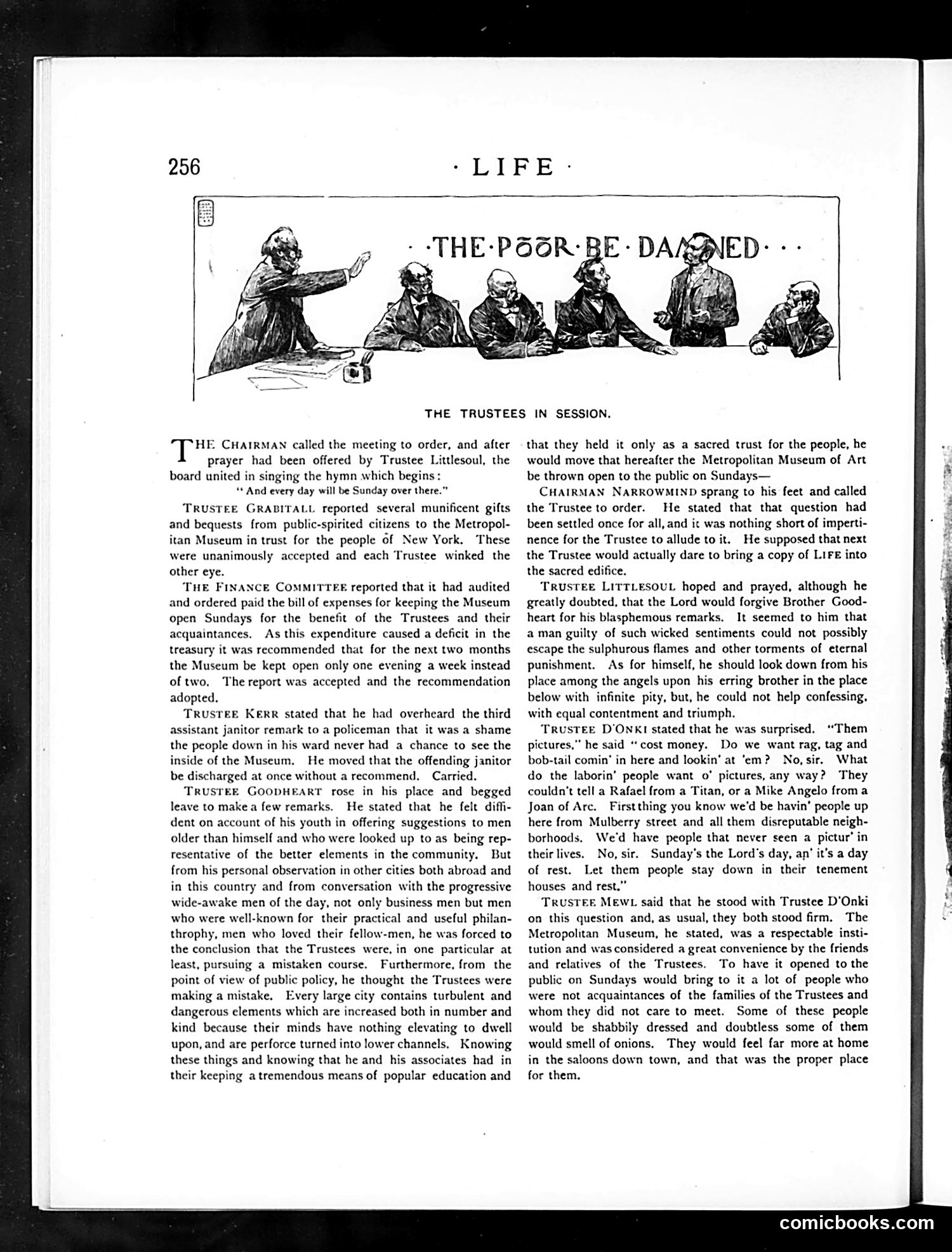
This satirical cartoon depicts a board meeting of museum trustees discussing whether to open the Metropolitan Museum of Art to the public on Sundays. The cartoon's title suggests the trustees' indifference to working-class access. The accompanying article details trustee debates, with several opposing Sunday opening. Trustee D'Onki argues that poor visitors would be unsuitably dressed, smell of onions, and belong in saloons instead. Trustee Mewl agrees, claiming such crowds would lower the institution's character. The satire targets wealthy elite gatekeeping of culture—their transparent classism and assumptions that poor people lack refinement or deserve cultural access. The cartoon visually emphasizes the trustees' self-satisfied expressions while debating whether to exclude the poor from "public" institutions funded partly by taxpayers.
📄 Transcribed text from this page (OCR, searchable)
Machine-transcribed from the original scan — historical spelling and the odd misread are preserved.
THE TRUSTEES IN SESSION. HE CHAIRMAN called the meeting to order, and after prayer had been offered by Trustee Littlesoul, the board united in singing the hymn which begins : “And every day will be Sunday over there.” TRUSTEE GRABITALL reported several munificent gifts and bequests from public-spirited citizens to the Metropol- itan Museum in trust for the people of New York. These were unanimously accepted and each Trustee winked the other eye. THE FINANCE COMMITTEE reported that it had audited and ordered paid the bill of expenses for keeping the Museum open Sundays for the benefit of the Trustees and their acquaintances. As this expenditure caused a deficit in the treasury it was recommended that for the next two months the Museum be kept open only one evening a week instead of two, The report was accepted and the recommendation adopted, TRUSTEE KERR stated that he had overheard the third assistant janitor remark to a policeman that it was a shame the people down in his ward never had a chance to see the inside of the Museum, He moved that the offending janitor be discharged at once without a recommend. Carried. TRUSTEE GOODHEART rose in his place and begged leave to make a few remarks. He stated that he felt difi- dent on account of his youth in offering suggestions to men older than himself and who were looked up to as being rep- resentative of the better elements in the community, But from his personal observation in other cities both abroad and in this country and from conversation with the progressive wide-awake men of the day, not only business men but men who were well-known for their practical and useful philan- throphy, men who loved their fellow-men, he was forced to the conclusion that the Trustees were, in one particular at least, pursuing a mistaken course. Furthermore, from the point of view of public policy, he thought the Trustees were making a mistake. Every large city contains turbulent and dangerous elements which are increased both in number and kind because their minds have nothing clevating to dwell upon, and are perforce turned into lower channels. Knowing these things and knowing that he and his associates had in their keeping a tremendous means of popular education and that they held it only as a sacred trust for the people, he would move that hereafter the Metropolitan Museum of Art be thrown open to the public on Sundays— CHAIRMAN NARROWMIND Sprang to his feet and called the Trustee to order. He stated that that question had been settled once for all, and it was nothing short of imperti- nence for the Trustee to allude to it. He supposed that next the Trustee would actually dare to bring a copy of LIFE into the sacred edifice. TRUSTEE LITTLESOUL hoped and prayed, although he greatly doubted, that the Lord would forgive Brother Good- heart for his blasphemous remarks. It seemed to him that aman guilty of such wicked sentiments could not possibly escape the sulphurous flames and other torments of eternal punishment. As for himself, he should look down from his place among the angels upon his erring brother in the place below with infinite pity, but, he could not help confessing, with equal contentment and triumph, ‘TRUSTEE D'ONKI stated that he was surprised. “Them pictures,” he said “cost money. Do we want rag, tag and bob-tail comin’ in here and lookin’ at ‘em? No, sir. What do the laborin’ people want o’ pictures, any way? They couldn't tell a Rafael from a Titan, or a Mike Angelo froma Joan of Arc. Firstthing you know we'd be havin’ people up here from Mulberry street and all them disreputable neigh- borhoods. We'd have people that never seen a pictur’ in their lives. No, sir. Sunday's the Lord's day, an’ it’s a day of rest. Let them people stay down in their tenement houses and rest.” TRUSTER MEWL said that he stood with Trustee D'Onki on this question and, as usual, they both stood firm. The Metropolitan Museum, he stated, was a respectable insti- tution and was considered a great convenience by the friends and relatives of the Trustees. To have it opened to the public on Sundays would bring to it a lot of people who were not acquaintances of the families of the Trustees and whom they did not care to meet. Some of these people would be shabbily dressed and doubtless some of them would smell of onions. They would feel far more at home in the saloons down town, and that was the proper place for them. comicbooks.com