
Life, 1891-04-23 · page 4 of 14
Life — April 23, 1891 — page 4: what you’re looking at
What you’re looking at
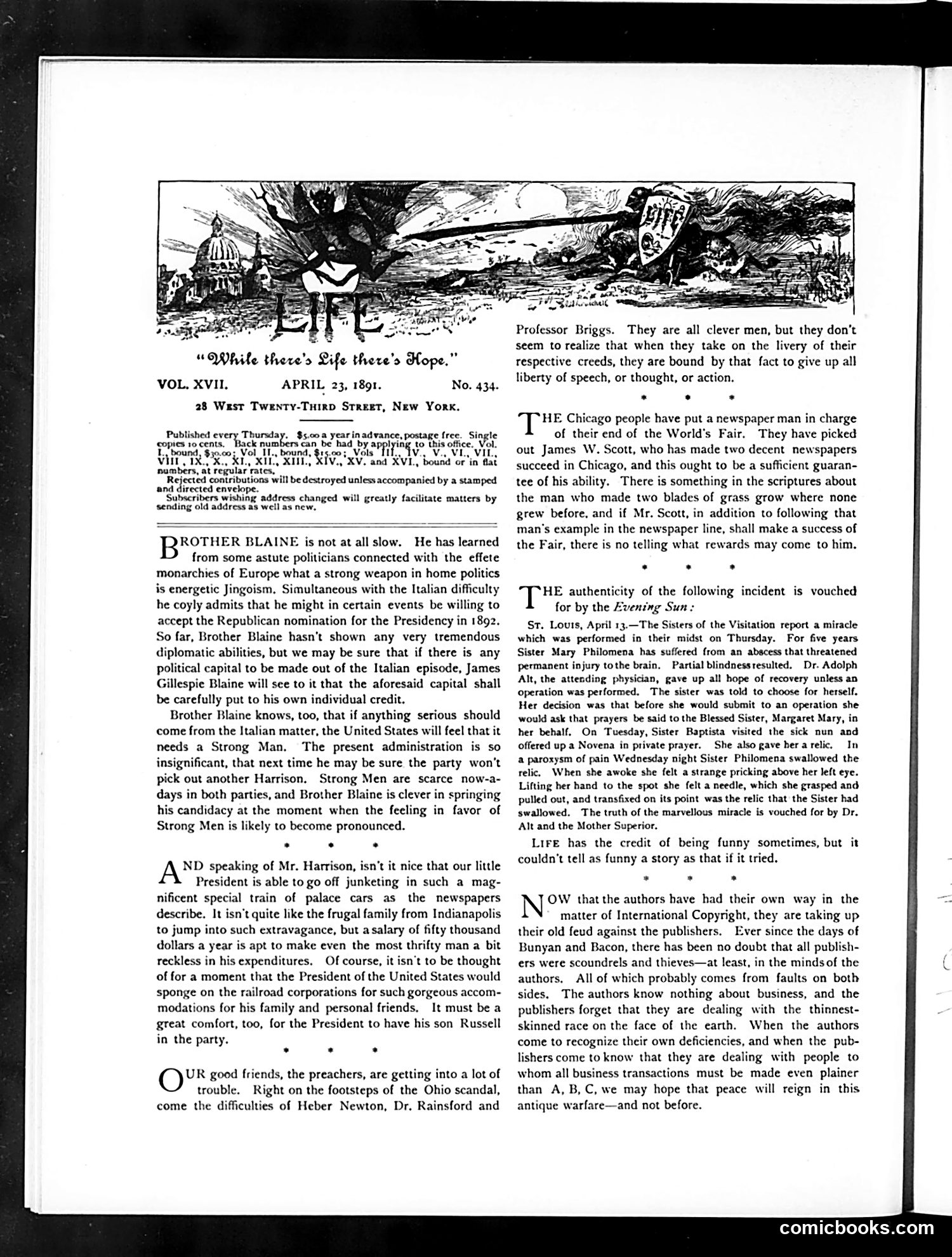
The main cartoon depicts a figure labeled "While there's Life there's Hope," showing what appears to be a skeletal or death-like figure amid architectural ruins and turmoil. This likely refers to political instability or crisis of the period. The text discusses Brother Blaine's potential candidacy for the 1892 U.S. presidency, suggesting he's maneuvering within Republican politics despite scandal. It also comments on President Harrison's extravagant spending on palace cars and railroad accommodations—a critique of his lavish use of public resources. The final section addresses conflicts between magazine authors and publishers over international copyright issues, describing publishers as "scoundrels and thieves." The overall tone is satirical commentary on political corruption, excessive presidential spending, and publishing industry disputes.
📄 Transcribed text from this page (OCR, searchable)
Machine-transcribed from the original scan — historical spelling and the odd misread are preserved.
& “Phile there's Life there's Hope. VOL. XVII. APRIL 23, 1891. No. 434. 28 West Twenty-Tuirp Street, New York. Published every Thursday, $5.00 year inadvance, postage free. Single copies ro cents. Back numbers can be had by applying to this office. Vo § Voll Bound. Greco; vols TL. IV. V...VL. VIL, . XL, XID, XML iv. XV. and XVI, bound or ‘in flat numbers, at regular rates, Rejected contributions will be destroyed unless accompanied by a stamped and directed envelope. Subscribers wishing address changed will greatly facilitate matters by sending old address as well as new. ROTHER BLAINE is not at all slow. He has learned from some astute politicians connected with the effete monarchies of Europe what a strong weapon in home politics is energetic Jingoism, Simultaneous with the Italian difficulty he coyly admits that he might in certain events be willing to accept the Republican nomination for the Presidency in 1892. So far, Brother Blaine hasn't shown any very tremendous diplomatic abilities, but we may be sure that if there is any political capital to be made out of the Italian episode, James Gillespie Blaine will see to it that the aforesaid capital shall be carefully put to his own individual credit. Brother Blaine knows, too, that if anything serious should come from the Italian matter, the United States will feel that it needs a Strong Man, The present administration is so insignificant, that next time he may be sure the party won’t pick out another Harrison. Strong Men are scarce no’ days in both parties, and Brother Blaine is clever in springing his candidacy at the moment when the feeling in favor of Strong Men is likely to become pronounced. . . . ND speaking of Mr. Harrison, isn’t it nice that our little President is able to go off junketing in such a mag- nificent special train of palace cars as the newspapers describe. It isn’t quite like the frugal family from Indianapolis to jump into such extravagance, but asalary of fifty thousand dollars a year is apt to make even the most thrifty man a bit reckless in his expenditures. Of course, it isn’t to be thought of for a moment that the President of the United States would sponge on the railroad corporations for such gorgeous accom- modations for his family and personal friends, It must be a great comfort, too, for the President to have his son Russell in the party. . . . UR good friends, the preachers, are getting into a lot of trouble. Right on the footsteps of the Ohio scandal, come the difficulties of Heber Newton, Dr. Rainsford and Professor Briggs. They are all clever men, but they don’t seem to realize that when they take on the livery of their respective creeds, they are bound by that fact to give up all liberty of speech, or thought, or action. . . . HE Chicago people have put a newspaper man in charge of their end of the World's Fair. They have picked out James W. Scott, who has made two decent newspapers succeed in Chicago, and this ought to be a sufficient guaran- tee of his ability. There is something in the scriptures about the man who made two blades of grass grow where none grew before, and if Mr. Scott, in addition to following that man’s example in the newspaper line, shall make a success of the Fair, there is no telling what rewards may come to him. . . * HE authenticity of the following incident is vouched for by the Evening Sun: St. Louts, April 13.—The Sisters of the Visitation report a miracle which was performed in their midst on Thursday. For five years Sister Mary Philomena has suffered from an abscess that threatened permanent injury tothe brain, Partial blindnessresulted. Dr. Adolph Alt, the attending physician, gave up all hope of recovery unless an operation was performed, The sister was told to choose for herself. Her decision was that before she would submit to an operation she would ask that prayers be said to the Blessed Sister, Margaret Mary, in her behalf, On Tuesday, Sister Baptista visited the sick nun and offered up a Novena in private prayer. She also gave her a relic. In a paroxysm of pain Wednesday night Sister Philomena swallowed the relic, When she awoke she felt a strange pricking above her left eye. Lifting her hand to the spot she felt a needle, which she grasped and pulled out, and transfixed on its point was the relic that the Sister had swallowed. The truth of the marvellous miracle is vouched for by Dr. Alt and the Mother Superior, Lire has the credit of being funny sometimes, but it couldn't tell as funny a story as that if it tried. * . . OW that the authors have had their own way in the matter of International Copyright, they are taking up their old feud against the publishers. Ever since the days of Bunyan and Bacon, there has been no doubt that all publish- ers were scoundrels and thieves—at least, in the minds of the authors, All of which probably comes from faults on both sides, The authors know nothing about business, and the publishers forget that they are dealing with the thinnest- skinned race on the face of the earth. When the authors come to recognize their own deficiencies, and when the pub- lishers come to know that they are dealing with people to whom all business transactions must be made even plainer than A, B, C, we may hope that peace will reign in this antique warfare—and not before. comicbooks.com