
A complete issue · 14 pages · 1891
Life — March 12, 1891
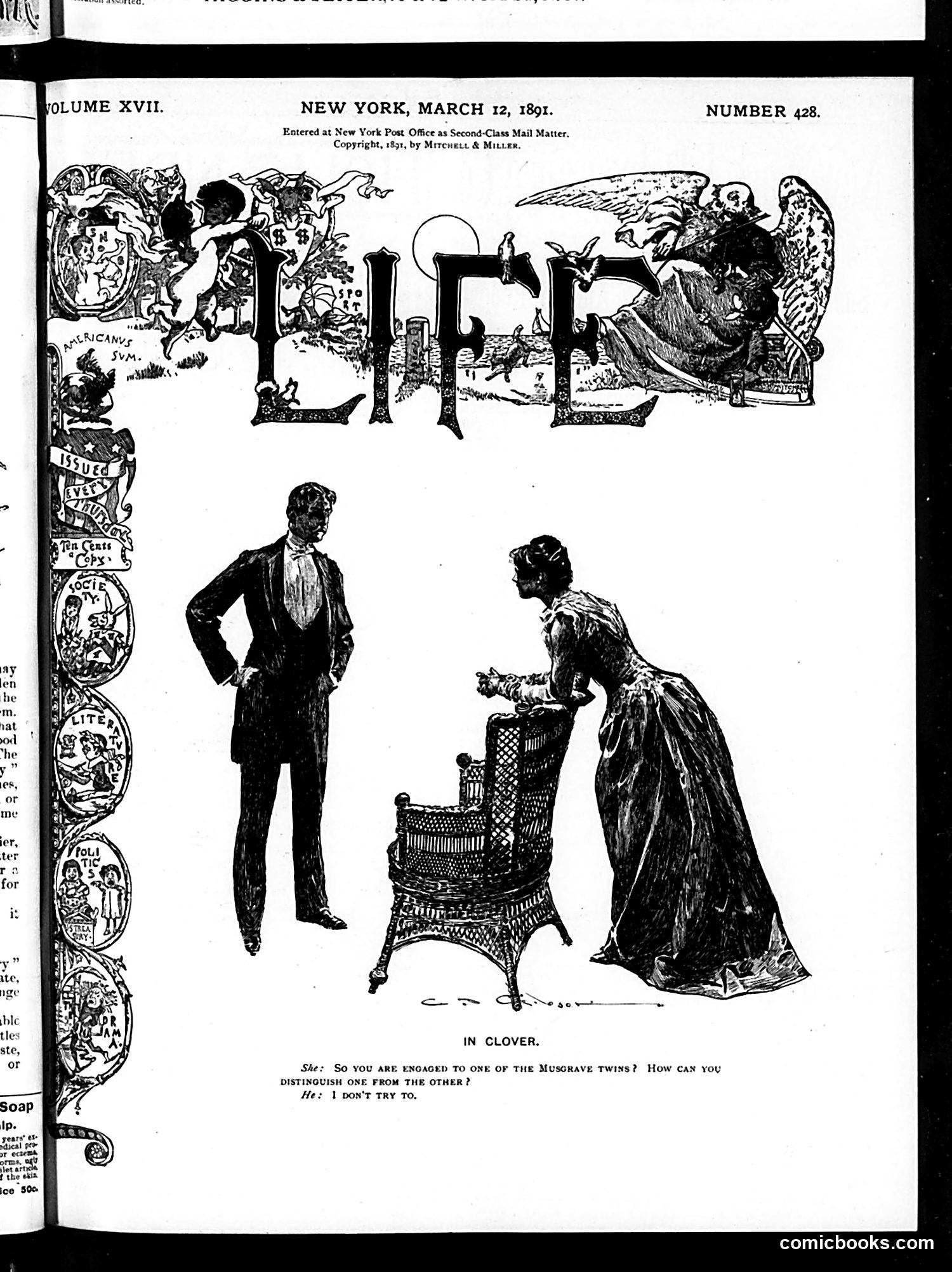
This cartoon satirizes the Musgrove Twins, apparently identical twins who were notable public figures at the time. The joke plays on the difficulty of distinguishing between them: a man stands perplexed while a woman (likely their romantic interest) sits between them in a wicker chair. The dialogue reveals the satire's point—the woman claims she cannot tell which twin is which, making it impossible to know which one she's actually engaged to marry. The man's resigned response ("I don't try") suggests this confusion was a recurring social problem or running joke about the twins. The cartoon mocks both the impracticality of identical twins in romantic situations and perhaps the twins' celebrity status during this era. The "in clover" phrase suggests fortunate circumstances—here, the romantic advantage of being indistinguishable.
This page is primarily **advertising content** rather than satirical cartoons. The left side features the New-York Life Insurance Company's annual financial report (dated January 1, 1891), while the right contains advertisements for: - Hollanders (fabric and clothing) - Brewster & Co. (carriages) - "The Divine Sarah" Récamier Cream (cosmetics, featuring an illustrated portrait) - Various alcohol and grocery products The only illustration with potential satirical content is the decorative head portrait accompanying the Récamier Cream ad, but it appears to be a generic classical-style beauty image rather than a specific political or social caricature. The page reflects late-19th-century consumer culture and commercial advertising practices.
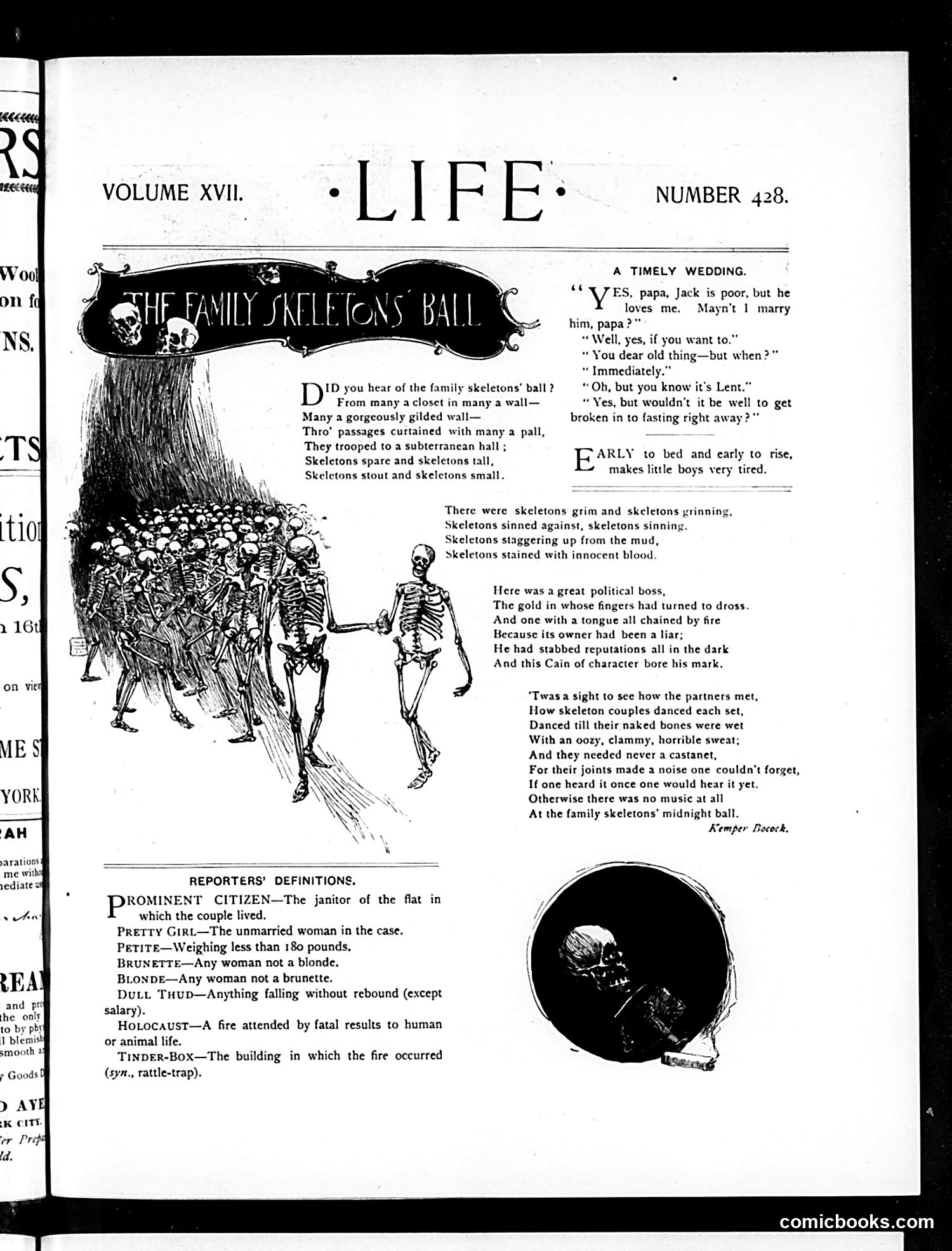
This satirical poem and illustration mock corrupt public figures through the metaphor of skeletons—representing their hidden scandals and moral failings—attending a midnight ball. The verse describes skeletal "political bosses" with damning secrets: one whose fingers "turned to dross" (corruption), another with a "tongue all chained by fire" (silenced liar), and characters bearing "Cain of character" marks. The dense illustration shows skeletons dancing together, their "naked bones" making noise—meaning their scandals cannot be hidden despite attempts at secrecy. The joke is that powerful corrupt figures can maintain respectability in daylight, but their true nature (skeletons) emerges in darkness. The satirical "Reporters' Definitions" below mock journalistic euphemisms used to describe these same figures more politely.
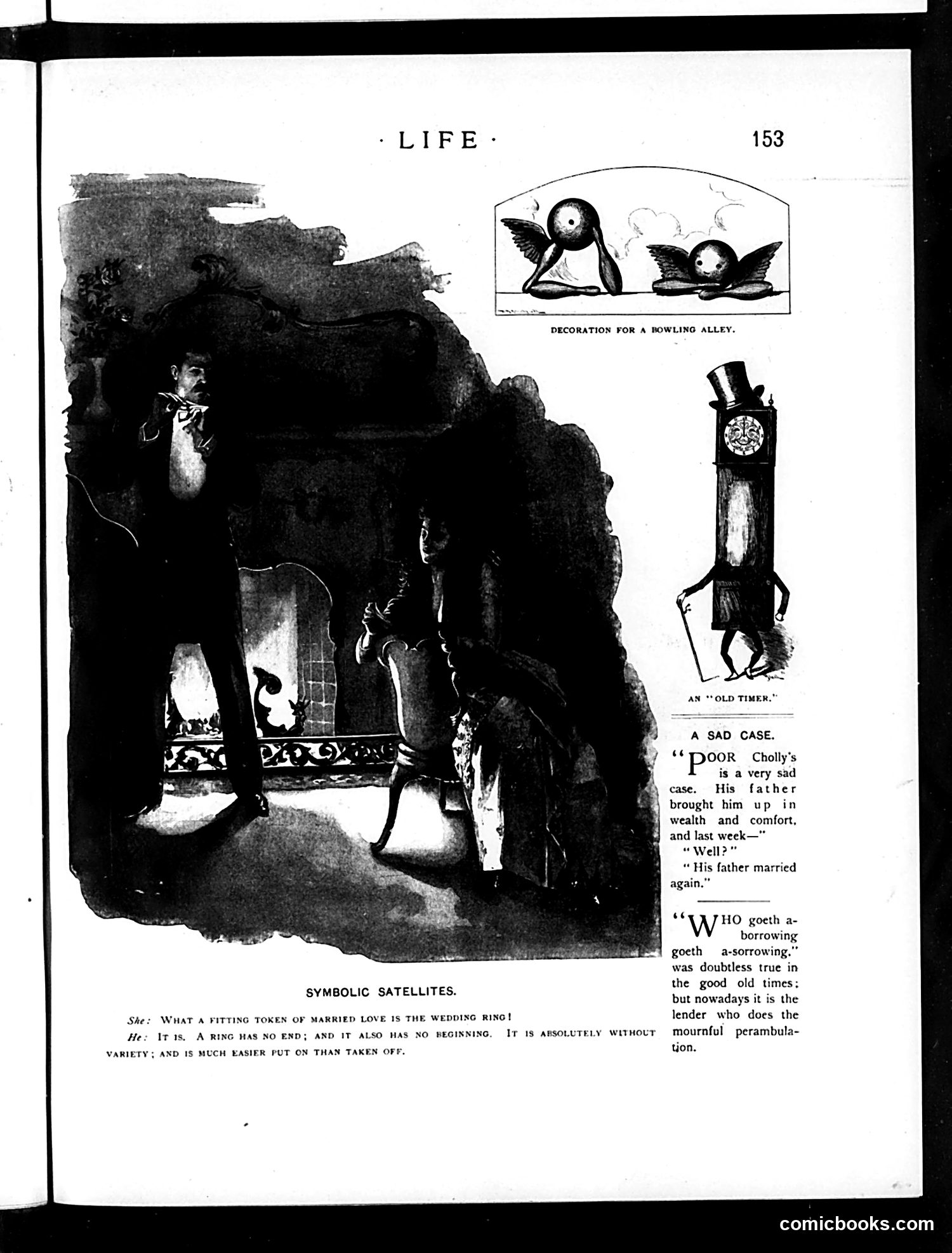
**Main Cartoon ("Symbolic Satellites"):** This depicts a domestic scene where a man and woman discuss marriage symbolism. The woman notes the wedding ring as "a fitting token of married love," while the man cynically responds that a ring "has no end, and it also has no beginning" and is "much easier put on than taken off"—a joke about divorce difficulty and the permanence (or trap) of marriage. The satirical point: marriage bonds are binding in ways that may not be entirely romantic. **Side Content:** Small illustrations include "Decoration for a Bowling Alley" (cherubs with balls) and "An 'Old Timer'" (anthropomorphized clock). A brief story titled "A Sad Case" describes a wealthy man whose son's stepmother remarriage situation creates hardship—likely social commentary on inheritance and remarriage complications among the wealthy.
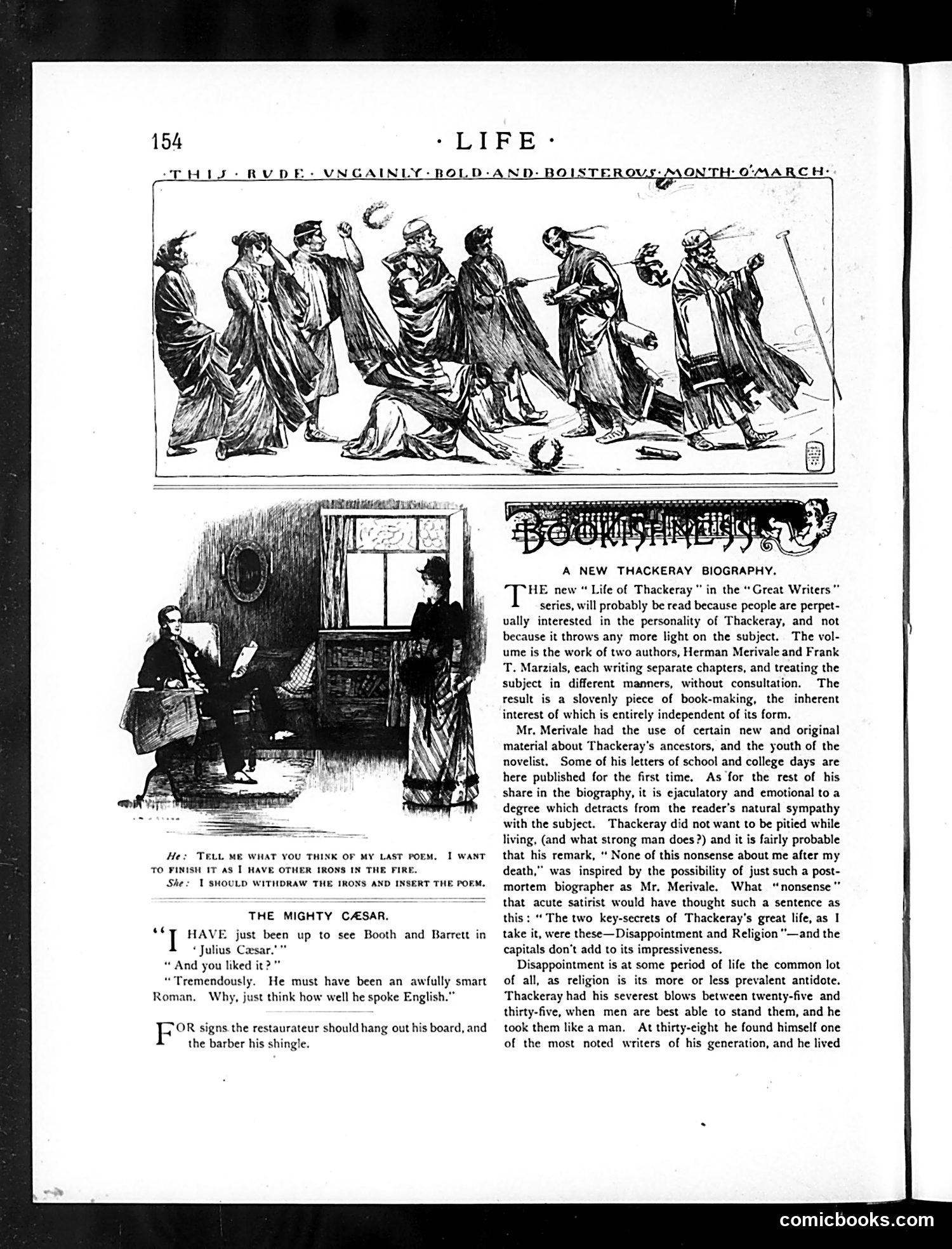
**Top Cartoon**: Depicts a rude, uncouth mob of people in March weather—poorly dressed, aggressive, and disorderly. The title indicates this represents "rude, ungainly, bold and boisterous" March itself, personified as a rowdy group rather than an individual. This is a seasonal satire common to the era, treating the month as having a "personality." **Main Content**: "Book Shelf" section reviewing a new Thackeray biography by Herman Merivale and Frank T. Marzials. The accompanying illustration shows an indoor scene, likely depicting a literary or social moment. The text discusses Thackeray's life, noting his difficulties with poverty and disappointment, published here as a serious literary review rather than satire.
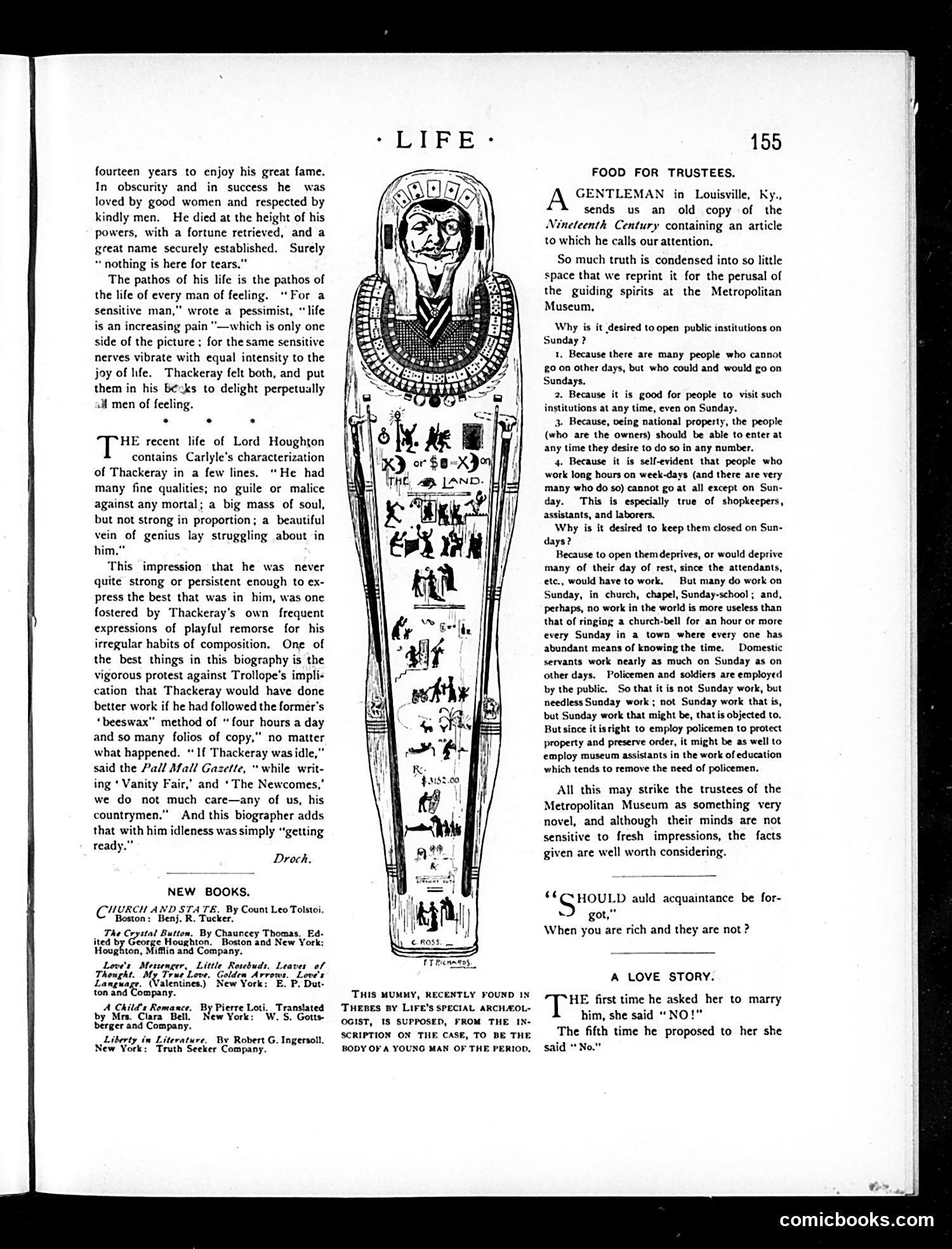
The central image is an **Egyptian mummy case** decorated with hieroglyphics and symbolic figures. This illustration accompanies the article "Food for Trustees," which discusses whether major public institutions like the Metropolitan Museum should open on Sundays. The mummy appears to be **satirical commentary on museum trustees themselves**—depicting them as antiquated, preserved relics out of touch with modern needs. The satire suggests these wealthy, conservative board members are as rigid and lifeless as the ancient artifact they curate. The article argues for Sunday access, noting that working people cannot visit museums on weekdays. The mummy-as-trustee visual joke implies these institutional leaders are figuratively "dead" to contemporary social concerns, making decisions that benefit only the privileged classes.
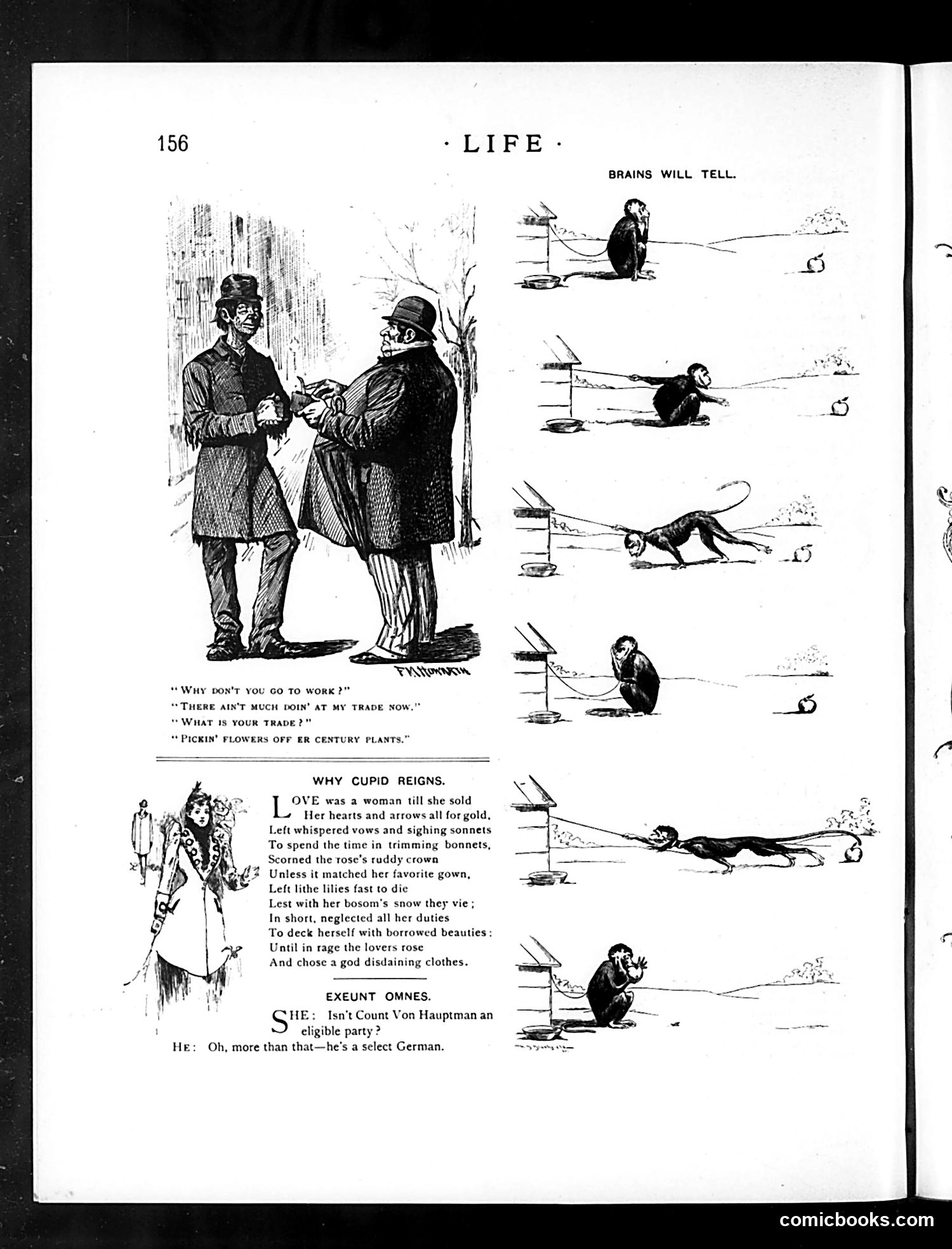
This page contains two satirical pieces: **Top Left**: A dialogue between two men about employment. One man asks why the other doesn't work, and receives the reply that there's "ain't much doin' at my trade now" — his trade being "Pickin' flowers off er century plants." This appears to satirize unemployment or underemployment, possibly mocking someone claiming inability to find work while describing obviously non-viable "employment." **Right Side**: "Brains Will Tell" — a series of illustrations showing progressively degrading human postures and behavior, from upright walking to crawling, suggesting a satirical commentary on intellectual decline or devolution. **Bottom Left**: "Why Cupid Reigns" and "Exeunt Omnes" — poetic pieces about women's vanity and social climbing, with a dialogue joke about Count Von Hauptman being "select" German. The overall tone mocks social pretension and human folly.
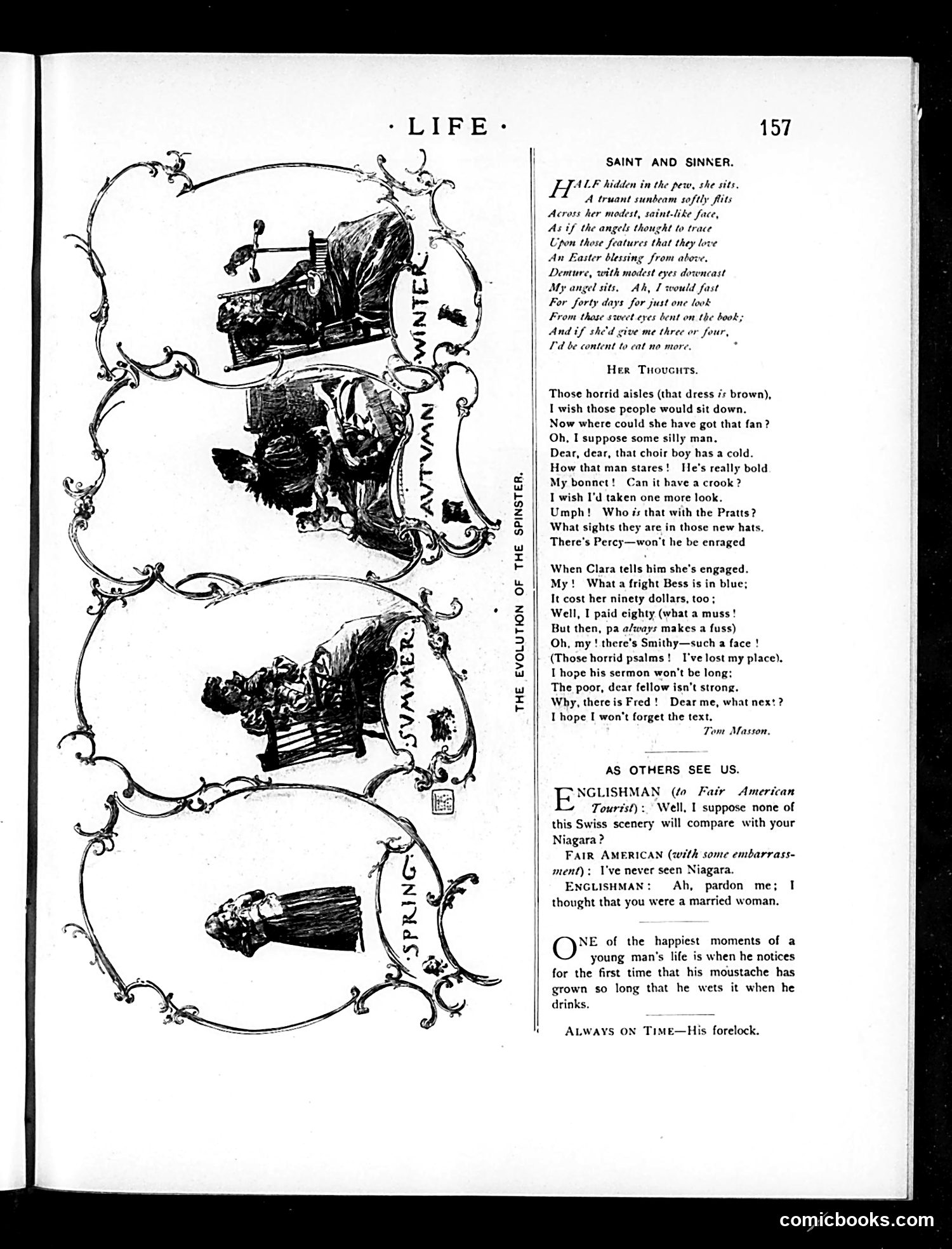
This page from *Life* magazine contains satirical sketches labeled "The Evolution of the Sinner" and "Saint and Sinner." The left side shows decorative vignettes depicting what appears to be the progression or different states of a sinful character, though the specific illustrations are stylized and somewhat unclear in detail. The right side presents a poem about a woman noticing an angel in church, followed by "Her Thoughts"—a humorous internal monologue where the character's mind wanders during the sermon to mundane concerns: fashion ("those horrid aisles"), choir boys, and gossip about Clara's engagement and the cost of a hat. The satire mocks the gap between outward religious piety and actual human preoccupations, particularly women's social vanity during church services.
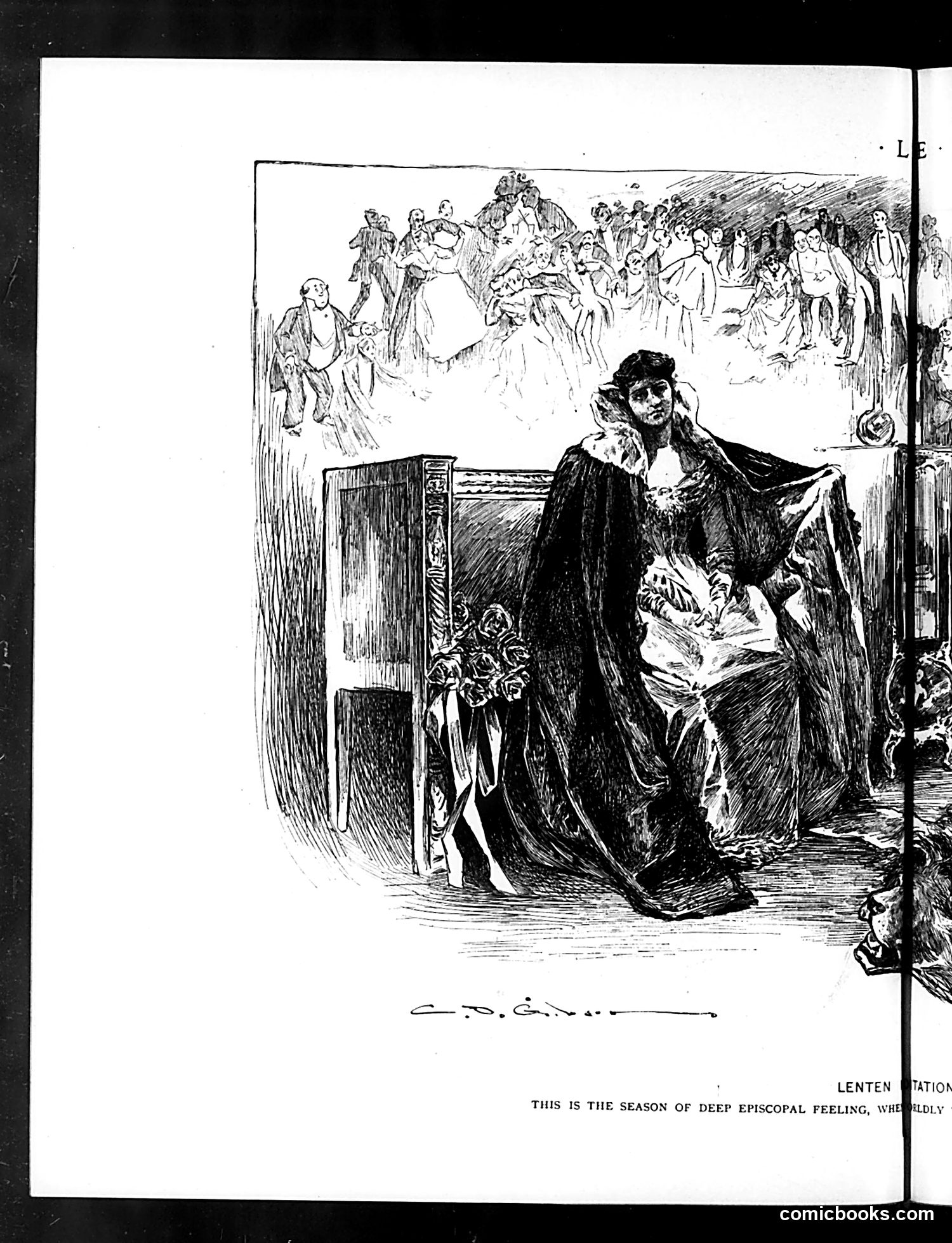
This appears to be a satirical illustration about Lenten religious observance. The image shows a well-dressed man in dark clothing sitting in what appears to be a church pew, looking downward in apparent pious contemplation. Behind him, a crowd of people engage in various activities. The caption reads: "THIS IS THE SEASON OF DEEP EPISCOPAL FEELING, WHEN—" (text cuts off) The satire appears to mock the performative nature of religious devotion during Lent, particularly among Episcopal Church members of means. The contrast between the man's composed, solemn pose and the bustling crowd behind him suggests commentary on superficial piety—the idea that some observe Lenten traditions as social ritual rather than genuine spiritual reflection. The humor targets both religious hypocrisy and class-based attitudes toward religion.
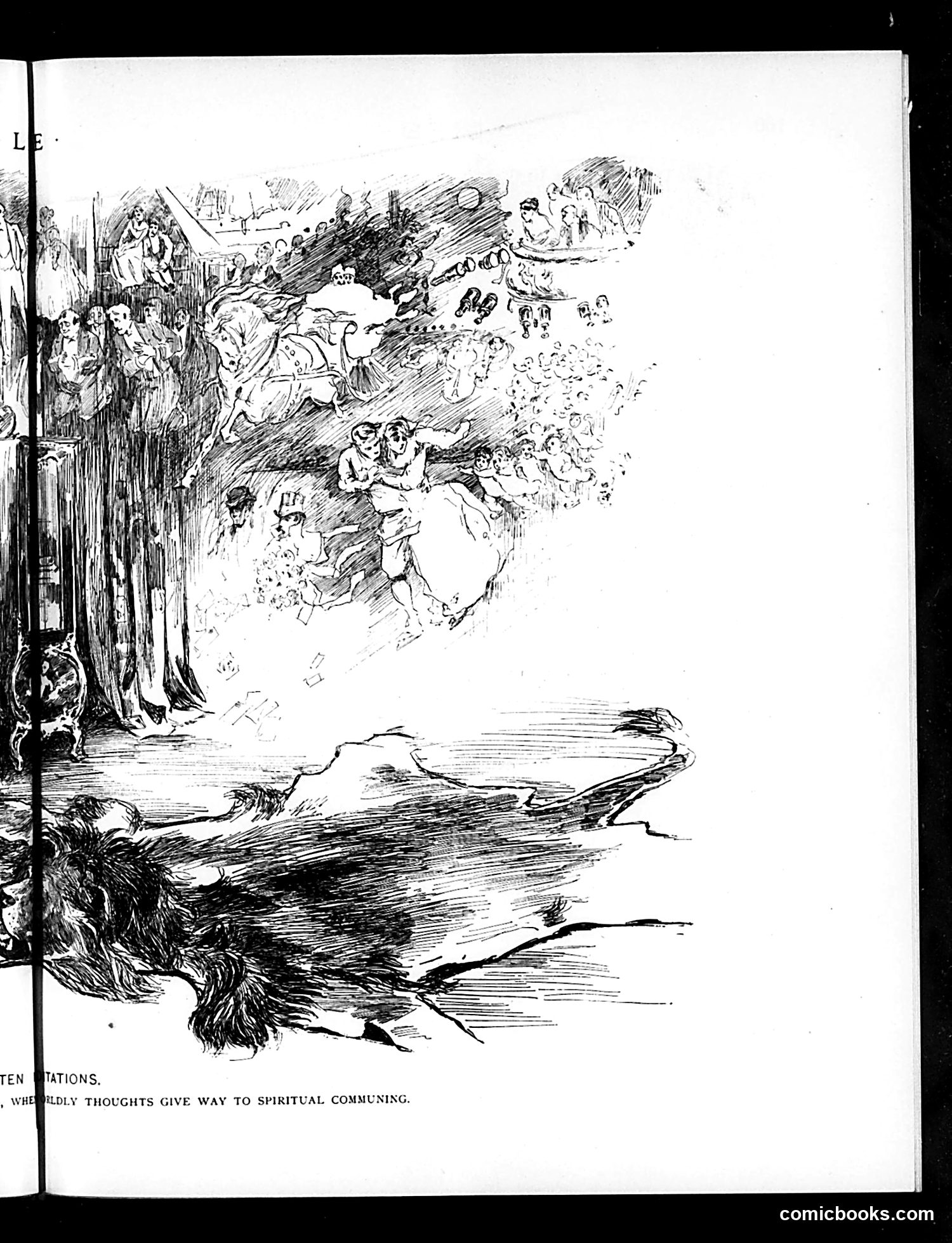
This page contains a single illustration with the caption "WHERE WORLDLY THOUGHTS GIVE WAY TO SPIRITUAL COMMUNING." The drawing depicts a stark contrast: on the left, a group of well-dressed figures in worldly dress stand near a building; on the right, a ghostly, ethereal vision emerges showing spiritual or heavenly figures in lighter, more flowing forms, ascending upward. A large tree stump or log occupies the foreground. The satire appears to comment on the gap between material/worldly life and spiritual aspiration. The illustration suggests a moment of spiritual transcendence or religious awakening, where ordinary people transition from earthly concerns to divine communion. The artistic technique—detailed realism on the left becoming increasingly ethereal on the right—emphasizes this contrast visually. Without additional context, the specific target of satire remains unclear.
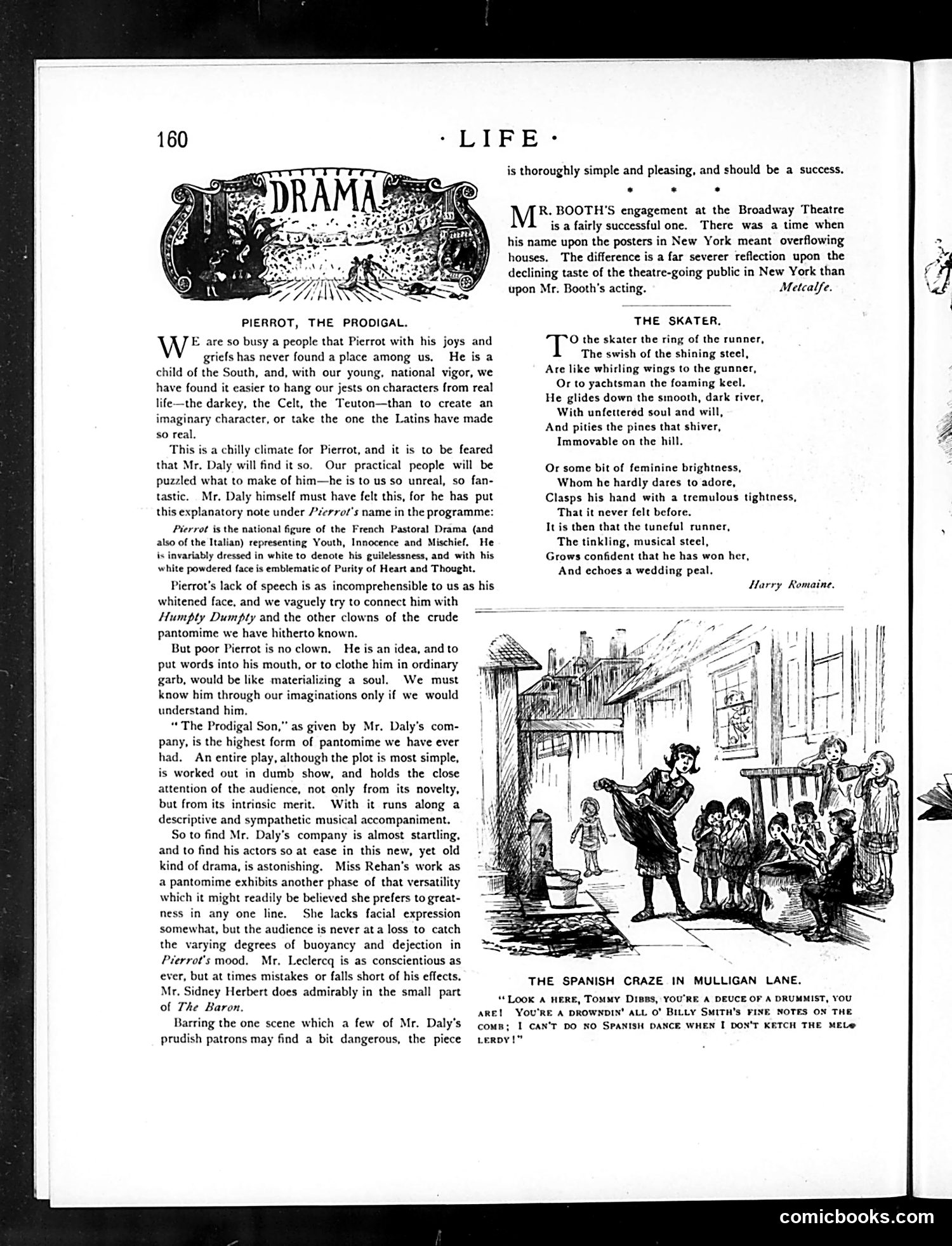
This page contains drama criticism and poetry from an American satirical magazine. The main article discusses Mr. Daly's theatrical production of "Pierrot, the Prodigal," a pantomime adaptation of the Prodigal Son story. The critic argues that Pierrot—a traditional figure from French and Italian pastoral drama representing youthful innocence—is an unsuitable subject for American audiences, whom he characterizes as practical and unaccustomed to such abstract, symbolic characters. He praises the production's execution despite these cultural obstacles, commending the cast's pantomime abilities. The page also includes a romantic poem about ice skating and a humorous illustration titled "The Spanish Craze in Mulligan Lane," depicting working-class Irish characters attempting Spanish-style music and dance, satirizing contemporary fads among immigrant communities.
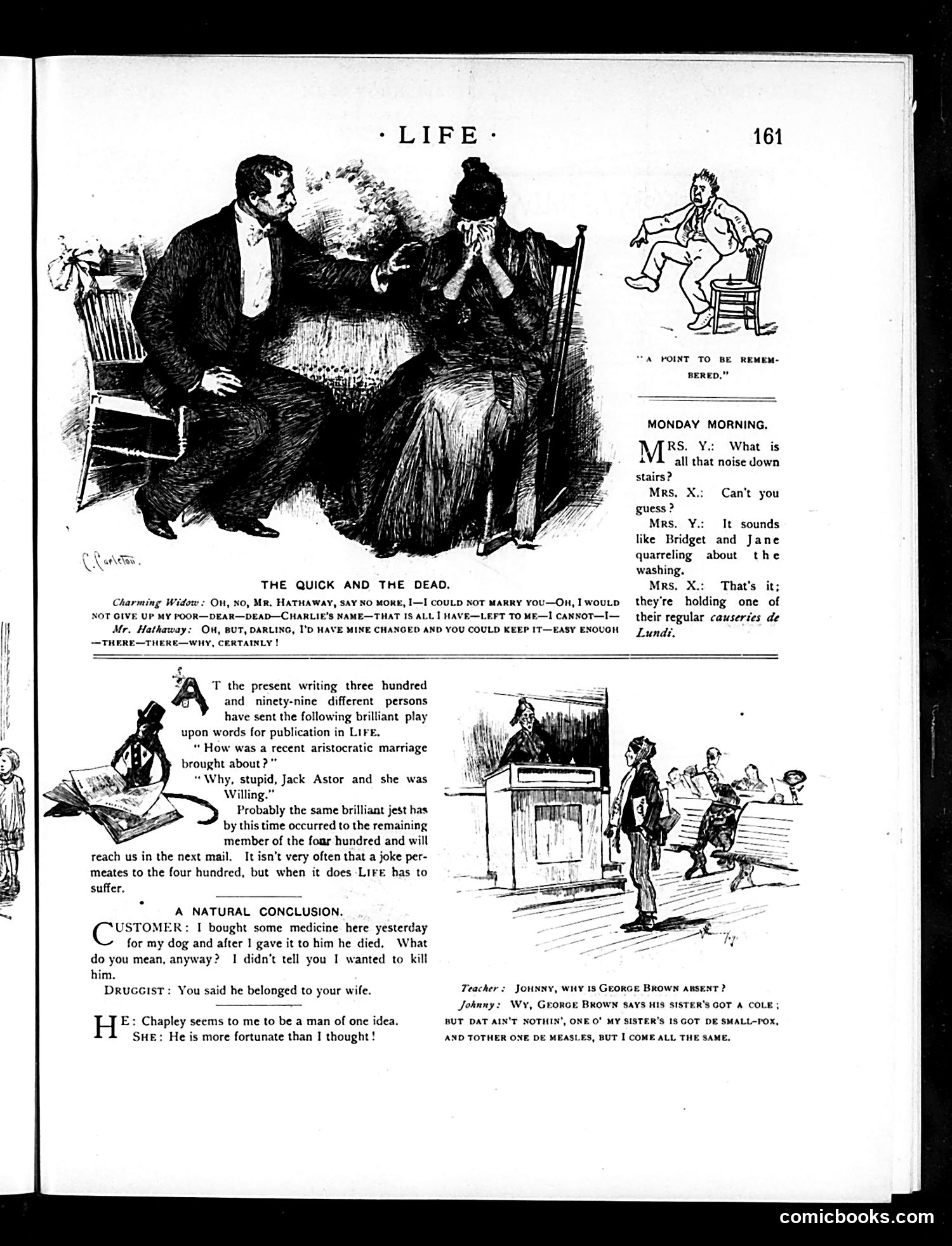
This page contains four separate comic sketches satirizing contemporary society: **"The Quick and the Dead"** mocks wealthy widow-remarriage customs. A suitor offers to change his surname so the widow can keep her dead husband's name—suggesting the absurdity of how the wealthy prioritize social appearance (preserving a name) over genuine emotion. **"A Point to Be Remembered"** jokes about servants' French conversation ("causeries de Lundi"—Monday chats), implying domestic staff ape upper-class pretensions. **The "Jack Astor" joke** satirizes a recent aristocratic marriage, likely referencing the Astor family. The repeated submission of this pun—now sent 399 times to Life's editors—ridicules both the society pages' obsession with wealthy marriages and the public's exhausted repetition of weak humor. **"A Natural Conclusion"** darkly jokes that a druggist's medicine killed someone's dog; when the customer protests, the druggist implies the customer's wife deserved the poison—misogynistic humor typical of the era. **"Teacher and Johnny"** uses a child's speech impediment ("cole" for "cold") for comic effect while showcasing working-class resilience.
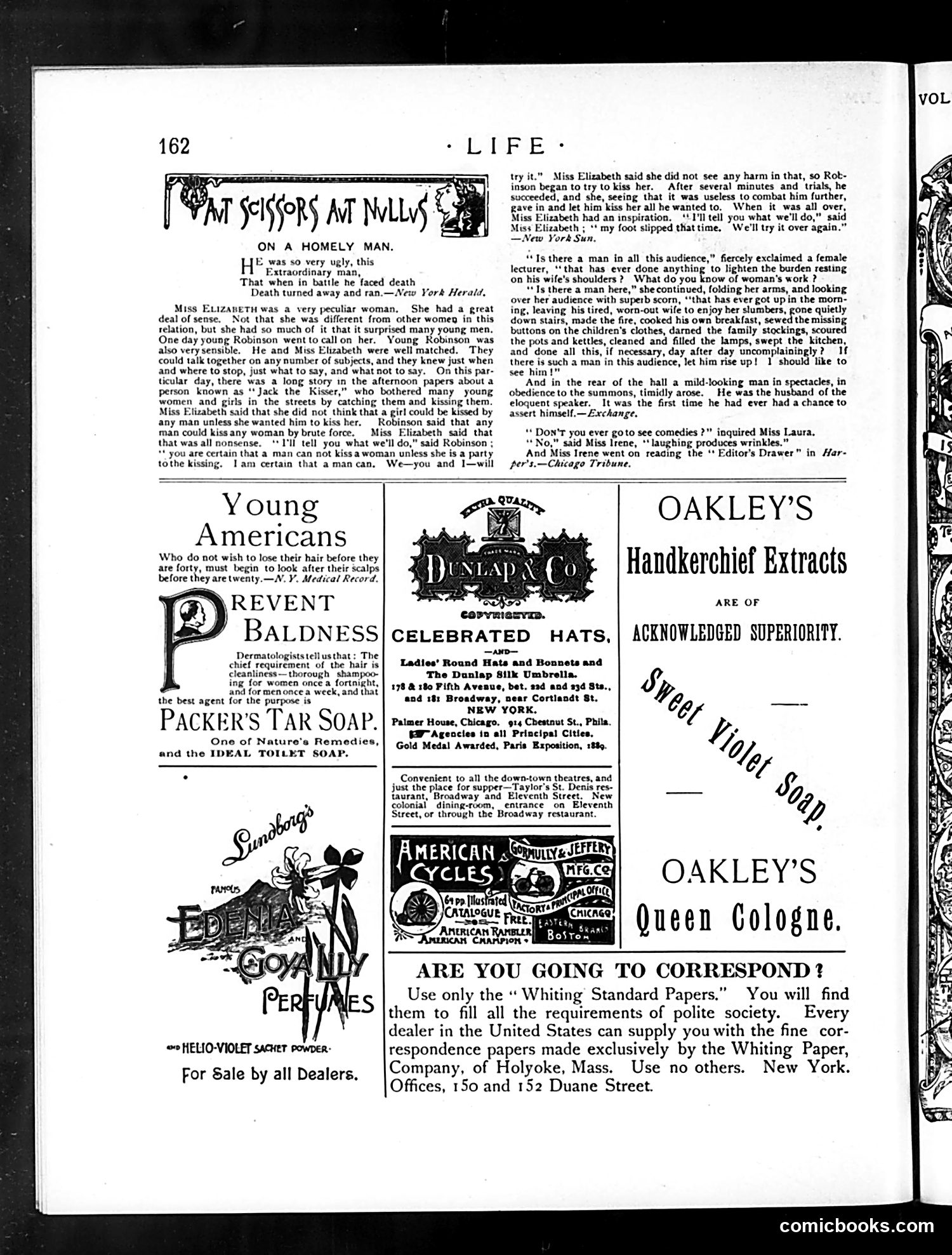
This page contains three humorous anecdotes satirizing gender relations and social pretense of the era: **"At Scissors at Nulls"** mocks the debate over consent and physical force in courtship. A sensible couple tests whether a man can kiss an unwilling woman "by brute force." After Robinson succeeds through persistence, Miss Elizabeth cleverly claims her "foot slipped"—suggesting she'll try again, implying women retain agency through wit rather than physical resistance. **The Female Lecturer anecdote** satirizes earnest women's rights advocates. A fierce speaker demands men share domestic labor, shaming her audience. When a meek man finally stands—he's revealed as her own henpecked husband, the only one doing such work. The joke: her rhetoric has domesticated her own spouse completely. **The Comedy Joke** pokes fun at vain women prioritizing appearance over entertainment, with Miss Irene avoiding comedies because "laughing produces wrinkles." The page is primarily **advertisements** for period products: baldness remedies, Dunlap hats, Edelweitz perfumes, and American bicycles—typical of *Life* magazine's revenue model.