
Life, 1891-03-12 · page 6 of 14
Life — March 12, 1891 — page 6: what you’re looking at
What you’re looking at
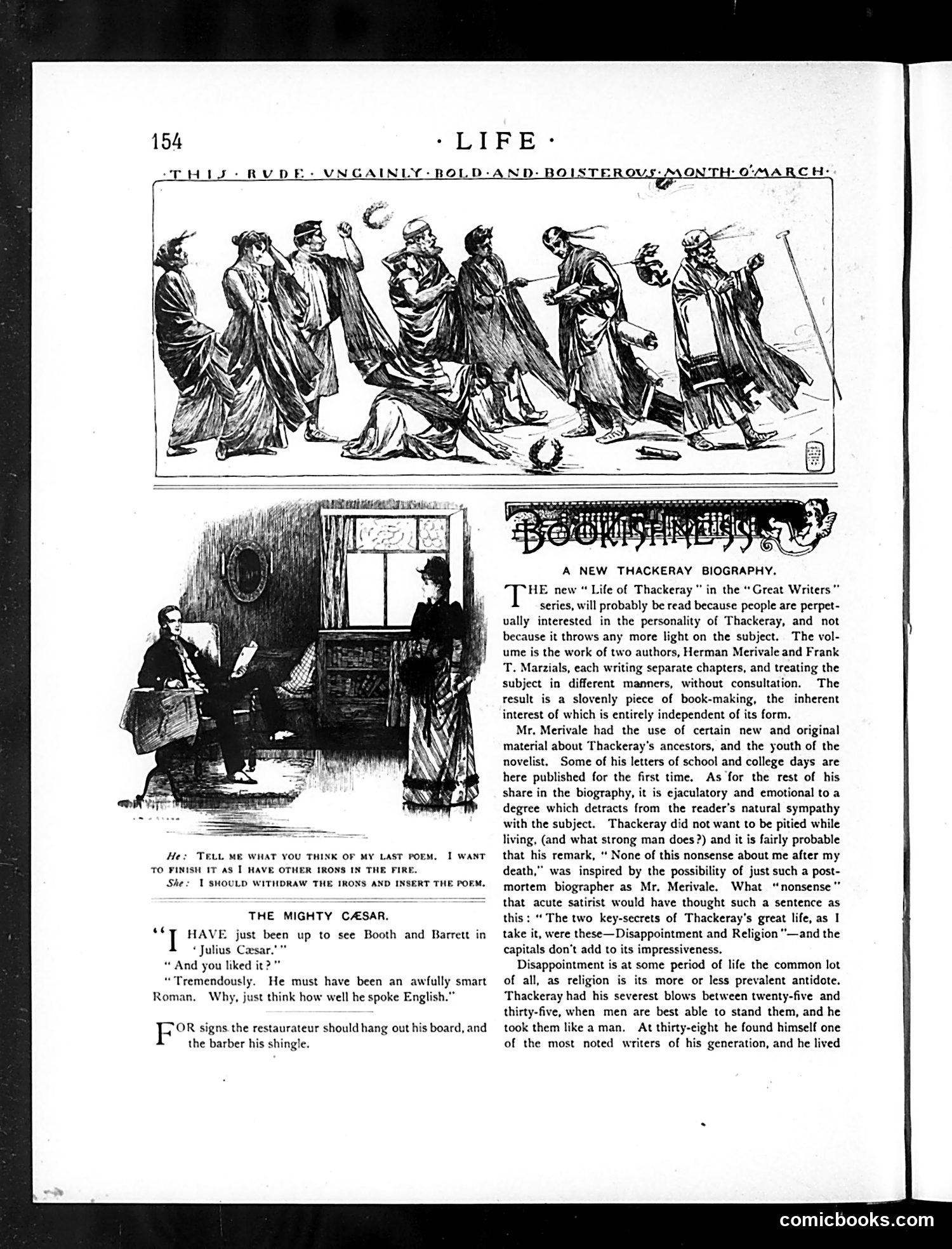
**Top Cartoon**: Depicts a rude, uncouth mob of people in March weather—poorly dressed, aggressive, and disorderly. The title indicates this represents "rude, ungainly, bold and boisterous" March itself, personified as a rowdy group rather than an individual. This is a seasonal satire common to the era, treating the month as having a "personality." **Main Content**: "Book Shelf" section reviewing a new Thackeray biography by Herman Merivale and Frank T. Marzials. The accompanying illustration shows an indoor scene, likely depicting a literary or social moment. The text discusses Thackeray's life, noting his difficulties with poverty and disappointment, published here as a serious literary review rather than satire.
📄 Transcribed text from this page (OCR, searchable)
Machine-transcribed from the original scan — historical spelling and the odd misread are preserved.
154 ‘LIFE: “7 : ye ’ J : : ID: STE ‘ J | O"MARCH: THIS: RVUDE- VNGAINLY-BOLD-AND BOISTEROUS SAON TH’ O44 RC + He: TELL ME WHAT YOU THINK OF MY LAST POEM. TO FINISH IT AS I HAVE OTHER IRONS IN THE FIRE. She: 1 SHOULD WITHDRAW THE IRONS AND INSERT THE POEM, I want THE MIGHTY CASAR, HAVE just been up to see Booth and Barrett in ‘Julius Cassar.” “And you liked it?” “Tremendously. He must have been an awfully smart Roman, Why, just think how well he spoke English.” “ For signs. the restaurateur should hang out his board, and the barber his shingle. A NEW THACKERAY BIOGRAPHY. HE new “ Life of Thackeray" in the “Great Writers” series, will probably be read because people are perpet- ually interested in the personality of Thackeray, and not because it throws any more light on the subject. The vol- ume is the work of two authors, Herman Merivale and Frank T. Marzials, each writing separate chapters, and treating the subject in different manners, without consultation. The result is a slovenly piece of book-making, the inherent interest of which is entirely independent of its form. Mr. Merivale had the use of certain new and original material about Thackeray's ancestors, and the youth of the novelist. Some of his letters of school and college days are here published for the first time. As for the rest of his share in the biography, it is ejaculatory and emotional to a degree which detracts from the reader's natural sympathy with the subject. Thackeray did not want to be pitied while living, (and what strong man does?) and it is fairly probable that his remark, ‘ None of this nonsense about me after my death,” was inspired by the possibility of just such a post- mortem biographer as Mr. Merivale. What “nonsense” that acute satirist would have thought such a sentence as this: “ The two key-secrets of Thackeray's great life, as I take it, were these—Disappointment and Religion "—and the capitals don’t add to its impressiveness. Disappointment is at some period of life the common lot of all, as religion is its more or less prevalent antidote. Thackeray had his severest blows between twenty-five and thirty-five, when men are best able to stand them, and he took them like a man. At thirty-eight he found himself one of the most noted writers of his generation, and he lived comicbooks.com