
Life, 1891-03-12 · page 4 of 14
Life — March 12, 1891 — page 4: what you’re looking at
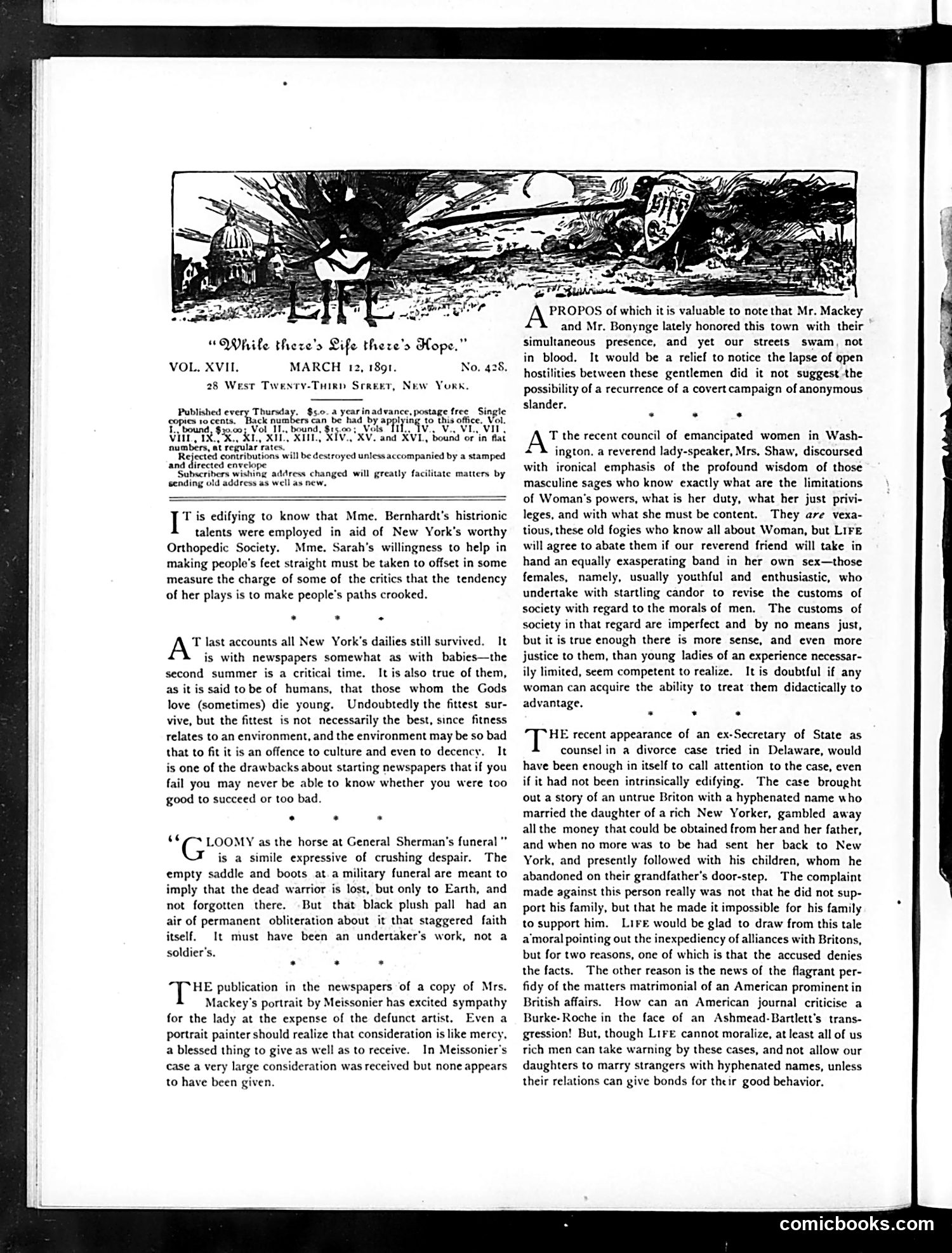
A restored page from Life, 1891-03-12. Page through the whole issue in the reader above.
📄 Transcribed text from this page (OCR, searchable)
Machine-transcribed from the original scan — historical spelling and the odd misread are preserved.
“Mhile there's Life there's Hope.” VOL. XVII. MARCH 12, 1891. No, 428. 28 West Twentv-Tuinn Srreer, New York. Published every Thursday, $5.0. a year inadvance, postage free Single gonies recenta. Back numbers can be had by applying to this ofice. Vol I. Vol 1 pund, $15.00; Vols og SV., Vi. VE, VEE. VHT Te kT Rit, SEV XV, and XVI bound or in fad numbers, at regular rat Rejected contributions will be destroyed unlessaccompanied by a stamped and directed envelope ‘Subscribers wishing address changed will greatly facilitate matters by sending old address as well as new, T is edifying to know that Mme. Bernhardt’s histrionic talents were employed in aid of New York's worthy Orthopedic Society. Mme. Sarah's willingness to help in making people's feet straight must be taken to offset in some measure the charge of some of the critics that the tendency of her plays is to make people's paths crooked. T last accounts all New York's dailies still survived. It is with newspapers somewhat as with babies—the second summer is a critical time. It is also true of them, as it is said to be of humans, that those whom the Gods love (sometimes) die young. Undoubtedly the fittest sur- vive, but the fittest is not necessarily the best, since fitness relates to an environment, and the environment may be so bad that to fit it is an offence to culture and even to decency. It is one of the drawbacks about starting newspapers that if you fail you may never be able to know whether you were too good to succeed or too bad. 6€~ LOOMY as the horse at General Sherman's funeral ” is a simile expressive of crushing despair. The empty saddle and boots at.a military funeral are meant to imply that the dead warrior is lost, but only to Earth, and not forgotten there. But that black plush pall had an air of permanent obliteration about it that staggered faith itself. It must have been an undertaker’s work, not a soldier's. . . . Tre publication in the newspapers of a copy of Mrs. Mackey’s portrait by Meissonier has excited sympathy for the lady at the expense of the defunct artist. Even a portrait painter should realize that consideration is like mercy, a blessed thing to give as well as to receive. In Meissonier's case a very large consideration was received but none appears to have been given. PROPOS of which it is valuable to note that Mr. Mackey and Mr. Bonynge lately honored this town with their simultaneous presence, and yet our streets swam, not in blood. It would be a relief to notice the lapse of open hostilities between these gentlemen did it not suggest the possibility of a recurrence of a covert campaign of anonymous slander. . . . T the recent council of emancipated women in Wash- + & ington. a reverend lady-speaker, Mrs, Shaw, discoursed with ironical emphasis of the profound wisdom of those masculine sages who know exactly what are the limitations of Woman's powers, what is her duty, what her just privi- leges, and with what she must be content. They are vexa- tious, these old fogies who know all about Woman, but LIFE will agree to abate them if our reverend friend will take in hand an equally exasperating band in her own sex—those females, namely, usually youthful and enthusiastic, who undertake with startling candor to revise the customs of society with regard to the morals of men. The customs of society in that regard are imperfect and by no means just, but it is true enough there is more sense, and even more justice to them, than young ladies of an experience necessar- ily limited, seem competent to realize. It is doubtful if any woman can acquire the ability to treat them didactically to advantage, . * . HE recent appearance of an ex-Secretary of State as counsel in a divorce case tried in Delaware, would have been enough in itself to call attention to the case, even if it had not been intrinsically edifying. The case brought out a story of an untrue Briton with a hyphenated name who married the daughter of a rich New Yorker, gambled away all the money that could be obtained from her and her father, and when no more was to be had sent her back to New York, and presently followed with his children, whom he abandoned on their grandfather's door-step. The complaint made against this person really was not that he did not sup- port his family, but that he made it impossible for his family to support him. Lire would be glad to draw from this tale amoral pointing out the inexpediency of alliances with Britons, but for two reasons, one of which is that the accused denies the facts. The other reason is the news of the flagrant per- fidy of the matters matrimonial of an American prominent in British affairs. How can an American journal criticise a Burke- Roche in the face of an Ashmead-Bartlett’s trans- gression! But, though LiFe cannot moralize, at least all of us rich men can take warning by these cases, and not allow our daughters to marry strangers with hyphenated names, unless their relations can give bonds for their good behavior. comicbooks.com 4