
Life, 1891-03-12 · page 7 of 14
Life — March 12, 1891 — page 7: what you’re looking at
What you’re looking at
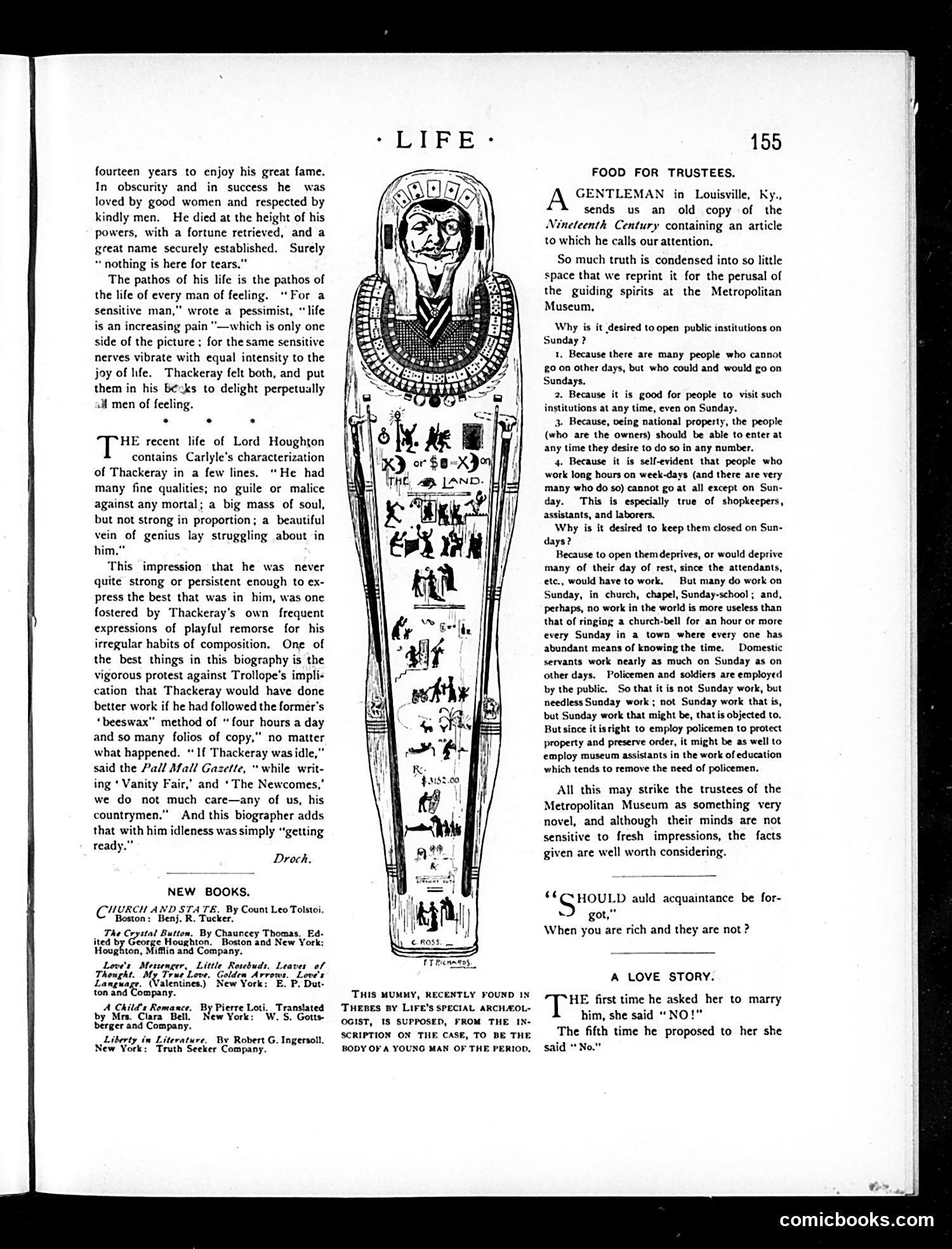
The central image is an **Egyptian mummy case** decorated with hieroglyphics and symbolic figures. This illustration accompanies the article "Food for Trustees," which discusses whether major public institutions like the Metropolitan Museum should open on Sundays. The mummy appears to be **satirical commentary on museum trustees themselves**—depicting them as antiquated, preserved relics out of touch with modern needs. The satire suggests these wealthy, conservative board members are as rigid and lifeless as the ancient artifact they curate. The article argues for Sunday access, noting that working people cannot visit museums on weekdays. The mummy-as-trustee visual joke implies these institutional leaders are figuratively "dead" to contemporary social concerns, making decisions that benefit only the privileged classes.
📄 Transcribed text from this page (OCR, searchable)
Machine-transcribed from the original scan — historical spelling and the odd misread are preserved.
fourteen years to enjoy his great fame. In obscurity and in success he was loved by good women and respected by kindly men. He died at the height of his powers, with a fortune retrieved, and a great name securely established. Surely “ nothing is here for tears.” The pathos of his life is the pathos of the life of every man of feeling. “For a sensitive man,” wrote a pessimist, “life is an increasing pain "—which is only one side of the picture ; for the same sensitive nerves vibrate with equal intensity to the joy of life. Thackeray felt both, and put them in his beaks to delight perpetually sil men of feeling. . . . HE recent life of Lord Houghton contains Carlyle’s characterization of Thackeray in a few lines. “He had many fine qualities; no guile or malice against any mortal; a big mass of soul, but not strong in proportion; a beautiful vein of genius lay struggling about in him.” This impression that he was never quite strong or persistent enough to ex- press the best that was in him, was one fostered by Thackeray's own frequent expressions of playful remorse for his irregular habits of composition, One of the best things in this biography is the vigorous protest against Trollope’s impli- cation that Thackeray would have done better work if he had followed the former's ‘beeswax” method of “four hours a day and so many folios of copy,” no matter what happened. “If Thackeray wasidle,” said the Pall Mall Gazette, “while writ- ing ‘ Vanity Fair,’ and ‘The Newcomes,’ we do not much care—any of us, his countrymen.” And this biographer adds that with him idleness was simply “getting ready.” Droch. NEW BOOKS. CHURCH AND STATE. By Count Leo Tolstoi. Boston: Benj. R. Tucker. The Crystal Button, By Chauncey Thomas. Ed- ited by George Houghton. “Boston and New ¥ Houghton, Miffiia and Company. Love's Messenger, Little Resebuds Thought. My True Love. Golden A Language. (Valentines.) New York: ton'and Company. A Child's Romance. By Pierre Loti, Translated by Mrs. Clara Bell. New York: W. S. Gotts berger and Company. Liberty in Literature, By Robert G. Ingersoll. New York: Truth Seeker Company. TT Remnaes. THIS MUMMY, RECENTLY FOUND IN Tueses BY LIFE’s SPECIAL ARCHAOL- OGIST, 1S SUPPOSED, FROM THE IN- SCRIPTION ON THE CASE, TO BE THE BODY OF A YOUNG MAN OF THE PERIOD, FOOD FOR TRUSTEES. GENTLEMAN in Louisville, Ky., sends us an old copy of the Nineteenth Century containing an article to which he calls our attention. So much truth is condensed into so little space that we reprint it for the perusal of the guiding spirits at the Metropolitan Museum, Why is it desired to open public institutions on Sunday ? 1, Because there are many people who cannot 0 on other days, but who could and would go on Sundays. 2, Because it is good for people to visit such institutions at any time, even on Sunday. 3. Because, being national property, the people (who are the owners) should be able to enter at any time they desire to do so in any number, 4. Because it is self-evident that people who work long hours on week-days (and there are very many who do so) cannot go at all except on Sun- day. This is especially true of shopkeepers, assistants, and laborers, Why is it desired to keep them closed on Sun- days? Because to open themdeprives, or would deprive many of their day of rest, since the attendants, etc., would have to work. But many do work on Sunday, in church, chapel, Sunday-school ; and, perhaps, no work in the world is more useless than that of ringing a church-bell for an hour or more every Sunday in a town where every one has abundant means of knowing the time. Domestic servants work nearly as much on Sunday as on other days, Policemen and soldiers are employed by the public, So that it is not Sunday work, but needless Sunday work ; not Sunday work that is, but Sunday work that might be, that is objected to, But since it isright to employ policemen to protect property and preserve order, it might be as well to employ museum assistants in the work of education which tends to remove the need of policemen. All this may strike the trustees of the Metropolitan Museum as something very novel, and although their minds are not sensitive to fresh impressions, the facts given are well worth considering. §©CHOULD auld acquaintance be for- “J got,” When you are rich and they are not ? A LOVE STORY. HE first time he asked her to marry him, she said “NO!” The fifth time he proposed to her she said “No.” comicbooks.com