
Life, 1891-03-12 · page 12 of 14
Life — March 12, 1891 — page 12: what you’re looking at
What you’re looking at
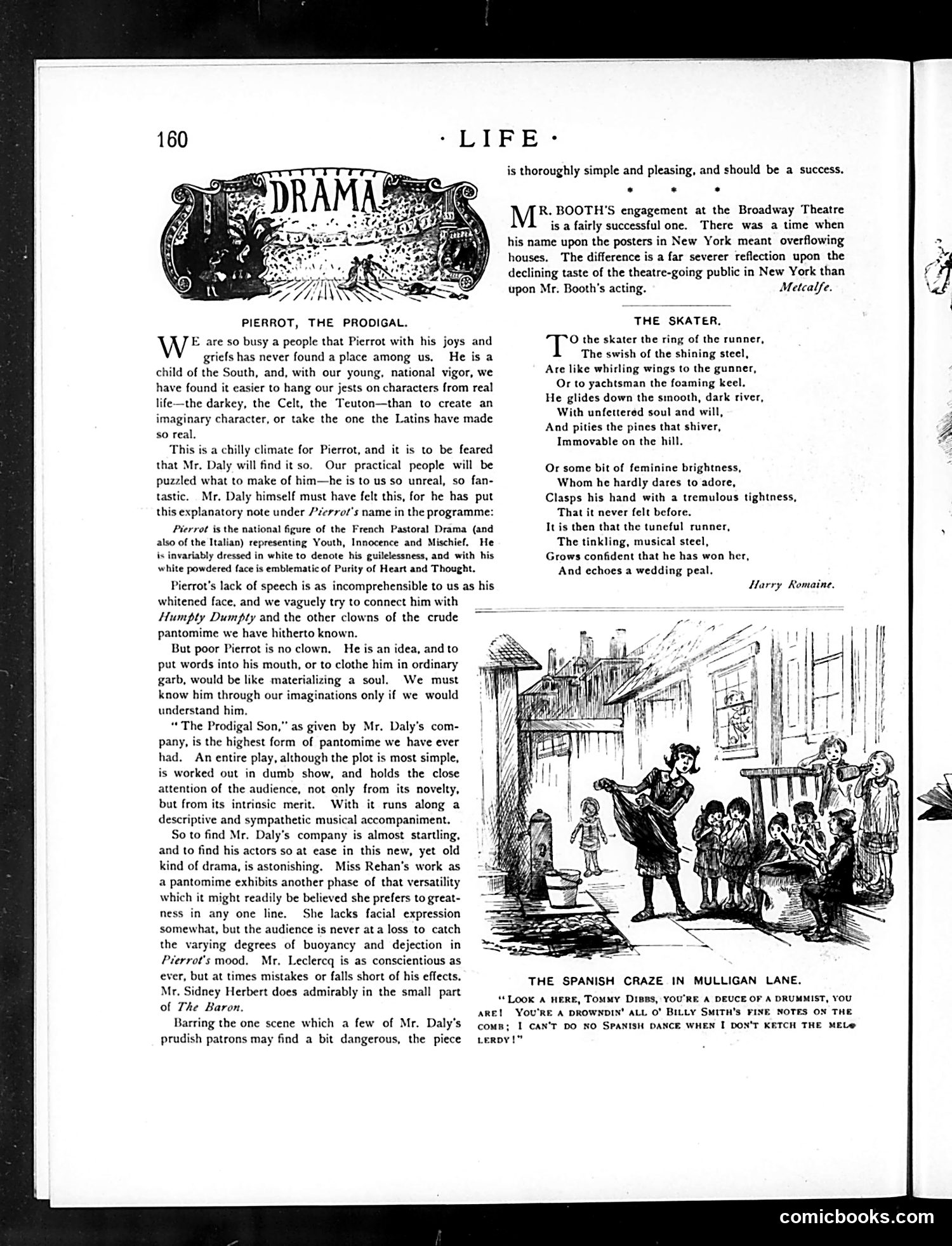
This page contains drama criticism and poetry from an American satirical magazine. The main article discusses Mr. Daly's theatrical production of "Pierrot, the Prodigal," a pantomime adaptation of the Prodigal Son story. The critic argues that Pierrot—a traditional figure from French and Italian pastoral drama representing youthful innocence—is an unsuitable subject for American audiences, whom he characterizes as practical and unaccustomed to such abstract, symbolic characters. He praises the production's execution despite these cultural obstacles, commending the cast's pantomime abilities. The page also includes a romantic poem about ice skating and a humorous illustration titled "The Spanish Craze in Mulligan Lane," depicting working-class Irish characters attempting Spanish-style music and dance, satirizing contemporary fads among immigrant communities.
📄 Transcribed text from this page (OCR, searchable)
Machine-transcribed from the original scan — historical spelling and the odd misread are preserved.
“LDF E PIERROT, THE PRODIGAL. W E are so busy a people that Pierrot with his joys and griefs has never found a place among us. He is a child of the South, and, with our young, national vigor, we have found it easier to hang our jests on characters from real life—the darkey, the Celt, the Teuton—than to create an imaginary character, or take the one the Latins have made so real. This is a chilly climate for Pierrot, and it is to be feared that Mr. Daly will find it so, Our practical people will be puzzled what to make of him—he is to us so unreal, so fan- tastic. Mr. Daly himself must have felt this, for he has put this explanatory note under /zerrof's name in the programme: Pierrot is the national Ggure of the French Pastoral Drama (and also of the Italian) representing Youth, Innocence and Mischief, He is invariably dressed in white to denote his guilelessness, and with his white powdered face is emblematic of Purity of Heart and Thought. Pierrot’s lack of speech is as incomprehensible to us as his whitened face, and we vaguely try to connect him with Humply Dumpty and the other clowns of the crude pantomime we have hitherto known. But poor Pierrot is no clown. He is an idea, and to put words into his mouth, or to clothe him in ordinary garb, would be like materializing a soul. We must know him through our imaginations only if we would understand him, “ The Prodigal Son,” as given by Mr. Daly's com- pany, is the highest form of pantomime we have ever had. An entire play, although the plot is most simple, is worked out in dumb show, and holds the close attention of the audience, not only from its novelty, but from its intrinsic merit. With it runs along a descriptive and sympathetic musical accompaniment, So to find Mr. Daly's company is almost startling, and to find his actors so at ease in this new, yet old kind of drama, is astonishing. Miss Rehan's work as a pantomime exhibits another phase of that versatility which it might readily be believed she prefers to great- ness in any one line. She lacks facial expression somewhat, but the audience is never ata loss to catch the varying degrees of buoyancy and dejection in Prerrot’s mood. Mr. Leclercq is as conscientious as ever, but at times mistakes or falls short of his effects. Mr. Sidney Herbert does admirably in the small part of The Baron, are! Barring the one scene which a few of Mr. Daly's coma; is thoroughly simple and pleasing, and should be a success, R. BOOTH’S engagement at the Broadway Theatre is a fairly successful one. There was a time when his name upon the posters in New York meant overflowing houses. The difference is a far severer reflection upon the declining taste of the theatre-going public in New York than upon Mr. Booth’s acting. Metcalfe. THE SKATER, O the skater the ring of the runner, The swish of the shining steel, Are like whirling wings to the gunner, Or to yachtsman the foaming keel. He glides down the sinooth, dark river, With unfettered soul and will, And pities the pines that shiver, Immovable on the hill. Or some bit of feminine brightness, Whom he hardly dares to adore, Clasps his hand with a tremulous tightness, That it never felt before. It is then that the tuneful runner, The tinkling, musical steel, Grows confident that he has won her, And echoes a wedding peal. Harry Romaine. THE SPANISH CRAZE IN MULLIGAN LANE. “Look A HERE, TOMMY D1BBS, YOU'RE A DEUCE OF A DRUMMIST, YOU You'RE A DROWNDIN’ ALL O° BILLY SMITH’s FINE NOTES ON THE I CAN'T DO NO SPANISH DANCE WHEN I DON'T KETCH THE MEL@ prudish patrons may find a bit dangerous, the piece Leroy!” comicbooks.com