
A complete issue · 14 pages · 1891
Life — January 29, 1891
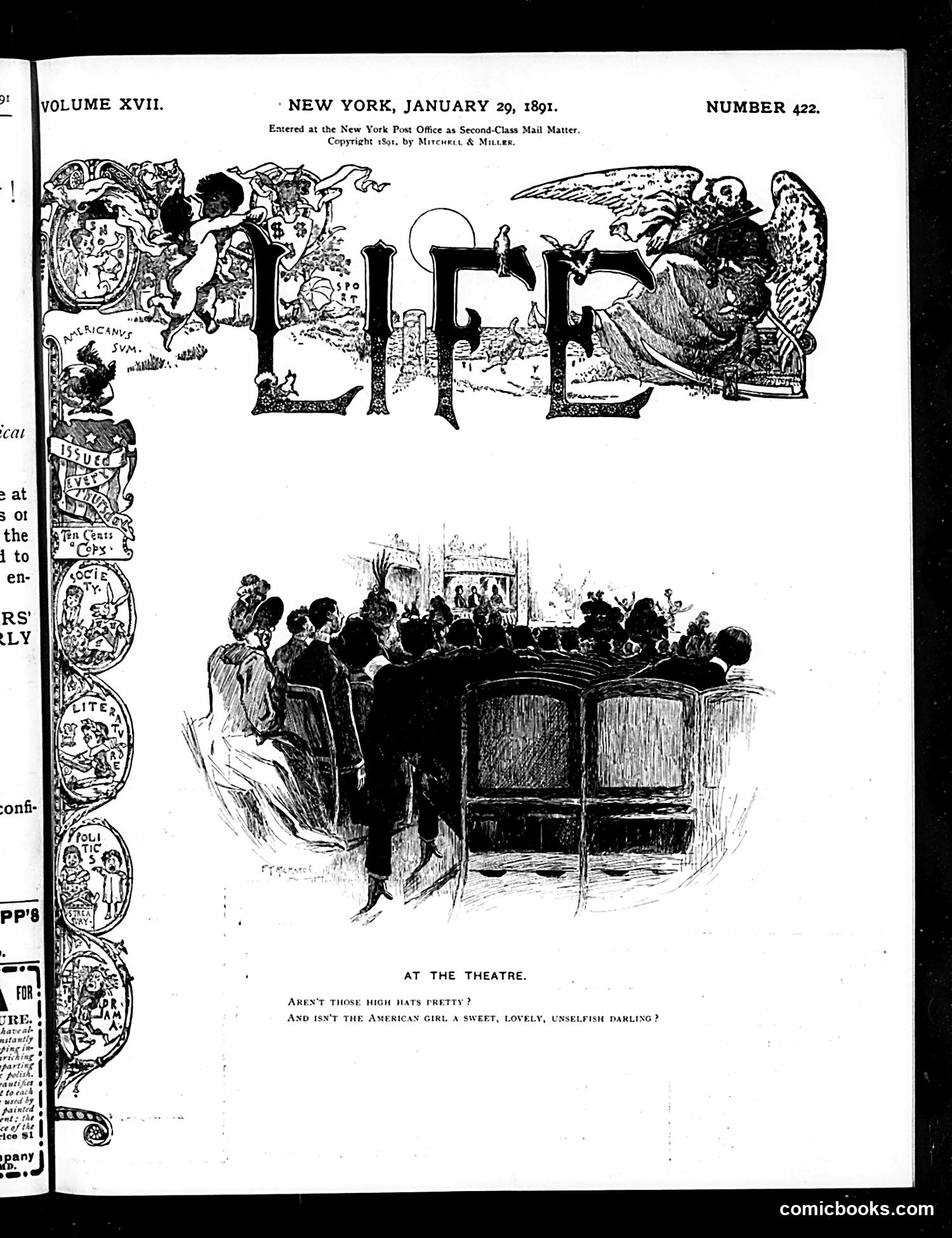
This satirical illustration comments on theater fashion and American gender roles. The sketch depicts an audience at a theater box, with the caption questioning whether those "high hats" (tall formal hats worn by men) are "pretty" and whether the American girl is a "sweet, lovely, unselfish darling." The satire appears to mock male vanity regarding fashionable headwear while simultaneously—and ironically—praising American women in a way that suggests sarcasm. The "unselfish darling" comment likely critiques the self-centeredness of American women of the era, particularly those concerned with theater-going and fashion display. The piece satirizes both sexes' preoccupation with theatrical social performance and appearance rather than substance.
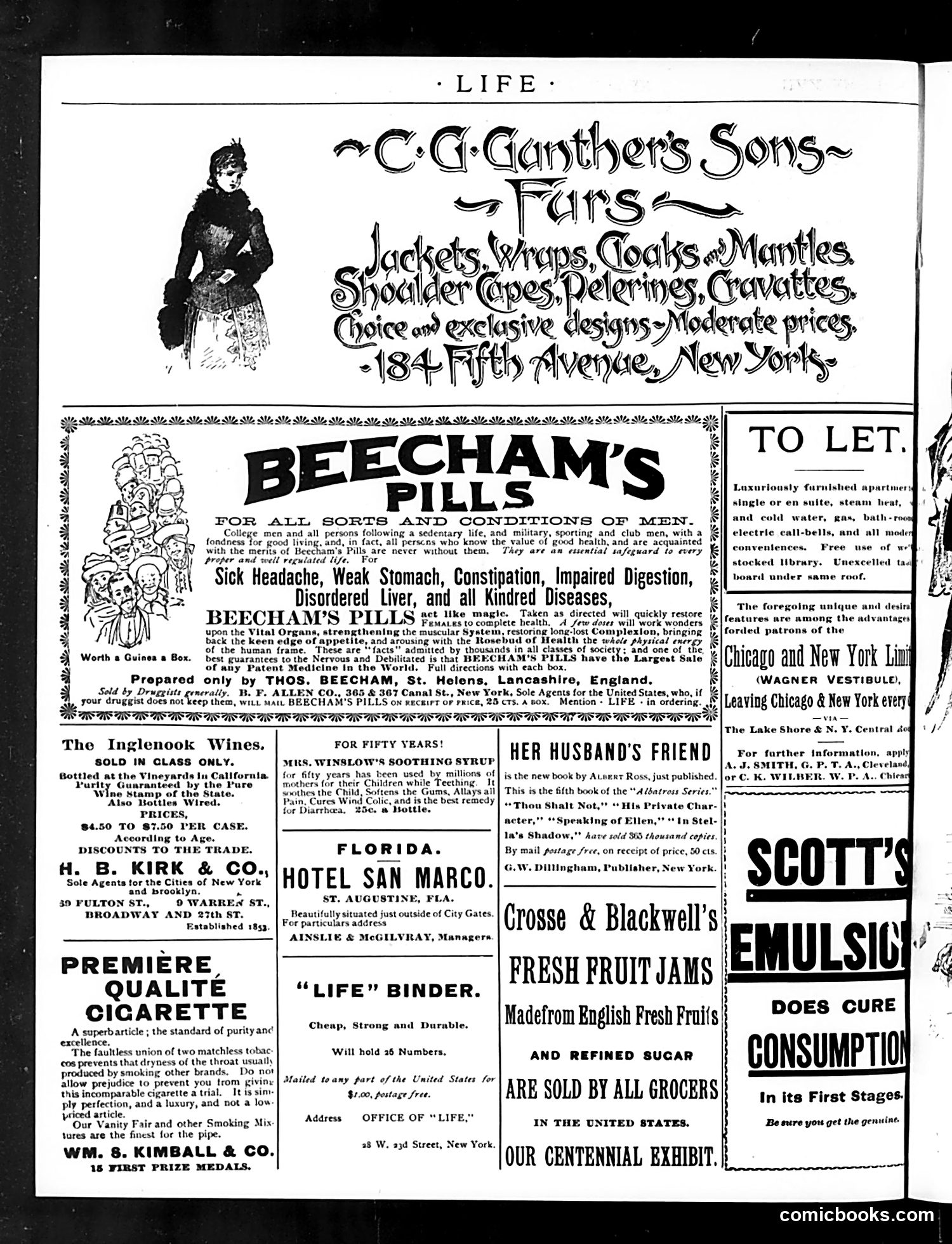
This page is **primarily advertising** from what appears to be a late 19th-century issue of *Life* magazine. The advertisements include: - **C.G. Ganthers Sons** fur fashion on Fifth Avenue - **Beecham's Pills** (a patent medicine claiming to cure digestive ailments and "kindred diseases") - **Inglenook Wines** - **Hotel San Marco** in Florida - **Scott's Emulsion** (a consumption/tuberculosis remedy) - Various other period products The single illustrated advertisement shows a fashionably-dressed woman in Victorian attire, typical of contemporary fashion advertising. There are **no political cartoons visible** on this page. The content is straightforwardly commercial, reflecting the magazine's reliance on patent medicine and luxury goods advertising—common in American publications of this era. The claims made (especially for Beecham's Pills and Scott's Emulsion) reflect pre-FDA regulation standards.
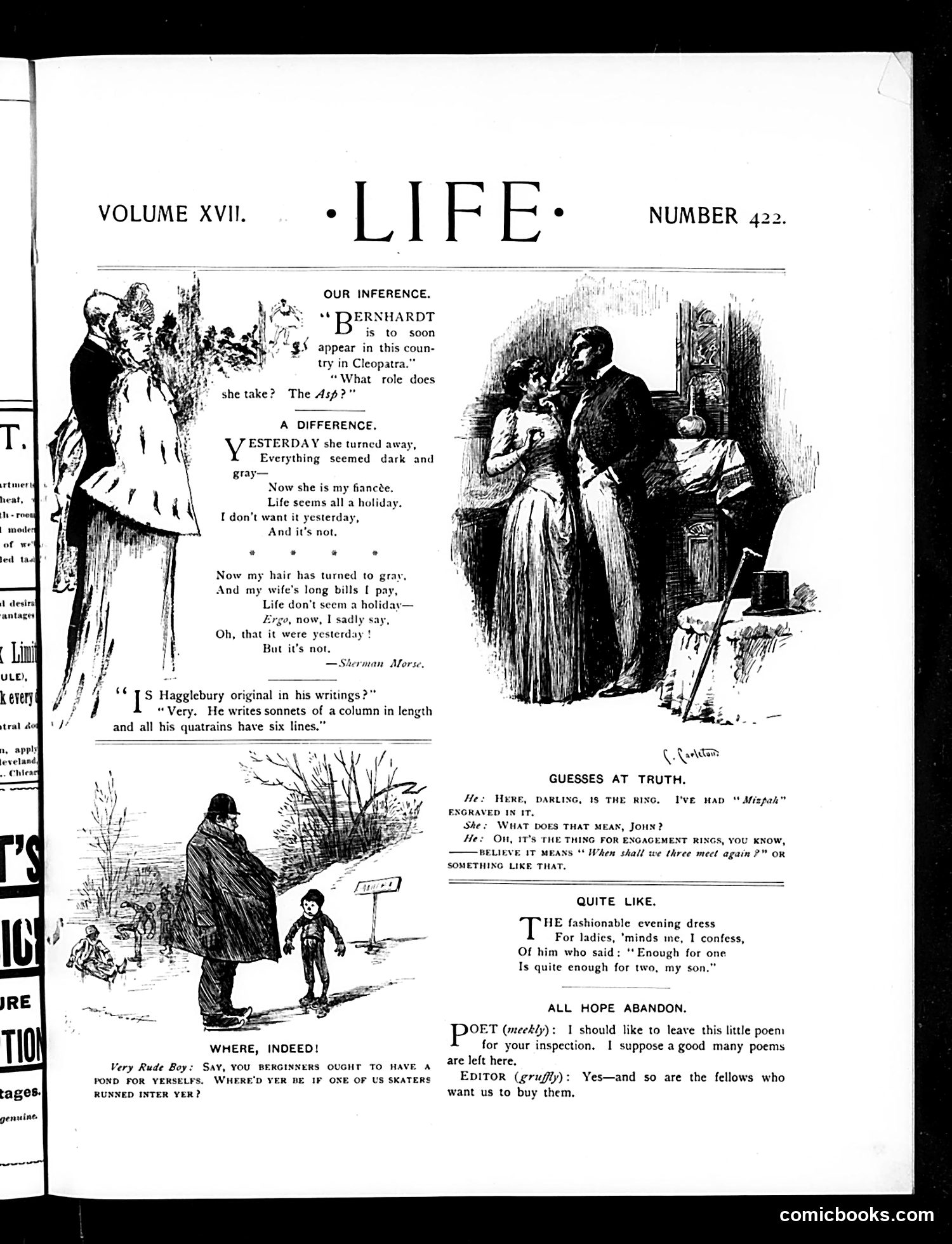
This page from *Life* (Volume XVII, Number 422) contains several brief satirical pieces and illustrations typical of the magazine's humor: **"Our Inference"** jokes about Bernhardt appearing in "Cleopatra," questioning what role she plays—a reference to the famous French actress Sarah Bernhardt. **"A Difference"** contrasts a man's mood before and after engagement, satirizing how marriage changes one's outlook on life and finances. **"Where, Indeed!"** depicts a rude boy asking about skaters, mocking poor etiquette. **"Guesses at Truth"** presents witty dialogue about engagement rings. The cartoons use sketch illustrations typical of early-20th-century satirical journalism, poking gentle fun at social conventions, marriage, theater personalities, and manners rather than addressing serious political issues.
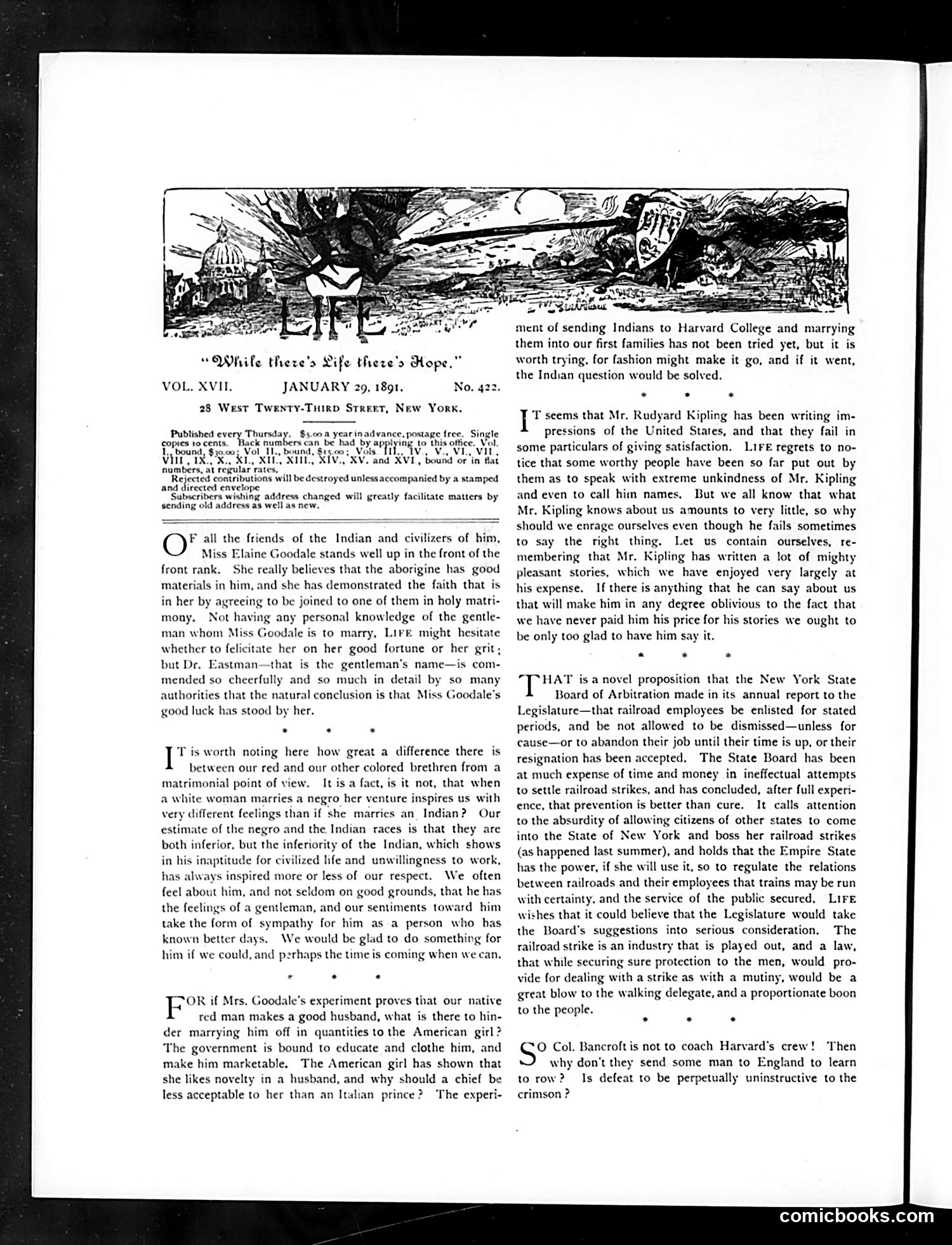
The masthead cartoon depicts a figure labeled "While there's Life there's Hope," referencing the magazine's name and satirical mission. The main editorial content discusses Rudyard Kipling's negative impressions of America and criticizes his unfairness. It defends American culture against Kipling's "extreme unkindness" and argues that Life has paid handsomely for his stories despite his complaints. Additional pieces address: Mrs. Elaine Goodale's advocacy for Native Americans and potential intermarriage with white Americans; debates about New York State's railroad labor arbitration board; and commentary on Harvard's crew coach Colonel Bancroft. The tone is characteristic of *Life*'s satirical defense of American institutions and society against foreign criticism and contemporary social controversies.
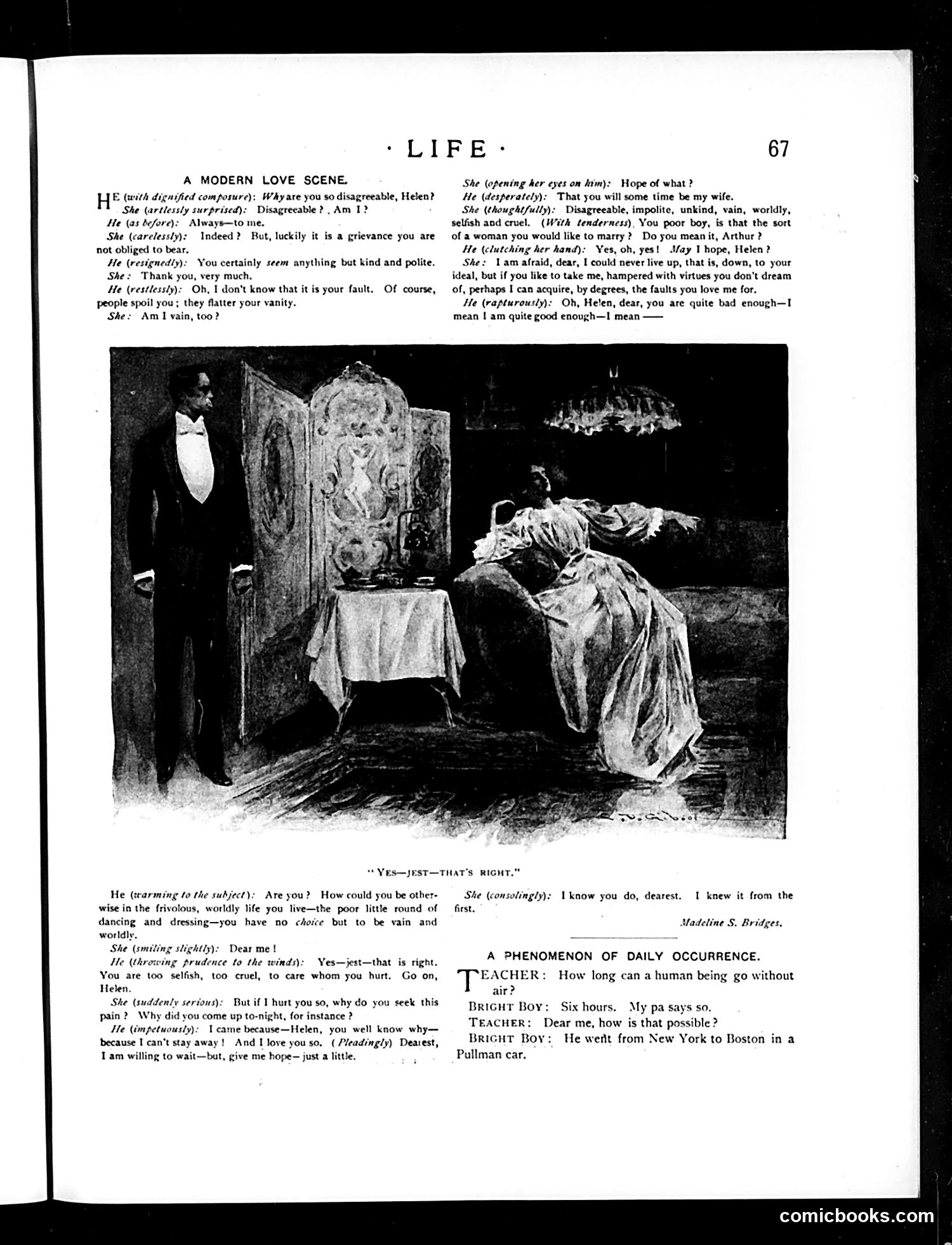
This page contains two distinct pieces: **"A Modern Love Scene"** (top): A dramatic dialogue between a couple, with an accompanying photograph showing a man in formal attire and a woman in a negligée in an intimate bedroom setting. The conversation depicts a woman refusing a marriage proposal, claiming she's unworthy—"selfish and cruel"—while the man insists she's "quite good enough." This appears to satirize contemporary romantic melodrama and the performative emotional negotiations between courting couples, poking fun at both overwrought sentimentality and self-deprecating female modesty conventions of the era. **"A Phenomenon of Daily Occurrence"** (bottom): A brief comic dialogue about a boy claiming his father traveled from New York to Boston without air. The joke plays on the impossibility of surviving without oxygen, seemingly mocking either the boy's logical reasoning or advertising claims about rapid travel. Both pieces use dialogue-driven humor typical of Life's satirical approach.
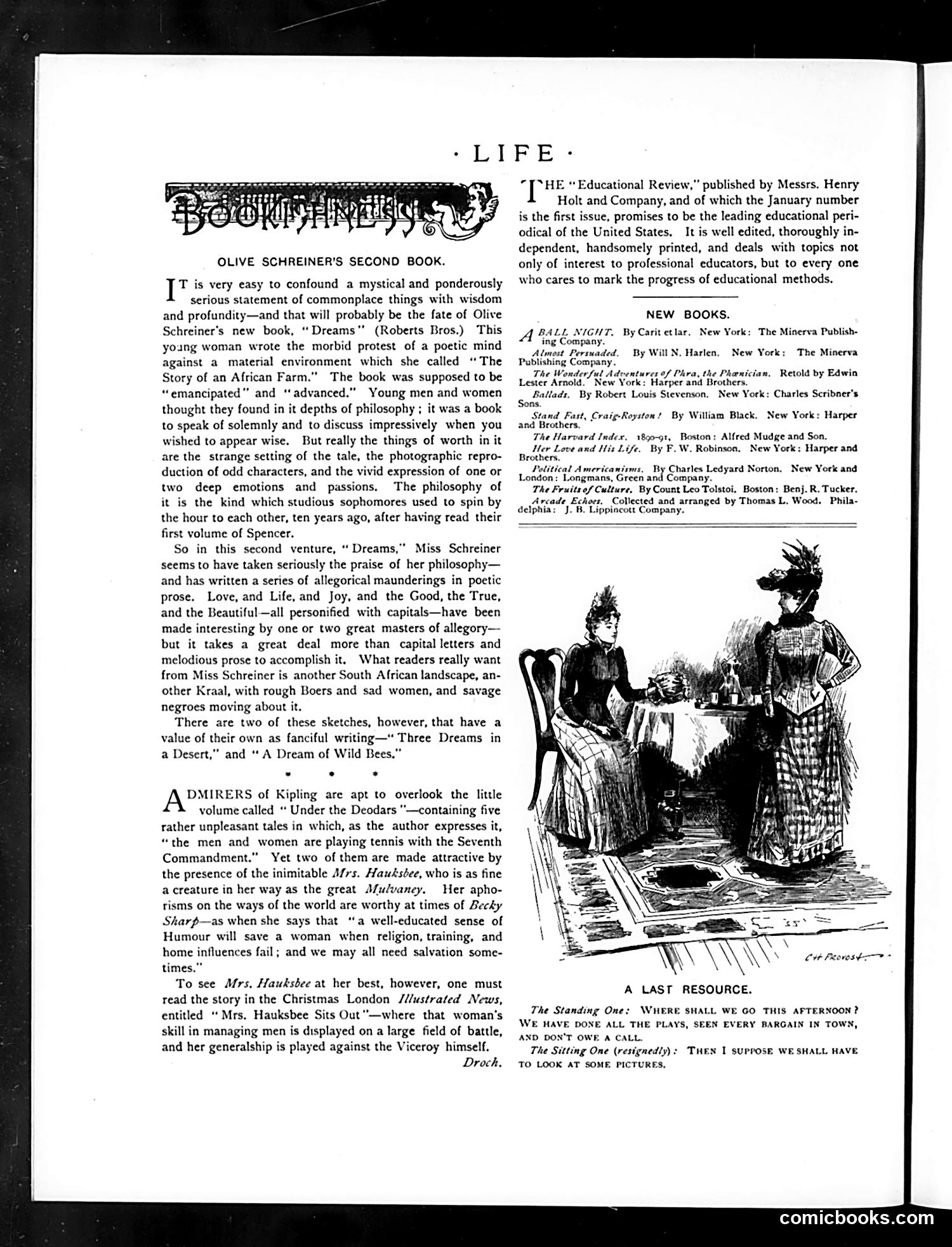
This page primarily contains book reviews rather than political cartoons. The main illustration, titled "A LAST RESOURCE," depicts two women in Victorian dress discussing afternoon plans. One suggests they've exhausted entertainment options ("done all the plays, seen every bargain in town") and proposes looking at pictures as a final resort. The satire targets upper-class leisure—the implication being that even wealthy women of leisure struggle to fill their time and resort to viewing art only as a last, desperate option. It mocks both the aimlessness of idle society life and perhaps the low cultural priority given to visual art among the fashionable set. The reviews discuss works by Kipling and Olive Schreiner, reflecting late-19th-century literary interests.
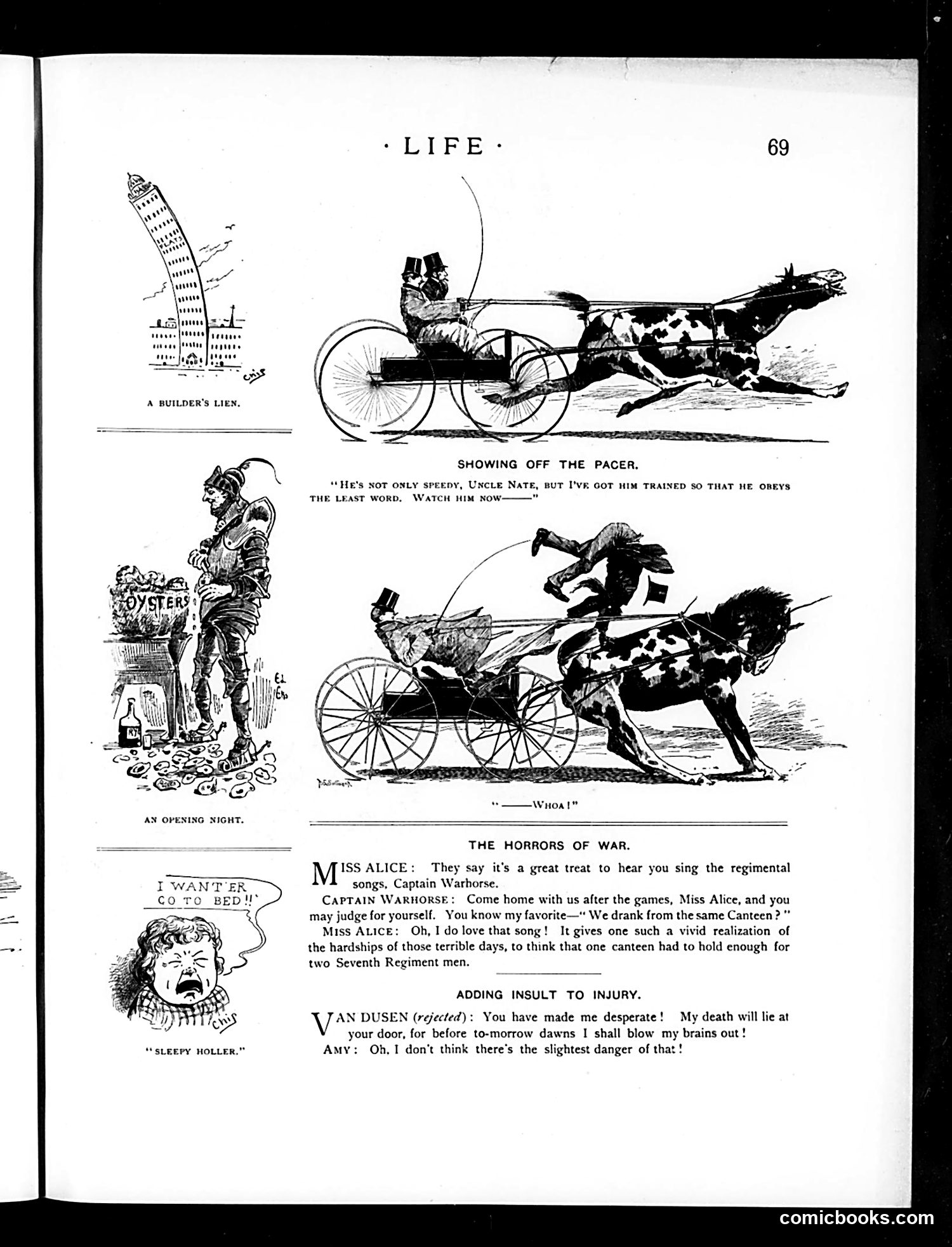
This page contains several unrelated satirical cartoons: **"A Builder's Lies"** shows a leaning skyscraper, mocking construction industry exaggerations about building stability. **"Showing off the Pacer"** depicts someone controlling a horse-drawn cart with an exaggerated whip, captioned about training an animal to obey. This is absurdist humor about dominance. **"An Opening Night"** shows an elaborately dressed figure at what appears to be an oyster bar—likely mocking theatrical opening-night excess and pretension. **"The Horrors of War"** presents dialogue between Miss Alice and Captain Warhorse about regimental songs, satirizing romanticized military culture and the disconnect between civilian and soldier experiences. **"Adding Insult to Injury"** depicts Van Dusen threatening suicide over romantic rejection, mocking melodramatic male responses to female refusal. The page is typical early-20th-century satirical humor targeting social pretension and absurd behavior.
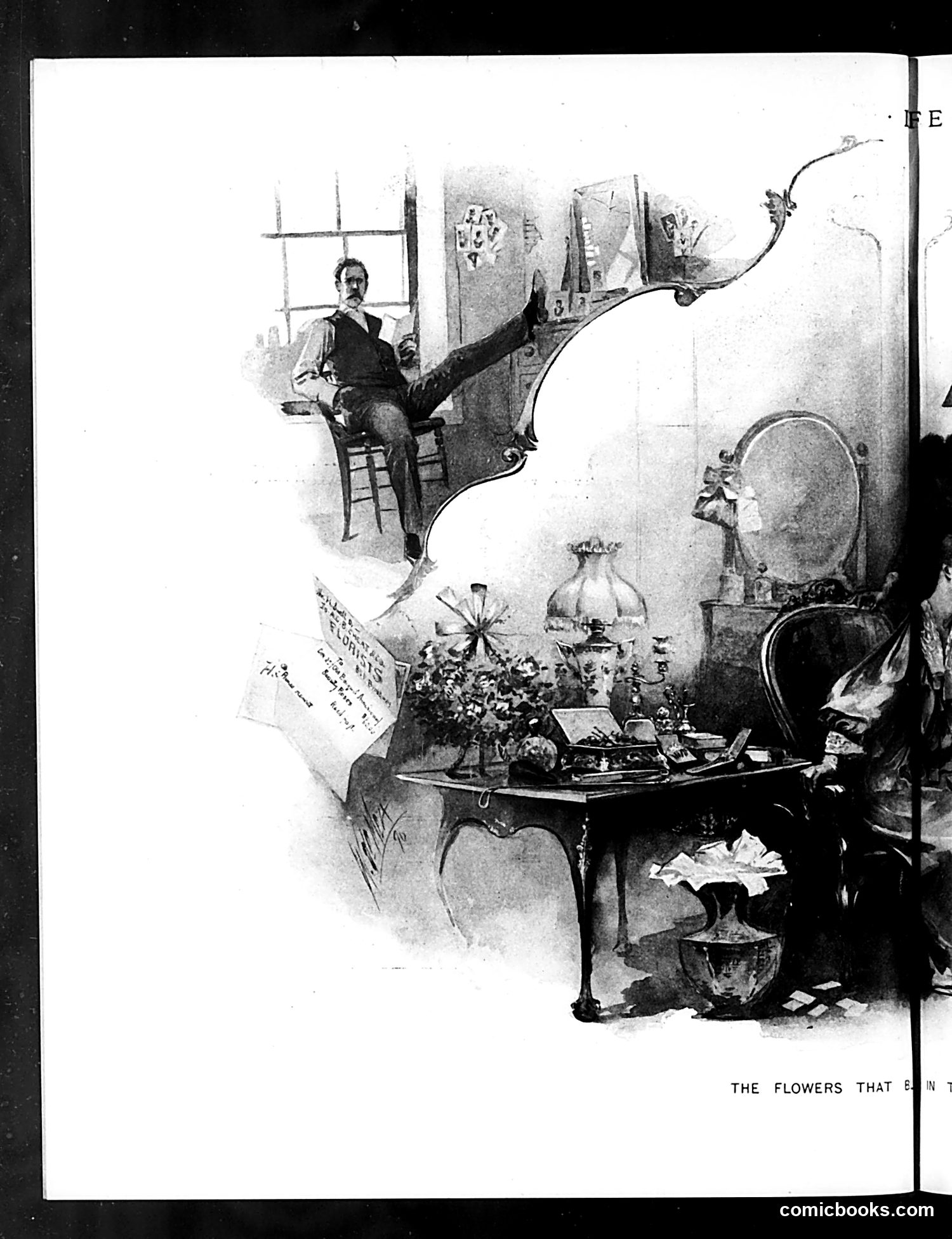
This appears to be a satirical illustration titled "The Flowers That Be in..." (text cuts off). The image depicts a man seated precariously on an enormous chair leg or piece of furniture, kicking his feet in an exaggerated, undignified pose. He's positioned above a cluttered desk or table containing flowers, decorative objects, and writing materials. The satire likely mocks someone's pretensions or unstable position—the precarious perch suggests vulnerability despite surrounding luxuries or status symbols. The flowers may reference affectation or vanity. Without the complete caption or publication date, the specific political or social target remains unclear, though the style suggests early-to-mid 20th century American satirical commentary on social pretension or political instability.
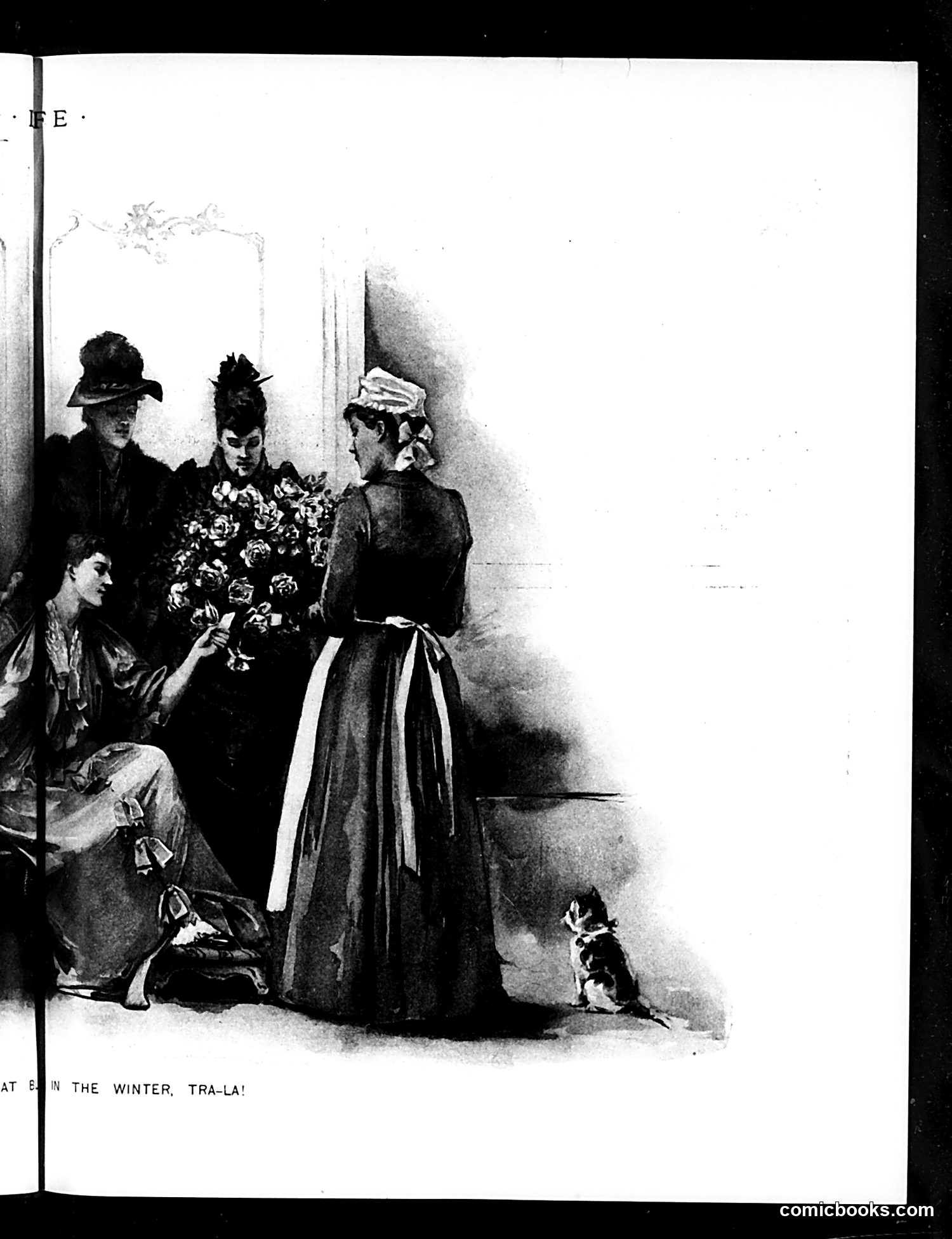
This appears to be a satirical illustration titled "In the Winter, Tra-La!" depicting fashionable women of the late 19th or early 20th century in winter attire. The cartoon shows four elegantly dressed women gathered together, with one seated holding flowers while others stand nearby wearing elaborate hats, coats, and accessories typical of the period. A small dog is also present. The satire likely mocks the excessive ornamentation and impracticality of upper-class winter fashion—particularly the elaborate hats and heavy clothing worn more for social display than warmth. The cheerful "Tra-La!" suggests ironic commentary on the frivolous attitudes of wealthy women prioritizing fashionable appearance over comfort during winter. Life magazine frequently satirized such vanities of the social elite.
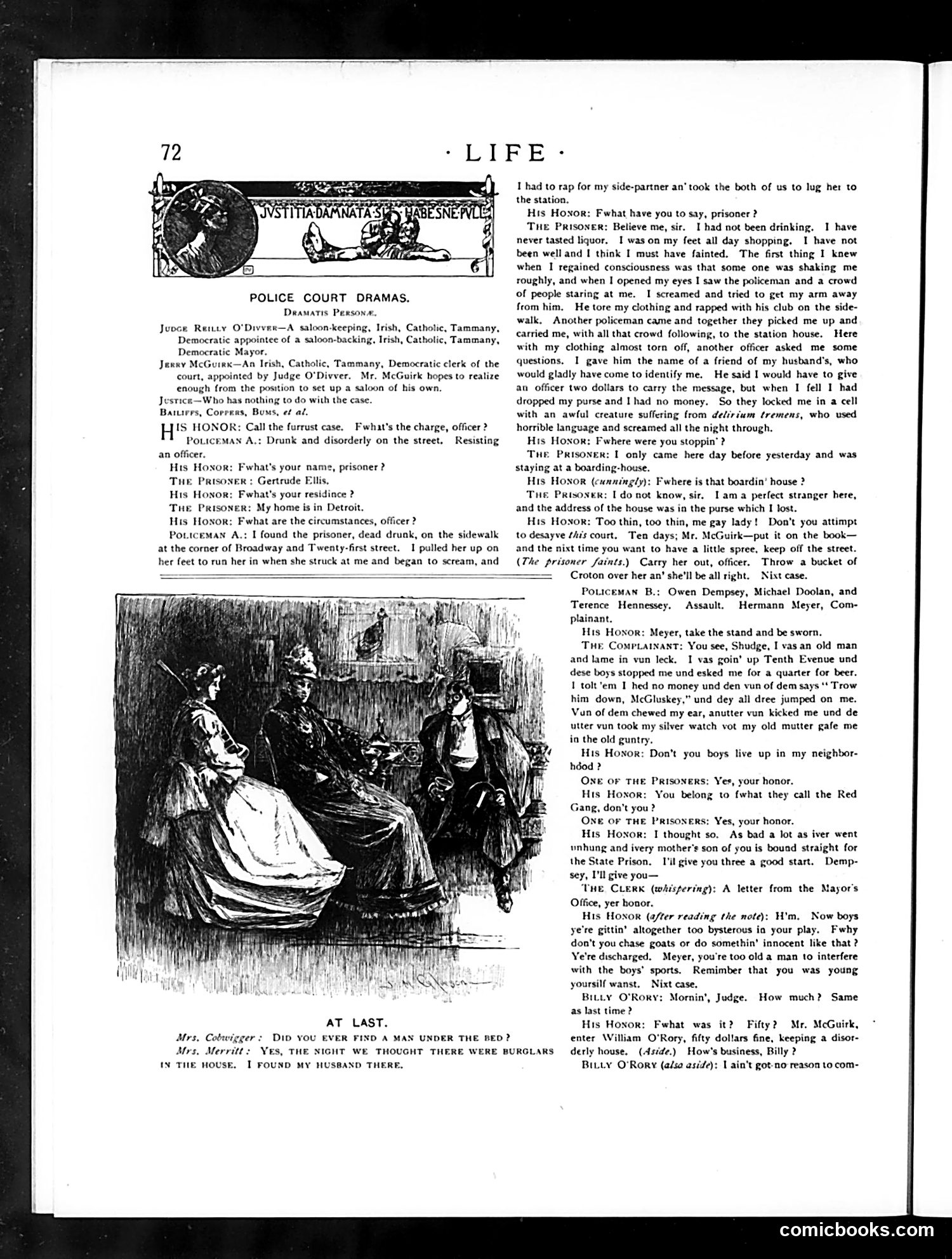
This page satirizes the judicial theater of police courts through scripted dramatic dialogue. The content mocks how police court proceedings resembled theatrical performances, with judges, officers, and defendants playing predictable roles. The illustrated scene ("At Last") depicts a woman confronting another woman under a bed—likely referencing domestic scandal or infidelity cases common in police court testimony of the era. The dramatic persons listed include Judge Reilly O'Dwyer and other court figures portrayed as stock characters. The satirical dialogue shows the repetitive, formulaic nature of cases: drunkenness charges, assault, disorderly conduct. The humor targets how these proceedings became entertainment spectacles, with judges treating them as moral melodramas rather than serious judicial matters. The page suggests police courts were less about justice and more about public performance and moralistic judgment.
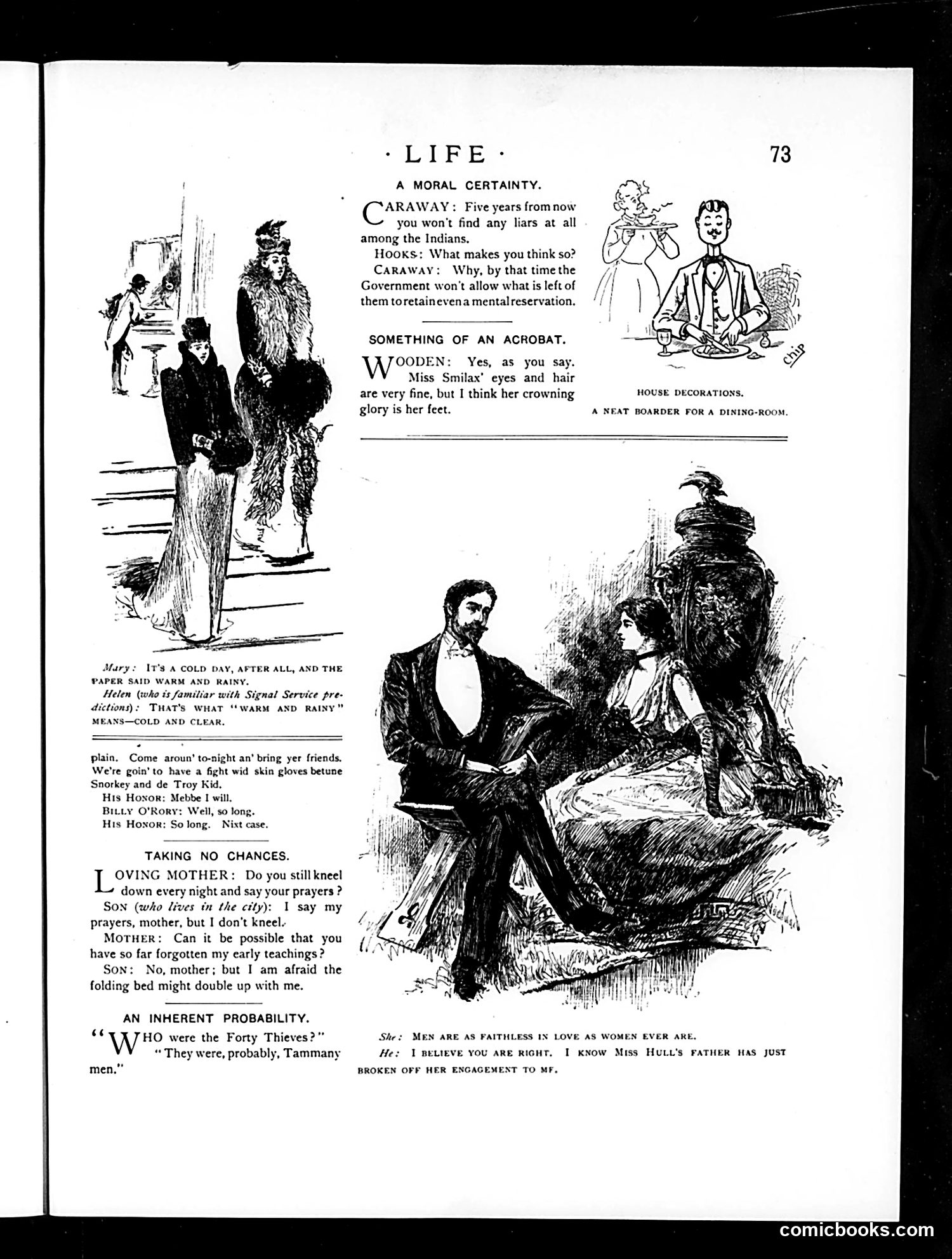
This page contains several brief satirical dialogues and sketches typical of Life's humor format: **"A Moral Certainty"** mocks Native Americans, with Caraway claiming Indians will become liars once the government confines them to reservations—a darkly cynical commentary on U.S. Indian policy. **"Something of an Acrobat"** jokes about a woman named Miss Similax, with Wooden praising her feet over her face—shallow commentary on female beauty standards. **"Taking No Chances"** presents a mother-son exchange about prayer and folding beds, playing on working-class anxieties. **"An Inherent Probability"** references the "Forty Thieves" (unclear context) but seems to be a joke about infidelity. The larger illustration depicts a romantic scene with a couple and ornate furniture, captioned about broken engagements and male faithlessness in love.
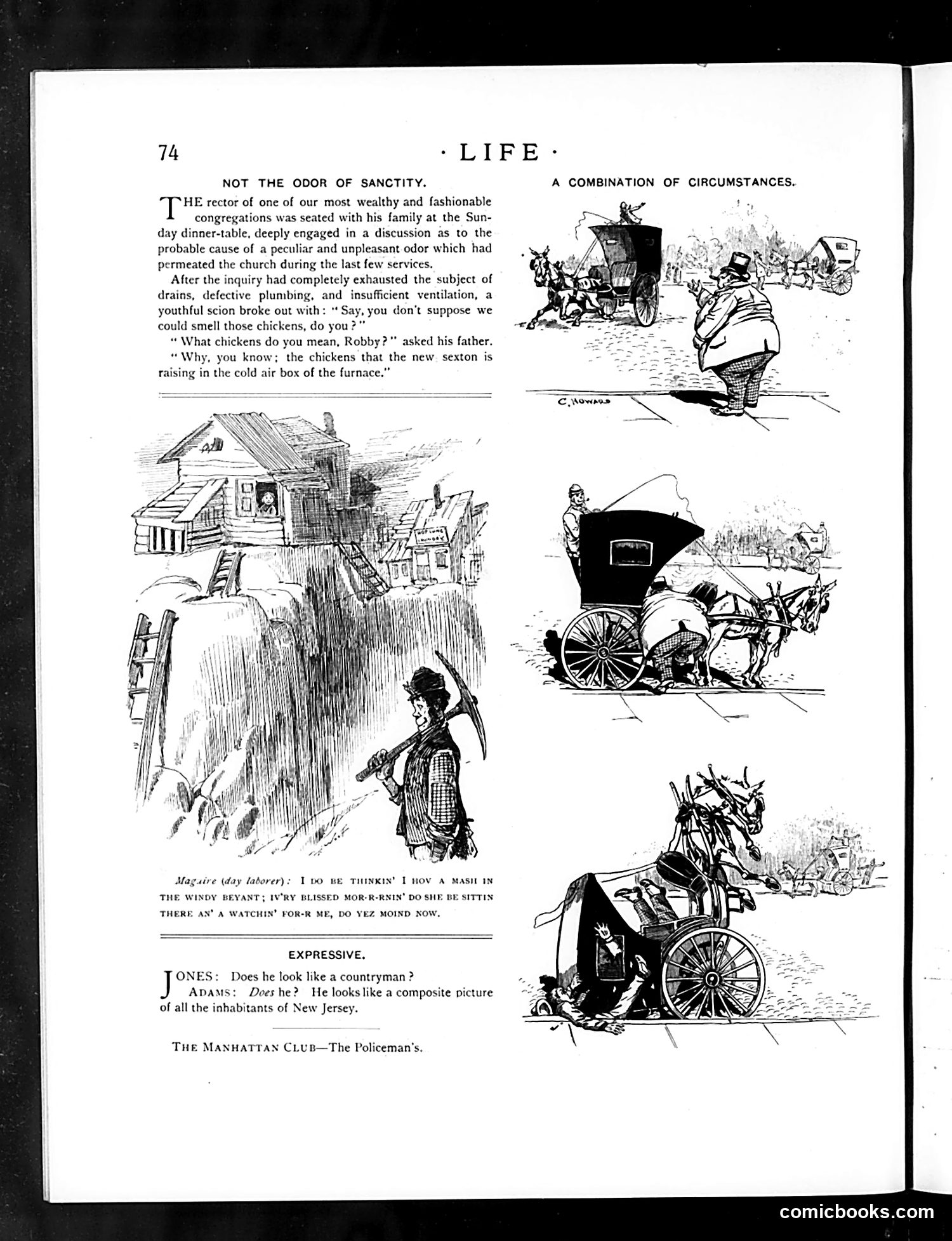
This page contains two separate satirical pieces from *Life* magazine: **"Not the Odor of Sanctity"**: A humor piece mocking hypocrisy in wealthy churches. A rector's family discusses an unpleasant smell in their fashionable congregation, only to discover the new church sexton (caretaker) is illegally raising chickens in the church furnace's cold air box for extra income. The title's ironic reference to "odor of sanctity" (a phrase for spiritual purity) undercuts the pretense of the wealthy congregation. **"Expressive" & "A Combination of Circumstances"**: Two brief jokes. The first jokes that an Irishman (Maguire, depicted with stereotypical dialect) looks like "a composite picture of all the inhabitants of New Jersey"—satirizing New Jersey's rough reputation. The accompanying sketches show various lower-class people with horses and carts, illustrating the crude social types being mocked. The overall theme targets class hypocrisy and ethnic stereotyping common to late-19th-century American humor.
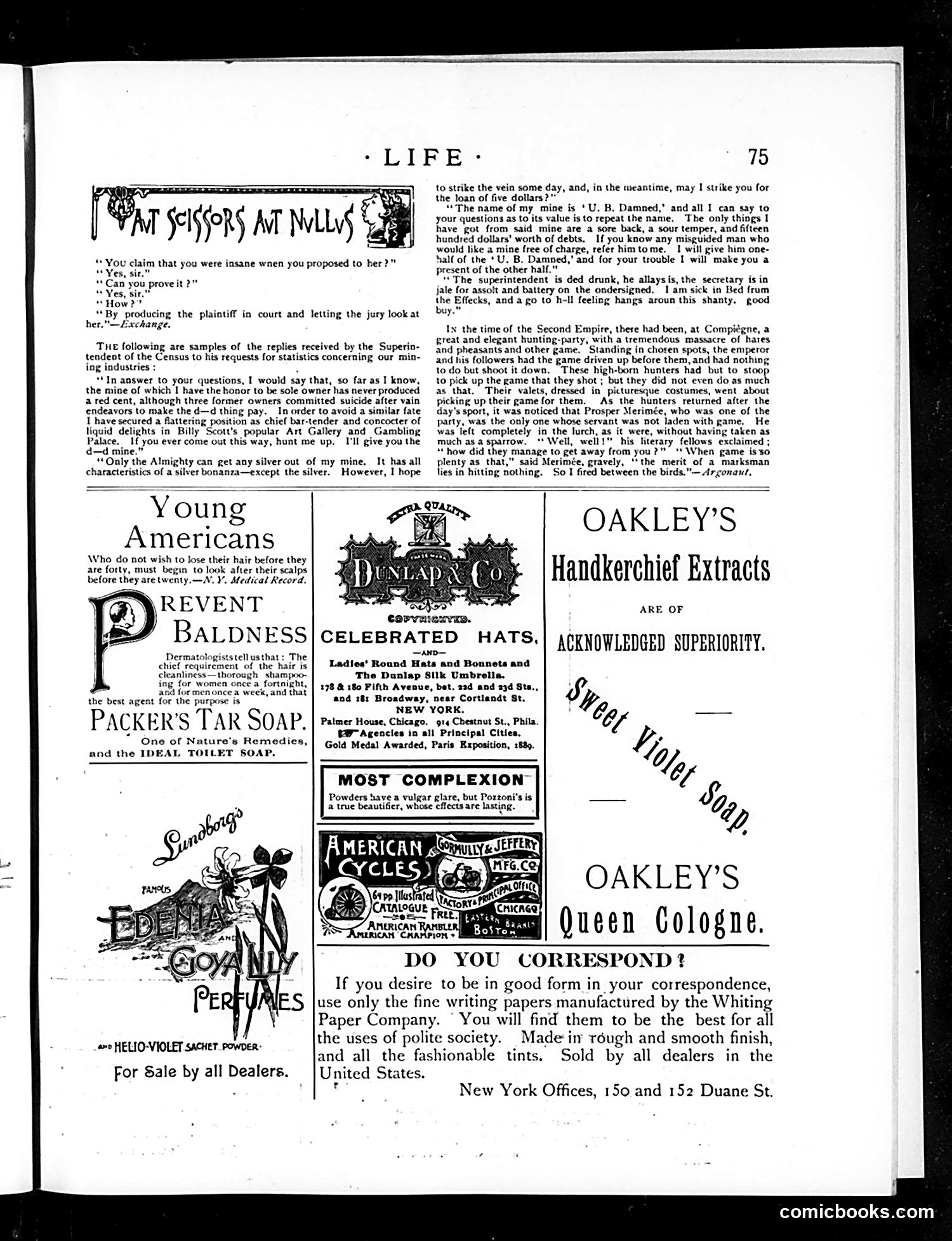
This page contains three distinct elements: **The Main Cartoon** (top): A legal joke about insanity. A man sued for breach of promise argues he was insane when proposing marriage. When asked for proof, he offers to produce the plaintiff in court—implying that seeing her would demonstrate his insanity to any jury. The humor relies on a misogynistic stereotype about women's unattractiveness. **Mining Industry Satire** (center): Humorous "census replies" from mine owners describing worthless operations. They catalog failed ventures, suicides, debts, and complete lack of silver or profit—all written in deliberately crude, exaggerated dialect. The satire targets both the mining industry's speculative fraud and the government's census-gathering efforts. **Advertisements** (bottom half): For baldness prevention (Packer's Tar Soap), Dunlap hats, writing paper, and fragrances. These are standard period advertisements. The page primarily showcases satirical humor about failed enterprises and legal absurdities typical of *Life* magazine's early editorial approach.
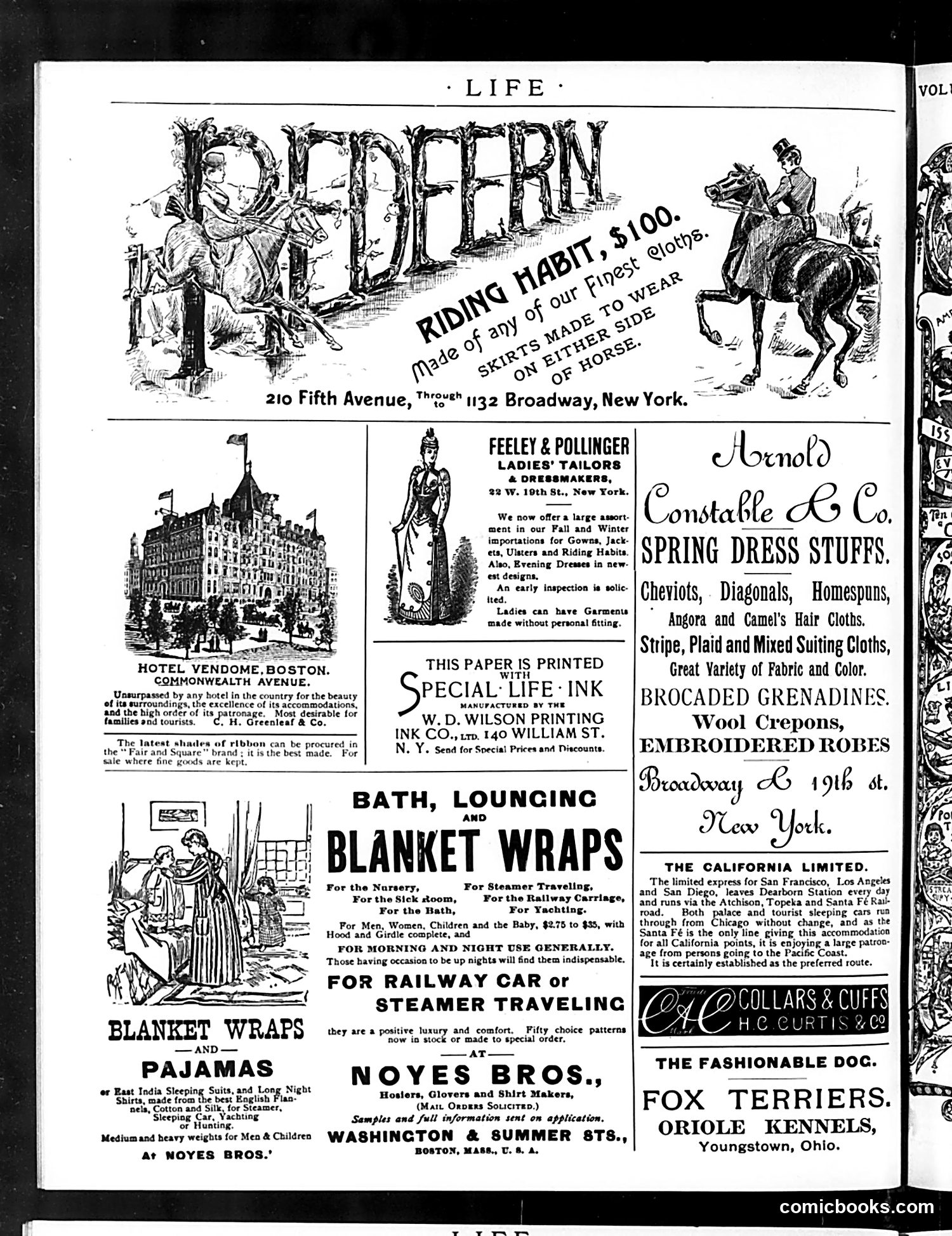
This is primarily an **advertising page** from Life magazine, not a satirical cartoon page. The upper third features a decorative advertisement for "De Fern" riding habits ($100, made-to-measure clothing) at a New York shop, illustrated with period engravings of women on horseback. The rest consists of commercial advertisements for luxury goods and services typical of the era: tailoring and dressmaking services, fabrics and clothing, hotels (Hotel Vendome in Boston), blanket wraps and pajamas, printing ink, rail travel (the California Limited train), and dog kennels specializing in fox terriers. **Context for modern readers:** This reflects late 19th-century consumer culture—high-end clothing was custom-made, travel by rail was the primary long-distance option, and specialized commercial breeding of dogs was an established luxury market. The page demonstrates how Life monetized its readership through advertisements targeting affluent, urban audiences.