
Life, 1891-01-29 · page 4 of 14
Life — January 29, 1891 — page 4: what you’re looking at
What you’re looking at
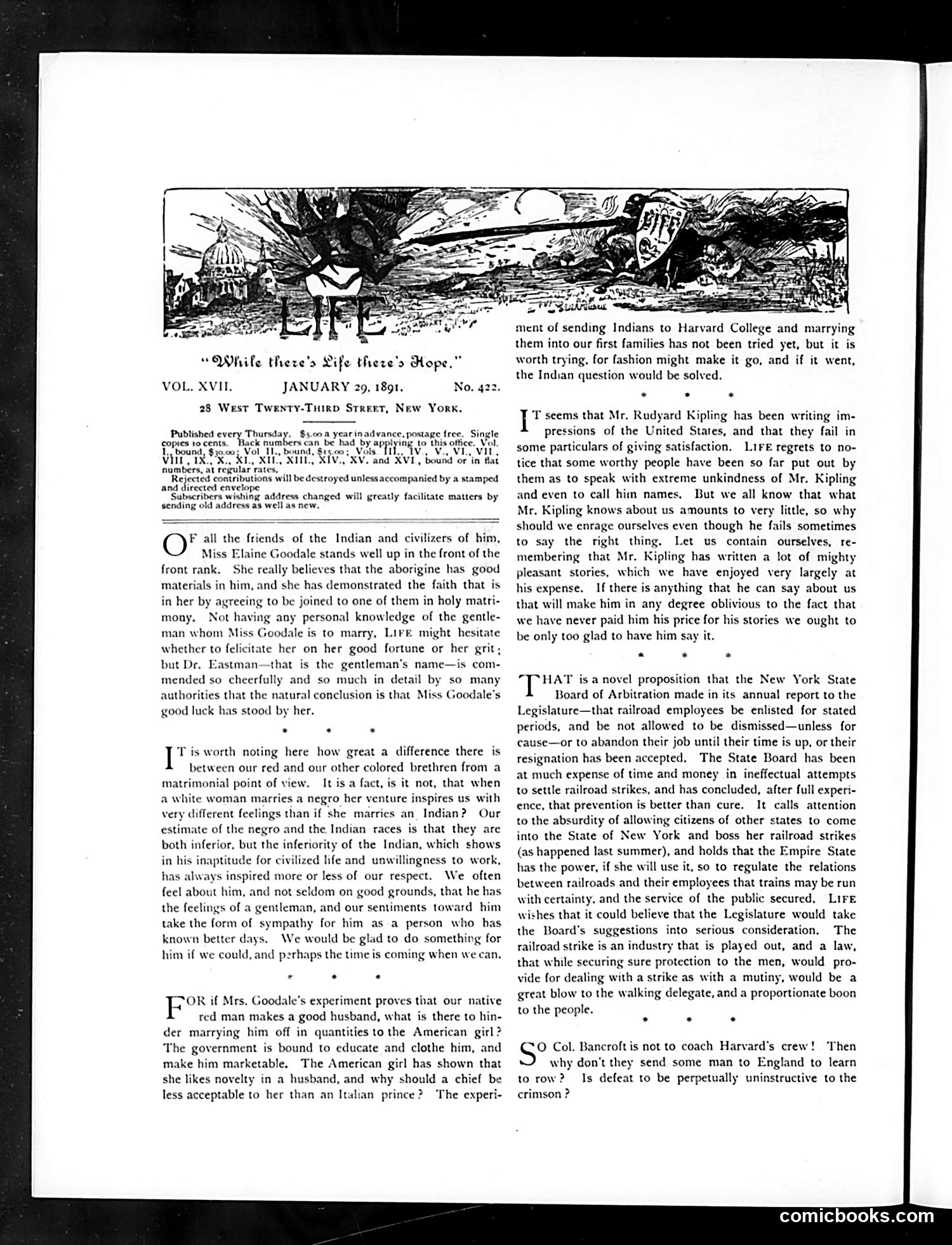
The masthead cartoon depicts a figure labeled "While there's Life there's Hope," referencing the magazine's name and satirical mission. The main editorial content discusses Rudyard Kipling's negative impressions of America and criticizes his unfairness. It defends American culture against Kipling's "extreme unkindness" and argues that Life has paid handsomely for his stories despite his complaints. Additional pieces address: Mrs. Elaine Goodale's advocacy for Native Americans and potential intermarriage with white Americans; debates about New York State's railroad labor arbitration board; and commentary on Harvard's crew coach Colonel Bancroft. The tone is characteristic of *Life*'s satirical defense of American institutions and society against foreign criticism and contemporary social controversies.
📄 Transcribed text from this page (OCR, searchable)
Machine-transcribed from the original scan — historical spelling and the odd misread are preserved.
“While there's Life there's Hope.” VOL. XVII. JANUARY 29, 1891. 28 West Twenty-Tuirp Street, New York. No. 422. Published ever copies 10 cents. bound, $32 Thursday. $5.00 year inadvance, postage free. Single Back numbers can be had by applying to this office. Vol. i Jol_I1., bound, $15.00; V: y. V. Vi, VIL, VHT, IX. X., XL, X an XIV, bound of in flat numbers, at regular rates, Rejected contributions will be destroyed unless accompanied by a stamped and directed envelope Subscribers wishing address changed wi sending old address as well as new. Sul Maly ve and XVI, greatly facilitate matters by all the friends of the Indian and civilizers of him, Miss Elaine Goodale stands well up in the front of the front rank. She really believes that the aborigine has good materials in him, and she has demonstrated the faith that is in her by agreeing to be joined to one of them in holy matri- mony. Not having any personal knowledge of the gentle man whom Miss Goodale is to marry, LIFE might hesitate whether to felicitate her on her good fortune or her grit; but Dr. Eastman—that is the gentleman’s name—is com- mended so cheerfully and so much in detail by so many authorities that the natural conclusion is that Miss Goodale’s good luck has stood by her. I" is worth noting here how great a difference there is between our red and our other colored brethren from a matrimonial point of view. It is a fact, is it not, that when a white woman marries a negro her venture inspires us with very different feelings than if she marries an Indian? Our estimate of the negro and the. Indian races is that they are both inferior, but the inferiority of the Indian, which shows in his inaptitude for civilized life and unwillingness to work, has always inspired more or less of our respect. We often feel about him, and not seldom on good grounds, that he has the feelings of a gentleman, and our sentiments toward him take the form of sympathy for him as a person who has known better days. We would be glad to do something for him if we could, and perhaps the time is coming when we can, Fe if Mrs. Goodale’s experiment proves that our native red man makes a good husband, what is there to hin- der marrying him off in quantities to the American girl? The government is bound to educate and clothe him, and make him marketable. The American girl has shown that she likes novelty in a husband, and why should a chief be less acceptable to her than an Italian prince? ‘The experi- ment of sending Indians to Harvard College and marrying them into our first families has not been tried yet, but it is worth trying, for fashion might make it go, and if it went, the Indian question would be solved. jie seems that Mr, Rudyard Kipling has been writing im- pressions of the United States, and that they fail in some particulars of giving satisfaction. LiFe regrets to no- tice that some worthy people have been so far put out by them as to speak with extreme unkindness of Mr. Kipling and even to call him names. But we all know that what Mr. Kipling knows about us amounts to very little, so why should we enrage ourselves even though he fails sometimes to say the right thing. Let us contain ourselves, re- membering that Mr. Kipling has written a lot of mighty pleasant stories, which we have enjoyed very largely at his expense. If there is anything that he can say about us that will make him in any degree oblivious to the fact that we have never paid him his price for his stories we ought to be only too glad to have him say it. . . * iC Gears is a novel proposition that the New York State Board of Arbitration made in its annual report to the Legislature—that railroad employees be enlisted for stated periods, and be not allowed to be dismissed—unless for cause—or to abandon their job until their time is up, or their resignation has been accepted, The State Board has been at much expense of time and money in ineffectual attempts to settle railroad strikes, and has concluded, after full experi- ence, that prevention is better than cure. It calls attention to the absurdity of allowing citizens of other states to come into the State of New York and boss her railroad strikes (as happened last summer), and holds that the Empire State has the power, if she will use it, so to regulate the relations between railroads and their employees that trains may be run with certainty, and the service of the public secured. LIFE wishes that it could believe that the Legislature would take the Board's suggestions into serious consideration, The railroad strike is an industry that is played out, and a law, that while securing sure protection to the men, would pro- vide for dealing with a strike as with a mutiny, would be a great blow to the walking delegate, and a proportionate boon to the people. ° . ~O Col. Bancroft is not to coach Harvard's crew! Then why don’t they send some man to England to learn to row? Is defeat to be perpetually uninstructive to the crimson ? comicbooks.com