
Life, 1891-01-29 · page 6 of 14
Life — January 29, 1891 — page 6: what you’re looking at
What you’re looking at
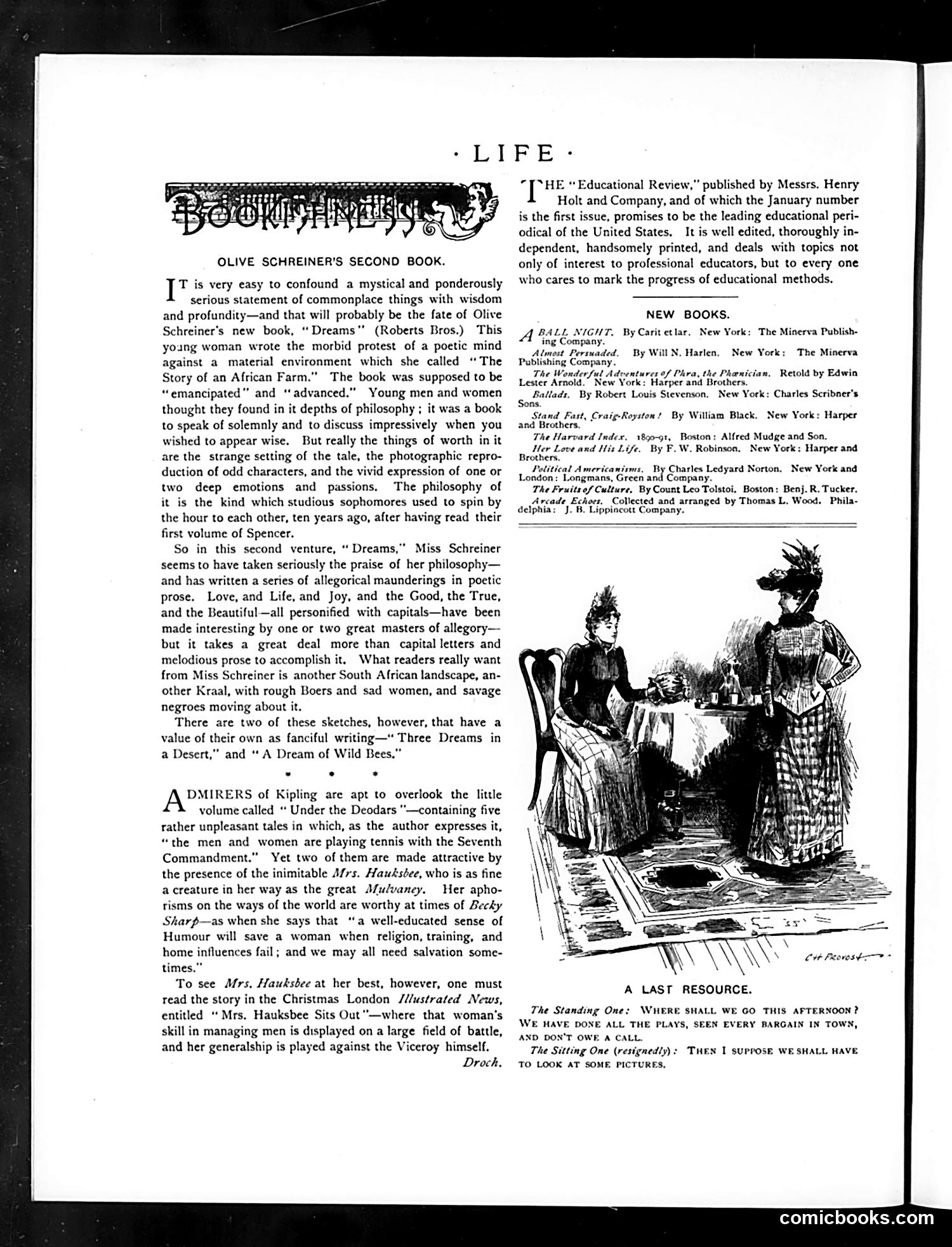
This page primarily contains book reviews rather than political cartoons. The main illustration, titled "A LAST RESOURCE," depicts two women in Victorian dress discussing afternoon plans. One suggests they've exhausted entertainment options ("done all the plays, seen every bargain in town") and proposes looking at pictures as a final resort. The satire targets upper-class leisure—the implication being that even wealthy women of leisure struggle to fill their time and resort to viewing art only as a last, desperate option. It mocks both the aimlessness of idle society life and perhaps the low cultural priority given to visual art among the fashionable set. The reviews discuss works by Kipling and Olive Schreiner, reflecting late-19th-century literary interests.
📄 Transcribed text from this page (OCR, searchable)
Machine-transcribed from the original scan — historical spelling and the odd misread are preserved.
-LIFE- OLIVE SCHREINER’S SECOND BOOK. J™ is very easy to confound a mystical and ponderously serious statement of commonplace things with wisdom and profundity—and that will probably be the fate of Olive Schreiner’s new book, “Dreams” (Roberts Bros.) This young woman wrote the morbid protest of a poetic mind against a material environment which she called ‘The Story of an African Farm.” The book was supposed to be “emancipated” and “advanced.” Young men and women thought they found in it depths of philosophy ; it was a book to speak of solemnly and to discuss impressively when you wished to appear wise. But really the things of worth in it are the strange setting of the tale, the photographic repro- duction of odd characters, and the vivid expression of one or two deep emotions and passions. The philosophy of it is the kind which studious sophomores used to spin by the hour to each other, ten years ago, after having read their first volume of Spencer. So in this second venture, “ Dreams,” Miss Schreiner seems to have taken seriously the praise of her philosophy— and has written a series of allegorical maunderings in poetic prose. Love, and Life, and Joy, and the Good, the True, and the Beautiful—all personified with capitals—have been made interesting by one or two great masters of allegory— but it takes a great deal more than capital letters and melodious prose to accomplish it. What readers really want from Miss Schreiner is another South African landscape, an- other Kraal, with rough Boers and sad women, and savage negroes moving about it. There are two of these sketches, however, that have a value of their own as fanciful writing— Three Dreams in a Desert,” and ‘A Dream of Wild Bees.” . . . DMIRERS of Kipling are apt to overlook the little volume called “ Under the Deodars "—containing five rather unpleasant tales in which, as the author expresses it, “the men and women are playing tennis with the Seventh Commandment.” Yet two of them are made attractive by the presence of the inimitable A/rs. Hauksbee, who is as fine a creature in her way as the great Afu/vaney, Her apho- risms on the ways of the world are worthy at times of Becky Sharp—as when she says that ‘a well-educated sense of Humour will save a woman when religion, training, and home influences fail; and we may all need salvation some- times.” To see Mrs, Hauksbee at her best, however, one must read the story in the Christmas London J///ustrated News, entitled “Mrs. Hauksbee Sits Out"’—where that woman's skill in managing men is displayed on a large field of battle, and her generalship is played against the Viceroy himself. Droch, ° [T’HE “Educational Review,” published by Messrs. Henry Holt and Company, and of which the January number is the first issue, promises to be the leading educational peri- odical of the United States, It is well edited, thoroughly in- dependent, handsomely printed, and deals with topics not only of interest to professional educators, but to every one who cares to mark the progress of educational methods. NEW BOOKS. BALL NIGHT, By Carit etlar. New York: The Minerva Publish- ing Company. Almest Persuaded. By Will N, Harlen. Publishing Company. The Wonderful Adventures of Phra, the Phanician, Lester Arnold.” New York: Harper and Brothers. Ballads, By Robert Louis Stevenson. New York: Charles Scribner's ns. New York: The Minerva Retold by Edwin So Stand Fast, Craig-Royston! and Brothers. The Harvard Index, i891, Boston: Alfred Mudge and Son. Her Love and His Life. By F.W. Robinson, New York: Harper and Brothers. Political Americanisms, By Charles Ledyard Norton. London: Longmans, Green and Company. The Fruits of Culture, By Count Leo Tolstoi, Boston: Benj. R. Tucker. Arcade Echoes. Collected and arranged by Thomas L. Wood. Phila- delphia: J. B. Lippincott Company. By William Black. New York: Harper New York and A LAST RESOURCE. The Standing One: WWERE SHALL WE GO THIS AFTERNOON? WE MAVE DONE ALL THE PLAYS, SEEN EVERY BARGAIN IN TOWN, AND DON'T OWE A CALL. The Sitting One (resignedly): THES 1 SUPPOSE WE SHALL HAVE TO LOOK AT SOME PICTURES, comicbooks.com