
A complete issue · 20 pages · 1890
Life — November 27, 1890
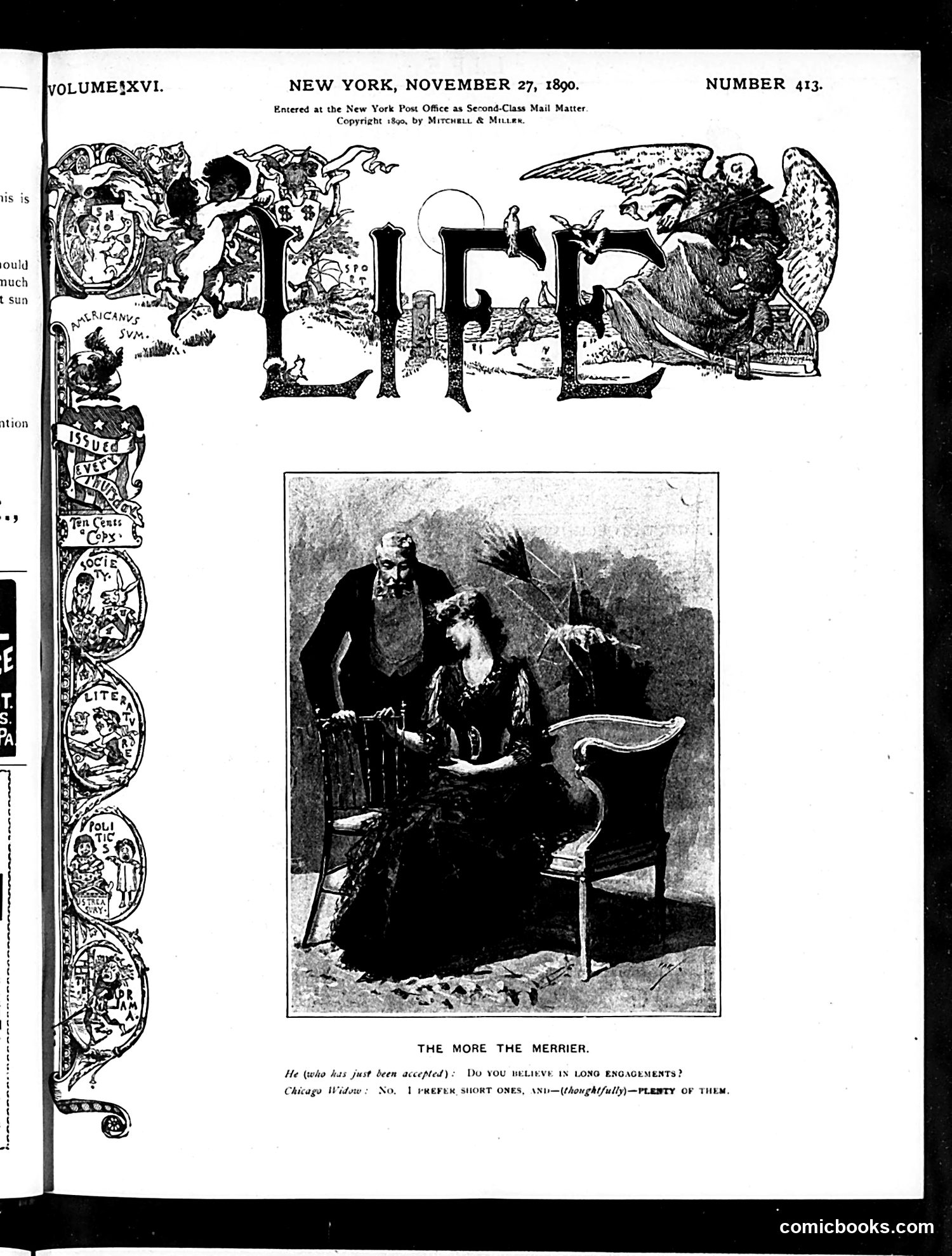
This cartoon depicts a domestic scene with the caption referencing "long engagements." A man stands beside a seated woman, who appears to hold a document or letter. The exchange reads: "He (who has just been accepted): Do you believe in long engagements?" with the Chicago Widow's response: "No. I prefer short ones." The joke satirizes serial marriage, particularly targeting a woman identified as "Chicago Widow"—suggesting she has been married multiple times. The humor lies in her preference for "short" engagements, implying quick marriages that end just as quickly (presumably through the deaths of her husbands). This reflects late-19th-century anxieties about wealthy widows and remarriage patterns, presented as dark comedy.
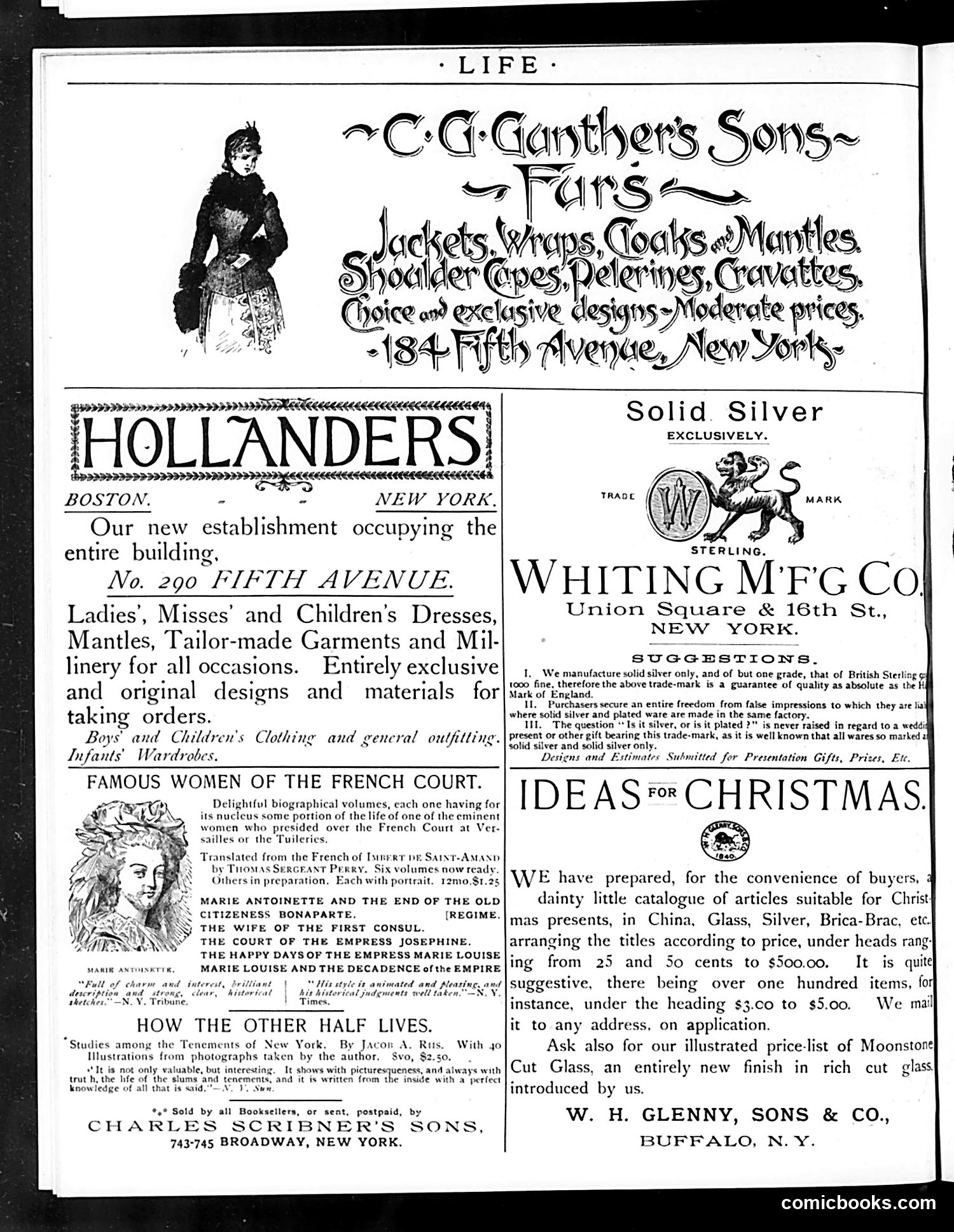
This page is **primarily advertising**, not satire or political commentary. It contains four commercial advertisements from what appears to be a late 19th-century issue of *Life* magazine: 1. **C.C. Ganthers Sons** - fur clothing retailer on Fifth Avenue, New York 2. **Hollanders** - dress and clothing shop in Boston and New York 3. **Whiting Mfg Co.** - sterling silver manufacturer 4. **W.H. Glenny, Sons & Co.** - Buffalo-based retailer offering Christmas gift suggestions The page also includes a book advertisement for "Famous Women of the French Court" and another for "How the Other Half Lives." There are **no political cartoons or satire** on this page. The illustrated vignettes are purely decorative elements accompanying period retail advertisements aimed at upper and middle-class readers.
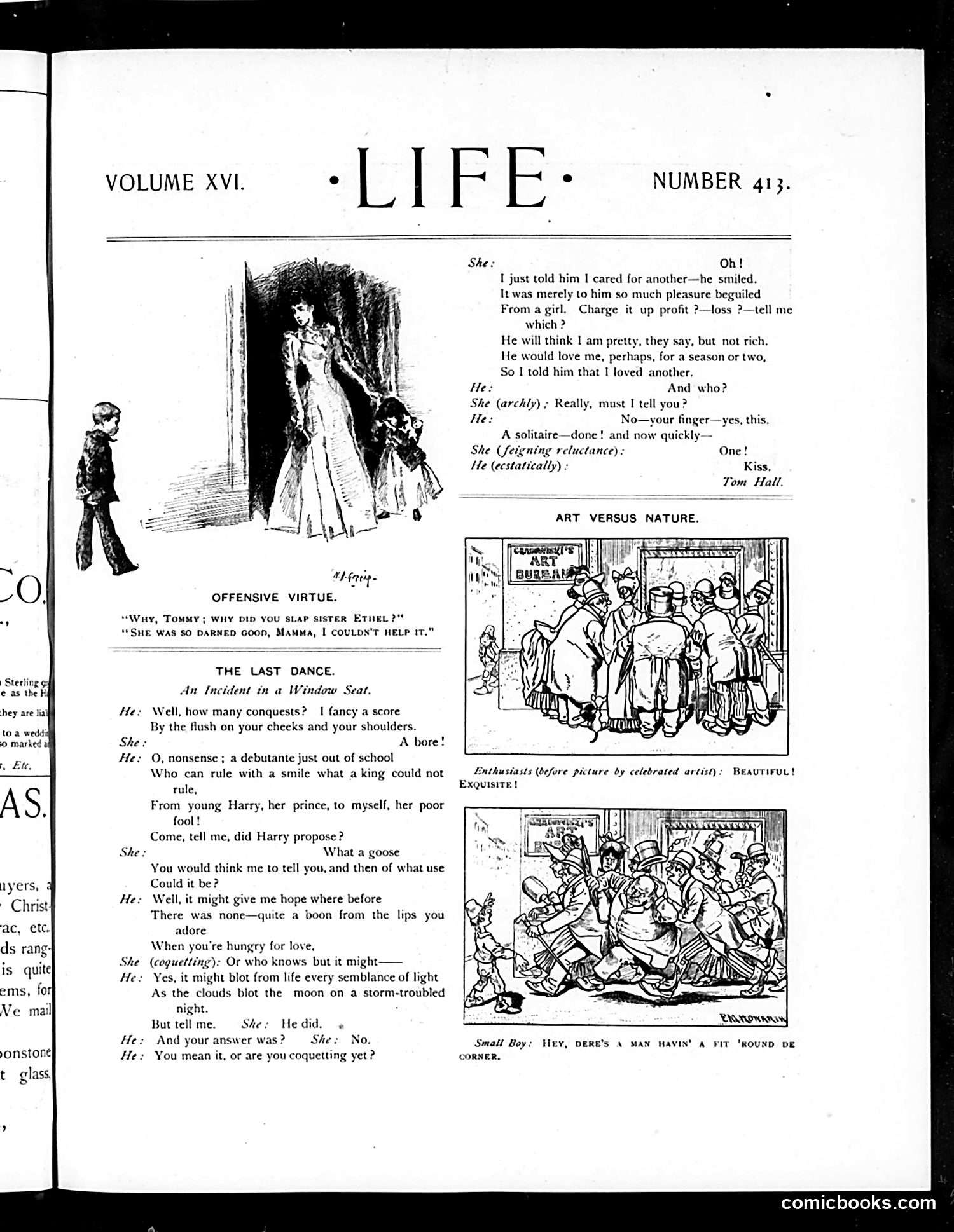
This page contains satirical dialogue and comic sketches typical of early 20th-century humor magazine content. **"Offensive Virtue"** presents a domestic comedy sketch where a boy explains he hit his sister because she was "so darn'd good, Mamma, I couldn't help it"—satirizing excessive moral virtue as annoying. **"The Last Dance"** depicts romantic banter between a man and woman, with witty wordplay about proposals and love, typical of the era's sophisticated society humor. **"Art Versus Nature"** shows two contrasting scenes: enthusiasts praising a celebrated artist's work as "beautiful" and "exquisite," versus a street scene labeled with cruder commentary. This likely satirizes pretentious art criticism by comparing refined aesthetic judgment to crude reality. The sketches mock social conventions, courtship rituals, and artistic pretension common to the period.
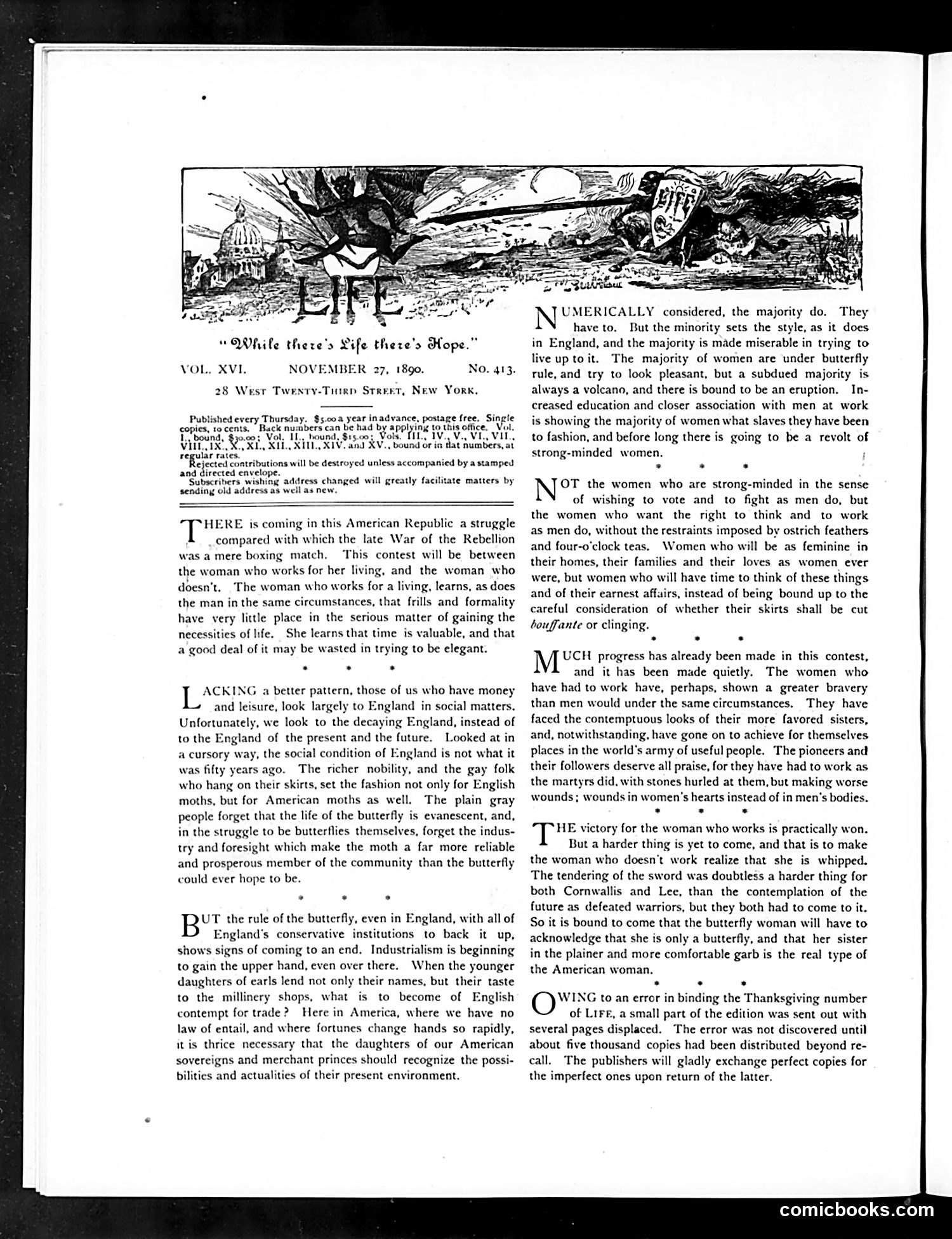
The header illustration depicts a woman with flowing hair riding a broomstick across a nighttime landscape—a witchcraft reference used satirically to represent the emerging "New Woman" movement. The editorial articles discuss women entering the workforce and their push for equal rights, particularly voting rights. The text sarcastically compares women's social progress to witchcraft, suggesting that traditional society views female independence as supernatural or dangerous. Key satirical points: the "butterfly woman" (ornamental, leisured) is being replaced by women demanding work, education, and political participation. The magazine critiques both the conservative English social order and American industrial capitalism's effects on gender roles. The overall tone mocks societal anxiety about women's liberation while suggesting such progress is inevitable—comparing resistance to "butterflies" trying to prevent their own transformation.
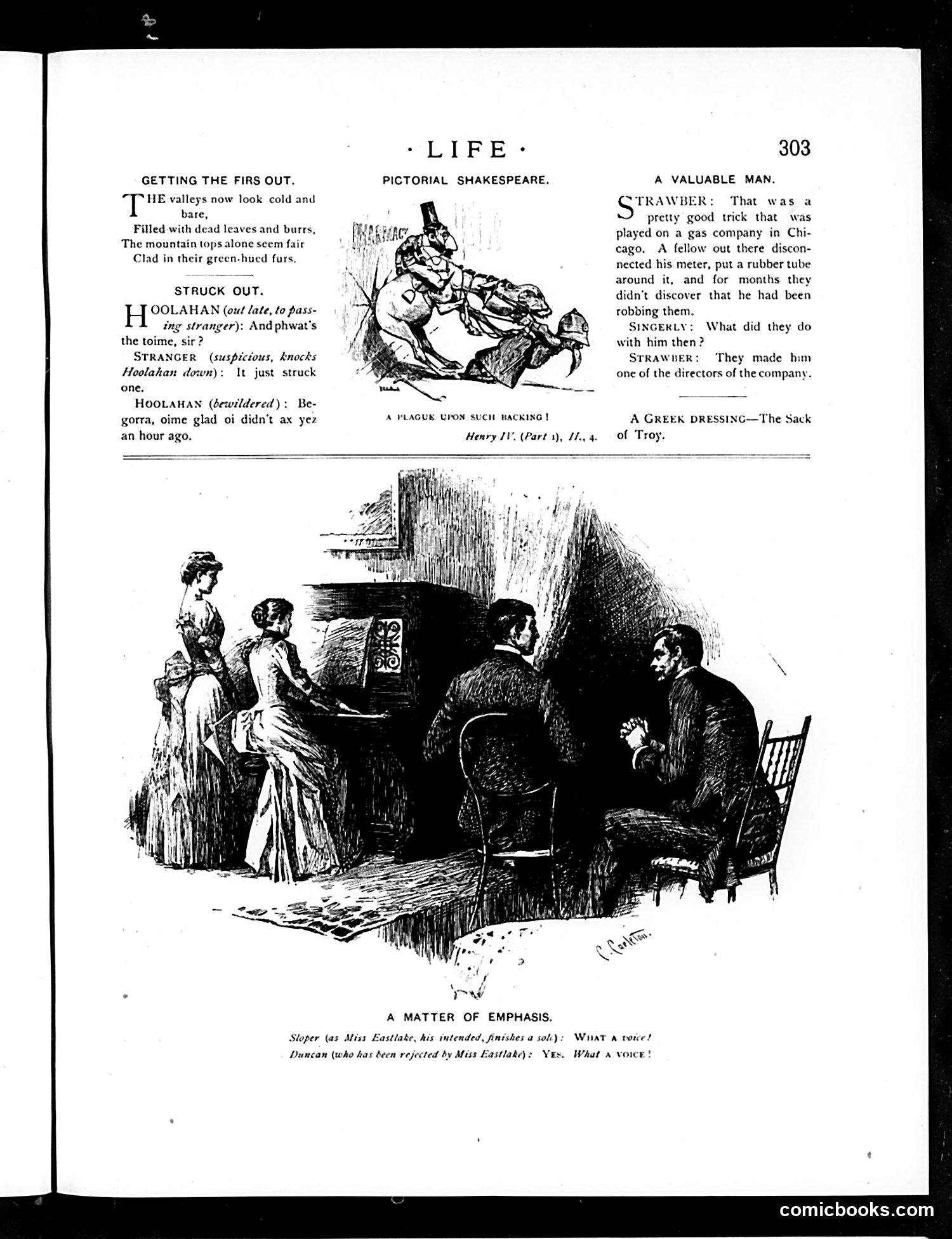
This page contains three separate items: 1. **"Getting the Firs Out"** and **"Struck Out"**: Poetry snippets about autumn and cricket, unrelated to satire. 2. **"Pictorial Shakespeare"**: A sketch from *Henry IV* showing a plague victim being stabbed—illustrating a famous scene. 3. **"A Valuable Man"** and **"A Matter of Emphasis"**: Two anecdotes about deception. The first describes a gas company employee who secretly stole from meters for months before being made a director. The second cartoon (bottom) depicts a singing teacher rejected by a student, then hired after the same rejection is reframed as prestigious endorsement—satirizing how perception and marketing can transform the identical fact into opposite valuations. The page blends literary and social humor without obvious political commentary.
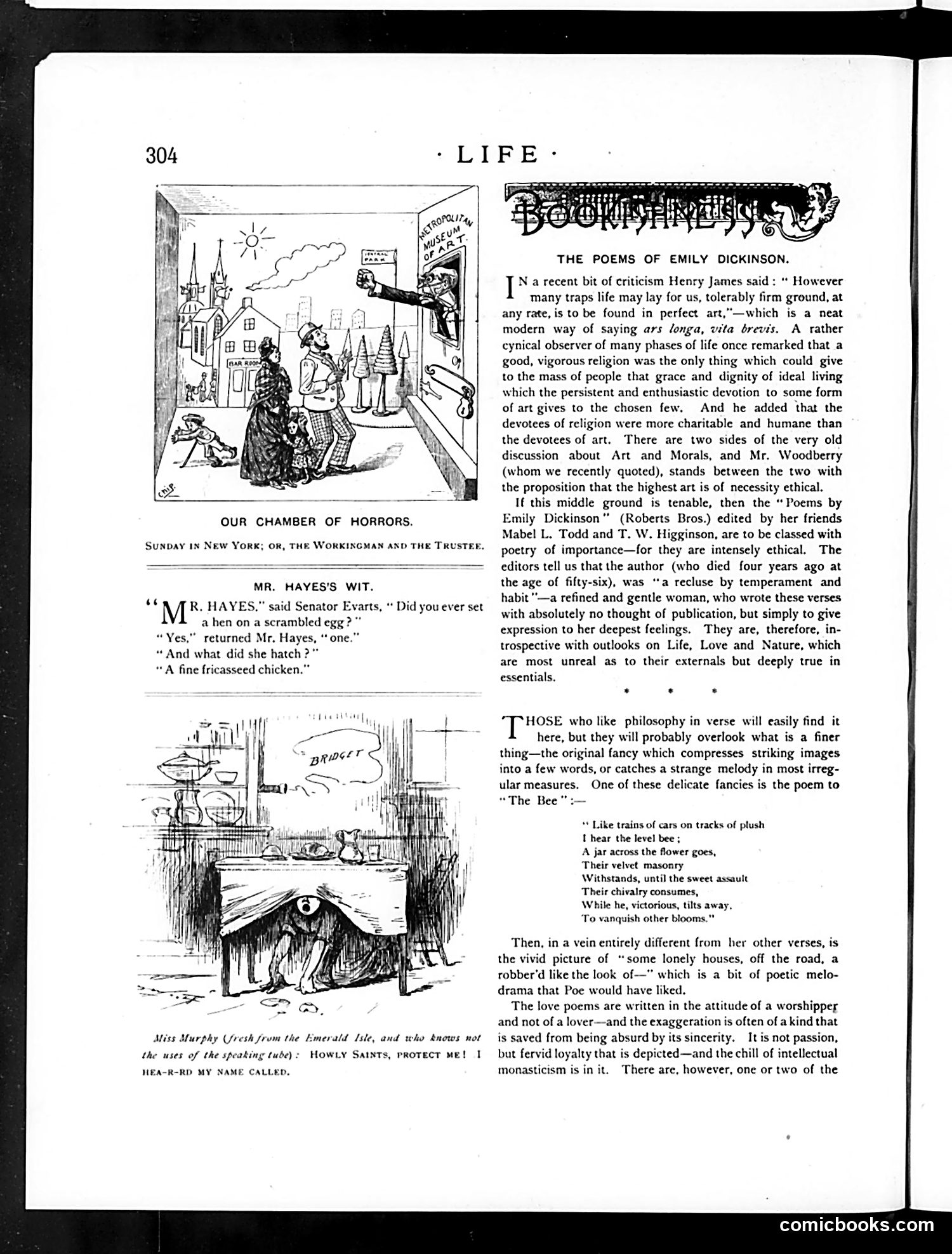
The page contains two distinct elements: **Top cartoon ("Our Chamber of Horrors"):** Depicts a chaotic Sunday street scene in New York, showing various urban characters and activities. The caption references "the Workingman and the Trustee," suggesting social class commentary typical of Life's satirical focus on labor and wealth inequality during the Gilded Age. **Below:** A brief joke attributed to "Mr. Hayes's Wit" about Senator Evans and a hen—a simple pun about "scrambled eggs." **Main content:** A literary review of Emily Dickinson's poems, edited by friends after her death. The reviewer discusses whether her philosophical verses constitute serious poetry, noting her original imagery and delicate fancy, while analyzing her love poems as sincere rather than passionate. The page blends satirical cartoons with serious literary criticism, typical of Life's mixed approach to American culture and society.
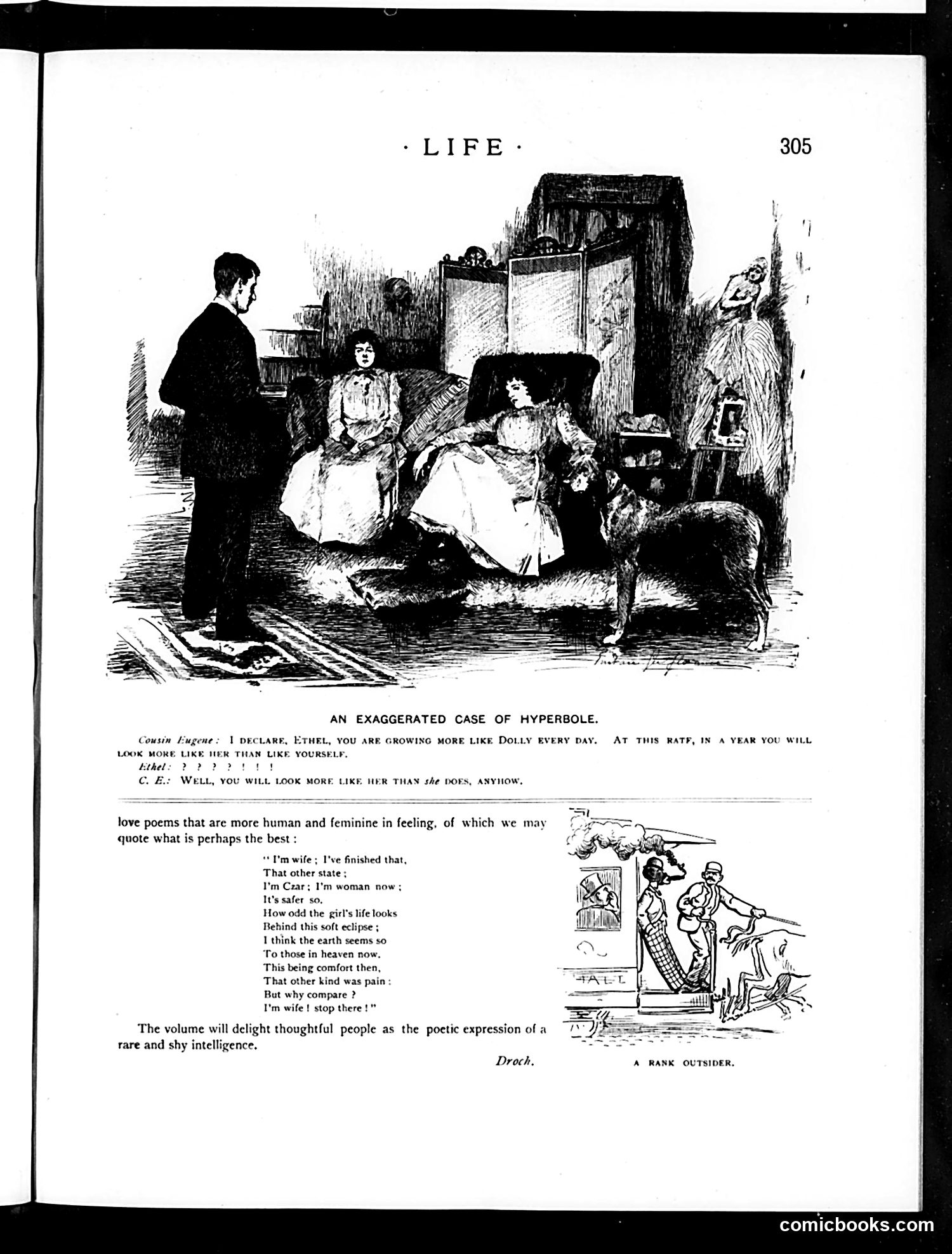
**Top Cartoon: "An Exaggerated Case of Hyperbole"** This domestic scene satirizes exaggerated compliments between relatives. Cousin Eugene teases Ethel that she's growing more like "Dolly" daily, and within a year will resemble Dolly entirely. Ethel responds that Ethel will look more like "her" (the dog) than Dolly does. The joke mocks the tendency of family members to use extreme, contradictory flattery—the "hyperbole" of the title. The dog's inclusion in the comparison amplifies the absurdity of such insincere compliments. **Bottom Section:** Contains poetic verses about marriage and womanhood, likely introducing or reviewing a literary volume. The accompanying small illustration titled "A Bark Outsider" appears unrelated to the main cartoon, possibly advertising or filler content typical of Life's format.
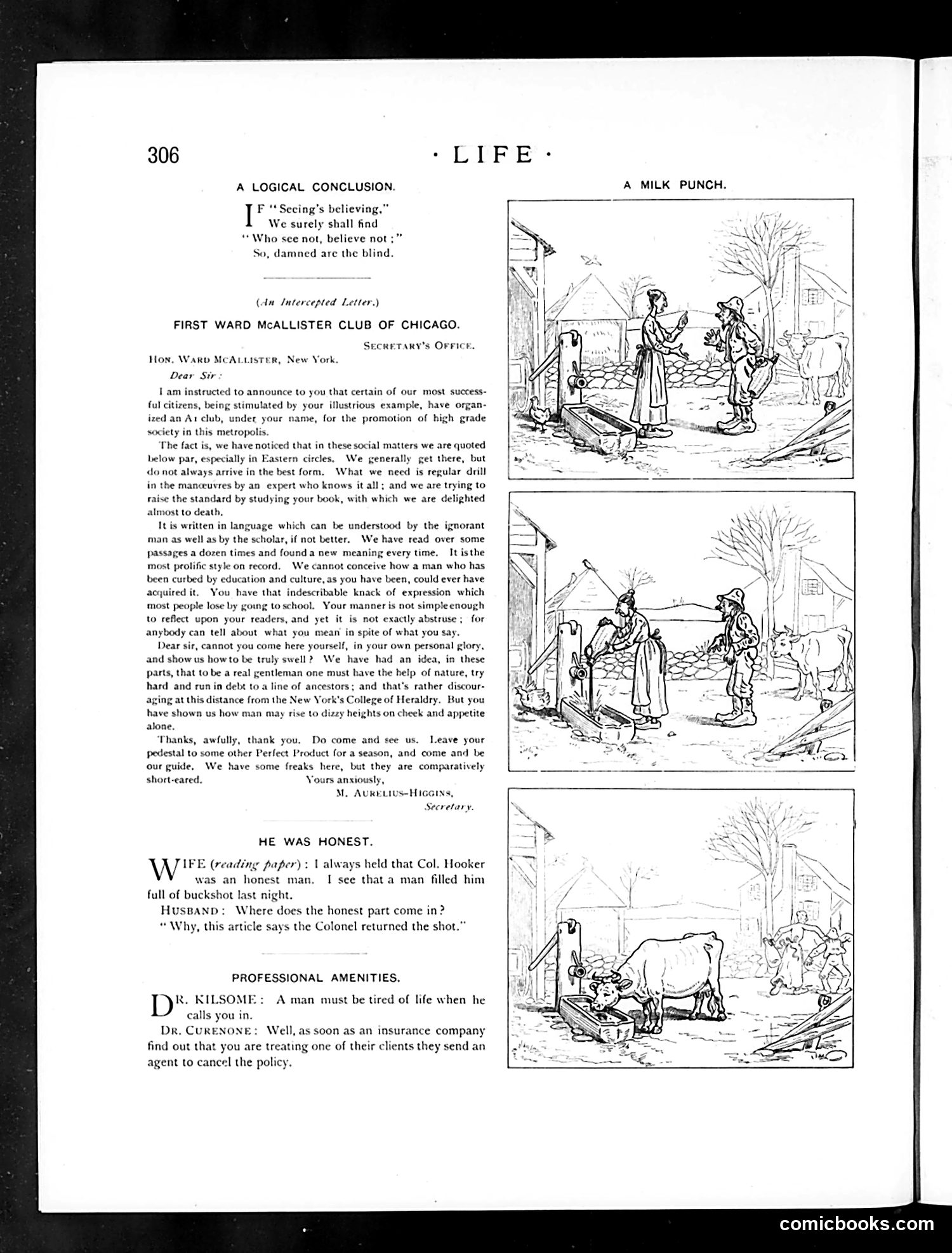
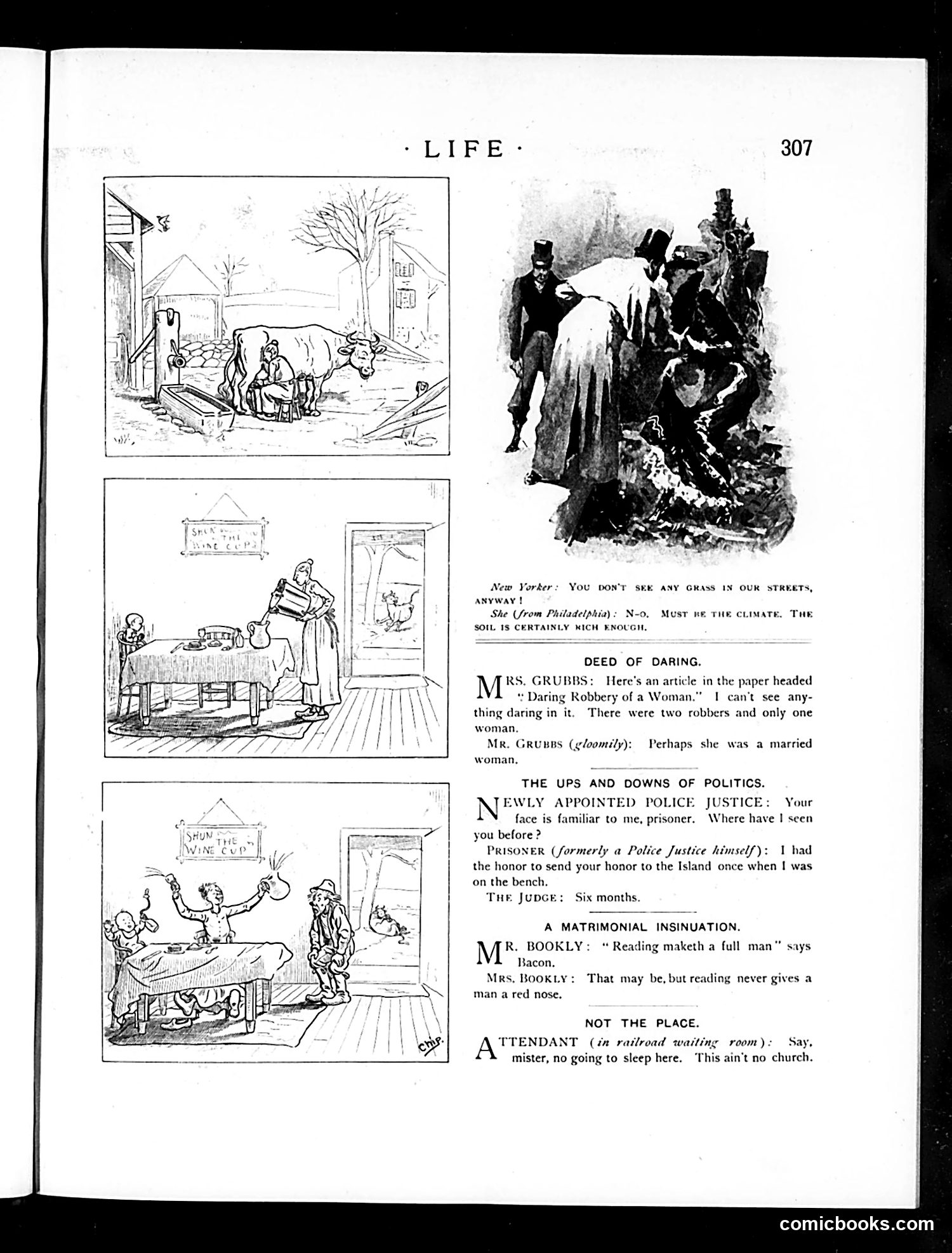
This page contains three sequential cartoon panels titled "A Milk Punch" depicting what appears to be a practical joke or slapstick scenario involving children and an adult. The comic shows a figure being hit or splashed, with the final panel revealing a cow - the visual punchline being a literal "milk punch." The page also includes unrelated satirical pieces: "A Logical Conclusion" (a poem about skepticism), an intercepted letter from the First Ward McAllister Club of Chicago satirizing social climbing and pretentiousness, "He Was Honest" (a brief joke about Colonel Hooker), and "Professional Amenities" (a quip about insurance agents). The overall tone reflects *Life* magazine's typical mix of visual humor and social commentary targeting wealthy pretenders and professional absurdities.
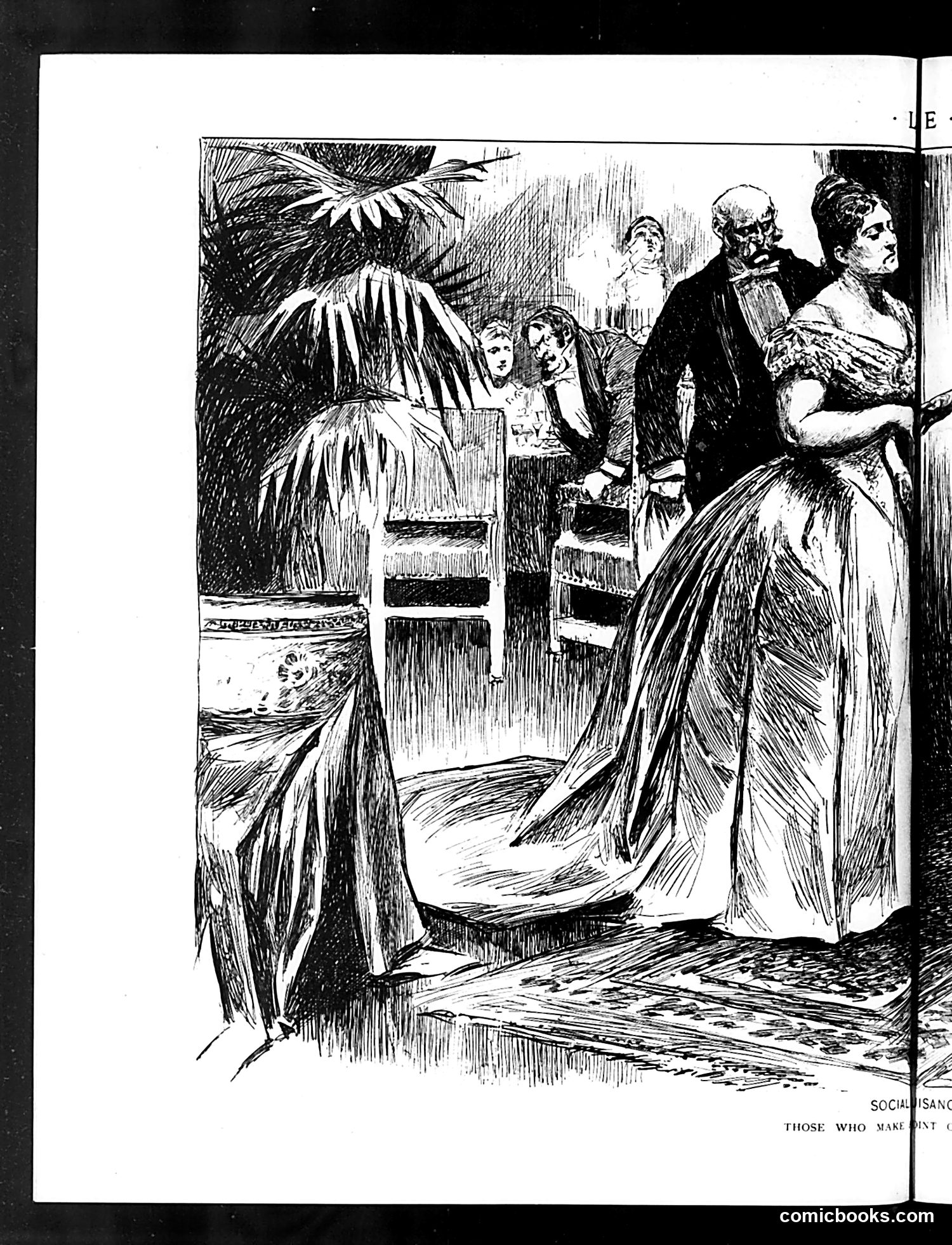
This appears to be a satirical illustration about social pretense and class performance. The scene depicts an elegant indoor gathering with well-dressed figures in formal attire. The visible text fragment at bottom reads "SOCIAL ISANC" and "THOSE WHO MAKE [?]," suggesting commentary on people who create or maintain social appearances. The cartoon likely critiques the artificiality of high society—the elaborate dress, formal posturing, and theater of social interaction. The figure with the distinctive feathered hat in the foreground appears central to the satire, possibly representing someone performing an exaggerated social role. Without the complete text or publication date, I cannot identify specific individuals or events referenced, but the tone suggests Life magazine's typical mockery of upper-class pretension and the gap between genuine character and social presentation.
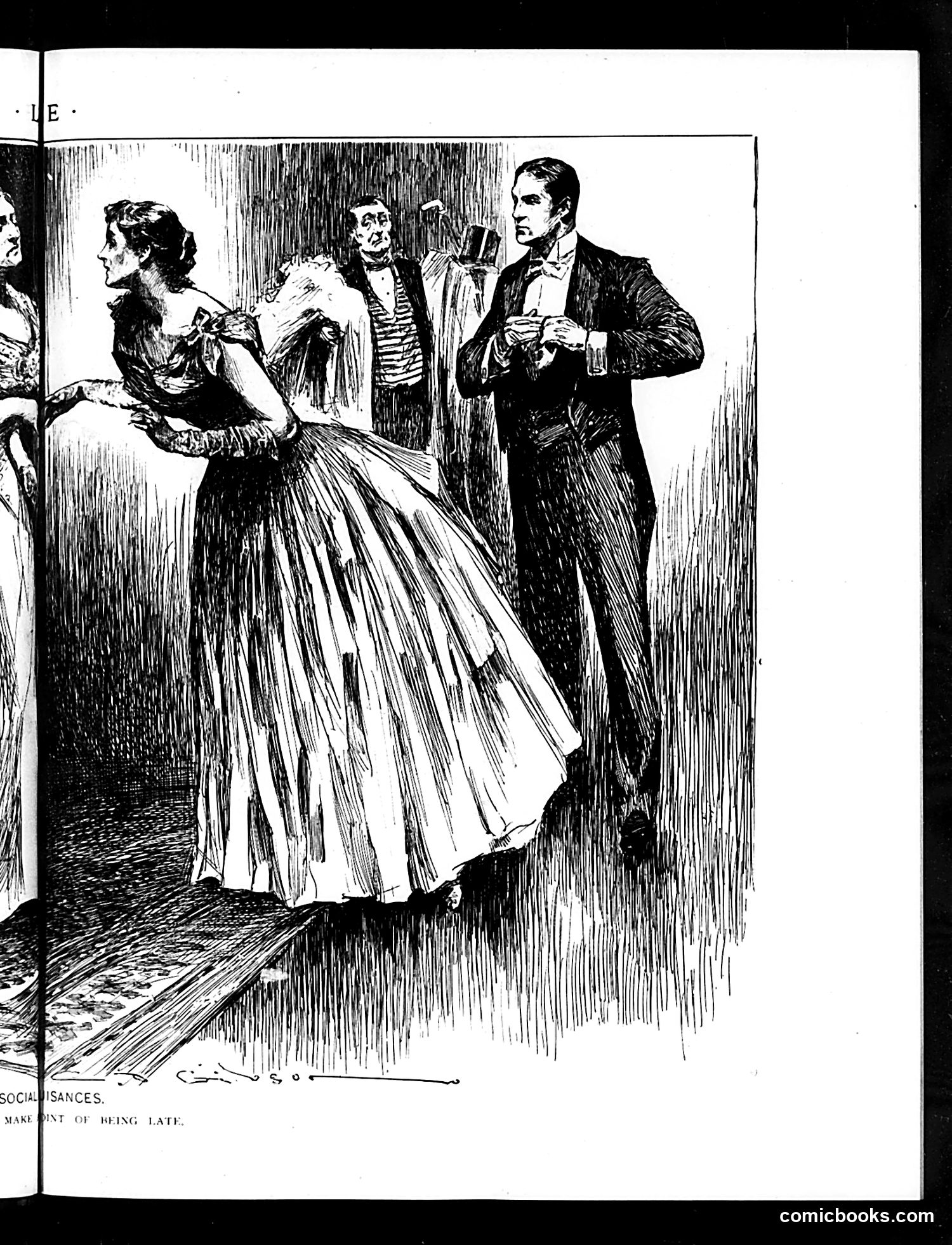
This illustration from *Life* magazine depicts a social scene titled "Making a Point of Being Late." The cartoon shows a well-dressed couple at what appears to be a formal evening event—the woman in an elegant gown, the man in black tie. Other guests are visible in the background. The satire targets a specific social behavior: the affectation of arriving late to formal gatherings as a status symbol. By appearing after the event has begun, attendees signaled importance and exclusivity—they were in such demand elsewhere that punctuality was beneath them. This was a recognizable upper-class pretension of the era, and *Life* magazine's satirical commentary mocked such affected sophistication.
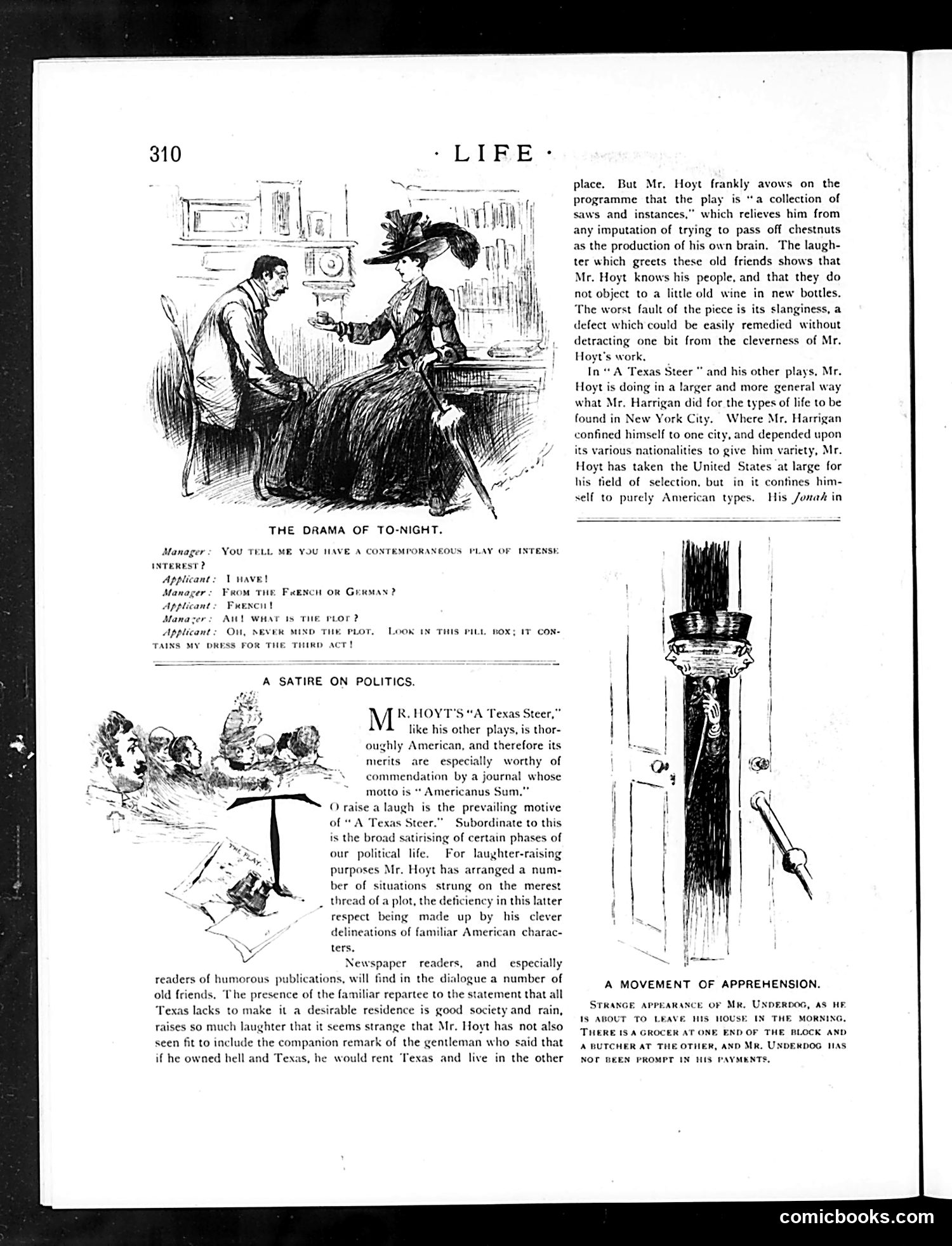
This page reviews playwright Charles Hoyt's play "A Texas Steer," praising his distinctly American comedic approach. Unlike competitor Edward Harrigan, who mined New York City's ethnic diversity for material, Hoyt draws from "purely American types" across the entire country. **Top cartoon** ("The Drama of To-Night"): Satirizes contemporary theater's shallow commercialism—a manager dismisses plot entirely, caring only that an actress has a fancy dress for Act Three. This mocks how 1890s theater prioritized spectacle over substance. **Middle cartoon** ("A Satire on Politics"): Illustrates Hoyt's comedic mining of American political life and familiar newspaper stereotypes, though details remain unclear from the visible portion. **Bottom caption** ("A Movement of Apprehension"): A brief humorous sketch about Mr. Underdog's financial anxiety—trapped between a grocer and butcher, both awaiting payment. It's everyday working-class anxiety treated as comedy.
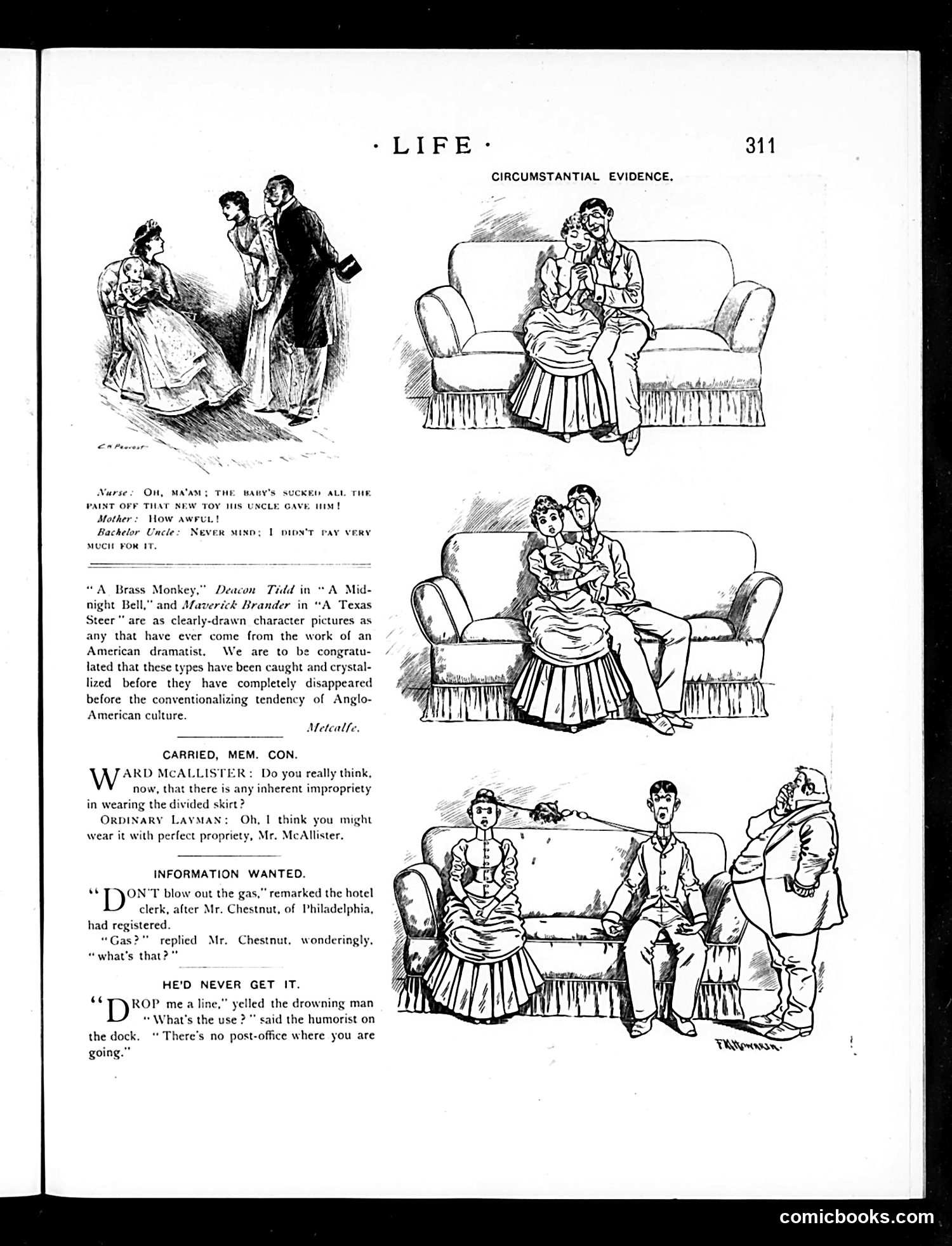
This page from *Life* magazine presents several unrelated satirical sketches typical of early 20th-century American humor. **Top cartoon** ("Circumstantial Evidence"): A series of vignettes showing a woman and man on a sofa in increasingly compromising positions, with the caption suggesting circumstantial evidence of impropriety—a joke about how innocent situations can appear scandalous to observers. **Middle sections** include brief comedic exchanges: Ward McAllister (a prominent New York society figure) asking about the propriety of divided skirts (a women's fashion controversy of the era); a hotel clerk's cryptic warning about "gas" (likely coal gas used for lighting); and a drowning man's dark joke about a post office. The text also praises theatrical characters from contemporary plays as authentic American types "before they have completely disappeared." **Overall context**: This represents *Life*'s mix of social satire, fashion commentary, and puns typical of Edwardian-era American humor—much focused on propriety, class markers, and wordplay that required period knowledge to fully appreciate.
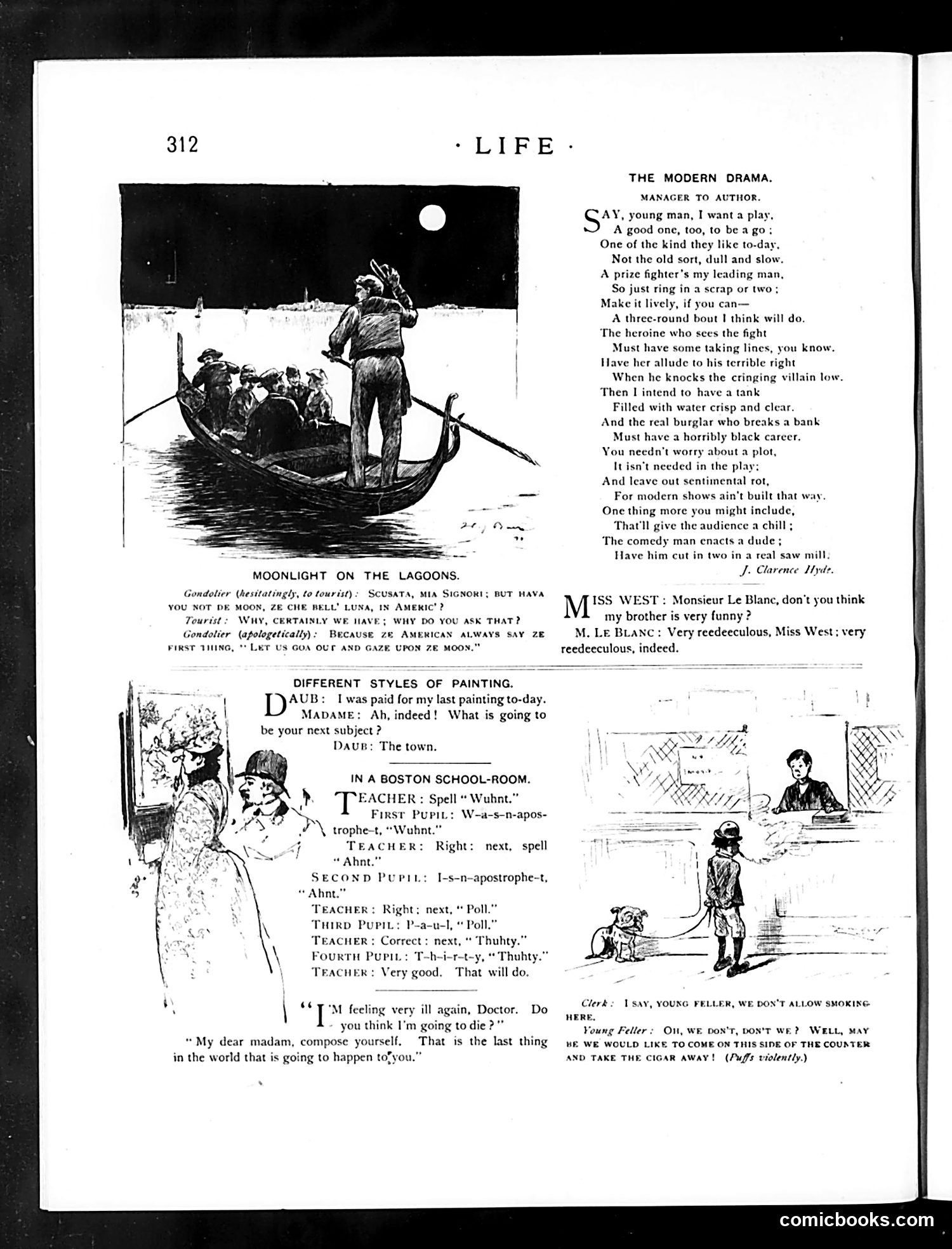
This page contains four separate satirical pieces mocking American behavior and contemporary trends: 1. **"Moonlight on the Lagoons"**: A Venetian gondolier is puzzled that an American tourist wants to gaze at the moon—apparently Americans are so obsessed with this activity that it's their stereotype abroad. 2. **"The Modern Drama"**: A theater manager instructs a playwright to create sensationalist entertainment: prize-fight scenes, tank sequences, bank robberies, and a man sawed in half—all plot devices replacing actual narrative. This satirizes the vulgar spectacle replacing serious theater. 3. **"Different Styles of Painting"**: Brief joke about an artist painting "the town" after being paid. 4. **"Boston School-Room"**: Teachers and pupils demonstrate how New England accents mangle pronunciations ("Wuhnt" for "want," "Abnt" for "aunt"). 5. **Smoking Incident**: A cigar clerk/customer dispute about shop conduct. The page ridicules American materialism, lowbrow entertainment tastes, regional dialects, and uncouth behavior.
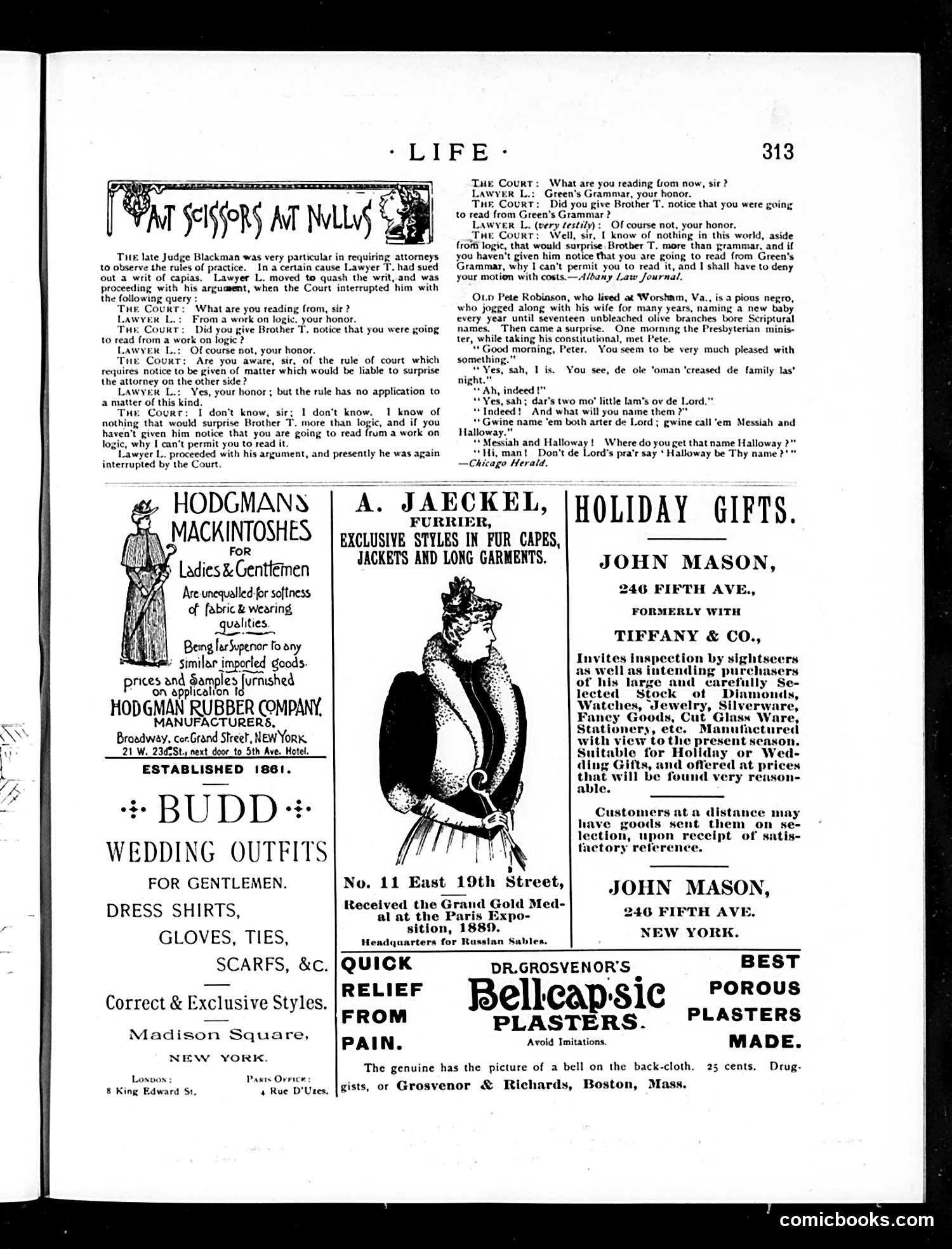
This page features two satirical anecdotes mocking legal and social pretension. **"Scissors at Nulls" (top):** A joke about Judge Blackman's strict courtroom rules. Lawyer L. argues a case while reading from logic textbooks, prompting the pedantic judge to demand notice be given to opposing counsel—as if logic itself would "surprise" them. When L. then reads from grammar, the judge repeats the absurd complaint about grammar being equally shocking. The satire mocks both excessive legal formalism and the assumption that lawyers lack basic logic and grammar. **"Pete Robinson" anecdote (bottom):** A dialect humor piece stereotyping a Black man naming his children biblical names. After having seventeen children with scriptural names, Pete announces twins named "Messiah" and "Halloway"—the latter a mangled reference to "hallowed be thy name" from the Lord's Prayer. The "joke" relies on racial caricature and mocking Black dialect to suggest ignorance. The remaining content is period advertising for furs, clothing, jewelry, and patent medicine—typical of Life magazine's revenue model.
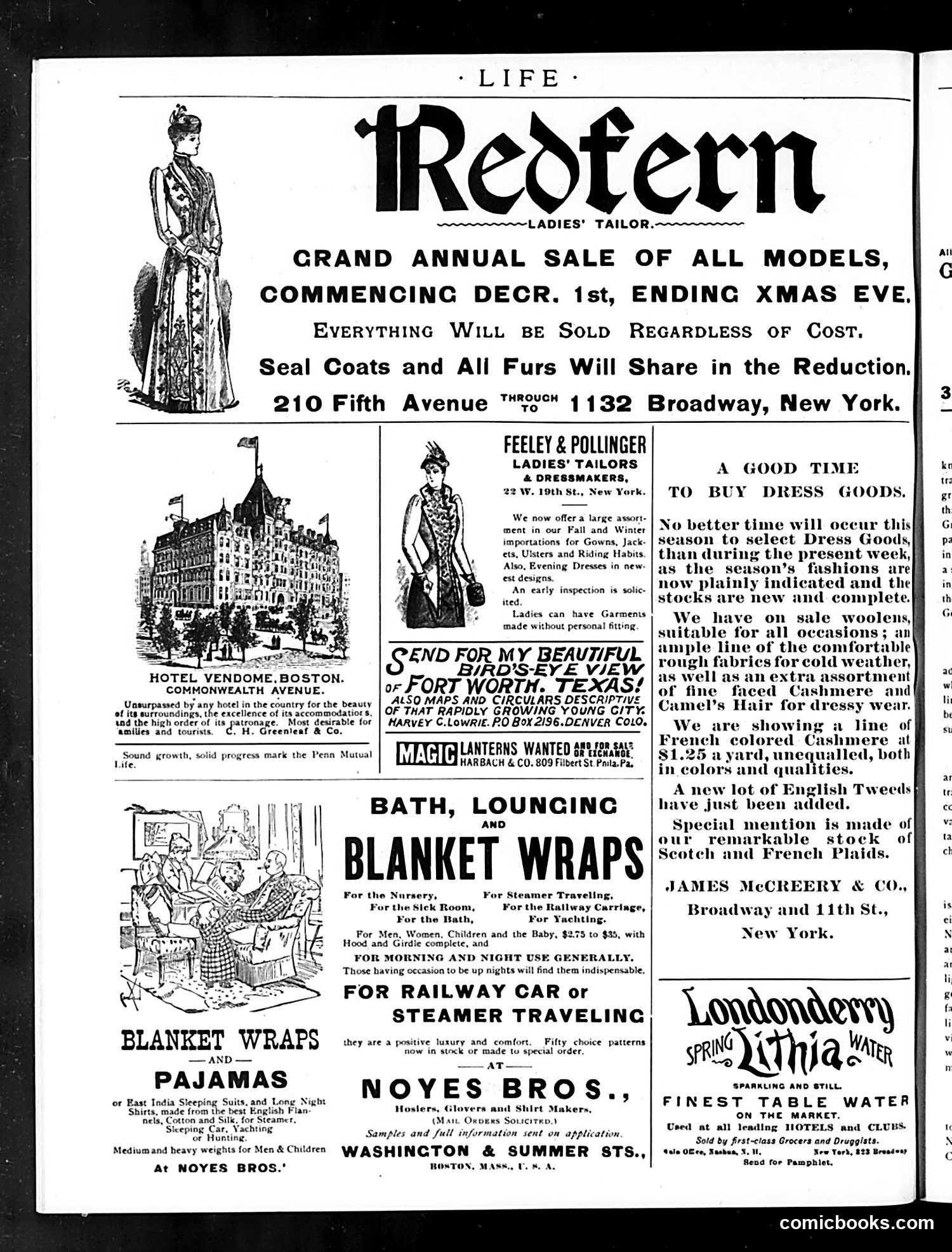
This page is primarily **commercial advertising** rather than satirical content. It showcases turn-of-the-century retail and product promotions typical of Life's business model. The dominant advertisement features **Redfern, a ladies' tailor**, announcing a grand annual sale from December 1st through Christmas Eve at their Fifth Avenue location—a seasonal retail pitch emphasizing discounts on coats, furs, and custom garments. Other advertisements promote: - Hotel Vendome in Boston - Feeley & Pollinger dressmakers - Blanket wraps and pajamas (practical travel wear) - James McCreery & Co. dress goods - Londonderry spring water The only illustrated content—a decorative engraving of a fashionable woman in period dress—serves the clothing advertisements. No political satire or social commentary is present; this represents Life functioning as a magazine venue for upscale, urban consumer goods targeting wealthy readers during the holiday shopping season.
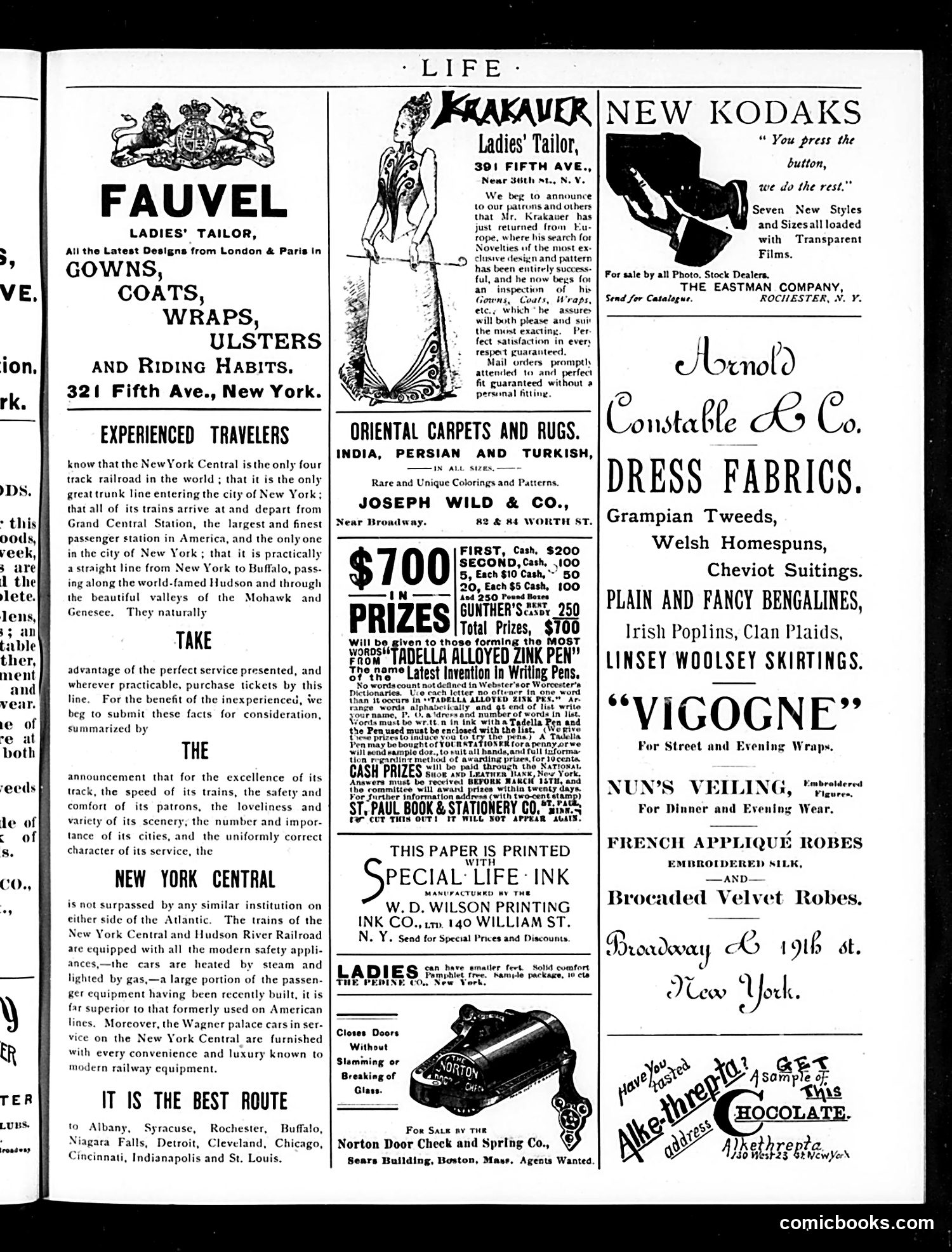
This page is primarily **advertising with no political cartoons or satirical content**. It consists entirely of commercial advertisements typical of early 20th-century American magazines. The ads feature: - **Ladies' tailors** (Fauvel, Krakauer) promoting fashionable gowns and coats from London and Paris designs - **New York Central Railroad** promoting itself as superior infrastructure—boasting it's the "only four track railroad in the world" serving major cities - **Luxury goods**: Oriental carpets, dress fabrics (tweeds, bengalines, velvets), chocolates - **A contest** for the "Tadella Alloyed Zink Pen" offering cash prizes The **tone reflects period class aspirations**: references to European fashion, rail travel luxury, and imported goods signal affluent readership. The railroad ad's detailed boasting about modernity (steam heat, electric lighting, palace cars) exemplifies Gilded Age competition between carriers. **No satire is evident here**—this is straightforward commercial content designed to reach Life's wealthy urban audience.
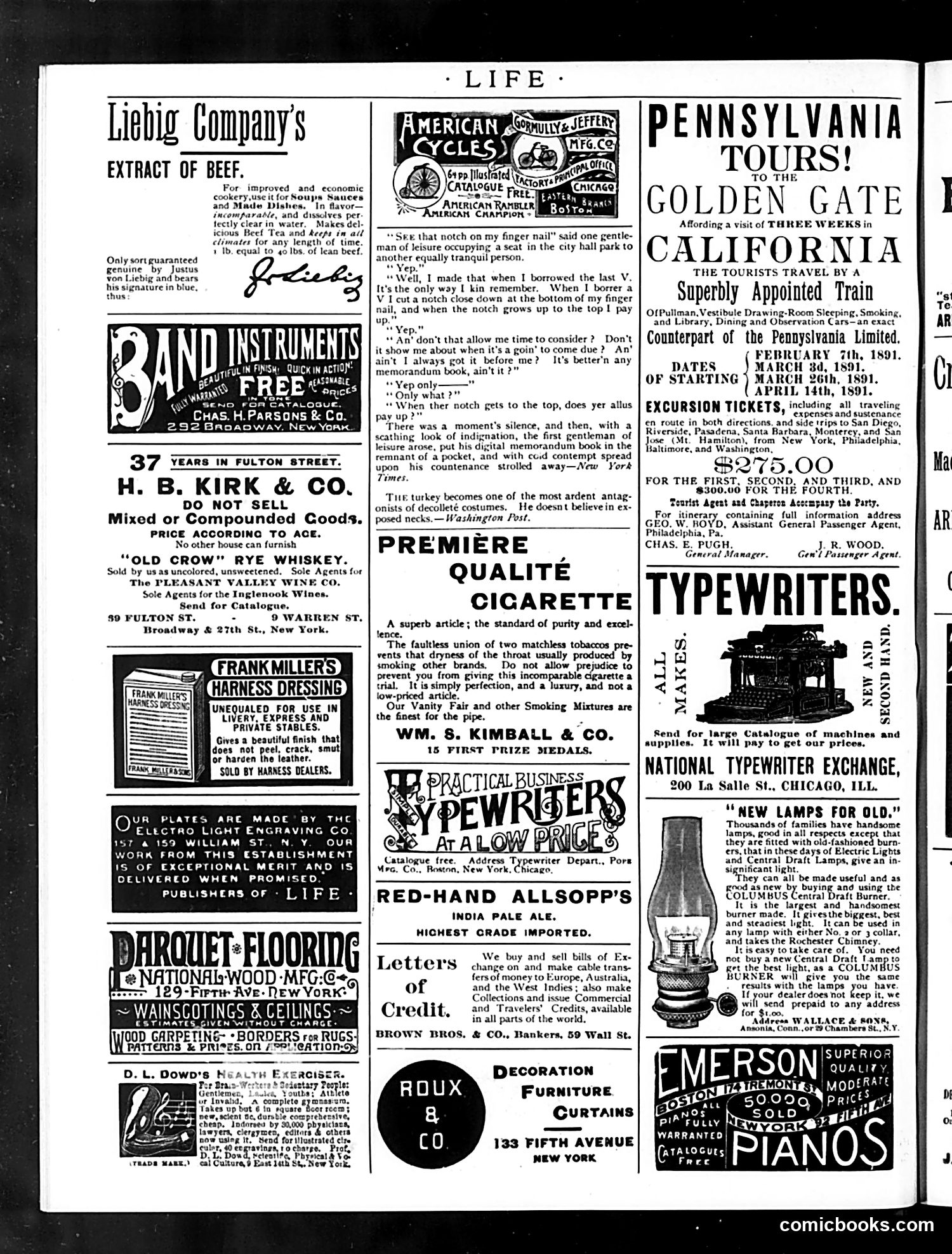
This is primarily an **advertising page** from Life magazine, not a political cartoon page. The ads feature period products: Liebig's beef extract, harness dressing, typewriters, pianos, whiskey, and furniture. The one **humorous anecdote** (likely a reprinted joke) concerns two unemployed men discussing debt. One gentleman tracks his borrowing using a notch in his fingernail—when the notch grows out, repayment is due. His companion asks the obvious punchline: "when the notch gets to the top, does yer allus pay up?" The man storms off offended. The joke satirizes **unreliable debtors** and self-deluding schemes to avoid obligations. It's a class commentary on men with time to sit idle in the city park, mocking both their poverty and their elaborate justifications for not paying debts. The page also includes a brief quip about turkeys opposing low-cut dresses (he "doesn't believe in exposed necks").
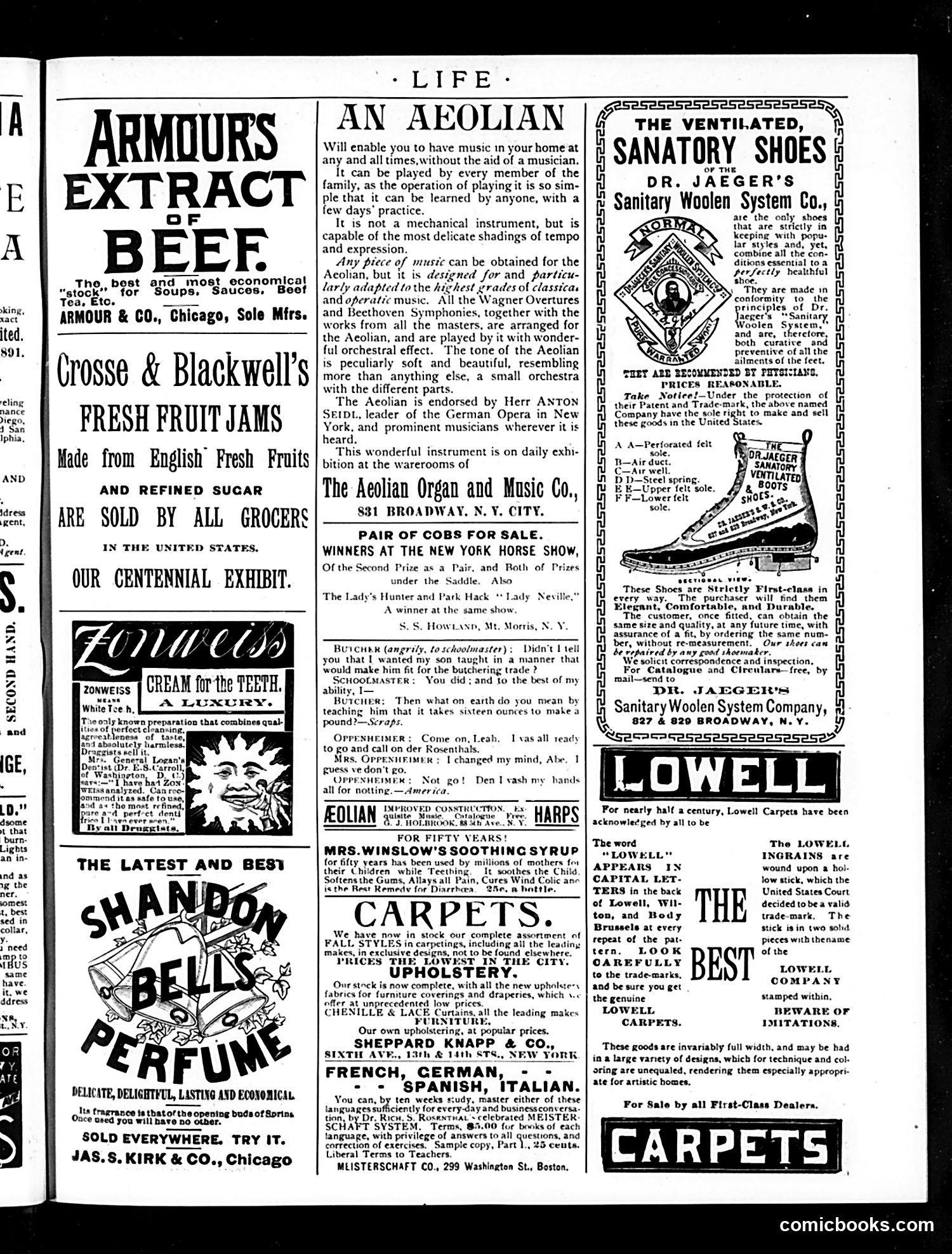
This page is primarily **advertisements** with minimal satirical content. The main visual humor appears in two brief comic dialogues: 1. **Butcher-Schoolmaster Exchange**: A butcher complains that his son's teacher is making him "unfit" for the butchering trade by teaching accurate weights (sixteen ounces to a pound). The joke satirizes either the butcher's dishonesty in his trade or his belief that education ruins practical skills—suggesting working-class suspicion of formal education. 2. **Oppenheimer Dialogue**: A brief Jewish-stereotyped exchange where a wife changes plans at the last moment, with her husband accepting it. This reflects period ethnic humor common in Life magazine. The bulk of the page consists of era-appropriate advertisements for beef extract, fruit jams, toothcream, an Aeolian player organ, carpets, and language instruction—typical late 19th-century consumer goods marketed to middle-class readers.
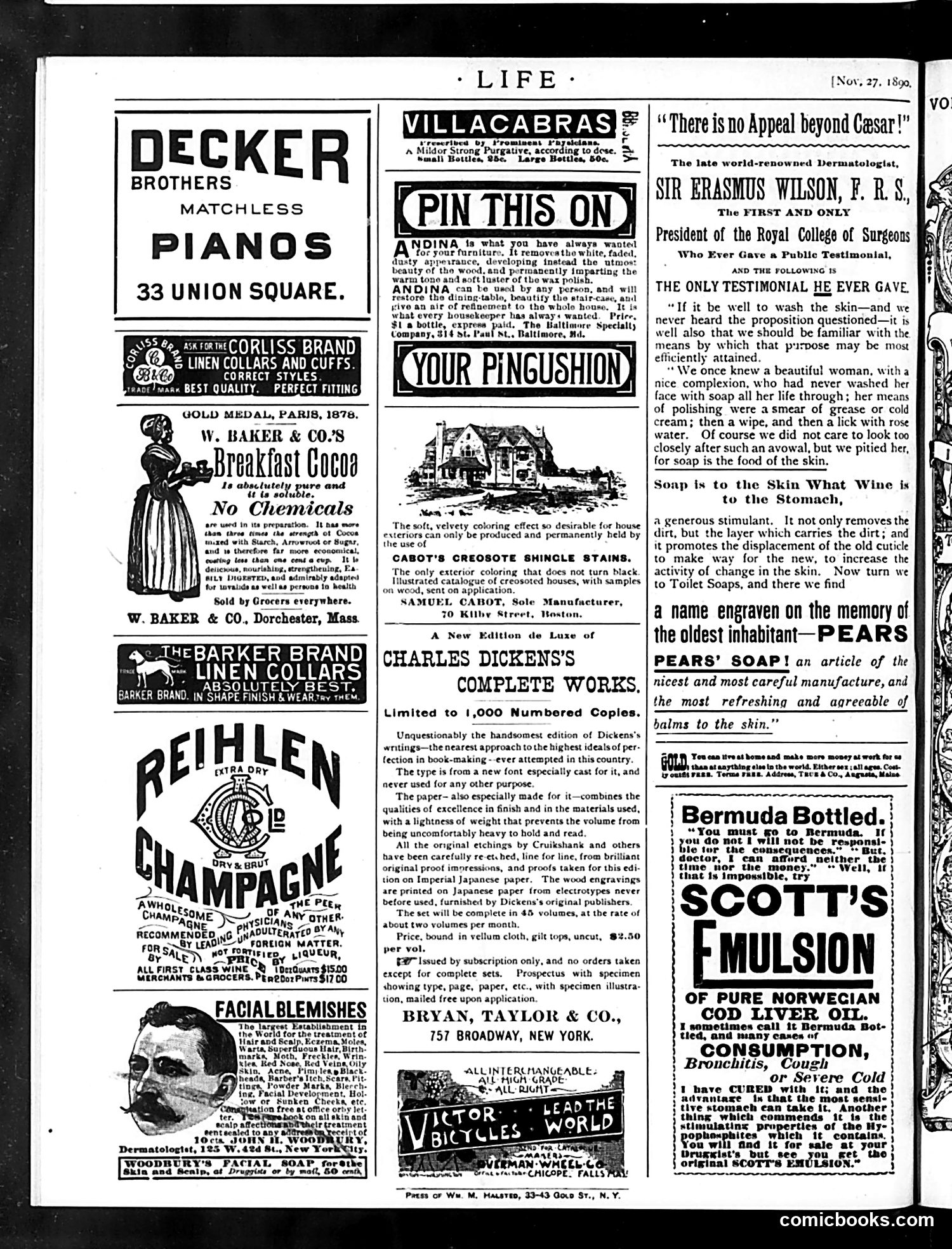
This page is primarily **advertisements** for Victorian-era consumer goods and services—pianos, breakfast cocoa, linen collars, champagne, and a de luxe edition of Charles Dickens. The only content with satirical or editorial intent appears to be the upper-right article featuring a testimonial attributed to Sir Erasmus Wilson (a real 19th-century dermatologist). The headline "There is no Appeal beyond Caesar!" appears ironic. The testimonial promotes Pears' Soap by describing how soap removes dirt not just from the surface but from deeper skin layers. The satire seems gentle: the breathless marketing language and Wilson's gravitas are being gently mocked as overstated product advocacy. The article positions soap almost medicinally, claiming it works on skin "as wine is to the stomach." This represents typical *Life* magazine content of the 1890s: mixing genuine advertisements with light satirical commentary on consumer culture and advertising excess.