
Life, 1890-11-27 · page 12 of 20
Life — November 27, 1890 — page 12: what you’re looking at
What you’re looking at
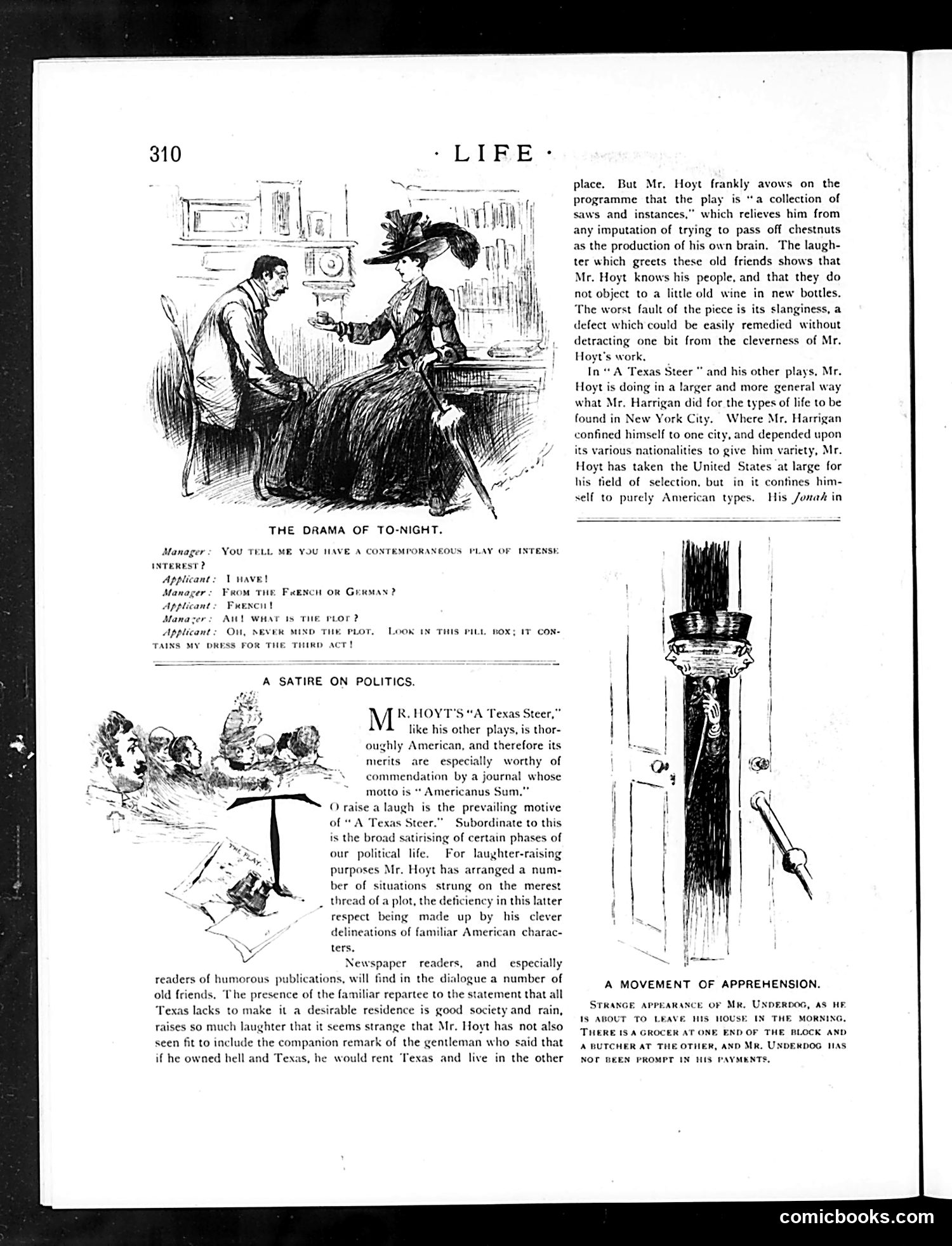
This page reviews playwright Charles Hoyt's play "A Texas Steer," praising his distinctly American comedic approach. Unlike competitor Edward Harrigan, who mined New York City's ethnic diversity for material, Hoyt draws from "purely American types" across the entire country. **Top cartoon** ("The Drama of To-Night"): Satirizes contemporary theater's shallow commercialism—a manager dismisses plot entirely, caring only that an actress has a fancy dress for Act Three. This mocks how 1890s theater prioritized spectacle over substance. **Middle cartoon** ("A Satire on Politics"): Illustrates Hoyt's comedic mining of American political life and familiar newspaper stereotypes, though details remain unclear from the visible portion. **Bottom caption** ("A Movement of Apprehension"): A brief humorous sketch about Mr. Underdog's financial anxiety—trapped between a grocer and butcher, both awaiting payment. It's everyday working-class anxiety treated as comedy.
📄 Transcribed text from this page (OCR, searchable)
Machine-transcribed from the original scan — historical spelling and the odd misread are preserved.
place, But Mr. Hoyt frankly avows on the programme that the play is “a collection of saws and instances,” which relieves him from any imputation of trying to pass off chestnuts as the production of his own brain. The laugh- ter which greets these old friends shows that Mr. Hoyt knows his people, and that they do not object to a little old wine in new bottles. The worst fault of the piece is its slanginess, a defect which could be easily remedied without detracting one bit from the cleverness of Mr. Hoyt's work. In “A Texas Steer” and his other plays, Mr. Hoyt is doing in a larger and more general way WH 4 < what Mr. Harrigan did for the types of life to be BY He , found in New York City. Where Mr, Harrigan Mis | i } \ f confined himself to one city, and depended upon its various nationalities to give him variety, Mr. Hoyt has taken the United States at large for his tield of selection, but in it contines him- self to purely American types. His Jonah in THE DRAMA OF TO-NIGHT. Manager: YoU TELL ME YOU HAVE A CONTEMPORANEOUS PLAY OF INTENSE INTEREST? Applicant: V Mave! Manager: FRoM THE Feencn or Grrstay ? Applicant: Frexcut Mana yer: AWY WHAT Is THE PLor ? Applicant: OU, SEVER MIND THE PLOT, LOOK IN THIS PILL, nox; IT CON- TAINS MY DRESS FOR THE THIRD ACT! A SATIRE ON POLITICS. R, HOYT’S “A Texas Steer,” like his other plays, is thor- oughly American, and therefore its merits are especially worthy of commendation by a journal whose motto is * Americanus Sum.” O raise a laugh is the prevailing motive of “A Texas Steer.” Subordinate to this is the broad satirising of certain phases of our political life. For laughter-raising purposes Mr. Hoyt has arranged a num- ber of situations strung on the merest thread of a plot, the deficiency in this latter respect being made up by his clever delineations of familiar American cha ters. Newspaper readers, and especially readers of humorous publications, will find in the dialogue a number of A MOVEMENT OF APPREHENSION. old friends, The presence of the familiar repartee to the statement that all Texas lacks to make it a desirable residence is good society and rain, STRANGE APPEARANCE oF Mk. UNDERDOG, AS HF * a 1S ABOUT TO LEAVE HIS HOUSE IN THE MORNING, raises so much laughter that it seems strange that Mr. Hoyt has not also 2 ° THERE 1S 4 GROCER AT ONE END OF THE BLOCK AND seen fit to include the companion remark of the gentleman who said that 4 purcner at THE OTIER, AND MR. UNDERDOG 11A8 if he owned hell and Texas, he would rent ‘Texas and live in the other nor seen PROMPT IN IIS PAYMENTS, comicbooks.com