
Life, 1890-11-27 · page 4 of 20
Life — November 27, 1890 — page 4: what you’re looking at
What you’re looking at
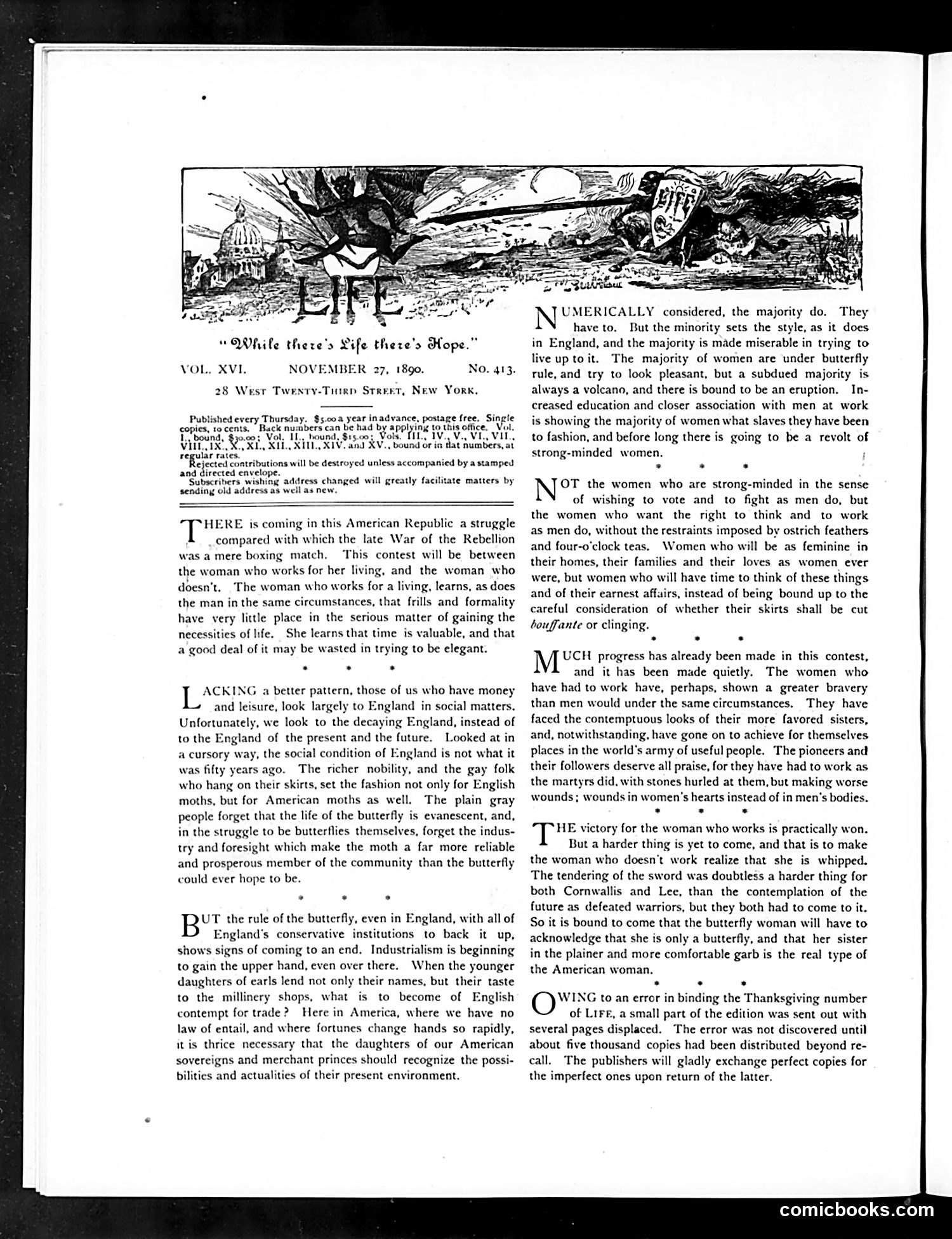
The header illustration depicts a woman with flowing hair riding a broomstick across a nighttime landscape—a witchcraft reference used satirically to represent the emerging "New Woman" movement. The editorial articles discuss women entering the workforce and their push for equal rights, particularly voting rights. The text sarcastically compares women's social progress to witchcraft, suggesting that traditional society views female independence as supernatural or dangerous. Key satirical points: the "butterfly woman" (ornamental, leisured) is being replaced by women demanding work, education, and political participation. The magazine critiques both the conservative English social order and American industrial capitalism's effects on gender roles. The overall tone mocks societal anxiety about women's liberation while suggesting such progress is inevitable—comparing resistance to "butterflies" trying to prevent their own transformation.
📄 Transcribed text from this page (OCR, searchable)
Machine-transcribed from the original scan — historical spelling and the odd misread are preserved.
“While there's Life there's Hope.” XVI. NOV 1890. 28 Wesr Twenty-Tinrp Street, New York, IBER No. 413. Published every Thursday. $5.00 year inadvance, postage free. Single copies, ro cents. Back numbers can be had by applying to this offi 1,, bound, co; Vol, IL, bound, $15.00; Vols, TIL. IV. ‘oo VI, VAL... VII. IX., X. XI, XUL, XH, XIV, and XV, bound or in flat numbers, at regular rat ejected contributions will be destroyed unless accompanied by a stamped and directed envelope. Subscribers wishing address changed will greatly facilitate matters by sending old address a3 well as new, HERE is coming in this American Republic a struggle compared with which the late War of the Rebellion was a mere boxing match. This contest will be between the woman who works for her living, and the woman who doesn’t, The woman who works for a living, learns, as does the man in the same circumstances, that frills and formality have very little place in the serious matter of gaining the necessities of life. She learns that time is valuable, and that a good deal of it may be wasted in trying to be elegant. . . . CKING a better pattern, those of us who have money and leisure, look largely to England in social matters. Unfortunately, we look to the decaying England, instead of to the England of the present and the future. Looked at in a cursory way, the social condition of England is not what it was fifty years ago. The richer nobility, and the gay folk who hang on their skirts, set the fashion not only for English moths, but for American moths as well. The plain gray people forget that the life of the butterfly is evanescent, and, in the struggle to be butterflies themselves, forget the indus- try and foresight which make the moth a far more reliable and prosperous member of the community than the butterfly could ever hope to be. ° . . B"t the rule of the butterfly, even in England, with all of England's conservative institutions to back it up, shows signs of coming to an end. Industrialism is beginning to gain the upper hand, even over there. When the younger daughters of earls lend not only their names, but their taste to the millinery shops, what is to become of English contempt for trade? Here in America, where we have no law of entail, and where fortunes change hands so rapidly, itis thrice necessary that the daughters of our American sovereigns and merchant princes should recognize the possi- bilities and actualities of their present environment. 2 N UMERICALLY considered, the majority do. They have to. But the minority sets the style, as it does in England, and the majority is made miserable in trying to live up to it. The majority of women are under butterfly tule, and try to look pleasant, but a subdued majority is always a volcano, and there is bound to be an eruption. In- creased education and closer association with men at work is showing the majority of women what slaves they have been to fashion, and before long there is going to be a revolt of strong-minded women. . . . OT the women who are strong-minded in the sense of wishing to vote and to fight as men do, but the women who want the right to think and to work as men do, without the restraints imposed by ostrich feathers and four-o'clock teas. Women who will be as feminine in their homes, their families and their loves as women ever were, but women who will have time to think of these things and of their earnest affairs, instead of being bound up to the careful consideration of whether their skirts shall be cut bouffante or clinging. . . . UCH progress has already been made in this contest, and it has been made quietly. The women who have had to work have, perhaps, shown a greater bravery than men would under the same circumstances. They have faced the contemptuous looks of their more favored sisters, and, notwithstanding, have gone on to achieve for themselves places in the world’s army of useful people. The pioneers and their followers deserve all praise, for they have had to work as the martyrs did, with stones hurled at them, but making worse wounds ; wounds in women’s hearts instead of in men’s bodies. . . . HE victory for the woman who works is practically won. But a harder thing is yet to come, and that is to make the woman who doesn’t work realize that she is whipped. The tendering of the sword was doubtless a harder thing for both Cornwallis and Lee, than the contemplation of the future as defeated warriors, but they both had to come to it. So it is bound to come that the butterfly woman will have to acknowledge that she is only a butterfly, and that her sister in the plainer and more comfortable garb is the real type of the American woman. * . . WING to an error in binding the Thanksgiving number of LIFE, a small part of the edition was sent out with several pages displaced. The error was not discovered until about five thousand copies had been distributed beyond re- call. The publishers will gladly exchange perfect copies for the imperfect ones upon return of the latter. comicbooks.com