
Life, 1890-11-27 · page 6 of 20
Life — November 27, 1890 — page 6: what you’re looking at
What you’re looking at
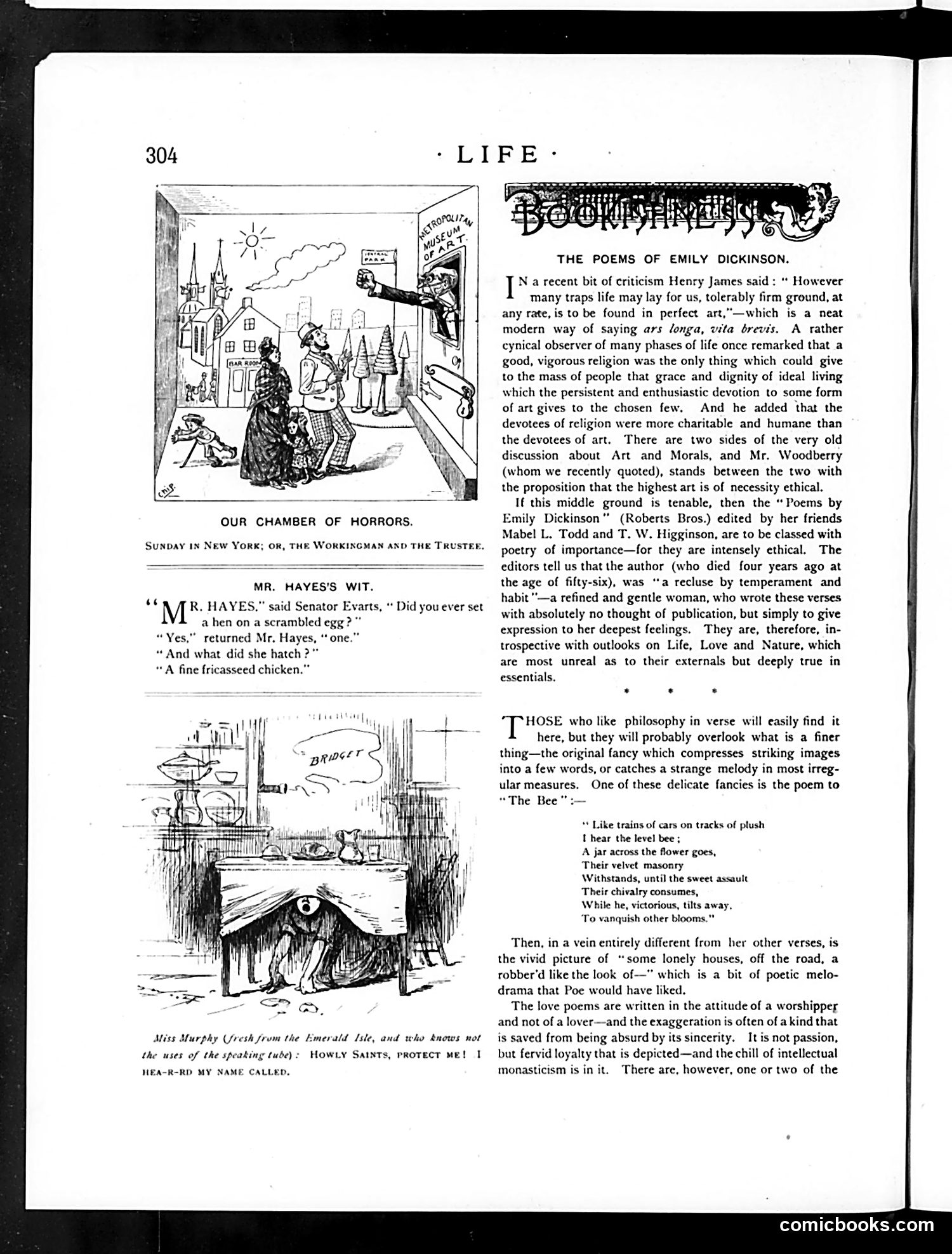
The page contains two distinct elements: **Top cartoon ("Our Chamber of Horrors"):** Depicts a chaotic Sunday street scene in New York, showing various urban characters and activities. The caption references "the Workingman and the Trustee," suggesting social class commentary typical of Life's satirical focus on labor and wealth inequality during the Gilded Age. **Below:** A brief joke attributed to "Mr. Hayes's Wit" about Senator Evans and a hen—a simple pun about "scrambled eggs." **Main content:** A literary review of Emily Dickinson's poems, edited by friends after her death. The reviewer discusses whether her philosophical verses constitute serious poetry, noting her original imagery and delicate fancy, while analyzing her love poems as sincere rather than passionate. The page blends satirical cartoons with serious literary criticism, typical of Life's mixed approach to American culture and society.
📄 Transcribed text from this page (OCR, searchable)
Machine-transcribed from the original scan — historical spelling and the odd misread are preserved.
MR. HAYES'S WIT. R, HAYES,” said Senator Evarts, “ Did you ever set a hen on a scrambled egg? “Yes,” returned Mr, Hayes, * one.” “And what did she hatch ?” “A fine fricasseed chicken.” Miss Murphy (fresh from the Emerald Isle, and who knows not the uses of the speaking tube): HOWLY Saints, protect ME! 1 HEA-R-RD MY NAME CALLED. THE POEMS OF EMILY DICKINSON. N a recent bit of criticism Henry James said : “ However Many traps life may lay for us, tolerably firm ground, at any rate, is to be found in perfect art,"—which is a neat modern way of saying ars /onga, vita brevis. A rather cynical observer of many phases of life once remarked that a good, vigorous religion was the only thing which could give to the mass of people that grace and dignity of ideal living which the persistent and enthusiastic devotion to some form of art gives to the chosen few. And he added that the devotees of religion were more charitable and humane than the devotees of art. There are two sides of the very old discussion about Art and Morals, and Mr. Woodberry (whom we recently quoted), stands between the two with the proposition that the highest art is of necessity ethical. If this middle ground is tenable, then the “Poems by Emily Dickinson" (Roberts Bros.) edited by her friends Mabel L. Todd and T. W. Higginson, are to be classed with poetry of importance—for they are intensely ethical. The editors tell us that the author (who died four years ago at the age of fifty-six), was ‘a recluse by temperament and habit "—a refined and gentle woman, who wrote these verses with absolutely no thought of publication, but simply to give expression to her deepest feelings. They are, therefore, in- trospective with outlooks on Life, Love and Nature, which are most unreal as to their externals but deeply true in essentials. . . . HOSE who like philosophy in verse will easily find it here, but they will probably overlook what is a finer thing—the original fancy which compresses striking images into a few words, or catches a strange melody in most irreg- ular measures. One of these delicate fancies is the poem to “The Bee" :— + Like trains of cars on tracks of plush Uhear the level bee ; A jar across the flower goes, ‘Their velvet masonry Withstands, until the sweet assault Their chivalry consumes, While he, victorious, tilts away, To vanquish other blooms.” Then, in a vein entirely different from her other verses, is the vivid picture of “some lonely houses, off the road, a robber’d like the look of—" which is a bit of poetic melo- drama that Poe would have liked. The love poems are written in the attitude of a worshipper and not of a lover—and the exaggeration is often of a kind that is saved from being absurd by its sincerity. It is not passion, but fervid loyalty that is depicted—and the chill of intellectual monasticism is in it. There are, however, one or two of the comicbooks.com