
A complete issue · 24 pages · 1890
Life — November 20, 1890
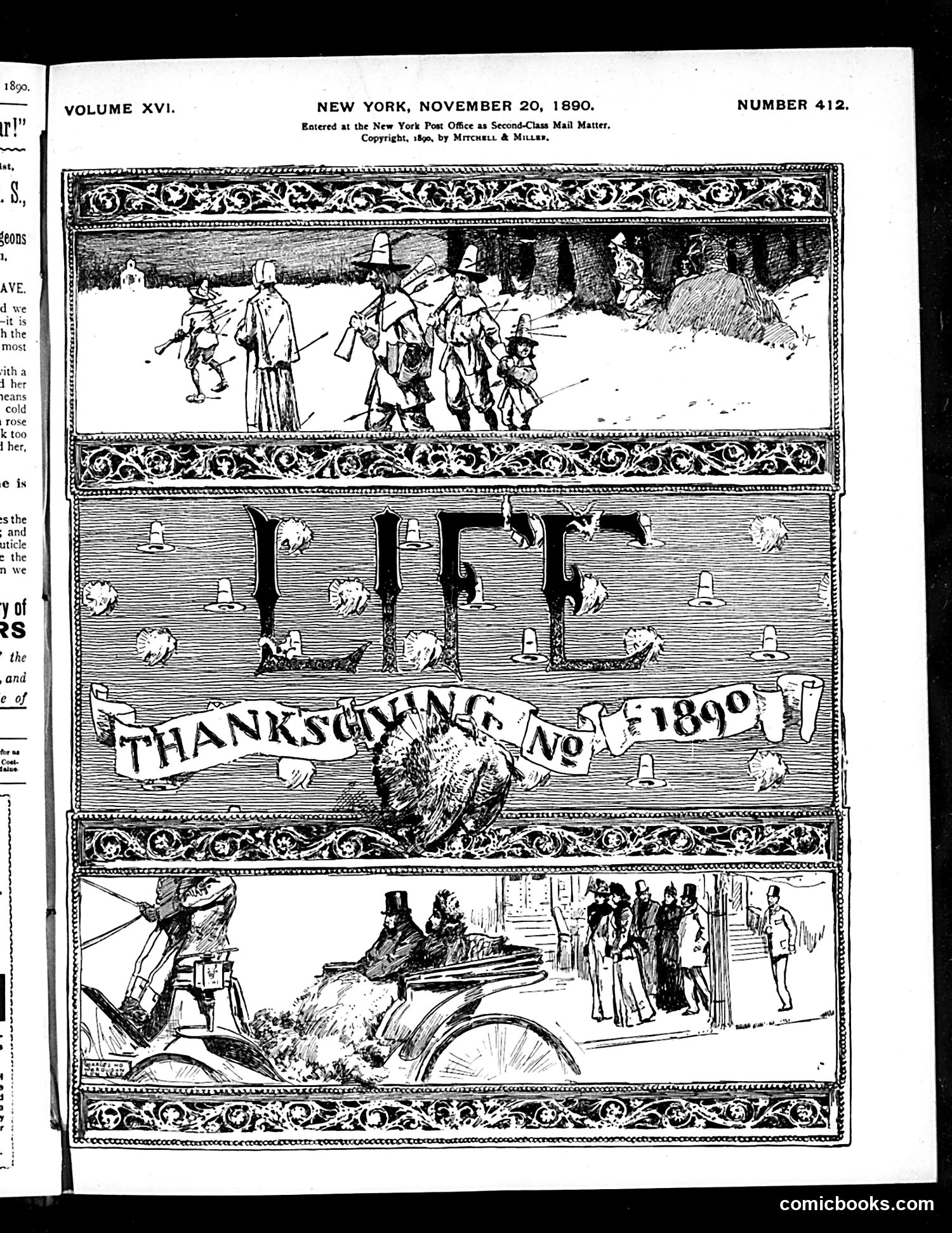
This page features Thanksgiving 1890 satirical content. The top panel shows figures in winter clothing near a snowy landscape, likely depicting a Thanksgiving scene or gathering. The central image, labeled "THANKSGIVING NO 1890," displays gravestones or tombstones in a cemetery-like setting with a turkey, suggesting dark humor about mortality during the holiday season—possibly satirizing financial hardship, deaths, or social troubles of 1890. The bottom panel shows a Thanksgiving Day parade or procession with a decorated carriage and onlookers, typical of late-19th-century holiday celebrations. Without additional OCR text or clearer identification of specific figures, the exact political targets remain unclear, though the juxtaposition of tombstones with holiday imagery suggests commentary on contemporary social or economic problems overshadowing the holiday.
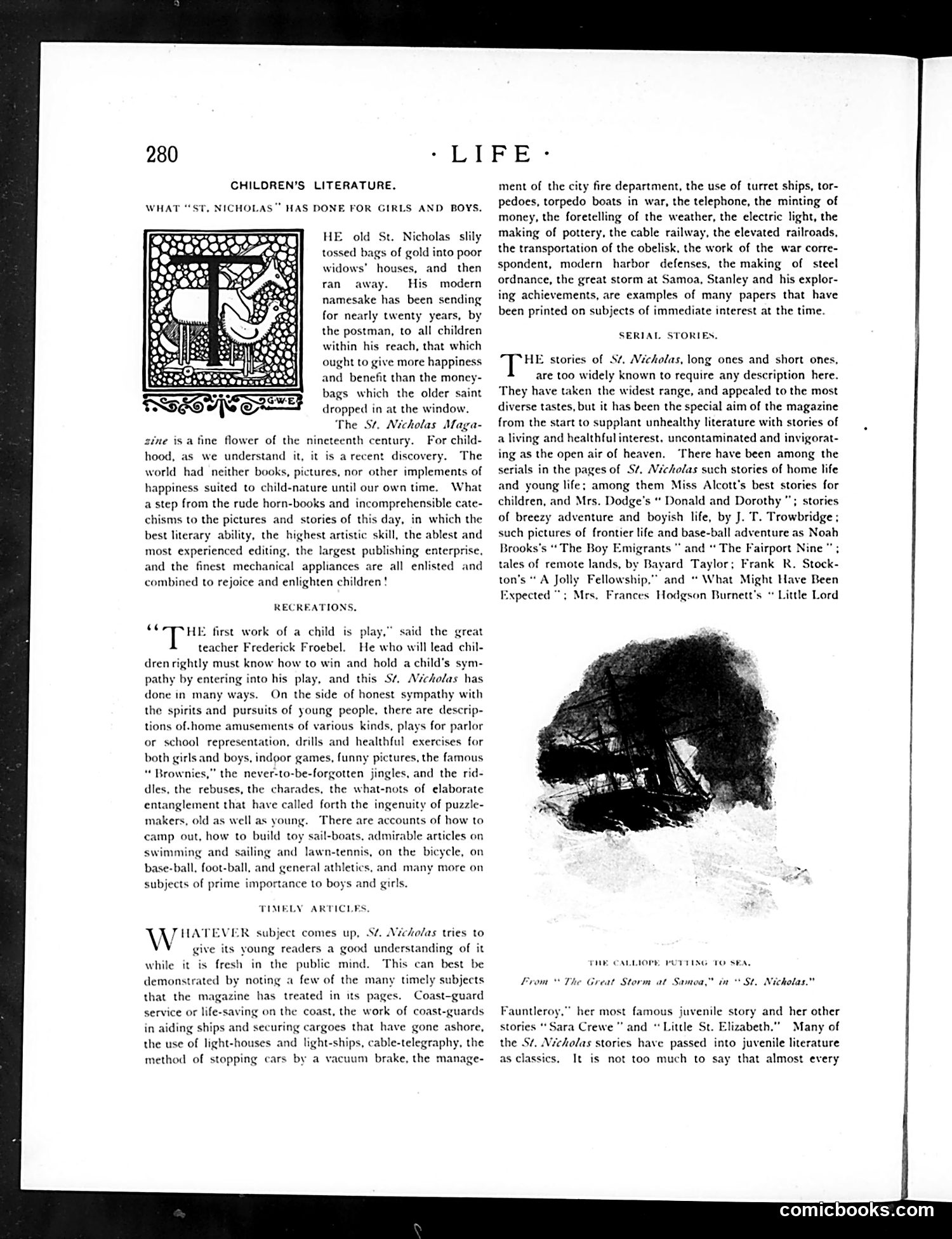
This page discusses St. Nicholas Magazine's contributions to children's literature. The text praises the publication for sending "bags of gold into poor windows" metaphorically—providing quality stories and illustrations to children for nearly twenty years. The single illustration shows a **ship in stormy seas**, captioned "The Calliope Putting to Sea" from "The Great Storm at Samoa" in St. Nicholas. This appears to be an example of the magazine's adventure content rather than political satire. The page celebrates St. Nicholas's diverse subject matter—from recreation and games to timely articles on modern developments (railroads, telephones, cable railways). There is no political cartoon or satire present. This is essentially promotional content about a respected children's publication.
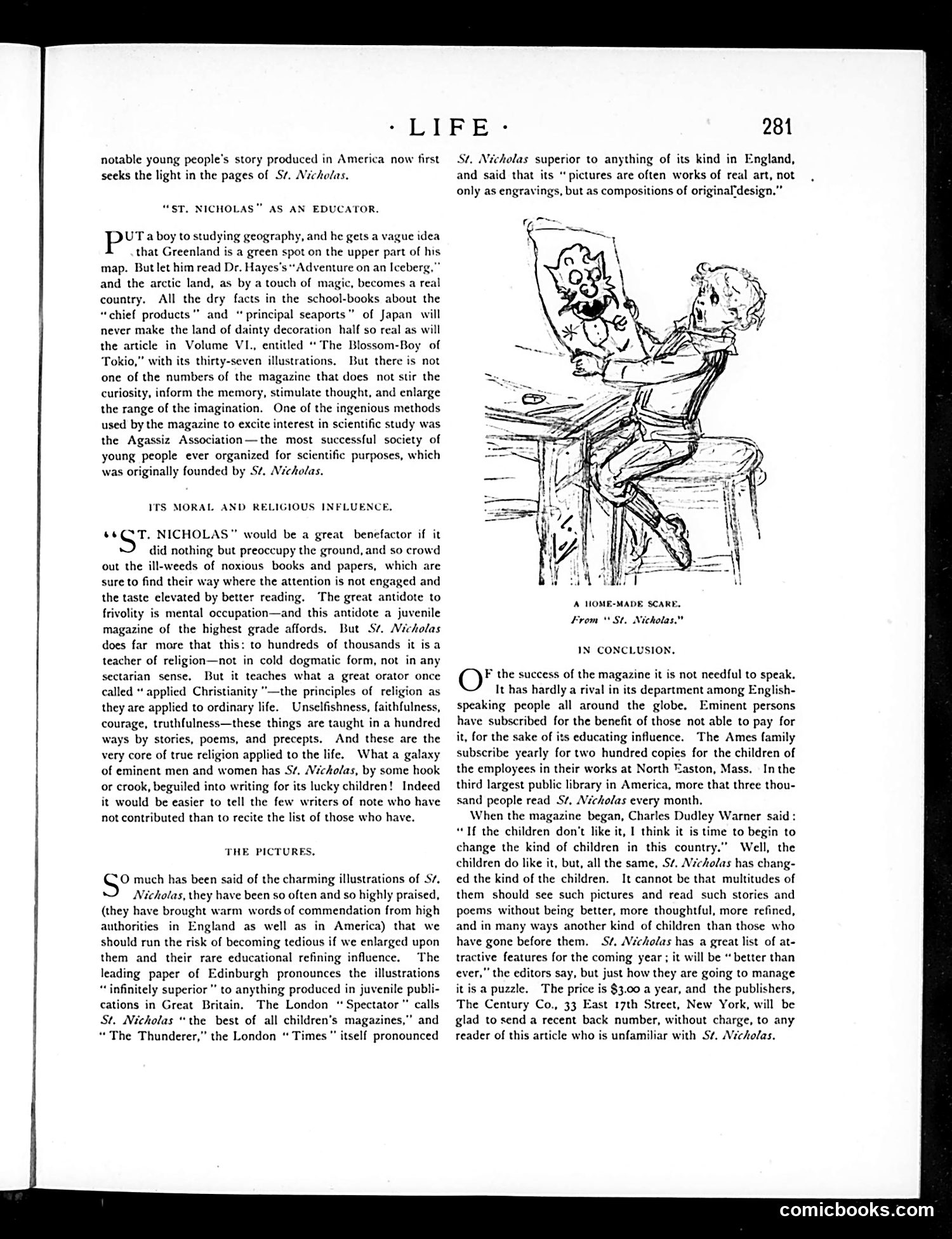
This page discusses *St. Nicholas* magazine's educational value and influence. The small illustration titled "A HOME-MADE SCARE" depicts a child showing another child a grotesque mask or creature face—likely demonstrating how the magazine's stories and illustrations could stimulate imagination and evoke emotion in young readers. The text praises *St. Nicholas* for promoting moral and religious values through storytelling rather than "dogmatic form," and credits it with founding the Agassiz Association for scientific study. The page argues the magazine's educational approach—through entertaining narratives and refined illustrations—was superior to frivolous publications, making it beneficial for childhood development. No specific political satire appears; this is editorial praise for a children's publication.
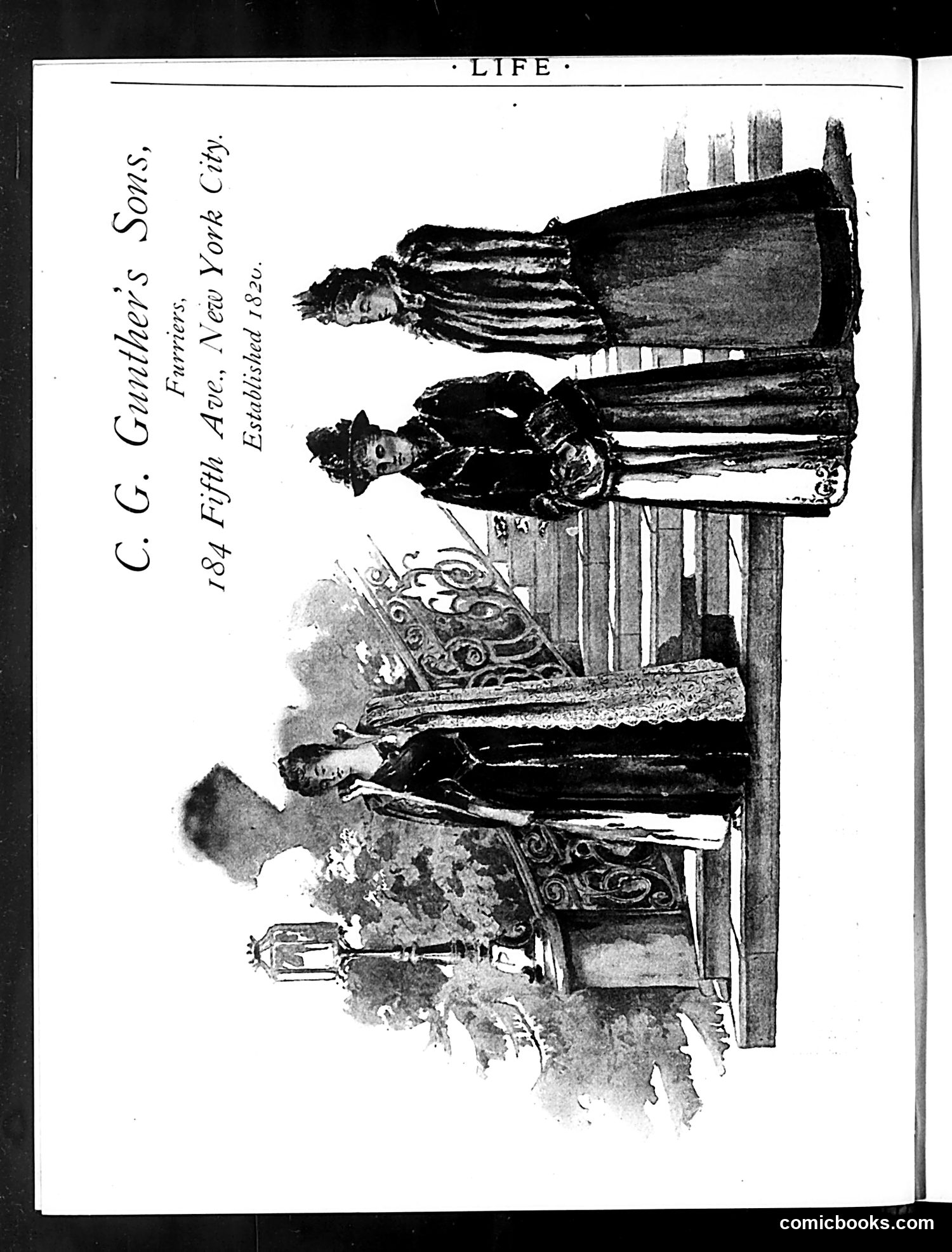
This appears to be an advertisement rather than editorial content. The page shows "C. G. Guthler's Sons, Furriers" displaying their business at "184 Fifth Ave., New York City, Established 1826." The image depicts two well-dressed figures in formal Victorian-era clothing with fur coats and accessories, standing in an interior setting with decorative architectural elements. A third figure appears seated or reclining in the background. This is a commercial advertisement showcasing the furrier's products and establishment's prestige through imagery of elegantly dressed clientele. There is no apparent political satire or social commentary—it's straightforward marketing content from Life magazine, using the publication's visual space to promote a luxury goods business to its affluent readership.
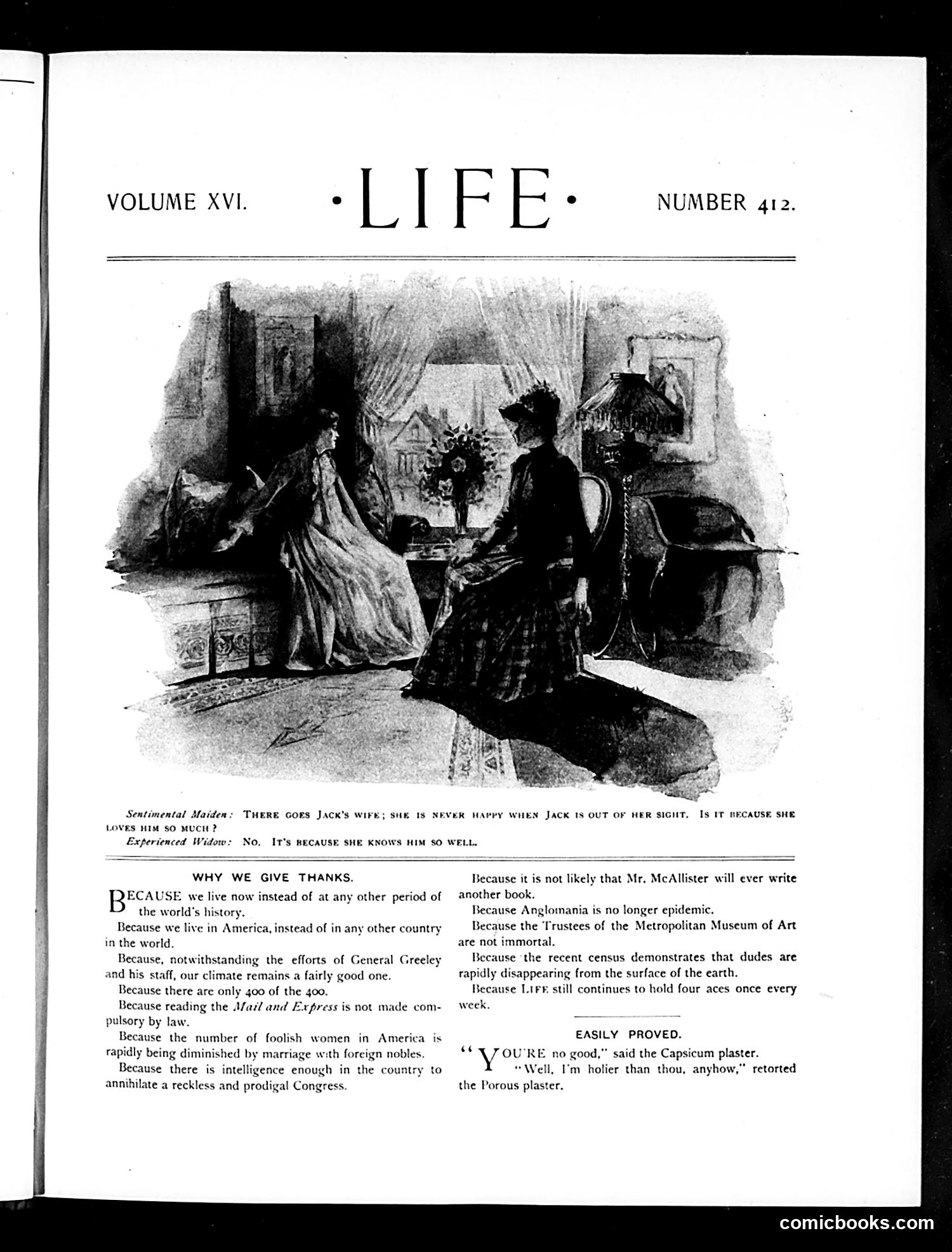
The main illustration depicts a domestic scene with the caption "Sentimental Maiden" discussing Jack's wife, who is unhappy during his absences. An "Experienced Widow" responds that the wife's unhappiness stems from knowing Jack too well—a joke about marital disillusionment. Below, "Why We Give Thanks" is a humorous list of reasons Americans should be grateful, including: living in America rather than elsewhere, having only "400 of the 400" (likely referencing New York's elite social circle), reading the Mail and Express, and reducing "foolish women" through marriages to foreign nobles. The "Easily Proved" item at bottom is a brief joke about a porous plaster. The overall content reflects early 20th-century American satirical humor about society, marriage, and civic pride.
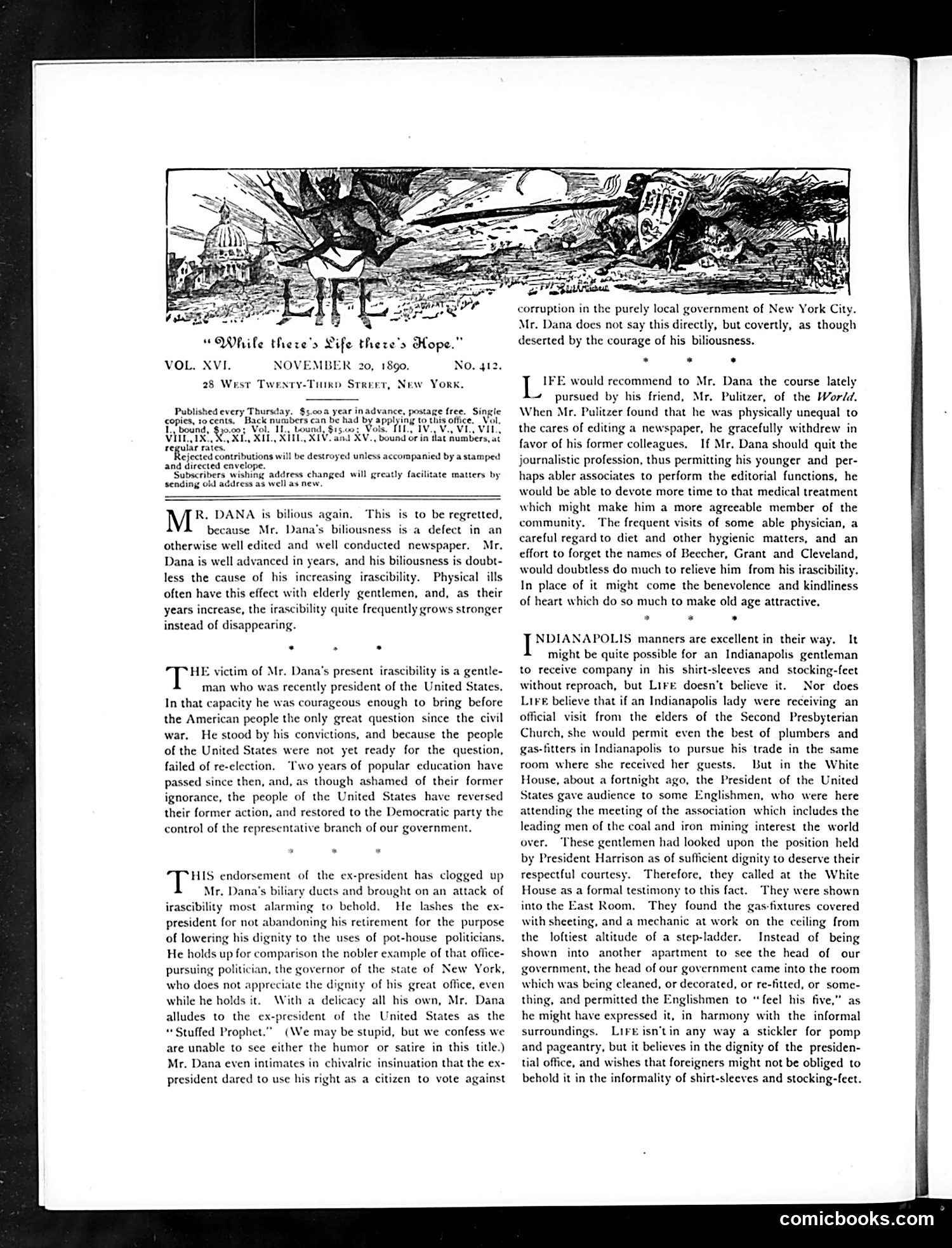
The page contains editorial commentary criticizing Mr. Dana's "bilious" temperament and his attack on ex-President Harrison's irascibility. The text suggests Dana, a newspaper editor, is hypocritical—denouncing Harrison's personality flaws while being equally disagreeable himself. The top illustration shows a nightmarish, demonic figure labeled "LIFE" soaring over a dark landscape, representing the satirical magazine's sharp critical voice. The second section mocks Indianapolis social customs, sarcastically praising their informality while criticizing President Harrison (who appears to be from Indianapolis) for allowing English visitors to be shown the White House in casual dress—suggesting this violated presidential dignity. The satire targets both Dana's journalistic hypocrisy and Harrison's perceived lapses in formal presidential decorum.
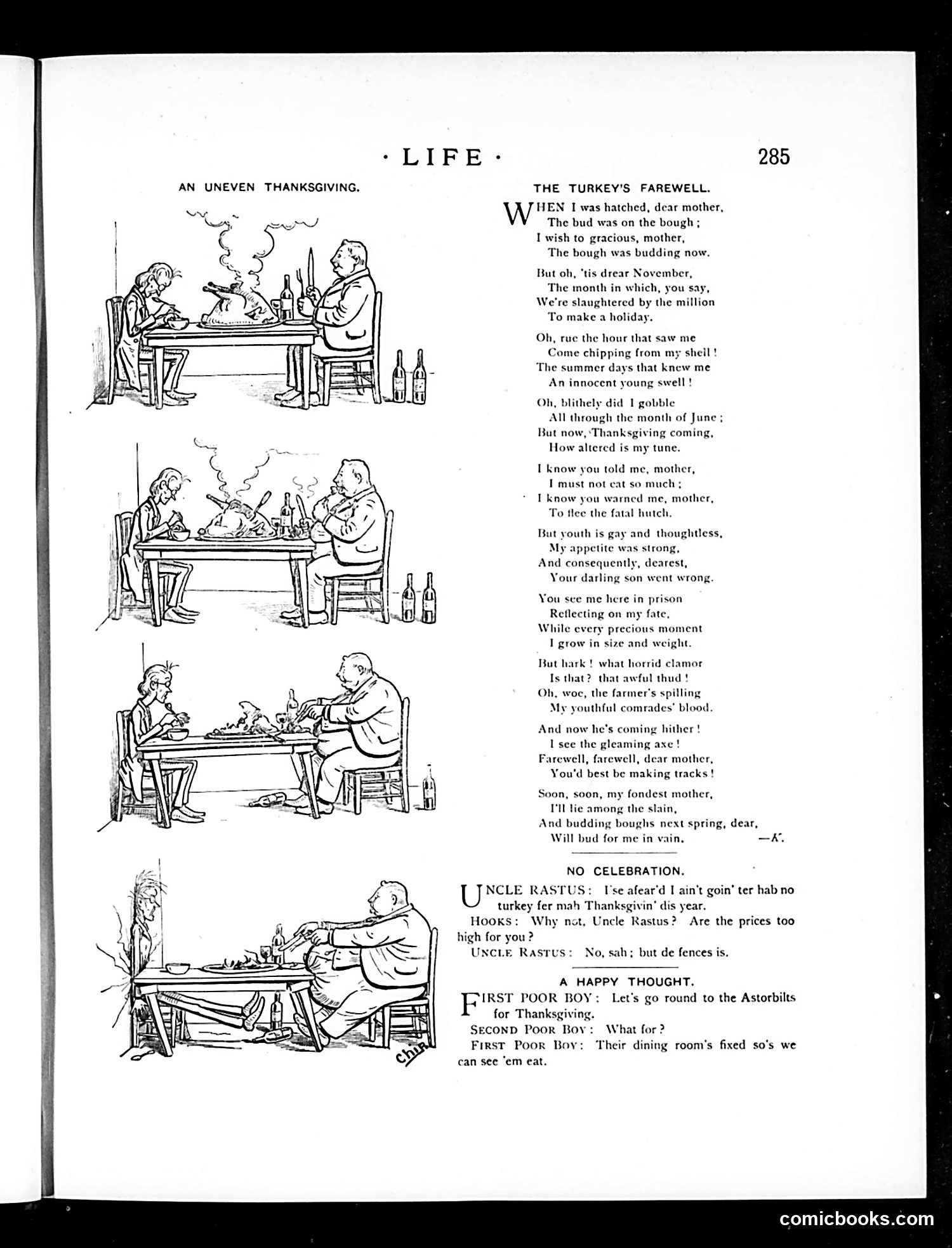
This page contains Thanksgiving-themed satirical content circa early 20th century. **"An Uneven Thanksgiving"** (left): Four sequential cartoons show a Thanksgiving dinner progressively deteriorating—the turkey shrinks from a substantial bird to nearly nothing, while the diners remain seated. The joke satirizes economic hardship or scarcity, suggesting poor families received inadequate holiday meals. **"The Turkey's Farewell"** (right): A poignant poem from a turkey's perspective, addressing its mother before slaughter. It's darkly humorous, personifying the bird while commenting on the casual violence of holiday traditions. **"No Celebration," "A Happy Thought"** (bottom): Brief comic dialogues about Thanksgiving affordability and poverty, with poor boys envying wealthy families' dining rooms. The page collectively satirizes class inequality and economic struggle during the holiday season.
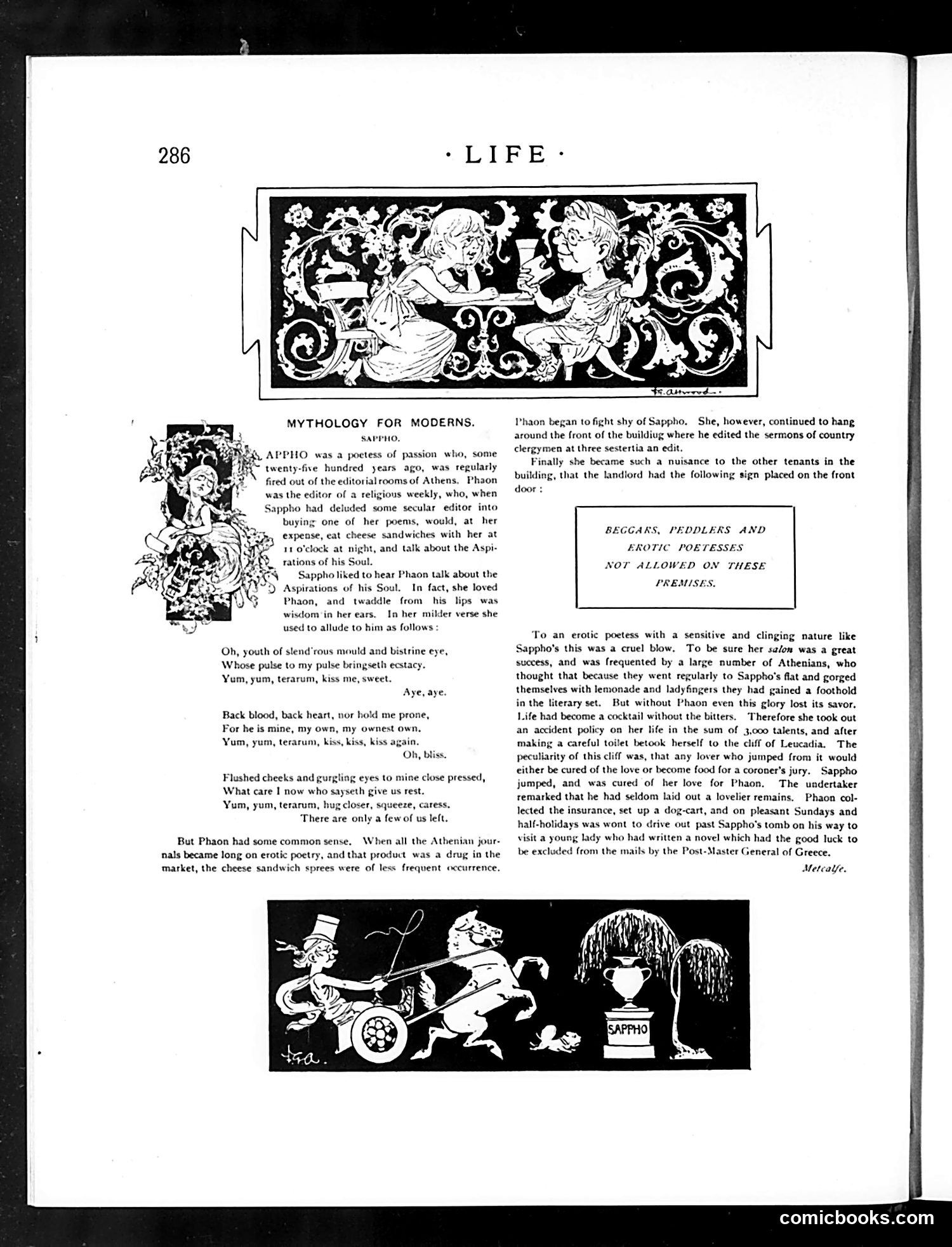
This page presents a satirical piece about Sappho, the ancient Greek poetess, reimagined for modern times. The article humorously depicts Sappho as a passionate but impractical poet living in Athens, regularly treated to cheese sandwiches by an admiring "secular editor" named Phaon at 11 PM dinners where he'd listen to her poetry. The satire mocks both Sappho's romantic, sensitive nature and the impoverished "bohemian" lifestyle of modern poets and artists. The accompanying decorative illustrations show classical figures in ornate frames. A sign posted by her landlord banning "beggars, peddlers and prostitutes" suggests the satirical conflation of struggling artists with society's lower classes—a commentary on how modern artistic life was viewed as disreputable or economically precarious.
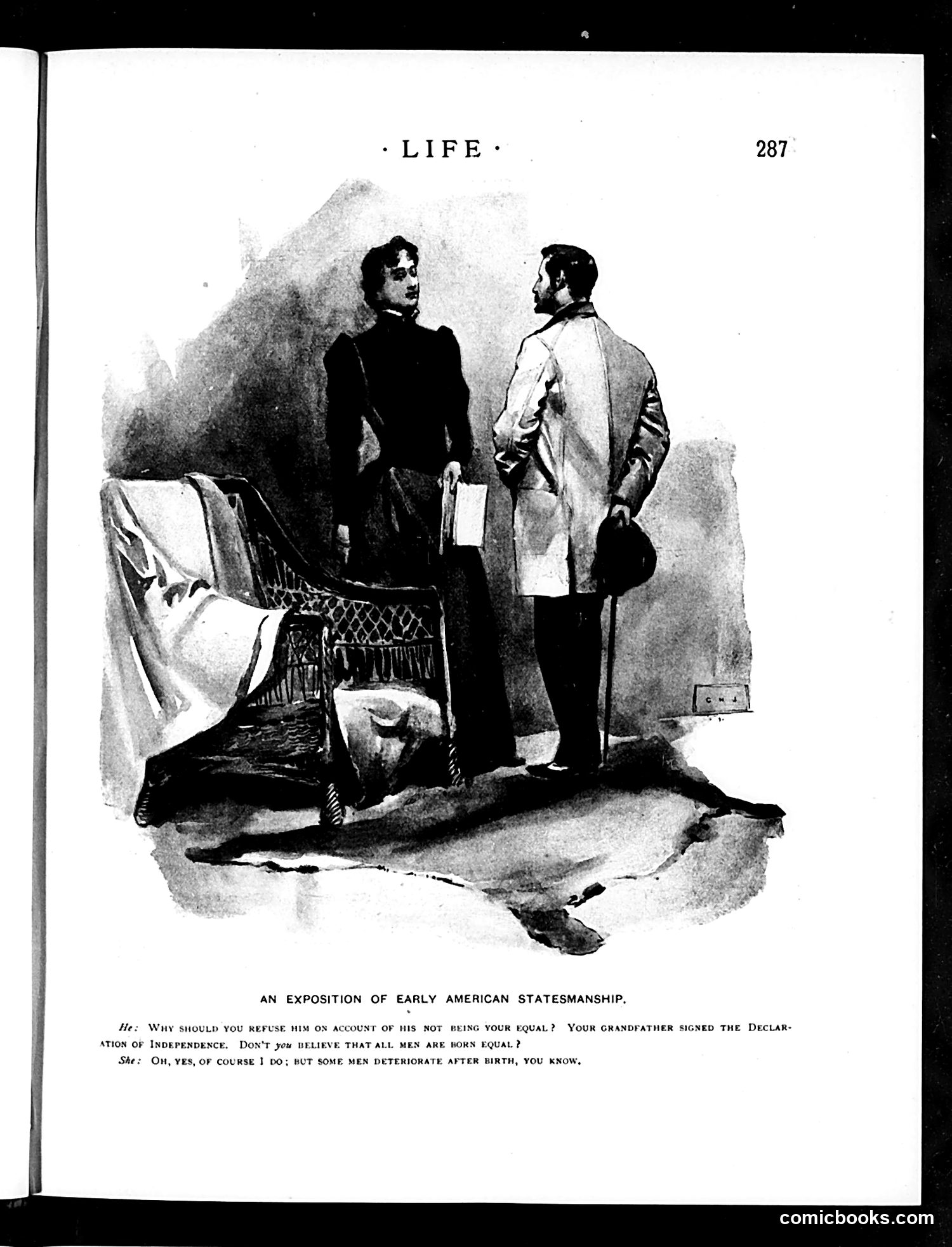
This satirical cartoon depicts two well-dressed men in what appears to be a heated debate about equality and merit. One challenges the other by invoking the Declaration of Independence and the principle that "all men are born equal." The responding figure sarcastically agrees but adds that "some men deteriorate after birth"—a cutting remark suggesting that inequality results from personal failings rather than inherent difference. The satire targets hypocritical American political discourse: the cartoon mocks statesmen who publicly espouse democratic ideals of equality while privately justifying social hierarchies through claims about individual character or merit. The title implies this contradiction represents a fundamental flaw in early American political philosophy and practice.
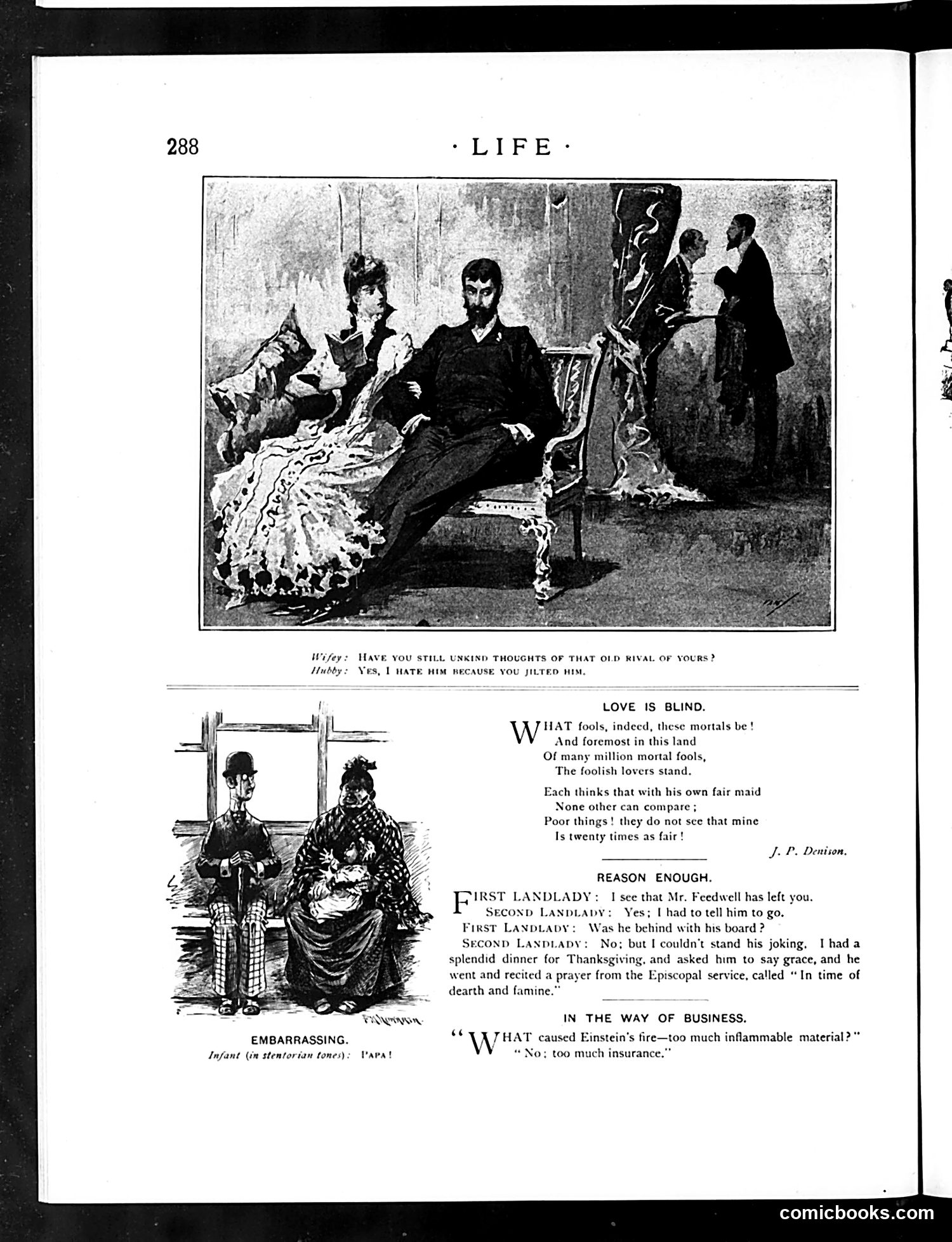
This page contains three separate satirical pieces typical of early Life magazine humor: 1. **Top image**: A domestic scene where a wife confronts her husband about lingering feelings for a rival. The satire mocks romantic jealousy and Victorian-era relationship drama. 2. **"Love is Blind"**: A poem by J.P. Donlam satirizing foolish lovers who cannot see their partners' actual faults, believing their own romantic interest to be uniquely superior. 3. **"Reason Enough"** and **"In the Way of Business"**: Brief comedic dialogues. The first jokes about excuses for leaving social gatherings; the second is a pun on Einstein's fire—humorously attributing it to "too much insurance" rather than scientific causes. The **"Embarrassing"** sketch depicts social awkwardness between two people at a window.
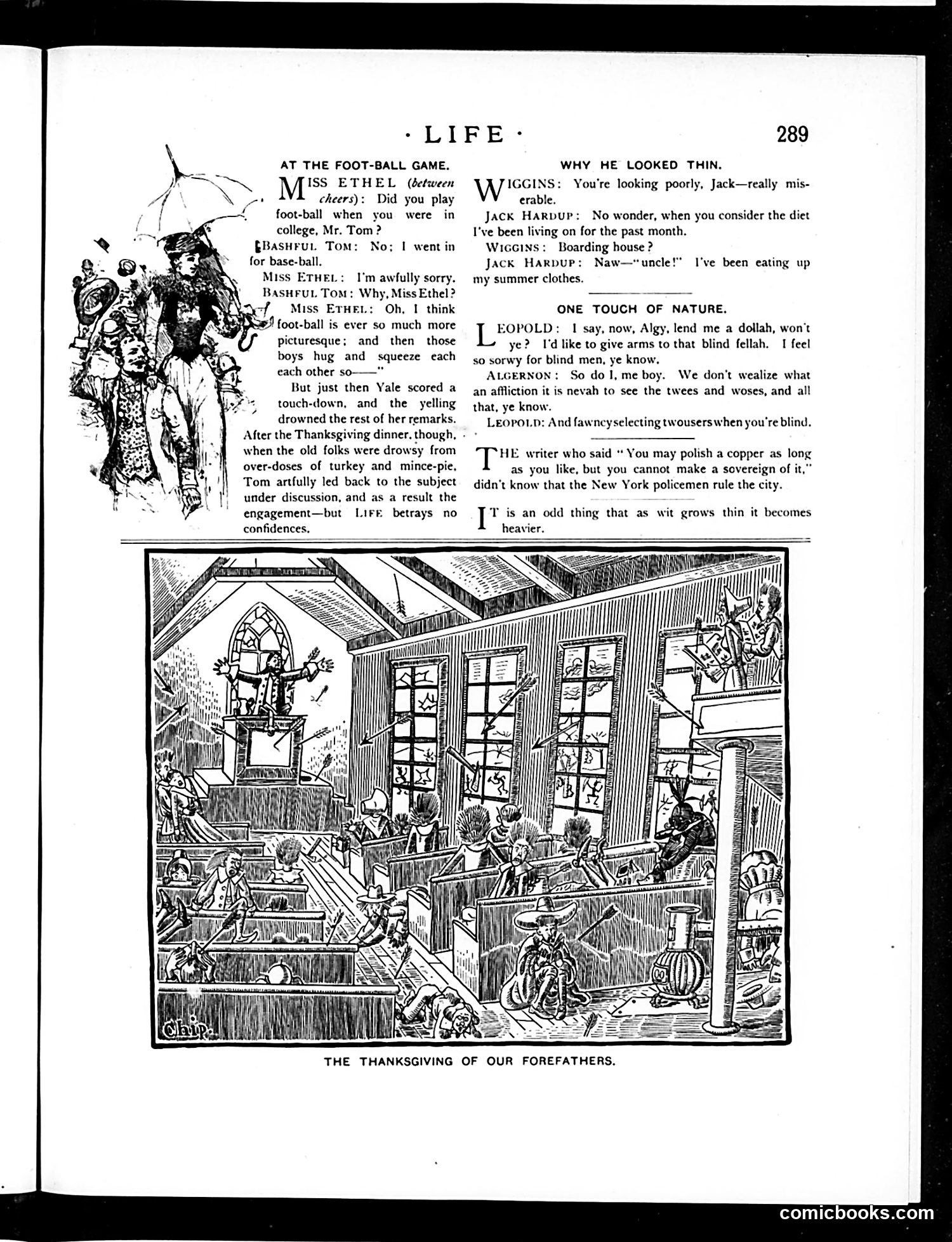
This page contains three distinct humor pieces from *Life* magazine: 1. **"At the Foot-Ball Game"** (top left): A comic dialogue between Miss Ethel and Bashful Tom about college football. Tom admits he attended a baseball game instead, leading Miss Ethel to find this "picturesque" compared to football's rough physicality—a gentle satire on early 1900s college sports culture and gender attitudes. 2. **"Why He Looked Thin"** (top right): A brief exchange where Jack Hardup's thin appearance is explained by his diet of summer clothes, satirizing poverty or financial hardship through wordplay. 3. **"The Thanksgiving of Our Forefathers"** (large illustration): A detailed engraving depicting a chaotic colonial Thanksgiving scene with figures crowded in a colonial home, likely satirizing romanticized historical narratives by showing the actual messy reality of early American life.
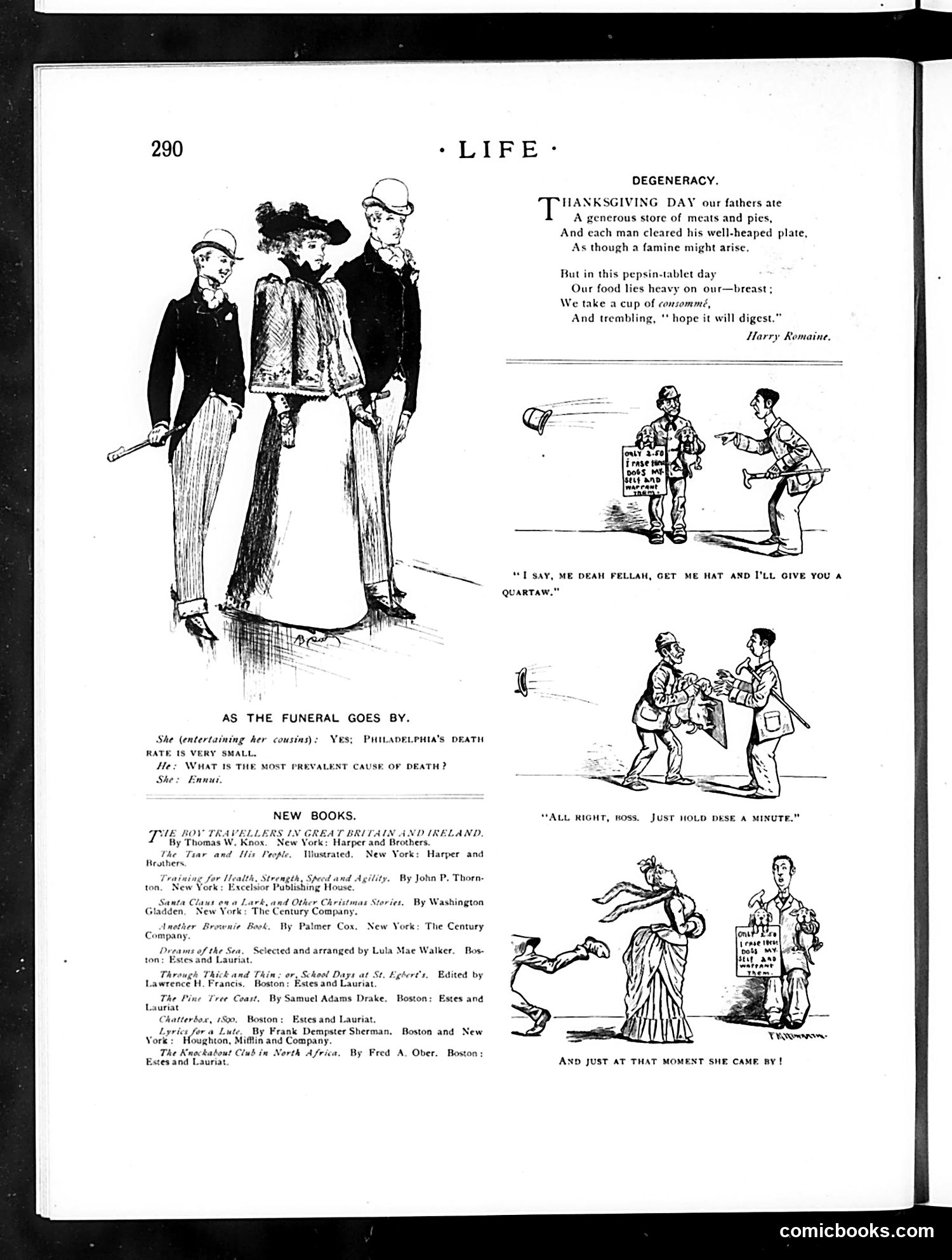
This *Life* magazine page satirizes American social "degeneracy"—a late 19th/early 20th-century concern about declining vigor. **The main cartoon** contrasts past and present: ancestors ate hearty Thanksgiving feasts without worry; modern people nervously consume only light consommé (soup), obsessing over digestion and needing "pepsin tablets" (antacids). The joke mocks contemporary hypochondria and physical weakness. **The side comics** show working-class men in comedic situations—one offering a quarter for a hat, another juggling objects. These appear unrelated vignettes typical of *Life's* humor format. **"As the Funeral Goes By"** jokes darkly that Philadelphia's low death rate stems from citizens dying of *ennui* (boredom/apathy)—suggesting modern urban life is so tedious it's literally fatal. The page reflects period anxiety about whether modern civilization was making Americans physically and morally soft compared to hardier ancestors.
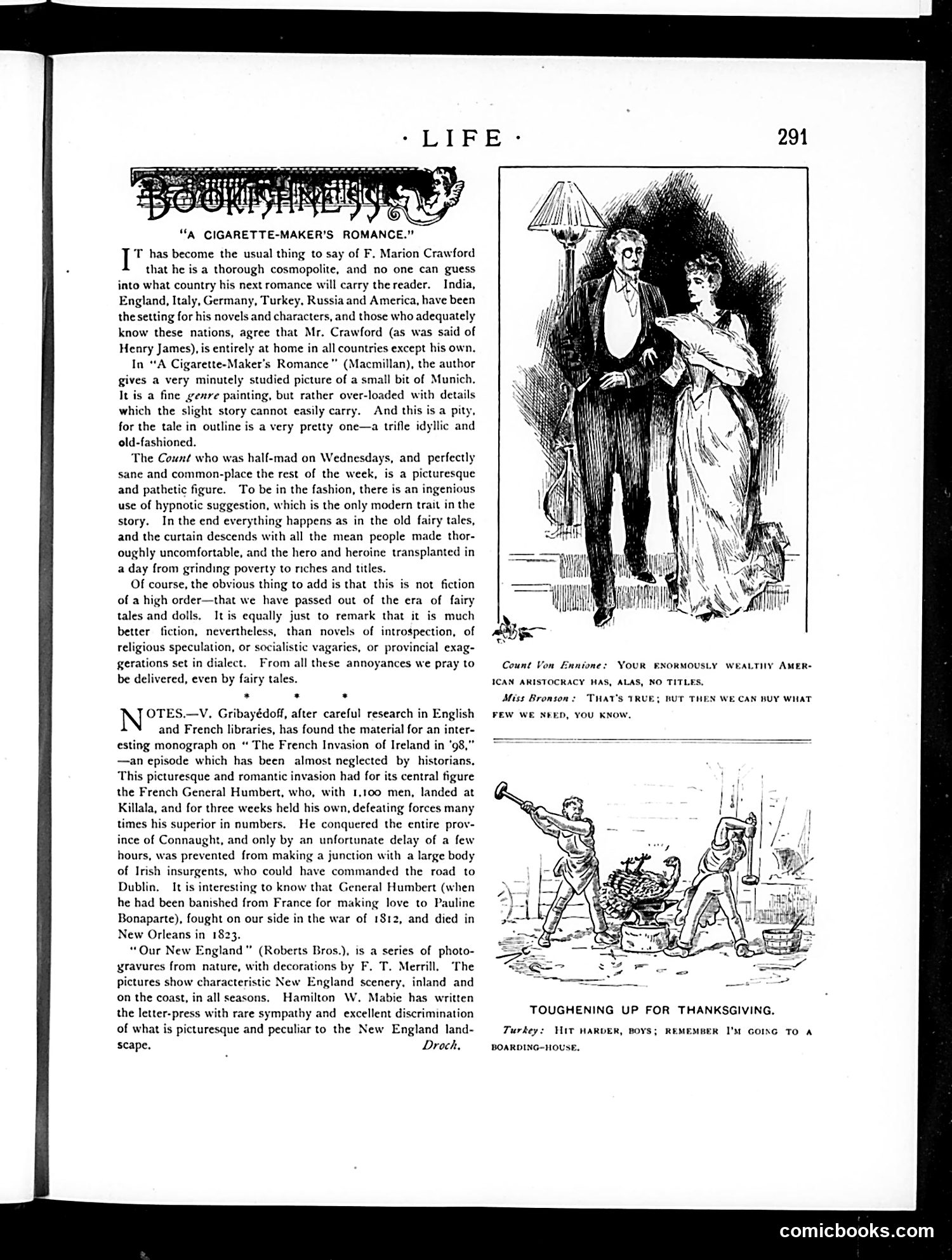
This page reviews F. Marion Crawford's novel "A Cigarette-Maker's Romance," set in Munich. The reviewer praises the book's fairy-tale structure while criticizing its excessive detail and old-fashioned plot (a count descends from poverty to riches through hypnotic suggestion). The top cartoon depicts a wealthy American aristocrat and Miss Bronson. The joke targets American social anxiety about European nobility: the Count boasts that American wealth lacks titles, and Miss Bronson retorts that Americans don't need them—they can simply *buy* what they want. This satirizes both American materialism and the period's fascination with European aristocratic status. The lower cartoon shows turkeys being "toughened up" for Thanksgiving at a boarding house—a dark joke about preparing fowl for slaughter before the holiday. The page also notes a historical work by Gribayédoff on the 1798 French invasion of Ireland.
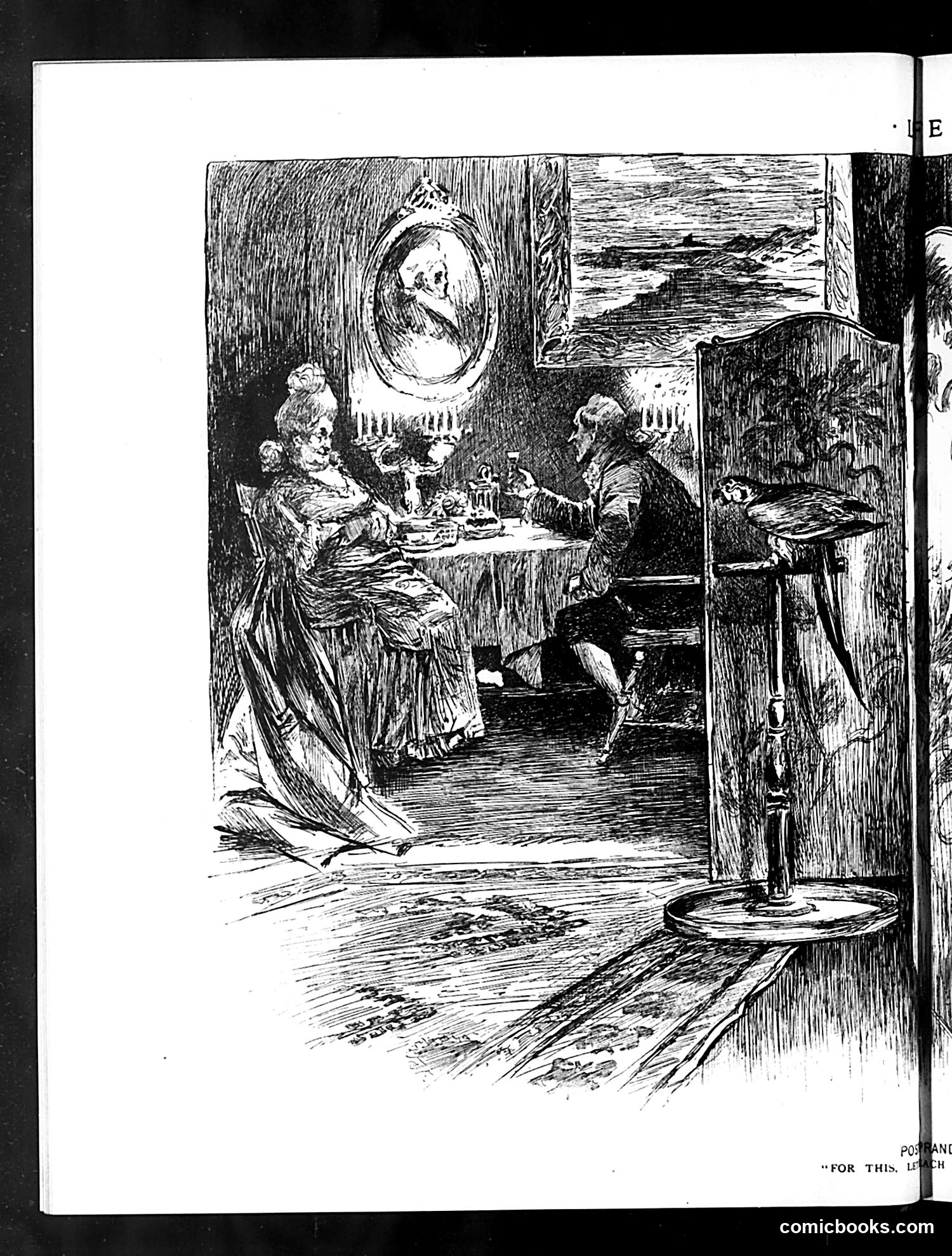
This is a satirical illustration from *Life* magazine showing an interior domestic scene. A woman in an elegant dress stands in a doorway on the left, observing two men seated at a table having a meal or drink. A portrait hangs on the wall above them, and a window shows a seascape. The style is detailed pen-and-ink engraving typical of late 19th-century magazine illustration. Without additional visible text identifying the specific figures or context, I cannot definitively state who these individuals represent or what political/social commentary the scene conveys. The composition suggests domestic or social satire—possibly commentary on hospitality, infidelity, or class dynamics—but the precise satirical target remains unclear from the image alone.
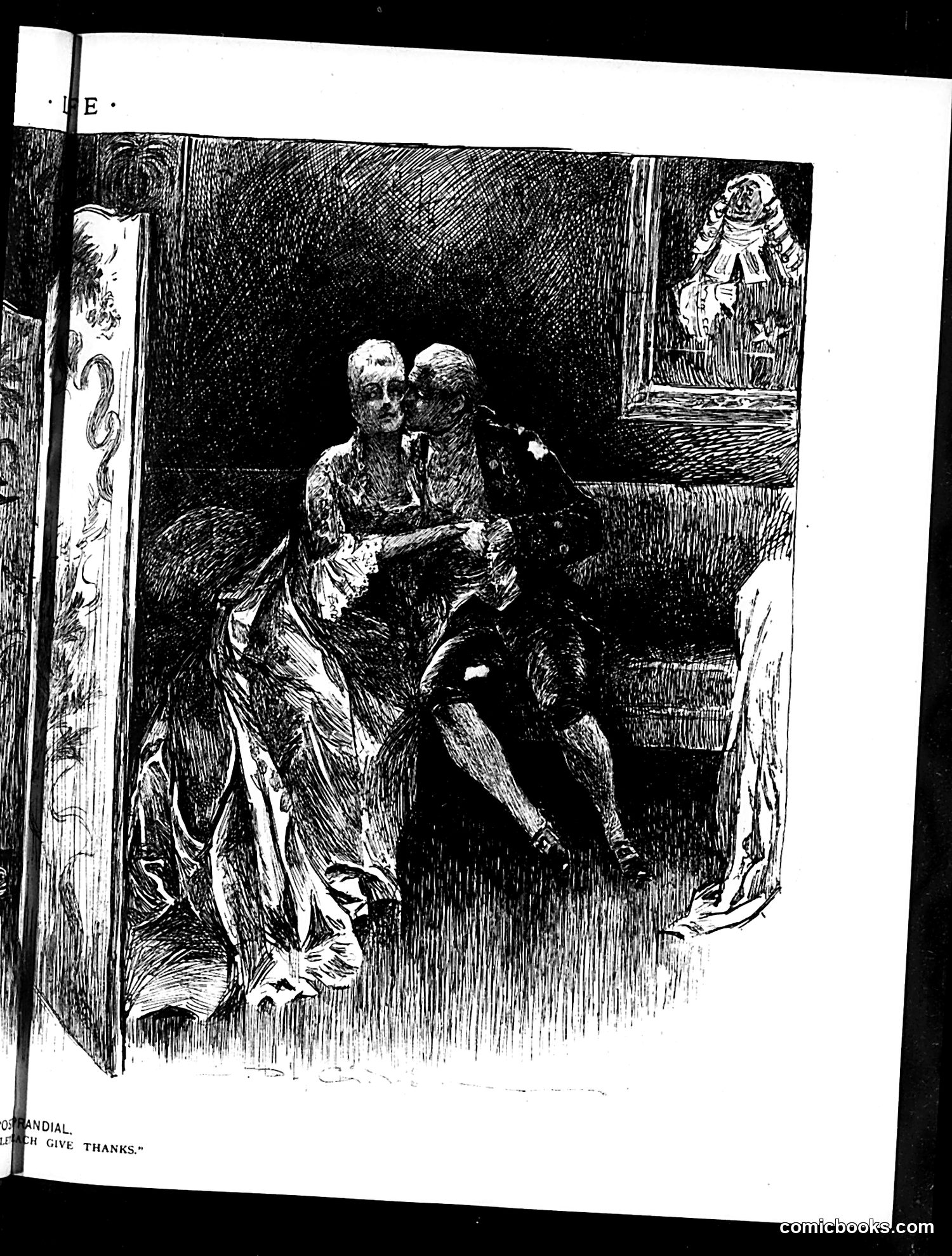
This appears to be a Victorian-era etching showing two men in an interior domestic setting. One man leans toward another in what seems an intimate or conspiratorial manner. A picture hangs on the wall behind them. The visible text fragment reads "...SH GIVE THANKS," suggesting gratitude or appreciation is the cartoon's subject. Without additional context—such as the publication date, artist attribution, or complete caption—I cannot identify the specific figures or determine what social/political situation this satirizes. The intimate body language and interior setting suggest either a commentary on personal relationships or potentially scandalous conduct, but the exact meaning and targets of satire remain unclear from the image and partial text alone.
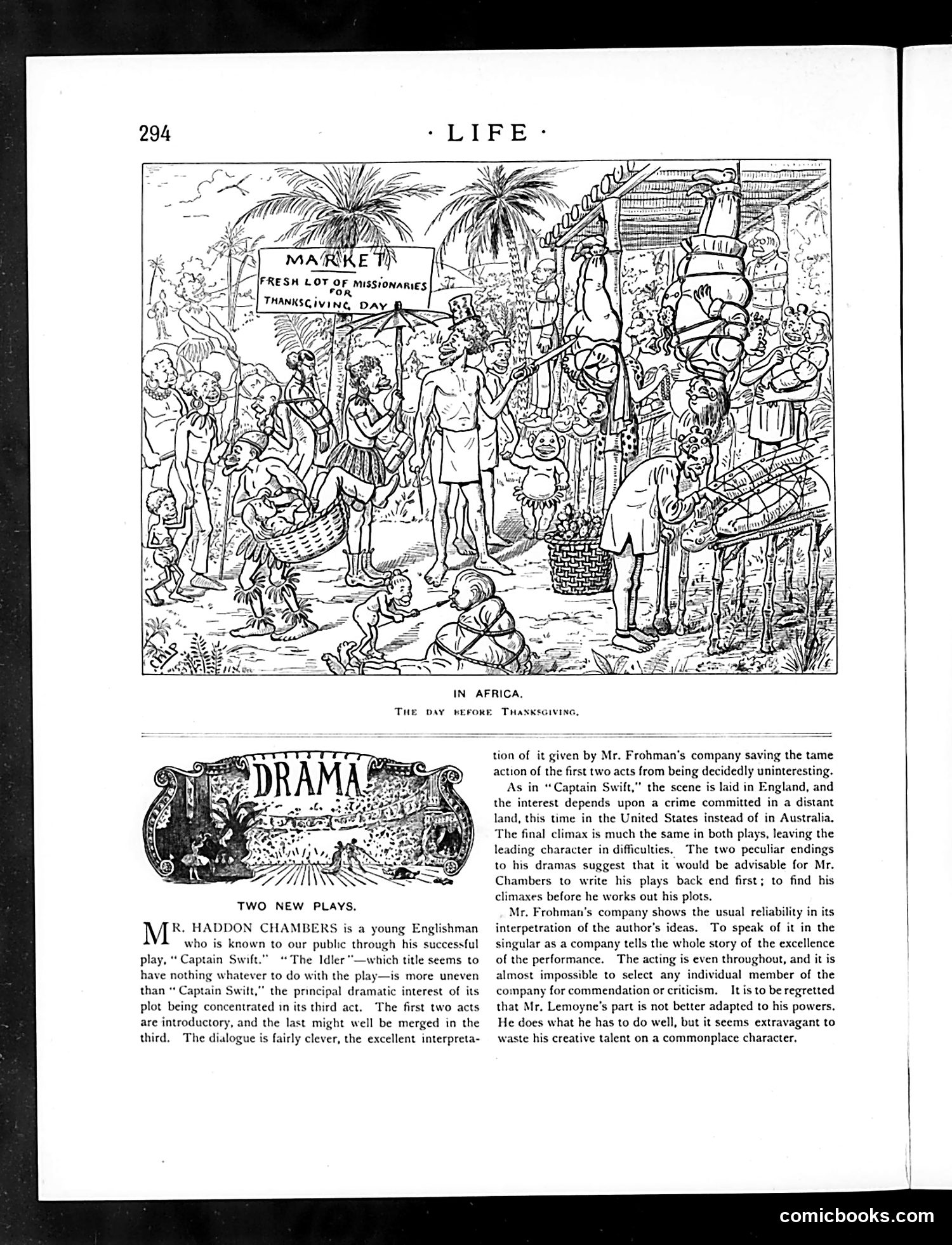
This satirical cartoon depicts a colonial-era African market scene labeled as a "Fresh Lot of Missionaries" for Thanksgiving—a darkly ironic commentary on Christian missionary work in Africa. The cartoon mocks the idea of missionaries as commodities being "sold" or distributed like goods in a marketplace, suggesting their work was commercial enterprise rather than genuine religious calling. The juxtaposition of "Thanksgiving" with an African setting implies criticism of Western attitudes toward colonialism and forced conversion. The crowded scene with indigenous people and Western figures reflects late-19th-century *Life* magazine's satirical stance against American imperialism and the paternalistic missionary movement—portraying both as exploitative rather than altruistic endeavors. The humor relies on the reader recognizing the hypocrisy between stated Christian charitable intentions and actual commercial/colonial motives.
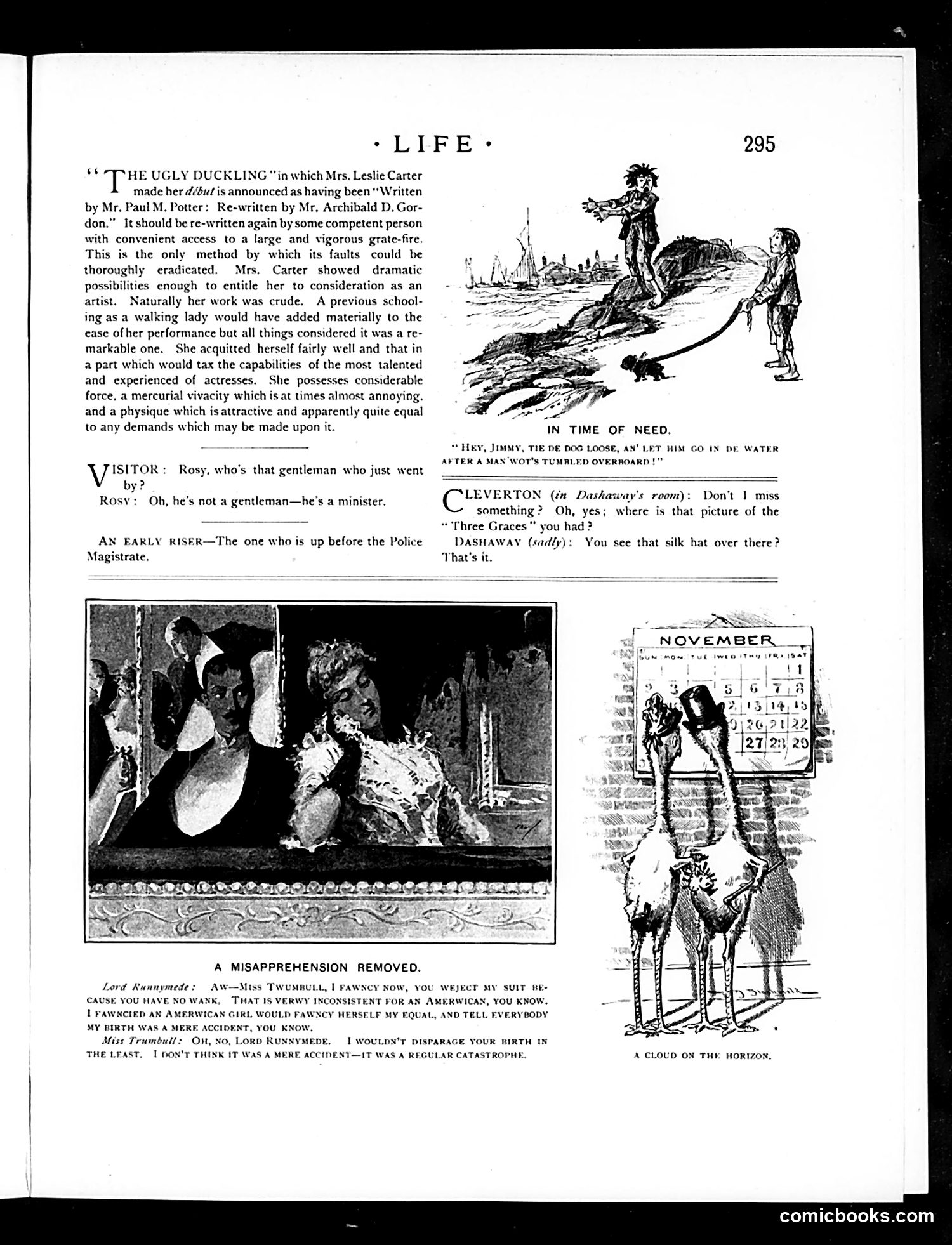
This page contains several satirical humor pieces typical of Life magazine's format: **"The Ugly Duckling" review**: Critic attacks the play starring Mrs. Leslie Carter, praising her natural talent but mocking the script quality so severely he suggests burning it rather than rewriting. This represents Life's theatrical criticism. **Visual cartoons**: - "In Time of Need" depicts a drowning scene with dark humor about a dog being released to help - "A Misapprehension Removed" shows a British nobleman (Lord Runnymede, identifiable by his affected speech) proposing to an American woman (Miss Trumbull). The joke: he assumes American girls reject him for lacking rank; she replies his *birth itself* was a "catastrophe"—insulting his very existence rather than his social status. This satirizes both British class pretension and American democratic irreverence toward nobility. **"An Early Riser"**: Brief joke about someone arrested before police magistrate hours. The page reflects Life's focus on theatrical criticism, American-British social tensions, and class-based humor popular in early 20th-century satire.
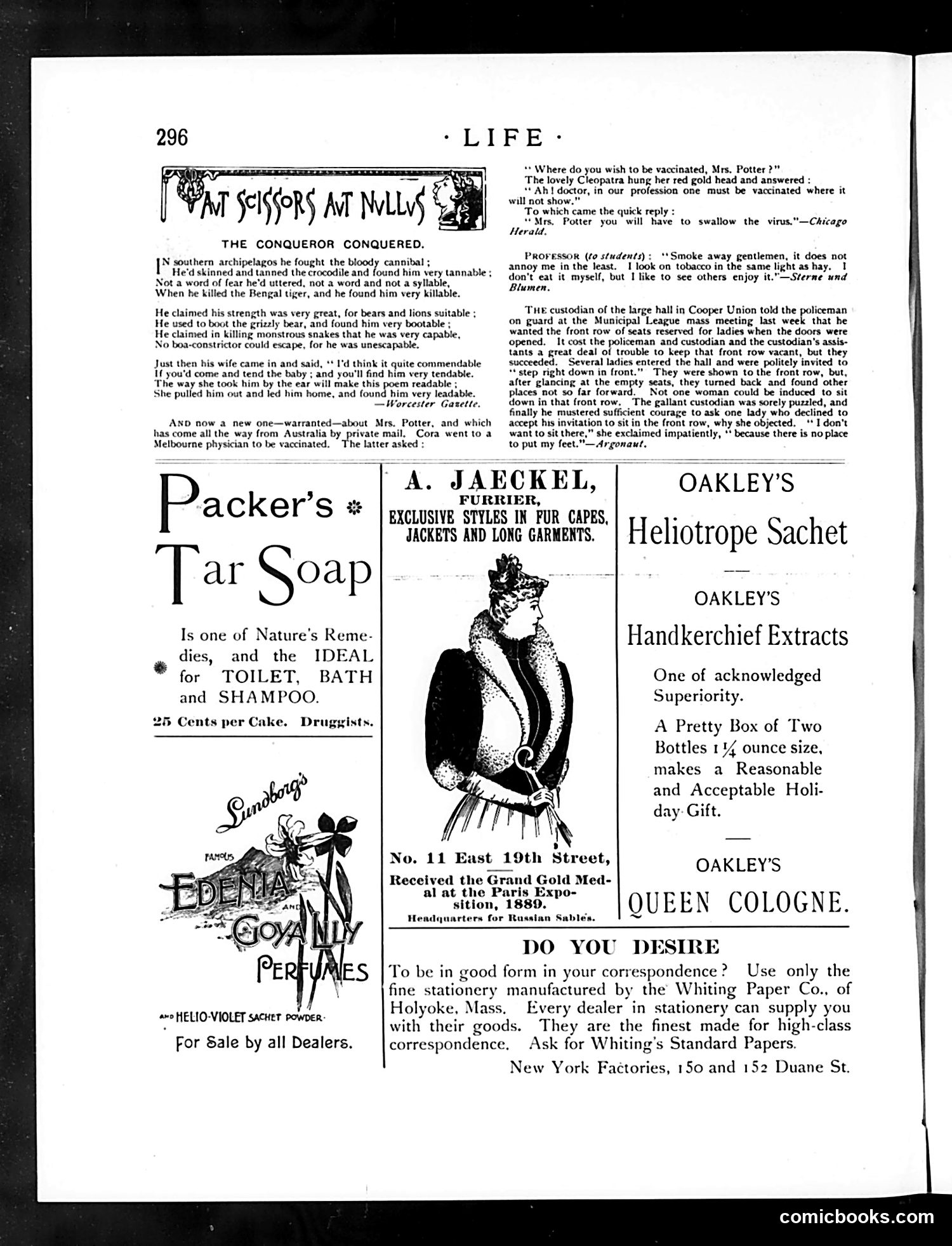
The main cartoon satirizes masculine bravado. A supposedly fearless adventurer has conquered dangerous animals across the globe—crocodiles, tigers, bears, snakes—through brute strength. Yet when his wife enters and demands he tend their baby, she physically dominates him ("took him by the ear") and leads him away obediently. The joke targets Victorian gender dynamics: a man celebrated for conquering wild nature is helpless against his wife's domestic authority. His "conquest" of dangerous beasts means nothing compared to marital power. The poem's rhyming structure (each stanza ending with "-able" words) emphasizes the ironic reversal—the baby-tending proves the most challenging task of all. The page is primarily **advertisements** for toiletries and stationery, with three brief humorous anecdotes below the main cartoon addressing vaccination, professorial smoking, and women rejecting front-row theater seats due to nowhere to place their feet.
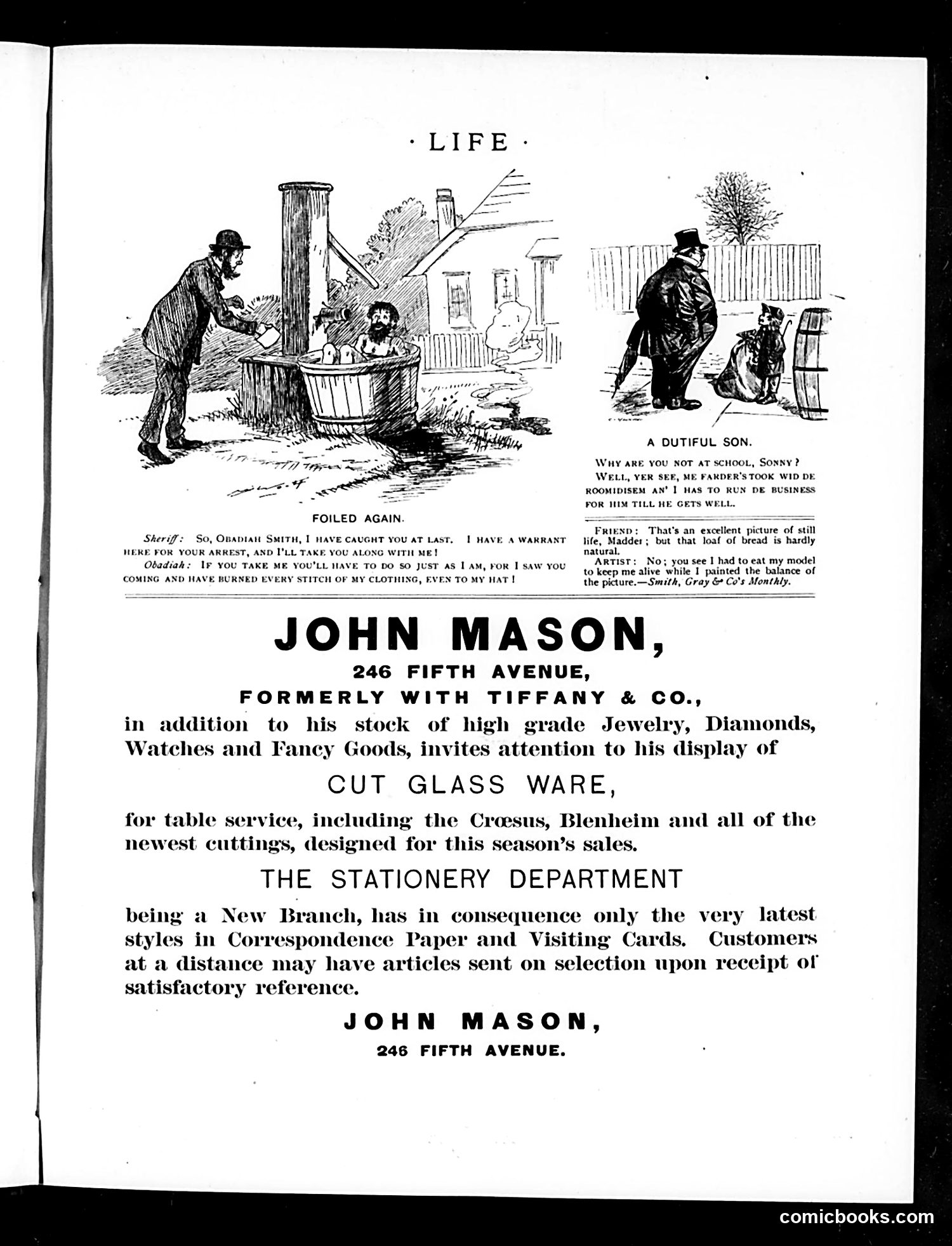
This page contains two satirical cartoons and a jeweler's advertisement. **"Foiled Again"** depicts a sheriff arresting a man (Obadiah) for arson. The joke: the suspect claims he burned all his clothing as evidence, so the sheriff cannot arrest him "just as I am" without violating decency—a absurdist legal loophole gag. **"A Dutiful Son"** shows a well-dressed man explaining to someone (possibly a truant officer) why he's not in school: his father has rheumatism, so the boy must run the family business. The humor lies in the child's matter-of-fact acceptance of adult responsibility, presenting hardship as dutiful obligation. Both cartoons employ working-class or struggling characters in predicaments—typical of Life's satirical style mocking social conventions and highlighting economic hardship with dark humor. The remainder is advertising for John Mason's jewelry and stationery business at 246 Fifth Avenue, New York, emphasizing his former association with Tiffany & Co.
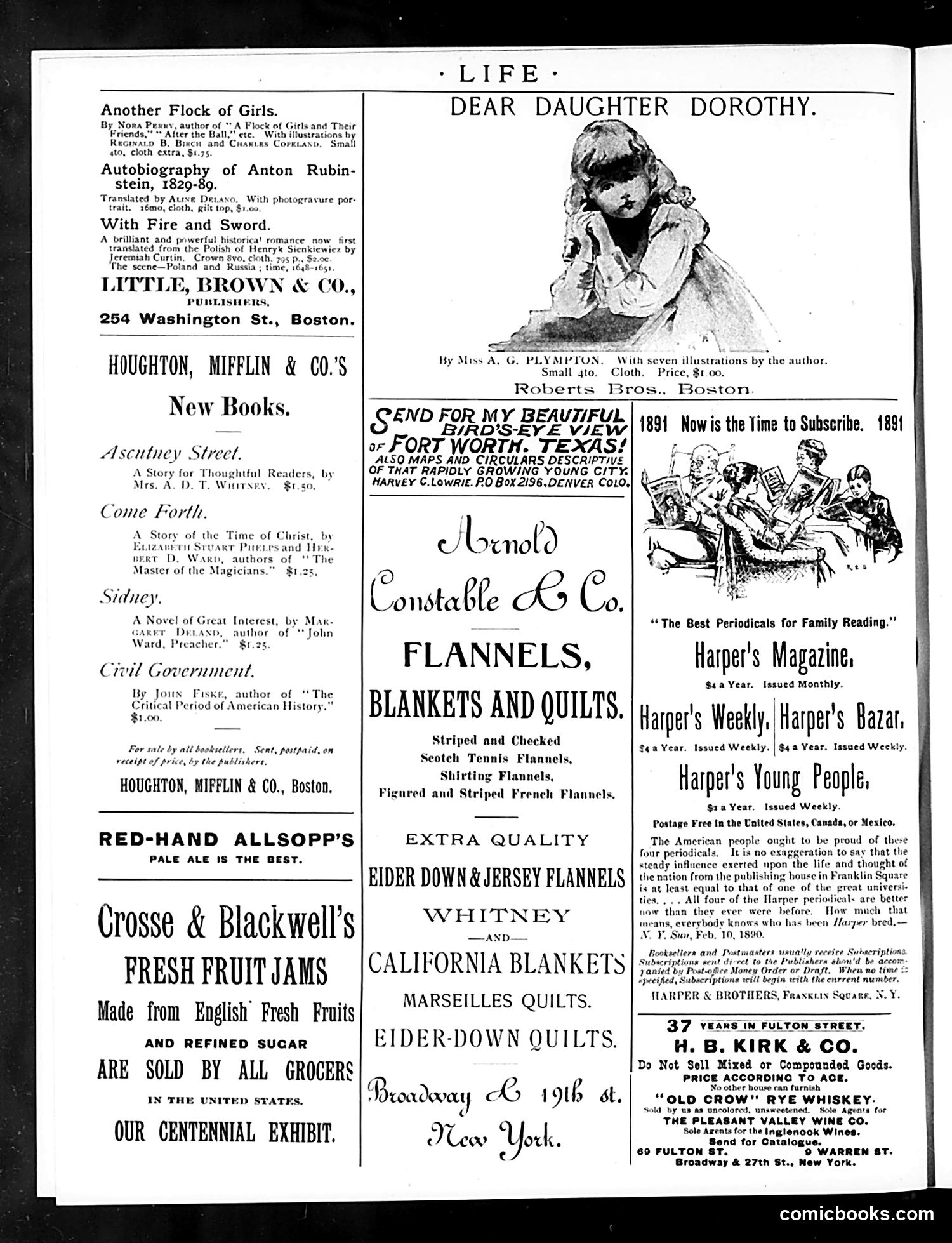
This page is primarily **advertising and book announcements**, not satirical content. The masthead "DEAR DAUGHTER DOROTHY" at top appears to be a serialized story or column rather than political commentary. The page contains commercial advertisements for: - Publishers (Little, Brown; Houghton, Mifflin) promoting new books - Household goods (Crosse & Blackwell jams, textile manufacturers Arnold Constable offering flannels and blankets) - Harper's Magazine subscription promotions - Liquor merchants (H.B. Kirk & Co. selling "Old Crow" rye whiskey) There is **one small illustration** showing what appears to be a domestic scene with multiple figures, accompanying an advertisement for Fort Worth, Texas promotional materials—likely meant to entice settlers or investors. The page reflects 1891 consumer culture: books, home furnishings, periodicals, and alcoholic beverages marketed to middle-class American readers. No identifiable political satire or caricature is evident.
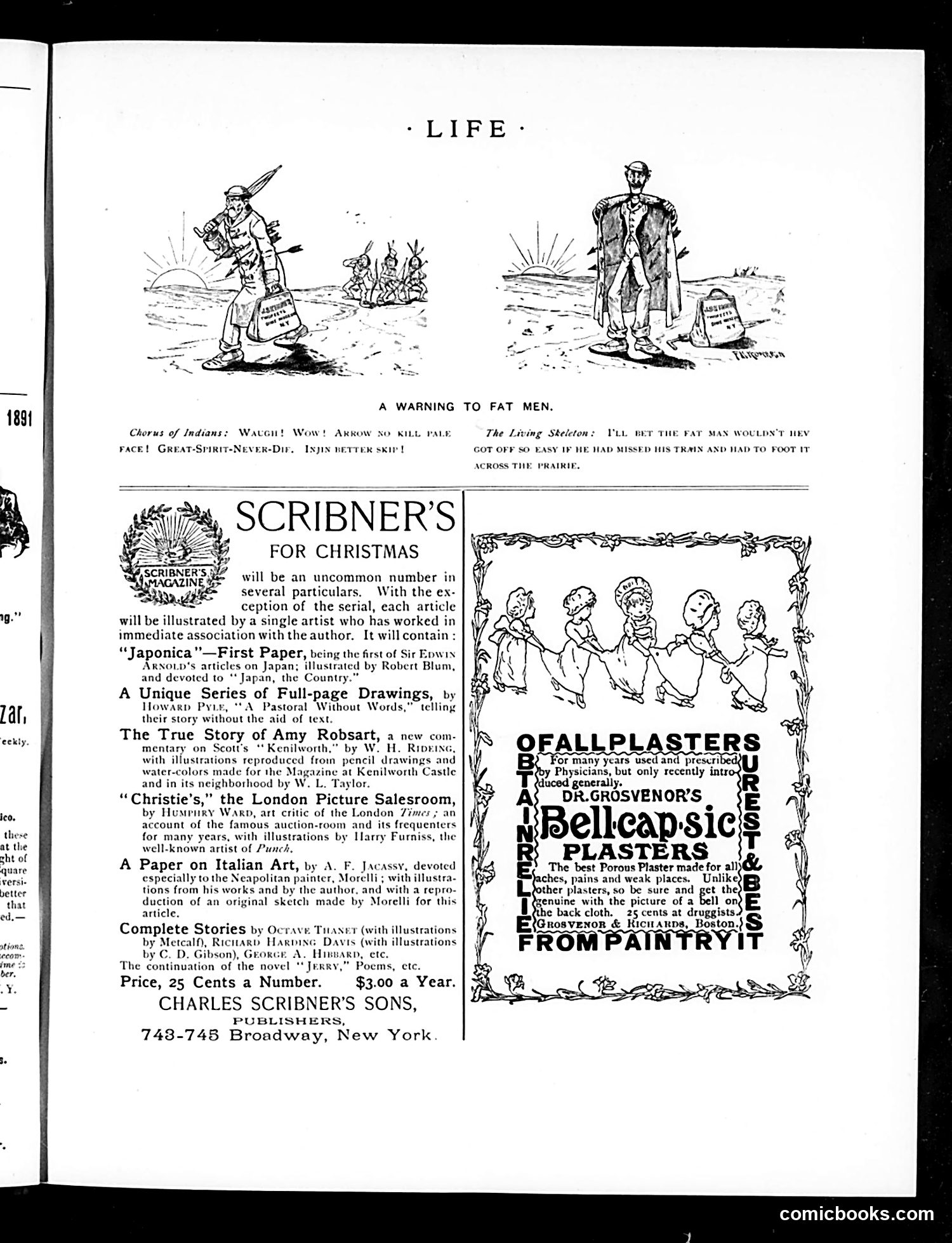
This 1891 *Life* magazine page contains a satirical cartoon titled "A Warning to Fat Men" (top). The cartoon depicts Native Americans (labeled "Chorus of Indians") threatening a visibly obese man with arrows. A skeletal figure ("The Living Skeleton") jokes that the fat man would've been unable to escape on foot across the prairie if he'd missed his train—implying his weight makes him vulnerable and burdensome. The satire mocks obesity as both physically dangerous and socially ridiculous, using a frontier scenario to suggest that excess body weight renders a man helpless and prey-like. The joke reflects late-19th-century attitudes treating fat bodies as objects of derision and moral weakness. The remainder of the page advertises *Scribner's* magazine's Christmas issue and a medical product (Bellcapsic Plasters). The cartoon's crude racial stereotyping and crude body-shaming reflect period attitudes we'd now recognize as offensive.
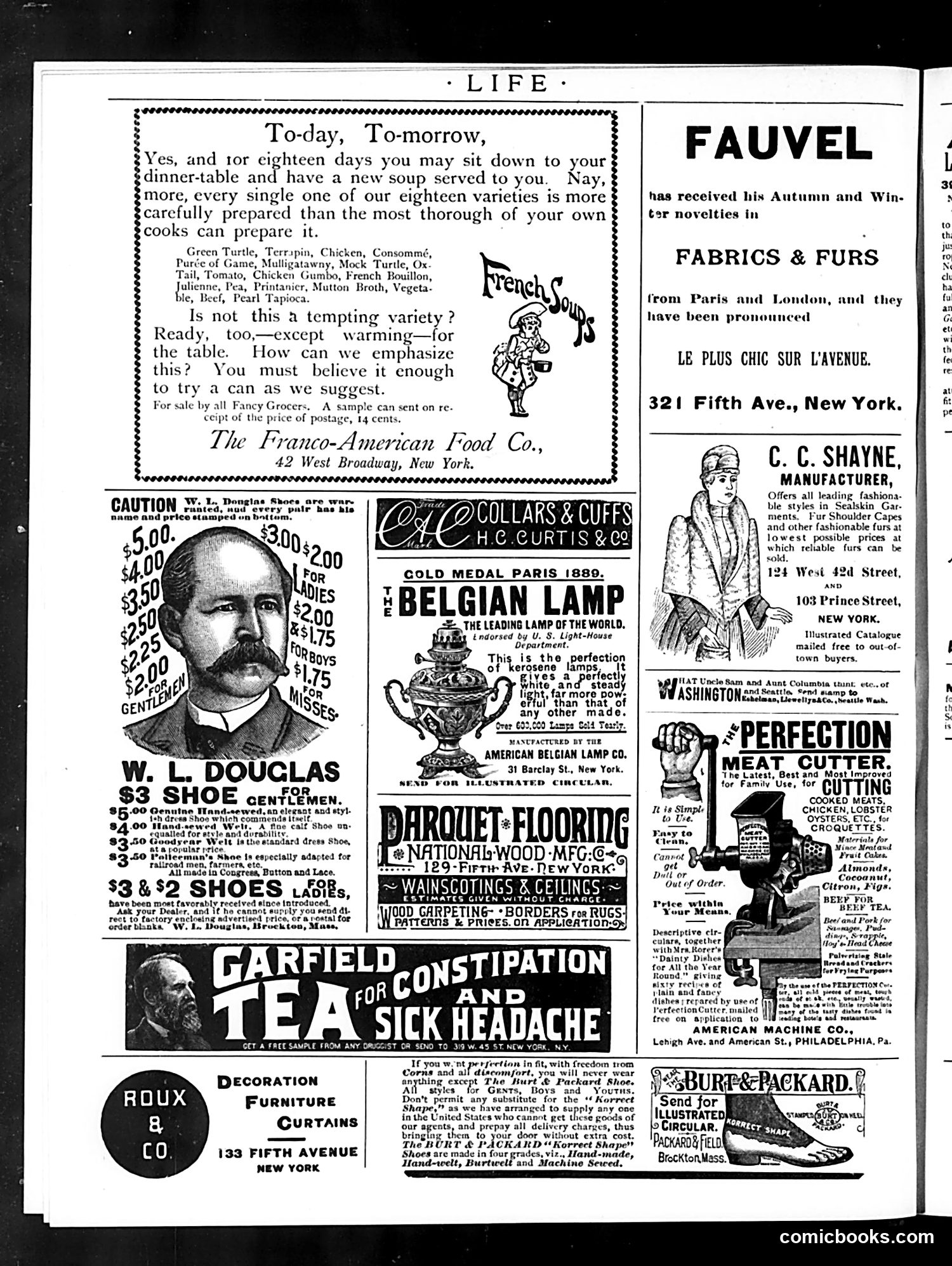
This is primarily an **advertising page** from Life magazine, with one prominent satirical element: **The Main Cartoon/Satire:** The top-left features a **French Soup Company advertisement** using a French caricature character labeled "French Soups." The satire mocks the pretension of French culinary superiority—the ad humorously promises 18 varieties of soup, suggesting Americans should trust canned French soups over their own homemade cooking. This plays on the period's obsession with French sophistication and the marketing strategy of appealing to American aspirations to seem cultured. **Context:** In the early 1900s, "French" was synonymous with luxury and refinement in American consumer culture. The joke targets both the marketing hype ("Nay, more, every single one...") and the absurdity that canned soup could rival home cooking. **The Rest:** The page is filled with product advertisements typical of Life's advertising model: shoes, lamps, furniture, meat cutters, and patent medicines (notably Garfield Tea for constipation). These ads reflect period consumer goods and marketing practices.
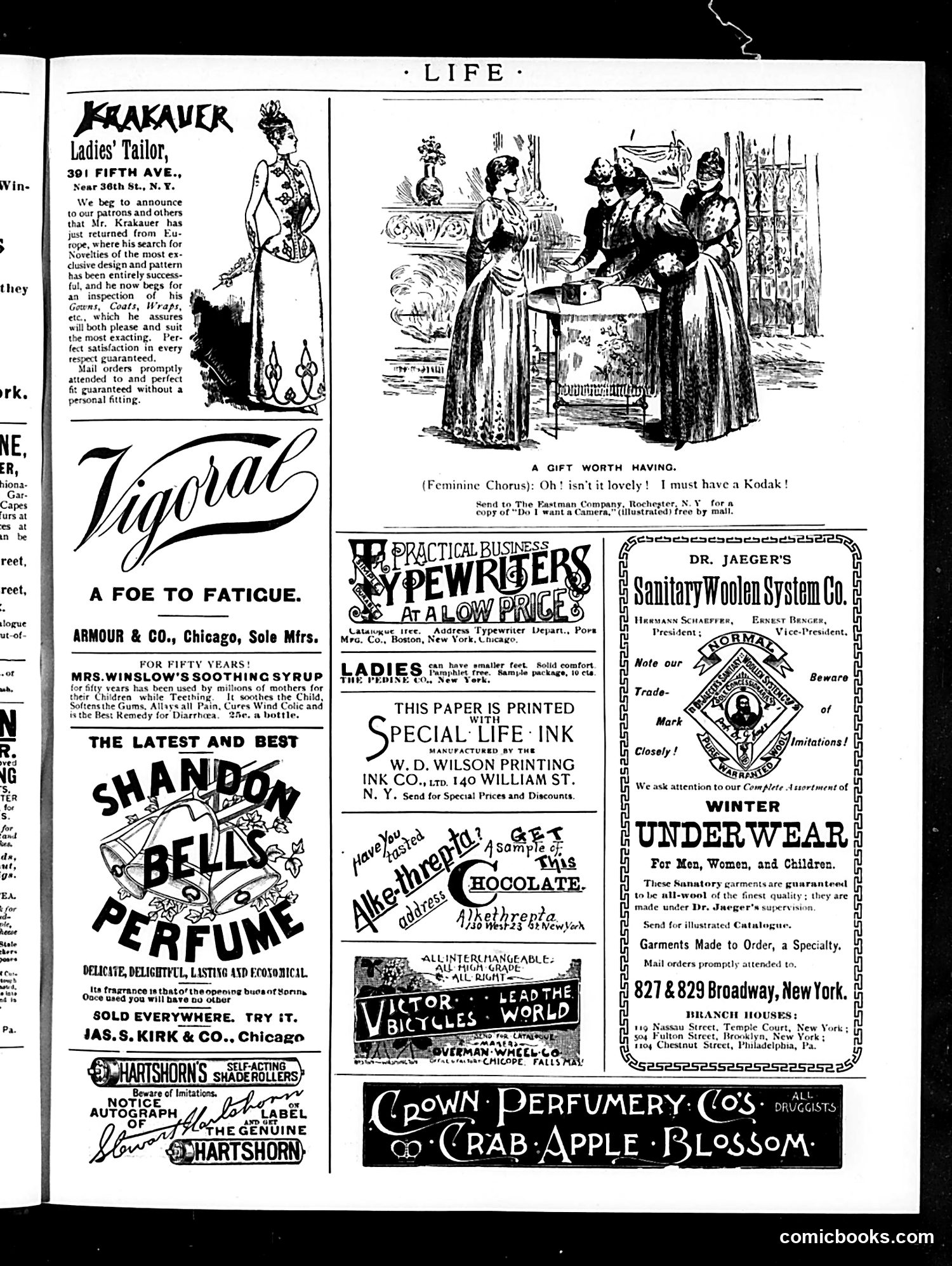
This page is primarily **advertising**, with one cartoon illustration titled "A Gift Worth Having." The cartoon depicts well-dressed women in what appears to be a Victorian-era parlor, enthusiastically discussing a **Kodak camera**. The humor relies on the camera's status as a desirable luxury item—the women's excited chorus ("Oh! isn't it lovely! I must have a Kodak!") satirizes feminine consumer desire and the social pressure to possess fashionable goods. The surrounding ads reflect turn-of-the-century consumer culture: Mrs. Winslow's Soothing Syrup (a widely-used patent medicine), Armour corsets, Mrs. Winslow's remedy, Shannon Bell Perfume, and Dr. Jaeger's wool underwear system. These advertisements suggest the magazine's target audience: middle and upper-class women with purchasing power. The page's satirical point appears mild—gently poking fun at women's enthusiasm for new consumer products rather than offering sharp social critique.
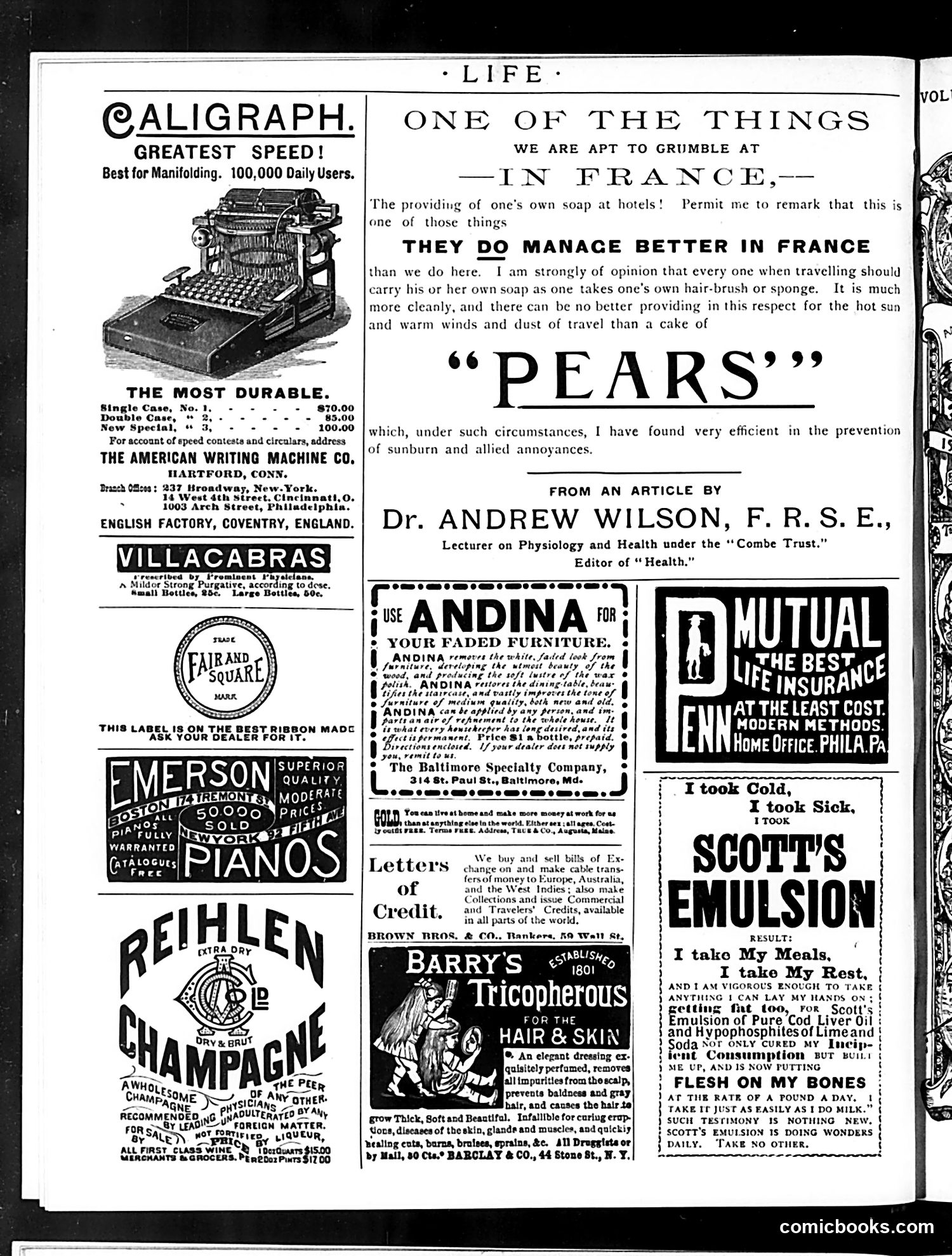
This is primarily an **advertising page** from Life magazine, not a political cartoon. The page contains multiple product advertisements typical of late 19th-century American publications. The main editorial content is an article by Dr. Andrew Wilson recommending **Pears' soap** for travelers to France. The doctor argues that French hotels don't provide soap, so visitors should carry their own—comparing soap to other personal items like hairbrushes. He endorses Pears' soap specifically as effective against sunburn. The surrounding advertisements promote various products: typewriters (Caligraph), furniture polish (Andina), pianos (Emerson), champagne (Reihlen), life insurance (Mutual), hair treatment (Barry's Tricopherous), and Scott's Emulsion (a cod liver oil health supplement). There is **no political satire** on this page. It represents typical period advertising and sponsored content mixed with editorial material—a common magazine format of the era.