
Life, 1890-11-20 · page 13 of 24
Life — November 20, 1890 — page 13: what you’re looking at
What you’re looking at
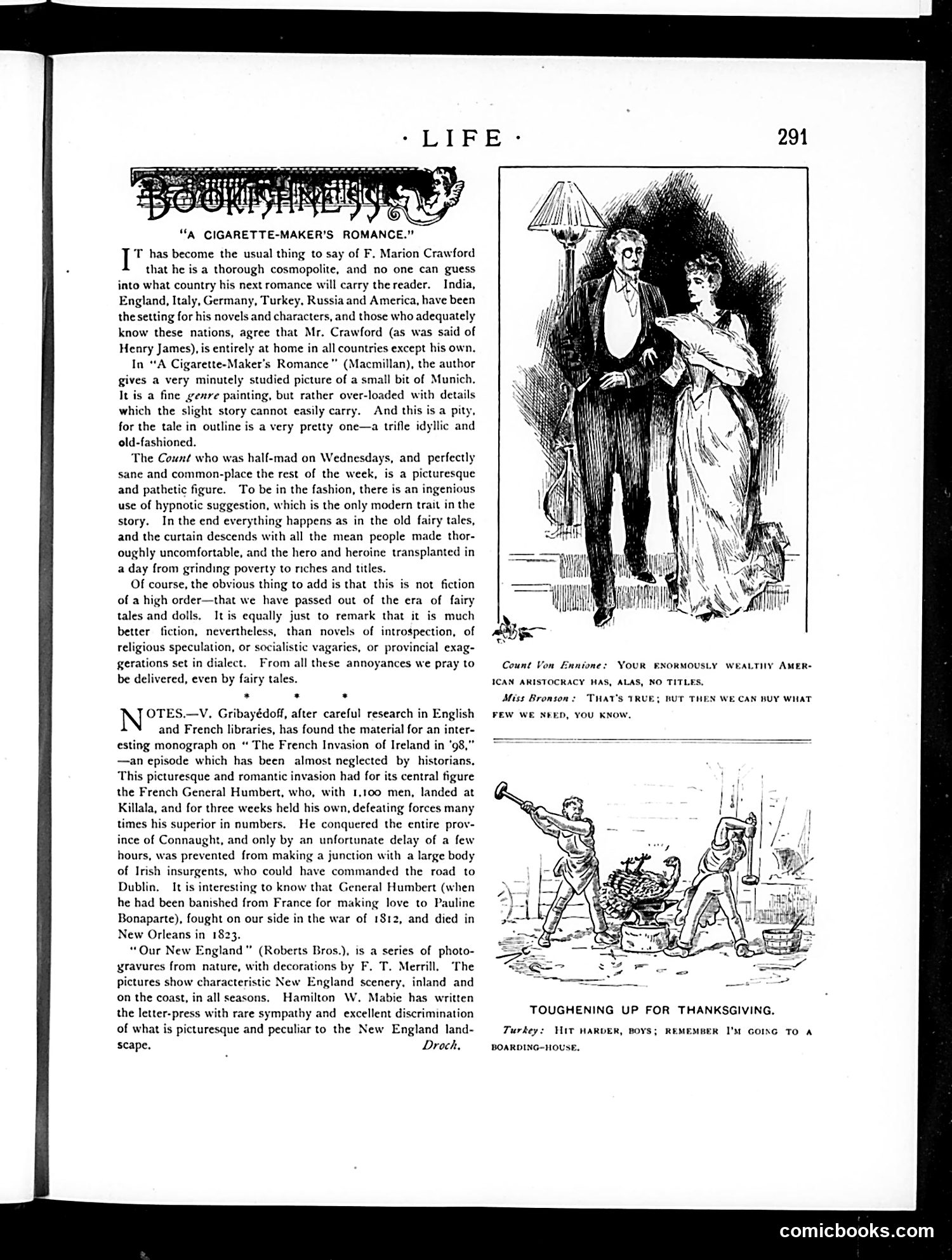
This page reviews F. Marion Crawford's novel "A Cigarette-Maker's Romance," set in Munich. The reviewer praises the book's fairy-tale structure while criticizing its excessive detail and old-fashioned plot (a count descends from poverty to riches through hypnotic suggestion). The top cartoon depicts a wealthy American aristocrat and Miss Bronson. The joke targets American social anxiety about European nobility: the Count boasts that American wealth lacks titles, and Miss Bronson retorts that Americans don't need them—they can simply *buy* what they want. This satirizes both American materialism and the period's fascination with European aristocratic status. The lower cartoon shows turkeys being "toughened up" for Thanksgiving at a boarding house—a dark joke about preparing fowl for slaughter before the holiday. The page also notes a historical work by Gribayédoff on the 1798 French invasion of Ireland.
📄 Transcribed text from this page (OCR, searchable)
Machine-transcribed from the original scan — historical spelling and the odd misread are preserved.
“A CIGARETTE-MAKER’S ROMANCE.” [7 has become the usual thing to say of F. Marion Crawford that he is a thorough cosmopolite, and no one can guess into what country his next romance will carry the reader. India, England, Italy, Germany, Turkey, Russia and America, have been the setting for his novels and characters, and those who adequately know these nations, agree that Mr. Crawford (as was said of Henry James), is entirely at home in all countries except his own, In “A Cigarette-Maker’s Romance” (Macmillan), the author gives a very minutely studied picture of a small bit of Munich. It is a fine genre painting, but rather over-loaded with details which the slight story cannot easily carry. And this is a pity, for the tale in outline is a very pretty one—a trifle idyllic and old-fashioned. The Count who was half-mad on Wednesdays, and perfectly sane and common-place the rest of the week, is a picturesque and pathetic figure. To be in the fashion, there is an ingenious use of hypnotic suggestion, which is the only modern trait in the story. In the end everything happens as in the old fairy tales, and the curtain descends with all the mean people made thor- oughly uncomfortable, and the hero and heroine transplanted in a day from grinding poverty to riches and titles. Of course, the obvious thing to add is that this is not fiction of a high order—that we have passed out of the era of fairy tales and dolls, It is equally just to remark that it is much better fiction, neverthel than novels of introspection, of religious speculation, or socialistic vagaries, or provincial exag- gerations set in dialect. From all these annoyances we pray to be delivered, even by fairy tales. . . . OTES.—V. Gribayédoff, after careful research in English and French libraries, has found the material for an inter- esting monograph on “ The French Invasion of Ireland in ‘98,” —an episode which has been almost neglected by historians. This picturesque and romantic invasion had for its central figure the French General Humbert, who, with 1,100 men, landed at Killala, and for three weeks held his own, defeating forces many times his superior in numbers. He conquered the entire prov- ince of Connaught, and only by an unfortunate delay of a few hours, was prevented from making a junction with a large body of Irish insurgents, who could have commanded the road to Dublin, It is interesting to know that General Humbert (when he had been banished from France for making love to Pauline Bonaparte), fought on our side in the war of 1812, and died in New Orleans in 1823. “Our New England" (Roberts Bros.), is a series of photo- yravures from nature, with decorations by F. T. Merrill, The pictures show characteristic New England scenery, inland and on the coast, in all seasons. Hamilton W. Mabie has written the letter-press with rare sympathy and excellent discrimination of what is picturesque and peculiar to the New England land- scape, Drock, Count Von Ennione: YOUR BNORMOUSLY WEALTHY AMER- ICAN ARISTOCRACY MAS, ALAS, NO TITLES, Afiss Bronson: THAT'S TRUE; FEW WE NEED, YOU KNOW. RUT THEN WE CAN BUY WHAT TOUGHENING UP FOR THANKSGIVING, Turkey: Vit HARDER, BOYS; BOARDING-HOUSE. REMEMBER I's GOING TO A comicbooks.com