
Life, 1890-11-20 · page 2 of 24
Life — November 20, 1890 — page 2: what you’re looking at
What you’re looking at
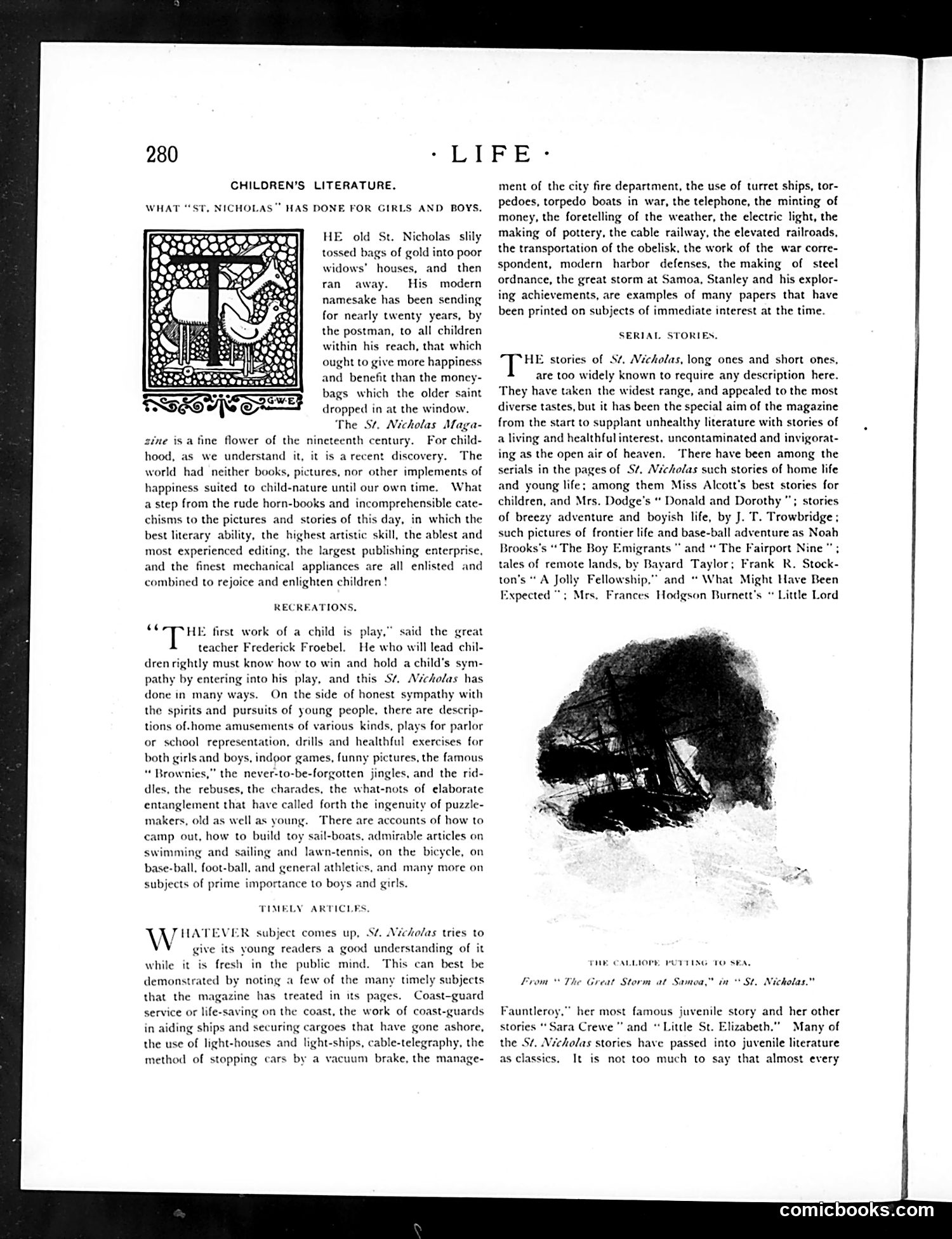
This page discusses St. Nicholas Magazine's contributions to children's literature. The text praises the publication for sending "bags of gold into poor windows" metaphorically—providing quality stories and illustrations to children for nearly twenty years. The single illustration shows a **ship in stormy seas**, captioned "The Calliope Putting to Sea" from "The Great Storm at Samoa" in St. Nicholas. This appears to be an example of the magazine's adventure content rather than political satire. The page celebrates St. Nicholas's diverse subject matter—from recreation and games to timely articles on modern developments (railroads, telephones, cable railways). There is no political cartoon or satire present. This is essentially promotional content about a respected children's publication.
📄 Transcribed text from this page (OCR, searchable)
Machine-transcribed from the original scan — historical spelling and the odd misread are preserved.
280 CHILDREN’S LITERATURE. WHAT “ST, NICHOLAS” HAS DONE FOR GIRLS AND BOYS. HE old St. Nicholas. slily tossed bags of gold into poor widows’ houses, and then ran away. His modern namesake has been sending for nearly twenty years, by the postman, to all children within his reach, that which ought to give more happiness and benefit than the money- bags which the older saint dropped in at the window. The St. Nicholas Maga- fine flower of the nineteenth century. For child- hood, as we understand it, it is a recent discovery. The world had neither books, pictures, nor other implements of happiness suited to child-nature until our own time, What a step from the rude horn-books and incomprehensible cate- chisms to the pictures and stories of this day, in which the best literary ability, the highest artistic skill, the ablest and most experienced editing, the largest publishing enterprise, and the finest mechanical appliances are all enlisted and combined to rejoice and enlighten children! sine is RECREATIONS. HE first work of a child is play,” said the great teacher Frederick Froebel. He who will lead chil- dren rightly must know how to win and hold a child's sym- pathy by entering into his play, and this S¢, Nicholas has done in many ways. On the side of honest sympathy with the spirits and pursuits of young people, there are descrip- tions of.home amusements of various kinds, plays for parlor or school repre: and healthful exercises for both girls and boys, indoor games, funny pictures, the famous “ Brownies,” the never-to-be-forgotten jingles, and the rid- dles, the rebuses, the charades, the what-nots of elaborate entanglement that have called forth the ingenuity of puzzle- makers, old as well as young. There are accounts of how to camp out, how to build toy sail-boats, admirable articles on swimming and sailing and lawn-tennis, on the bicycle, on base-ball, foot-ball, and general athletics, and many more on ntation, drills subjects of prime importance to boys and girls. TIMELY ARTICLES, \ THATEVER subject comes up, St. Nécholas tries to y give its young readers a good understanding of it while it is fresh in the public mind. demonstrated by noting a few of the many timely subjects that the magazine has treated in its pag! Coast-guard service or life-saving on the coast, the work of coast-guards that have gone ashore, This can best be in aiding ships and securing cargoes the use of light-houses and light-ships, cable-telegraphy, the method of stopping cars by a vacuum brake, the manage- -LIFE-: ment of the city fire department, the use of turret ships, tor- pedoes, torpedo boats in war, the telephone, the minting of money, the foretelling of the weather, the electric light, the making of pottery, the cable railway, the elevated railroads, the transportation of the obelisk, the work of the war corre- spondent, modern harbor defenses, the making of steel ordnance, the great storm at Samoa, Stanley and his explor- ing achievements, are examples of many papers that have been printed on subjects of immediate interest at the time. SERIAL STORIES. HE stories of S¢, Necholas, long ones and short ones, are too widely known to require any description here. They have taken the widest range, and appealed to the most diverse tastes, but it has been the special aim of the magazine from the start to supplant unhealthy literature with stories of a living and healthful interest, uncontaminated and invigorat- ing as the open air of heaven. There have been among the serials in the pages of St, Vécholas such stories of home life and young life; among them Miss Alcott’s best stories for children, and Mrs. Dodge’s “ Donald and Dorothy "; stories of breezy adventure and boyish life, by J. T. Trowbridge ; such pictures of frontier life and base-ball adventure as Noah Brooks's The Boy Emigrants “ and * The Fairport Nine"; tales of remote lands, by Bayard Taylor; Frank R. Stock- ton’s “A Jolly Fellowship,” and “ What Might Have Been Expected “; Mrs, Frances Hodgson Burnett's * Little Lord PME CALLIOPE PUTTING TO SEA, From The Great Storm at Samoa,” in” St. Nickolas.” Fauntleroy,” her most famous juvenile story and her other stories Sara Crewe" and “ Lite St. Elizabeth.” Many of the St, Nicholas stories have passed into juvenile literature as classics, It is not too much to say that almost every comicbooks.com