
Life, 1890-11-20 · page 3 of 24
Life — November 20, 1890 — page 3: what you’re looking at
What you’re looking at
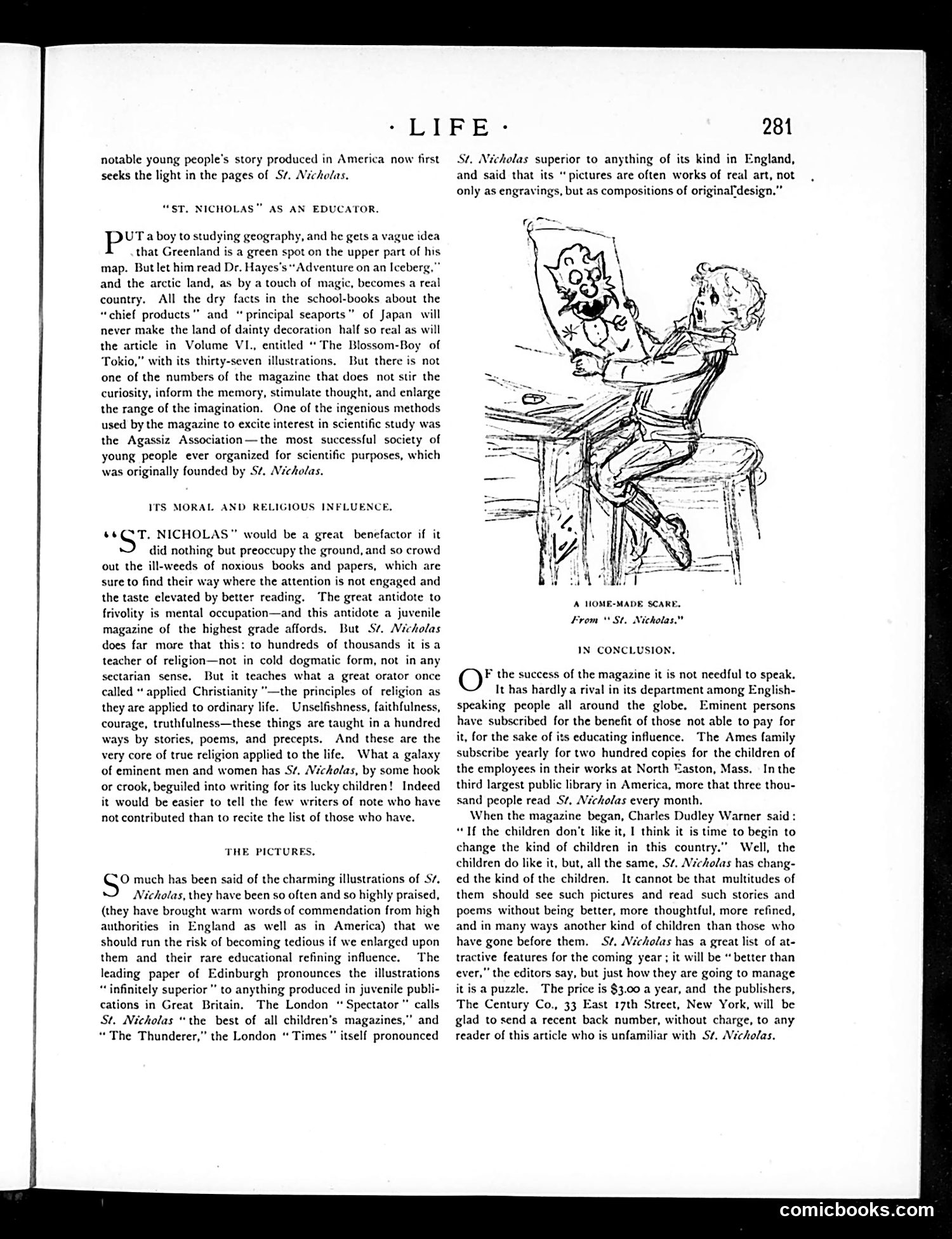
This page discusses *St. Nicholas* magazine's educational value and influence. The small illustration titled "A HOME-MADE SCARE" depicts a child showing another child a grotesque mask or creature face—likely demonstrating how the magazine's stories and illustrations could stimulate imagination and evoke emotion in young readers. The text praises *St. Nicholas* for promoting moral and religious values through storytelling rather than "dogmatic form," and credits it with founding the Agassiz Association for scientific study. The page argues the magazine's educational approach—through entertaining narratives and refined illustrations—was superior to frivolous publications, making it beneficial for childhood development. No specific political satire appears; this is editorial praise for a children's publication.
📄 Transcribed text from this page (OCR, searchable)
Machine-transcribed from the original scan — historical spelling and the odd misread are preserved.
- LIFE: notable young people's story produced in America now first seeks the light in the pages of S¢. Nicholas. “ST, NICHOLAS" AS AN EDUCATOR. UT a boy to studying geography, and he gets a vague idea that Greenland is a green spot on the upper part of his map. Butlet him read Dr. Hayes’s “Adventure on an Iceberg,” and the arctic land, as by a touch of magic, becomes a real country. All the dry facts in the school-books about the “chief products" and “principal seaports” of Japan will never make the land of dainty decoration half so real as will the article in Volume VI., entitled ‘The Blossom-Boy of Tokio,” with its thirty-seven illustrations. But ther not one of the numbers of the magazine that does not stir the curiosity, inform the memory, stimulate thought, and enlarge the range of the imagination. One of the ingenious methods used by the magazine to excite interest in scientific study was the Agassiz Association—the most successful society of young people ever organized for scientific purposes, which was originally founded by S¢, Necholas. ITS MORAL AND RELIGIOUS INFLUENCE, 6¢6@T. NICHOLAS” would be a great benefactor if it did nothing but preoccupy the ground, and so crowd out the ill-weeds of noxious books and papers, which are sure to find their way where the attention is not engaged and the taste elevated by better reading. The great antidote to frivolity is mental occupation—and this antidote a juvenile magazine of the highest grade affords. But S¢. Nicholas does far more that this: to hundreds of thousands it is a teacher of religion—not in cold dogmatic form, not in any sectarian sense. But it teaches what a great orator once called “ applied Christianity "—the principles of religion as they are applied to ordinary life. Unselfishness, faithfulness, courage, truthfulness—these things are taught in a hundred ways by stories, poems, and precepts. And these are the very core of true religion applied to the life. What a galaxy of eminent men and women has S¢, Nicholas, by some hook or crook, beguiled into writing for its lucky children! Indeed it would be easier to tell the few writers of note who have not contributed than to recite the list of those who have. THE PICTURES, ~O much has been said of the charming illustrations of S/. Nicholas, they have been so often and so highly praised, (they have brought warm words of commendation from high authorities in England as well as in America) that we should run the risk of becoming tedious if we enlarged upon them and their rare educational refining influence. The leading paper of inburgh pronounces the illustrations “infinitely superior" to anything produced in juvenile publi- cations in Great Britain. The London “ Spectator” calls St. Nicholas “the best of all children's magazines,” and “The Thunderer,” the London “ Times " itself pronounced 281 St. Nicholas superior to anything of its kind in England, and said that its “pictures are often works of real art, not only as engravings, but as compositions of original‘design.”” A HOME-MADE SCARE, From *' St. Nicholas.” IN CONCLUSION, F the success of the magazine it is not needful to speak. It has hardly a rival in its department among English- speaking people all around the globe. Eminent persons have subscribed for the benefit of those not able to pay for it, for the sake of its educating influence. The Ames family subscribe yearly for two hundred copies for the children of the employees in their works at North Easton, Mass. Inthe third largest public library in America, more that three thou- sand people read S¢, Nicholas every month, When the magazine began, Charles Dudley Warner said: “Tf the children don’t like it, I think it is time to begin to change the kind of children in this country.” Well, the children do like it, but, all the same, S¢. Necholas has chang- ed the kind of the children. It cannot be that multitudes of them should see such pictures and read such stories and poems without being better, more thoughtful, more refined, and in many ways another kind of children than those who have gone before them. S¢, Nicholas has a great list of at- tractive features for the coming year; it will be “ better than "the editors say, but just how they are going to manage it is a puzzle. The price is $3.00 a year, and the publishers, The Century Co., 33 East 17th Street, New York, will be glad to send a recent back number, without charge, to any reader of this article who is unfamiliar with St. Nicholas. comicbooks.com