
Life, 1890-11-20 · page 16 of 24
Life — November 20, 1890 — page 16: what you’re looking at
What you’re looking at
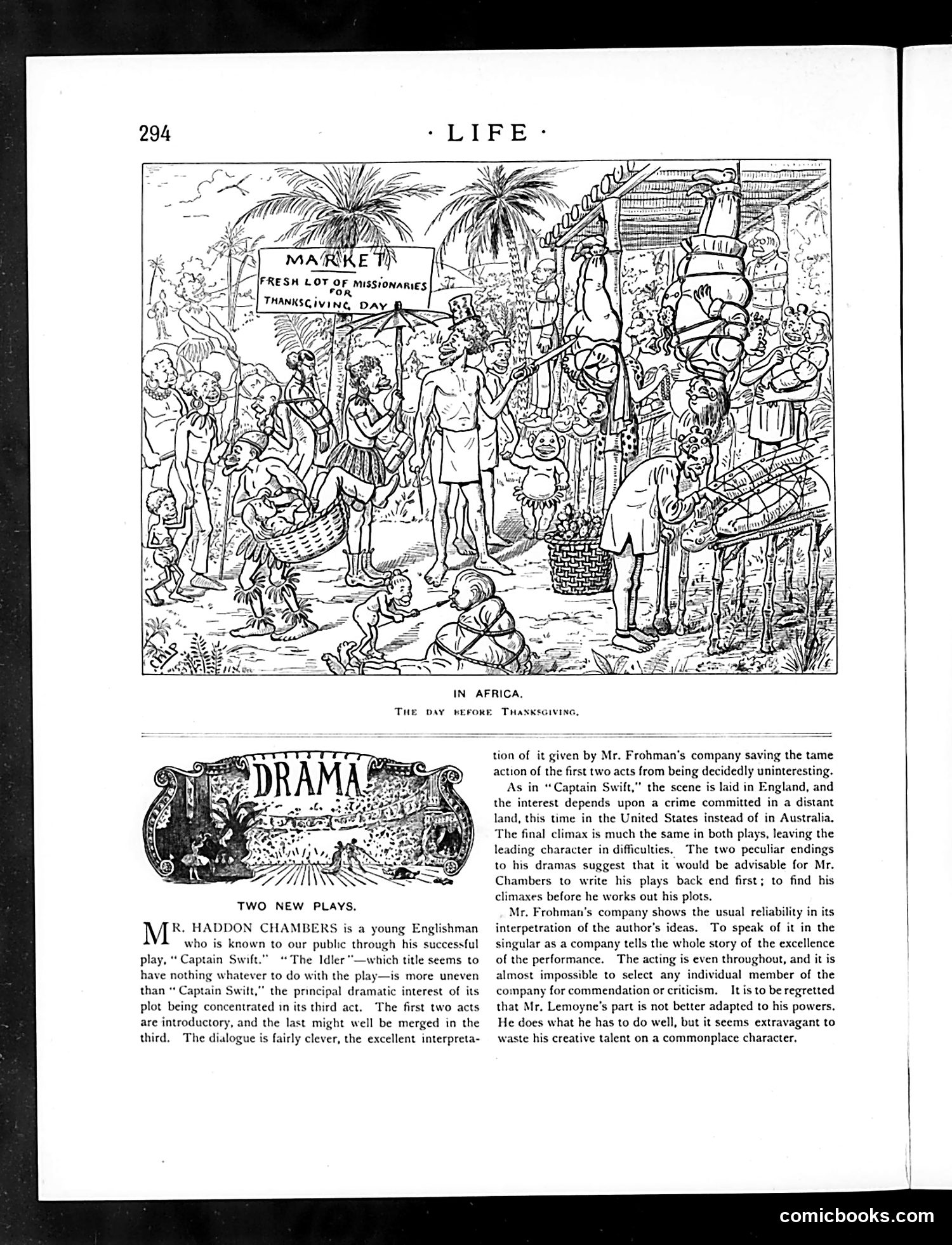
This satirical cartoon depicts a colonial-era African market scene labeled as a "Fresh Lot of Missionaries" for Thanksgiving—a darkly ironic commentary on Christian missionary work in Africa. The cartoon mocks the idea of missionaries as commodities being "sold" or distributed like goods in a marketplace, suggesting their work was commercial enterprise rather than genuine religious calling. The juxtaposition of "Thanksgiving" with an African setting implies criticism of Western attitudes toward colonialism and forced conversion. The crowded scene with indigenous people and Western figures reflects late-19th-century *Life* magazine's satirical stance against American imperialism and the paternalistic missionary movement—portraying both as exploitative rather than altruistic endeavors. The humor relies on the reader recognizing the hypocrisy between stated Christian charitable intentions and actual commercial/colonial motives.
📄 Transcribed text from this page (OCR, searchable)
Machine-transcribed from the original scan — historical spelling and the odd misread are preserved.
MOM Zp E; ; A MAR (| FRESH LOT OF MISSIONARIES sa THANKSGIVING DAY KEM Jt | The WS TWO NEW PLAYS. M*: HADDON CHAMBERS is a young Englishman who is known to our public through his successful play, “Captain Swift." “The Idler “—which title seems to have nothing whatever to do with the play more uneven than “ Captain Swift,” the principal dramatic interest of its plot being concentrated in its third act. The first two acts are introductory, and the last might well be merged in the third. The dialogue is fairly clever, the excellent interpreta- IN AFRICA. DAY KEFORE THANKSGIVING. tion of it given by Mr. Frohman’s company saving the tame action of the first two acts from being decidedly uninteresting. As in “Captain Swift,” the scene is laid in England, and the interest depends upon a crime committed in a distant land, this time in the United States instead of in Australia. The final climax is much the same in both plays, leaving the leading character in difficulties. The two peculiar endings to his dramas suggest that it would be advisable for Mr. Chambers to write his plays back end first; to find his climaxes before he works out his plots. Mr. Frohman's company shows the usual reliability in its interpetration of the author's ideas. To speak of it in the singular as a company tells the whole story of the excellence of the performance. The acting is even throughout, and it is almost impossible to select any individual member of the company for commendation or criticism, It is to be regretted that Mr. Lemoyne'’s part is not better adapted to his powers. He does what he has to do well, but it seems extravagant to waste his creative talent on a commonplace character. comicbooks.com