
A complete issue · 14 pages · 1890
Life — October 9, 1890
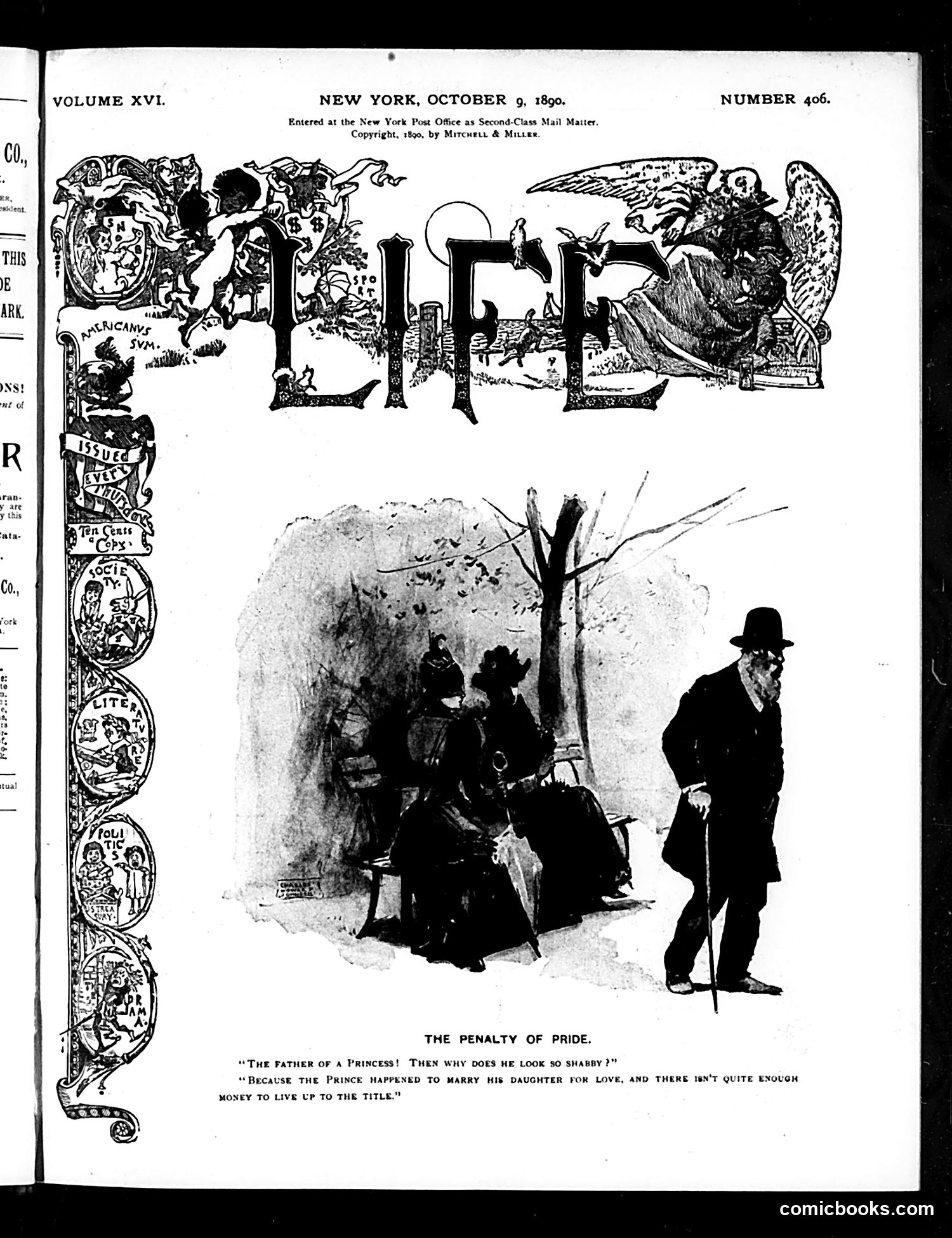
This 1890 *Life* magazine cartoon illustrates a social commentary on class and marriage. The caption depicts a shabby, elderly gentleman standing apart from a group of well-dressed women huddled together, apparently in distress or conversation. The text reveals the satirical point: a princess's father refuses to allow his daughter to marry a prince for love because the prince lacks sufficient wealth to support the title. The father's pride in maintaining aristocratic financial standards prevents the daughter's happiness. The cartoon mocks upper-class obsession with wealth and status over genuine human connection. The figure of the impoverished nobleman represents the consequences of such prideful, mercenary attitudes—social isolation and family discord. The satire critiques both aristocratic pretension and the reduction of marriage to financial transaction.
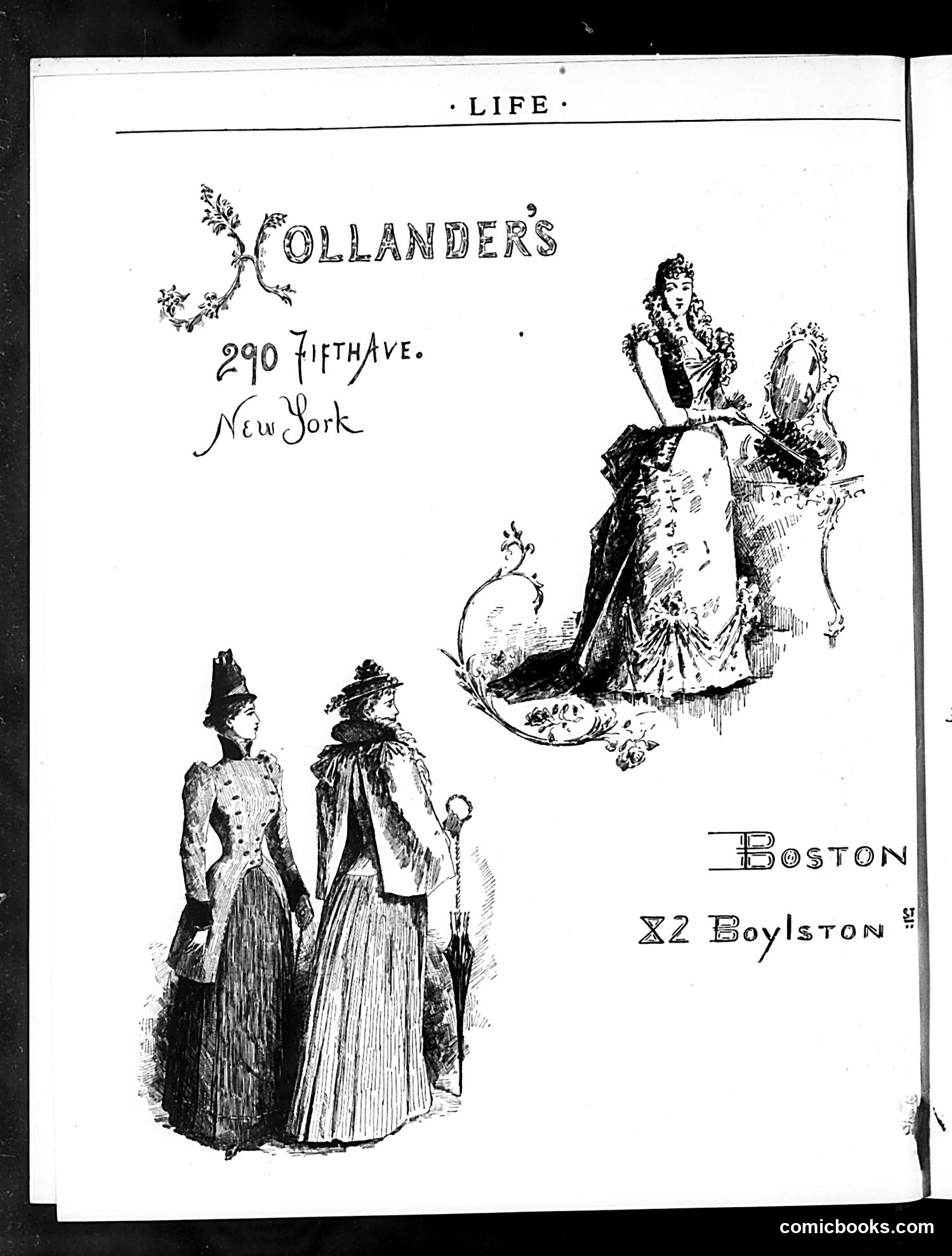
This is an **advertisement**, not political satire. Hollanders, a clothing retailer located at 290 Fifth Avenue in New York (with a Boston branch at 32 Boylston), is showcasing fashionable women's garments from what appears to be the late 19th or early 20th century. The illustration displays three elegantly dressed women in period attire featuring: - Fitted bodices with decorative details - Long, flowing skirts - Elaborate hats and accessories - Elaborate cloaks and trim The decorative "Hollanders" text at top left and the stylized illustrations are typical of period fashion advertising. This page serves purely commercial purposes rather than containing editorial cartoon content or social commentary.
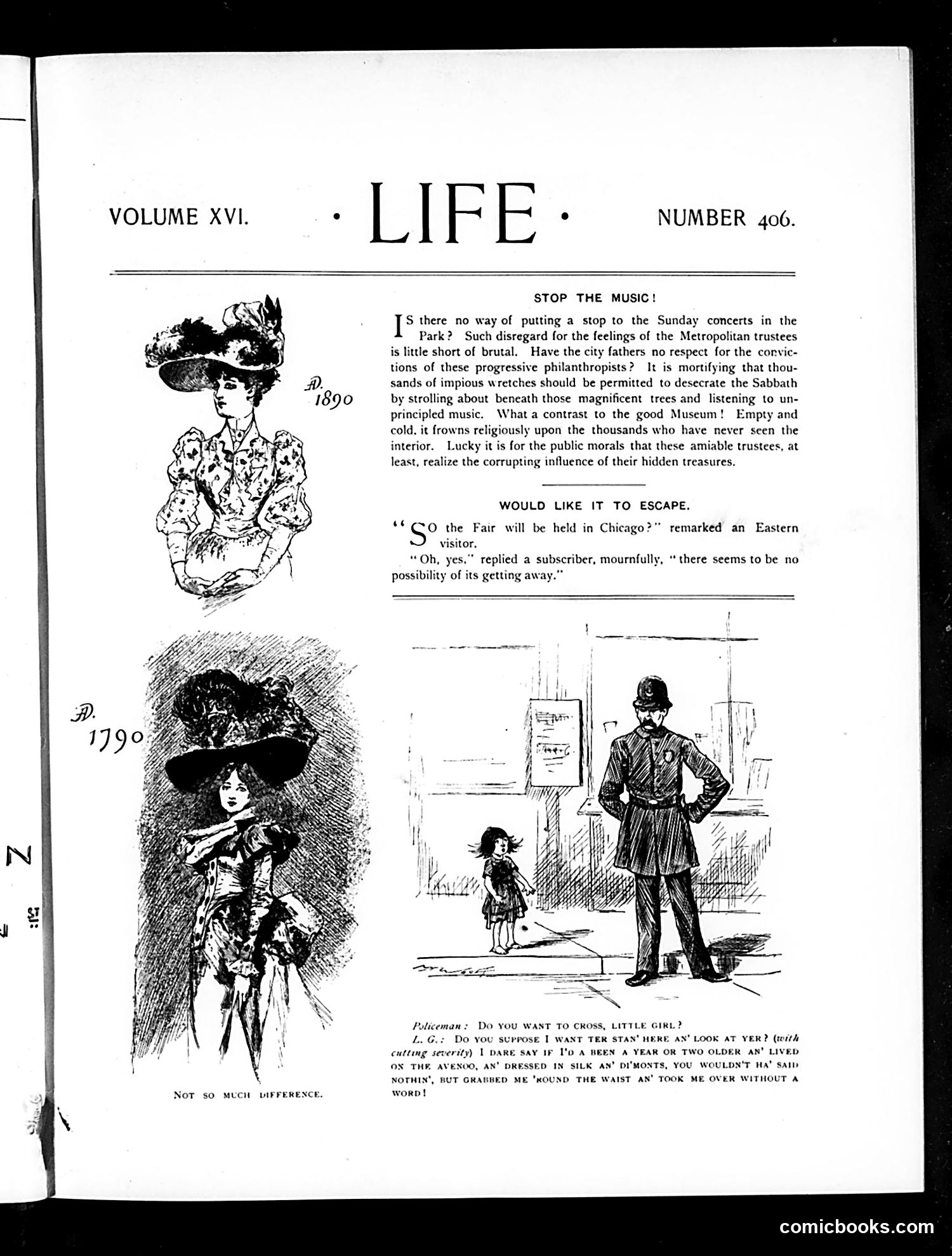
This page contains social commentary rather than political cartoons. The top article "Stop the Music!" criticizes wealthy New York philanthropists ("Metropolitan trustees") who permit Sunday concerts in Central Park, arguing these disturb the Sabbath peace and corrupt public morals—a contrast to the "good Museum" which remains closed on Sundays. The second item, "Would Like It to Escape," is a brief joke about Chicago's reputation as an undesirable, inescapable city. The sketches labeled "A.D. 1890" and "A.D. 1790" under "Not So Much Difference" appear to compare women's fashions across a century, suggesting minimal change in women's dress styles. The bottom cartoon depicts a policeman confronting a street child, illustrating urban class differences.
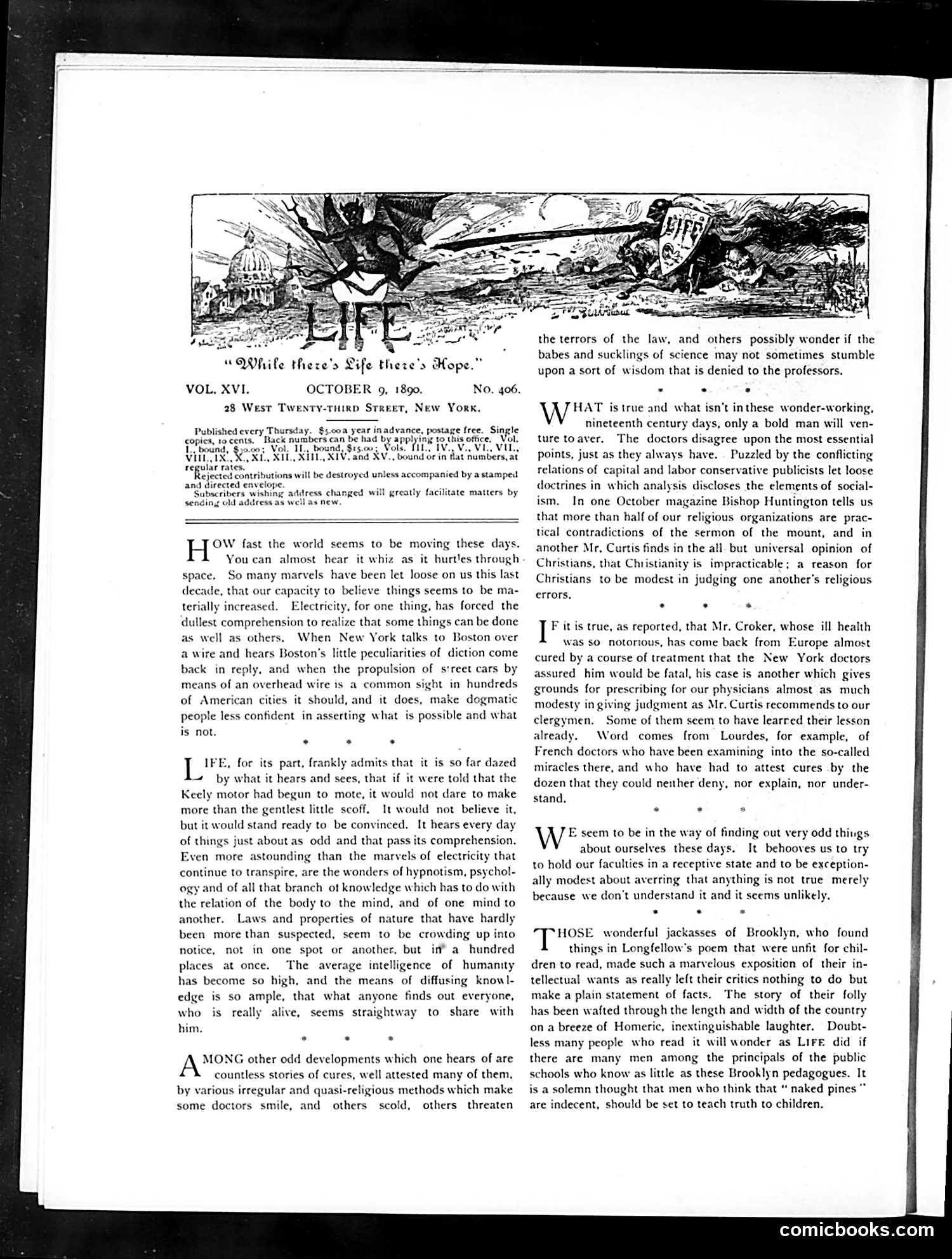
The masthead illustration depicts a personified figure of "Life" itself—shown as a dynamic, energetic character gesturing broadly across a landscape. The accompanying text discusses rapid modernization: "How fast the world seems to be moving these days." The editorial commentary critiques the era's intellectual and medical frauds. It mocks doctors' contradictory prescriptions, references purported miracle cures at Lourdes, and sarcastically discusses Brooklyn pedagogues who produced a children's book called "The Story of their Folly." The overall satire targets 1890s society's credulity toward pseudo-scientific medical treatments and dubious educational claims, while lamenting that public institutions and figures—doctors, teachers, clergy—exploit public confusion rather than provide genuine expertise or honest guidance.
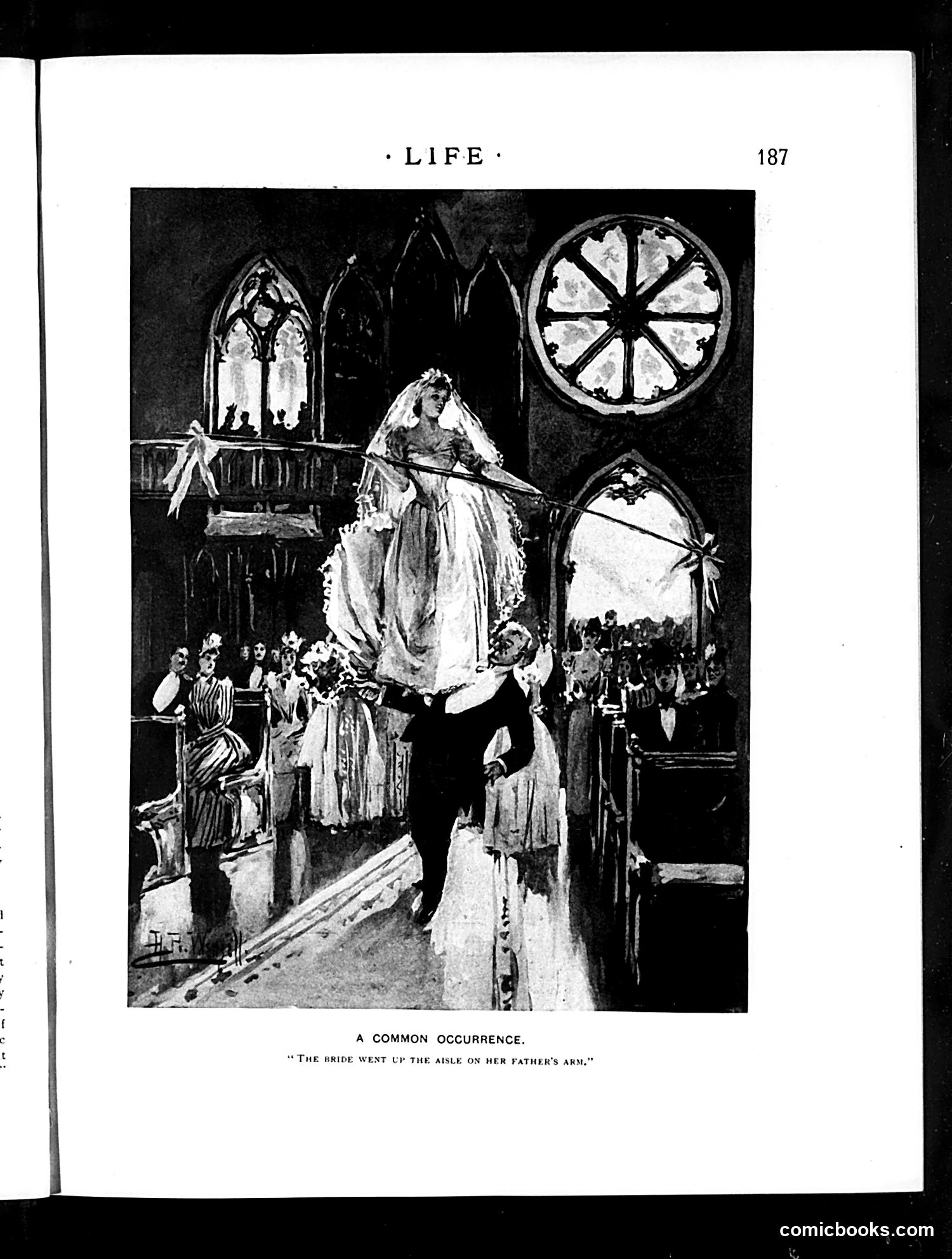
This page from *Life* magazine (page 187) shows a wedding scene titled "A Common Occurrence," with the caption "The bride went up the aisle on her father's arm." The image depicts a bride being escorted down the aisle in a Gothic church interior, with wedding guests visible. The illustration appears to be satirizing standard wedding customs and traditions of the era—specifically the conventional practice of a father escorting his daughter to the altar. Without additional context about the magazine's publication date or specific social commentary of that period, the satire's precise target is unclear. It may be mocking the formality of wedding traditions, gender roles in marriage, or some contemporary wedding-related social trend. The title suggests the humor lies in portraying this as unremarkable despite its elaborate staging.
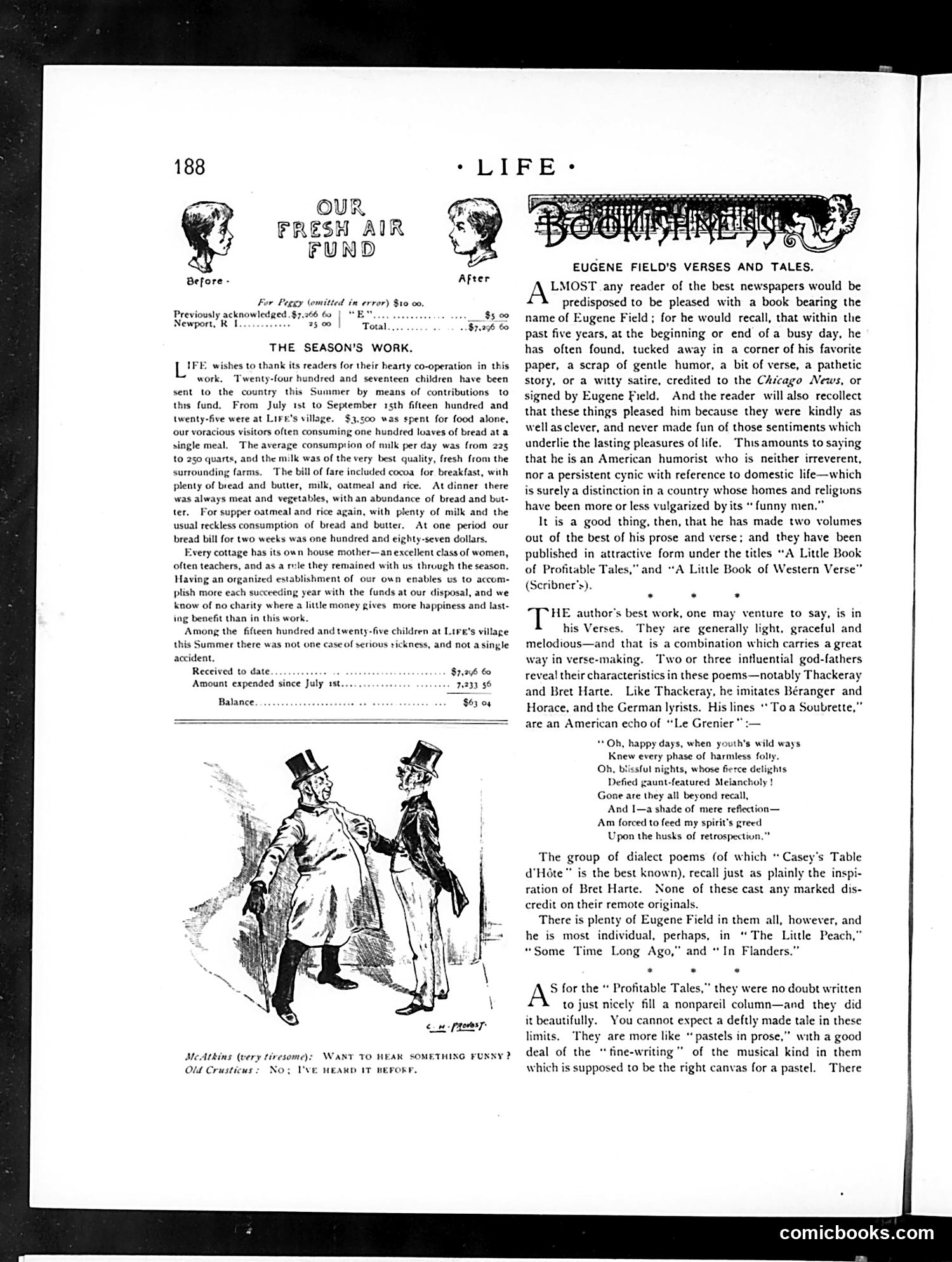
This page contains two distinct sections: **"Our Fresh Air Fund"** (top left): A before-and-after illustration showing a malnourished child ("Before") transformed into a healthy one ("After"). The accompanying text describes Life magazine's charitable campaign providing summer country experiences and nutritious meals for poor urban children. This documents a genuine philanthropic initiative. **"Eugene Field's Verses and Tales"** (right): A literary appreciation of humorist Eugene Field's published works. The text praises Field as a distinctly American humorist—gentle rather than irreverent—whose domestic humor and satire appeared in newspapers. **The cartoon** (lower left) by C.H. Tafdy shows two well-dressed men in formal attire. The caption indicates Mr. Atkins requesting "something funny" from "Old Crantics," a joke about seeking humor from supposedly cantankerous sources.
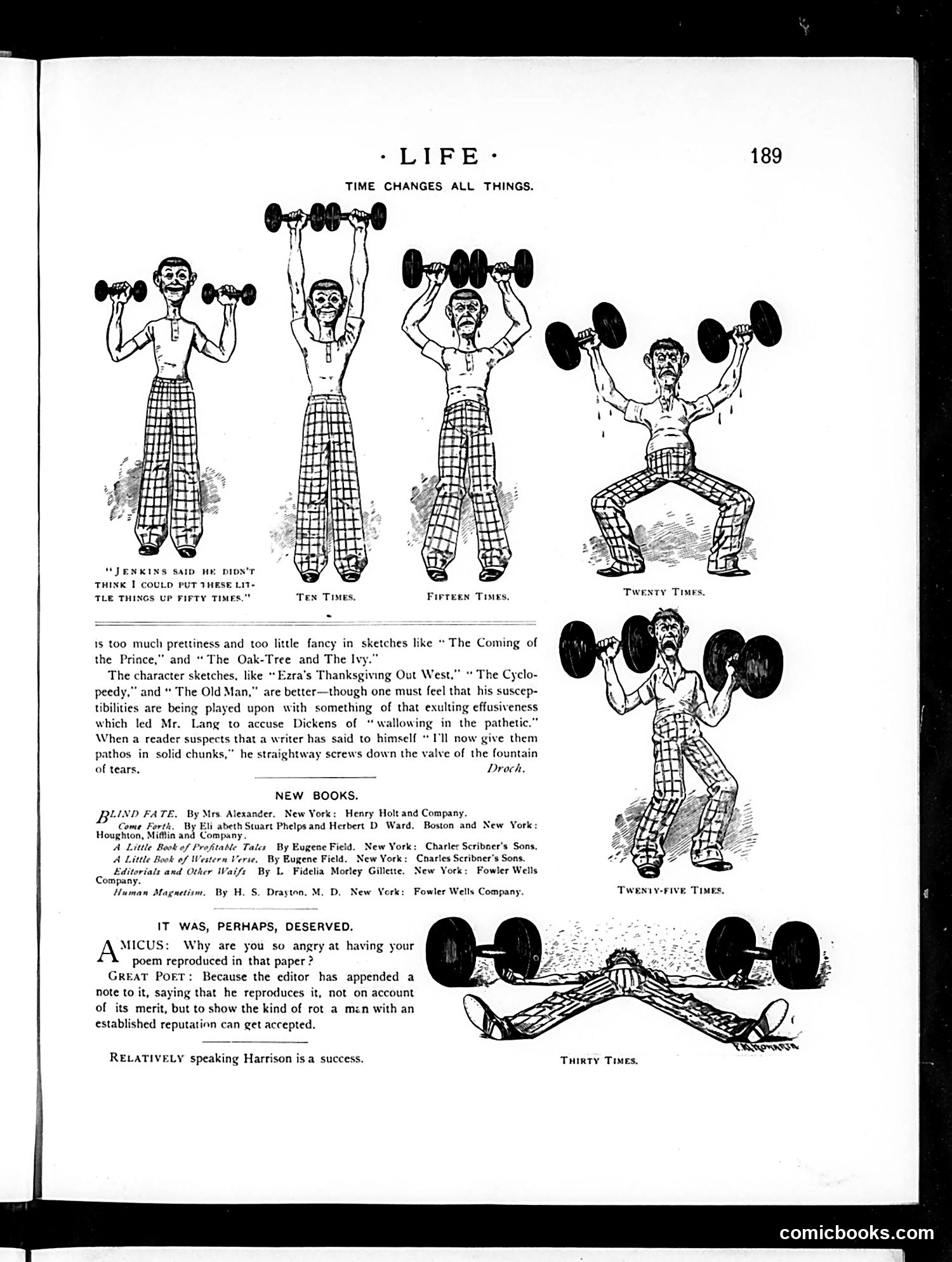
This cartoon depicts a man's deteriorating strength across his lifetime, measured by weightlifting capacity. The sequence shows him lifting dumbbells with ease in youth ("Ten Times"), then progressing through "Fifteen Times" and "Twenty Times" with increasing strain, until reaching "Thirty Times" where he's flat on his back, barely able to lift the weights at all. The joke satirizes the physical toll of aging—the ironic title suggests time transforms vigor into infirmity. The caption references "Jenkins," suggesting this mocks a specific public figure or type. The exaggerated visual progression humorously illustrates the inevitable decline from youthful athleticism to elderly weakness, a timeless theme of physical comedy.
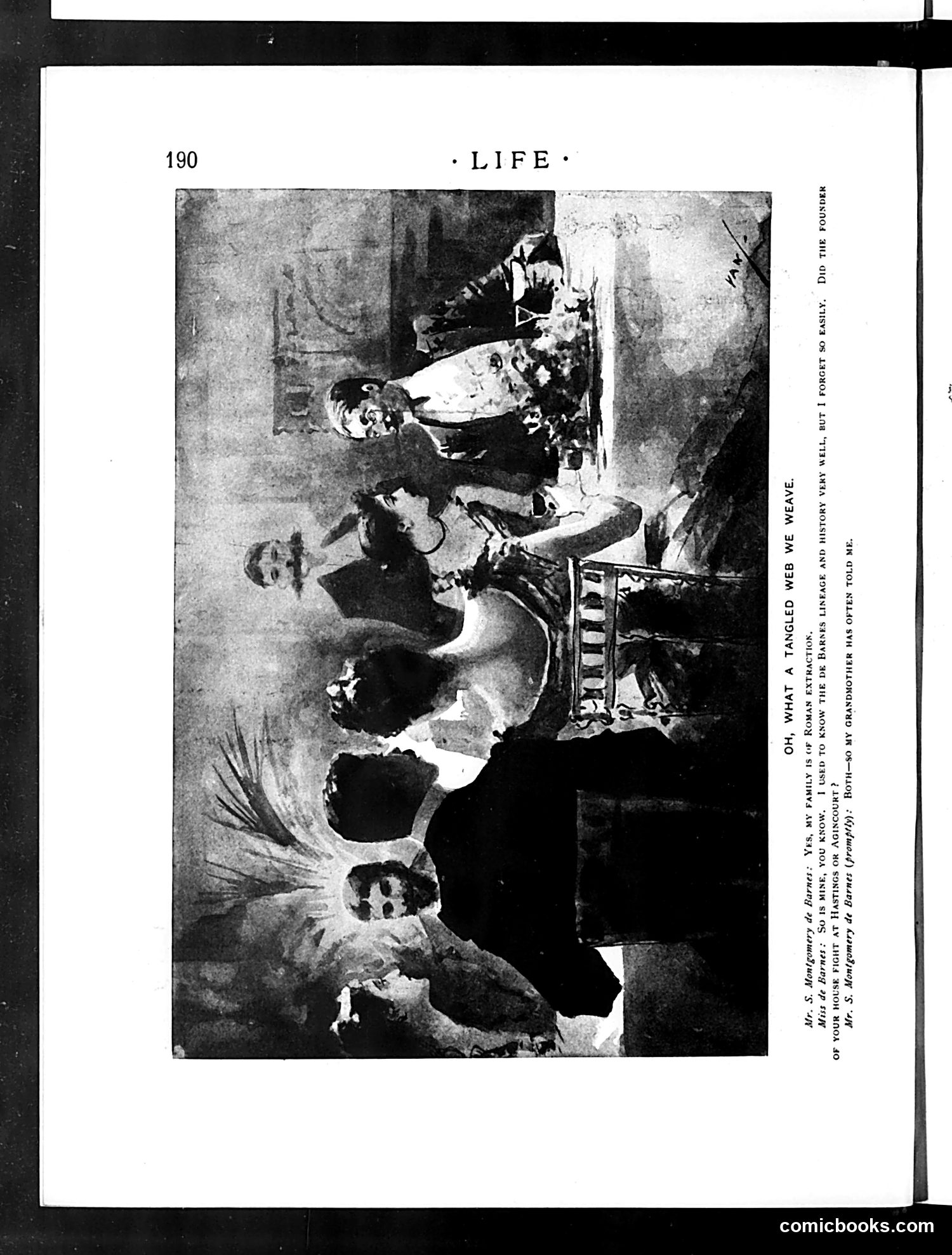
This page from *Life* magazine (page 190) contains a photograph turned upside-down, showing what appears to be a domestic or social scene with multiple figures. The accompanying caption reads: "Mr. S. McGregor Burns: 'Yer by Jerry is it a room extension...'" followed by text about "a priest" and "ears parked," though the OCR is unclear. The satire likely relies on the upside-down image creating visual confusion or absurdity—a common *Life* magazine technique. Without clearer OCR or caption text, the specific political or social target remains uncertain. The photograph appears to show an indoor scene, possibly mocking contemporary social behavior or domestic situations, but the precise satirical point is difficult to determine from the degraded image quality and garbled text.
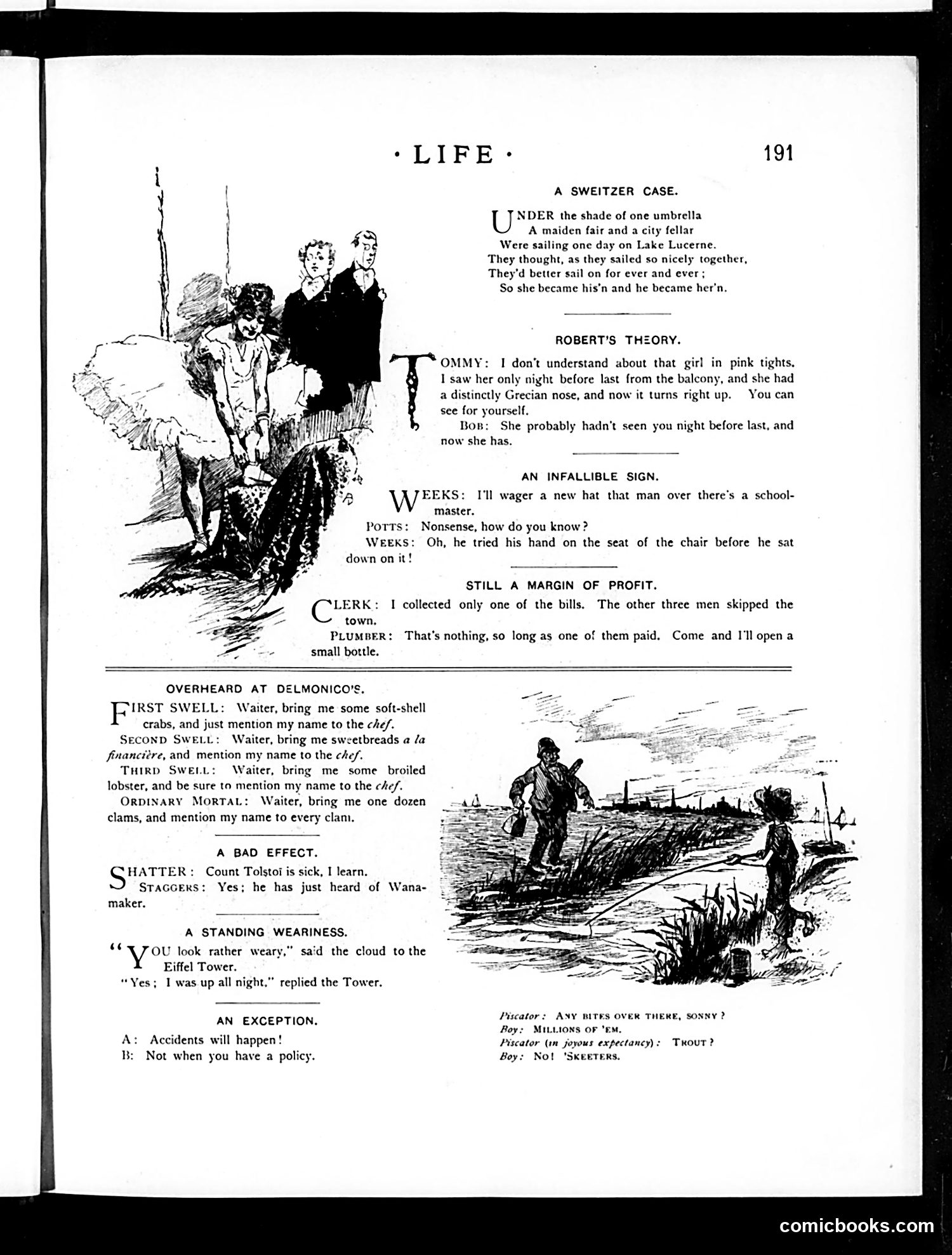
This page contains several brief satirical anecdotes and jokes rather than a single cartoon. The humor targets social pretension and human nature: **"A Switzer Case"** jokes about a couple becoming engaged under an umbrella on Lake Lucerne, playing on romantic clichés. **"Robert's Theory"** uses mistaken identity humor—a man notices a girl in pink tights he'd only glimpsed before, attributing her changed appearance to seeing him. **"Overheard at Delmonico's"** mocks wealthy diners' social climbing by having each successive swell demand the waiter mention their name to the chef—escalating absurdly to demanding mention with every clam. The sketches on the page illustrate these anecdotes in a light, humorous style typical of early 20th-century American satire magazine humor, targeting vanity and social affectation among the upper classes.
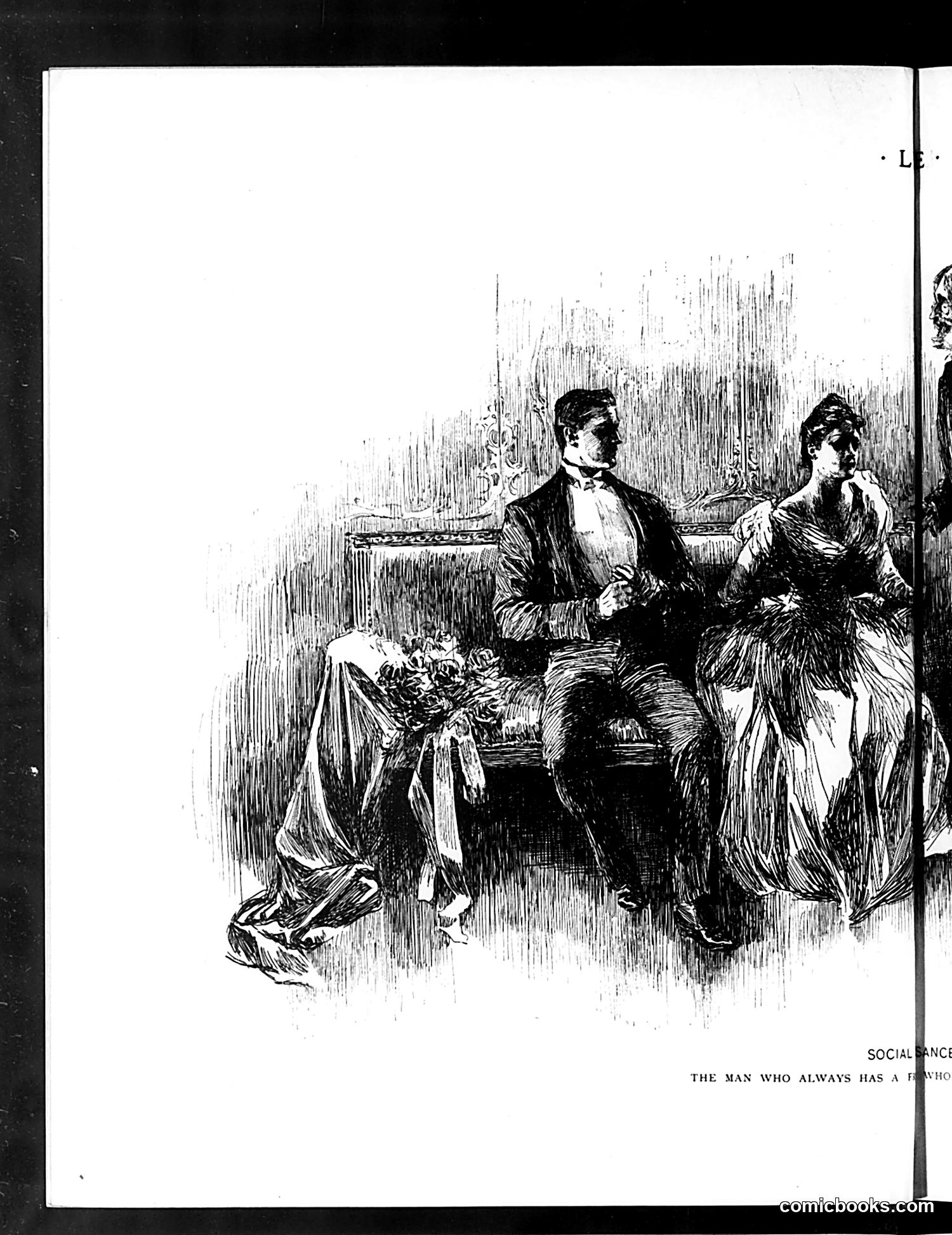
This is a satirical illustration from Life magazine depicting an interior social scene. A well-dressed man in formal evening wear sits between two elegantly dressed women in what appears to be an upscale parlor or drawing room, with decorative furnishings visible in the background. The caption reads "THE MAN WHO ALWAYS HAS A..." with the remainder cut off. Based on the social setting and the man's central positioning between two women, this appears to be satirizing a particular social type—likely a man who always has female companionship or always has some advantage in social situations. The illustration critiques upper-class social pretensions and gender dynamics of the Edwardian era when Life was at its height as a satirical publication.
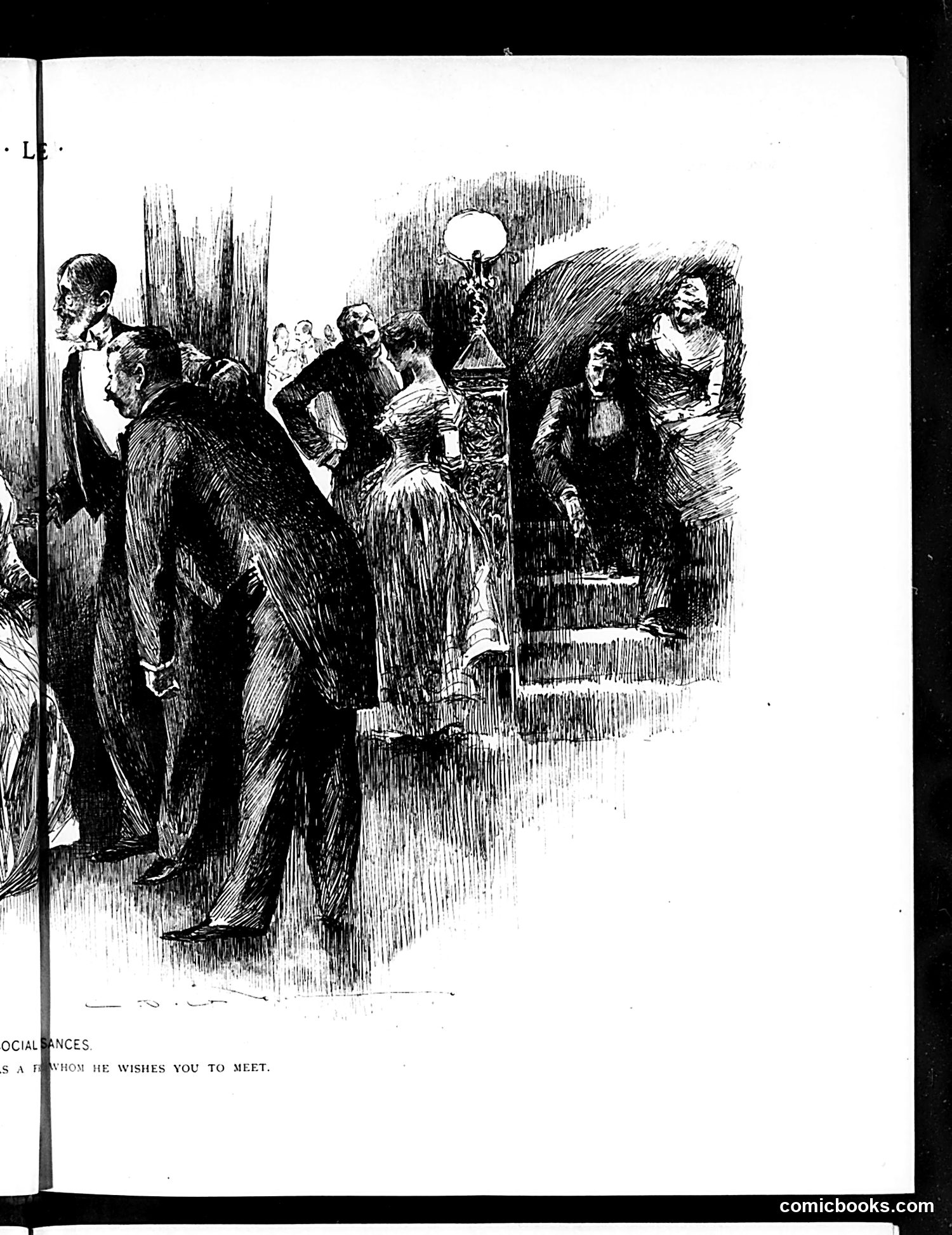
This appears to be a social satire illustration from Life magazine showing a formal social gathering or reception. The visible caption reads "...A FASHION HE WISHES YOU TO MEET," suggesting commentary on social introductions and etiquette. The sketch depicts well-dressed men in formal attire at what appears to be an indoor social event, with a classical bust or statue visible in the background. The crowded, somewhat chaotic arrangement of figures suggests satire about the formality and artificiality of upper-class social conventions. However, without clearer identification of specific individuals or fuller context from surrounding text, the precise satirical targets remain unclear. The page heading mentions "OCIAL ANCES" (likely "SOCIAL DANCES"), but the exact political or social critique intended cannot be definitively determined from the visible portions alone.
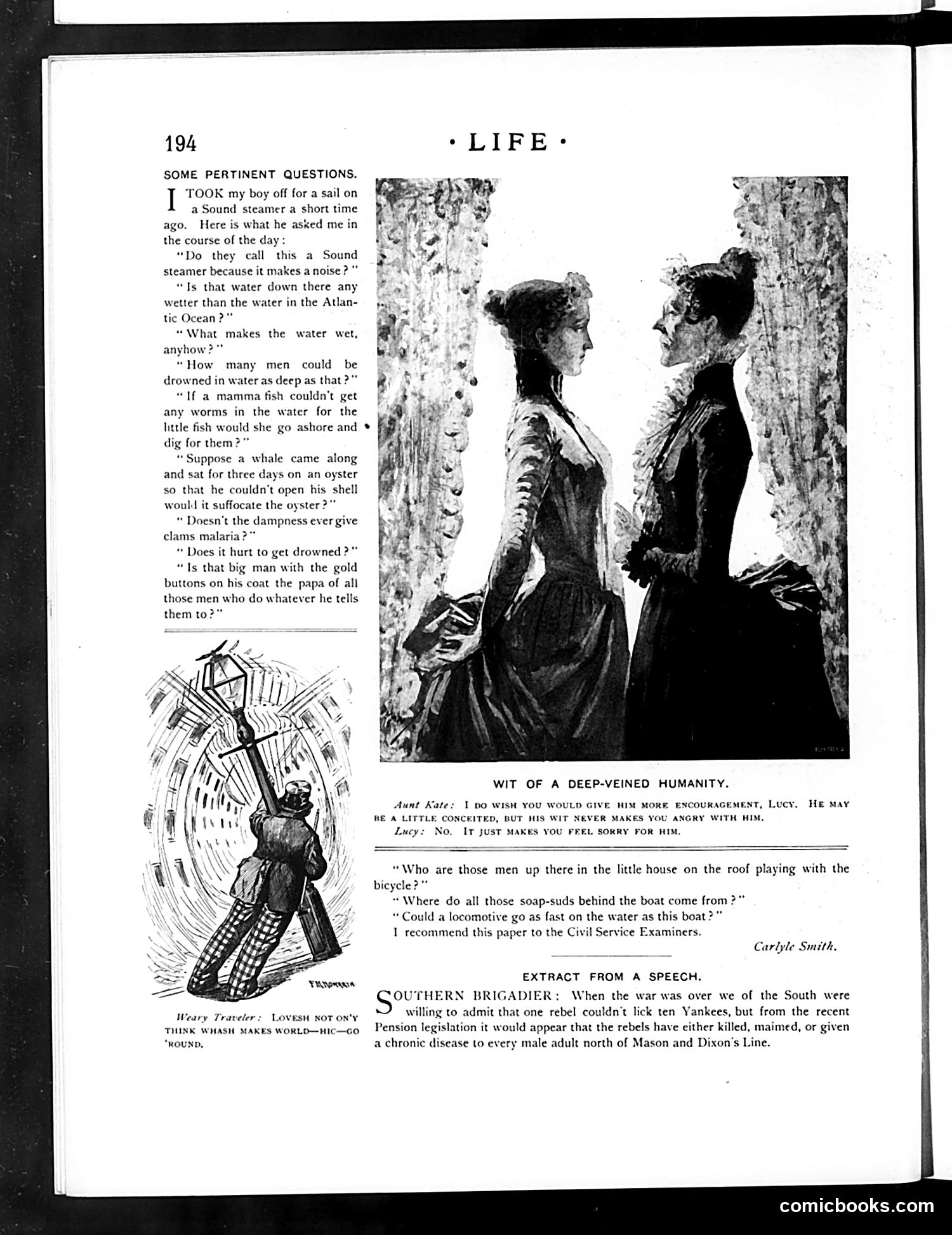
This page contains three satirical pieces: **"Some Pertinent Questions"** presents a child's innocent but absurd questions about a Sound steamer voyage—mixing genuine curiosity ("Is that water wetter?") with nonsensical ones ("Do clams get malaria?"). The humor targets both childhood logic and adult pretension. **"Weary Traveler"** shows a drunk man pontificating about cosmic philosophy, mocking both intoxicated rambling and pseudo-intellectual discourse. **"Extract from a Speech"** features a Southern brigadier general's complaint about post-Civil War pension legislation. He sardonically notes that recent pension claims suggest rebels killed or disabled virtually every Northern male—implying the North is fraudulently inflating pension applications. This satirizes Reconstruction-era tensions over veteran benefits and questions the legitimacy of Northern pension claims. The "Wit of a Deep-Veined Humanity" caption suggests these pieces celebrate human nature's quirky wisdom, even in foolishness.
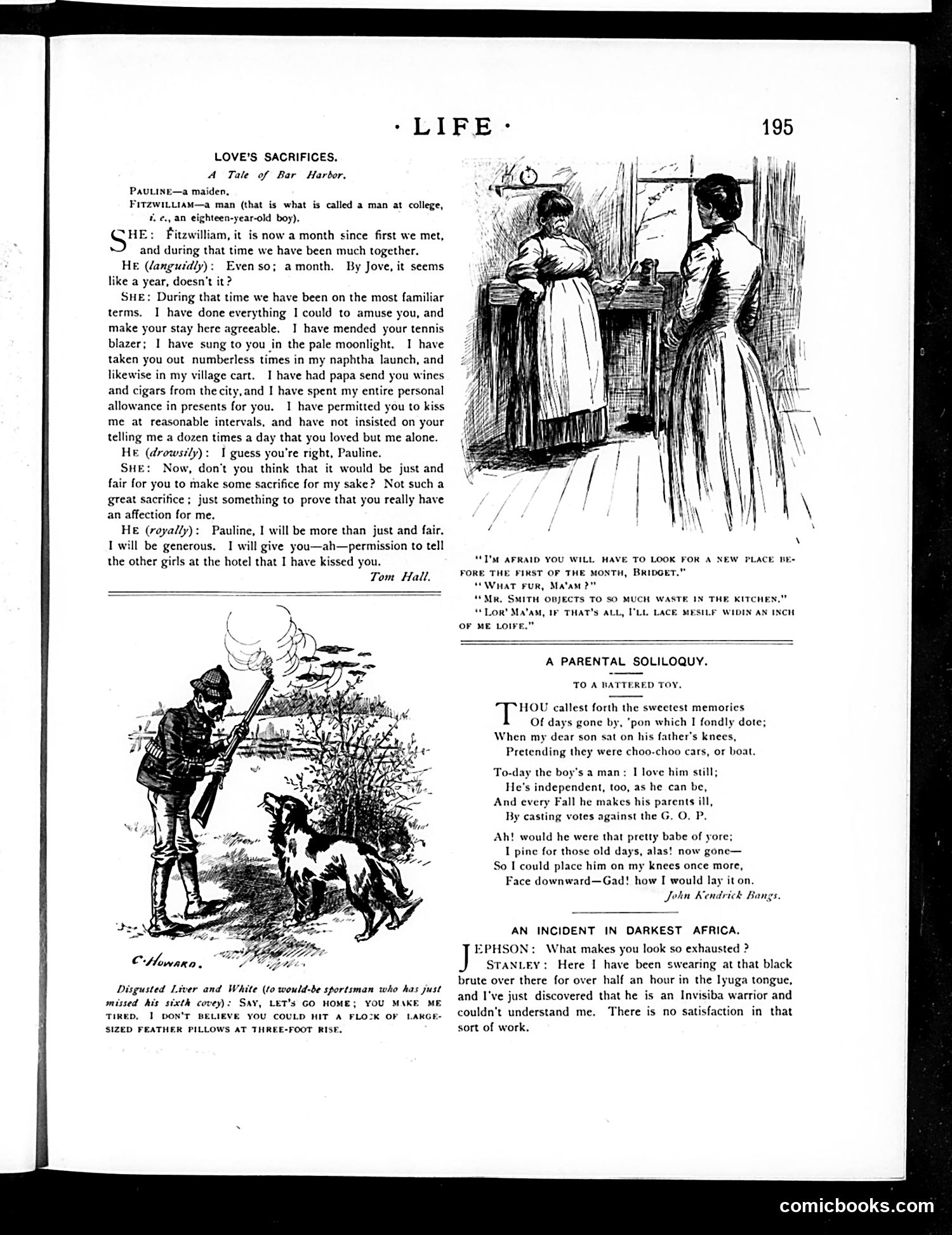
This page contains multiple humor pieces satirizing early 1900s social conventions: **"Love's Sacrifices"** mocks the entitlement of young men. A woman (Pauline) details her extensive romantic efforts—mending clothes, singing, providing transportation, spending her allowance—while her suitor (Fitzwilliam), described as merely "an eighteen-year-old boy," remains languidly indifferent. His "generous" offer—permission to boast about kissing him—exposes his callous vanity. The satire critiques male ingratitude and the unequal emotional labor in courtship. **"A Parental Soliloquy"** uses dark humor about parental politics: a father nostalgically recalls his son as a child, then reveals his modern frustration—the boy now votes Republican (G.O.P.), contradicting the father's presumed politics. The closing threat of corporal punishment jokes about generational political conflict. **"An Incident in Darkest Africa"** satirizes explorers' imperial arrogance. Stanley complains that swearing at a "black brute" in the local language provided no satisfaction—because the man couldn't understand insults. The joke mocks colonizers' assumptions of superiority while unable to even communicate effectively.
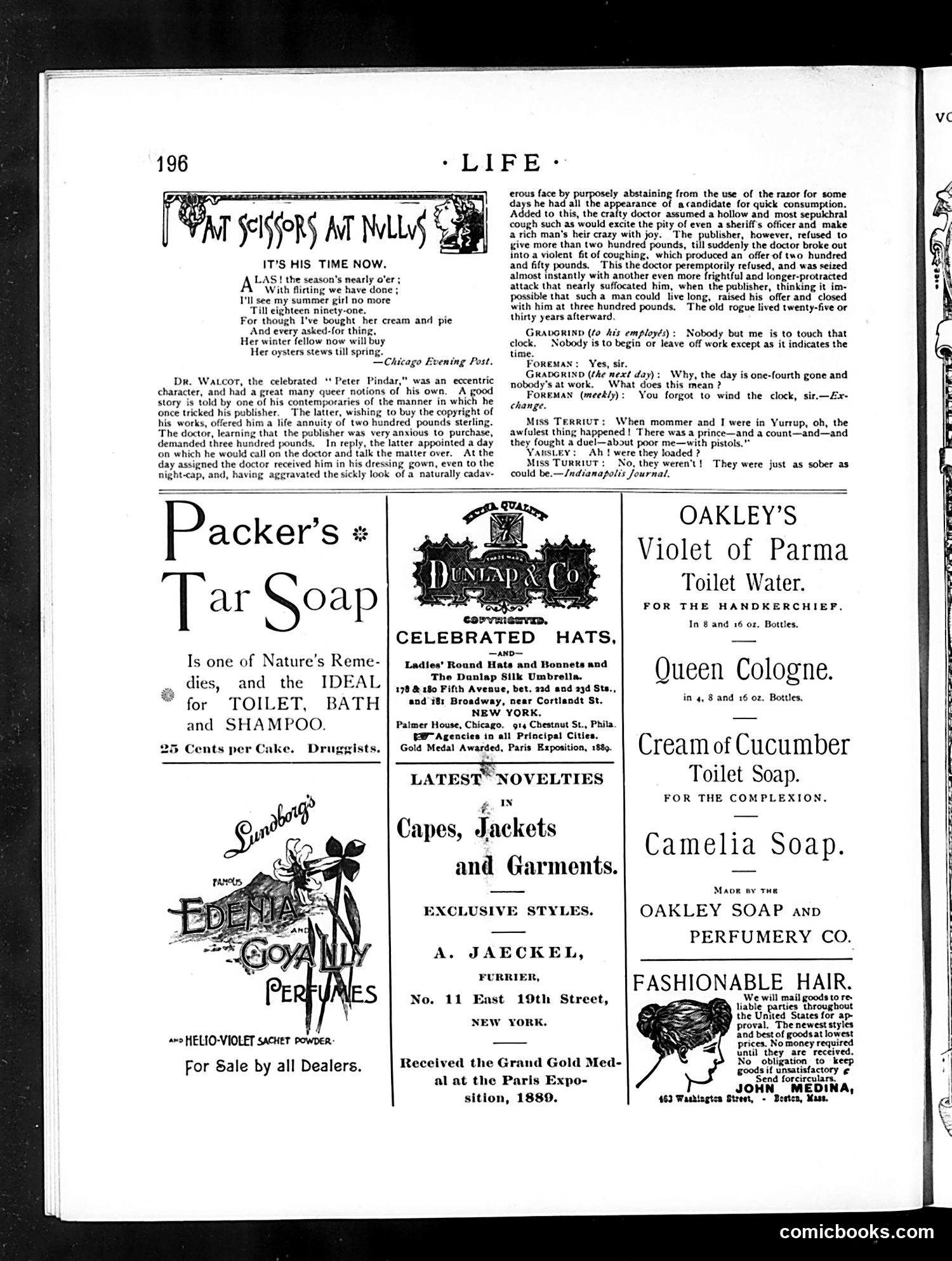
This page contains three brief satirical pieces and period advertisements. The "Scissors at Milly" cartoon (top) is a short poem about seasonal romance—a young man lamenting that summer flirtation season has ended and his girlfriend will spend winter with another suitor, humorously reducing romance to transactional gift-giving ("cream and pie," "oysters stews"). Below that is an anecdote about Dr. Walcot (Peter Pindar), an 18th-century eccentric who tricked his publisher into paying more money by deliberately appearing terminally ill through unshaved face and sickly dress, escalating his coughing fits to raise the offered price. It's a con-artist story celebrating cunning deception. Two other brief jokes follow: "Gradgrind" mocks obsessive workplace punctuality when a foreman forgets to wind the clock, halting all work; "Miss Turritt's" anecdote satirizes vapid high-society gossip about a duel fought by drunken suitors. The remainder is Victorian-era advertising for toiletries, hats, and clothing—typical period commercial content.