
Life, 1890-10-09 · page 6 of 14
Life — October 9, 1890 — page 6: what you’re looking at
What you’re looking at
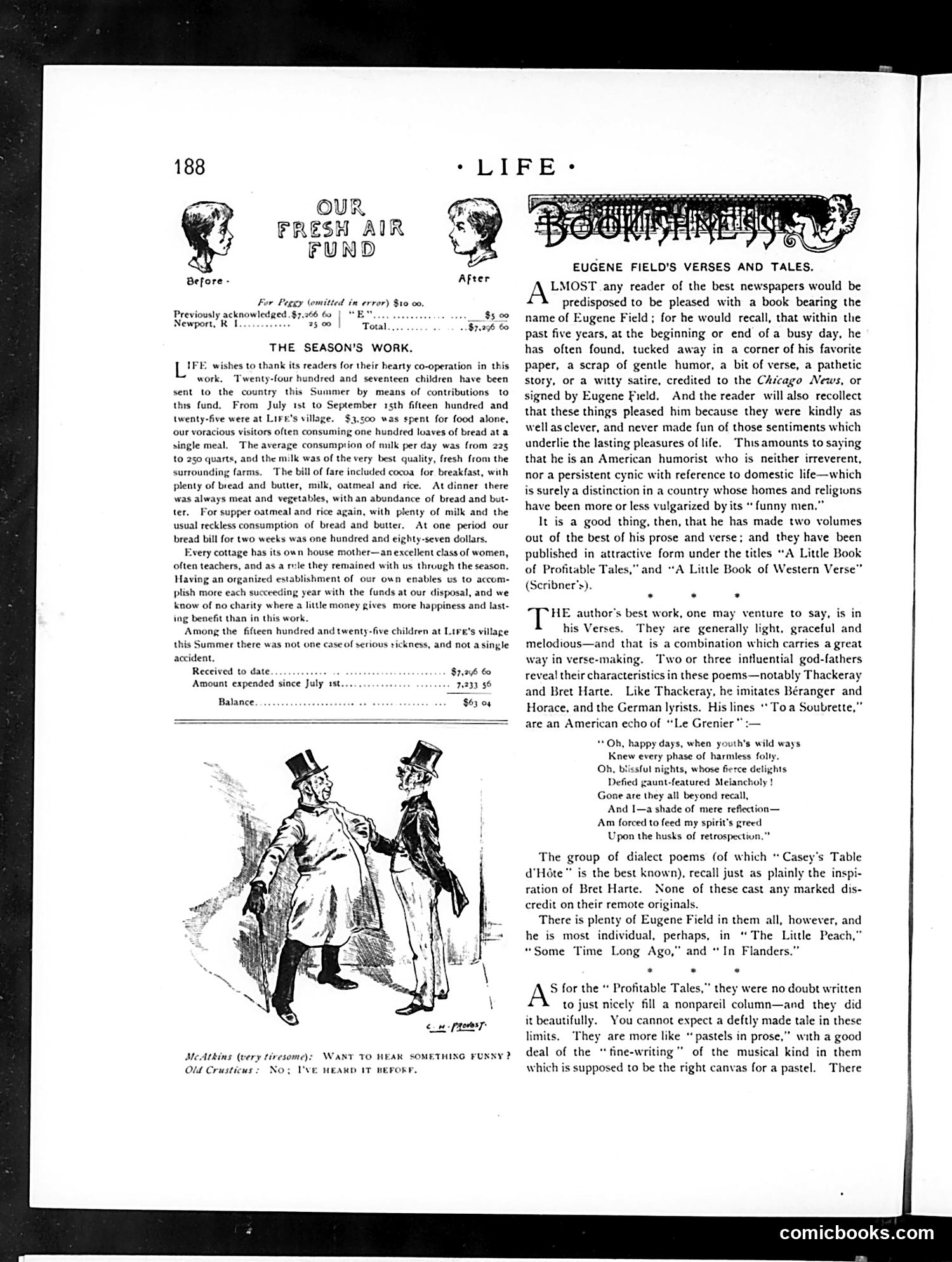
This page contains two distinct sections: **"Our Fresh Air Fund"** (top left): A before-and-after illustration showing a malnourished child ("Before") transformed into a healthy one ("After"). The accompanying text describes Life magazine's charitable campaign providing summer country experiences and nutritious meals for poor urban children. This documents a genuine philanthropic initiative. **"Eugene Field's Verses and Tales"** (right): A literary appreciation of humorist Eugene Field's published works. The text praises Field as a distinctly American humorist—gentle rather than irreverent—whose domestic humor and satire appeared in newspapers. **The cartoon** (lower left) by C.H. Tafdy shows two well-dressed men in formal attire. The caption indicates Mr. Atkins requesting "something funny" from "Old Crantics," a joke about seeking humor from supposedly cantankerous sources.
📄 Transcribed text from this page (OCR, searchable)
Machine-transcribed from the original scan — historical spelling and the odd misread are preserved.
OUR FRESH AIR FUND Before - After For Posey (omitted in Previously acknowledged .$7.266 60 Newport, R I sense 2500 ror) $10 00, $5 09 296 60 THE SEASON'S WORK. IFE, wishes to thank its readers for their hearty co-operation in this work, Twenty-four hundred and seventeen children have been sent to the country this Summer by means of contributions to this fund, From July ist to September 1sth fifteen hundred and twenty-five were at Life's village. $3,500 was spent for food alone, our voracious visitors often consuming one hundred loaves of bread at a single meal. The average consumption of milk per day was from 225 to 250 quarts, and the milk was of the very best quality, fresh from the surrounding farms, ‘The bill of fare included cocoa for breakfast, with plenty of bread and butter, milk, oatmeal and rice. Atdinner there was always meat and vegetables, with an abundance of bread and but- ter. For supper oatmeal and rice again, with plenty of milk and the usual reckless consumption of bread and butter. At one period our bread bill for two weeks was one hundred and eighty-seven dollars. Every cottage has its own house mother—an excellent class of women, often teachers, and as a rule they remained with us through the season, Having an organized establishment of our own enables us to accom- plish more each succeeding year with the funds at our disposal, and we know of no charity where a little money gives more happiness and last- ing benefit than in this work, Among the fifteen hundred and twenty-five children at Live's village this Summer there was not one case of serious rickness, and not a single accident. Received to date te $7.26 60 Amount expended since July 1st..... 76233 $6 Balance $63 04 <n faces McAthins (very tiresome): WANT TO HEAR SOMETHING FUNNY ? Old Crusticus: No; VE MEARD IT BEFORP. EUGENE FIELD'S VERSES AND TALES. Ariost any reader of the best newspapers would be predisposed to be pleased with a book bearing the name of Eugene Field ; for he would recall, that within the past five years, at the beginning or end of a busy day, he has often found, tucked away in a corner of his favorite paper, a scrap of gentle humor, a bit of verse, a pathetic story, or a witty satire, credited to the Chicago News, or signed by Eugene Field. And the reader will also recollect that these things pleased him because they were kindly as well as clever, and never made fun of those sentiments which underlie the lasting pleasures of life. This amounts to saying that he is an American humorist who is neither irreverent, nor a persistent cynic with reference to domestic life—which is surely a distinction in a country whose homes and religions have been more or less vulgarized by its “funny men.” It is a good thing, then, that he has made two volumes out of the best of his prose and verse; and they have been published in attractive form under the titles “A Little Book of Profitable Tales," and “A Little Book of Western Verse” (Scribner's). . . . HE author's best work, one may venture to say, is in his Ver They are generally light, graceful and melodious—and that is a combination which carries a great way in verse-making. Two or three intluential god-fathers reveal their characteristics in these poems—notably Thackeray and Bret Harte. Like Thackeray, he imitates Béranger and Horace, and the German lyrists. His lines ‘Toa Soubrette,” are an American echo of “Le Grenier” “Oh, happy days, when youth's wild ways Knew every phase of harmless folly Oh, blissful nights, whose fierce det Defied gaunt-featured Melancholy ! Gone are they all beyond recall, And l—a shade of mere refiection— Am forced to feed my spirit's greed Upon the husks of retrospection.”” The group of dialect poems (of which “ Casey’s Table d'Hote” is the best known), recall just as plainly the inspi- ration of Bret Harte. None of these cast any marked dis- credit on their remote original: There is plenty of Eugene Field in them all, however, and he is most individual, perhaps, in “The Little Peach,” “Some Time Long Ago,” and “In Flanders. S for the “ Profitable Tales,” they were no doubt written to just nicely fill a nonpareil column—and they did it beautifully. You cannot expect a deftly made tale in these limits. They are more like “pastels in prose,” with a good deal of the “ftine-writing of the musical kind in them which is supposed to be the right canvas for a pastel. There comicbooks.com