
Life, 1890-10-09 · page 7 of 14
Life — October 9, 1890 — page 7: what you’re looking at
What you’re looking at
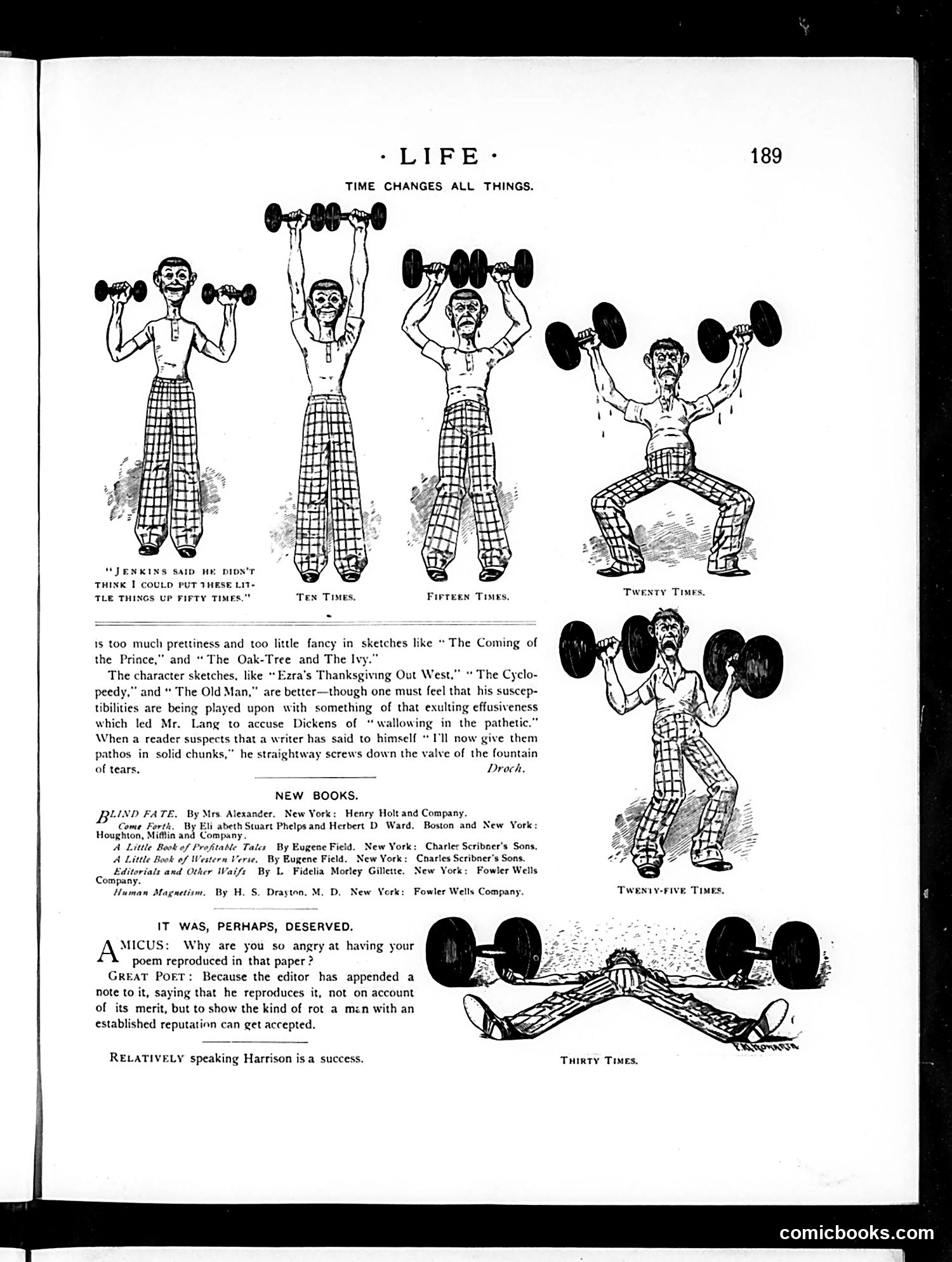
This cartoon depicts a man's deteriorating strength across his lifetime, measured by weightlifting capacity. The sequence shows him lifting dumbbells with ease in youth ("Ten Times"), then progressing through "Fifteen Times" and "Twenty Times" with increasing strain, until reaching "Thirty Times" where he's flat on his back, barely able to lift the weights at all. The joke satirizes the physical toll of aging—the ironic title suggests time transforms vigor into infirmity. The caption references "Jenkins," suggesting this mocks a specific public figure or type. The exaggerated visual progression humorously illustrates the inevitable decline from youthful athleticism to elderly weakness, a timeless theme of physical comedy.
📄 Transcribed text from this page (OCR, searchable)
Machine-transcribed from the original scan — historical spelling and the odd misread are preserved.
> LIFE: TIME CHANGES ALL THINGS. “JENKINS SAID He DIDN'T THINK I COULD PUT THESE LIT- TLE THINGS UP FIFTY TIMES.” 1s too much prettiness and too little fancy in sketches like * The Coming of the Prince,” and “The Oak-Tree and The Ivy The character sketches, like *Ezra’s Thanksgiving Out West,” “ The Cyclo- peedy,” and “ The Old Man,” are better—though one must feel that his suscep- tibilities are being played upon with something of that exulting effusiveness which led Mr. Lang to accuse Dickens of “ lowing in the pathetic.” When a reader suspects that a writer has said to himself “I'll now give them pathos in solid chunks,” he straightway screws down the valve of the fountain of tears. Droch. NEW BOOKS. BLIND FATE, By Mrs. Alexander. New York: Henry Holt and Company. Come Forth. By Eli abeth Swart Phelps and Herbert D Ward. Boston and New York: Houghton, Miffin and Company A Little Book of Profitable Tales By Eugene Field. New York: Charles Scribner's Sons. A Little Book of Western Verse. By Eugene Field. New York: Charles Scribner's Sons. Editorials and Other Waifs By L Fidelia Morley Gillette. New York: Fowler Wells Company. Human Magnetism. By H. S. Drayton, M.D. New York: Fowler Wells Company. IT WAS, PERHAPS, DESERVED. MICUS: Why are you so angry at having your poem reproduced in that paper ? GREAT POET: Because the editor has appended a Note to it, saying that he reproduces it, not on account of its merit, but to show the kind of rot a mn with an established reputation can get accepted. RELATIVELY speaking Harrison isa success. Tuirty Times, comicbooks.com