
Life, 1890-10-09 · page 4 of 14
Life — October 9, 1890 — page 4: what you’re looking at
What you’re looking at
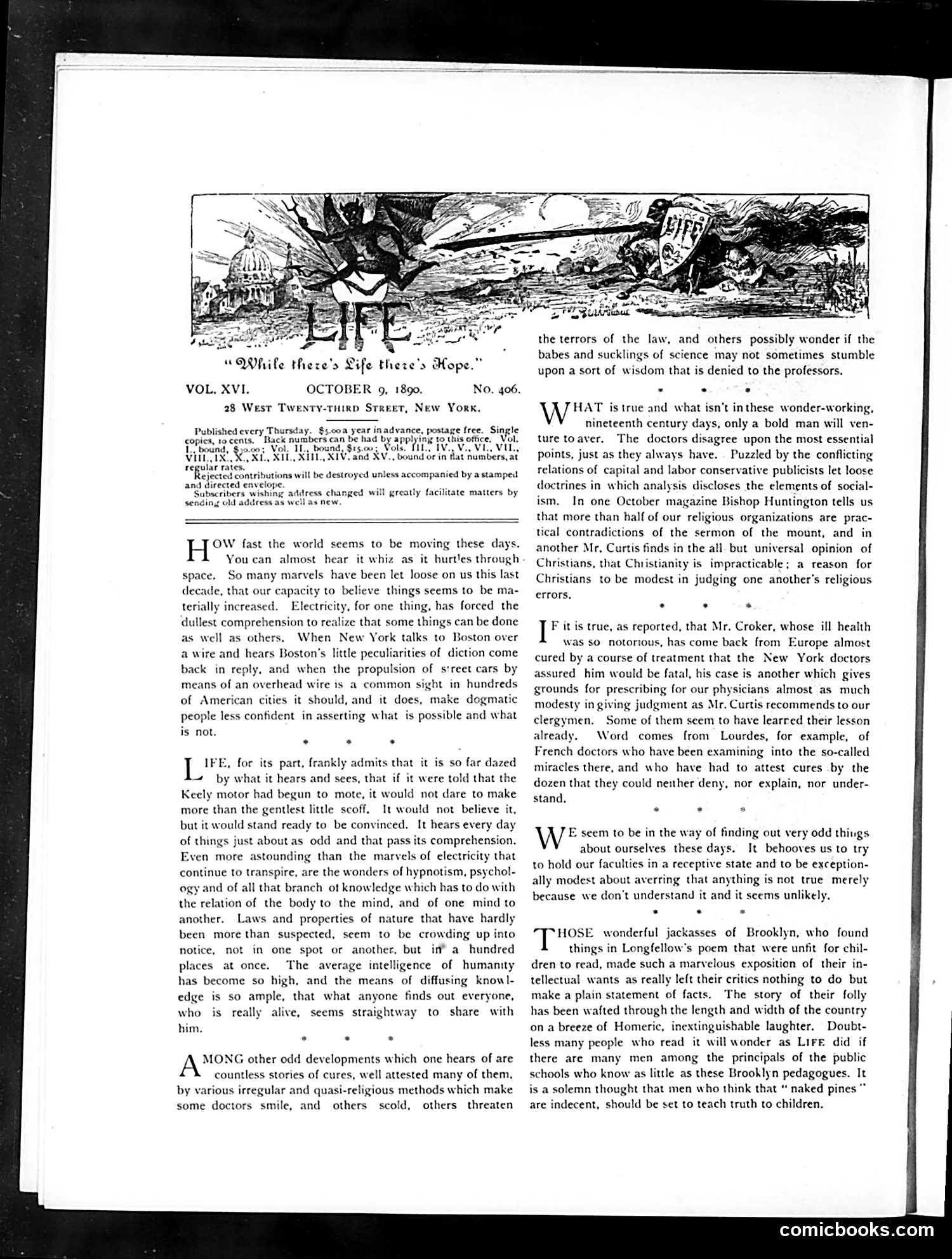
The masthead illustration depicts a personified figure of "Life" itself—shown as a dynamic, energetic character gesturing broadly across a landscape. The accompanying text discusses rapid modernization: "How fast the world seems to be moving these days." The editorial commentary critiques the era's intellectual and medical frauds. It mocks doctors' contradictory prescriptions, references purported miracle cures at Lourdes, and sarcastically discusses Brooklyn pedagogues who produced a children's book called "The Story of their Folly." The overall satire targets 1890s society's credulity toward pseudo-scientific medical treatments and dubious educational claims, while lamenting that public institutions and figures—doctors, teachers, clergy—exploit public confusion rather than provide genuine expertise or honest guidance.
📄 Transcribed text from this page (OCR, searchable)
Machine-transcribed from the original scan — historical spelling and the odd misread are preserved.
aera “While there's Life theze’s Hope.” VOL, XVI. OCTOBER 9, 1890. No. 406. 28 West Tw THIRD Street, New York. $5.00 year inadvance, postage free. Single bers can be had by applying to this office. Vol. pound, $is.o0; Vols. fie WW., V., Via, VIL, and XV., bound or in dat numbers, at Published every Thursd copies, 10 cents. Back ni f. $ vol. I regular ejected contributions will be destroyed unless accompanied by a stamped and directed envelope. bscribers wishing address changed w sending old address as well greatly facilitate matters by OW fast the world seems to be moving these days. You can almost hear it whiz as it burtles through space. So many marvels have been let loose on us this last decade, that our capacity to believe things seems to be ma terially increased. Electricity, for one thing, forced the dullest comprehension to realize that some things can be done as well as others. When New York talks to Boston over a wire and hears Boston's little peculiarities of diction come back in reply, and when the propulsion of s'reet cars by pt in hundreds make dogmatic means of an overhead wire 1s a common s of American cities it should, and it do people less contident in asserting what is possible and what is not. . . . I IFE, for its part, frankly admits that it is so far dazed —~ by what it hears and sees, that if it were told that the Keely motor had begun to mote, it would not dare to make more than the gentlest little scoff. It would not believe it, but it would stand ready to be convinced. It hears every day of things just about as odd and that pass its comprehension. Even more astounding than the marvels of electricity tha continue to transpire, are the wonders of hypnotism, psychol- ogy and of all that branch ot knowledge which has to do with the relation of the body to the mind, and of one mind to another. Laws and properties of nature that have hardly been more than suspected, seem to be crowding up into notice, not in one spot or another, but in’ a hundred places at once. The average intelligence of humanity has become so high, and the means of diffusing knowl- edge is so ample, that what anyone finds out everyone, who is really alive, seems straightway to share with him. . . . [AMON other odd developments which one hears of are countless stories of cures, well attested many of them, by various irregular and quasi-religious methods which make some doctors smile, and others scold, others threaten the terrors of the law, and others possibly wonder if the babes and sucklings of science may not sometimes stumble upon a sort of wisdom that is denied to the professors. HAT is true and what isn’t inthese wonder-working, nineteenth century days, only a bold man will ven- ture toaver. The doctors disagree upon the most essential points, just as they always have. Puzzled by the conflicting relations of capital and labor conservative publicists let loose doctrines in which analysis discloses the elements of social- ism. In one October magazine Bishop Huntington tells us that more than half of our religious organizations are prac- tical contradictions of the sermon of the mount, and in another Mr, Curtis finds in the all but universal opinion of Christians, that Christianity is impracticable; a reason for Christians to be modest in judging one another's religious errors. * . . I F it is true, as reported, that Mr. Croker, whose ill health Was so notorious, has come back from Europe almost cured by a course of treatment that the New York doctors assured him would be fatal, his case is another which gives grounds for prescribing for our physicians almost as much modesty in giving judgment as Mr. Curtis recommends to our clergymen. Some of them seem to have learred their lesson already. Word comes from Lourdes, for example, of French doctors who have been examining into the so-called miracles there, and who have had to attest cures .by the dozen that they could newher deny, nor explain, nor under- stand, E seem to be in the way of finding out very odd things about ourselves these days. It behooves us to try to hold our faculties in a receptive state and to be exception- ally modest about averring that anything is not true merely because we don't understand it and it seems unlikely. HOSE wonderful jackasses of Brooklyn, who found things in Longfellow’s poem that were unfit for chil- dren to read, made such a marvelous exposition of their in- tellectual wants as really left their critics nothing to do but make a plain statement of facts. The story of their folly has been wafted through the length and width of the country on a breeze of Homeric, inextinguishable laughter. Doubt- less many people who read it will wonder as Lire did if there are many men among the principals of the public hools who know as little as these Brooklyn pedagogues. It is a solemn thought that men who think that “ naked pines” are indecent, should be set to teach truth to children. comicbooks.com