
A complete issue · 20 pages · 1890
Life — June 12, 1890
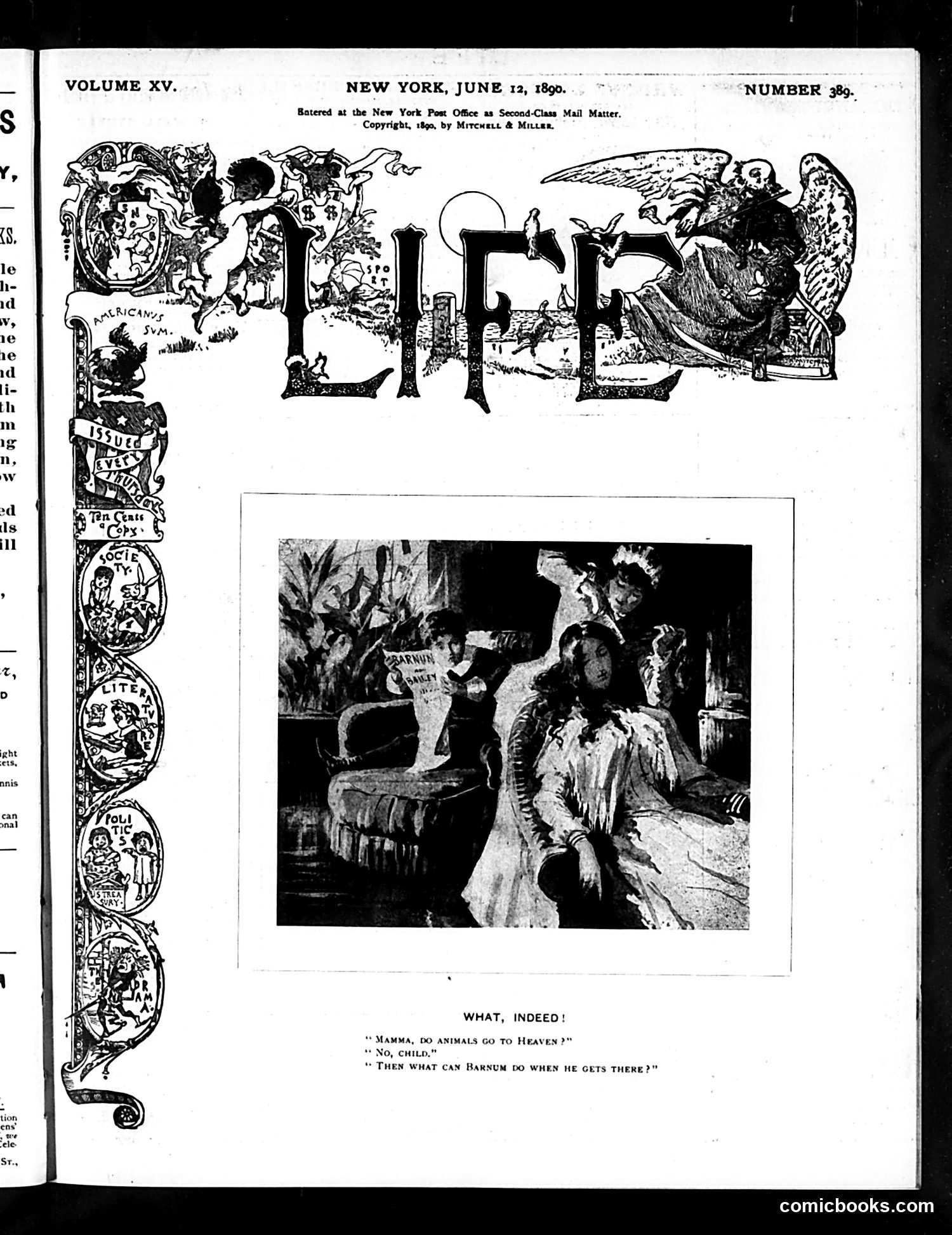
This page features a photograph with accompanying dialogue joke. The image shows what appears to be a circus or theatrical scene with performers in costume, including someone in exotic/animal-themed dress. The caption reads: "WHAT, INDEED! 'MAMMA, DO ANIMALS GO TO HEAVENS?' 'NO, CHILD.' 'THEN WHAT CAN RANSUM DO WHEN HE GETS THERE?'" The joke satirizes someone named Ransum (likely a performer or public figure of the era, possibly connected to circus entertainment). The humor relies on calling this person "animal-like"—a common form of period satire. The reference to heaven creates a moralistic contrast with base behavior or appearance. Without identifying Ransum specifically, the joke represents typical 1890s satirical humor targeting entertainers or public personalities through crude personal mockery.
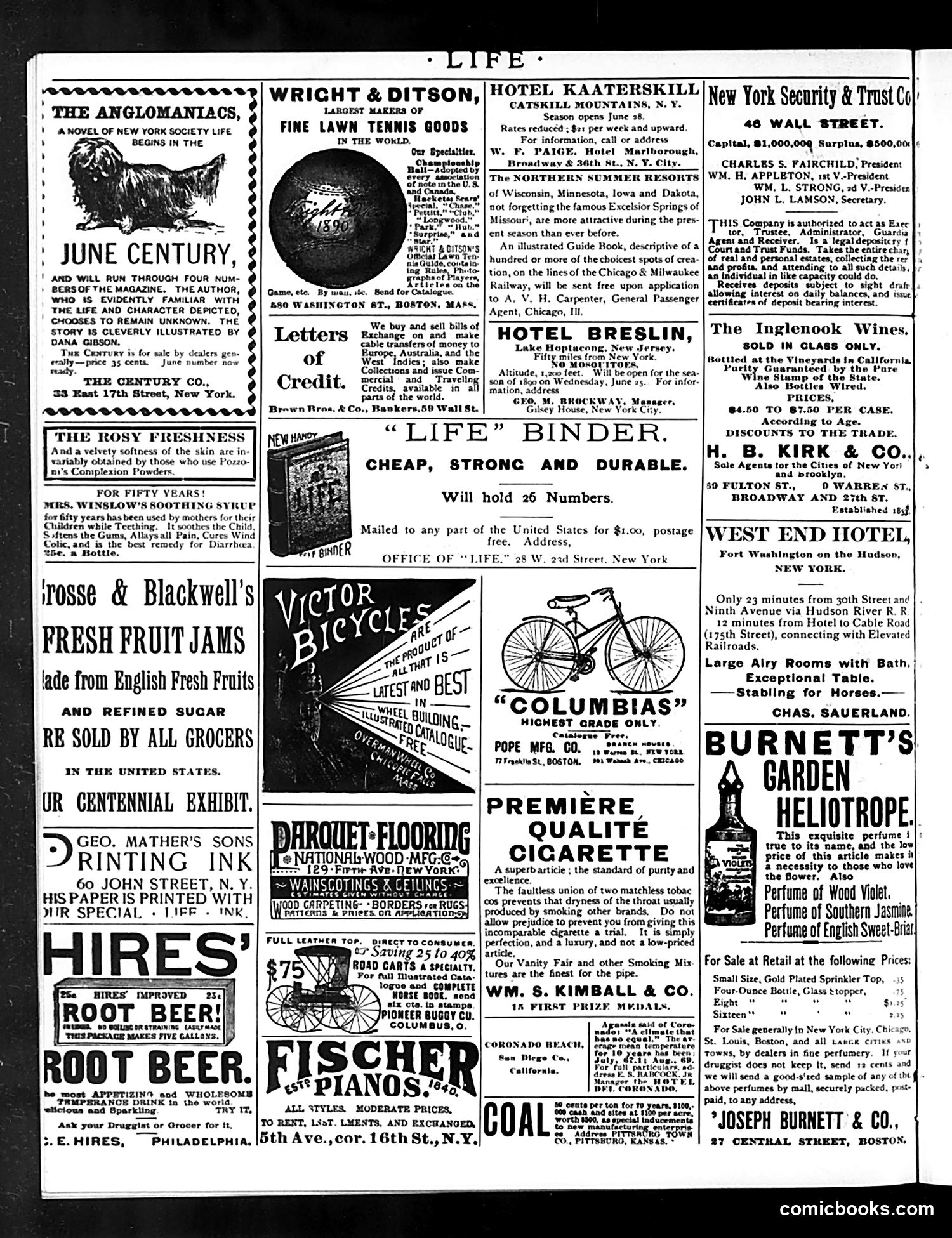
This page is **primarily advertisements** with minimal editorial content. The visible cartoons or illustrations are commercial in nature: 1. **The Anglomaniacs** (top left): Appears to be promoting the June Century magazine issue, featuring a caricatured dog or similar figure—likely satirizing anglophile trends or British cultural affectation among Americans. 2. **Victor Bicycles** and **Columbias** (center/lower): Standard product advertisements using illustrated bicycles, reflecting the 1890s bicycle craze. 3. **Parquet Flooring, Root Beer, and Pianos** (bottom): Typical period advertisements with decorative engravings. The page reflects late-19th-century *Life* magazine format—mixing satirical magazine promotion with commercial ads. Without clearer political imagery or dated references in the visible cartoons, the specific social satire is difficult to determine. The layout emphasizes consumer goods rather than political commentary.
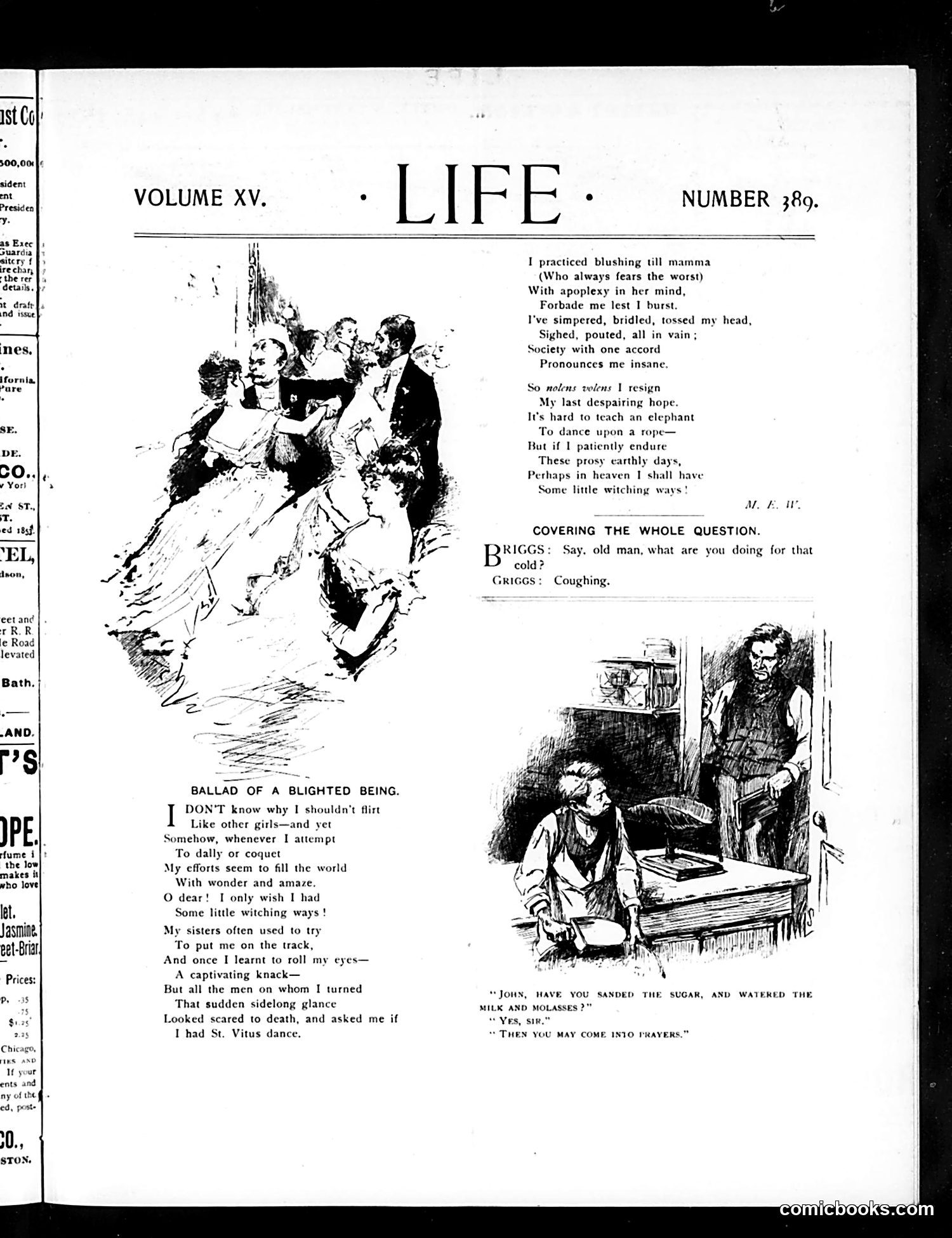
This page contains two satirical pieces: **"Ballad of a Blighted Being"** (bottom): A poem mocking a man who attempts to flirt with women but fails miserably. The speaker laments his romantic incompetence, noting that men "looked scared to death" when he tried courting, and he apparently lacked some quality ("St. Vitus dance") that would make him attractive. The satire targets male social awkwardness and failed seduction attempts. **"Governing the Whole Question"** (top right): A brief comic dialogue where Briggs asks an old man what he's doing for a cold, and receives the response "Coughing." This is simple wordplay humor—a literal, unhelpful answer to a medical question. Both pieces use gentle mockery of everyday social failures and misunderstandings typical of Life magazine's humor approach.
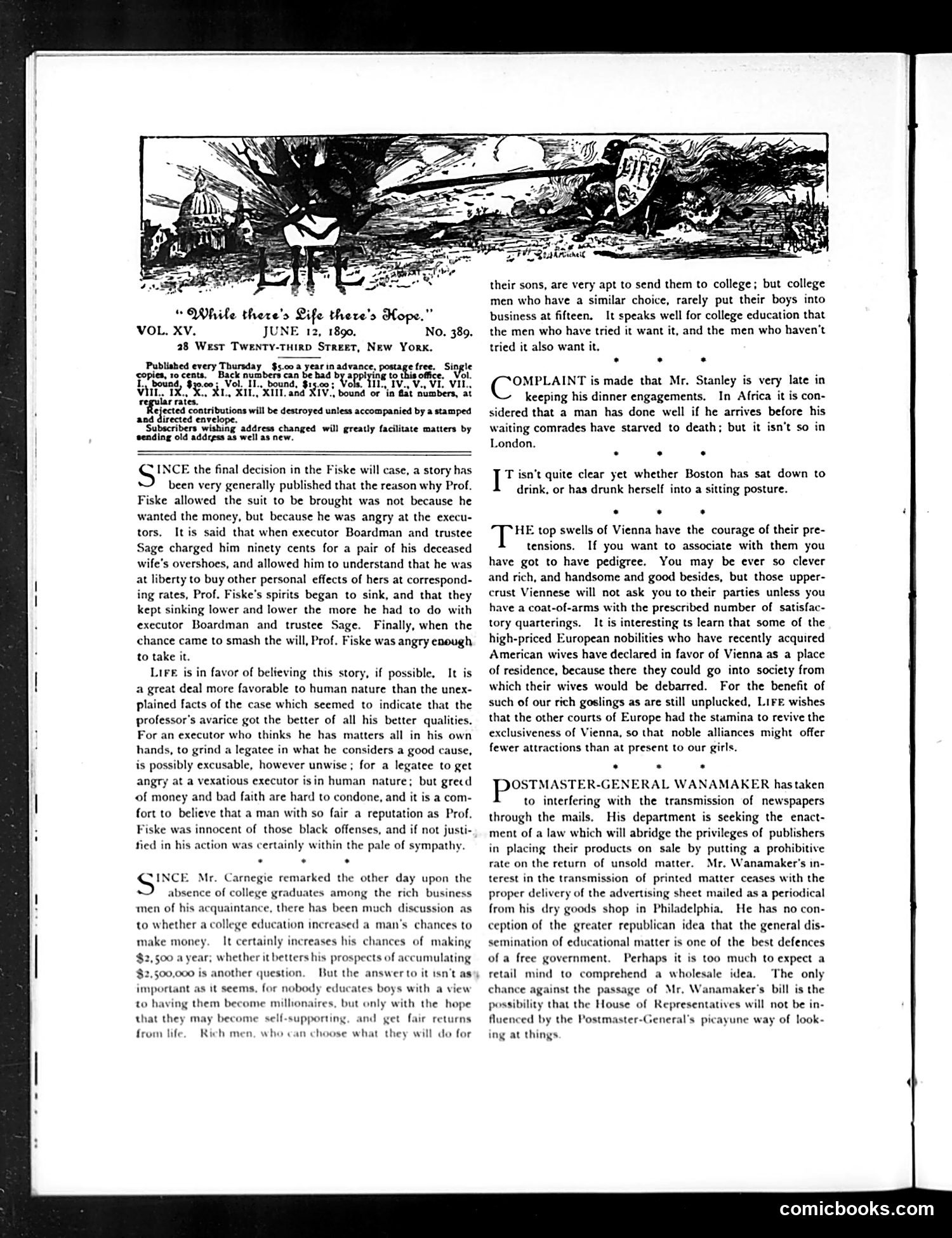
The masthead illustration depicts a contemplative figure amid classical architecture and landscape—likely representing editorial commentary on society and culture. The text discusses several topics: 1. **The Fiske Will Case**: A legal dispute where Prof. Fiske's executors allegedly delayed settlement, allegedly because Fiske was angry at them rather than lacking funds. The piece satirizes executor greed and incompetence. 2. **Vienna Society Standards**: Commentary on European aristocratic snobbery—wealthy Viennese require pedigree from social associates, making Vienna attractive to American wives seeking elevated status. 3. **Postmaster-General Wanamaker**: Criticism of his interference with newspaper transmission through mails by imposing prohibitive rates on unsold periodicals, presented as contrary to free-press principles. The tone is satirical editorial commentary on wealth, social pretension, and governmental overreach.
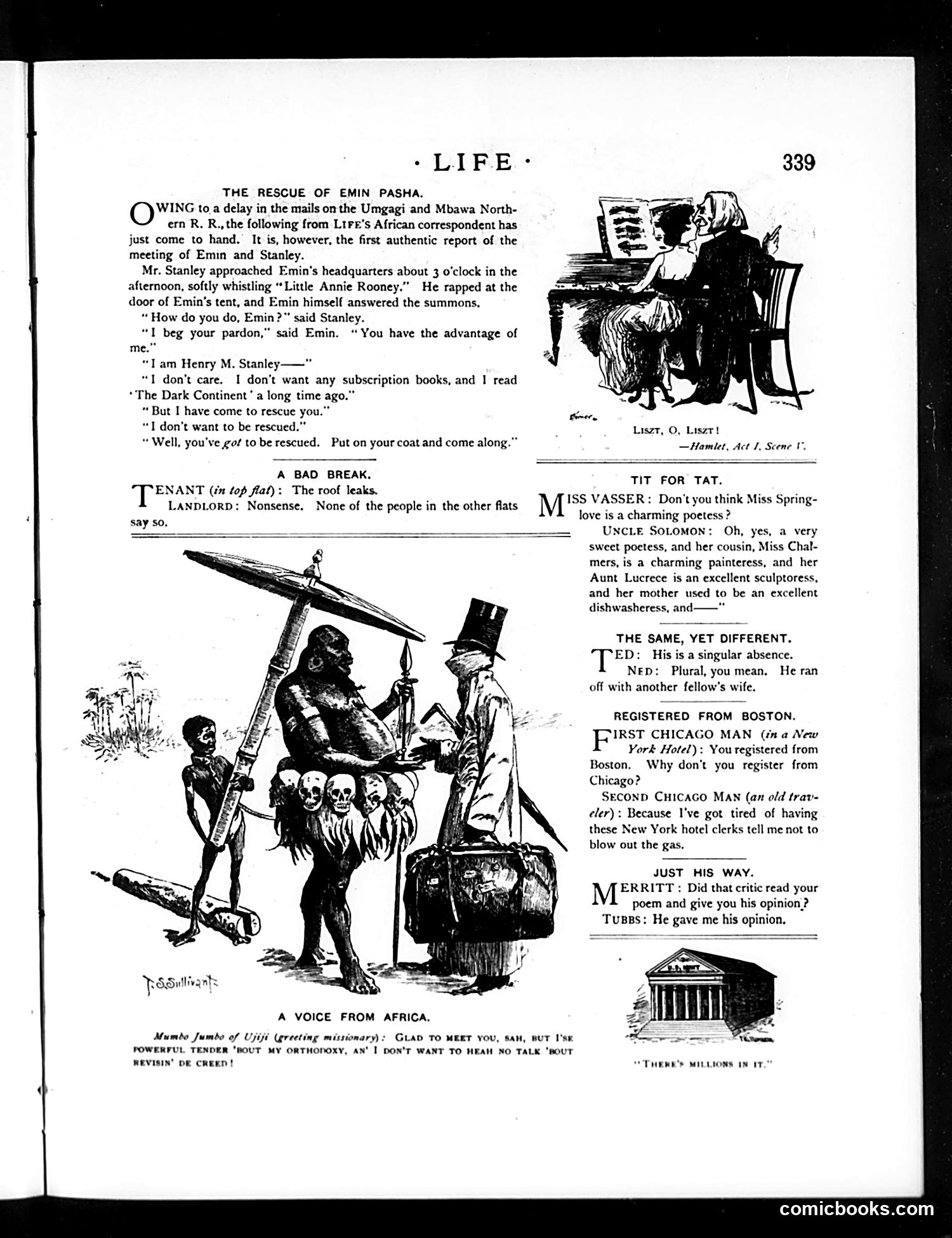
This page contains several satirical humor pieces typical of early 20th-century Life magazine: **"The Rescue of Emin Pasha"** references Henry M. Stanley's famous 1888-1889 expedition to rescue the isolated Emin Pasha in Africa. The dialogue mocks Stanley's self-importance—Emin refuses rescue, preferring his solitude. **"A Bad Break"** is a simple landlord-tenant joke about roof leaks. **"A Voice from Africa"** features a caricatured African missionary criticizing European Christian hypocrisy regarding missionary work and doctrine. The remaining pieces are brief comedic dialogues ("Tit for Tat," "The Same, Yet Different," "Registered from Boston," "Just His Way") playing on wordplay and social observations about hotel clerks, registration, and literary criticism—typical of the magazine's light satirical humor.
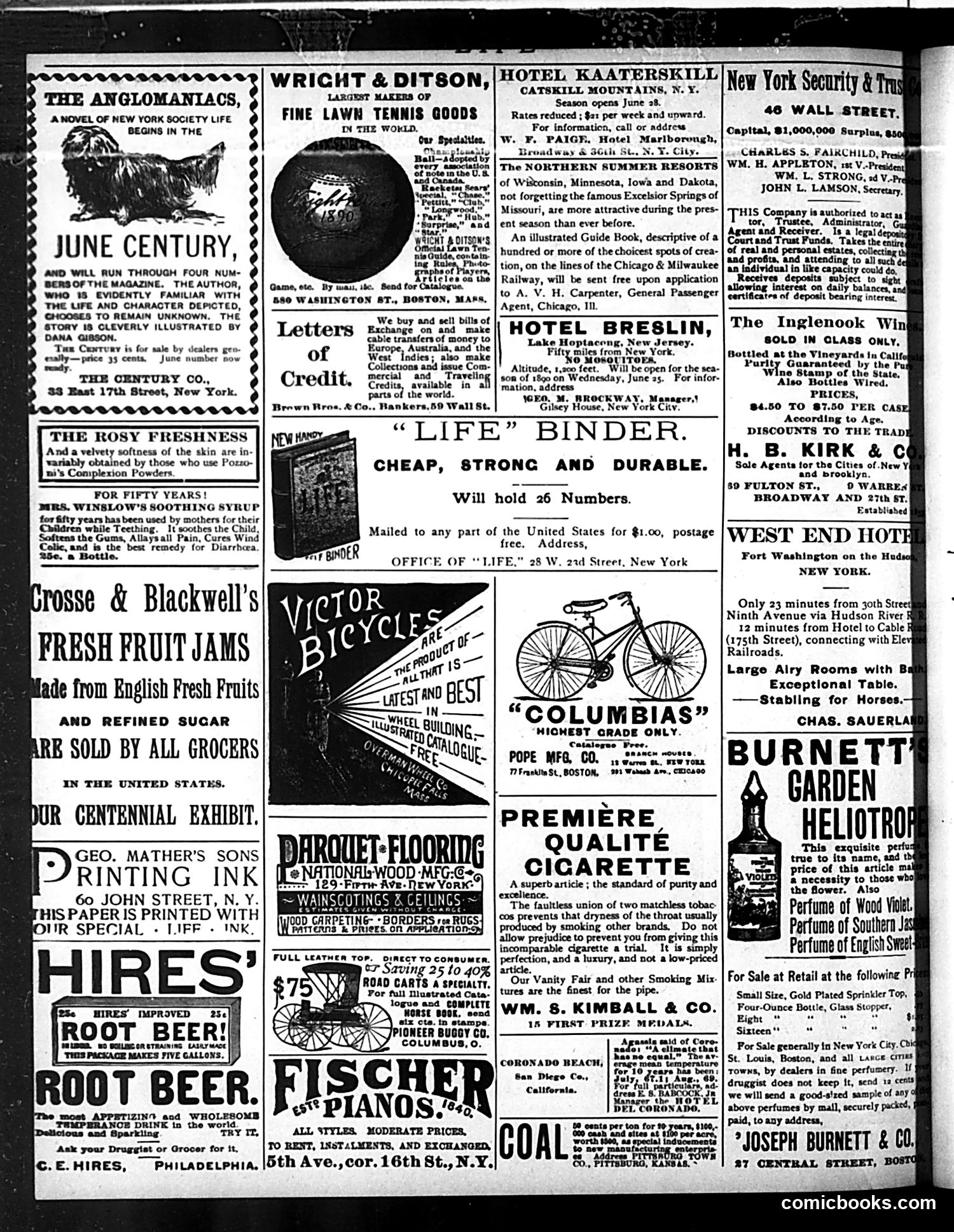
This page is **predominantly advertising**, not political satire. It contains commercial notices for products common in the late 19th or early 20th century: bicycles (Victor, Columbias), pianos, root beer, road carts, jams, cigars, lawn tennis goods, and hotels. The only editorial content is a book advertisement for "The Anglomaniacs," described as "a novel of New York society life." The accompanying illustration shows a caricatured figure, but without additional context, it's unclear what specific social commentary the novel might contain. The "Letters of Credit" section promotes financial services for travelers. Overall, this represents **Life magazine functioning primarily as a commercial vehicle** rather than as political commentary.
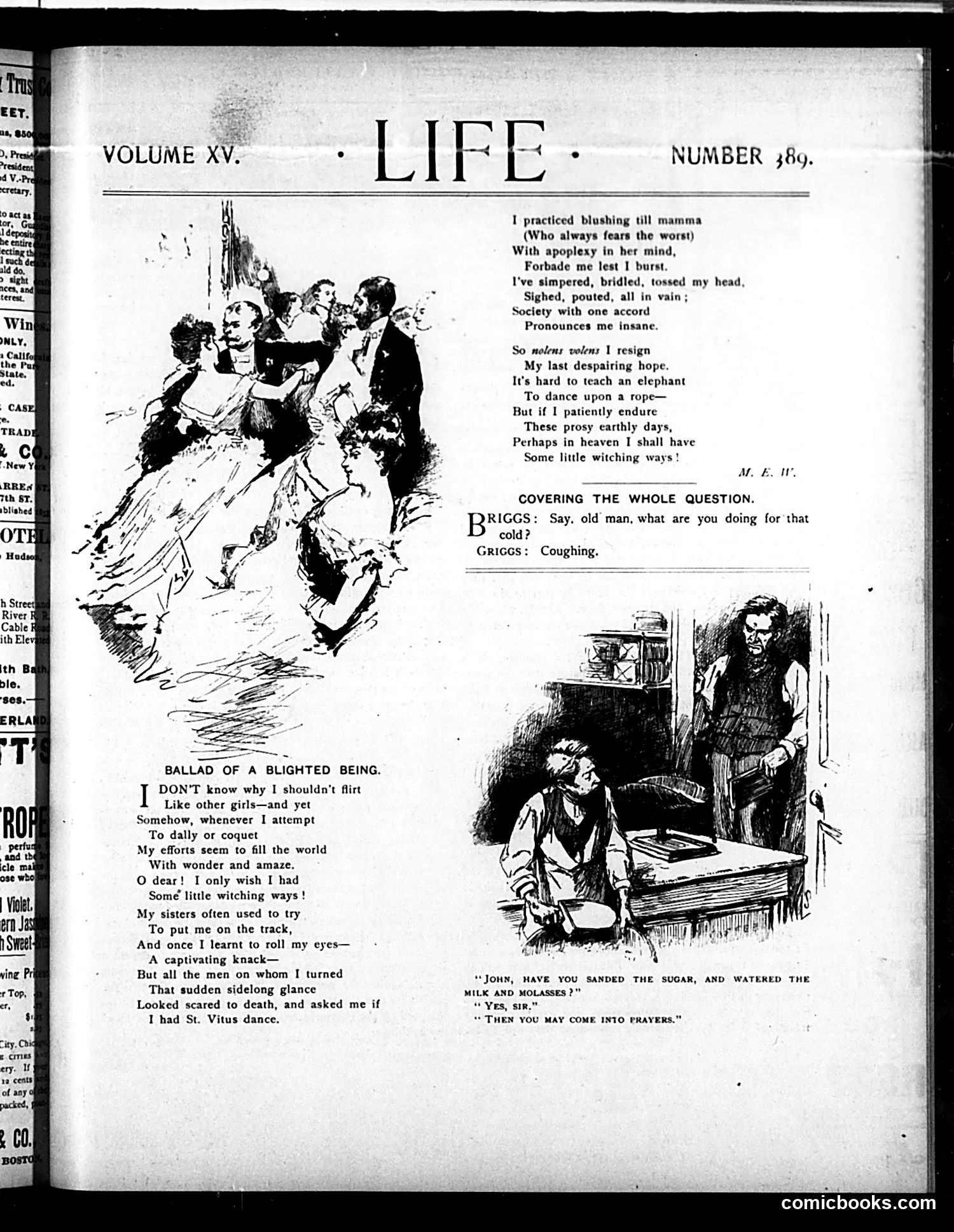
This page contains two satirical poems with accompanying illustrations. **"Ballad of a Blighted Being"** presents a female speaker lamenting her failed attempts at flirtation and romance. The poem mocks the social awkwardness of a woman trying to attract men's attention, with the punchline referencing St. Vitus dance (a neurological disorder causing involuntary movements)—suggesting her dancing was so poor it resembled a disease. **"Covering the Whole Question"** is a brief joke about an old man's persistent cough, playing on double meanings of "cough" as both illness and evasion. The illustrations are period sketches depicting the scenarios. The satire targets social expectations around courtship and gender performance, typical of early 20th-century Life magazine humor.
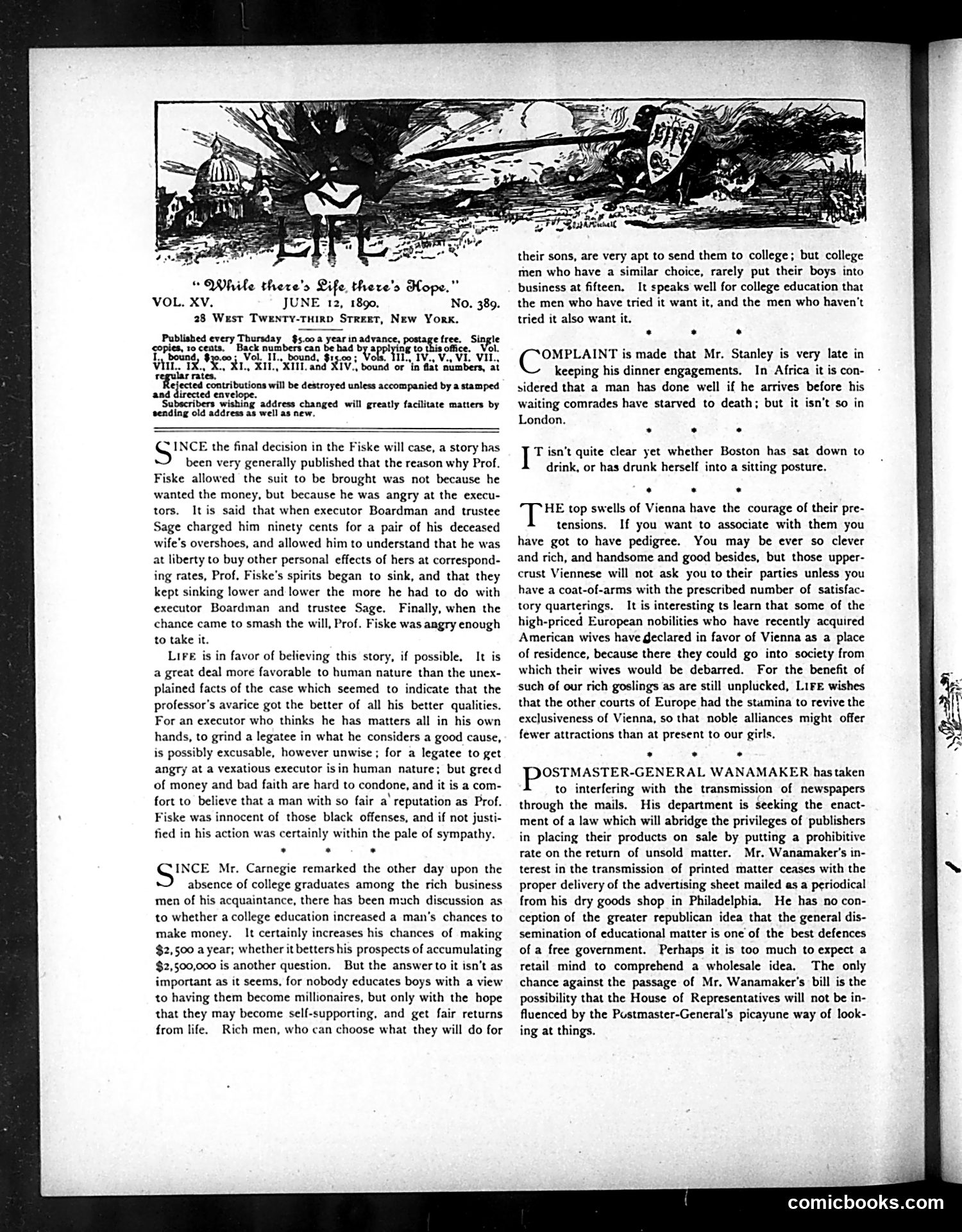
This page contains editorial commentary rather than cartoons. The masthead shows "While there's Life, there's Hope" — Life magazine's motto. The articles discuss several contemporary issues: 1. **The Fiske will case** — A legal dispute where executor Boardman allegedly treated Prof. Fiske unfairly regarding his deceased wife's personal effects, suggesting the executor prioritized money over principle. 2. **College education debate** — Commentary on whether wealthy men should send sons to college, noting that college-educated men sometimes struggle financially. 3. **Vienna's social exclusivity** — Satire of European nobility's resistance to American wives marrying into their ranks, criticizing their snobbish attitudes. 4. **Postmaster-General Wanamaker's interference** — Criticism of postal rate policies that restrict newspaper distribution, framed as censorship against free press principles. The commentary reflects Progressive-era concerns about class, education, and government overreach.
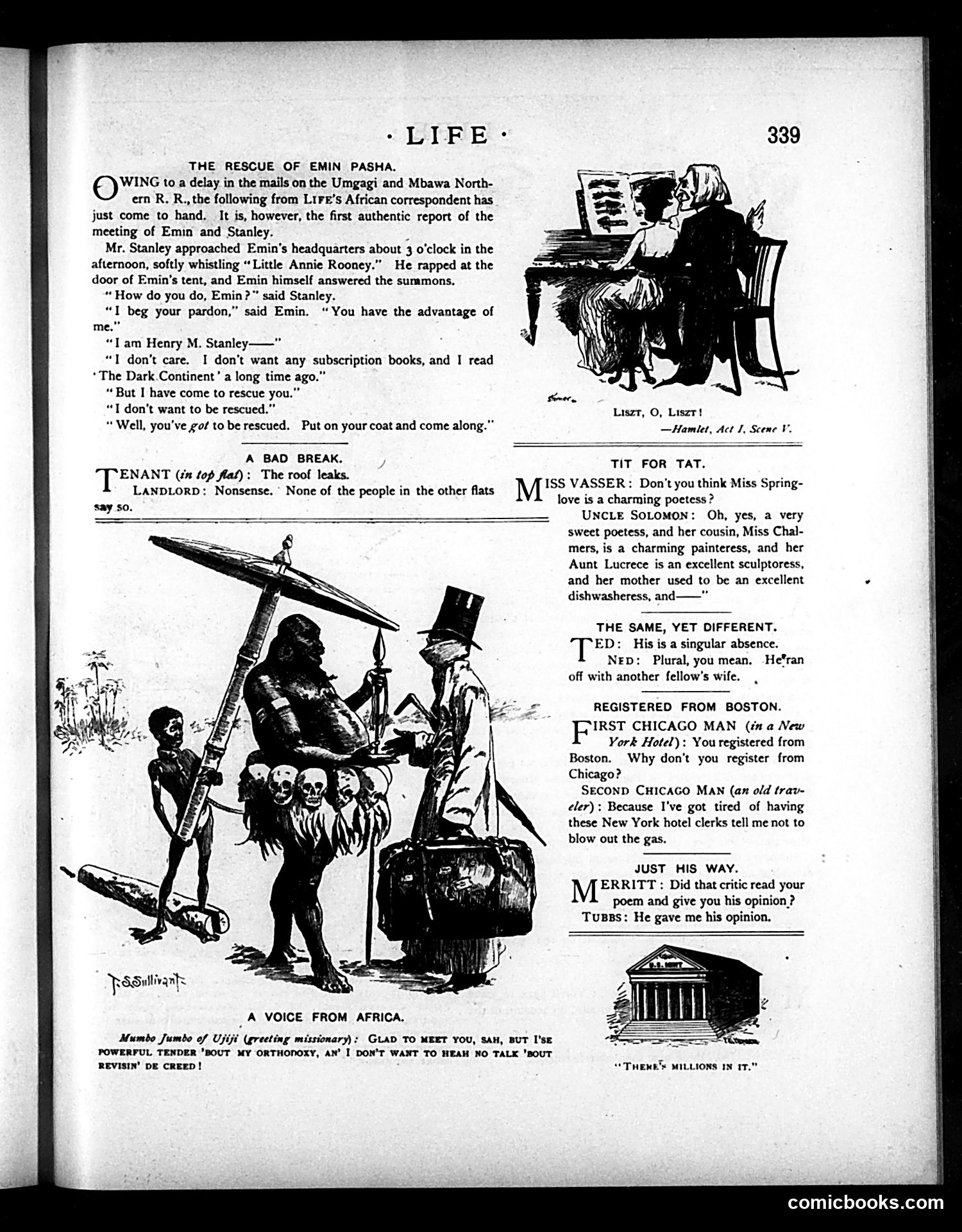
This cartoon depicts a gorilla (a common racist caricature in early 20th-century imagery) holding skulls while interacting with two men in formal dress. The caption reads "A BAD BREAK" with dialogue about a leaking roof in a tenant flat. The cartoon employs a grotesque visual metaphor—likely commenting on poor living conditions or squalid housing in tenements. The gorilla may represent either poverty itself or the dangerous/brutal nature of substandard housing. The formal-dressed figures contrast sharply with this primitive imagery, suggesting the disconnect between landlords/authorities and actual tenement conditions. The humor is cruel by modern standards, relying on visual shock rather than wit. Without additional historical context, the specific target remains unclear, though the message concerns housing inequality.
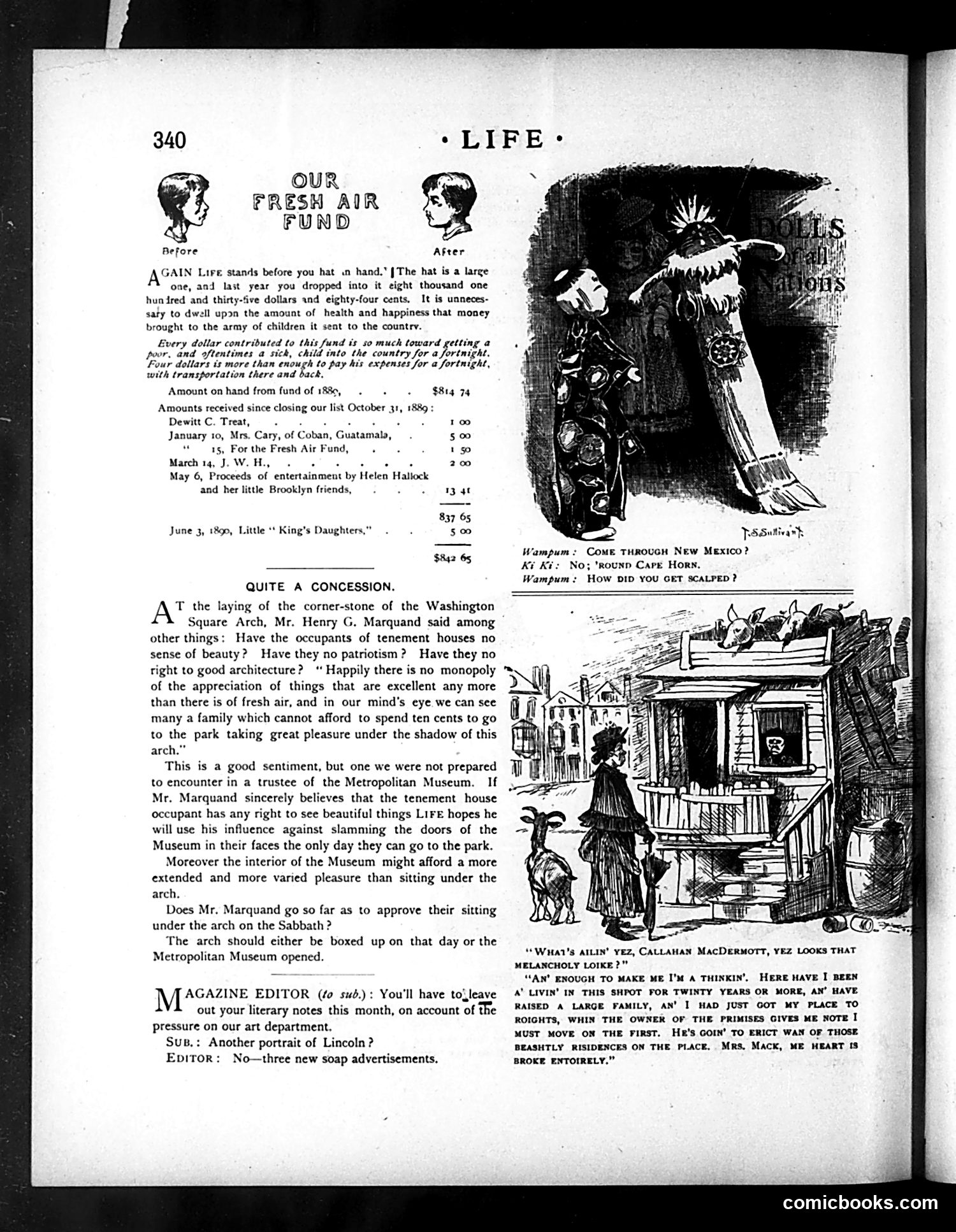
This page contains two distinct items: 1. **"Our Fresh Air Fund"** (top left): A fundraising notice showing a child's head before and after receiving fresh air. The text emphasizes how charitable donations help poor children escape tenements for healthy outdoor experiences—reflecting Progressive Era concern for urban child welfare. 2. **"Quite a Concession"** (bottom): A satirical piece mocking Henry G. Marquand, a Metropolitan Museum trustee, who argued tenement residents lack appreciation for beauty and architecture. Life's editors sardonically respond that while Marquand advocates park access for the poor, the Museum itself should open on Sundays so working-class New Yorkers can actually visit. The cartoons on the right appear to be unrelated humorous illustrations.
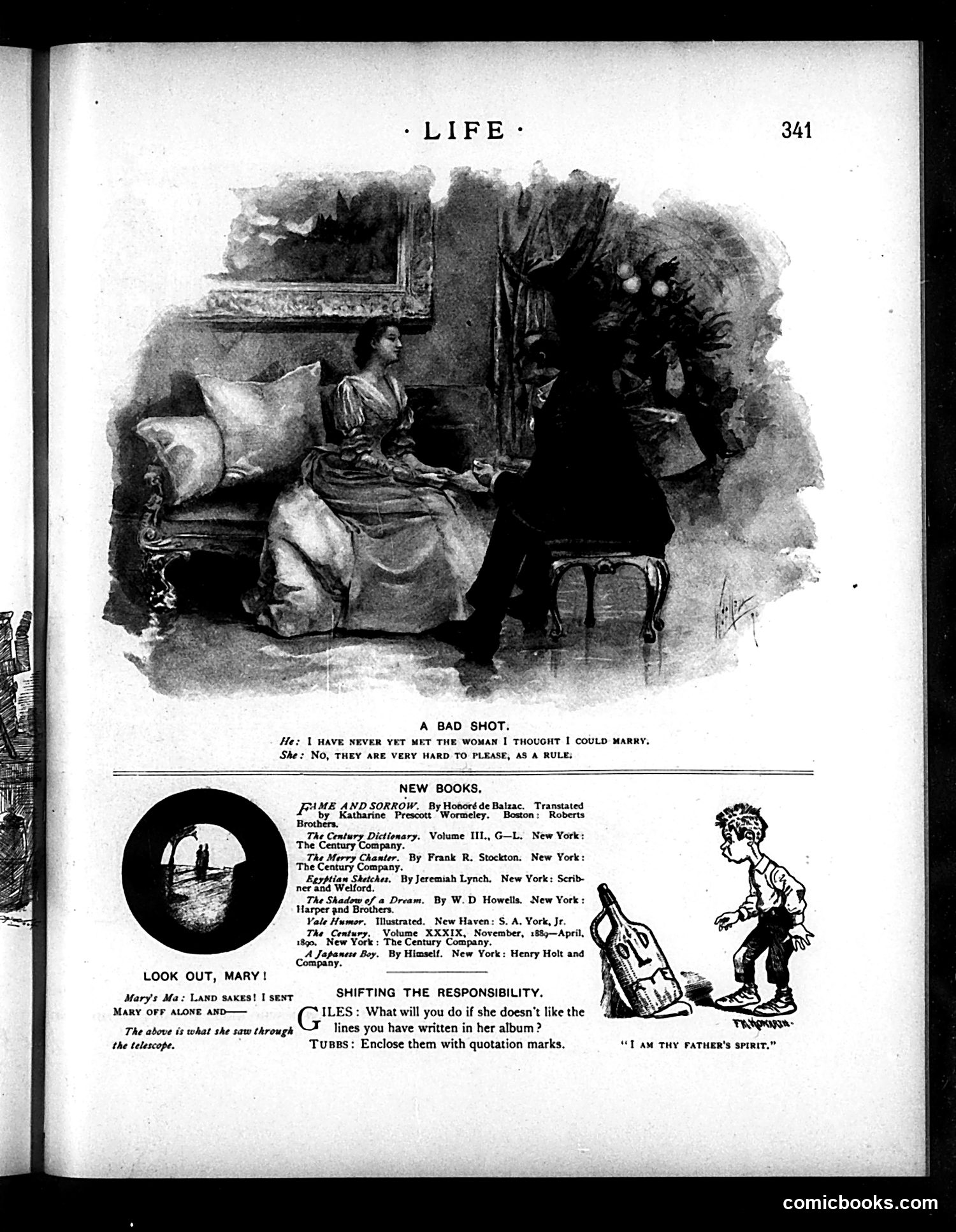
**"A Bad Shot" (top cartoon):** A woman sits while a man stands nearby. The dialogue reads: "I have never yet met the woman I thought I could marry" / "No, they are very hard to please, as a rule." This is a domestic humor piece mocking male pickiness—the man claims he's never found a suitable woman, but the woman sarcastically flips the blame back, suggesting men are the impossible ones to satisfy. **"Shifting the Responsibility" (bottom):** A brief joke about deflecting criticism. When asked how to handle negative comments about written work, one character suggests enclosing them with quotation marks—essentially attributing the criticism to someone else rather than accepting it. Both pieces use wordplay and role-reversal to create humor about relationships and accountability, typical of Life's satirical approach.
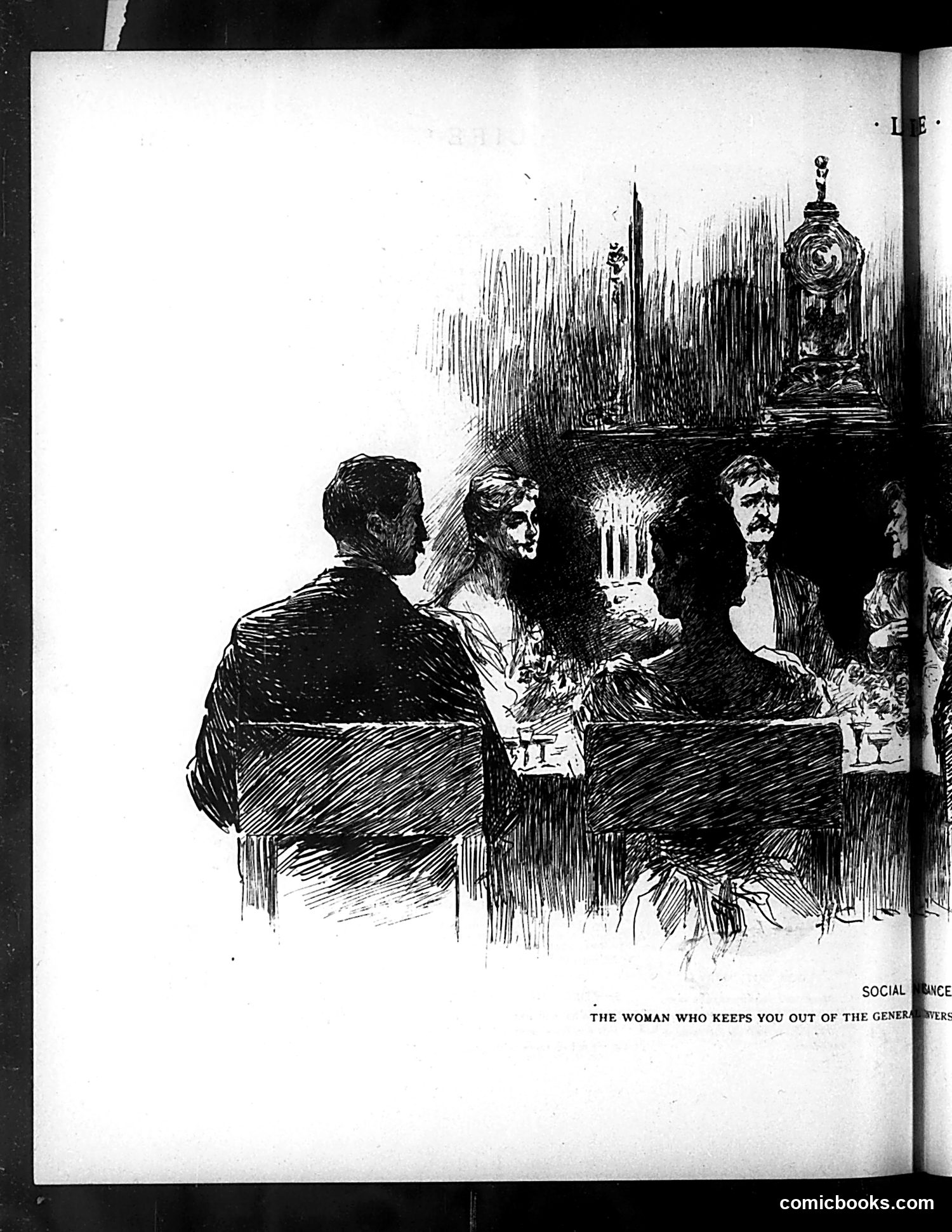
This is a satirical illustration from *Life* magazine depicting a social scene in what appears to be an elegant interior (note the decorative clock visible in the background). The caption reads "THE WOMAN WHO KEEPS YOU OUT OF THE GENERAL—" (text is cut off). The cartoon shows several well-dressed figures gathered together, with emphasis on a woman in the center. The satire appears to target social gatekeeping—specifically, a woman of influence who controls access to upper social circles or "general" society (likely meaning "general admission" or mainstream social acceptance). The artwork uses exaggerated pen-and-ink hatching typical of early-to-mid 20th century satirical illustration. Without the complete caption, the precise social commentary remains unclear, but the theme involves exclusionary social dynamics and women's power within elite social structures.
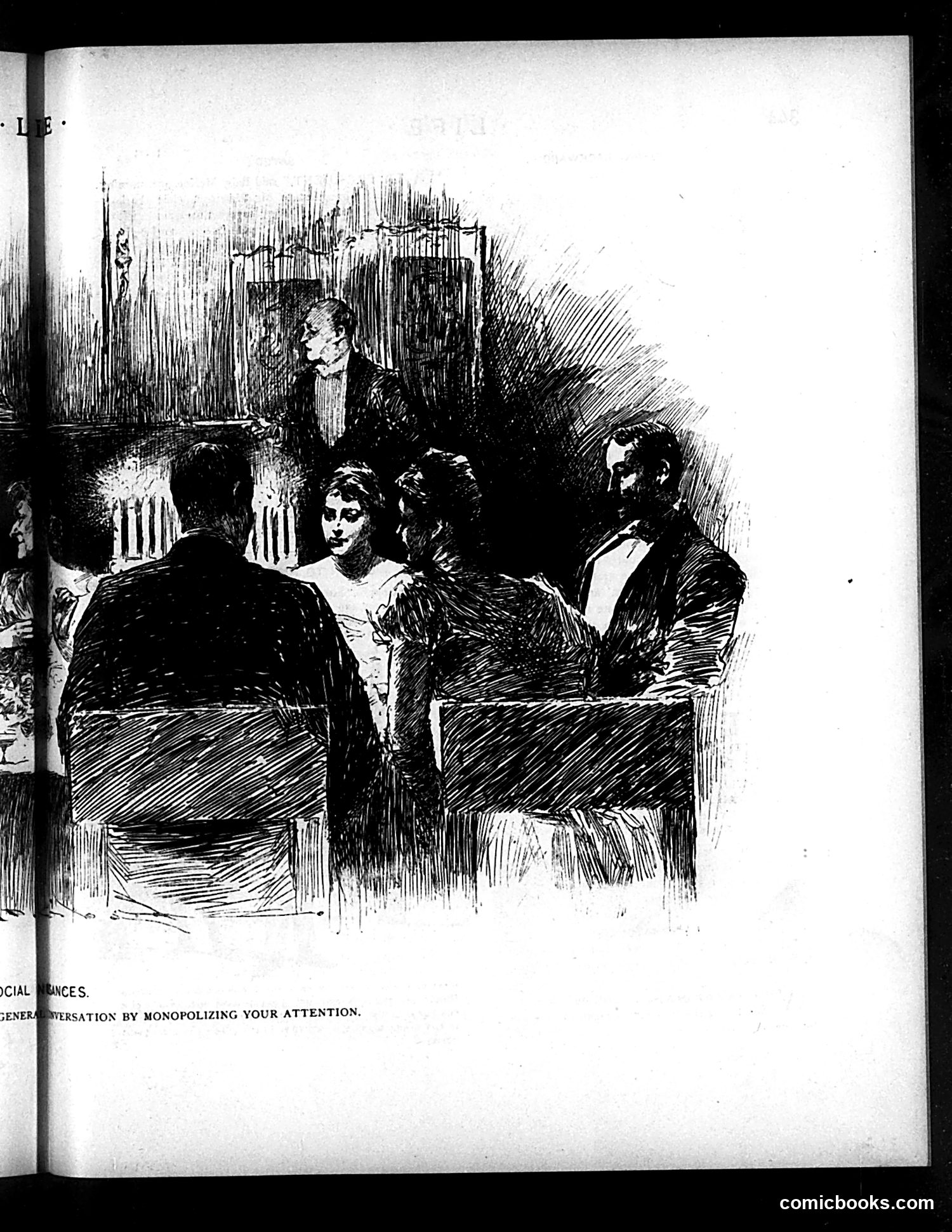
This is a sketch-style illustration depicting a formal social gathering, likely a dinner party or salon. Several well-dressed figures in Victorian or Edwardian-era clothing are seated around a table. The visible caption fragment reads "CONVERSATION BY MONOPOLIZING YOUR ATTENTION," suggesting the cartoon satirizes someone dominating social discourse. The drawing style uses heavy cross-hatching typical of late 19th/early 20th-century satirical illustration. The incomplete OCR text makes the specific target unclear, but the scene appears to mock poor social etiquette—likely someone holding forth at length while others are forced to listen. This was a common subject for *Life* magazine's social satire, critiquing both bad manners and the type of person who cornered others with tedious monologues at gatherings.
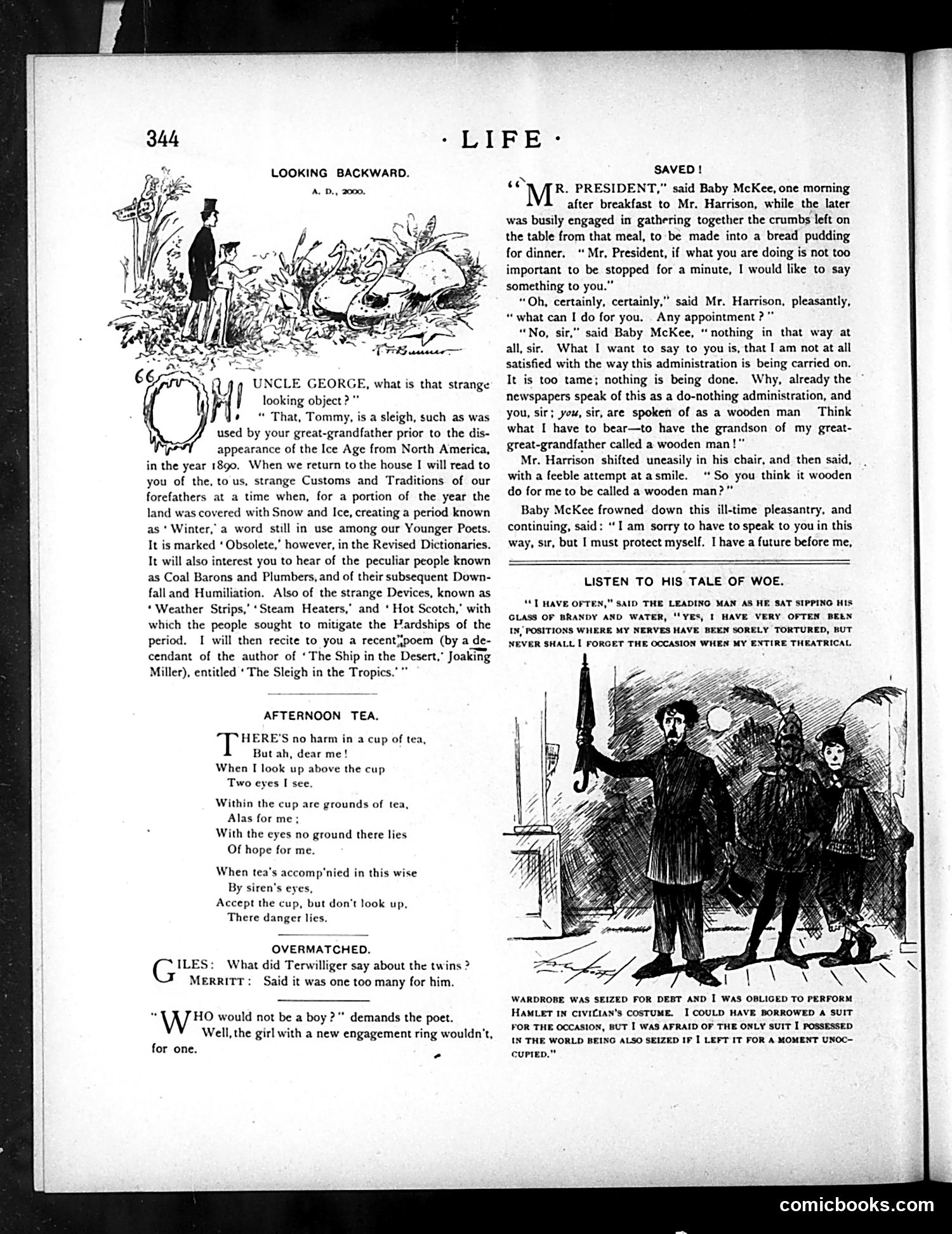
This page contains multiple satirical pieces from *Life* magazine (likely 1890s, based on references to President Harrison and "Baby McKee," his grandson): **"Looking Backward"**: A mock-serious dialogue predicting that snow, ice, and winter will become historical curiosities, with sleighs as museum pieces. The satire mocks technological optimism and environmental naïveté of the era. **"Afternoon Tea"**: A romantic poem warning against eye contact with women during tea—poking fun at Victorian courtship anxieties and the danger of romantic entanglement. **"Saved!"**: Satirizes President Harrison as a weak "do-nothing" administrator through his grandson's complaint that even the president is too dull and wooden to protect the family's reputation. **"Overmatched"**: A brief joke about fatherhood being overwhelming. **"Listen to His Tale of Woe"**: An actor's complaint about debtor's prison seizing his costume—satire on theatrical poverty and legal harshness. The overall tone mocks contemporary politics, Victorian social conventions, and economic hardship with gentle humor.
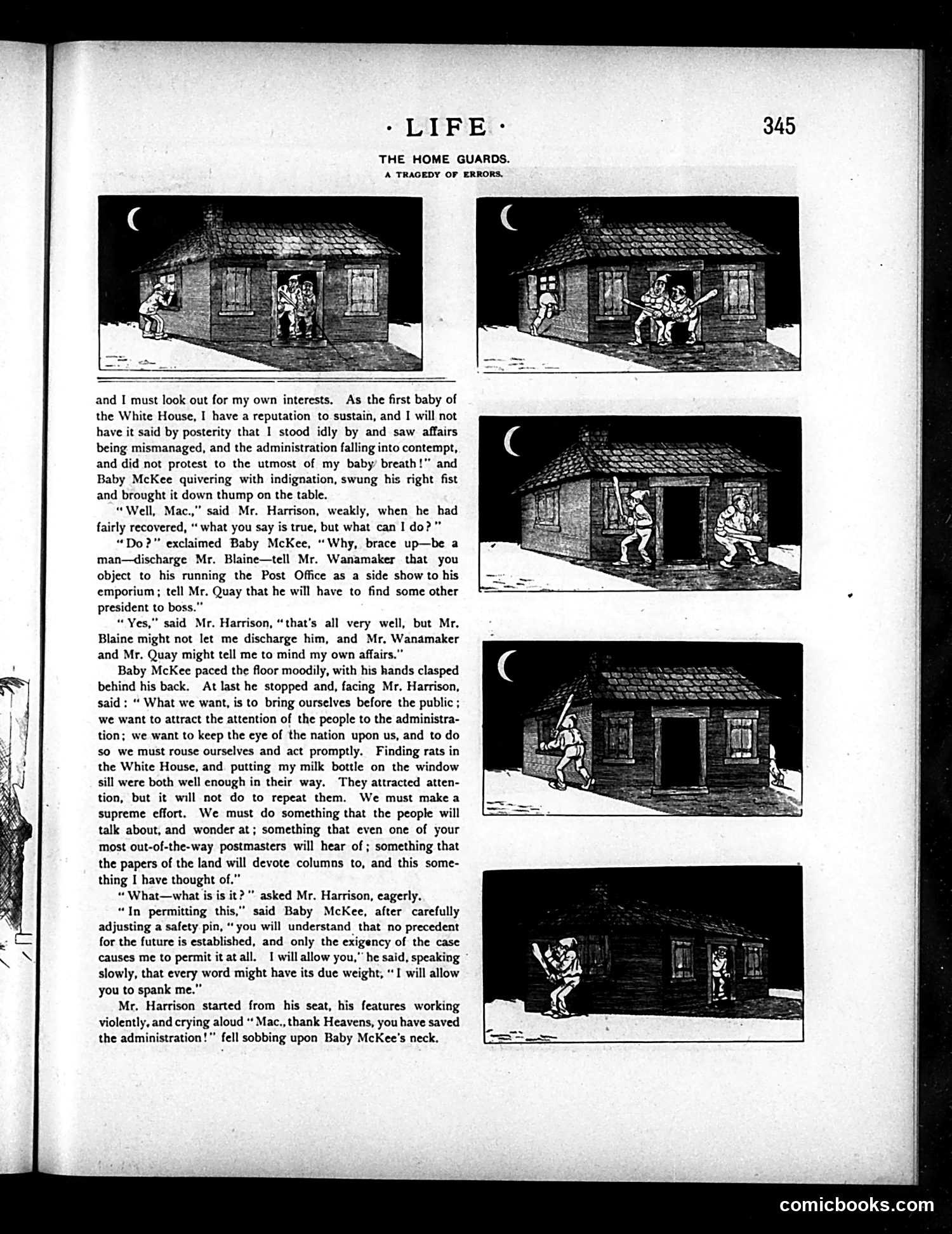
This satirical piece mocks President Benjamin Harrison's weak leadership. "Baby McKee" (Harrison's grandson, who lived in the White House and became a minor celebrity) lectures the president on managing his administration. The cartoon depicts McKee as more commanding than Harrison himself. The satire targets Harrison's inability to control powerful Republican figures: Secretary of State James G. Blaine, Postmaster General John Wanamaker (a wealthy businessman), and political boss Matthew Quay—all of whom allegedly wielded actual authority while the president remained figurehead-like. The joke culminates absurdly: McKee's solution to restore the administration's reputation is permitting Harrison to spank him publicly for attention. Harrison's tearful gratitude at this ridiculous gesture underscores his pathetic powerlessness. The cartoon suggests Harrison was literally governed by his precocious grandson and corrupt subordinates.
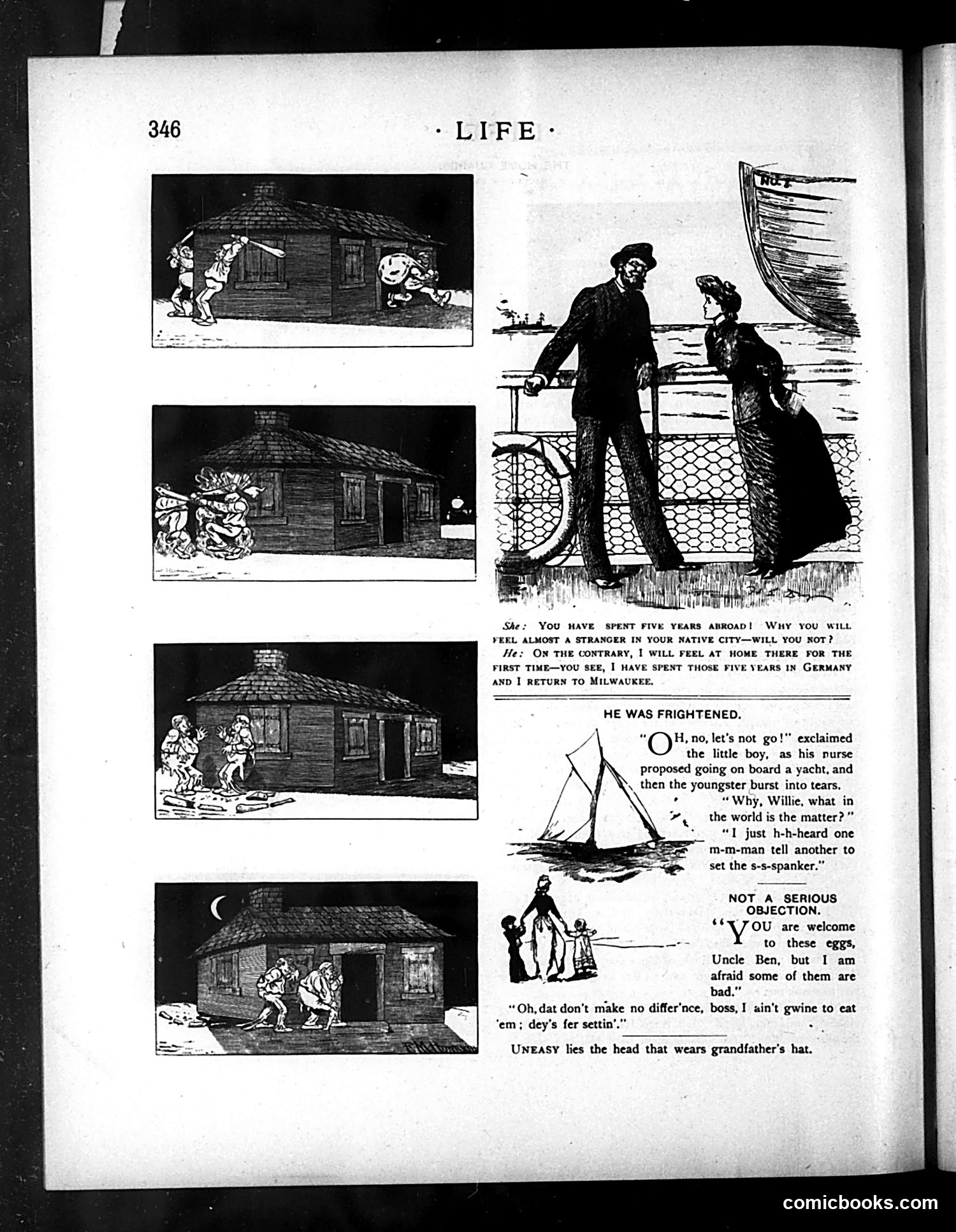
This page contains three unrelated humorous sketches typical of early 20th-century American satire: **Top sketch**: A man returning to Milwaukee after five years in Germany jokes he'll feel "at home" there for the *first time*—satirizing German-American immigrant communities in Milwaukee, suggesting they were so insular that the city felt more German than American. **Middle sketch**: A child mishears "set the spanker" (a sailing term) as something frightening, playing on innocent misinterpretation for comedic effect. **Bottom sketch**: Uses a racial stereotype (dialect and character name suggest a Black servant) for humor about eggs intended for hatching, not eating—a simple wordplay joke dependent on the era's offensive caricature conventions. The illustrations on the left appear to be sequential narrative panels, possibly from a longer story, but their specific content is unclear from this reproduction.
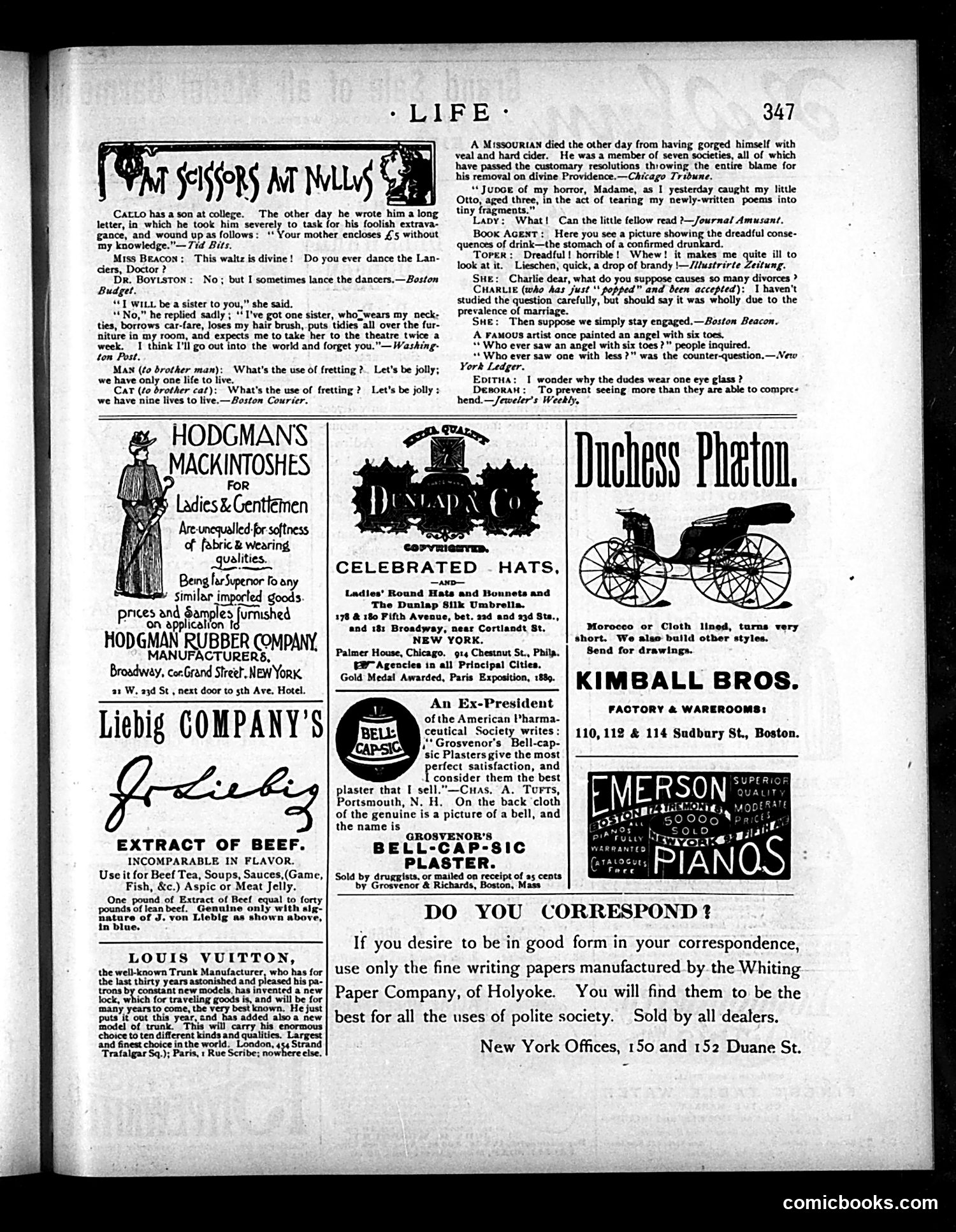
This page contains a title cartoon and nine short humorous anecdotes, each making social observations through exaggeration and irony. **The title cartoon** appears to show scissors and is labeled "At Nullys"—likely referencing a fashionable salon or gathering place where society figures congregate. **The jokes satirize** various hypocrisies and absurdities of the era: - Parental double-standards (fathers claiming poverty while mothers secretly send money) - Sibling annoyance and gender dynamics - Victorian death-culture (blaming death on "divine Providence") - Courtship anxieties ("Why marry when engaged is safer?") - Intellectual pretension (an artist defending anatomical errors with philosophical rhetoric) - Consumer behavior (viewing stomach contents of a drunk while ordering brandy) The bulk of the page is **advertising**—Hodgman mackintoshes, Liebig beef extract, Louis Vuitton trunks, Dunlap hats, and writing paper—reflecting Life magazine's business model of mixing editorial content with paid advertisements. Overall, the page reflects late-Victorian middle-class preoccupations: marriage, propriety, consumption, and the gap between public morality and private behavior.
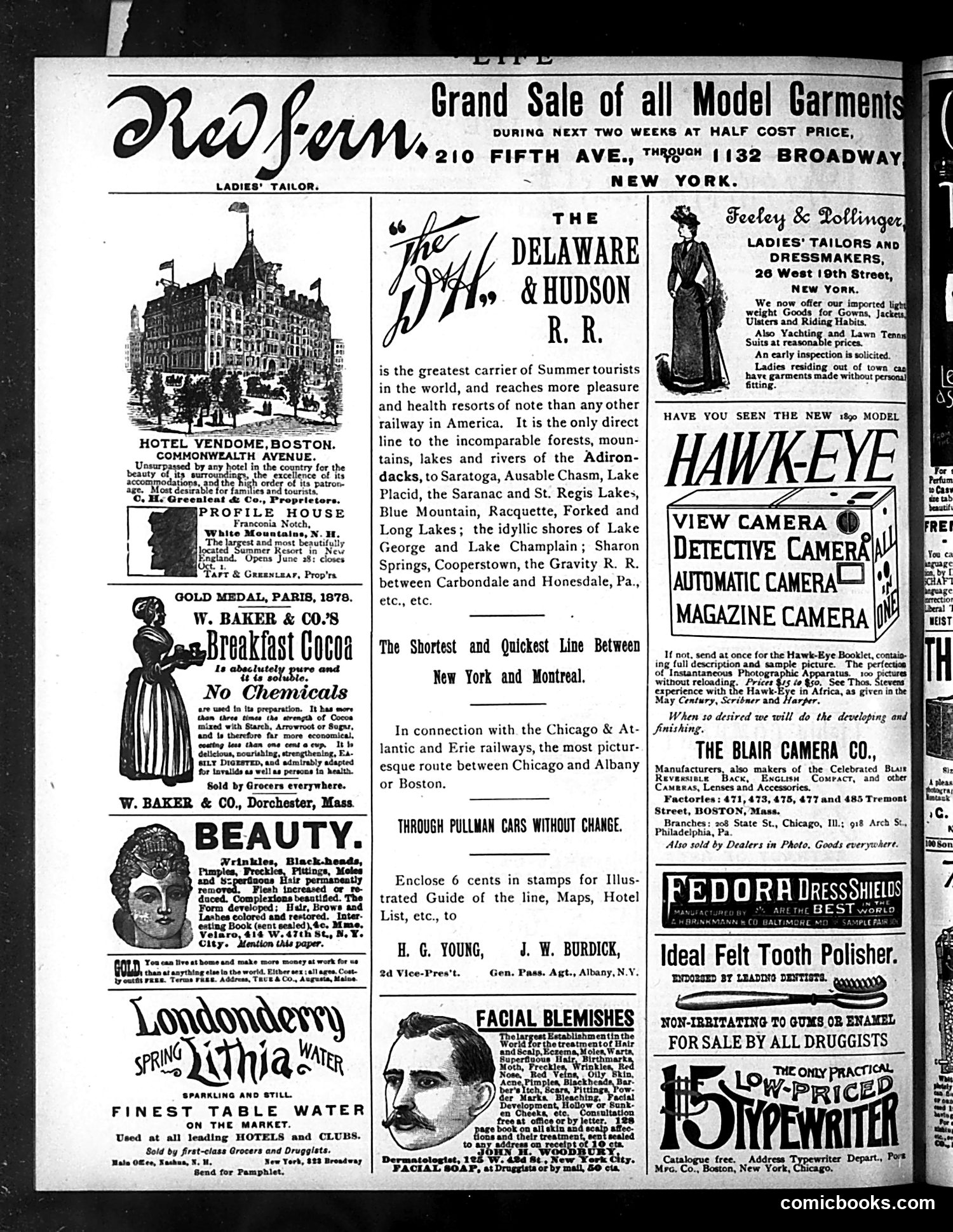
This is primarily a **advertising page** from Life magazine, not a political cartoon. The page contains dozens of period advertisements for consumer goods and services typical of the 1880s-1890s. Notable ads include: - **Red Fern**: A ladies' tailor grand sale in New York - **Delaware & Hudson Railroad**: Promoting tourist travel to Adirondack resorts and direct service to Montreal - **W. Baker & Co. Breakfast Cocoa**: Emphasizing it contains "no chemicals" - **Beauty treatments**: Promising to remove wrinkles and blemishes - **Hawk-Eye Camera**: A portable photography device - **Londonderry Spring Lithia Water**: Marketed as "finest table water" The ads reflect **late-Victorian consumer culture**: emphasis on rail tourism, photography as a new technology, beauty products targeting women, and manufactured food goods. The language stresses modernity, quality, and convenience—typical marketing appeals of the period. There are **no political cartoons or satire** visible on this page—it functions as a revenue source through advertising rather than editorial content.
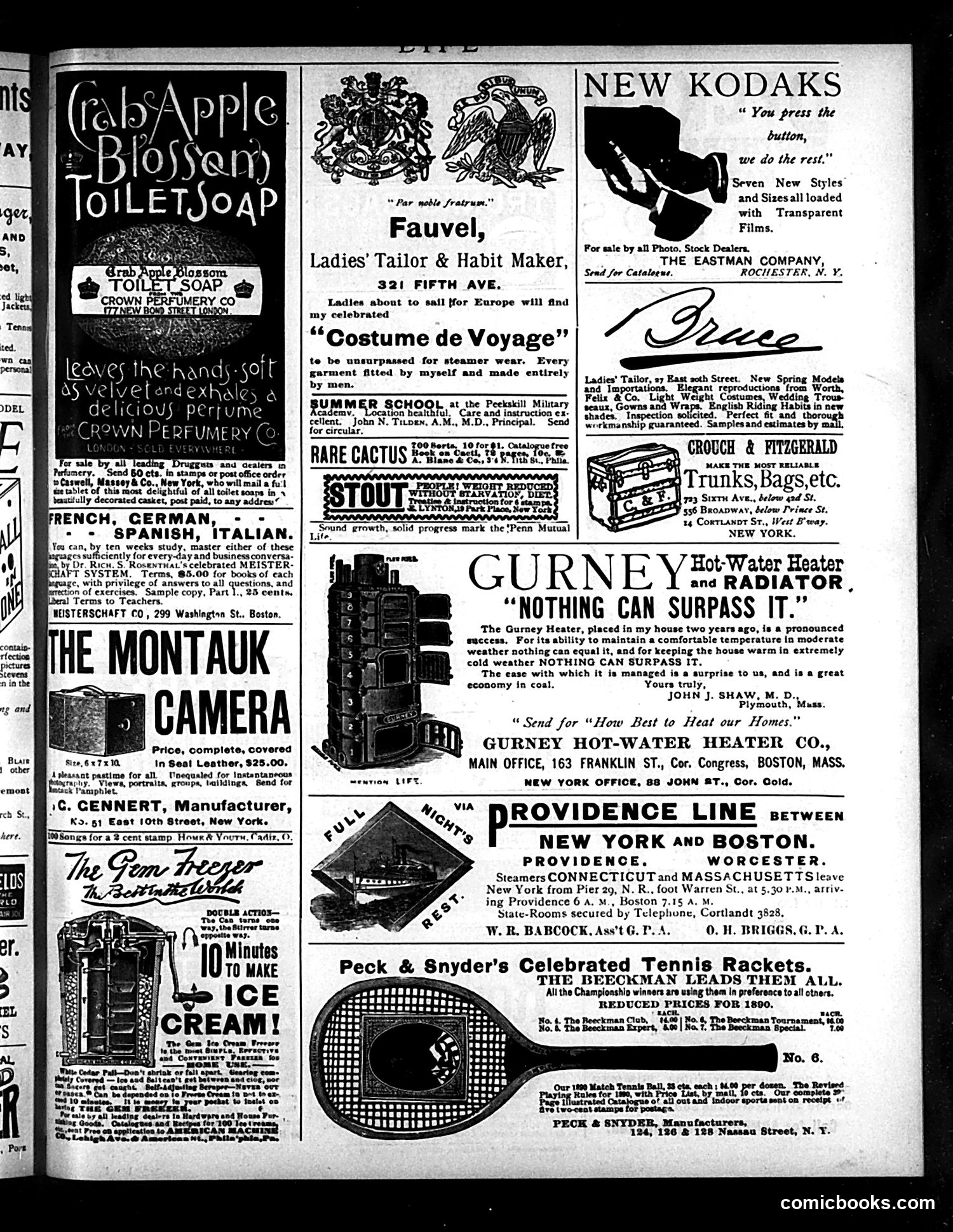
This is primarily an **advertisement page** from Life magazine, containing no political cartoons or satirical content requiring historical context. The page showcases late-19th-century consumer products and services: camera equipment (Kodak's famous "You press the button, we do the rest" slogan), toilet soap, language instruction courses, ladies' fashion tailoring, hot-water heating systems, steamship travel between New York and Boston, and tennis rackets. The only potentially notable item is the **Kodak advertisement**, which references their then-revolutionary snapshot camera technology that democratized photography by eliminating the need for professional darkroom expertise—a genuine innovation marketed here to general consumers. Otherwise, this represents standard commercial advertising of the era, with no satirical intent or political messaging. The page documents what products and services were marketed to Life's affluent, urban readership during this period.
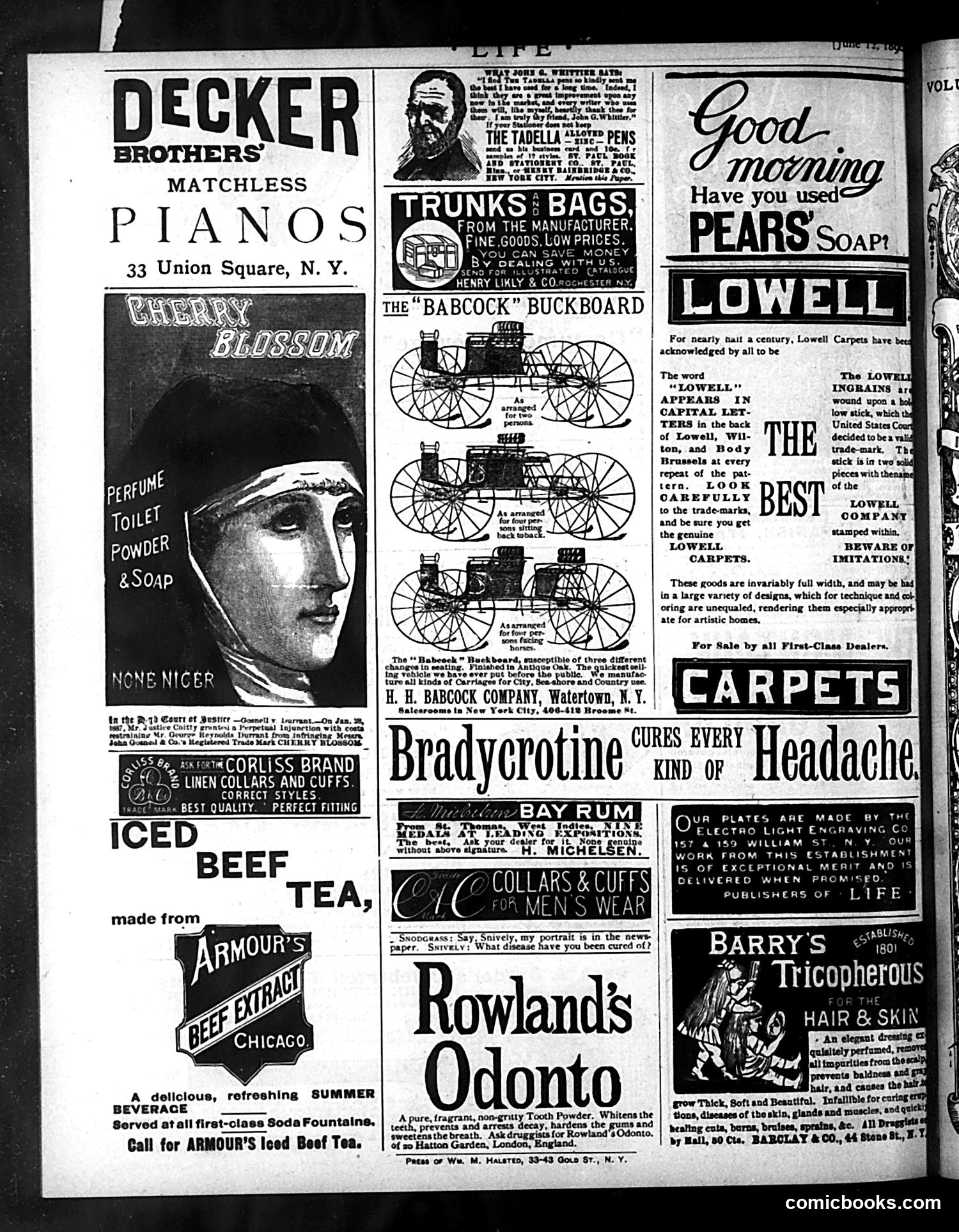
This is primarily an **advertising page**, not a satirical cartoon page. The page consists almost entirely of product advertisements typical of early 1900s America: pianos, beef extract, collars and cuffs, soap, carpets, tooth powder, hair treatment, and patent medicines. The only identifiable satirical content is a brief **comic dialogue** at the bottom between characters "Snodgrass" and "Snively." Snodgrass asks about Snively's portrait appearing in the newspaper, then quips: "Say, Snively, my portrait is in the paper. Snively: What disease have you been cured of?" This is a simple joke mocking the era's pervasive patent medicine advertising—the implication being that anyone whose portrait appeared in newspapers was likely promoting a dubious cure-all. It reflects contemporary skepticism toward the flood of unregulated health product claims flooding publications like *Life*. The page reflects how advertising and editorial content mixed in early periodicals.