
Life, 1890-06-12 · page 8 of 20
Life — June 12, 1890 — page 8: what you’re looking at
What you’re looking at
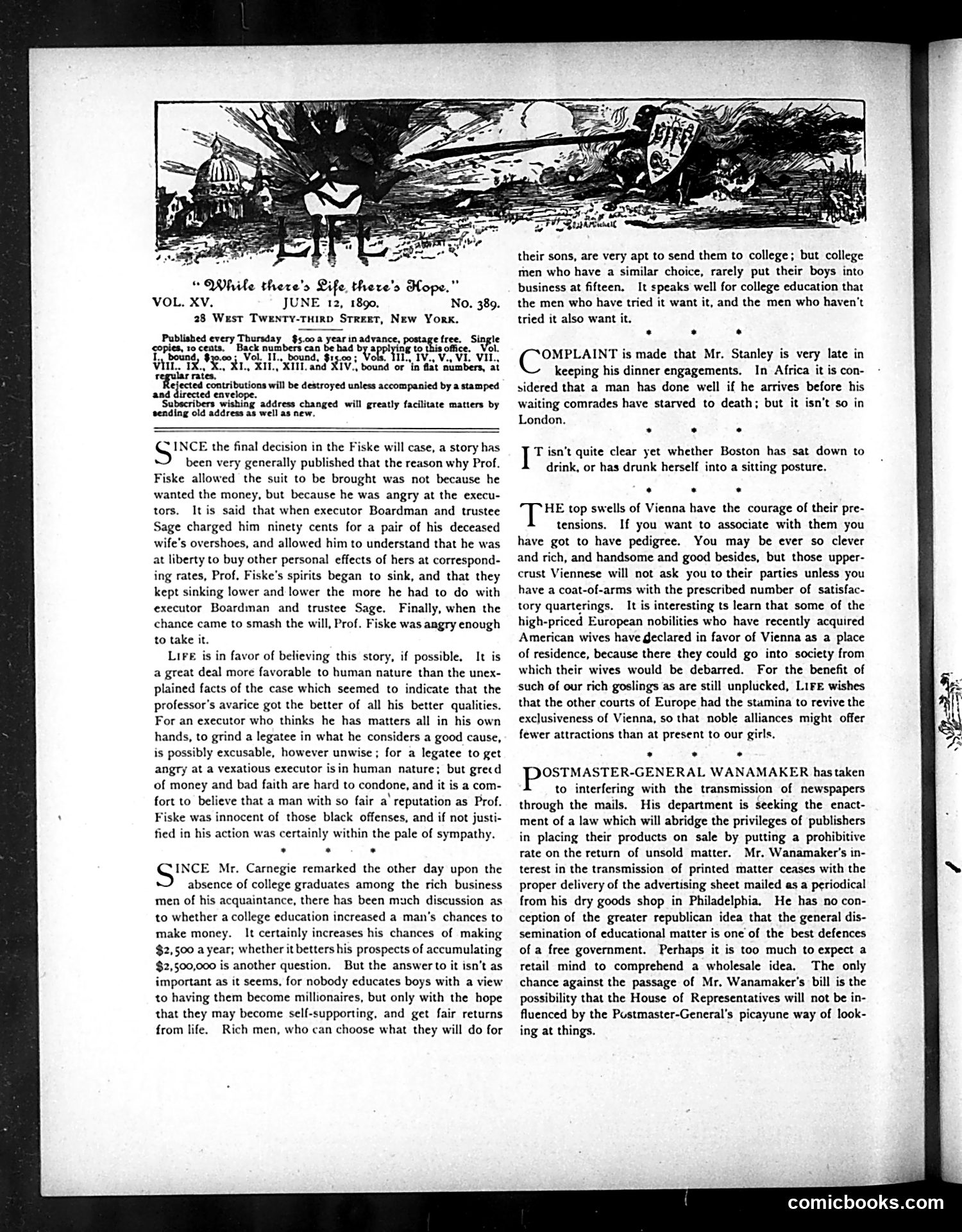
This page contains editorial commentary rather than cartoons. The masthead shows "While there's Life, there's Hope" — Life magazine's motto. The articles discuss several contemporary issues: 1. **The Fiske will case** — A legal dispute where executor Boardman allegedly treated Prof. Fiske unfairly regarding his deceased wife's personal effects, suggesting the executor prioritized money over principle. 2. **College education debate** — Commentary on whether wealthy men should send sons to college, noting that college-educated men sometimes struggle financially. 3. **Vienna's social exclusivity** — Satire of European nobility's resistance to American wives marrying into their ranks, criticizing their snobbish attitudes. 4. **Postmaster-General Wanamaker's interference** — Criticism of postal rate policies that restrict newspaper distribution, framed as censorship against free press principles. The commentary reflects Progressive-era concerns about class, education, and government overreach.
📄 Transcribed text from this page (OCR, searchable)
Machine-transcribed from the original scan — historical spelling and the odd misread are preserved.
“ While there's Life there's Hope.” VOL. XV. JUNE 12, 1890, No. 389. 28 West Twenty-tTHIrp Street, New York. Published every Thursday $5.00 a year in advance, postage free. Single copies, ro cents. Back numbers can be had Dy applying to is office. Vol. 1, bound. Spo, Vol. II., bound, $15.00 ; IL, IV., V., VI. VIL. Vit. 1X., X., XI. X11., X11 and XV. bound or"in flat numbers, at rates, ejected contributions will be destroyed unless accompanied by a stam: lies ed envelope. iu eer anch pea Subscribers wishing address changed will greatly facilitate matters by sending old address as well as new, ~ INCE the final decision in the Fiske will case, a story has been very generally published that the reason why Prof. Fiske allowed the suit to be brought was not because he wanted the money, but because he was angry at the execu- tors. Itis said that when executor Boardman and trustee Sage charged him ninety cents for a pair of his deceased wife's overshoes, and allowed him to understand that he was at liberty to buy other personal effects of hers at correspond- ing rates, Prof, Fiske's spirits began to sink, and that they kept sinking lower and lower the more he had to do with executor Boardman and trustee Sage. Finally, when the chance came to smash the will, Prof. Fiske was angry enough to take it. Lire is in favor of believing this story, if possible. It is a great deal more favorable to human nature than the unex- plained facts of the case which seemed to indicate that the professor's avarice got the better of all his better qualities. For an executor who thinks he has matters all in his own hands, to grind a legatee in what he considers a good cause, is possibly excusable, however unwise ; for a legatee to get angry at a vexatious executor isin human nature; but greed of money and bad faith are hard to condone, and it is a com- fort to believe that a man with so fair a‘ reputation as Prof. Fiske was innocent of those black offenses, and if not justi- fied in his action was certainly within the pale of sympathy. . . . INCE Mr. Carnegie remarked the other day upon the absence of college graduates among the rich business men of his acquaintance, there has been much discussion as to whether a college education increased a man’s chances to make money. It certainly increases his chances of making $2,500 a year; whether it betters his prospects of accumulating $2,500,000 is another question. But the answer to it isn’t as important as it seems, for nobody educates boys with a view to having them become millionaires, but only with the hope that they may become self-supporting, and get fair returns from life. Rich men, who can choose what they will do for their sons, are very apt to send them to college; but college men who have a similar choice, rarely put their boys into business at fifteen. It speaks well for college education that the men who have tried it want it, and the men who haven't tried it also want it. . . . OMPLAINT is made that Mr. Stanley is very late in keeping his dinner engagements. In Africa it is con- sidered that a man has done well if he arrives before his waiting comrades have starved to death; but it isn’t so in London. . . . T isn’t quite clear yet whether Boston has sat down to drink, or has drunk herself into a sitting posture. . . . HE top swells of Vienna have the courage of their pre- tensions. If you want to associate with them you have got to have pedigree. You may be ever so clever and rich, and handsome and good besides, but those upper- crust Viennese will not ask you to their parties unless you have a coat-of-arms with the prescribed number of satisfac- tory quarterings. It is interesting ts learn that some of the high-priced European nobilities who have recently acquired American wives have geclared in favor of Vienna as a place of residence, because there they could go into society from which their wives would be debarred. For the benefit of such of our rich goslings as are still unplucked, LiFe wishes that the other courts of Europe had the stamina to revive the exclusiveness of Vienna, so that noble alliances might offer fewer attractions than at present to our girls, OSTMASTER-GENERAL WANAMAKER has taken to interfering with the transmission of newspapers through the mails. His department is seeking the enact- ment of a law which will abridge the privileges of publishers in placing their products on sale by putting a prohibitive rate on the return of unsold matter. Mr. Wanamaker’s in- terest in the transmission of printed matter ceases with the proper delivery of the advertising sheet mailed as a periodical from his dry goods shop in Philadelphia. He has no con- ception of the greater republican idea that the general dis- semination of educational matter is one of the best defences of a free government. Perhaps it is too much to expect a retail mind to comprehend a wholesale idea, The only chance against the passage of Mr. Wanamaker’s bill is the possibility that the House of Representatives will not be in- fluenced by the Pustmaster-General’s picayune way of look- ing at things. comicbooks.com