
A complete issue · 18 pages · 1890
Life — May 15, 1890
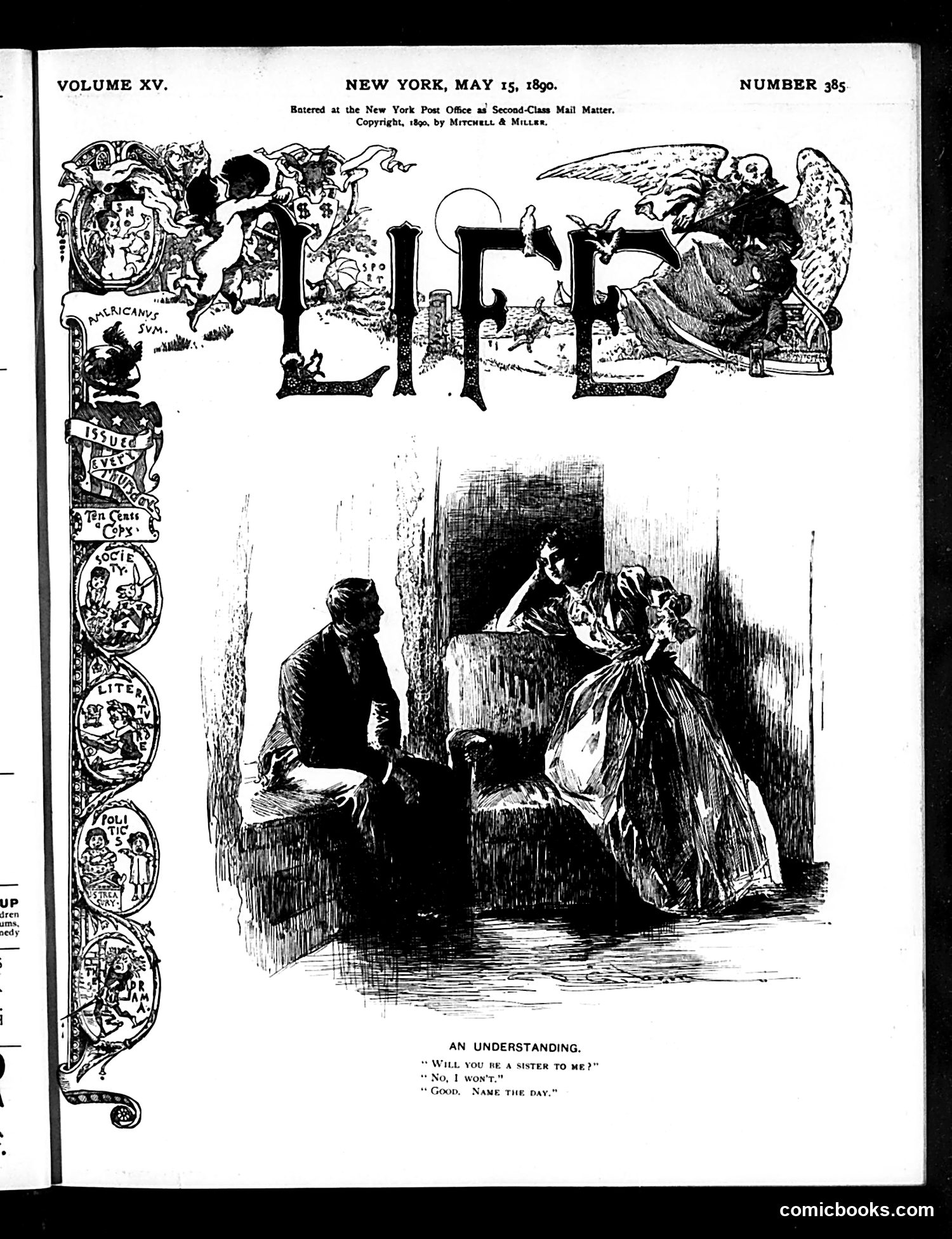
This illustration depicts a romantic scene between a man and woman with the caption "'Will you be a sister to me?' 'No, I won't.' 'Good. Name the day.'" The cartoon satirizes a common Victorian courtship convention—a man's indirect proposal framed as requesting a "sister" relationship, which was understood as romantic coded language. The woman rejects this euphemistic approach, and the man cheerfully accepts her refusal by immediately proposing marriage directly instead. The joke mocks both the artificiality of Victorian romantic conventions and the obtuse male assumption that rejection of the "sister" premise means acceptance of actual matrimony. It's commentary on courtship rituals and gender dynamics of 1890s American society.
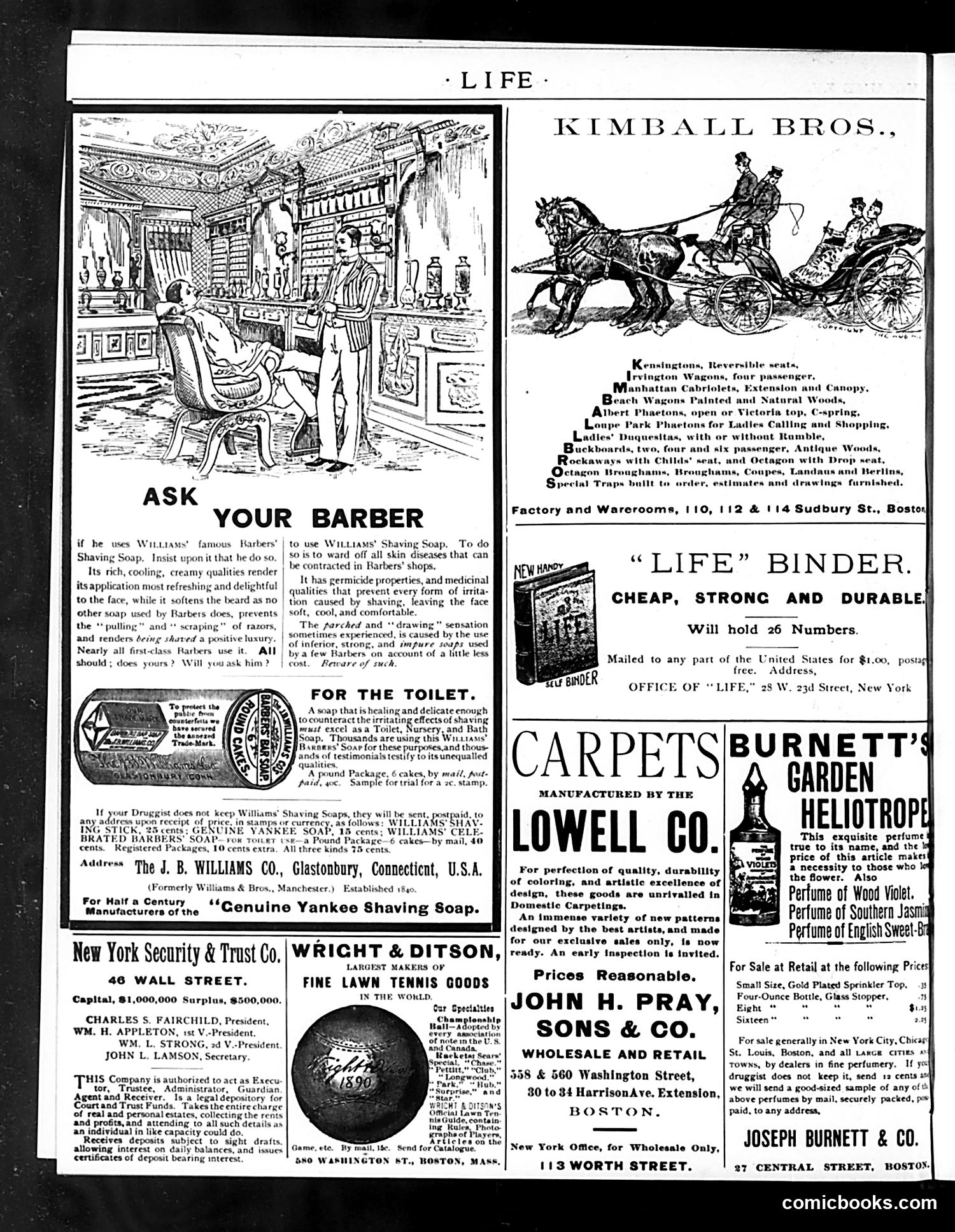
This page is primarily **advertising**, not satirical content. It contains multiple commercial advertisements from the early 20th century: - **Williams' Shaving Soap** promotes its product with claims about skin health and barber endorsement - **Kimball Bros.** advertises horse-drawn carriages and wagons for passengers - **Life Binder** offers magazine binding services - **Lowell Co.** sells carpets and domestic furnishings - **Wright & Ditson** promotes lawn tennis equipment - **John H. Pray & Co.** advertises wholesale perfumes and garden products - **New York Security & Trust Co.** offers banking services The only image with potential satirical intent is the barber advertisement, which depicts a man being shaved. However, this appears to be straightforward product promotion rather than political or social satire. The page reflects turn-of-the-century consumer culture and advertising practices.
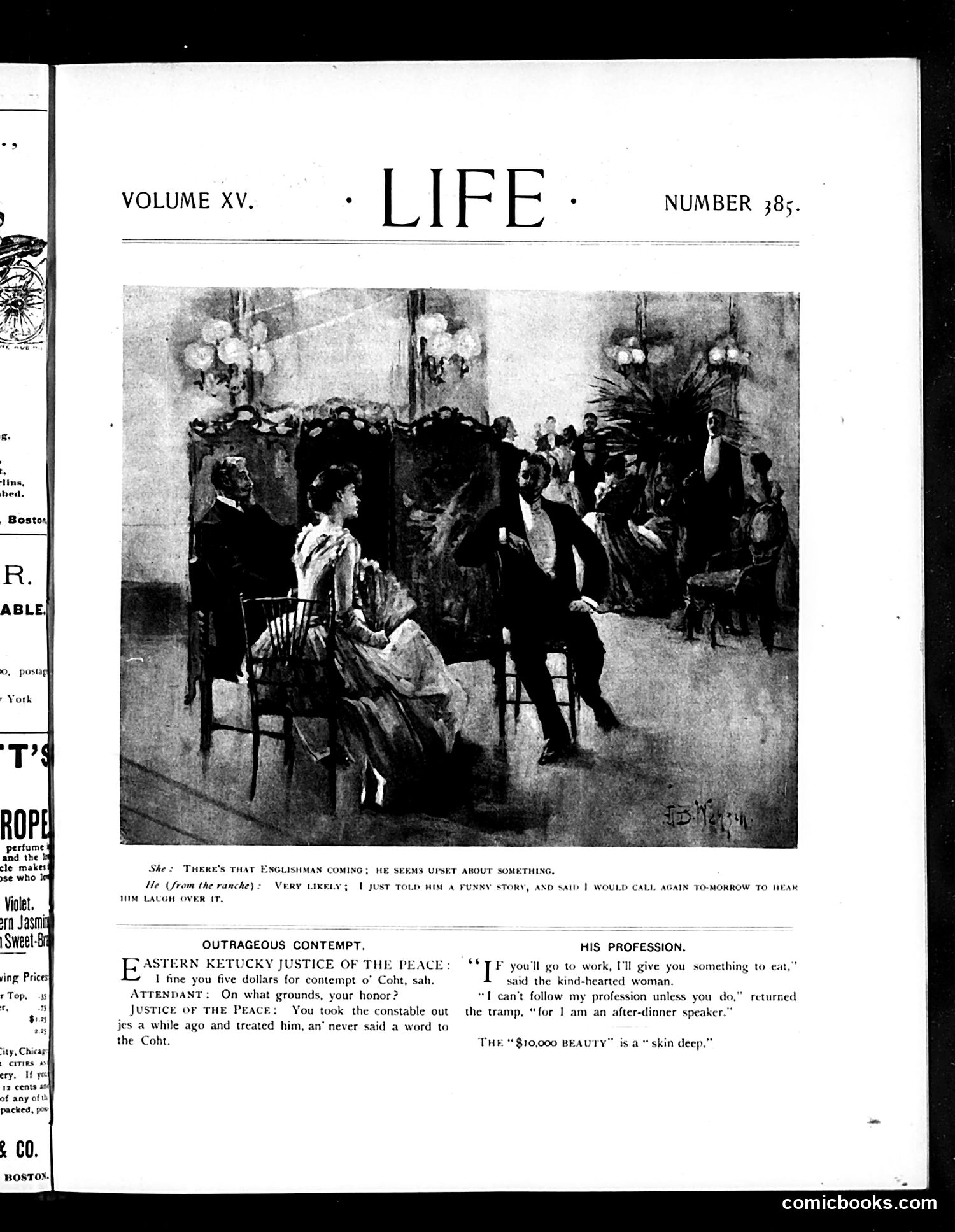
This page contains three separate humor items: **Top illustration**: A social scene depicting what appears to be an upper-class gathering or party, with the caption suggesting an Englishman arriving and being upset about something. The joke hinges on British social etiquette and misunderstanding. **"Outrageous Contempt"**: A dialogue between an Eastern Kentucky Justice of the Peace and an attendant, concerning a five-dollar fine for contempt of court involving a mule ("Colt"). The humor derives from rural/frontier justice system incompetence and the absurdity of fining an animal. **"His Profession"**: A brief exchange about a tramp's refusal to work unless allowed to eat first, identifying himself as an "after-dinner speaker"—mocking both vagrants and professional speakers as equally useless. All three rely on class-based humor common to early 20th-century satire.
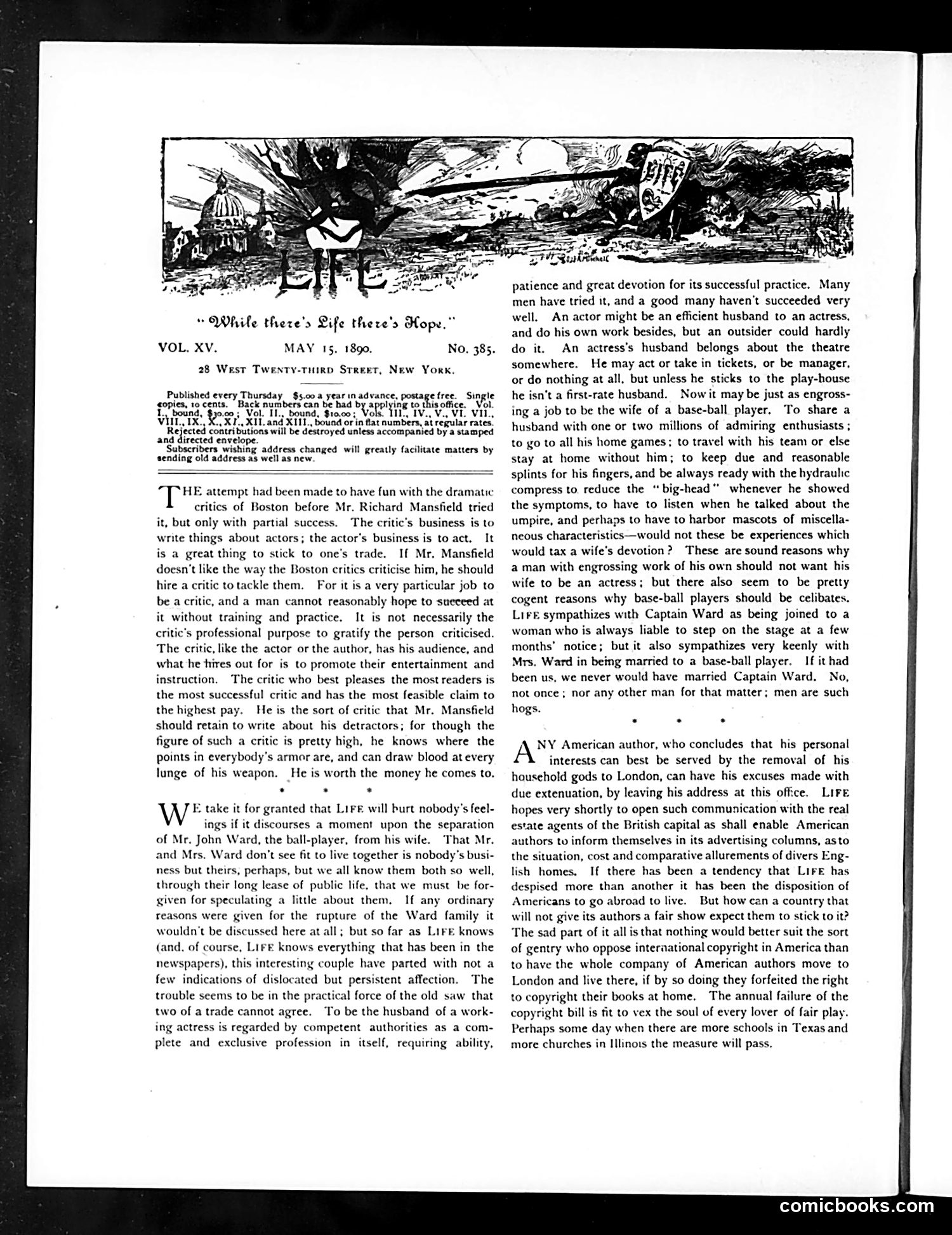
The masthead illustration shows a classical female figure (likely representing "Life" itself) overlooking a landscape with various symbolic elements. The page consists primarily of text columns discussing theatrical criticism and American authors. The main article critiques Boston dramatic critics and Richard Mansfield's acting, arguing that critics need special training to evaluate theatrical performance properly. A secondary piece discusses the separation of baseball player John Ward from his wife, using their situation to debate whether actresses can maintain successful marriages while pursuing their profession. A final section addresses American authors relocating to London to secure copyright protection, presenting this as a problematic brain drain. The page is essentially editorial commentary rather than traditional political satire, focusing on contemporary cultural and professional debates of 1890s America.
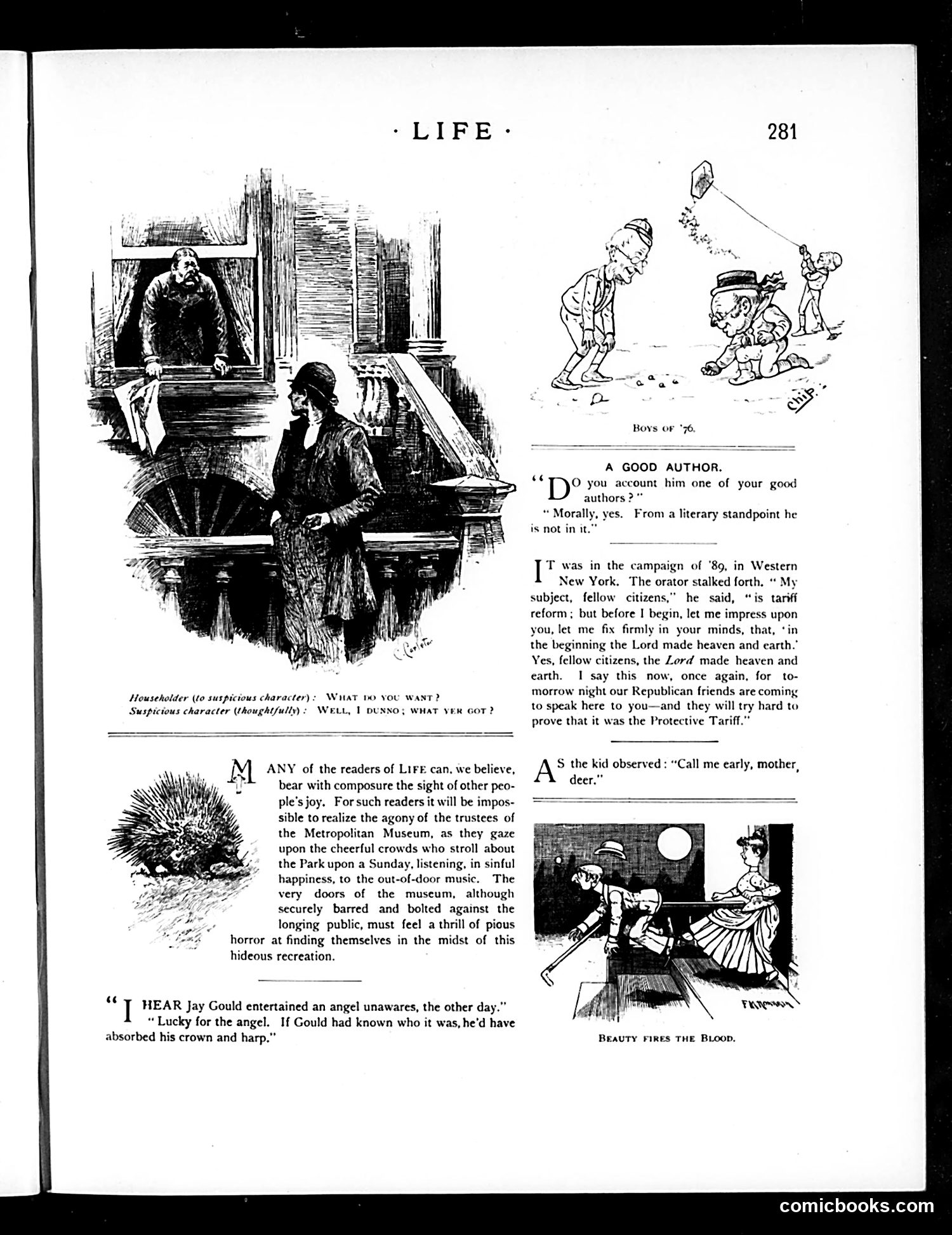
This page contains several satirical pieces typical of early Life magazine: 1. **"A Good Author"**: A dialogue mocking a political orator from an 1880 Western New York campaign who pompously invokes divine creation while discussing tariff reform. The joke questions whether such rhetorical grandstanding qualifies as good authorship. 2. **"Boys of '76"**: A lighthearted sketch of children playing, referencing Revolutionary War imagery. 3. **Metropolitan Museum critique**: Text sardonically sympathizes with museum trustees forced to endure crowds enjoying outdoor music on Sundays—treating public enjoyment as an affront. 4. **"Beauty Fires the Blood"**: An illustrated caption about romantic attraction. 5. **Jay Gould reference**: A joke about the wealthy industrialist entertaining an angel unknowingly. The page exemplifies Life's satirical approach to American social pretension, politics, and wealth.
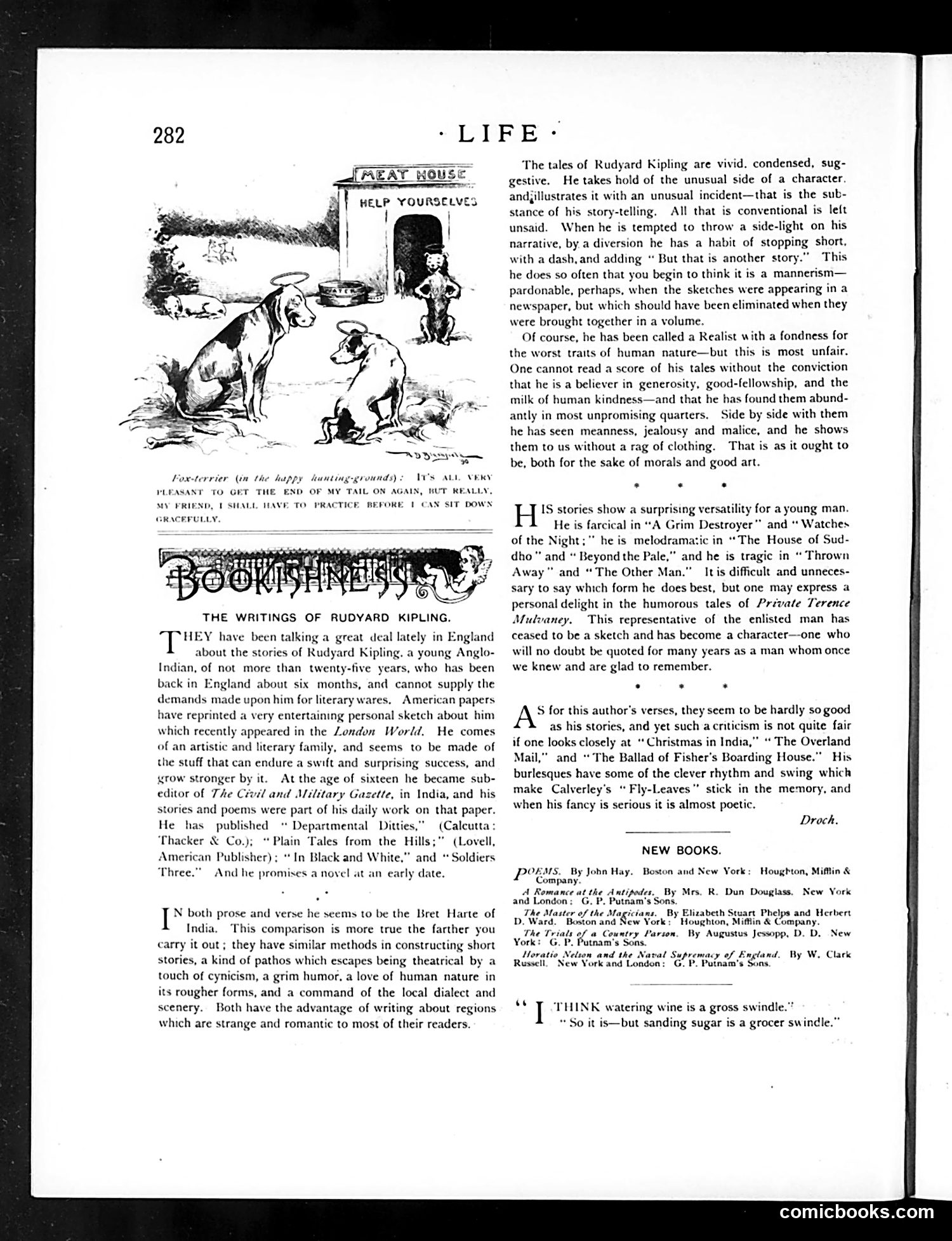
The page features a cartoon showing dogs at a "Meat House" with a sign reading "Help Yourselves." The caption reads: "Fox-terrier (in the happy hunting-ground): 'It's all very pleasant up here, but I do miss my tail on again, but really, my friend, I shall have to practice before I can sit down comfortably.'" This is a joke about the afterlife—a deceased fox-terrier in heaven misses its tail and needs practice readjusting to having it. The cartoon satirizes the period's sentimental Victorian attitudes toward pets and the supernatural, presenting a humorous, tongue-in-cheek perspective on animal existence after death. The joke relies on the absurdity of practical concerns persisting in the afterlife.
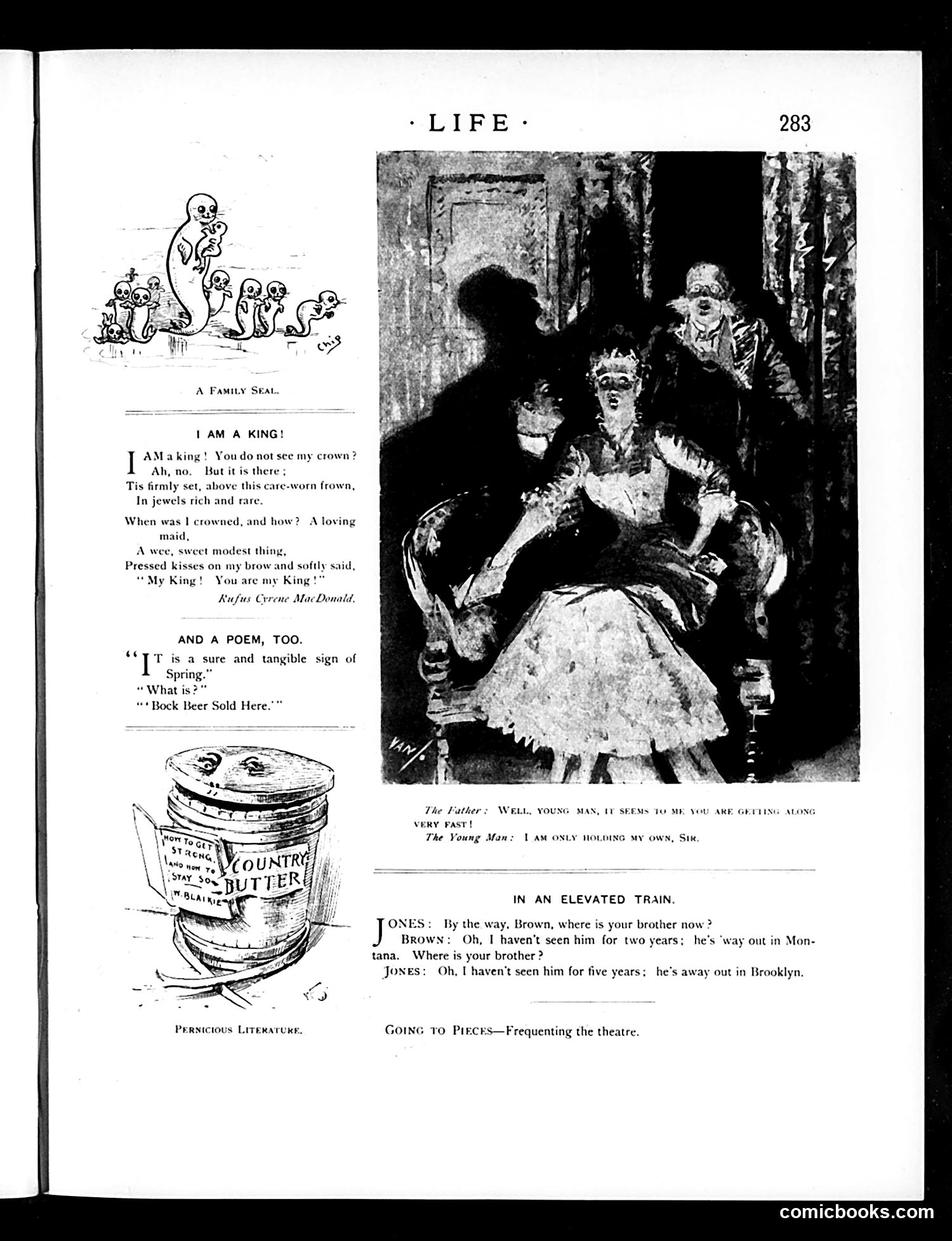
This page contains several unrelated humorous pieces typical of Life's satirical format: **"A Family Seal"** depicts a mother seal with offspring—a visual pun on aristocratic heraldry. **"I Am a King!"** quotes Rufus Cyeme MacDonald, presenting humorous royalist pretensions, likely mocking either actual or fictional pomposity. **"Pernicious Literature"** shows a butter container labeled with promises ("stay fresh," "country butter"), satirizing misleading product advertising—a common target of early 20th-century consumer critique. **"In an Elevated Train"** presents a brief dialogue between Jones and Brown discussing a brother's absence in Brooklyn versus Montana—likely just casual conversational humor with no deeper political meaning. **"Going to Pieces"** simply notes theater attendance as a leisure activity. The page is primarily entertainment rather than political commentary.
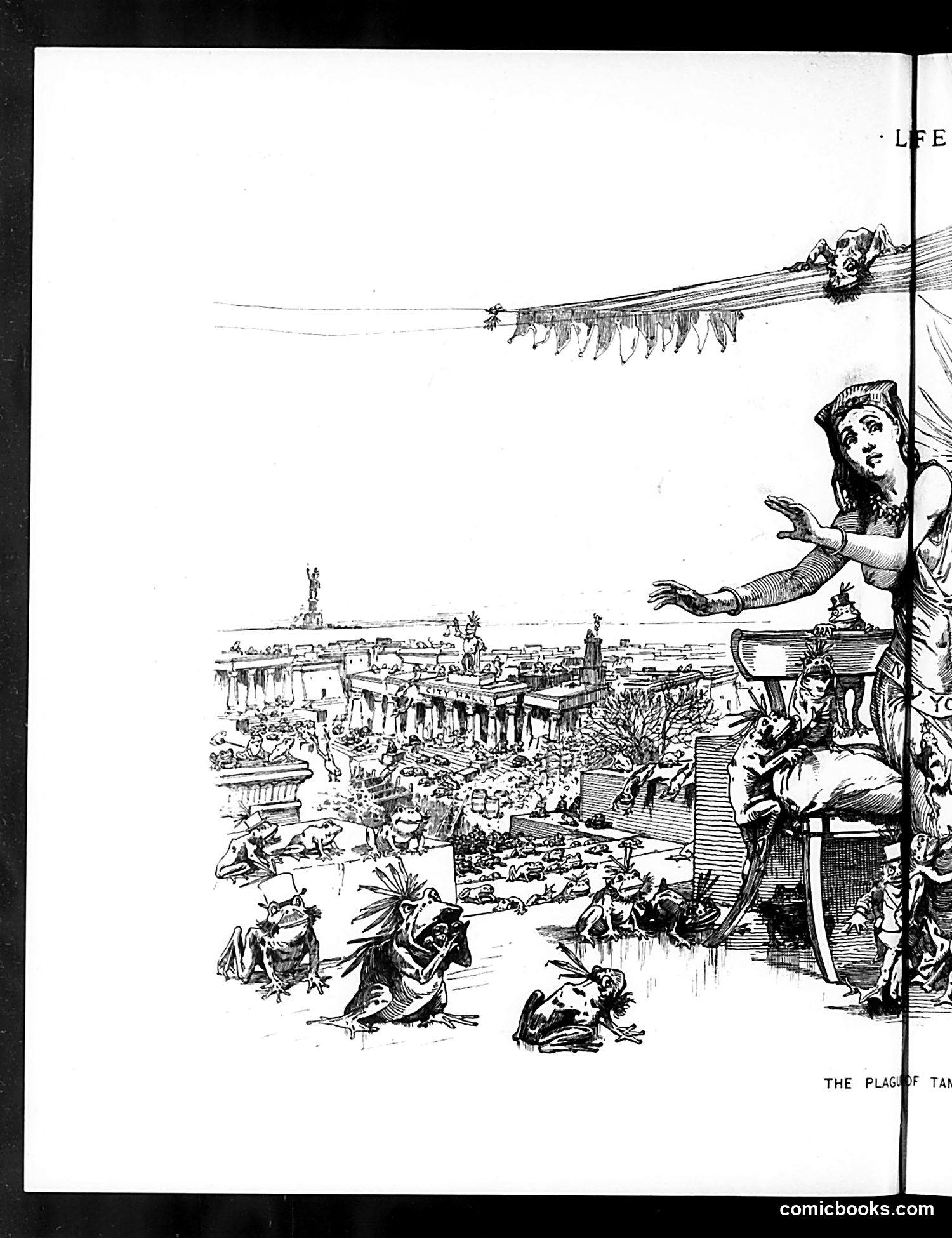
This illustration depicts a classical allegorical scene satirizing an apparent fashion or social trend of the era. A female figure (likely personifying Fashion or a social ideal) gestures from a columned structure overlooking a city, while frogs and toads plague the landscape below—suggesting the "plague of tan" referenced in the caption. The cartoon appears to mock either: 1. An excessive tanning fad among women, or 2. A trend toward darker complexions or sun-exposed skin that the cartoonist viewed as undesirable or ridiculous The classical framing and biblical plague imagery (evoking Egypt's plagues) suggests Life magazine treated this social phenomenon with absurdist humor, treating a cosmetic trend as a literal catastrophe worthy of mythological condemnation. The satire targets contemporary beauty standards and their perceived foolishness.
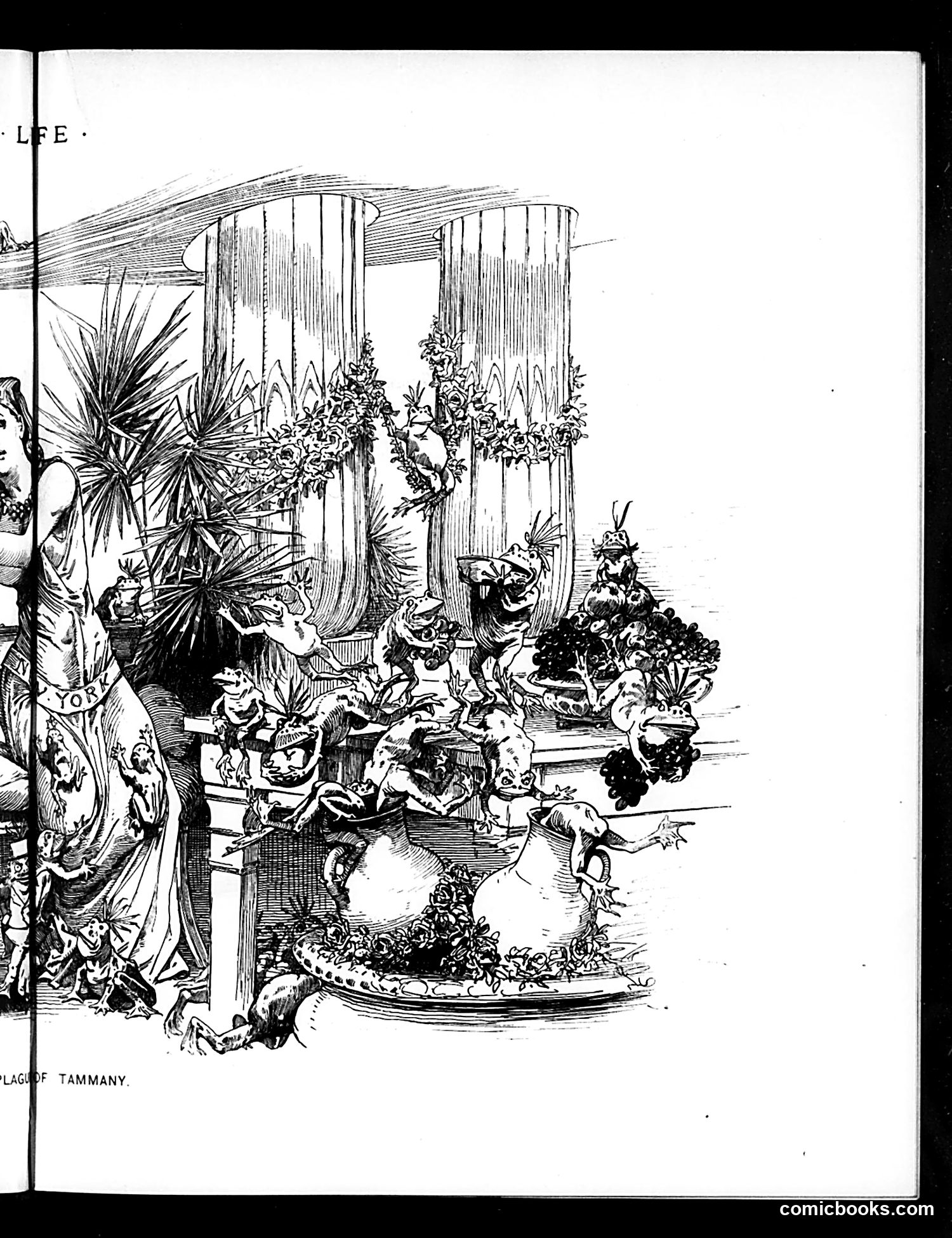
This satirical illustration depicts what appears to be the corrupt political machine of Tammany Hall, New York's Democratic Party organization. The cartoon shows grotesque, insect-like creatures (representing corrupt politicians or political operatives) infesting a classical architectural setting with columns and decorative plants. The "plague" metaphor suggests widespread corruption and infestation of the political system. The creatures' exaggerated features and the swarm-like composition convey that Tammany Hall corruption was pervasive and destructive to civic life. The classical setting (columns, formal garden) emphasizes the desecration of proper government institutions. This reflects late 19th/early 20th-century reform movements against Tammany Hall's notorious boss rule and patronage networks in New York City politics.
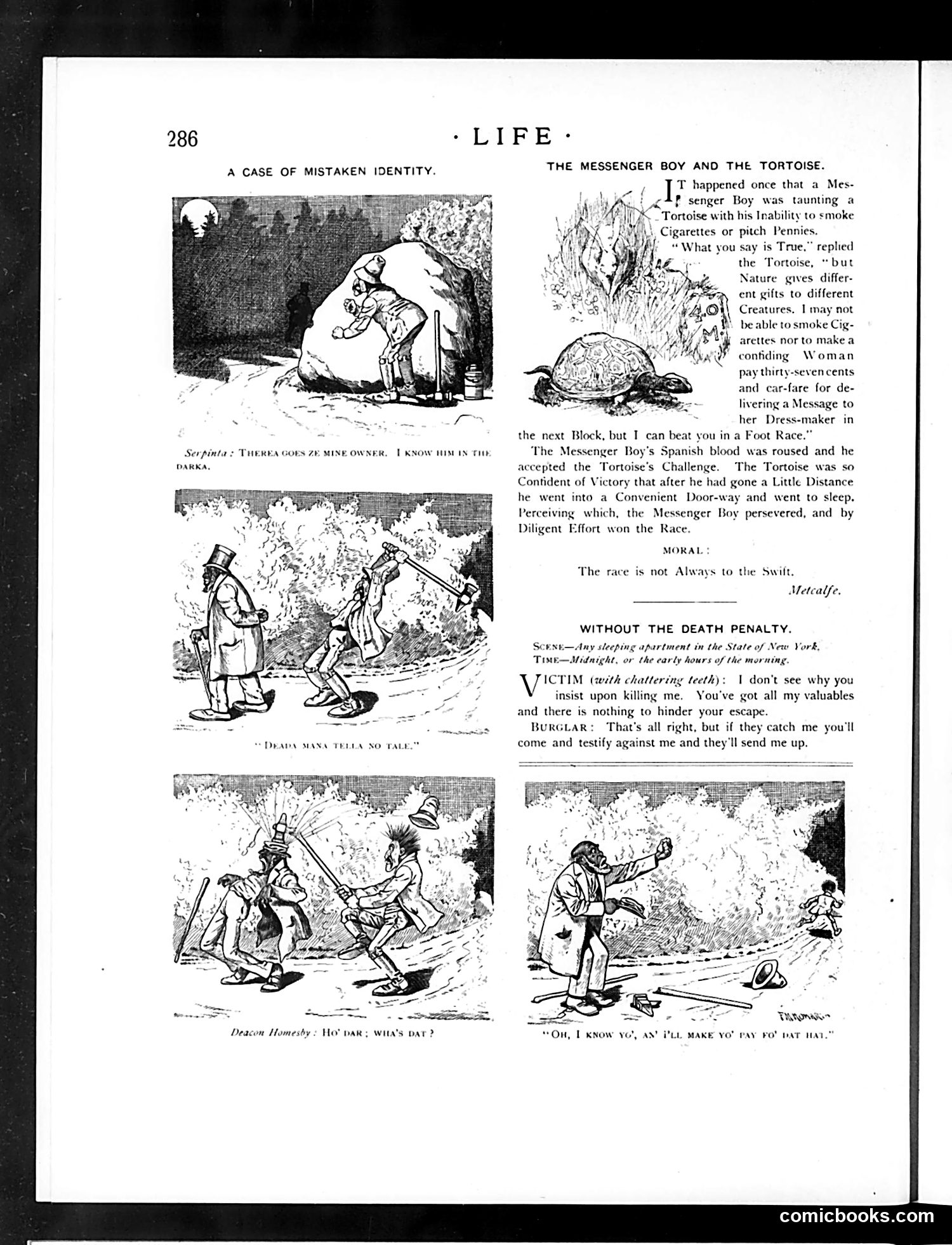
This page contains three separate satirical stories/cartoons from *Life* magazine: 1. **"A Case of Mistaken Identity"** — A visual gag about someone confusing a person with a mine owner (unclear specifics). 2. **"The Messenger Boy and the Tortoise"** — A fable illustrating that swift action doesn't guarantee success. The tortoise defeats a boastful messenger boy in a race, teaching that persistence matters more than speed. 3. **"Without the Death Penalty"** — A dialogue between a burglar and victim in New York. The burglar argues he shouldn't be killed since the death penalty isn't enforced; the victim counters that capture alone is sufficient punishment. This satirizes debates about capital punishment and criminal justice. The remaining cartoons appear to depict street scenes with working-class characters in comedic situations, though their specific references are unclear from the visible text.
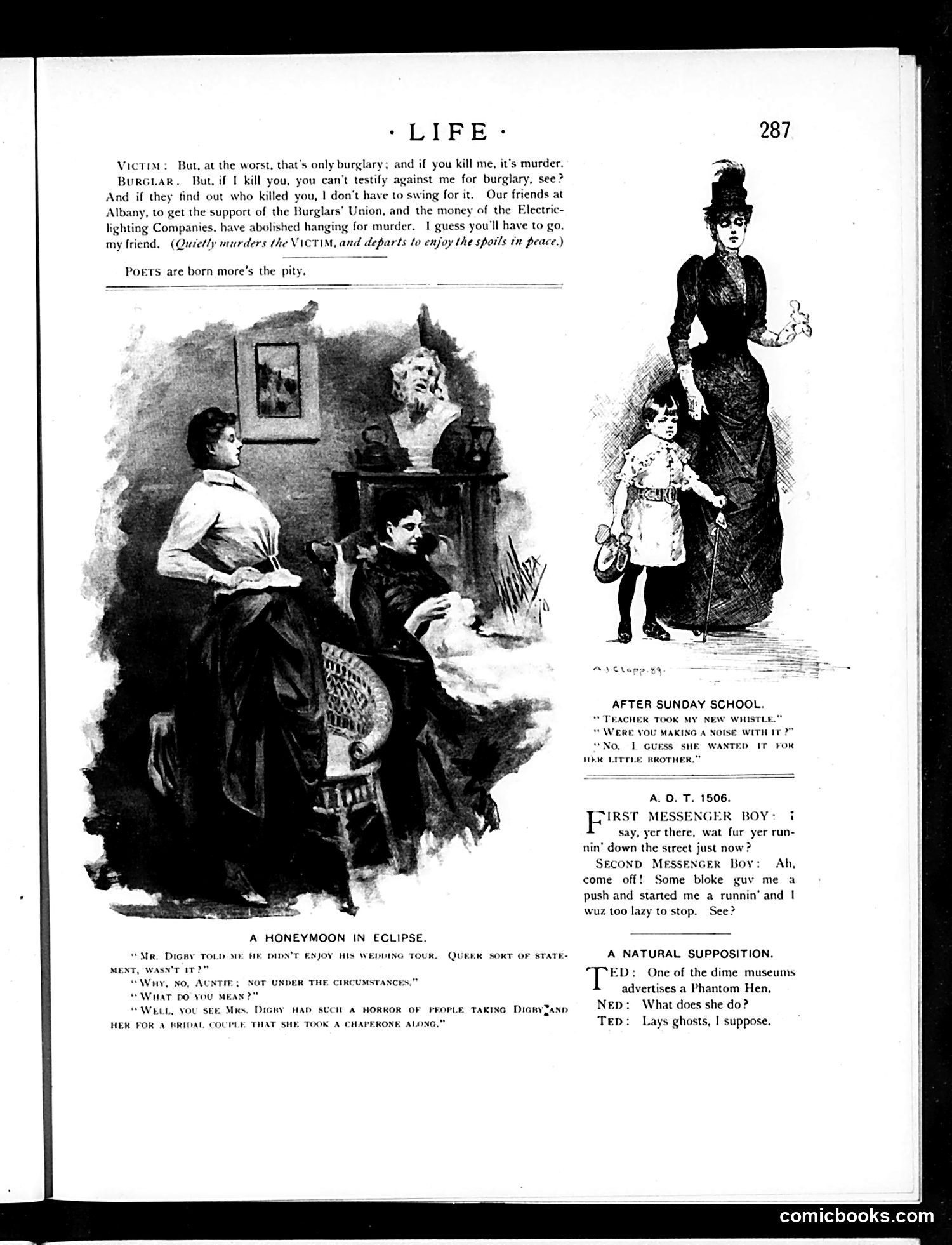
This page contains three separate satirical pieces: 1. **"A Honeymoon in Eclipse"**: A sketch mocking a couple's wedding tour. A man complains his wife won't enjoy the trip due to her horror of people staring at newlyweds in public—satirizing Victorian anxieties about marital visibility and propriety. 2. **"After Sunday School"**: A cartoon showing a woman and child, where the child has received a whistle from her teacher. The satire targets how Sunday school instruction supposedly encouraged children to make noise and cause household disruption. 3. **"A Natural Supposition"**: A brief joke about dime museum advertisements for "Phantom Hens," with the punchline that they must lay ghosts—poking fun at fraudulent or absurd carnival attractions common in the era. All three pieces use humor to critique social conventions and commercial deception.
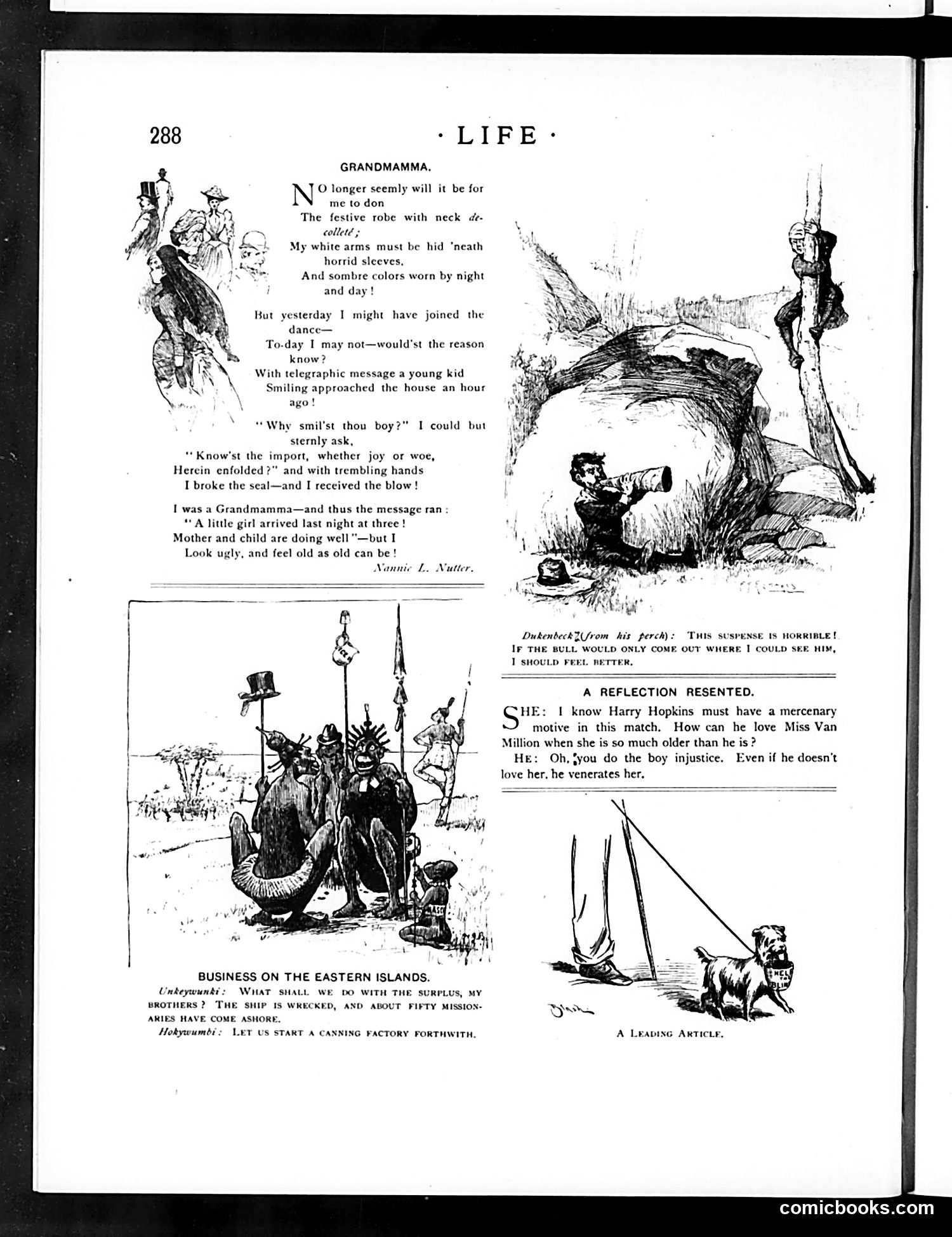
This page contains multiple satirical pieces typical of Life's humor: **"Grandmamma"** (top): A poem mocking the social conventions restricting older women. The speaker, newly a grandmother, must abandon fashionable low-necked gowns and wear somber colors—her youthful social life effectively ended by this domestic status change. The satire targets rigid Victorian/Edwardian dress codes that equated grandmotherhood with mandatory dowdiness. **"A Reflection Resented"** (middle right): A brief dialogue satirizing mercenary marriages. A man suspects his friend Harry Hopkins pursues the wealthy "Miss Van Million" for money despite their age gap; the friend defends him by claiming he "venerates" rather than loves her—a hollow consolation that highlights the transactional nature of such unions. **"Business on the Eastern Islands"** (bottom): Dark satire about colonial exploitation. Stranded missionaries become a resource; the response is to start a "canning factory"—a grimly comedic suggestion that the missionaries themselves might be processed, mocking both colonial callousness and cannibalism stereotypes.
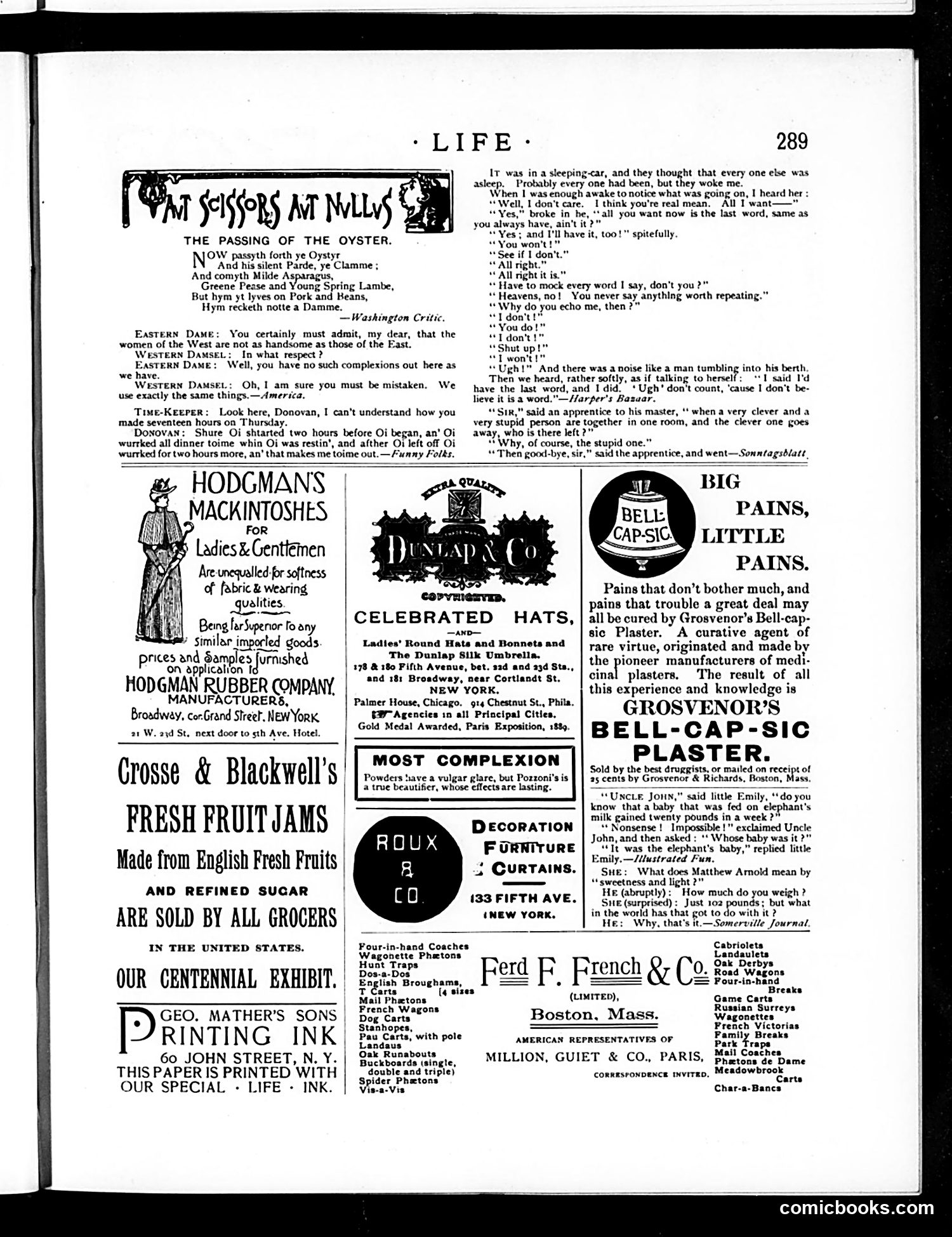
This page from *Life* magazine consists primarily of **advertisements and humorous short pieces**, not political cartoons. ## Main Content: The title piece, "The Passing of the Oyster," is a mock-archaic poem lamenting seasonal food changes—oysters giving way to spring vegetables. It's light social commentary, not political satire. The page includes several brief comedic dialogues: - A conversation between Eastern and Western women about beauty standards (regional humor) - A sleeping-car quarrel between a couple over "having the last word" (domestic comedy) - An exchange between a timekeeper and worker "Donovan" (Irish-accented character humor, common stereotyping of the era) - A master-and-apprentice riddle about clever versus stupid people ## Advertising: The bulk comprises period product ads: Hodgman's mackintoshes, jam, printing ink, hats, complexion powder, furniture, and medicinal plasters. **Overall:** This is a typical *Life* page mixing light humor with commercial content—no significant political message or historical reference beyond period attitudes about regional differences and Irish laborers.
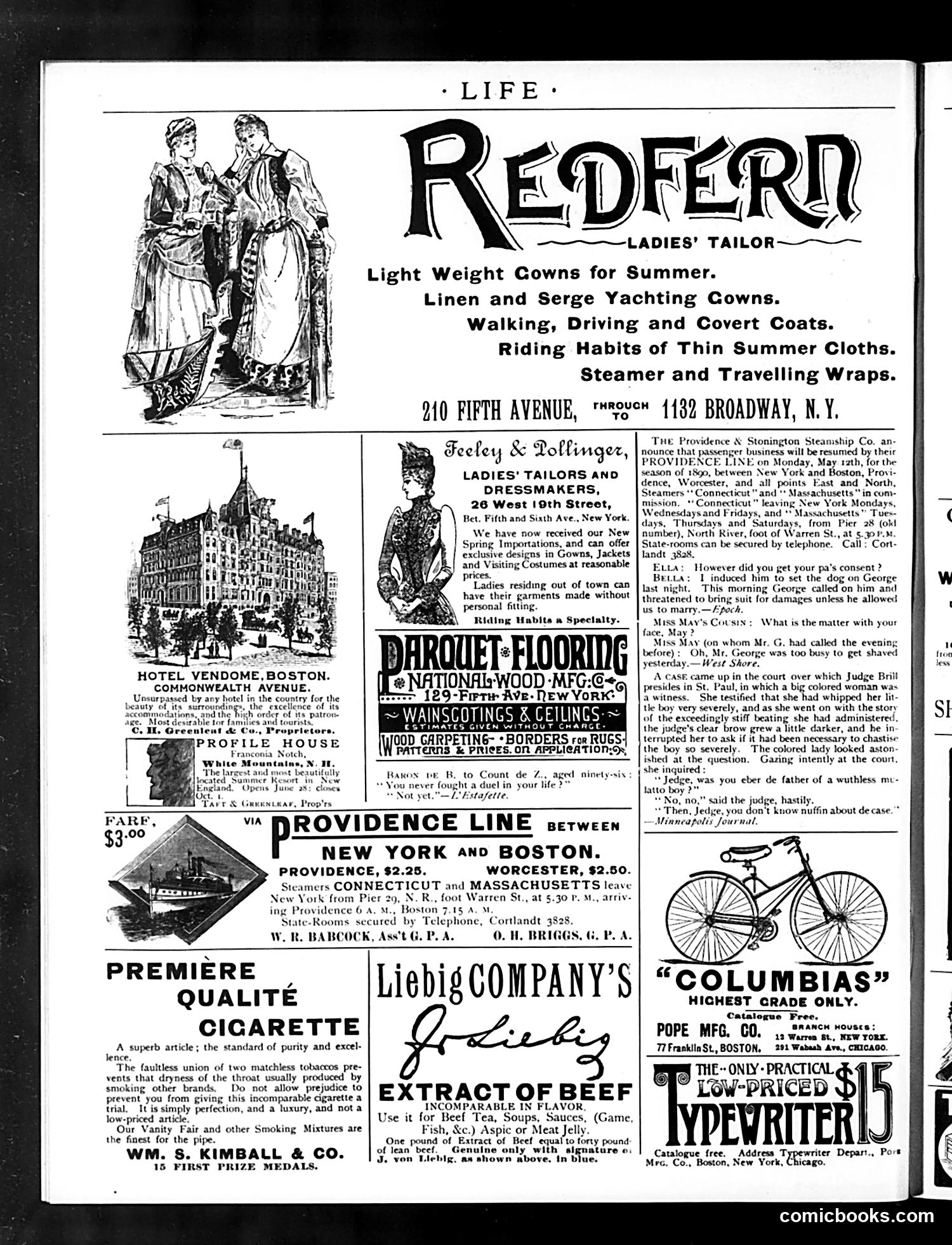
This page is **primarily advertising**, not satirical content. It's from Life magazine and consists almost entirely of commercial advertisements for ladies' fashion, hotels, steamship lines, and consumer products. The only identifiable satirical/humorous content appears in brief anecdotes: 1. A joke about a French nobleman (Count de Z.) never having fought a duel, playing on stereotypes about aristocratic honor culture. 2. A romantic comedy about a woman ("Miss May") getting her father's consent to marry by having her suitor threaten a lawsuit—satirizing both courtship conventions and legal threats. 3. A courthouse anecdote about a Black woman's severity toward her child, which the judge questions—reflecting period attitudes and racial prejudices, though the satirical intent (if any) is unclear. The page otherwise showcases Gilded Age consumer culture: tailoring services, steamship travel, cigarettes, and beef extract—reflecting the magazine's affluent audience and advertising-dependent business model.
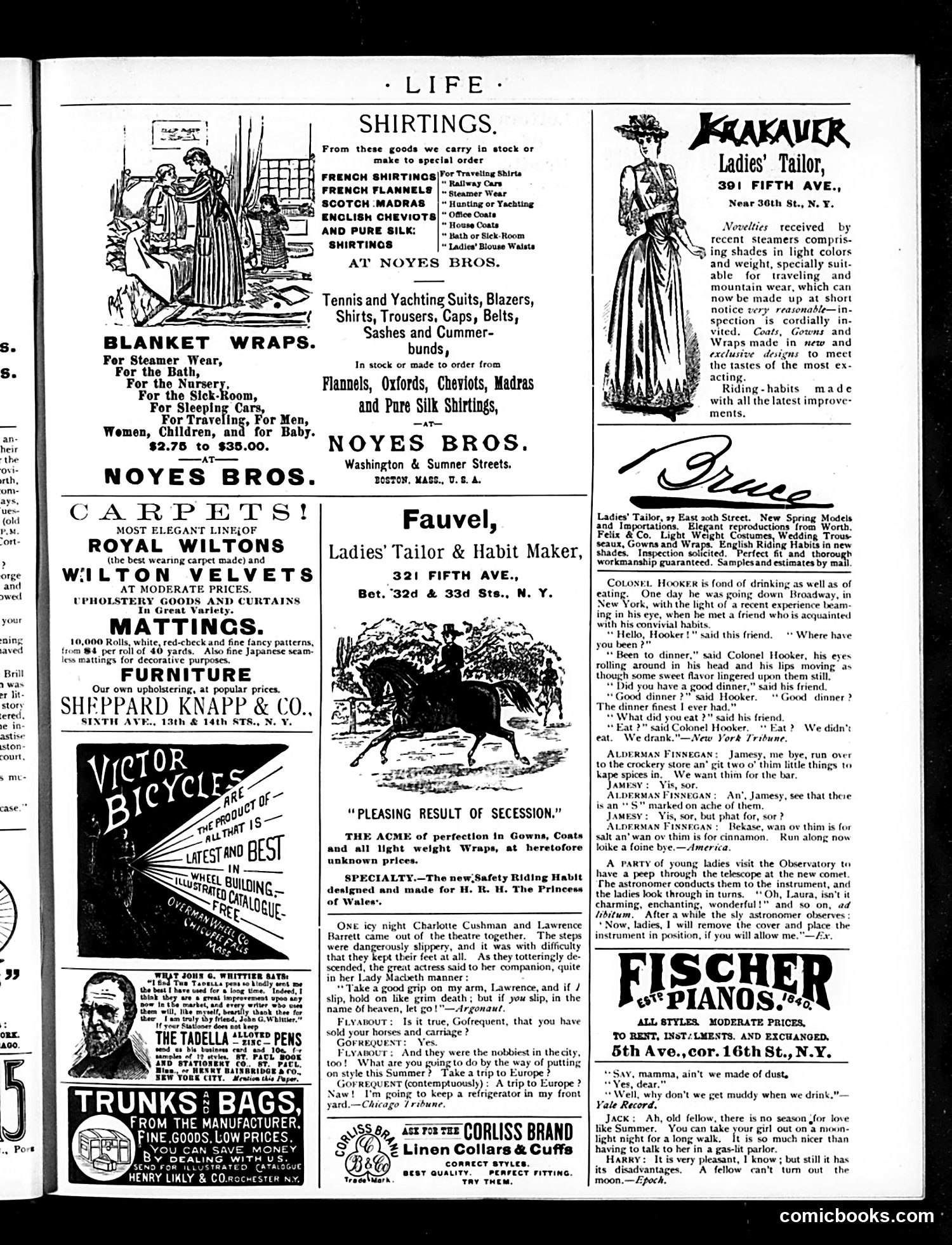
This page is primarily **advertising**, not political satire. It consists almost entirely of commercial advertisements for clothing merchants, furniture retailers, and related goods in late 19th-century New York and Boston. The one substantive content piece is a small illustrated anecdote titled **"Pleasing Result of Secession,"** which shows a poorly-drawn donkey or mule. The caption suggests this relates to post-Civil War consequences, though the connection between the image and title is unclear. The brief text below concerns theatrical anecdotes unrelated to the image. The advertisements themselves reflect period concerns: ladies' tailors, elaborate wraps and shirtings, blanket wraps for various purposes (sick rooms, sleeping cars, travel), and riding habits—indicating the fashion and transportation concerns of wealthy urban Americans of that era. **No clear political cartoon or satirical point is evident on this page.** It appears to be a standard magazine page mixing minor editorial content with revenue-generating advertisements.
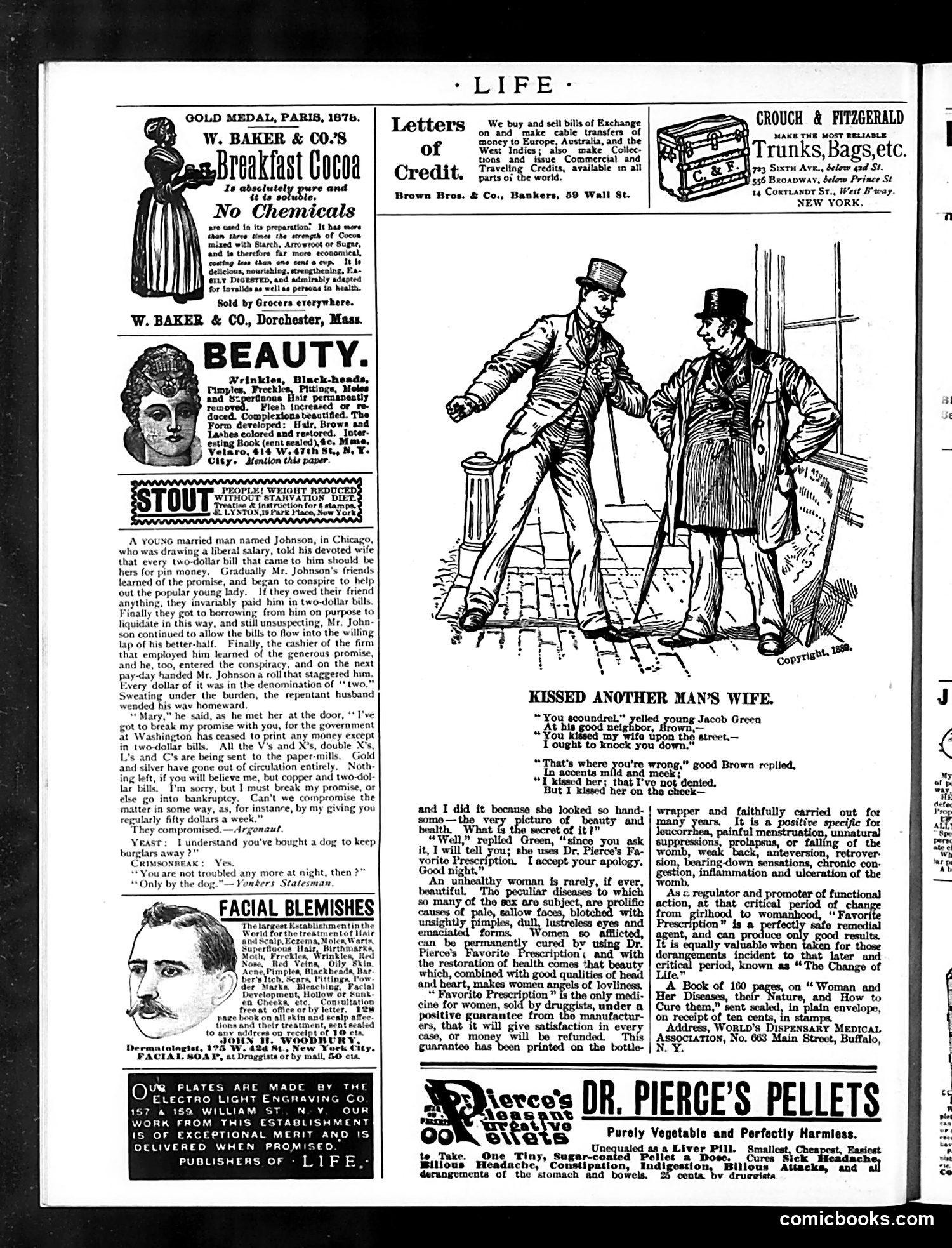
This page from *Life* magazine contains primarily **advertisements and two humorous anecdotes** rather than political satire. The main cartoon/story is titled **"Kissed Another Man's Wife,"** depicting a neighbor confrontation. A man accuses another of kissing his wife; the accused claims he only kissed her on the cheek. The joke's resolution reveals the wife's secret: **Dr. Pierce's "Favorite Prescription"** cosmetic product is responsible for her beauty, turning the angry husband's complaint into an inadvertent product endorsement. The page is otherwise dominated by period patent-medicine and beauty-product advertisements (cocoa, facial treatments, weight-loss remedies, pills), typical of late-19th-century magazines. A second brief anecdote about "Johnson" concerns a husband's promise to give all two-dollar bills to his wife—until the currency supposedly disappears from circulation, forcing compromise at fifty dollars weekly. Neither involves identifiable political figures. The satire is gentle, domestic humor rather than political commentary.
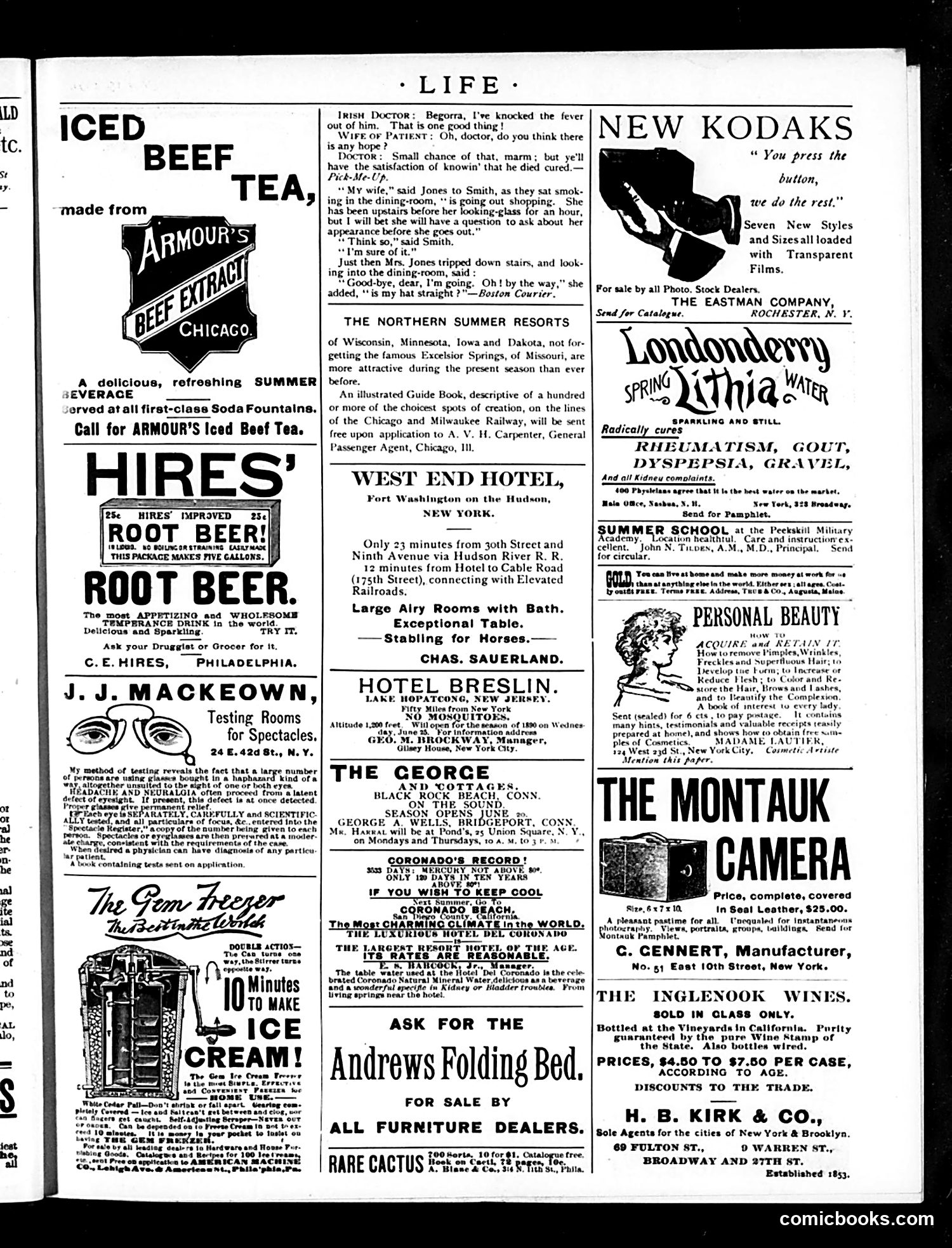
This appears to be primarily an **advertising page** from Life magazine rather than a satirical cartoon section. However, there are brief **humorous anecdotes** embedded among the ads: 1. **Irish Doctor joke**: A stereotypical Irish physician tells a patient's wife her husband will "die cured"—satirizing medical incompetence and Irish dialectal speech through crude ethnic caricature. 2. **Jones and his wife**: A domestic humor sketch where a husband predicts his wife will ask about her appearance before leaving—mocking women's vanity and preoccupation with looks. These represent common **turn-of-the-century Life magazine humor**: brief, mild social satire targeting ethnic stereotypes, gender roles, and domestic situations. The heavy advertising dominance suggests this is a filler/revenue page rather than editorial content. The tone is genteel mockery typical of 1890s publications aimed at middle-class readers.
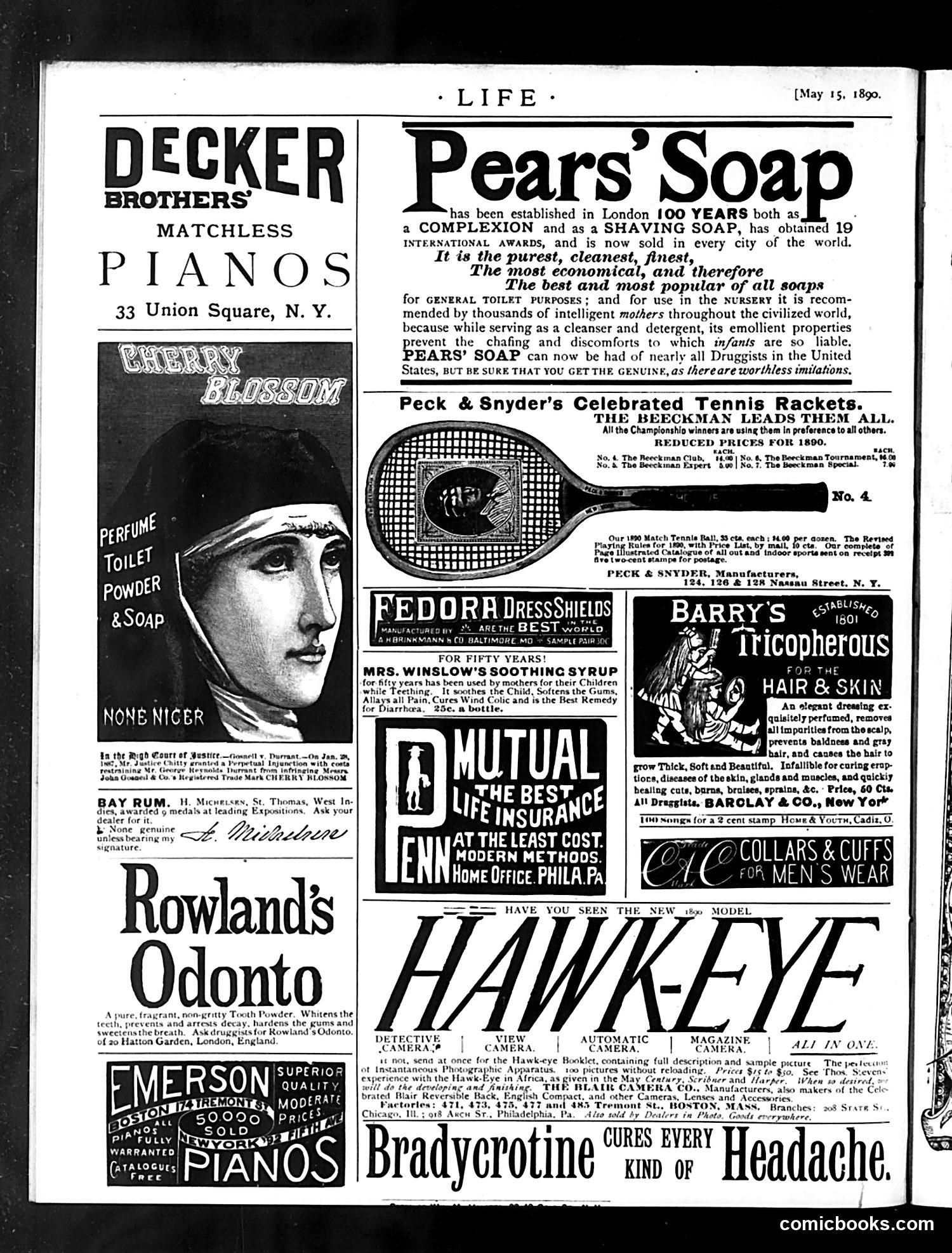
This page is primarily **advertising**, not political satire or editorial cartoons. It displays product advertisements typical of an 1890 American magazine, including: - **Decker Brothers Pianos** and other musical instruments - **Pears' Soap** (emphasizing its 100-year history and "purity," marketed especially to mothers for infant care—reflecting Victorian concerns about cleanliness and child health) - **Tennis equipment** from Peck & Snyder - **Mrs. Winslow's Soothing Syrup** (a patent medicine for teething children—common in this era) - **Rowland's Odonto** tooth powder - **The Hawkeye camera** (a new consumer camera model) - **Various other patent medicines and consumer goods** There are no political cartoons or satirical commentary visible. The only illustration of a human figure is a woman's profile advertising "None Nicer" perfume and toilet powder—a typical beauty advertisement of the period. The page reflects 1890s consumer culture and emerging mass-market advertising.