
Life, 1890-05-15 · page 4 of 18
Life — May 15, 1890 — page 4: what you’re looking at
What you’re looking at
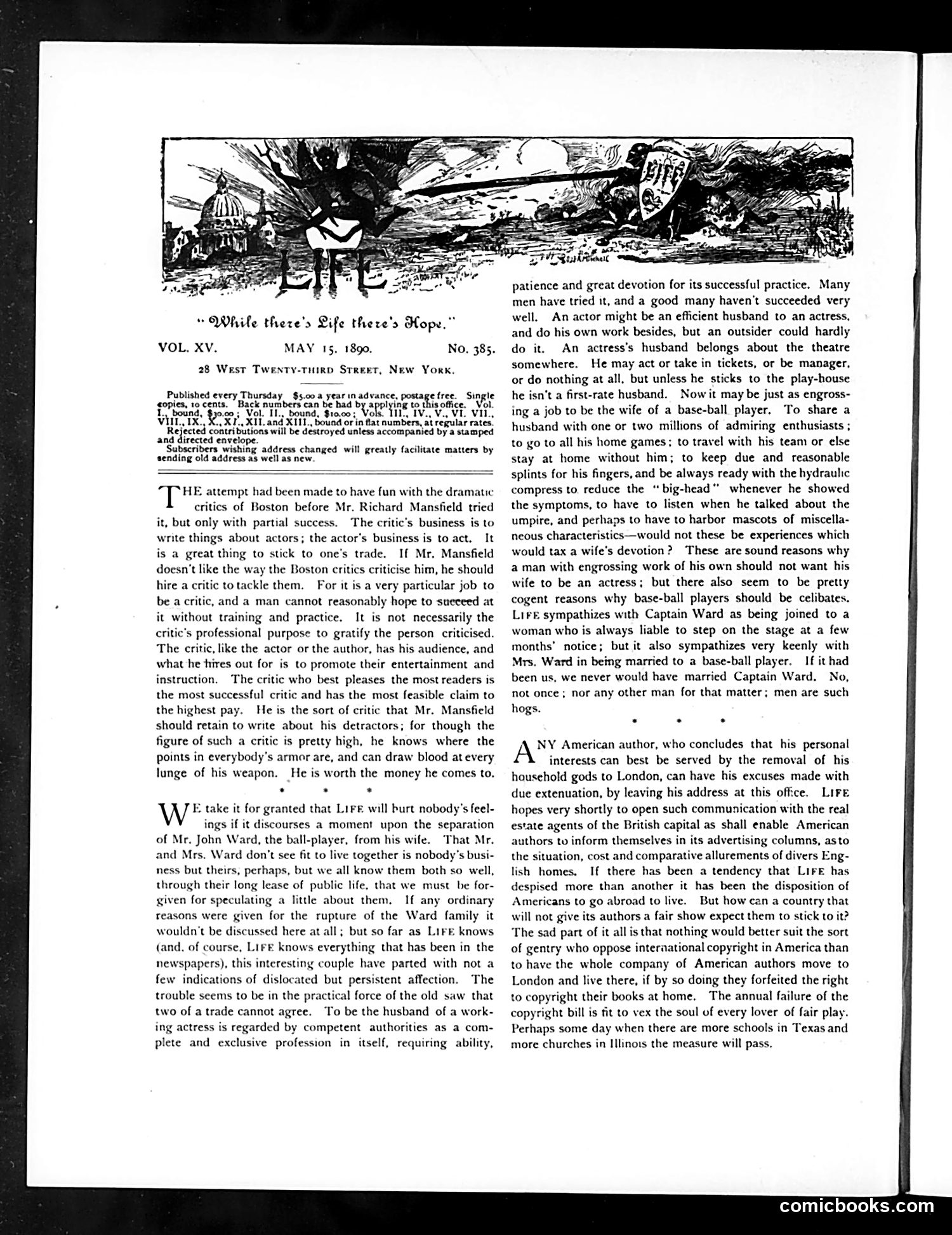
The masthead illustration shows a classical female figure (likely representing "Life" itself) overlooking a landscape with various symbolic elements. The page consists primarily of text columns discussing theatrical criticism and American authors. The main article critiques Boston dramatic critics and Richard Mansfield's acting, arguing that critics need special training to evaluate theatrical performance properly. A secondary piece discusses the separation of baseball player John Ward from his wife, using their situation to debate whether actresses can maintain successful marriages while pursuing their profession. A final section addresses American authors relocating to London to secure copyright protection, presenting this as a problematic brain drain. The page is essentially editorial commentary rather than traditional political satire, focusing on contemporary cultural and professional debates of 1890s America.
📄 Transcribed text from this page (OCR, searchable)
Machine-transcribed from the original scan — historical spelling and the odd misread are preserved.
“While there's Life there's Hope.” VOL. XV. MAY 15, 1890, No. 385. 28 West Twenty-THirp Street, New York. Published every Thursday $5.00 a year in advance, postage free. copies, ro cents. Back numbers can be had by ape ring to this office. iL fi Vol. Il, bound, $io00; Vols. Ile 1V., Ve VI, Vi, IX:, X.,X1., XIT. and XIIT., bound or in flat numbers, at r Rejected contri butions will be destroyed unless accompanied by a stamped and directed envelope. Subscribers wishing address changed will greatly facilitate matters by sending old address as well as new. Single "Vor HE attempt had been made to have fun with the dramatic critics of Boston before Mr. Richard Mansfield tried it, but only with partial success. The critic's business is to write things about actors; the actor's business is to act. It is a great thing to stick to one’s trade. If Mr. Mansfield doesn’t like the way the Boston critics criticise him, he should hire a critic totackle them. For it is a very particular job to be a critic, and a man cannot reasonably hope to sueceed at it without training and practice. It is not necessarily the critic's professional purpose to gratify the person criticised. The critic, like the actor or the author, has his audience, and what he tires out for is to promote their entertainment and instruction. The critic who best pleases the most readers is the most successful critic and has the most feasible claim to the highest pay. He is the sort of critic that Mr. Mansfield should retain to write about his detractors; for though the figure of such a critic is pretty high, he knows where the points in everybody's armor are, and can draw blood at every lunge of his weapon. He is worth the money he comes to. W 2 take it for granted that LiFe will burt nobody's feel- ings if it discourses a moment upon the separation of Mr. John Ward, the ball-player, from his wife. That Mr. and Mrs. Ward don’t see fit to live together is nobody's busi- ness but theirs, perhaps, but we all know them both so well, through their long lease of public life, that we must be for- given for speculating a little about them, If any ordinary reasons were given for the rupture of the Ward family it wouldn't be discussed here at all; but so far as Lire knows (and, of course, LIFE knows everything that has been in the newspapers), this interesting couple have parted with not a few indications of dislocated but persistent affection. The trouble seems to be in the practical force of the old saw that two of a trade cannot agree. To be the husband of a work- ing actress is regarded by competent authorities as a com- plete and exclusive profession in itself, requiring ability, patience and great devotion for its successful practice. Many men have tried it, and a good many haven't succeeded very well. An actor might be an efficient husband to an actress, and do his own work besides, but an outsider could hardly do it. An actress's husband belongs about the theatre somewhere. He may act or take in tickets, or be manager, or do nothing at all, but unless he sticks to the play-house he isn’t a first-rate husband. Now it may be just as engross- ing a job to be the wife of a base-ball player. To share a husband with one or two millions of admiring enthusiasts ; to go to all his home games; to travel with his team or else stay at home without him; to keep due and reasonable splints for his fingers, and be always ready with the hydraulic compress to. reduce the “big-head” whenever he showed the symptoms, to have to listen when he talked about the umpire, and perhaps to have to harbor mascots of miscella- neous characteristics—would not these be experiences which would tax a wife’s devotion ?- These are sound reasons why a man with engrossing work of his own should not want his wife to be an actress; but there also seem to be pretty cogent reasons why base-ball players should be celibates. Lire sympathizes with Captain Ward as being joined to a woman who is always liable to step on the stage at a few months’ notice; but it also sympathizes very keenly with Mrs. Ward in being married to a base-ball player. If ithad been us, we never would have married Captain Ward. No, not once; nor any other man for that matter; men are such hogs. A™ American author, who concludes that his personal interests can best be served by the removal of his household gods to London, can have his excuses made with due extenuation, by leaving his address at this office. LIFE hopes very shortly to open such communication with the real estate agents of the British capital as shall enable American authors to inform themselves in its advertising columns, asto the situation, cost and comparative allurements of divers Eng- lish homes. If there has been a tendency that Lire has despised more than another it has been the disposition of Americans to go abroad to live. But how can a country that will not give its authors a fair show expect them to stick to it? ‘The sad part of it all is that nothing would better suit the sort of gentry who oppose international copyright in America than to have the whole company of American authors move to London and live there, if by so doing they forfeited the right to copyright their books at home. The annual failure of the copyright bill is fit to vex the soul of every lover of fair play. Perhaps some day when there are more schools in Texas and more churches in Illinots the measure will pass, comicbooks.com