
Life, 1890-05-15 · page 6 of 18
Life — May 15, 1890 — page 6: what you’re looking at
What you’re looking at
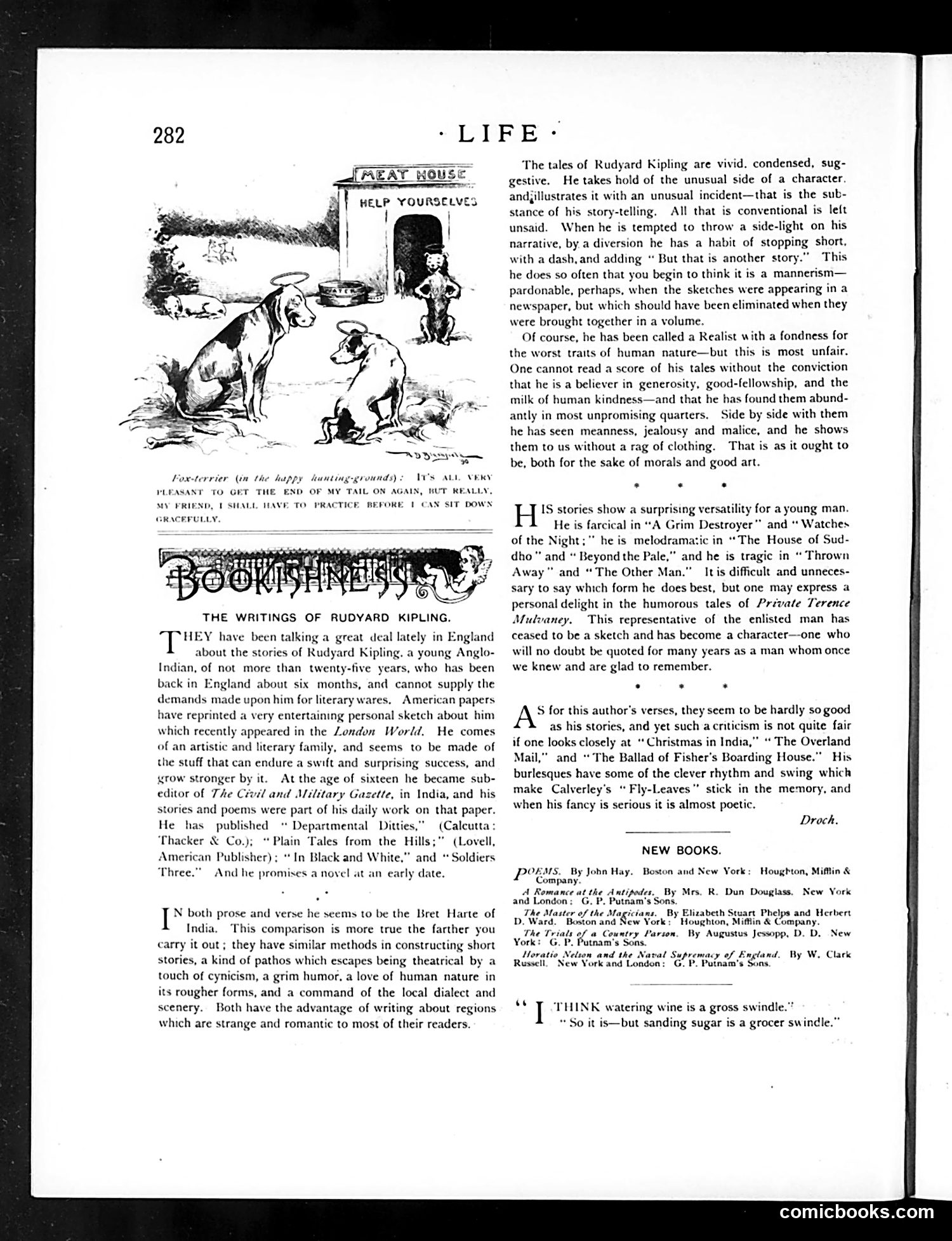
The page features a cartoon showing dogs at a "Meat House" with a sign reading "Help Yourselves." The caption reads: "Fox-terrier (in the happy hunting-ground): 'It's all very pleasant up here, but I do miss my tail on again, but really, my friend, I shall have to practice before I can sit down comfortably.'" This is a joke about the afterlife—a deceased fox-terrier in heaven misses its tail and needs practice readjusting to having it. The cartoon satirizes the period's sentimental Victorian attitudes toward pets and the supernatural, presenting a humorous, tongue-in-cheek perspective on animal existence after death. The joke relies on the absurdity of practical concerns persisting in the afterlife.
📄 Transcribed text from this page (OCR, searchable)
Machine-transcribed from the original scan — historical spelling and the odd misread are preserved.
- LIFE: res ge Fox-terrier (in the hip, VERY PLEASANT TO GET THE MV FRIEND, 1 SHALL hunting grounds): VCS Ma D OF MY TAIL ON AGAIN, HUT REALLY, HAVE TO PRACTICE BEFORE 1 CAN SIT DOWN GRACEFULLY, THE WRITINGS OF RUDYARD KIPLING. HEY have been talking a great deal lately in England about the stories of Rudyard Kipling. a young Anglo- Indian, of not more than twenty-five years, who has been back in England about six months, and cannot supply the demands made upon him for literary wares, American papers have reprinted a very entertaining personal sketch about him which recently appeared in the London World. He comes of an artistic and literary family, and seems to be made of the stuff that can endure a swift and surprising suc and Xrow stronger by it. At the age of sixteen he became sub- editor of The Civil and Military Gazette, in India, and his stories and poems were part of his daily work on that paper. He has published * Departmental Ditties," (Calcutta: Thacker & Co.); “Plain Tales from the Hills; (Lovell, merican Publisher); “In Black and White,” and “ Soldiers Three.” And he promises a novel at an early date. N both prose and ve India, he seems to be the Bret Harte of This comparison is more true the farther you carry it out; they have similar methods in constructing short stories, a kind of pathos which escapes being theatrical by a touch of cynicism, a grim humor, a love of human nature in its rougher forms, and a command of the local dialect and scenery. Both have the advantage of writing about regions which are strange and romantic to most of their readers. The tales of Rudyard Kipling are vivid. condensed, sug- gestive. He takes hold of the unusual side of a character. andjillustrates it with an unusual incident—that is the sub- stance of his story-telling. All that is conventional is left unsaid. When he is tempted to throw a side-light on his narrative, by.a diversion he has a habit of stopping short, with a dash, and adding “ But that is another story.” This he does so often that you begin to think it is a mannerism— pardonable, perhaps, when the sketches were appearing in a newspaper, but which should have been eliminated when they were brought together in a volume. Of course, he has been called a Realist with a fondness for the worst traits of human nature—but this is most unfair. One cannot read a score of his tales without the conviction that he is a believer in generosity, good-fellowship, and the milk of human kindness—and that he has found them abund- antly in most unpromising quarters. Side by side with them he has seen meanness, jealousy and malice, and he shows them to us without a rag of clothing. That is as it ought to be, both for the sake of morals and good art. . « . IS stories show a surprising versatility for a young man. He is farcical in “A Grim Destroyer” and ‘* Watches of the Night; he is melodramatic in **The House of Sud- dho " and “ Beyond the Pale,” and he is tragic in “ Thrown Away” and “The Other Man.” Itis difficult and unneces- sary to say which form he does best, but one may express a personal delight in the humorous tales of Prévate Terence Mulvaney. This representative of the enlisted man has ceased to be a sketch and has become a character—one who will no doubt be quoted for many years as a man whom once we knew and are glad to remember. . . . 5 for this author's verses, they seem to be hardly so good as his stories, and yet such a criticism is not quite fair if one looks closely at ‘Christmas in India,” “ The Overland Mail,” and “The Ballad of Fisher's Boarding House.” His burlesques have some of the clever rhythm and swing which make Calverley’s “ Fly-Leaves” stick in the memory, and when his fancy is serious it is almost poetic. Droch. NEW BOOKS. (POEMS. By Jobn Hay. Boston and New York: Houghton, Mimin & Company. A Romance at the Antipedes. By Mrs, R. Dun Douglass. and London; G. P. Putnam’s Sons. The Master of the Magicians. By Elizabeth Stuart Phelps D. Ward. Boston and New York: ntry Parson. . Putnam's Sons. Horatio Nelson and the Naval Supremacy of Russell, New York and London: G. P. Puinai “T New York and Herbert Houghton, Mifflin & Company. By Augustus Jessop, D. D, New ngta nd. Sons By W. Clark THINK watering wine is a gross swindle.” “So it is—but sanding sugar is a grocer swindh comicbooks.com