
A complete issue · 20 pages · 1890
Life — March 13, 1890
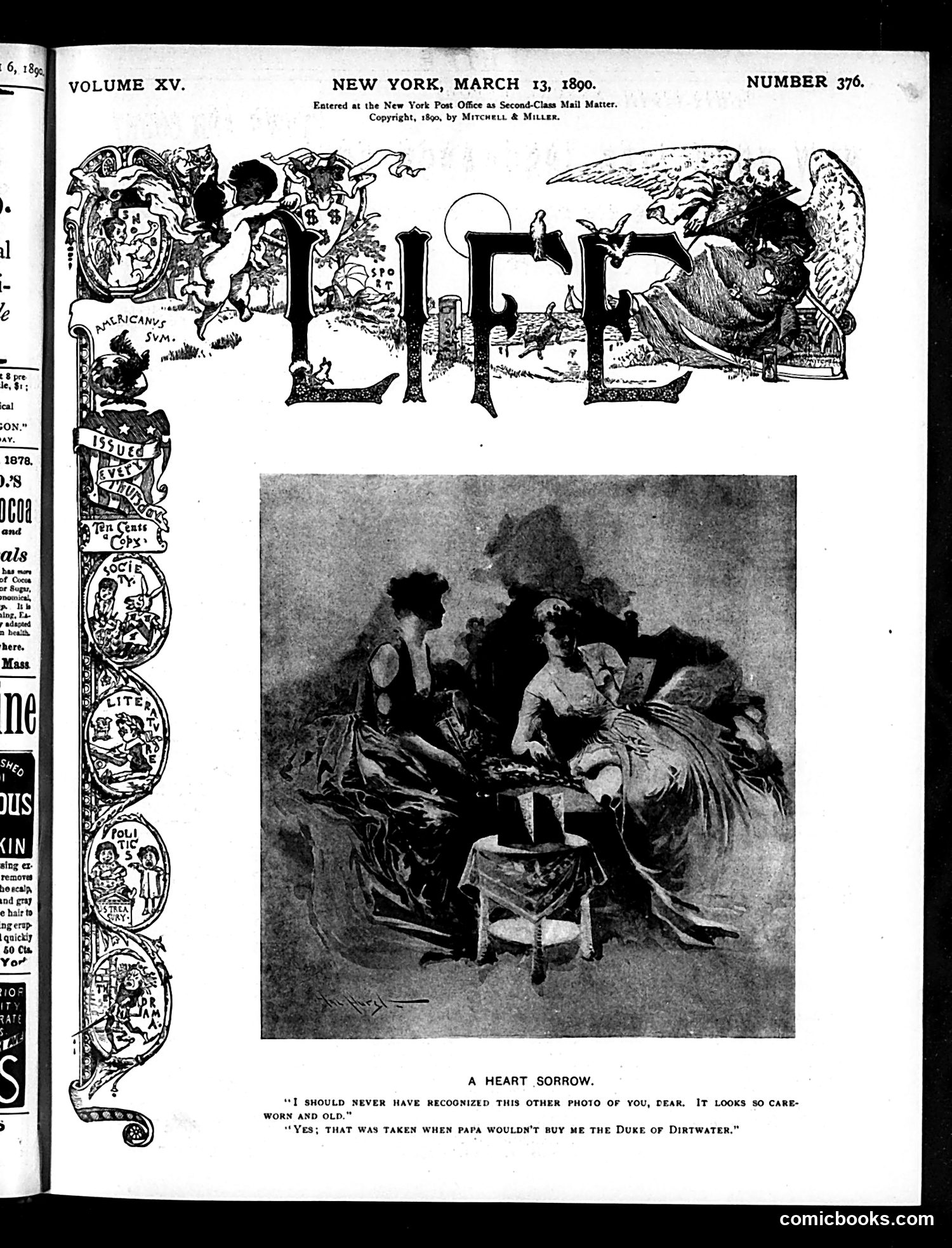
The main illustration titled "A Heart Sorrow" depicts three women examining an old photograph. The caption reveals a domestic tragedy: a woman regrets that her father refused to buy her "the Duke of Dirtwater," implying she married someone less desirable instead. The satire targets the class-conscious marriage market of the Gilded Age, where women's romantic prospects were determined by their fathers' wealth and willingness to purchase advantageous matches. The "Duke of Dirtwater" (likely a humorous invention) represents an eligible aristocrat or wealthy suitor her father deemed unworthy or unaffordable. The accompanying ornamental header and borders are typical Life magazine design elements from this period.
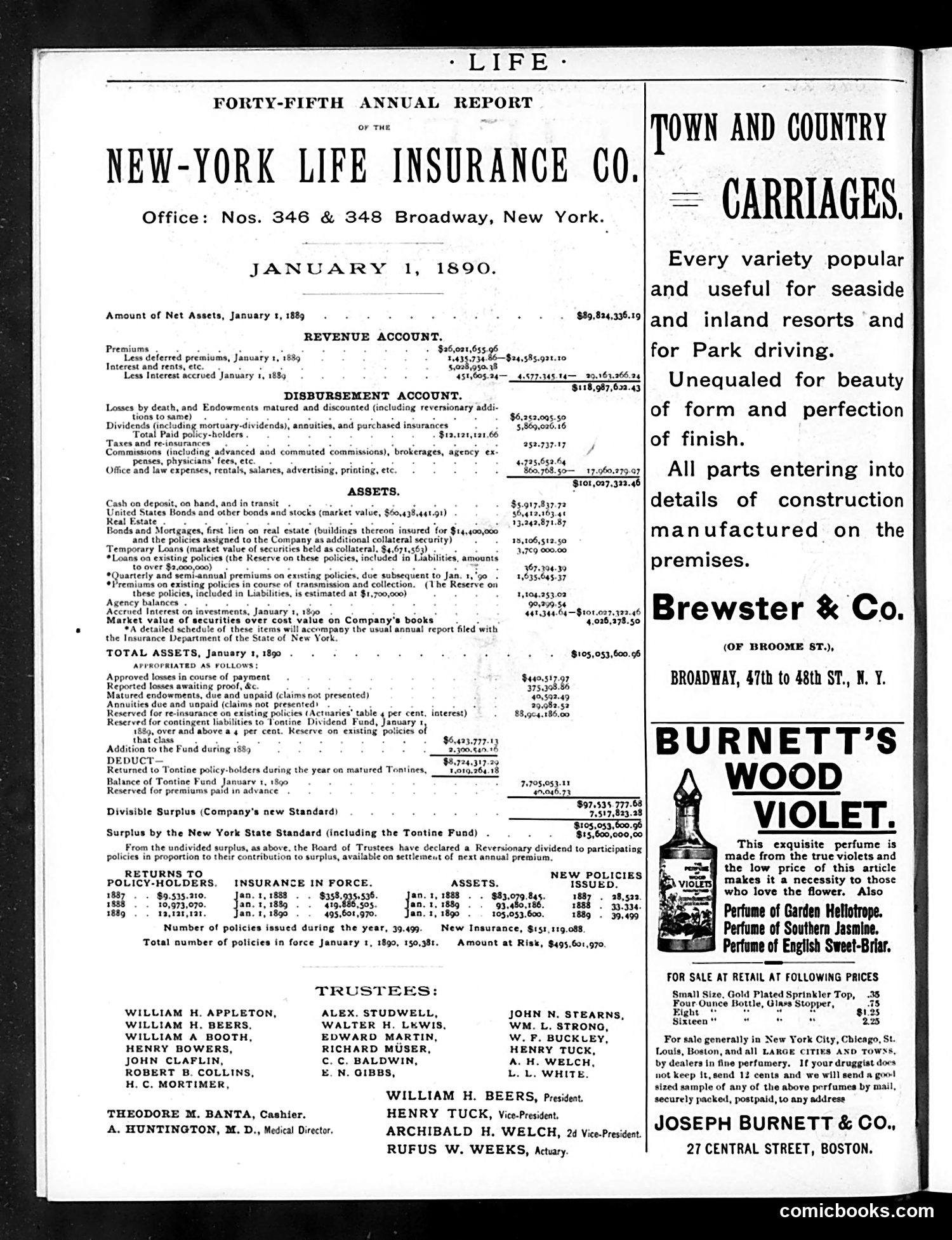
This page is primarily a financial report and advertisements, not political satire or cartoons. The left column contains the "Forty-Fifth Annual Report of the New-York Life Insurance Co." dated January 1, 1890, with detailed financial statements and asset information. The right side features advertisements for Brewster & Co. (carriage manufacturer on Broadway), and Joseph Burnett & Co.'s perfume products, particularly "Burnett's Wood Violet." The perfume ad includes a small decorative bottle illustration but no political content. There are no political cartoons, caricatures, or satirical commentary visible on this page. It's a business and commercial document typical of 1890s publications.
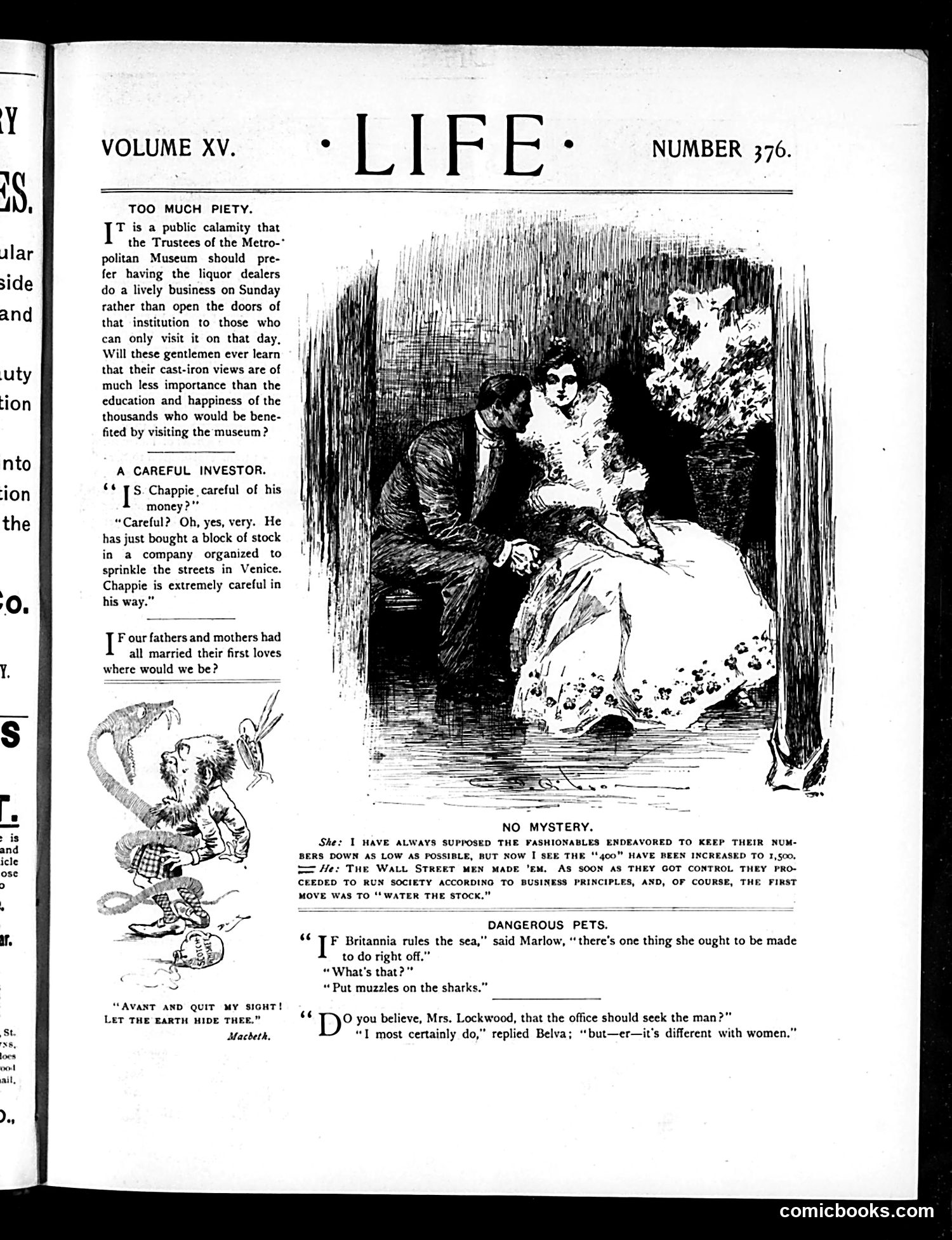
This page contains several short satirical pieces typical of Life's humor: **"Too Much Piety"** criticizes the Metropolitan Museum's policy of closing on Sundays, arguing this prevents working-class visitors from accessing education and culture. **"A Careful Investor"** jokes about S. Chappie, described as cautious with money, who invests in a Venetian street-sprinkling company—satirizing absurd business ventures. **"No Mystery"** appears to mock Wall Street speculation and stock manipulation, suggesting wealthy financiers deliberately manipulate markets for profit while presenting it as legitimate business. **"Dangerous Pets"** features a brief exchange about "muzzling sharks," likely satirizing dangerous people or practices in society using animal metaphor. The main illustration depicts a romantic scene, accompanying various romantic or relationship-themed quips about marriage and gender dynamics.
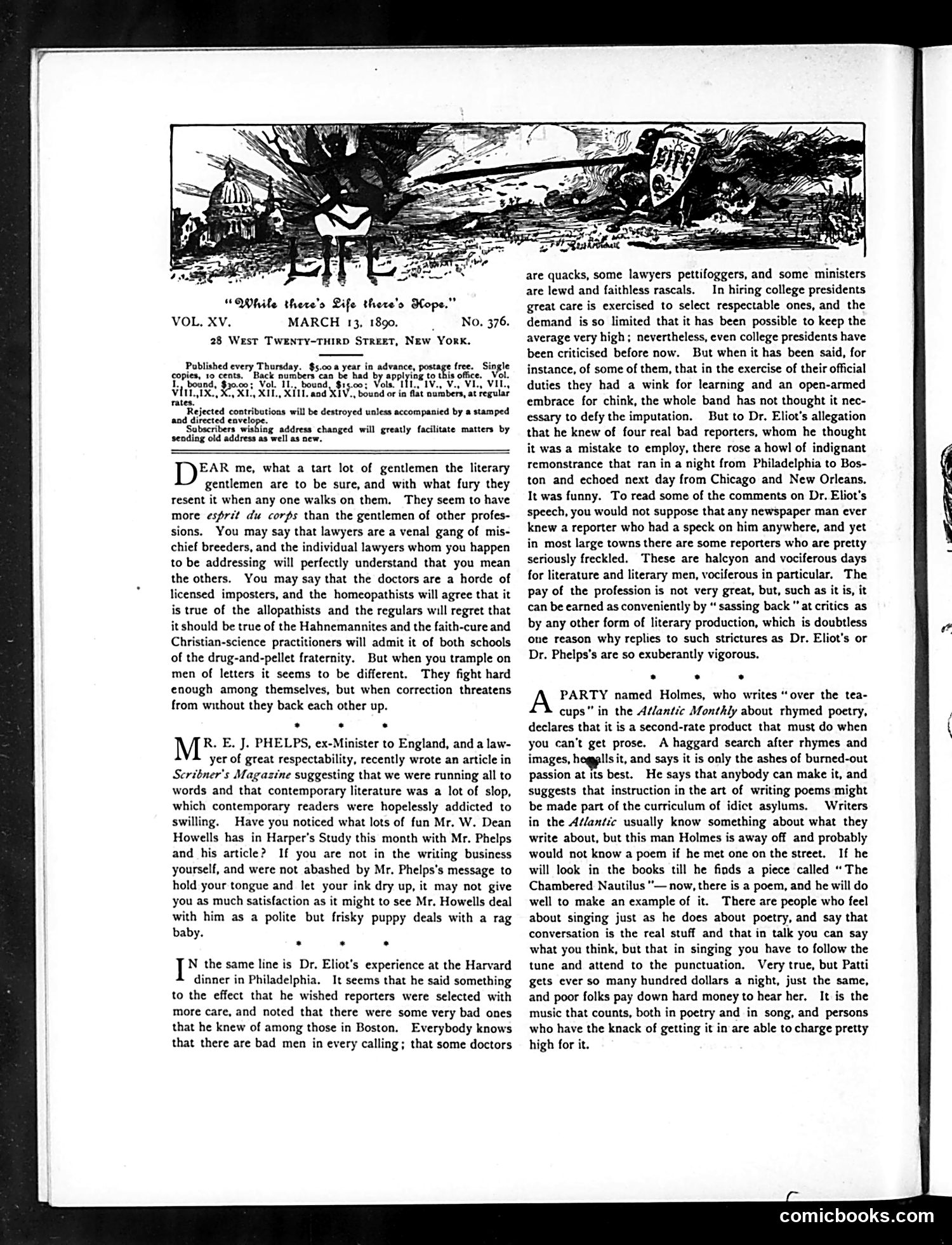
The visible masthead cartoon depicts a cherub or allegorical figure amid classical architecture and clouds—a typical decorative header for the era. The text itself contains no political cartoon, but rather satirical commentary on American professionals. The author critiques lawyers as "a venal gang of mischief-breeders," doctors as often incompetent, and college presidents as sometimes disreputable. A specific anecdote mocks Dr. E.J. Phelps (ex-Minister to England), who allegedly complained about newspaper reporters' quality. The piece sardonically notes that even literary figures like Dr. Eliot experienced poor-quality journalism. The satire targets the low standards of American professional classes—suggesting that lawyers, doctors, and educators were frequently unqualified or corrupt, while simultaneously mocking the mediocre reporters covering them.
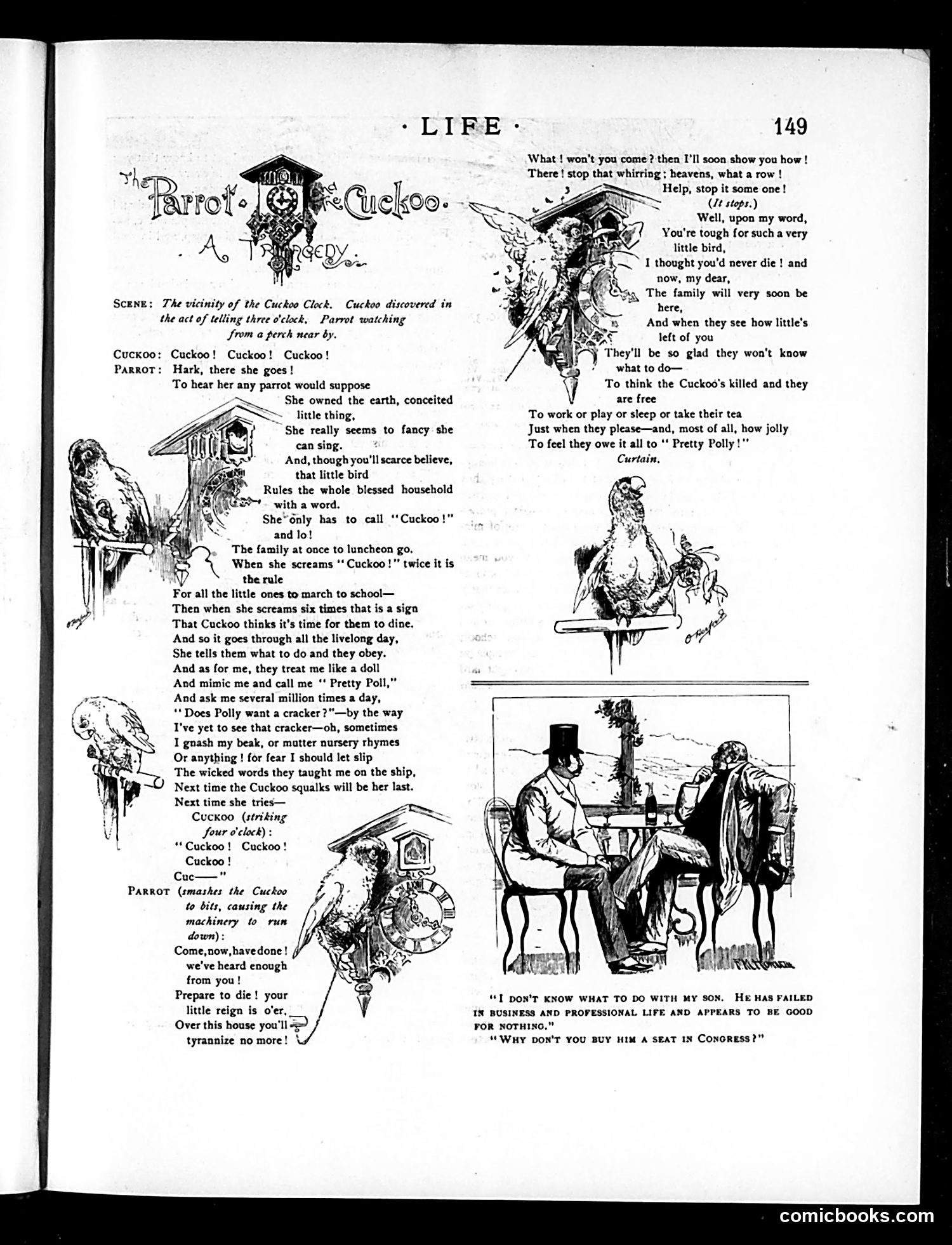
This is a satirical one-act play featuring anthropomorphic birds. The parrot describes how a cuckoo bird tyrannically controls a household by calling "Cuckoo!" — at which the family obeys unconditionally, marching to school, going to lunch, and treating the bird like "Pretty Polly." The satire appears to mock blind obedience to authority figures or social conventions. The parrot warns that the cuckoo's reign will end fatally. The bottom illustration shows two men in conversation, with dialogue about a son who "has failed in business and professional life" and a suggestion to "buy him a seat in Congress" — a direct jab at political corruption and the buying of Congressional seats, implying wealth could secure positions regardless of competence.
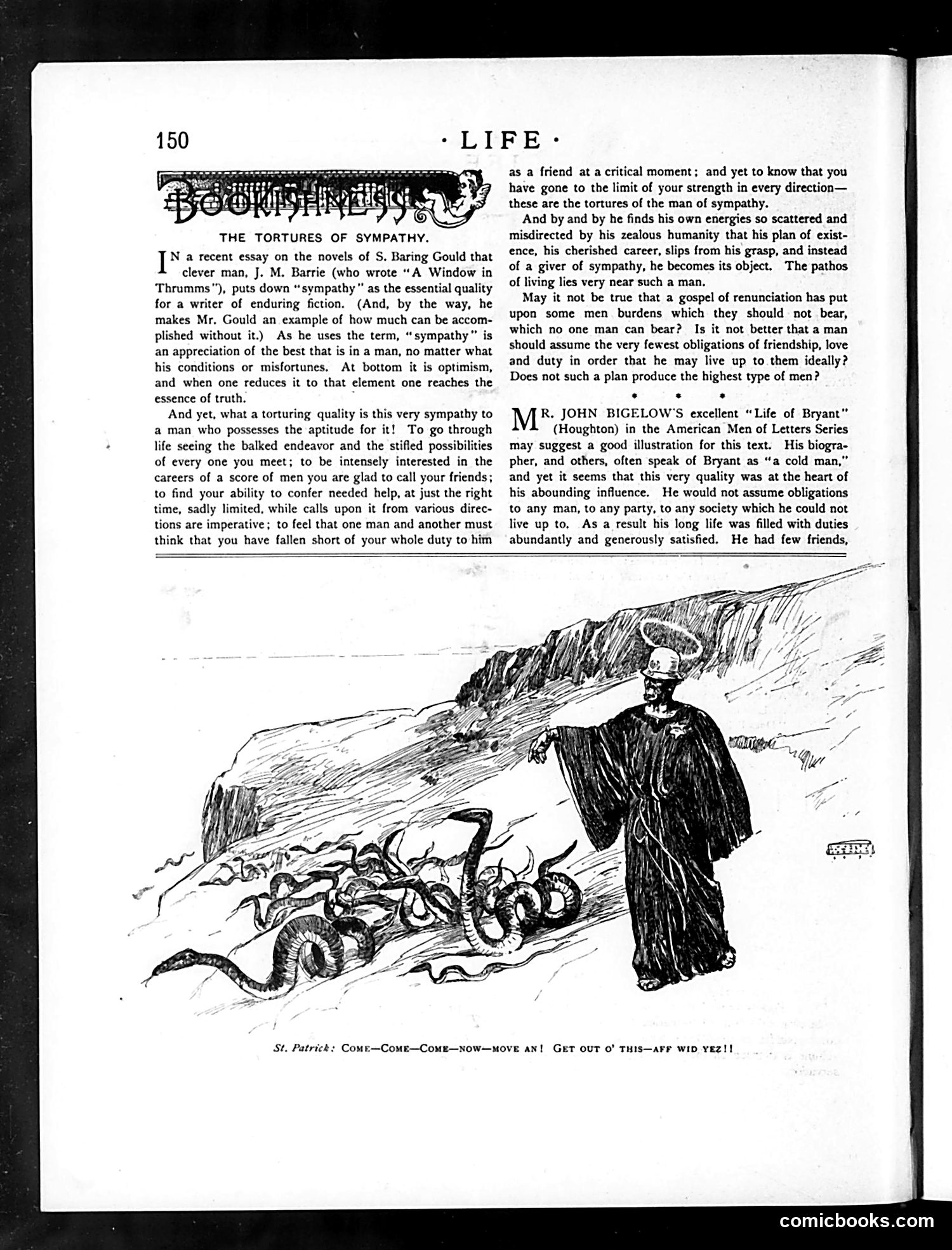
This page discusses S. Baring Gould's novels, praising "sympathy" as essential to good fiction while warning of its dangers. The article argues that excessive sympathy can become a burden—forcing people to help others beyond reasonable obligation and leaving them feeling they've failed their duty. The accompanying cartoon illustrates this torment. It shows St. Patrick struggling with a mass of snakes, with the caption "Come-Come-Come-now-move an! Get out of this-aff wid yez!!" The image uses the saint's legendary snake-banishing as a metaphor: just as St. Patrick battled persistent snakes, the sympathetic person battles unending demands from those seeking help. The satire suggests sympathy, however well-intentioned, can become an exhausting, inescapable burden.
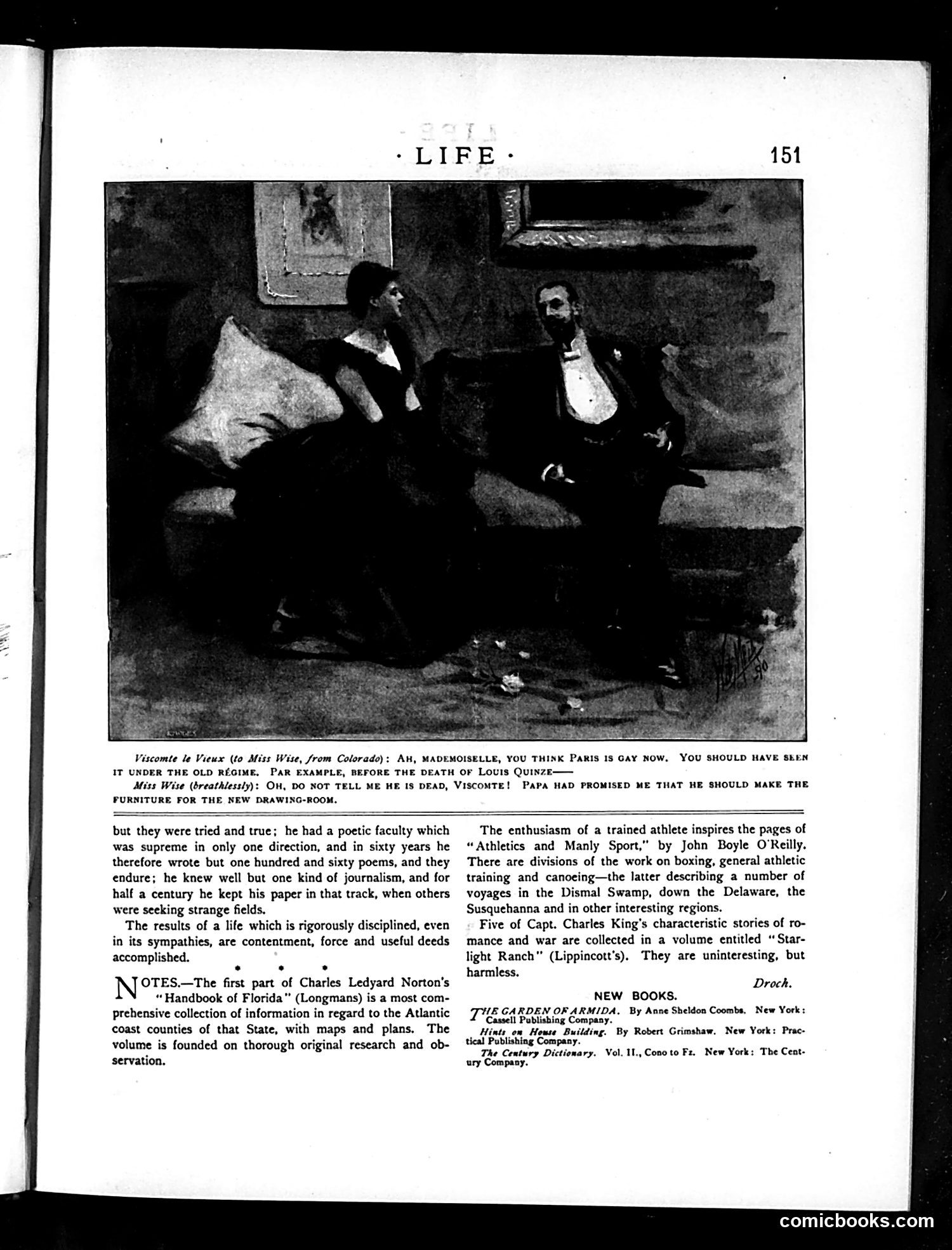
This page from *Life* magazine contains a satirical illustration and accompanying text about French politics and journalism. The cartoon depicts two men in formal dress in what appears to be an interior setting, with a caption referencing "Visconte is Vieux" and dialogue about Paris under an old regime versus a new drawing-room. The dialogue mentions "Mademoiselle," "Paris is gay," and "Louis Quinze"—suggesting satire about French aristocratic society and possibly restoration politics. One figure appears to be addressing another about furniture and the "new drawing-room," likely mocking pretensions about modernization while maintaining old aristocratic values. The text below discusses journalism and literary discipline, praising a comprehensive handbook about Atlantic coast counties. The "New Books" section lists recent publications on military history and dictionary entries. Without clearer identification of the specific political figures or historical moment referenced, the precise satirical target remains somewhat unclear.
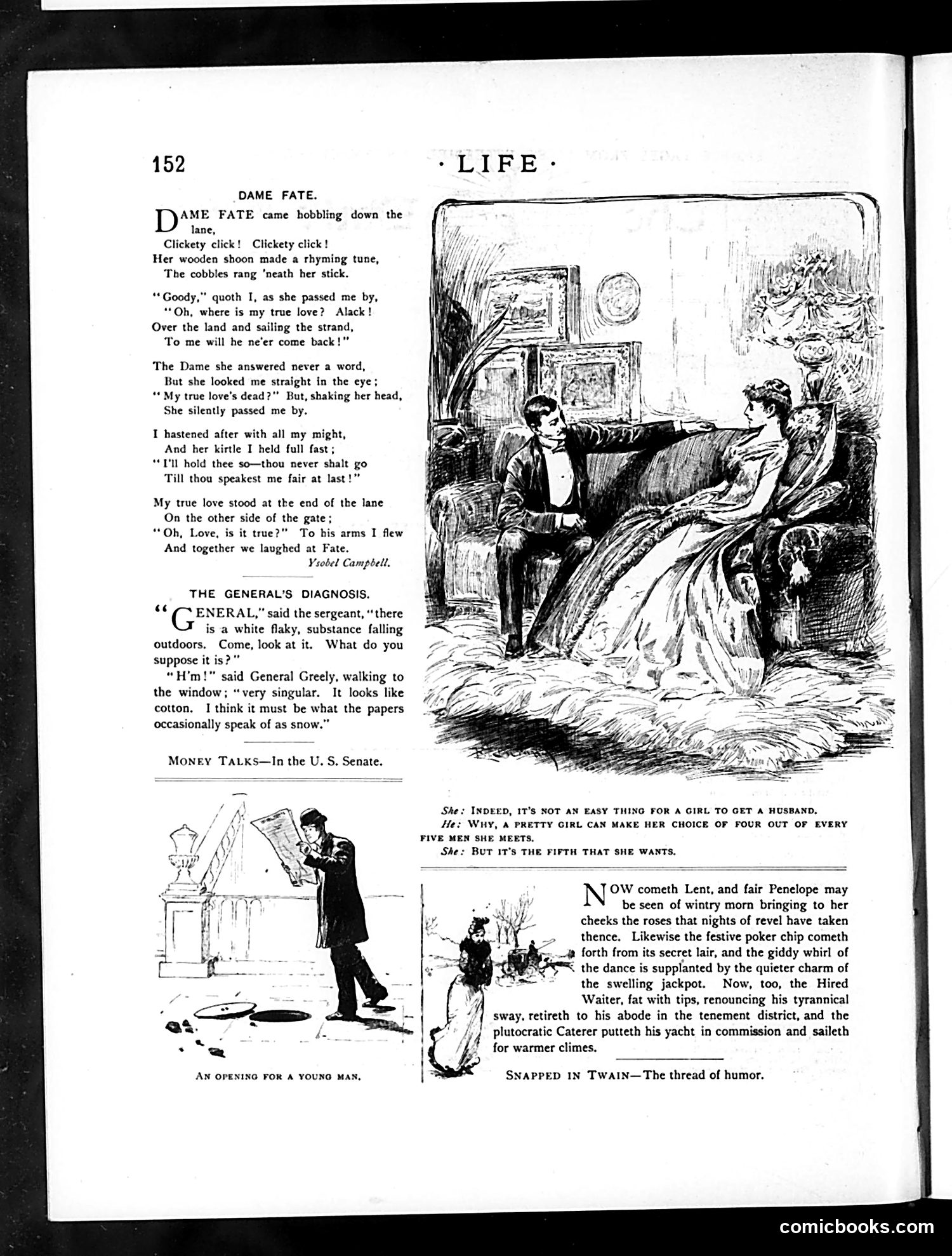
This page contains three distinct items: **"Dame Fate"** (top): A romantic poem by Violet Campbell about a man pursuing his true love, illustrated with a sketch of a couple in an interior setting. **"The General's Diagnosis"** (middle): A brief comedic dialogue where a sergeant shows General Greeley a white flaky substance falling outdoors. The General, examining it through a window, diagnoses it as "snow"—the humor lying in his peculiar, overly technical explanation that it resembles cotton rather than recognizing snow directly. **"Money Talks—In the U.S. Senate"** (bottom): A satirical cartoon showing a man at a podium labeled "An Opening for a Young Man," with a dialogue about women and marriage. This mocks Senate corruption or financial motivations in politics, though specific contemporary references are unclear. The page exemplifies Life's mix of romantic verse, gentle humor, and political satire.
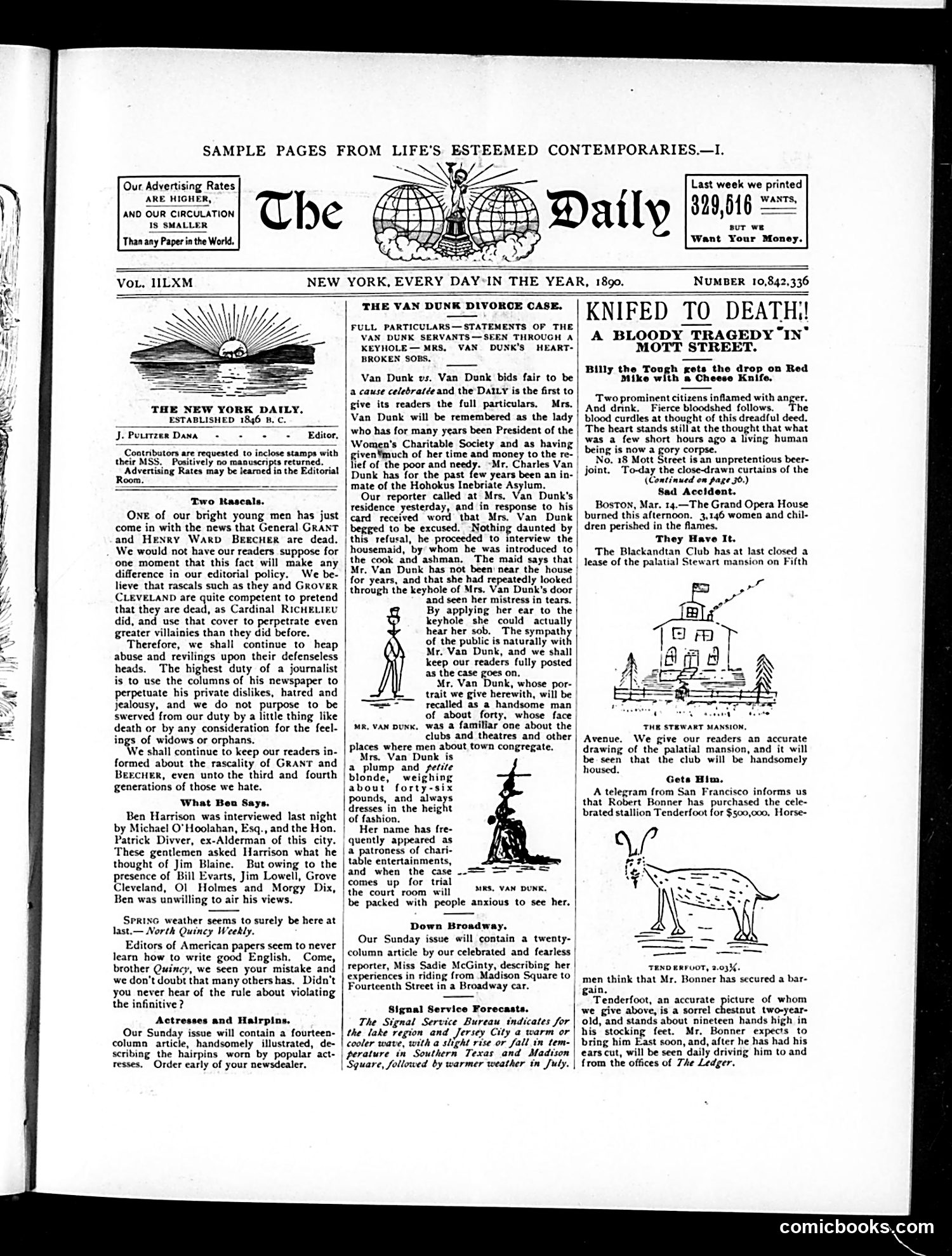
This appears to be a sample page from *The Daily*, a fictional newspaper Life created to satirize contemporary journalism. The page mocks sensationalist reporting through exaggerated headlines like "KNIFED TO DEATH!" and "A BLOODY TRAGEDY 'IN' MOTT STREET." The satire targets several journalistic practices: overly dramatic coverage of crime, invasion of privacy (interviewing grieving Mrs. Van Dunk), and reliance on gossip and speculation. References to "Billy the Tough" and street violence satirize penny-dreadful sensationalism. The small illustrations (a house, a statue, a horse) appear to be crude advertisements or filler—further mocking newspapers' low standards. Life's critique suggests 1890s newspapers prioritized shocking headlines and advertisements over accurate reporting, sacrificing dignity and truth for circulation and revenue.
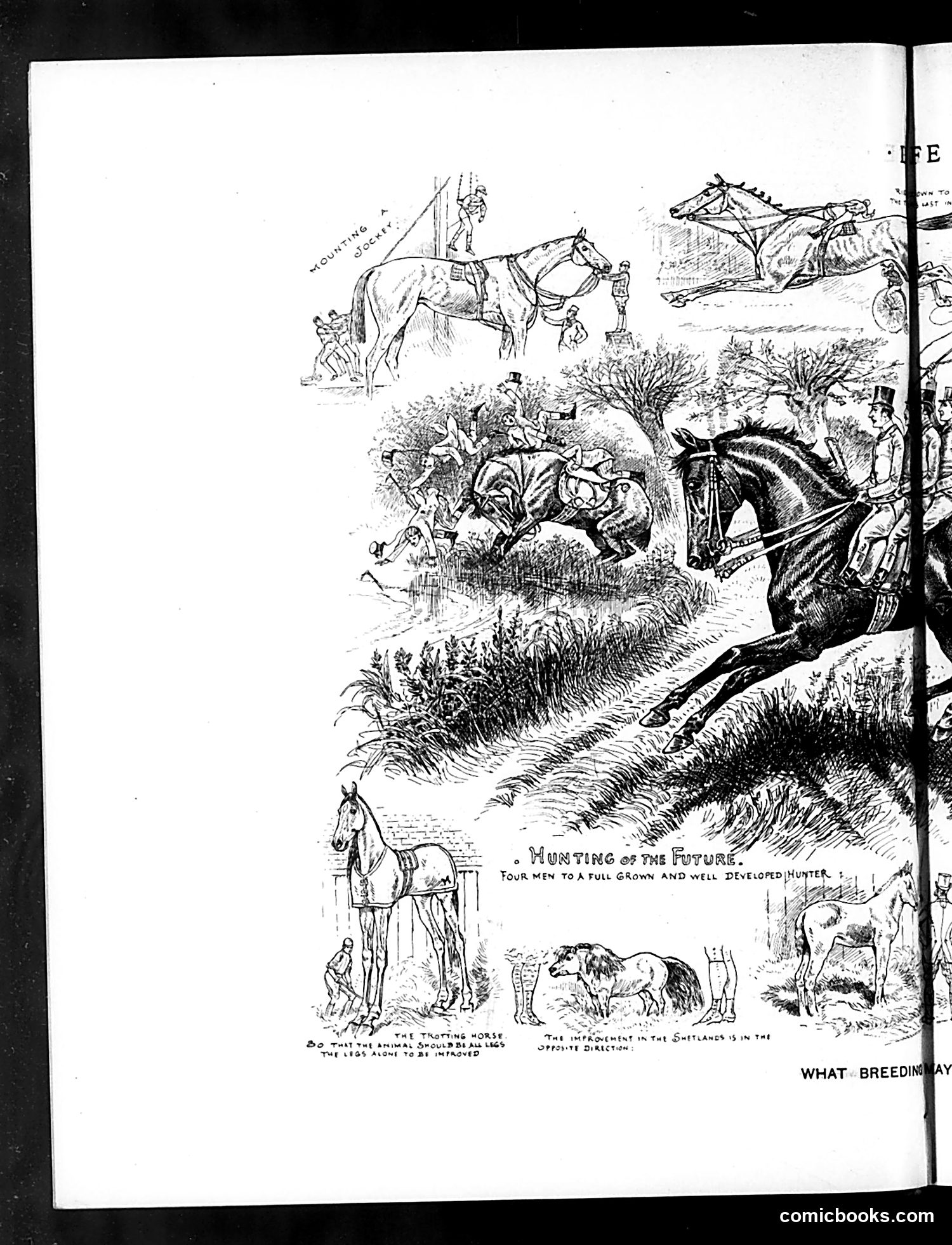
This satirical illustration depicts horse breeding and training, captioned "Hunting of the Future: Tour men to a full grown and well developed hunter." The sketch shows various stages of developing a hunting horse, with small figures demonstrating training methods. The bottom panels include text about proper animal care: "Do not let animal should be left alone the legs alone to be injured" and "The improvement in the Settlements is in the opposite direction." The satire appears to critique contemporary horse-breeding practices or agricultural methods, suggesting that future hunting depends on proper, careful development of animals—contrasting what "should be" done versus what practitioners actually do. The tone suggests irony about whether such care is actually being taken. The page header reads "WHAT BREEDI[NG]," indicating this is part of a larger article on breeding practices.
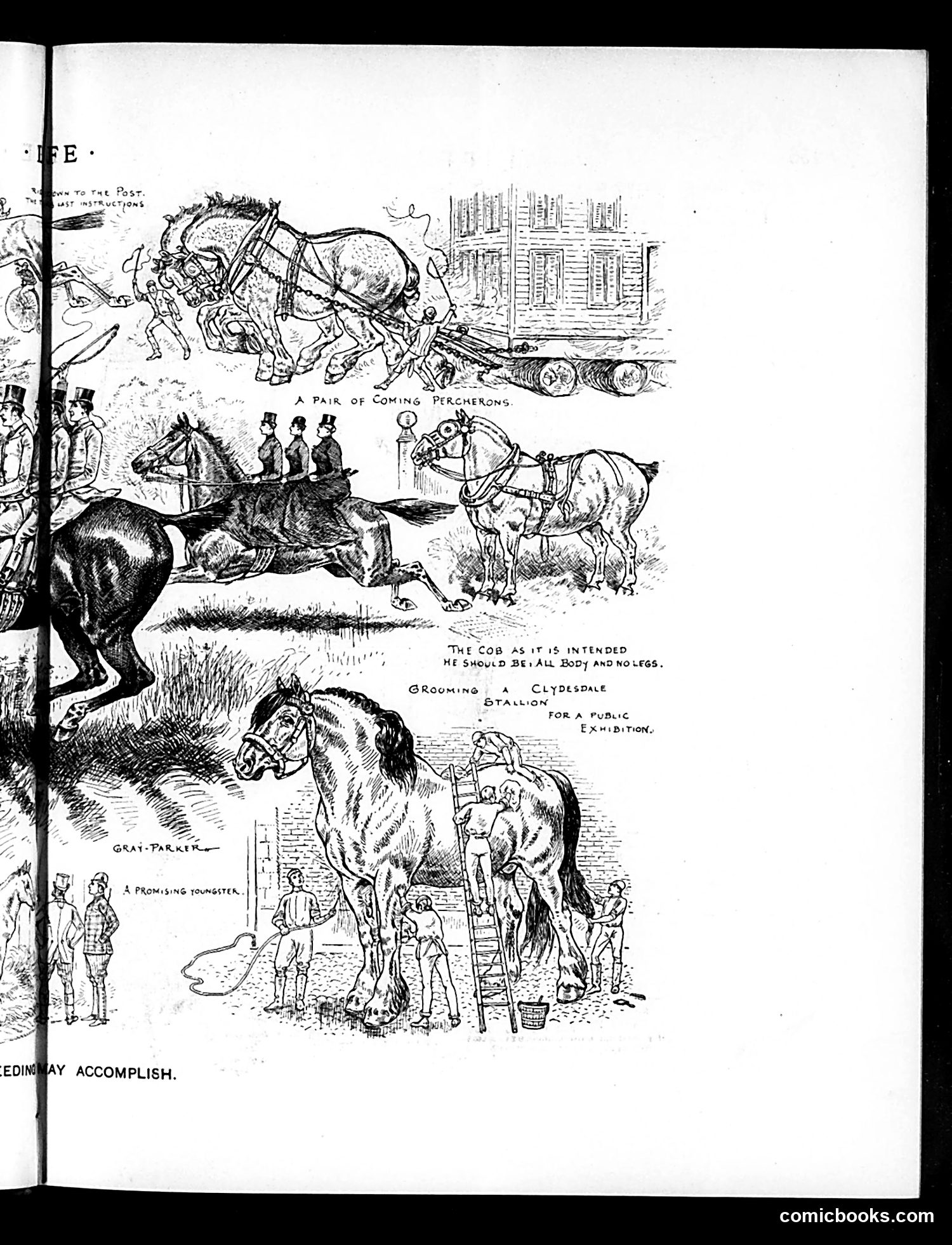
This page contains three satirical sketches about horses and equestrian topics: 1. **"A Pair of Coming Percherons"** - depicts large draft horses pulling a heavy load, likely satirizing something contemporary (unclear without additional context). 2. **"The Cob as it is Intended"** - shows a stocky horse breed with the caption "He should be a full body and no legs," poking fun at breed standards or horse show conventions. 3. **"Grooming a Clydesdale Stallion for a Public Exhibition"** - the largest sketch, illustrates attendants grooming and presenting a massive Clydesdale horse, satirizing the excessive preparation and artificiality involved in competitive horse showing. The humor appears to target the pretentiousness of equestrian culture and breed standards in what was likely the late 19th or early 20th century.
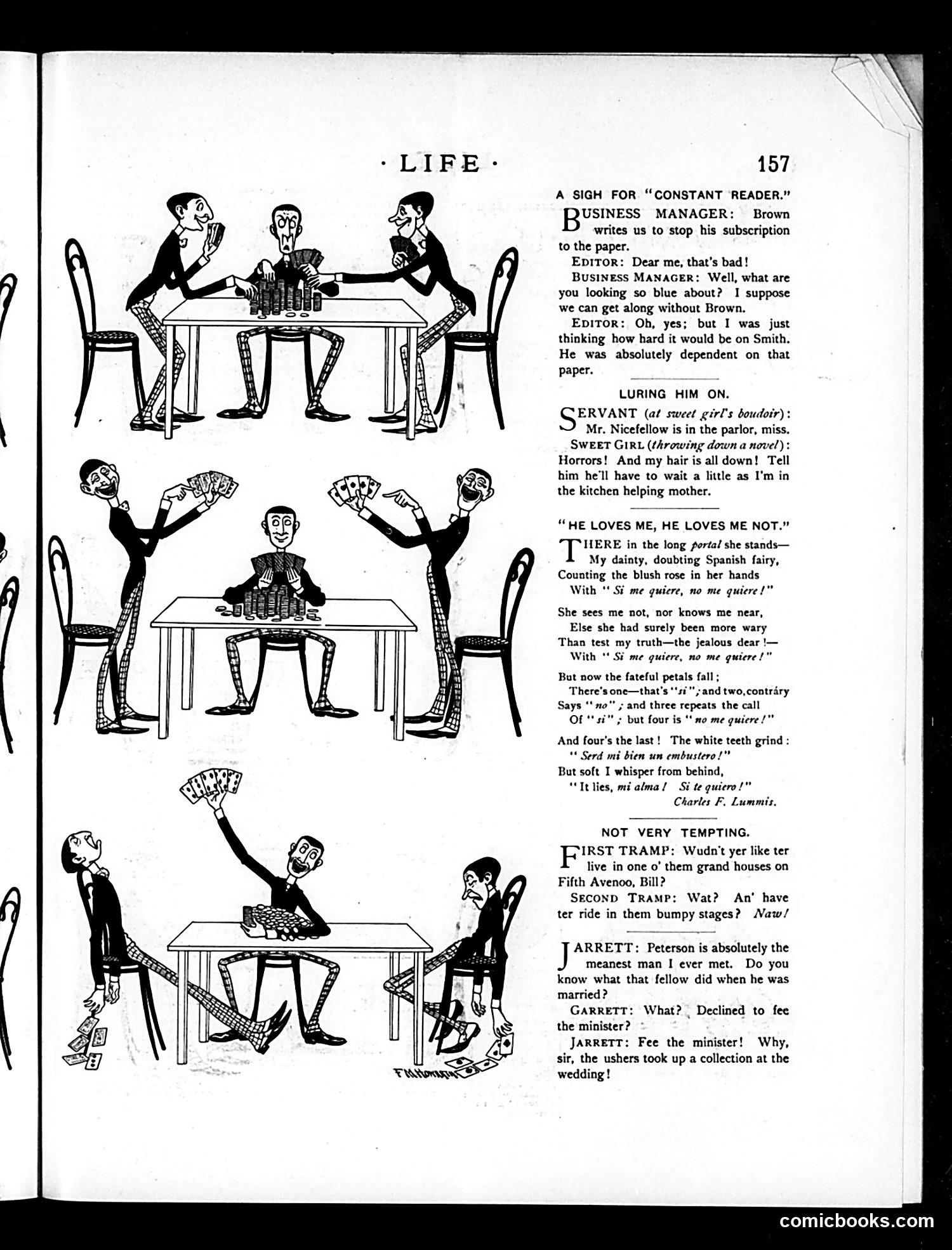
This page contains four unrelated humor pieces typical of early 20th-century Life magazine: **"A Sigh for Constant Reader"**: An editor and business manager discuss losing a subscriber named Brown. The joke is the editor's concern isn't about losing Brown himself, but about how losing the paper will hurt "Smith"—implying the editor assumes readers depend on Life for something essential (likely social standing or intellectual credibility). **"Luring Him On"**: A servant announces a gentleman caller while the young woman claims she's helping mother in the kitchen—a joke about the elaborate social pretense young women maintained around suitors. **"He Loves Me, He Loves Me Not"**: A romantic poem about a Spanish woman plucking rose petals using the phrase "Si me quiere, no me quiere" (he loves me, he loves me not), with a male observer ultimately declaring his devotion. **"Not Very Tempting" and other items**: Brief conversational jokes about homelessness and miserliness—standard period humor relying on class stereotypes and exaggeration for effect.
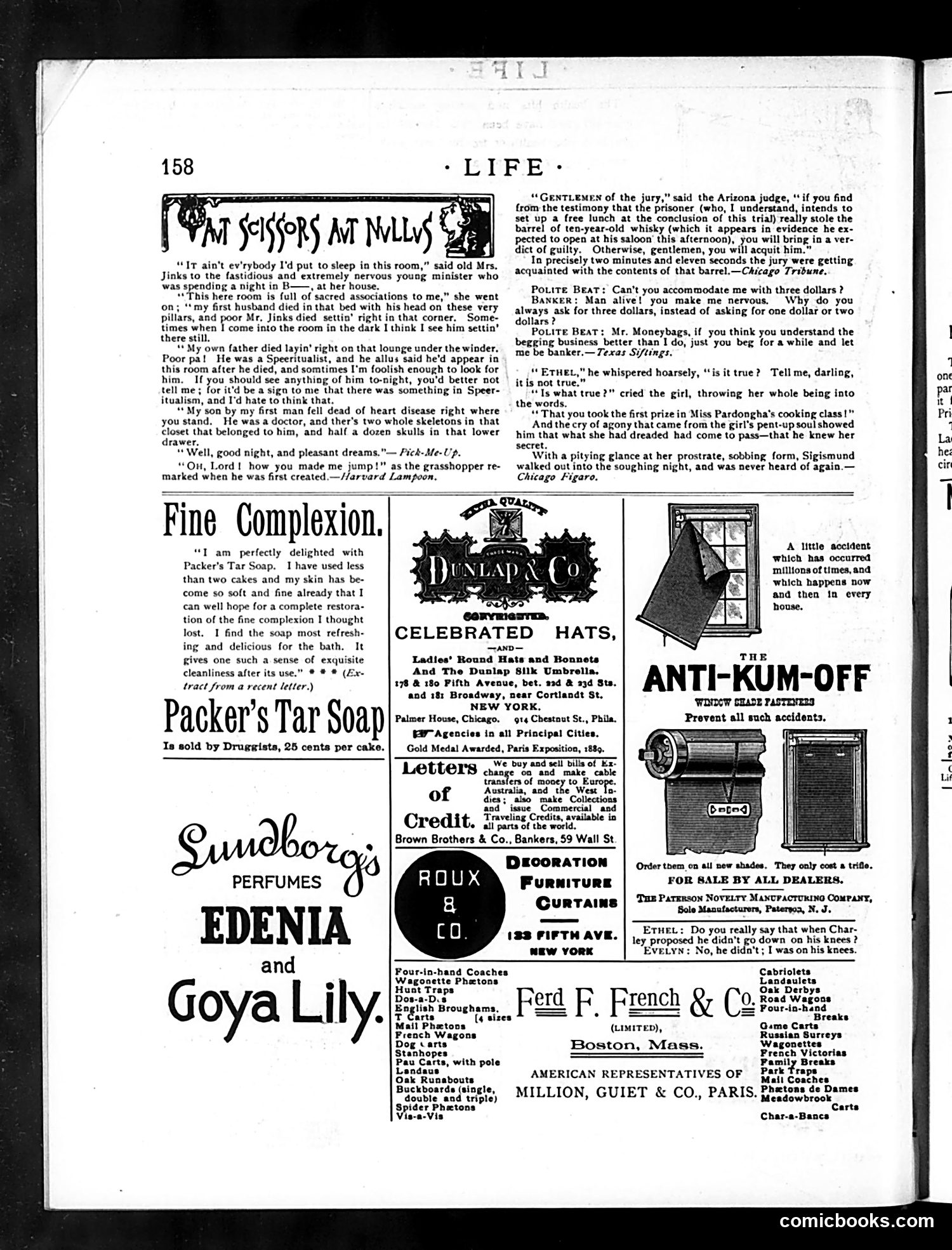
This is primarily a **humor page** with multiple brief comedic anecdotes rather than a political cartoon. The title piece "Señors at Mully's" depicts a comedic vignette: a nervous young minister is invited to sleep at Mrs. Jinks's house, and she regales him with macabre details about the room—multiple deaths of relatives (husband, father, son), skeletons in closets, and her late husband's ghost potentially appearing. The humor comes from the minister's mounting discomfort as she casually catalogs these death associations while trying to settle him for sleep. The additional anecdotes below include stories about an Arizona judge whose jury acquits a defendant after learning he'll provide free whisky; a beggar's witty response to a banker about borrowing money; and a dramatic scene where a man discovers his fiancée lost a cooking competition. The humor is **Victorian-era domestic and social satire**—focusing on class differences, nervous propriety, and absurd situations rather than politics. The page is otherwise filled with **period advertisements** for soap, hats, furniture, and perfumes.
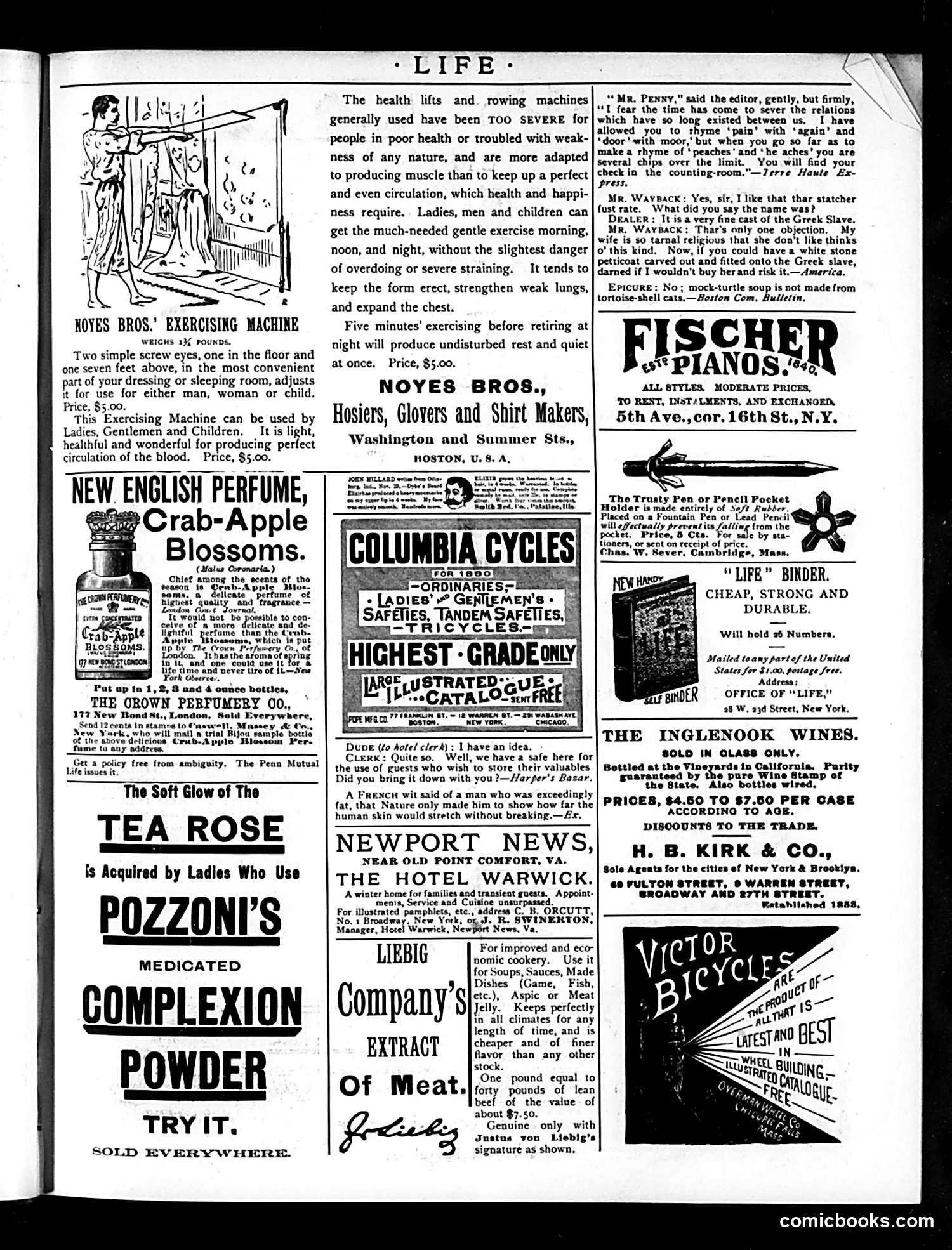
This page is primarily **advertising**, featuring various health and beauty products typical of the late 19th/early 20th century: exercising machines, perfumes, complexion powder, bicycles, pianos, and food extracts. However, there are **two brief satirical items**: 1. **"Dude" joke**: A hotel clerk asks if a guest brought down a safe himself—humor based on the stereotype of wealthy "dudes" as incompetent or dependent on servants. 2. **"Mr. Penny" editorial cartoon**: An editor fires a poet for terrible rhymes ("peaches"/"he aches"), mocking bad verse and Victorian publication standards. The humor relies on readers' familiarity with poetry submission rejections and editorial standards of the era. Both jokes reflect period concerns with social pretension and cultural literacy. The page's bulk—however—is commercial promotion of products claiming health and beauty benefits, demonstrating how *Life* magazine funded itself through advertising.
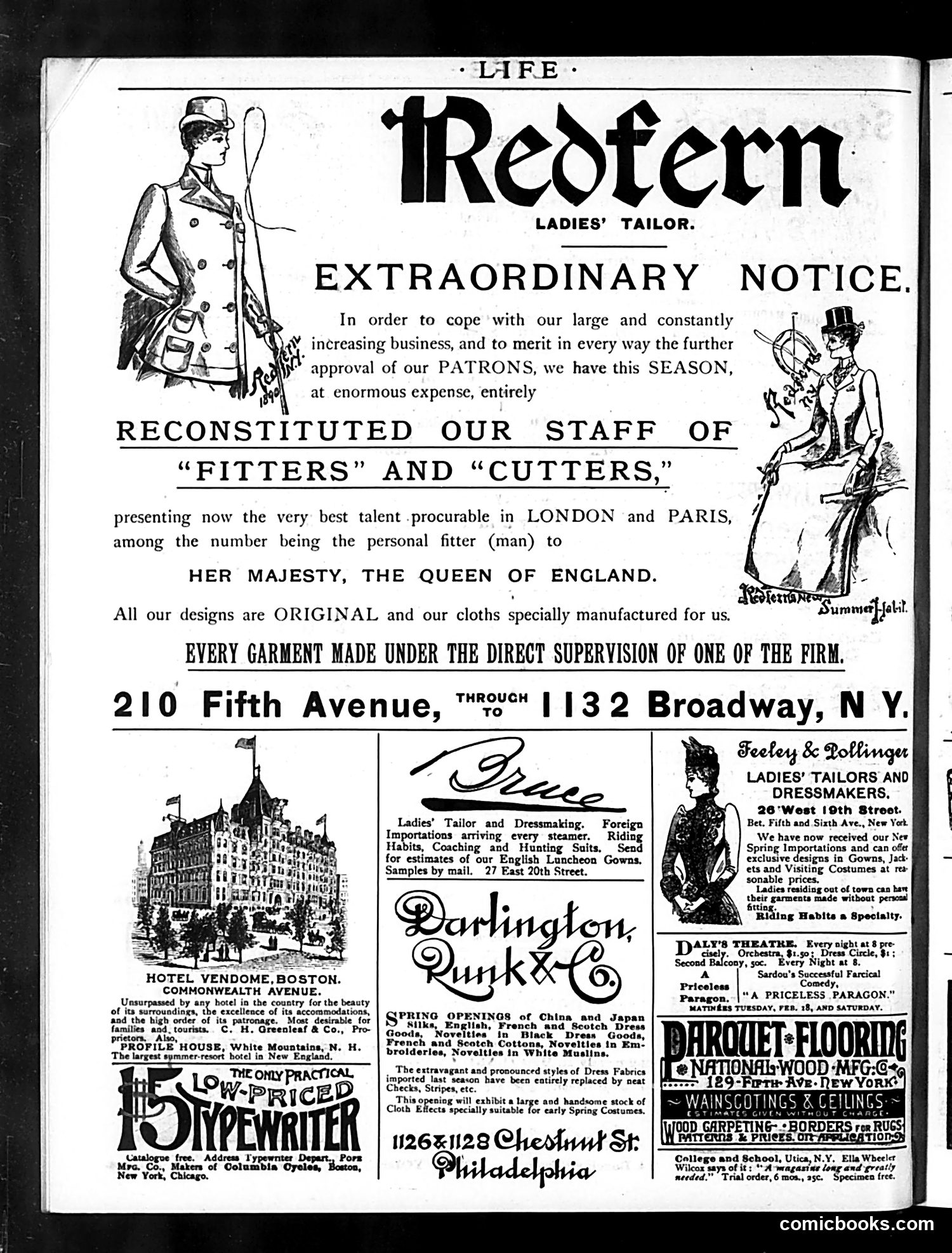
This page is primarily a **fashion advertisement**, not a political cartoon. The Redfern ladies' tailor company announces a major staffing upgrade for the spring season. The key claim: Redfern has hired the "personal fitter (man) to Her Majesty, the Queen of England"—likely Queen Victoria, given the era. This is their main selling point to customers, suggesting royal patronage enhances their credibility and prestige. The two illustrated figures on the page appear to be fashionable women modeling the tailor's work, dressed in contemporary ladies' clothing with fitted jackets and elaborate details typical of the period. The satirical element, if any, is subtle: the advertisement's boastful tone about hiring "the very best talent procurable in London and Paris" and emphasizing the Queen's personal fitter may be gently mocking the fashion industry's obsession with aristocratic credentials and expensive European imports—a common target of *Life* magazine's satire.
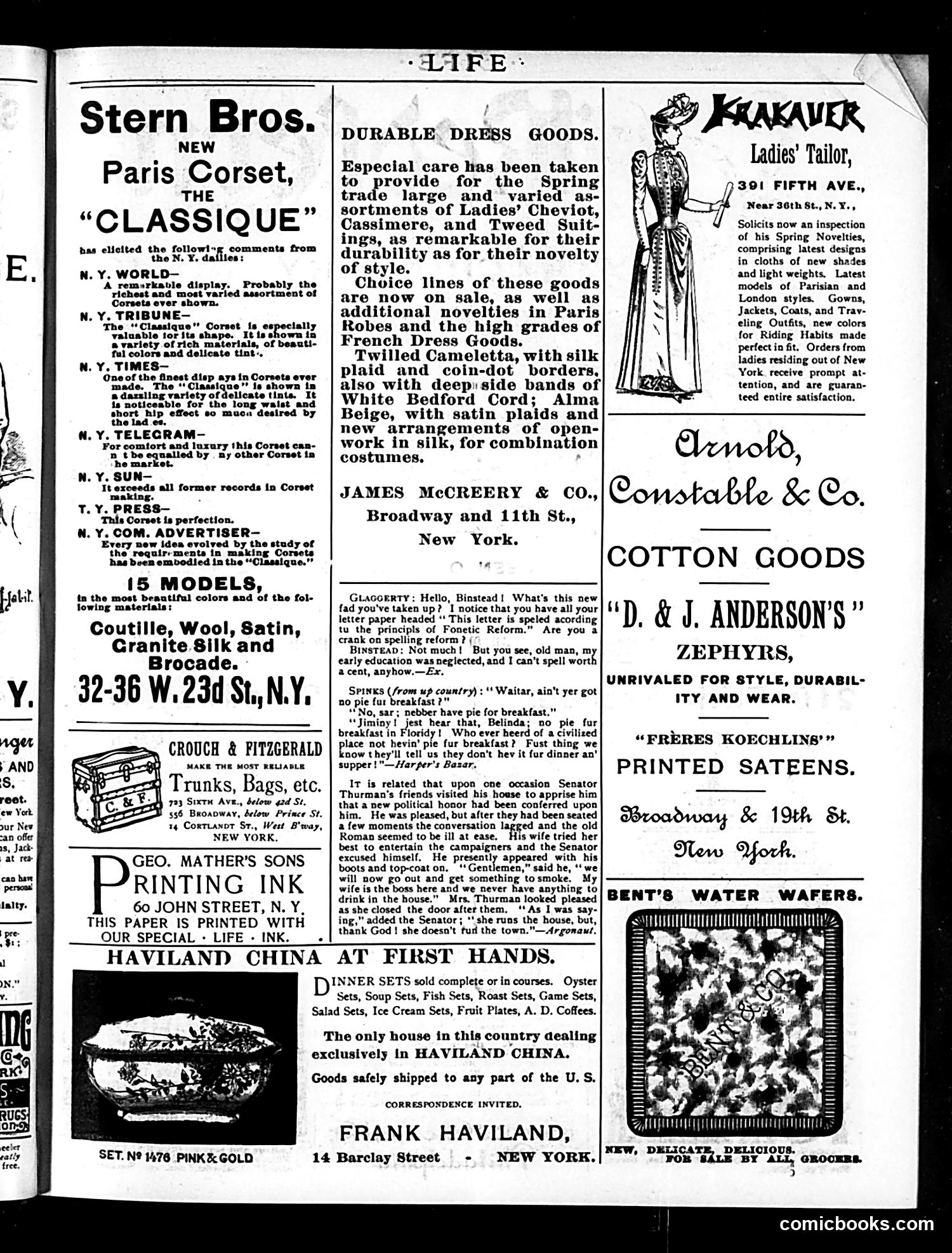
This is primarily an **advertisement page** from Life magazine featuring fashion, home goods, and printing services (corsets, dress goods, china, trunks, printing ink). The page includes three **humorous anecdotes** rather than political cartoons: 1. **"Spelling Reform"**: A joke about someone claiming to use "phonetic spelling" on letterhead—revealed as just poor education, not principle. 2. **"No Pie for Breakfast"**: A country visitor shocked that Florida lacks pie at breakfast, treating it as a civilized necessity. 3. **Senator Thurman anecdote**: An elderly politician's wife runs the household so strictly he must leave to smoke with guests, leading to his quip that she controls the house but "thank God she doesn't run the town." These are light social humor pieces mocking spelling fads, regional customs, and domestic authority—typical of Life's satirical content. No specific political figures are targeted beyond the apparently well-known Senator Thurman reference.
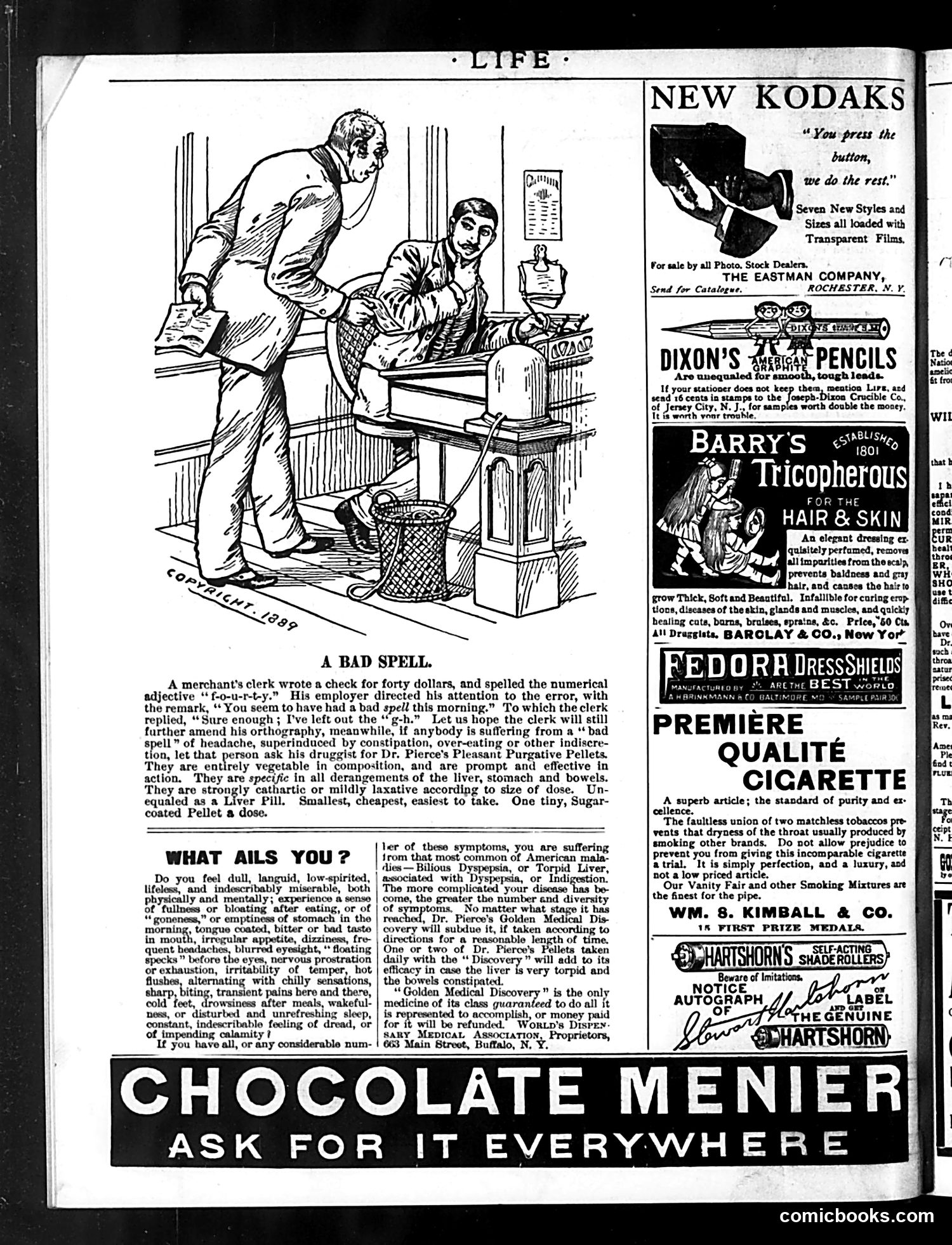
This page centers on a simple pun-based joke. A merchant's clerk misspells "forty" as "f-o-u-r-t-y" (omitting the 'g-h'), prompting his employer to remark the clerk has had a "bad spell"—a play on words meaning both a spelling error and a temporary affliction. The cartoon illustrates this wordplay with two figures in an office setting, with the employer pointing out the mistake to the embarrassed clerk. The humor relies on the double meaning of "spell," which was accessible to 19th-century readers familiar with both spelling errors and the phrase "bad spell" (meaning temporary illness). The remainder of the page is **primarily advertising**—patent medicines, photography equipment (Kodak cameras), pencils, hair products, and cigarettes—typical of Life magazine's revenue model at this period.
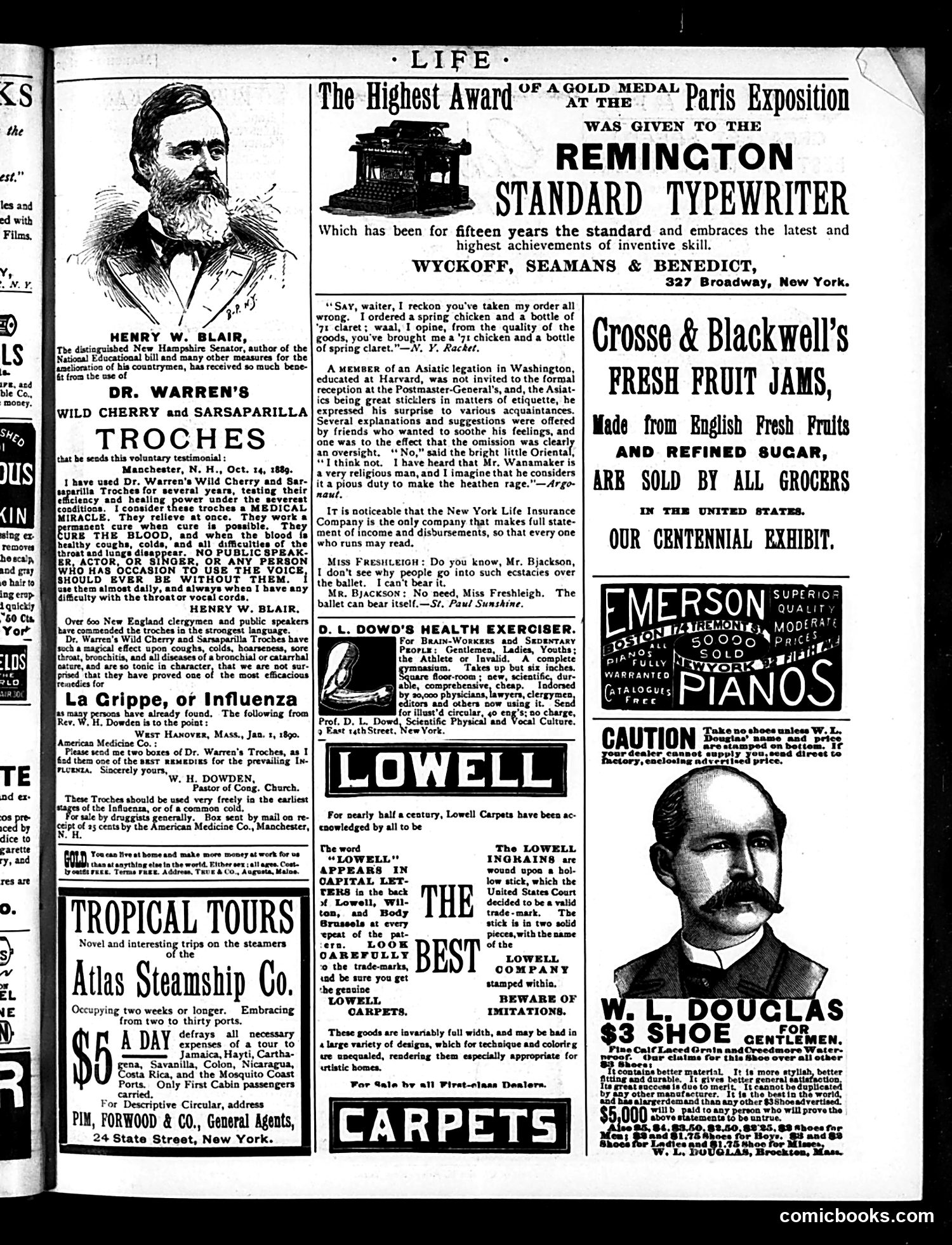
This is primarily an **advertising page** from Life magazine, not a political cartoon. The page features commercial advertisements interspersed with brief humorous anecdotes and jokes—typical of the magazine's format. **Key content:** The largest advertisements are for the Remington Standard Typewriter (which won a Paris Exposition award) and Lowell Carpets. Other ads promote Dr. Warren's medicinal troches, Crosso & Blackwell jams, Emerson pianos, W.L. Douglas shoes, and tropical tours. **The humor pieces** include a waiter joke (ordering a "spring chicken" and receiving an actual young chicken), an anecdote about an Asian diplomat omitted from a reception, and a brief joke about ballet dancing. **For modern readers:** This reflects the era's advertising conventions and patent medicines (commonplace before FDA regulation). The diplomat joke hints at diplomatic protocol concerns of the period. The page shows how Life mixed humor with commercial promotion for its audience of educated, middle-class readers.
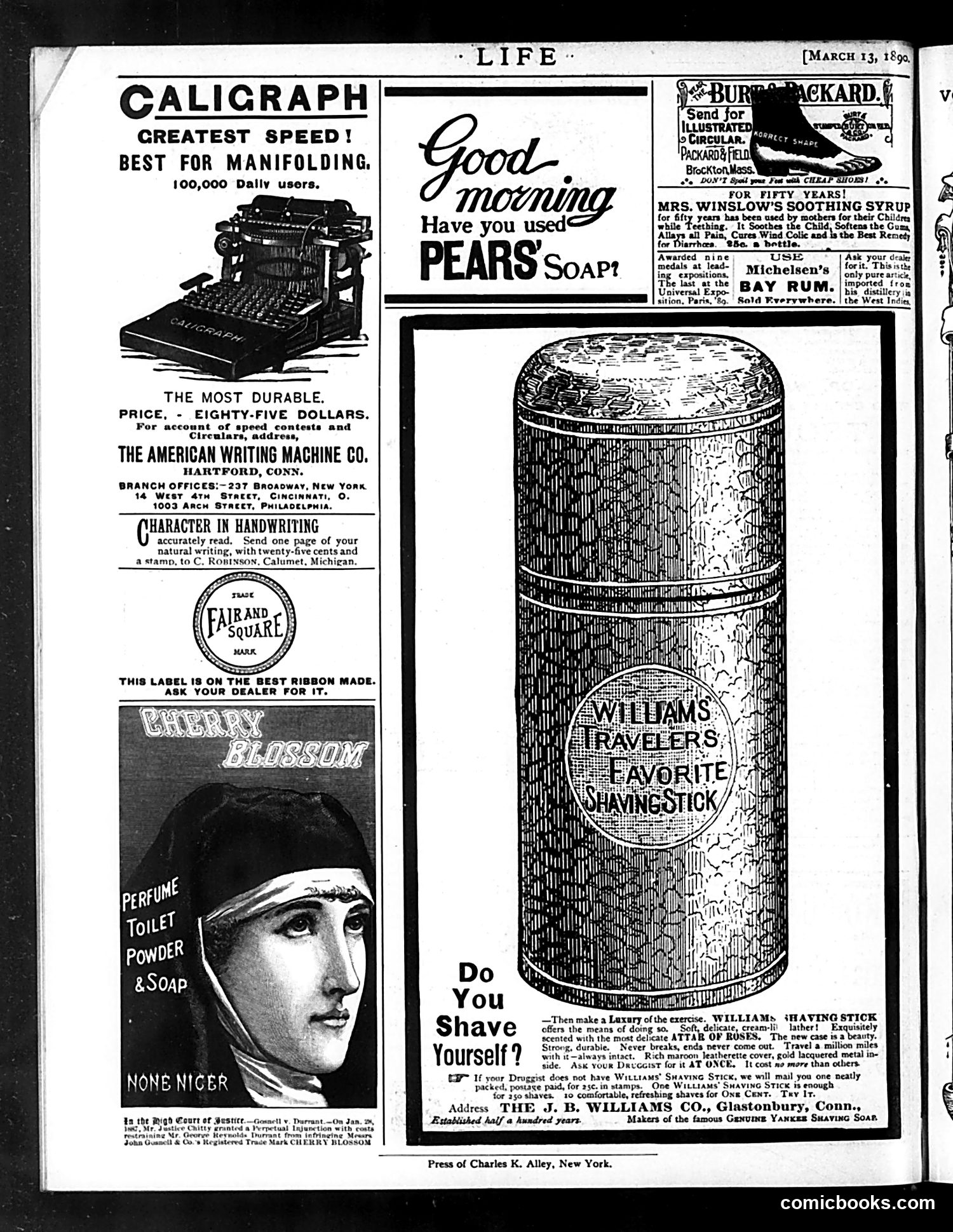
This page is **primarily advertisements**, not satire or political commentary. It showcases various consumer products typical of the 1890s: - **Caligraph typewriter**: marketed as fastest and most durable at $85 - **Pears' Soap**: a greeting-card style ad asking "Have you used Pears' Soap?" - **Mrs. Winslow's Soothing Syrup**: a patent medicine for teething babies (note: such products often contained opiates, now recognized as harmful) - **Williams' Traveler's Favorite Shaving Stick**: emphasizing luxury grooming The page includes a character-reading service advertisement and mentions a legal case involving George Bernard Shaw (though details are unclear from the OCR). For modern readers: this reflects an era when patent medicines made unregulated health claims, and advertising aggressively marketed new technologies (typewriters) and consumer goods as luxuries. The "shaving stick" ad's emphasis on leisure and travel reveals aspirational marketing to middle-class readers.