
Life, 1890-03-13 · page 6 of 20
Life — March 13, 1890 — page 6: what you’re looking at
What you’re looking at
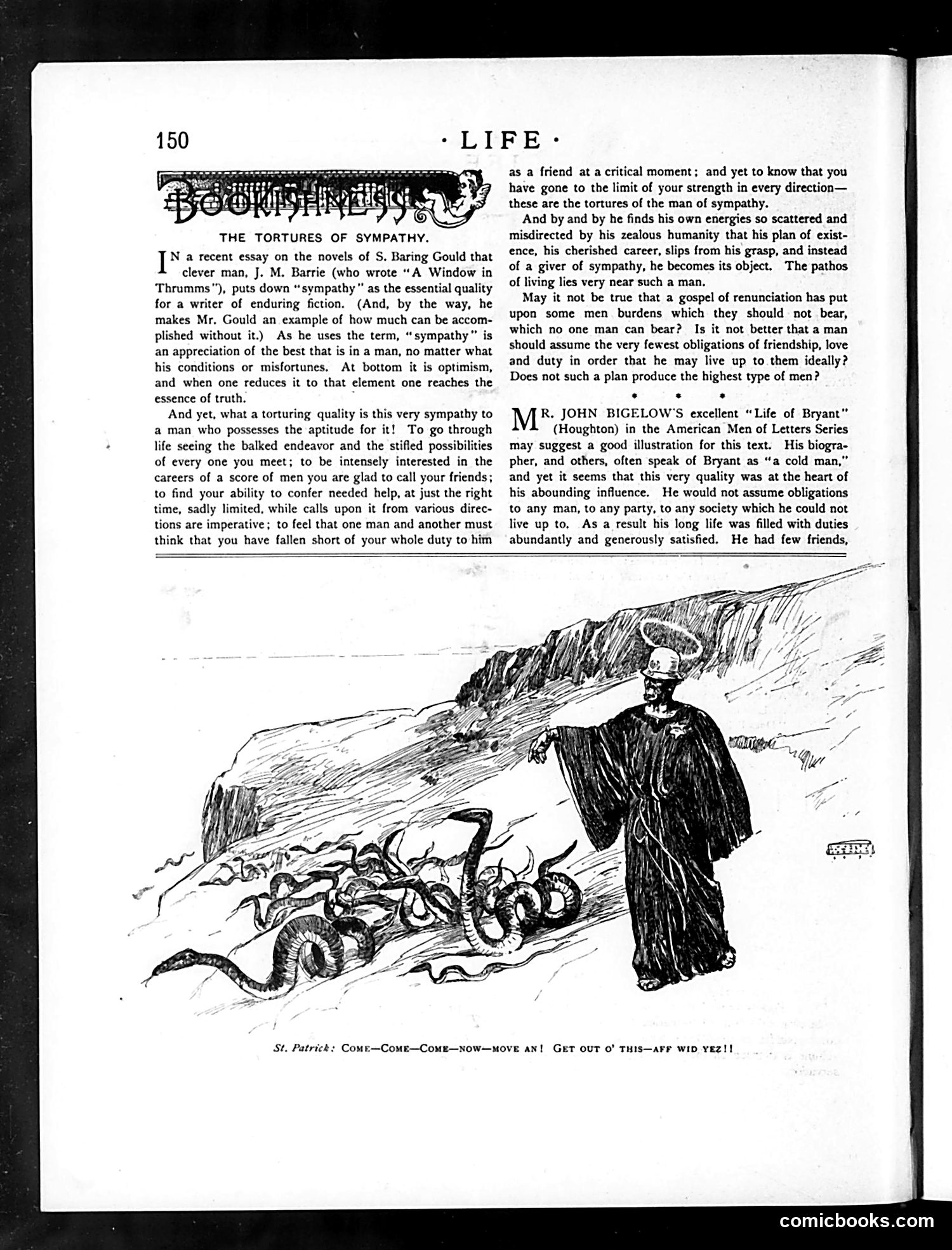
This page discusses S. Baring Gould's novels, praising "sympathy" as essential to good fiction while warning of its dangers. The article argues that excessive sympathy can become a burden—forcing people to help others beyond reasonable obligation and leaving them feeling they've failed their duty. The accompanying cartoon illustrates this torment. It shows St. Patrick struggling with a mass of snakes, with the caption "Come-Come-Come-now-move an! Get out of this-aff wid yez!!" The image uses the saint's legendary snake-banishing as a metaphor: just as St. Patrick battled persistent snakes, the sympathetic person battles unending demands from those seeking help. The satire suggests sympathy, however well-intentioned, can become an exhausting, inescapable burden.
📄 Transcribed text from this page (OCR, searchable)
Machine-transcribed from the original scan — historical spelling and the odd misread are preserved.
- LIFE: THE TORTURES OF SYMPATHY. N a recent essay on the novels of S, Baring Gould that clever man, J. M. Barrie (who wrote “A Window in Thrumms”), puts down “sympathy” as the essential quality for a writer of enduring fiction. (And, by the way, he makes Mr. Gould an example of how much can be accom- plished without it.) As he uses the term, “sympathy” is an appreciation of the best that is in a man, no matter what his conditions or misfortunes, At bottom it is optimism, and when one reduces it to that element one reaches the essence of truth. And yet, what a torturing quality is this very sympathy to a man who possesses the aptitude for it! To go through life seeing the balked endeavor and the stifled possibilities of every one you meet; to be intensely interested in the careers of a score of men you are glad to call your friends; to find your ability to confer needed help, at just the right time, sadly limited, while calls upon it from various direc- tions are imperative ; to feel that one man and another must think that you have fallen short of your whole duty to him as a friend at a critical moment; and yet to know that you have gone to the limit of your strength in every direction— these are the tortures of the man of sympathy. And by and by he finds his own energies so scattered and misdirected by his zealous humanity that his plan of exist- ence, his cherished career, slips from his grasp, and instead of a giver of sympathy, he becomes its object. The pathos of living lies very near such a man, May it not be true that a gospel of renunciation has put upon some men burdens which they should not bear, which no one man can bear? Is it not better that a man should assume the very fewest obligations of friendship, love and duty in order that he may live up to them ideally? Does not such a plan produce the highest type of men? . . . R. JOHN BIGELOW'S excellent “Life of Bryant” (Houghton) in the American Men of Letters Series may suggest a good illustration for this text. His biogra- pher, and others, often speak of Bryant as “a cold man,” and yet it seems that this very quality was at the heart of his abounding influence. He would not assume obligations to any man, to any party, to any society which he could not live up to, As a result his long life was filled with duties abundantly and generously satisfied. He had few friends, St. Patrick: Come—ComE—Come—Now—MOVE AN! GET OUT 0’ THIS—AFF WID YEz!! comicbooks.com