
Life, 1890-03-13 · page 4 of 20
Life — March 13, 1890 — page 4: what you’re looking at
What you’re looking at
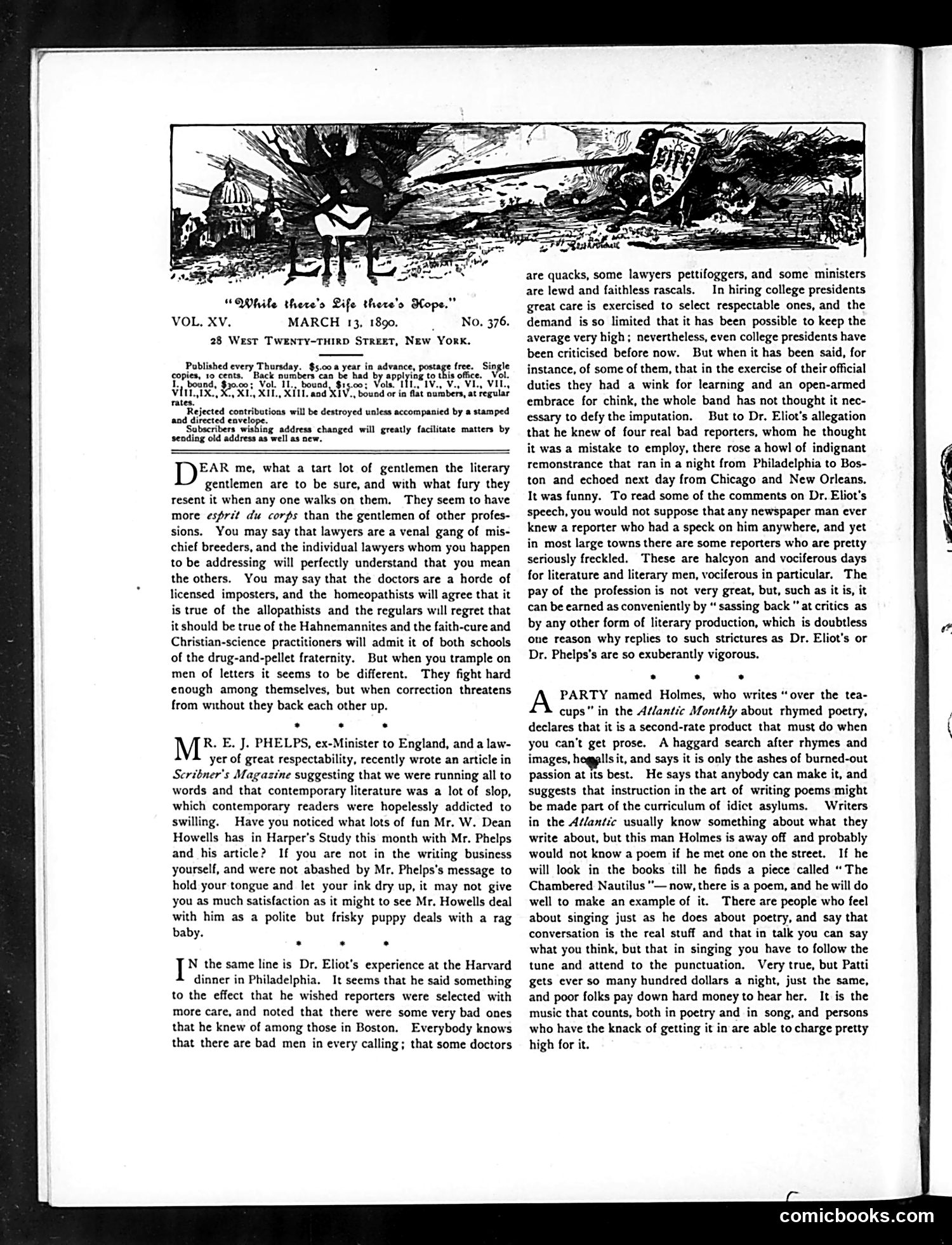
The visible masthead cartoon depicts a cherub or allegorical figure amid classical architecture and clouds—a typical decorative header for the era. The text itself contains no political cartoon, but rather satirical commentary on American professionals. The author critiques lawyers as "a venal gang of mischief-breeders," doctors as often incompetent, and college presidents as sometimes disreputable. A specific anecdote mocks Dr. E.J. Phelps (ex-Minister to England), who allegedly complained about newspaper reporters' quality. The piece sardonically notes that even literary figures like Dr. Eliot experienced poor-quality journalism. The satire targets the low standards of American professional classes—suggesting that lawyers, doctors, and educators were frequently unqualified or corrupt, while simultaneously mocking the mediocre reporters covering them.
📄 Transcribed text from this page (OCR, searchable)
Machine-transcribed from the original scan — historical spelling and the odd misread are preserved.
“Mile there's Life there's Hope.” VOL. XV. MARCH 13, 1890. No. 376. 28 West TWENTY-THIRD STREET, NEw YoRK. Published every Thursday. $5.00 a year in advance, postage free. Sent Back numbers can be had by applying to to this ofice. Vol. I1., bound, $15.00; Vol IT, X11, and XIV., bound or in flat numbers, ve regelst Rejected contributions will be destroyed unless accompanied by a stamped and directed envel: Subscribers wis! ing address changed will greatly facilitate matters by sending old address as well as new. EAR me, what a tart lot of gentlemen the literary gentlemen are to be sure, and with what fury they resent it when any one walks on them. They seem to have more esprit du corps than the gentlemen of other profes- sions. You may say that lawyers are a venal gang of mis- chief breeders, and the individual lawyers whom you happen to be addressing will perfectly understand that you mean the others. You may say that the doctors are a horde of licensed imposters, and the homeopathists will agree that it is true of the allopathists and the regulars will regret that it should be true of the Hahnemannites and the faith-cure and Christian-science practitioners will admit it of both schools of the drug-and-pellet fraternity. But when you trample on men of letters it seems to be different. They fight hard enough among themselves, but when correction threatens from without they back each other up. . . . R. E. J. PHELPS, ex-Minister to England, and a law- yer of great respectability, recently wrote an article in Scribner's Magazine suggesting that we were running all to words and that contemporary literature was a lot of slop, which contemporary readers were hopelessly addicted to swilling. Have you noticed what lots of fun Mr. W. Dean Howells has in Harper's Study this month with Mr. Phelps and his article? If you are not in the writing business yourself, and were not abashed by Mr. Phelps's message to hold your tongue and let your ink dry up, it may not give you as much satisfaction as it might to see Mr. Howells deal with him as a polite but frisky puppy deals with a rag baby. . . . N the same line is Dr. Eliot's experience at the Harvard dinner in Philadelphia. It seems that he said something to the effect that he wished reporters were selected with more care, and noted that there were some very bad ones that he knew of among those in Boston. Everybody knows that there are bad men in every calling; that some doctors are quacks, some lawyers pettifoggers, and some ministers are lewd and faithless rascals. In hiring college presidents great care is exercised to select respectable ones, and the demand is so limited that it has been possible to keep the average very high; nevertheless, even college presidents have been criticised before now. But when it has been said, for instance, of some of them, that in the exercise of their official duties they had a wink for learning and an open-armed embrace for chink, the whole band has not thought it nec- essary to defy the imputation. But to Dr. Eliot's allegation that he knew of four real bad reporters, whom he thought it was a mistake to employ, there rose a howl of indignant remonstrance that ran in a night from Philadelphia to Bos- ton and echoed next day from Chicago and New Orleans. It was funny. To read some of the comments on Dr, Eliot's speech, you would not suppose that any newspaper man ever knew a reporter who had a speck on him anywhere, and yet in most large towns there are some reporters who are pretty seriously freckled. These are halcyon and vociferous days for literature and literary men, vociferous in particular. The pay of the profession is not very great, but, such as it is, it can be earned as conveniently by “ sassing back" at critics as by any other form of literary production, which is doubtless one reason why replies to such strictures as Dr. Eliot's or Dr. Phelps’s are so exuberantly vigorous. . . . PARTY named Holmes, who writes “over the tea- cups” in the Aé/antic Monthly about rhymed poetry, declares that it is a second-rate product that must do when you can’t get prose. A haggard search after rhymes and images, hogglls it, and says it is only the ashes of burned-out passion at its best. He says that anybody can make it, and suggests that instruction in the art of writing poems might be made part of the curriculum of idict asylums. Writers in the Ad/antic usually know something about what they write about, but this man Holmes is away off and probably would not know a poem if he met one on the street. If he will look in the books till he finds a piece called “The Chambered Nautilus “— now, there is a poem, and he will do well to make an example of it. There are people who feel about singing just as he does about poetry, and say that conversation is the real stuff and that in talk you can say what you think, but that in singing you have to follow the tune and attend to the punctuation. Very true, but Patti gets ever so many hundred dollars a night, just the same, and poor folks pay down hard money to hear her. It is the music that counts, both in poetry and in song, and persons who have the knack of getting it in are able to charge pretty high for it. comicbooks.com