
A complete issue · 14 pages · 1890
Life — January 16, 1890
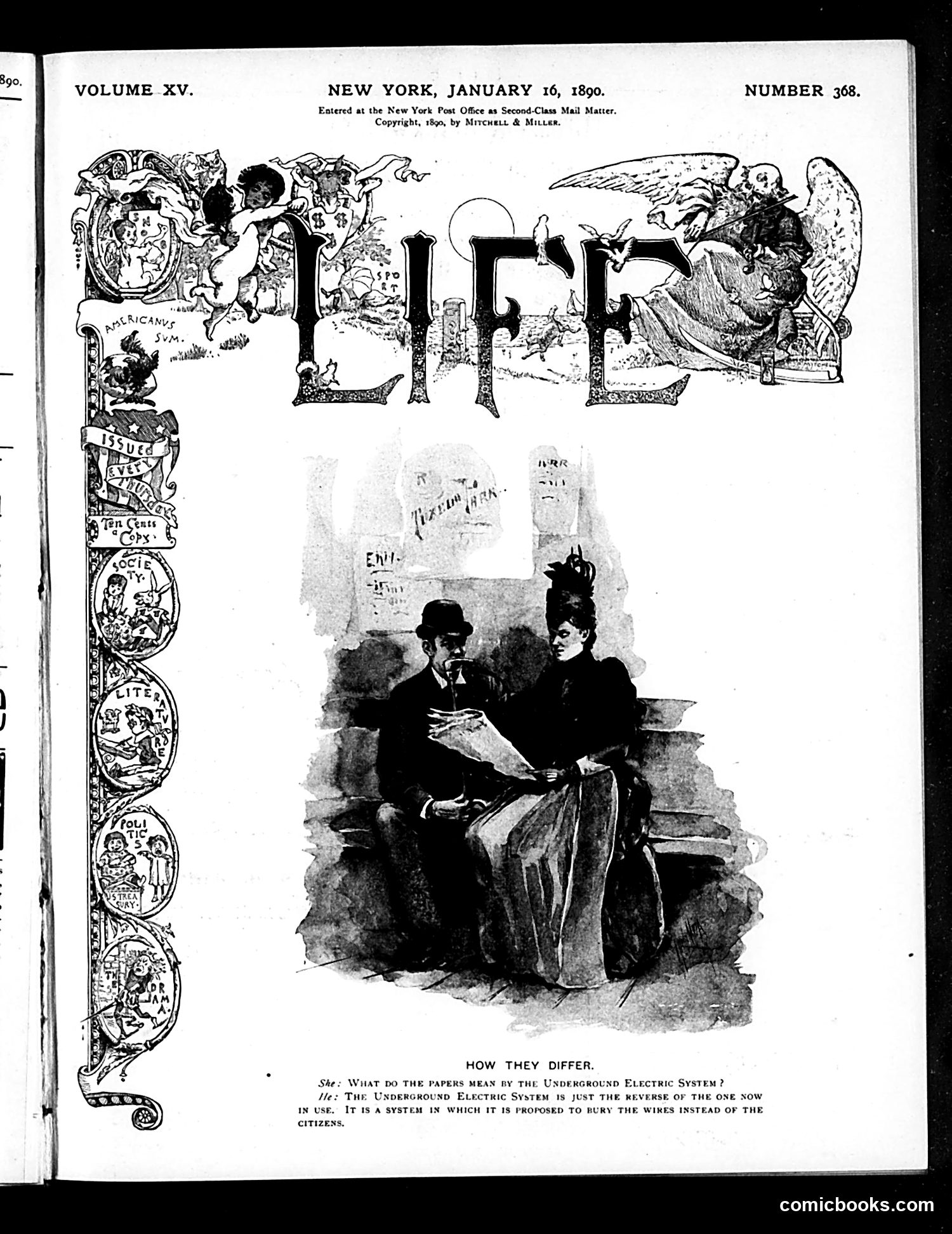
This page satirizes a debate over **underground electric systems** versus existing overhead electrical wiring infrastructure in New York City during the 1890s. The cartoon depicts two well-dressed men discussing competing electrical proposals. The caption indicates one supports burying electrical wires underground (the "Underground Electric System"), while the current system keeps wires overhead, strung across the city. The satire's point: the proposed underground system would simply reverse existing practice—burying wires instead of displaying them—rather than fundamentally solving the problem. The caption suggests this is a distinction without meaningful difference, mocking both systems as equally flawed approaches to urban electrical infrastructure. This reflects genuine 1890s debates about managing New York's rapidly expanding electrical networks and the dangers of overhead wires.
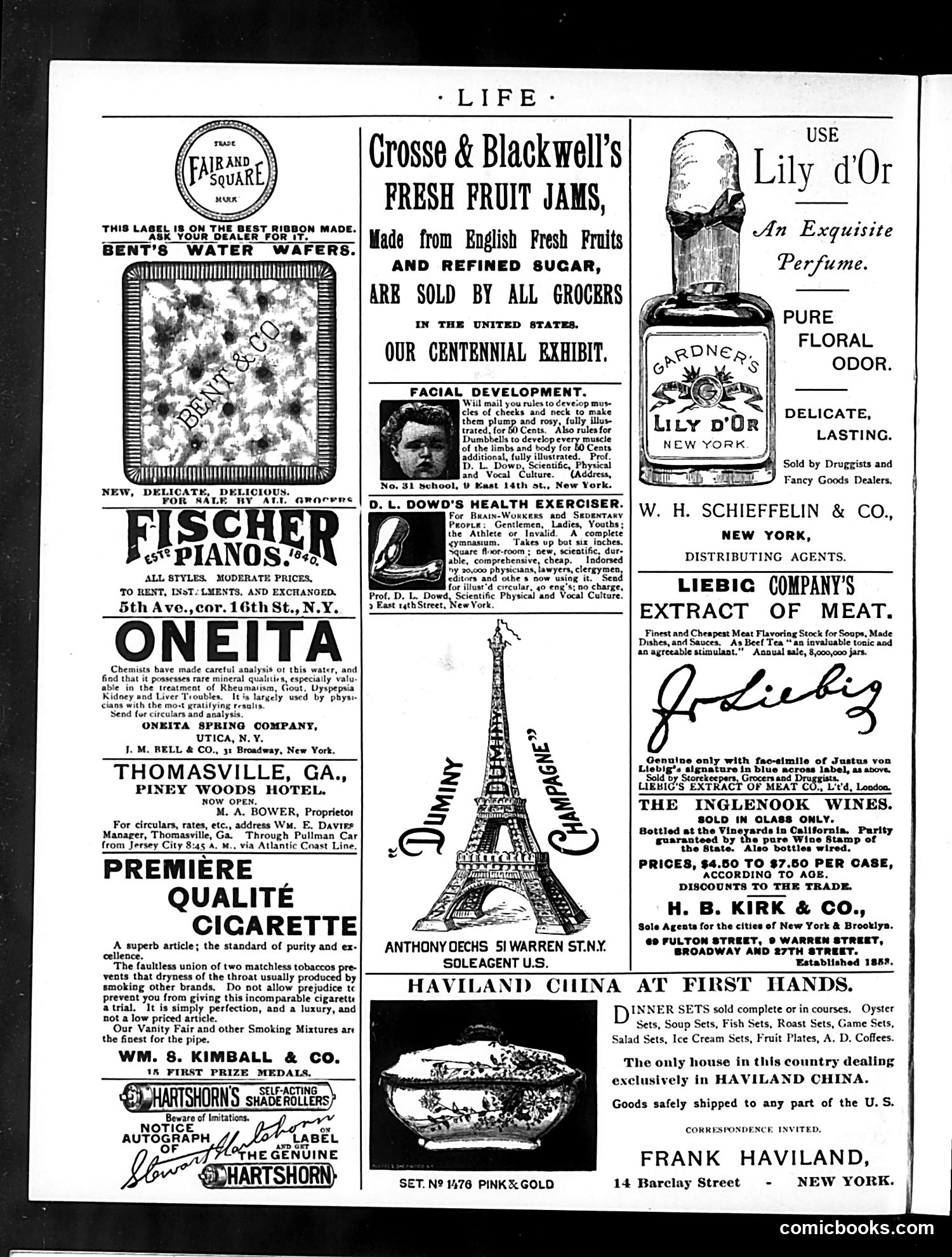
This page is **primarily advertisements**, not political satire or comics. It contains product endorsements typical of late 19th or early 20th-century Life magazine, including: - Bent's Water Wafers (crackers) - Fischer Pianos - Oneita mineral water - Lily d'Or perfume - Liebig's Extract of Meat - Haviland China - Various other consumer goods The only potentially illustrative content is the **Eiffel Tower image** with "Dummy's Important" text—likely a decorative advertisement for Anthony Oeches cigars in New York. The page functions as a **revenue-generating advertisement section** rather than editorial content with political or social commentary. No identifiable caricatures or satirical commentary appear present.
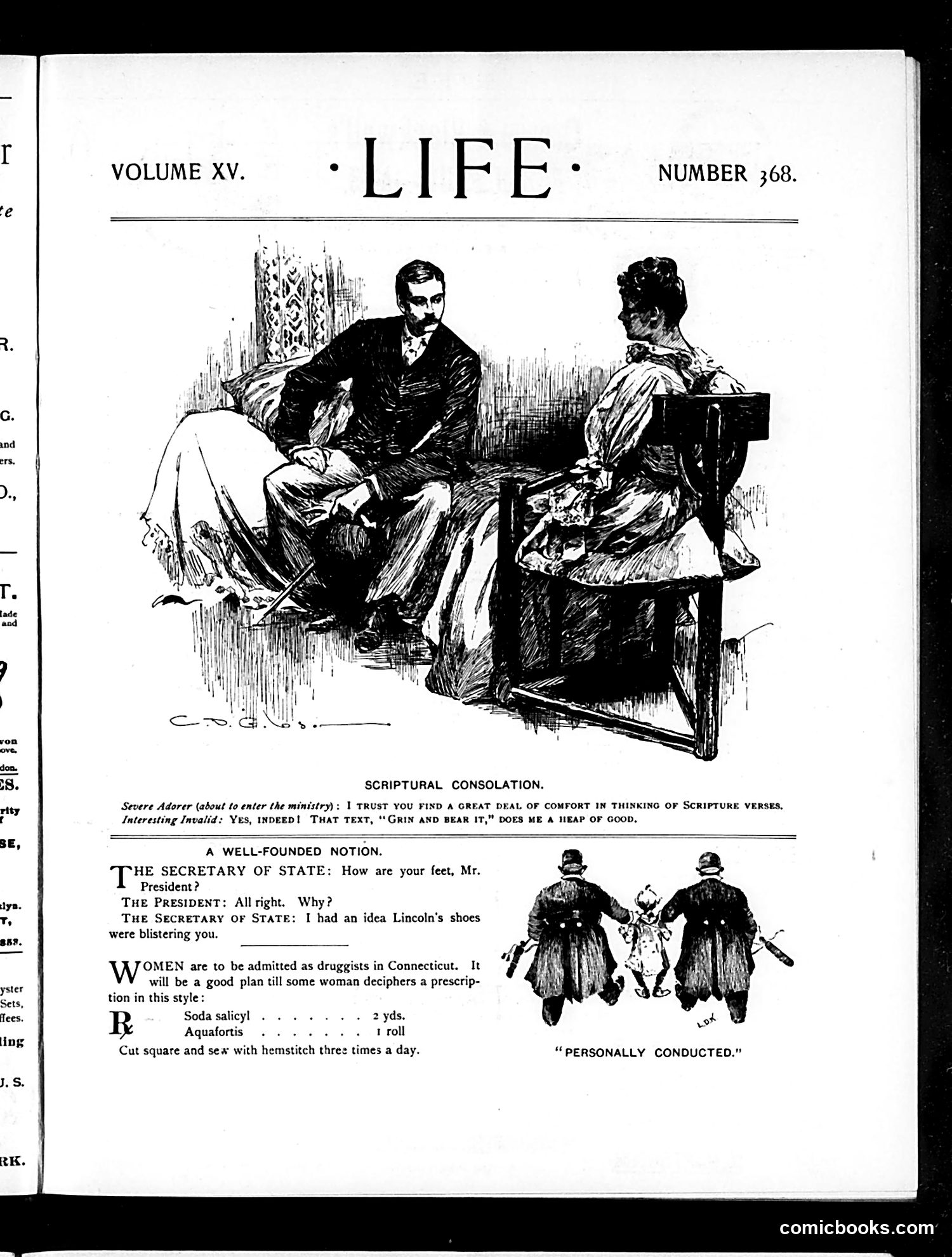
The top cartoon depicts a "Severe Adorer" visiting someone (likely a political or public figure) offering comfort through Bible verses, specifically "Grin and bear it." The satire suggests that religious platitudes are being offered as hollow consolation to someone facing difficulties. # "A Well-Founded Notion" This joke depicts a conversation between the Secretary of State and the President about the President's feet, with a reference to Lincoln's shoes blistering him. The humor relies on a pun: the Secretary mistakenly thought Lincoln's shoes were causing the President's discomfort, when the President was simply asking why his feet hurt. # "Personally Conducted" The bottom cartoon shows two large figures escorting a smaller figure between them, captioned "Personally Conducted," likely satirizing intrusive or controlling oversight of someone's affairs.
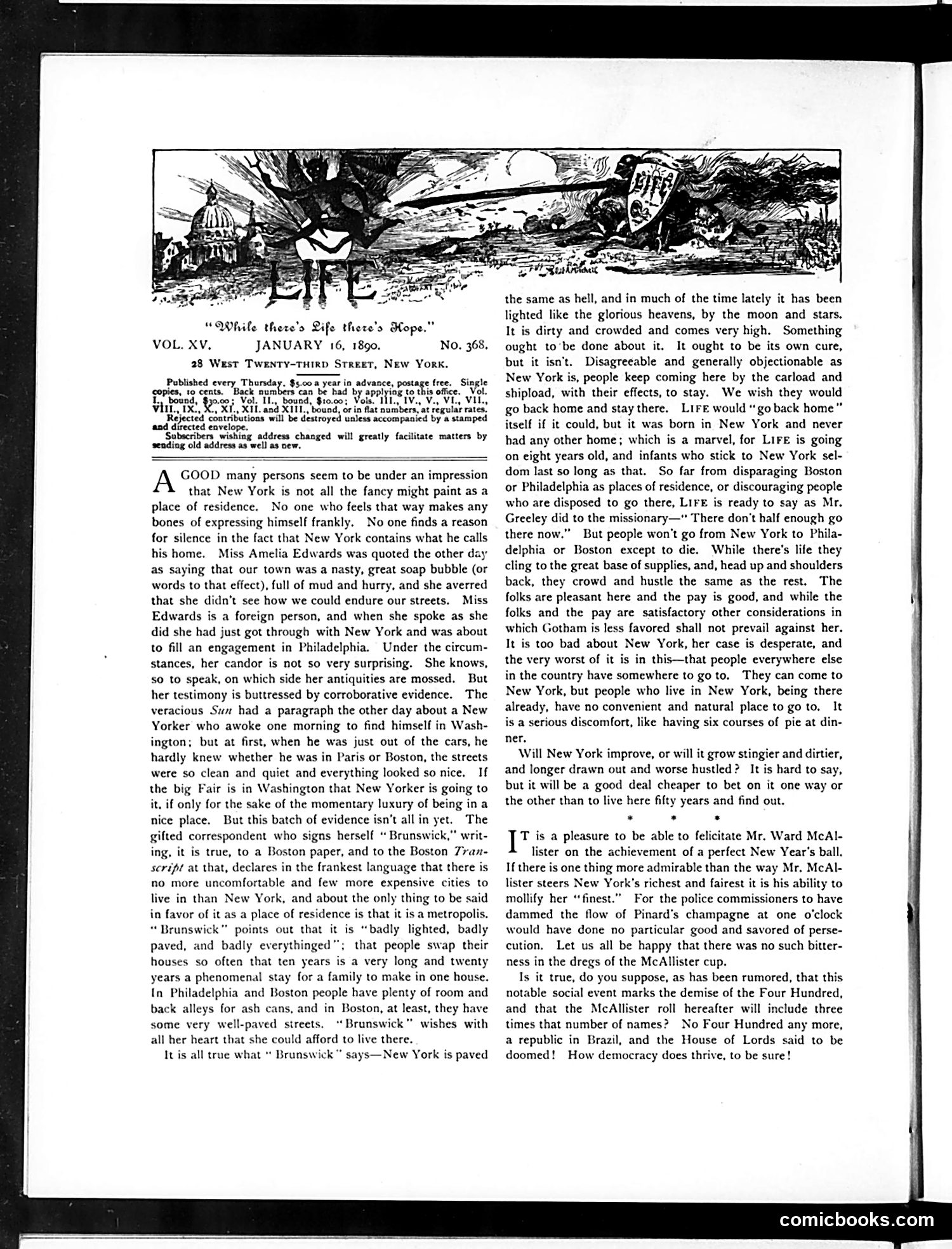
The masthead cartoon depicts a cityscape with classical architecture (dome visible left) and various urban scenes, illustrating the article's theme about New York City. The text is a satirical editorial criticizing New York as an undesirable place to live—dirty, crowded, and poorly maintained. The author argues that despite New York's reputation and status, people constantly leave for Boston, Philadelphia, and Washington, suggesting these cities offer superior living conditions. The piece references a specific incident: a New Yorker who woke in Washington unable to remember how he arrived, apparently having been intoxicated. The satire uses this anecdote to mock New York's chaotic nature. The final section mentions Mr. Ward McAllister and the McAllister Cup, referencing high society and New Year's celebrations, though the exact context remains unclear from this excerpt.
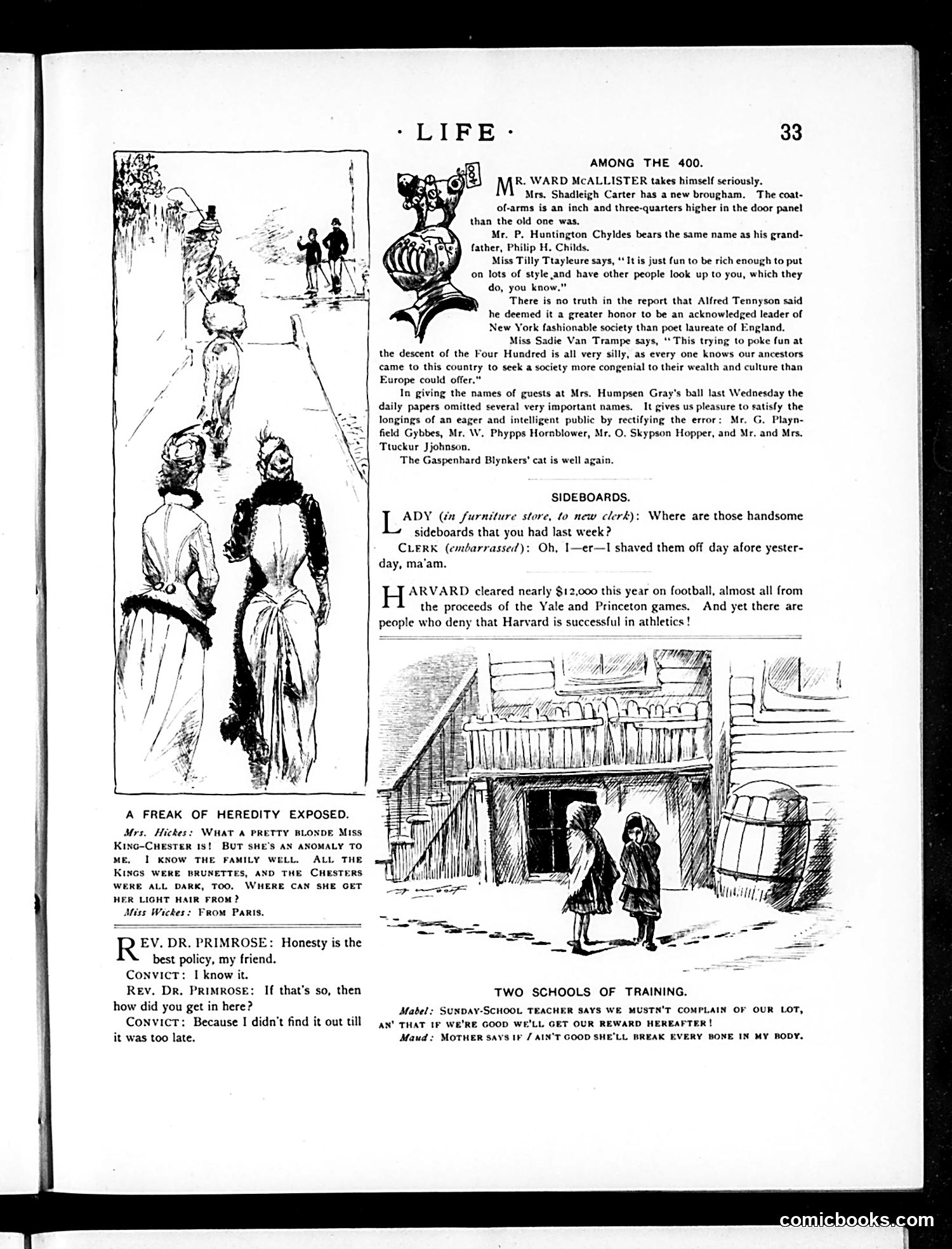
This page contains several social satirical items: **"Among the 400"** section mocks New York's wealthy elite. It reports on prominent society families and their activities with light ridicule—noting absurdities like boasting about ancestors and pretending to humble origins despite obvious wealth. **"A Freak of Heredity Exposed"** cartoon jokes about a blonde child born to dark-haired parents, questioning paternity with humor typical of period gossip columns. **"Sideboards"** is a brief humorous exchange about furniture removal. **"Two Schools of Training"** contrasts a Sunday-school teacher's optimism about reward with a mother's cynical expectation of physical punishment—satirizing different parenting philosophies. The overall tone targets aristocratic pretension and social hypocrisy through gentle mockery rather than sharp political critique.
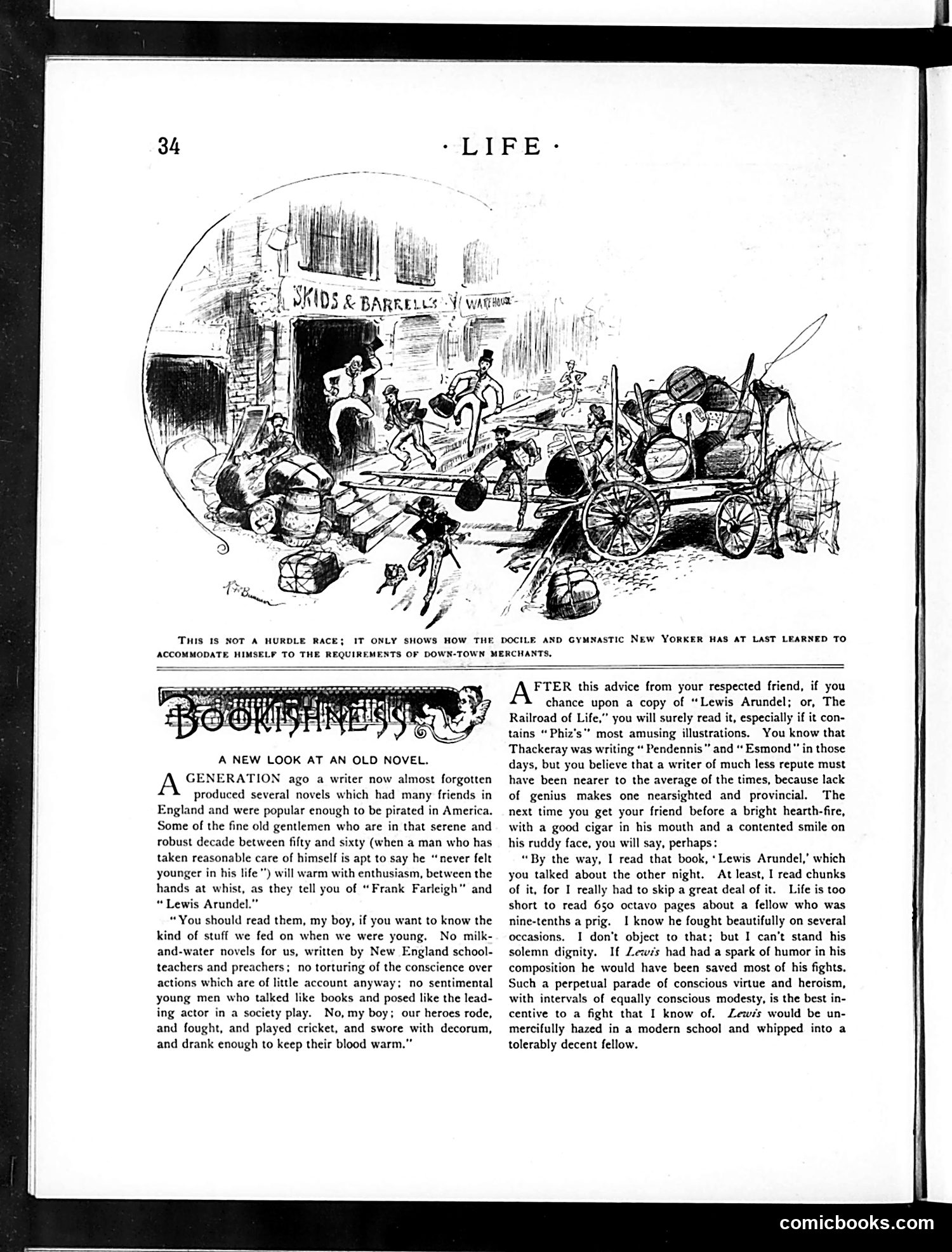
The cartoon depicts a chaotic street scene outside a "Skids & Barrels" shop, showing children engaged in rough play with wagons, boxes, and other street debris. The caption states this illustrates "how the docile and gymnastic New Yorker has at last learned to accommodate himself to the requirements of down-town merchants." The satire mocks how New York City children have adapted to urban, cramped conditions by turning street clutter into playgrounds. Rather than countryside pastimes, they've become resourceful—using available materials in congested downtown areas. The accompanying text discusses old adventure novels like "Lewis Arundel," contrasting genteel literary heroes with modern urban youth who are rough, practical, and unsentimental. The overall point critiques both industrialized city life and changing childhood experiences in early 20th-century America.
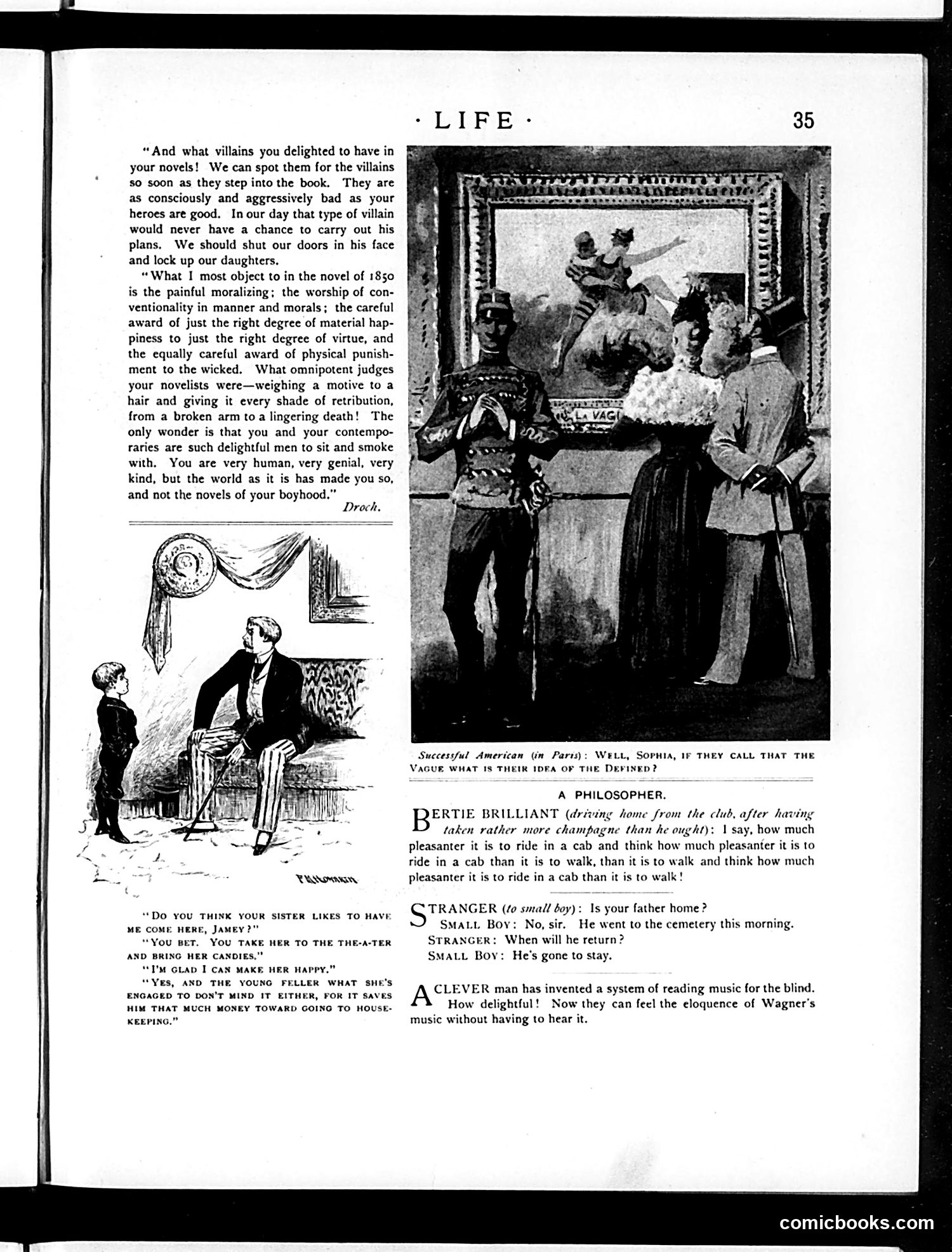
This page contains literary criticism and humorous anecdotes rather than political cartoons. The main text criticizes 1850s novels for their heavy-handed moralizing and convenient punishment of villains. The author (signed "Drech") argues that novelists acted as omnipotent judges, and praises contemporary writers for being more human and nuanced. The small sketch by Telamanson shows a child asking an adult about attending theater—a domestic scene illustrating social customs. Below are three brief jokes: one about entertaining a sister at the theater, another about a boy whose father has died, and a third about a blind man's music-reading system (likely referring to Louis Braille's tactile musical notation). These items reflect Victorian-era literary taste and social concerns rather than political satire.
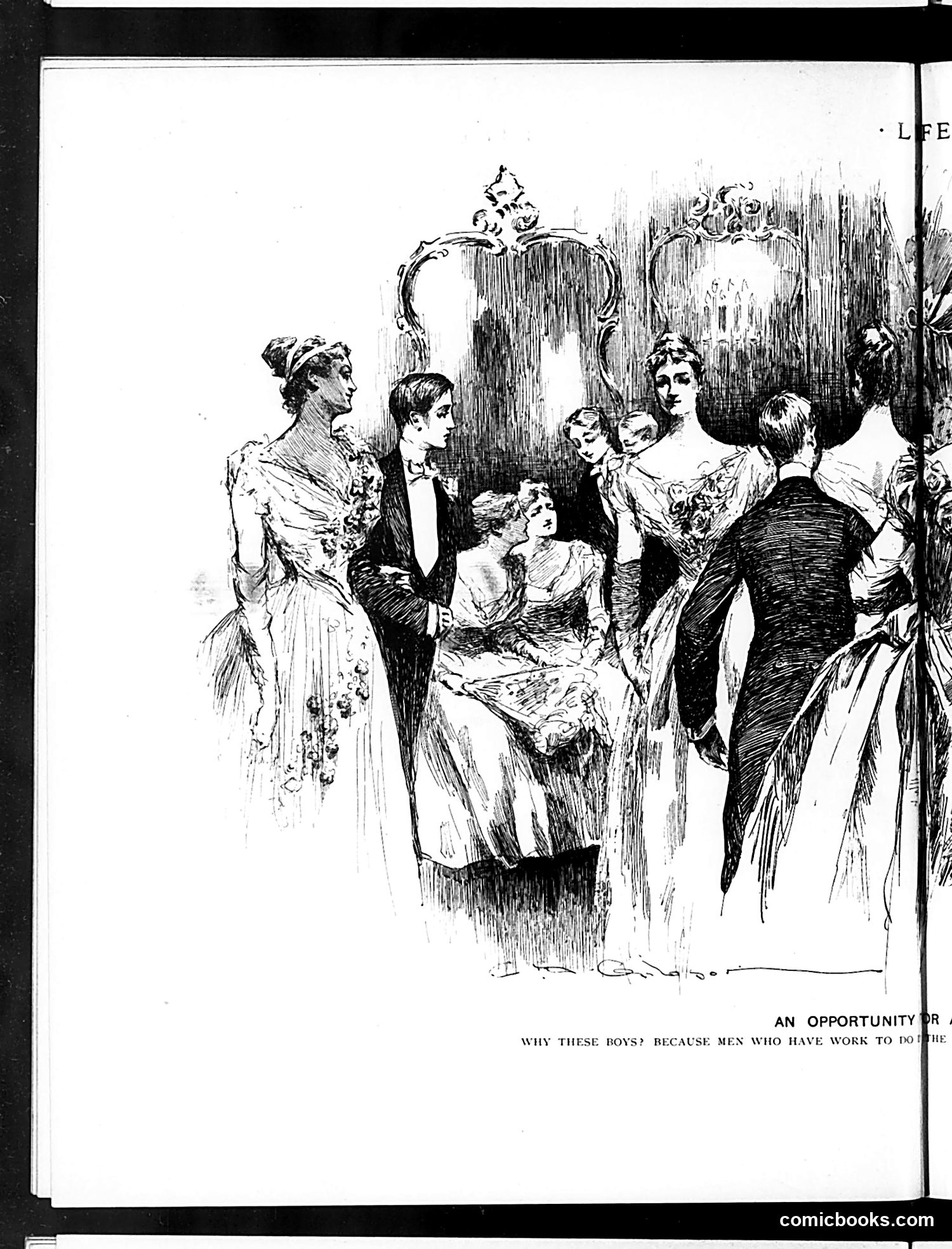
This illustration depicts an elegant social gathering where well-dressed men and women in formal attire converse. The caption reads "AN OPPORTUNITY FOR..." with the question "WHY THESE BOYS? BECAUSE MEN WHO HAVE WORK TO DO [text cuts off]" The satire appears to critique social dynamics around employment and eligible young men. The incomplete caption suggests the cartoon is commenting on why certain young men are present at this social event—apparently because they have "work to do," implying they're not idle aristocrats but employed professionals. Without the complete caption, the precise target of satire is unclear. It may mock social pretensions about employment status, or perhaps satirize the inclusion of working-class men in upper-class social circles. The elegant illustration style and fashionable dress suggest commentary on class and social climbing in early-20th-century American society.
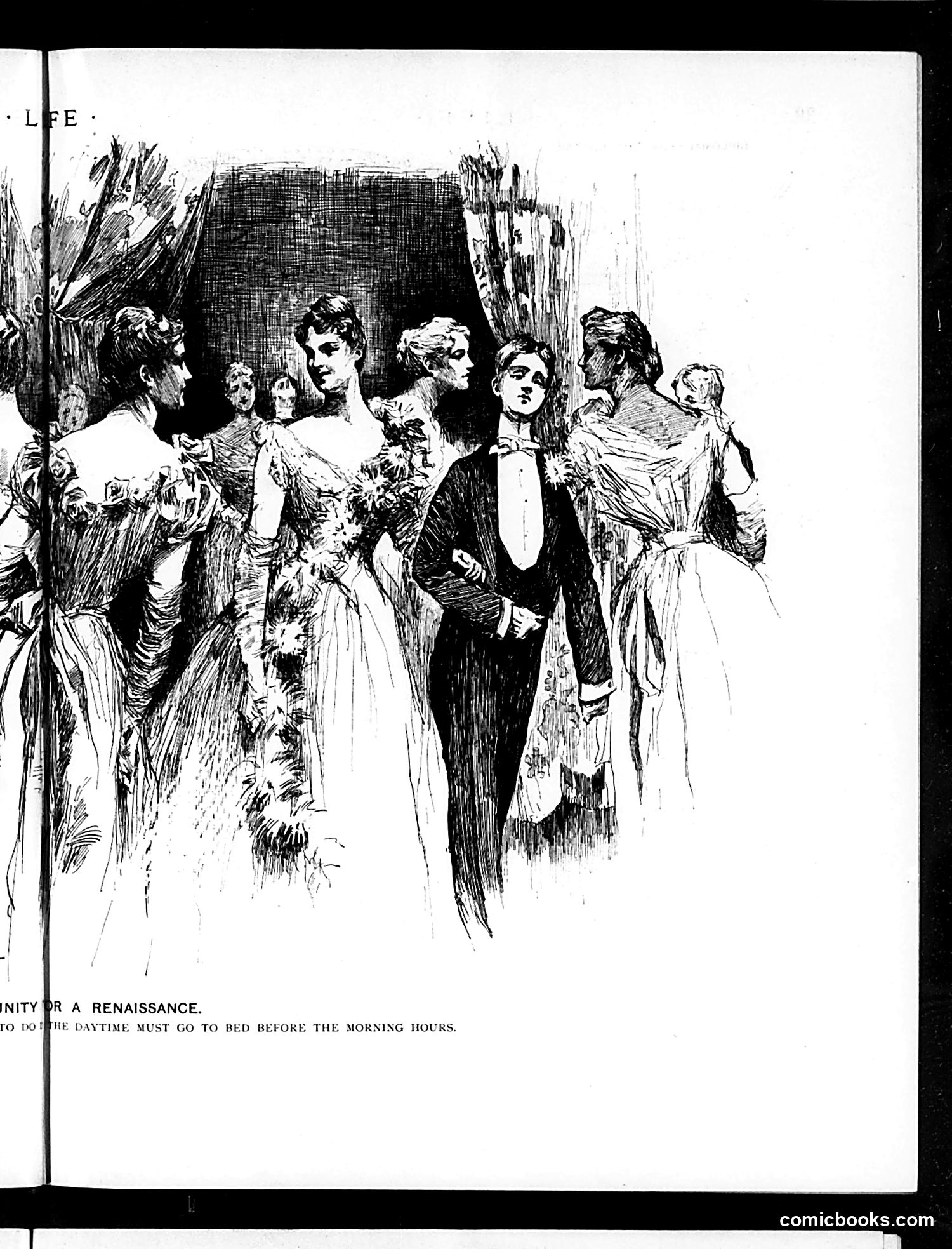
This illustration depicts a formal social gathering—likely a high-society evening event or ball. The caption reads: "TO DO THE DAYTIME MUST GO TO BED BEFORE THE MORNING HOURS," suggesting satire about the exhausting social obligations of the wealthy elite. The central figure is a man in formal evening dress (tuxedo) surrounded by elegantly dressed women in elaborate gowns, some holding flowers. The sketch style emphasizes the artificiality and superficiality of the scene. The satire appears to target the decadent lifestyle of the upper class—the relentless social calendar that requires attendees to party through the night, then sleep during daytime hours. It's a commentary on the vanity and empty pursuits of high society during what appears to be the Gilded Age or early 20th century.
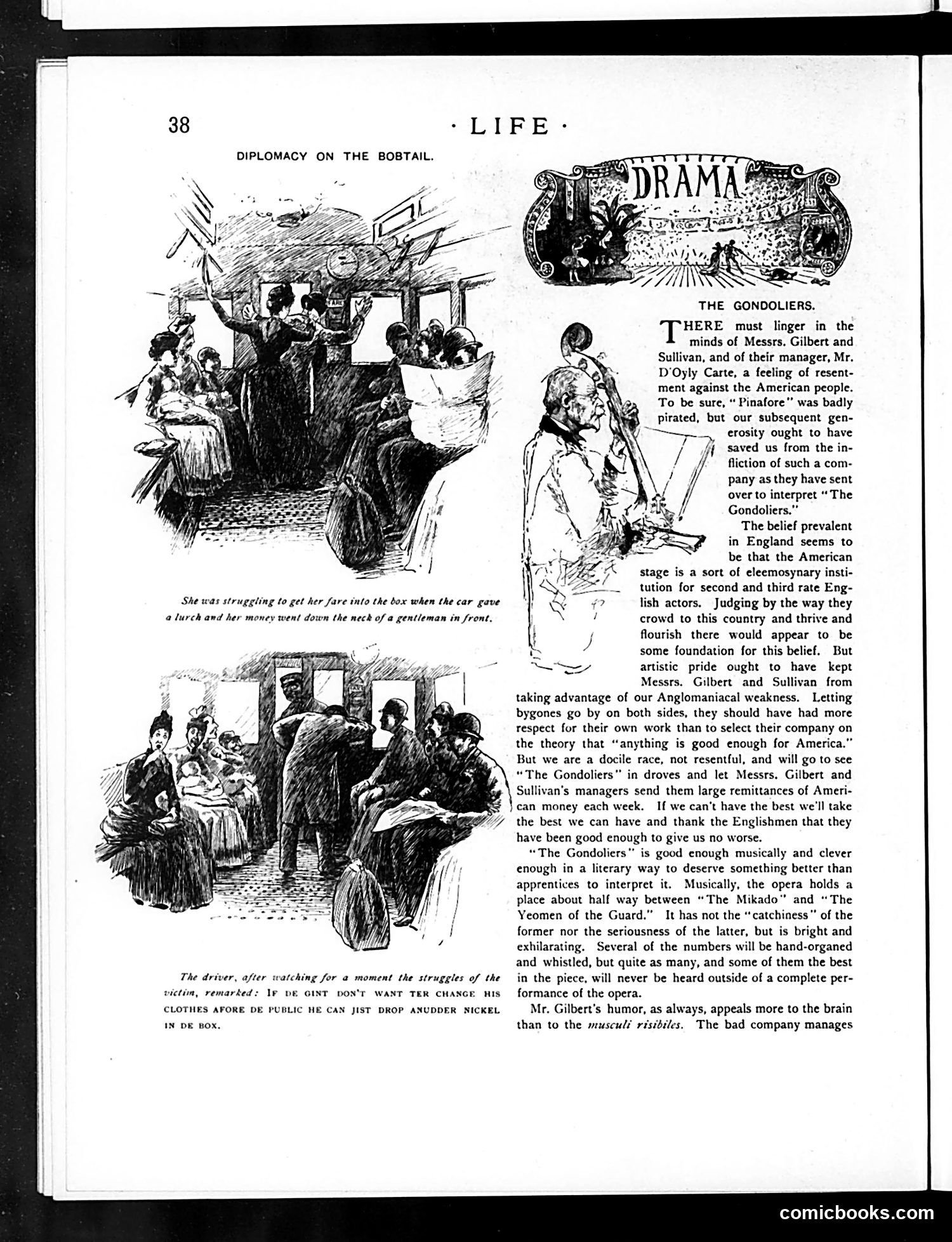
This page satirizes Gilbert and Sullivan's operetta "The Gondoliers" and its American production. The sketches show crowded streetcar scenes with the caption humorously noting a woman struggling to board while her money falls—"diplomacy" being needed in tight spaces. The text criticizes Messrs. Gilbert and Sullivan's manager, Mr. D'Oyly Carte, for licensing the opera to an American company despite "Pinafore" being badly pirated. The writer argues Americans should have more pride and not rely on English theatrical exports, suggesting the American stage should develop its own talent rather than serve as a dumping ground for second-rate English performers. The satire targets both theatrical management and American cultural deference to Britain.
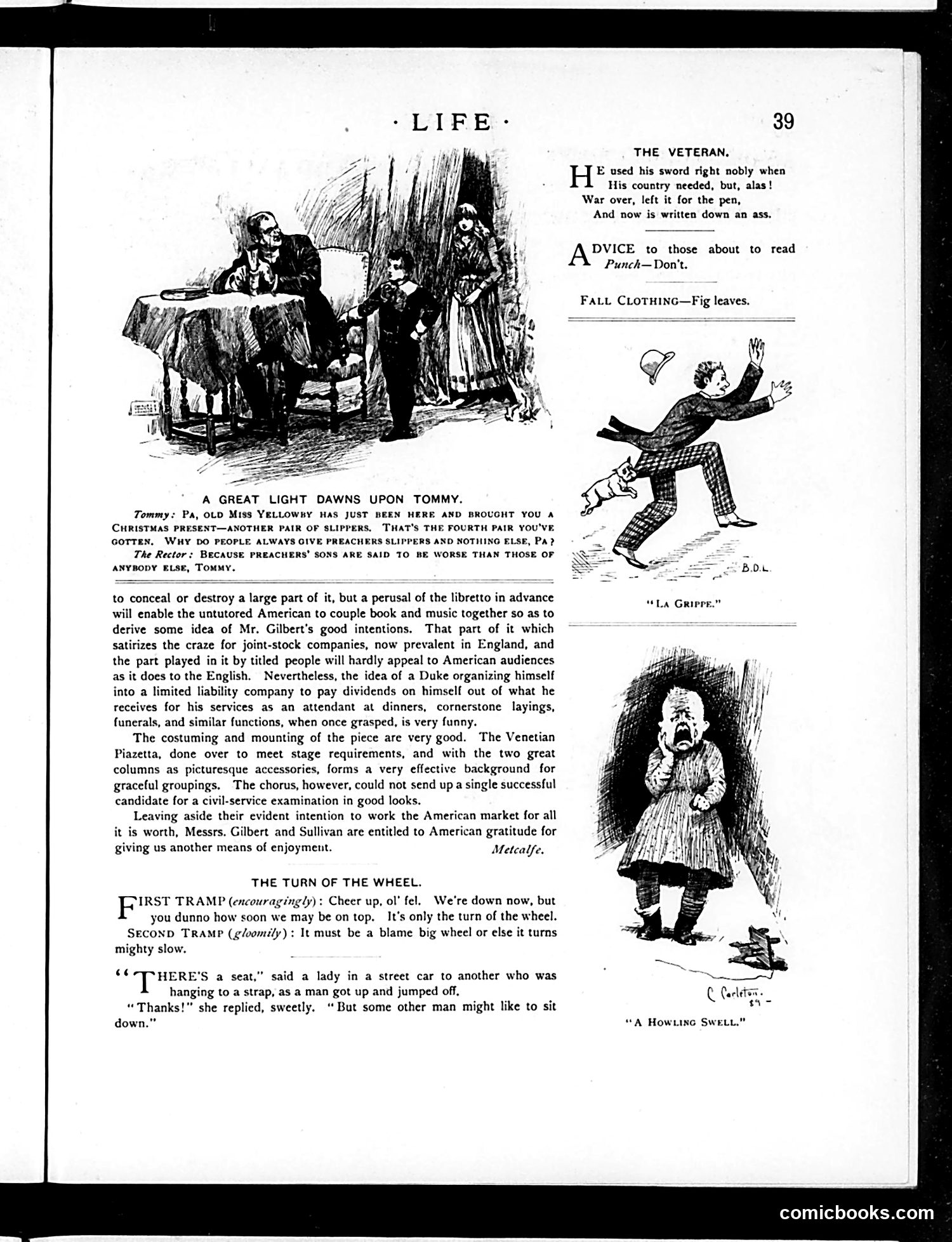
This page contains theatrical reviews and satirical illustrations from Life magazine's arts section. **"The Veteran"** satirizes retired military men who abandoned swords for writing, now producing poorly written work—a jab at former soldiers trying literary careers. **"Fall Clothing"** is a humorous fashion note about autumn leaves. **The illustrated cartoons** by artists labeled B.D.L. and C. Lederer depict everyday urban comedy: "La Grippe" shows illness-related pratfalls, while "A Howling Swell" mocks an overdressed, fashionable man slipping on ice—targeting the pretentious wealthy. **"The Turn of the Wheel"** presents a street-car dialogue about fortune changing, using working-class optimism as gentle comedy. The page blends theatrical criticism with social satire aimed at the upper classes and cultural pretension.
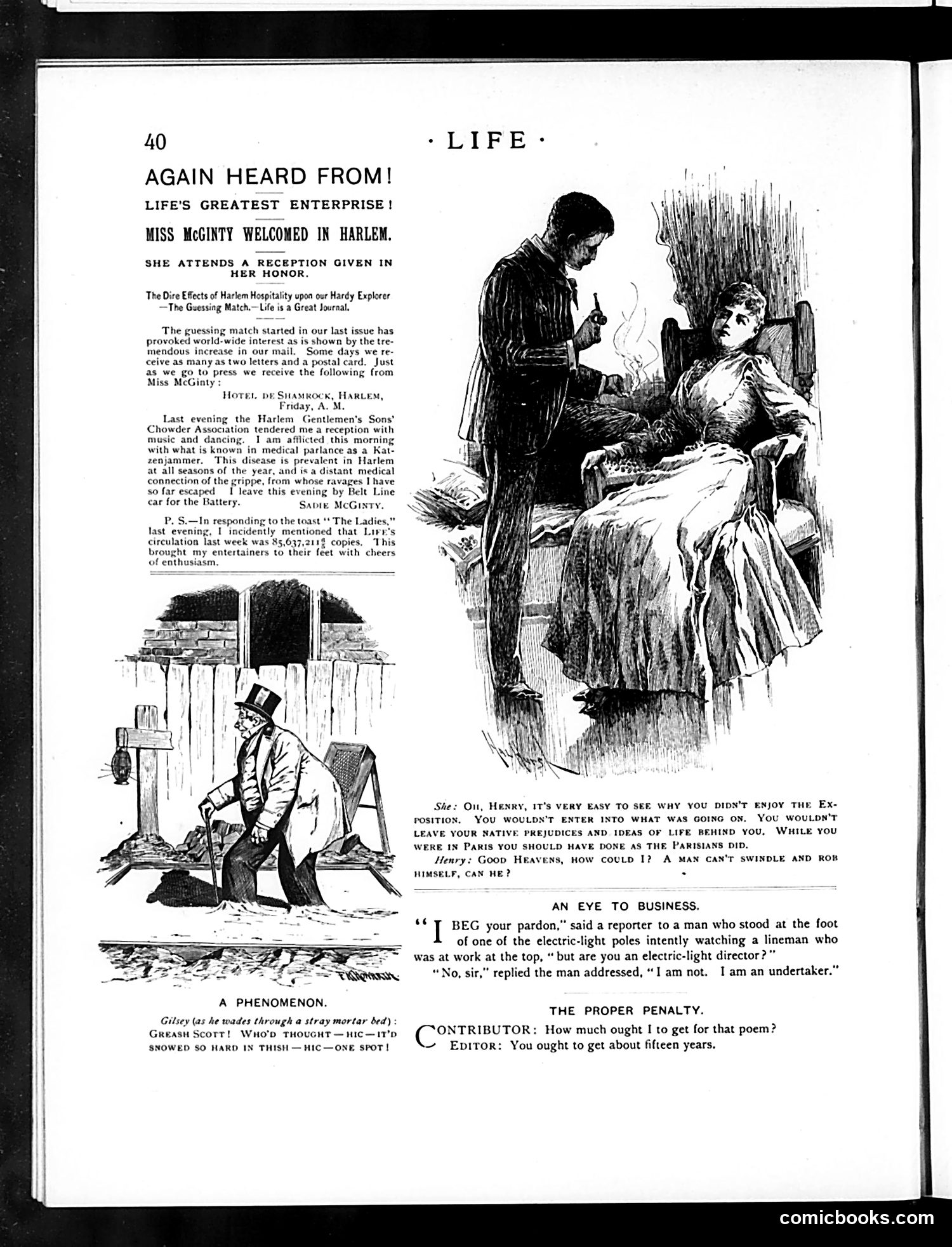
This page satirizes Life magazine's own self-promotion and contains unrelated social humor typical of the era. The main feature mocks Life's exaggerated circulation claims through "Miss McGinty," a fictional character supposedly reporting from Harlem. The joke: McGinty attended a reception where she casually mentioned Life's circulation figures (85,637,211 copies—obviously absurd) and the audience cheered. This lampoons Life's tendency to boast about its readership and influence. The smaller cartoons offer period humor: "A Phenomenon" shows a drunk man (Gilsey) who didn't enjoy a Paris exposition because he wouldn't abandon his prejudices. "An Eye to Business" plays on mistaking an undertaker for an electric-light director—a joke about business acumen. The final exchange between contributor and editor jokes that bad poetry deserves prison time. The illustrations depict social scenes in Harlem and domestic situations typical of Life's satirical style, though the racial context of a "hardy explorer" visiting Harlem reflects attitudes of that era.
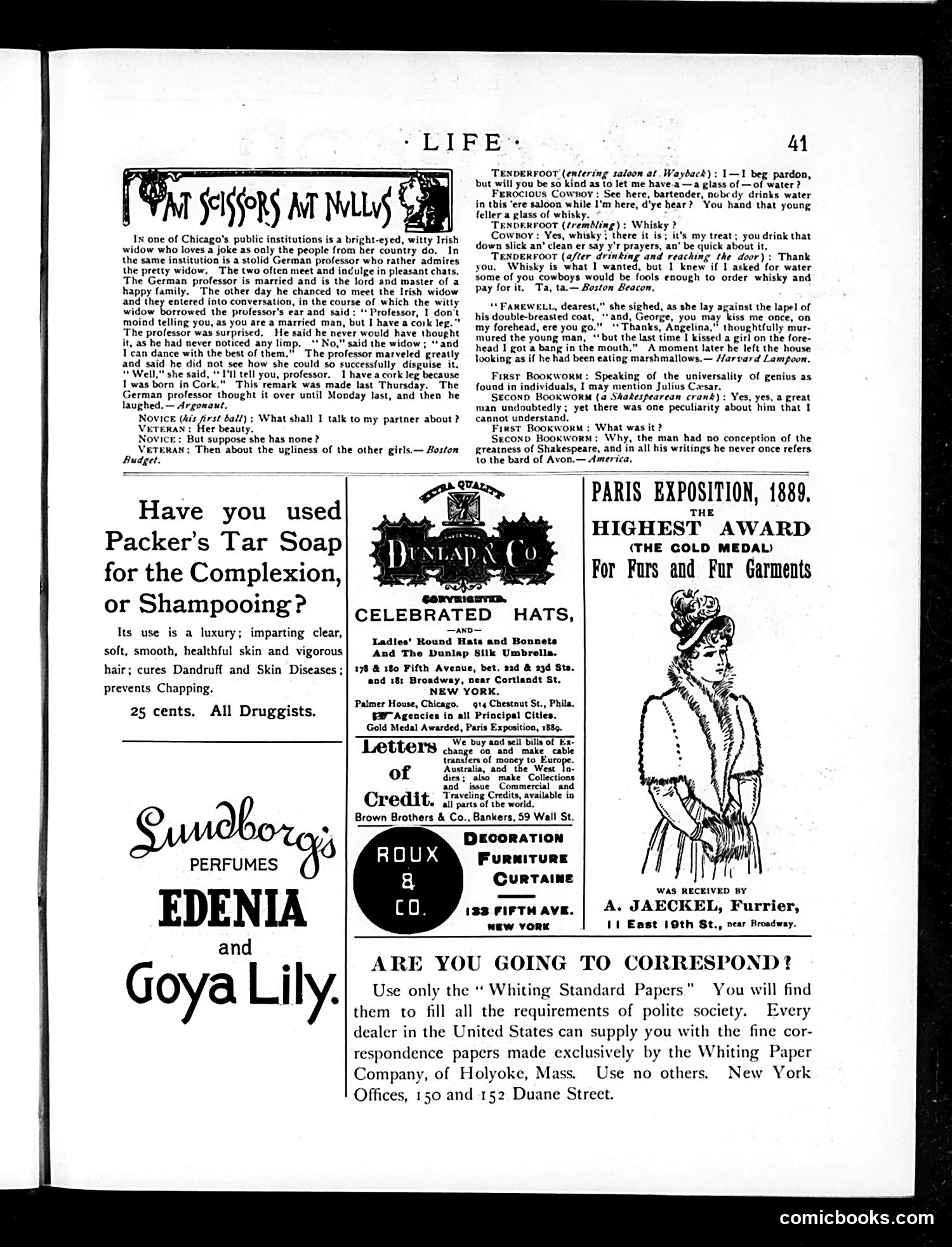
This page contains five humorous anecdotes typical of *Life* magazine's satirical humor: 1. **"Scissors at Nelly's"**: An Irish widow jokes with a German professor that she has a "cork leg because I was born in Cork"—a pun playing on Cork, Ireland. The German takes days to understand the wordplay, satirizing perceived German humorlessness. 2. **The Tenderfoot**: A naive easterner ("tenderfoot") tricks a rough Western cowboy into paying for whisky by requesting water—reversing the stereotype of the Wild West forcing civilization on newcomers. 3. **The Forehead Kiss**: A young man deflects a romantic farewell, referencing getting "a bang in the mouth" from a previous forehead kiss—suggesting he'd been struck for taking liberties. 4. **Shakespeare Debate**: Two bookish characters argue that Julius Caesar was ignorant because he never referenced Shakespeare in his writings—absurdist literary snobbery. 5. **Ball Etiquette**: Dating advice suggests discussing a partner's beauty, or if lacking, "the ugliness of the other girls." The page is primarily **advertising** for period products (Packer's Tar Soap, perfumes, hats, financial services).
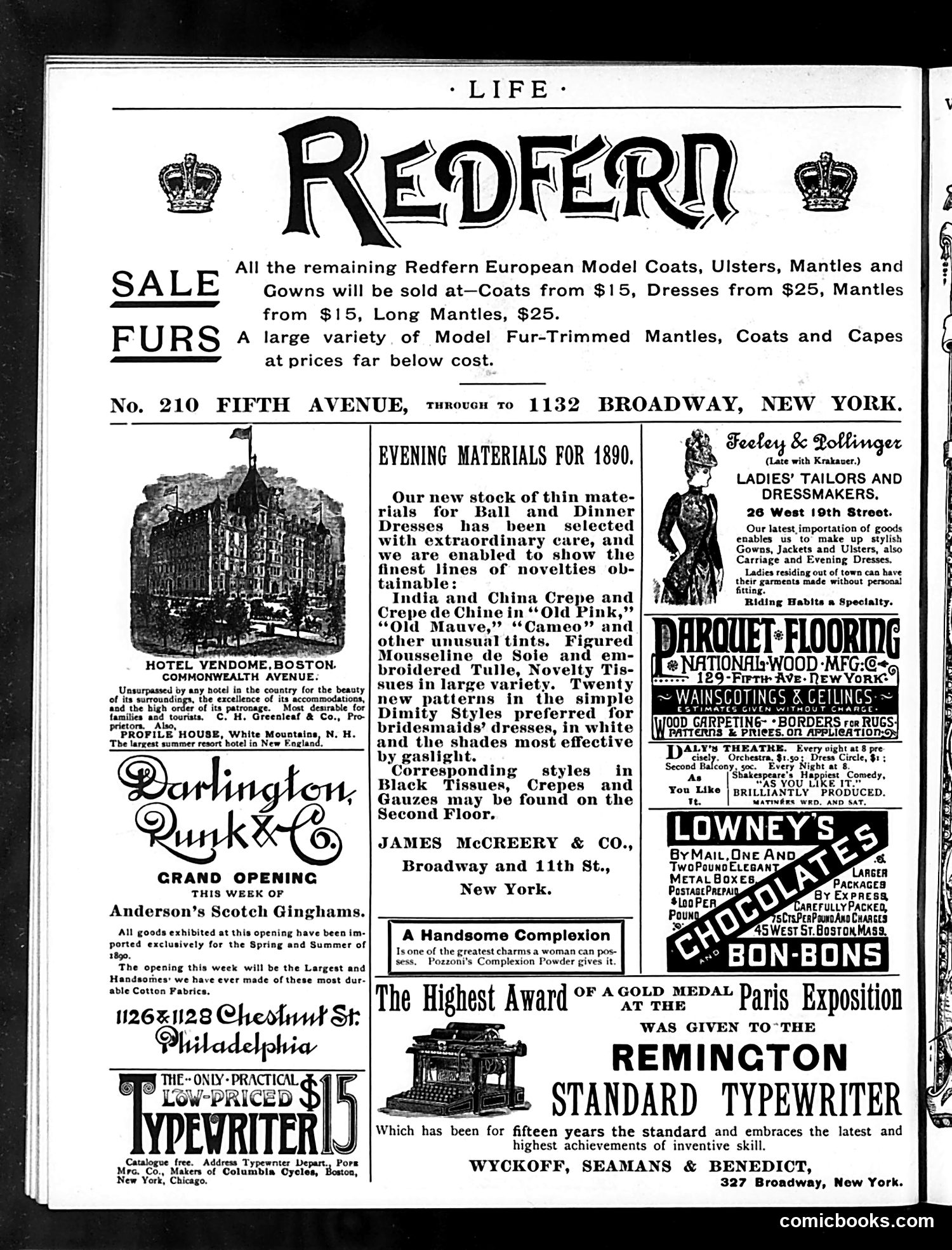
This is primarily an **advertising page** from Life magazine (circa 1890), not a satirical cartoon. The page contains commercial advertisements for high-end fashion, hotels, and office equipment popular with wealthy New Yorkers of the era. Key advertisements include: - **Redfern** (Fifth Avenue): European designer coats and gowns at luxury prices - **James McCReery & Co.**: Fine evening dress materials (India crepe, silk) for balls and formal wear - **Remington Standard Typewriter**: Promoted as the industry standard, awarded a gold medal at the Paris Exposition - **Hotels and resorts**: Boston's Hotel Vendome and New Hampshire's Profile House - **Ladies' tailors**: Custom dressmaking services - **Complexion powder** and other toiletries The page reflects **1890s upper-class consumer culture**, targeting wealthy women and professionals. There is no political satire visible—this appears to be pure commercial content reflecting the fashion, technology, and leisure interests of affluent Americans in that period.