
Life, 1890-01-16 · page 10 of 14
Life — January 16, 1890 — page 10: what you’re looking at
What you’re looking at
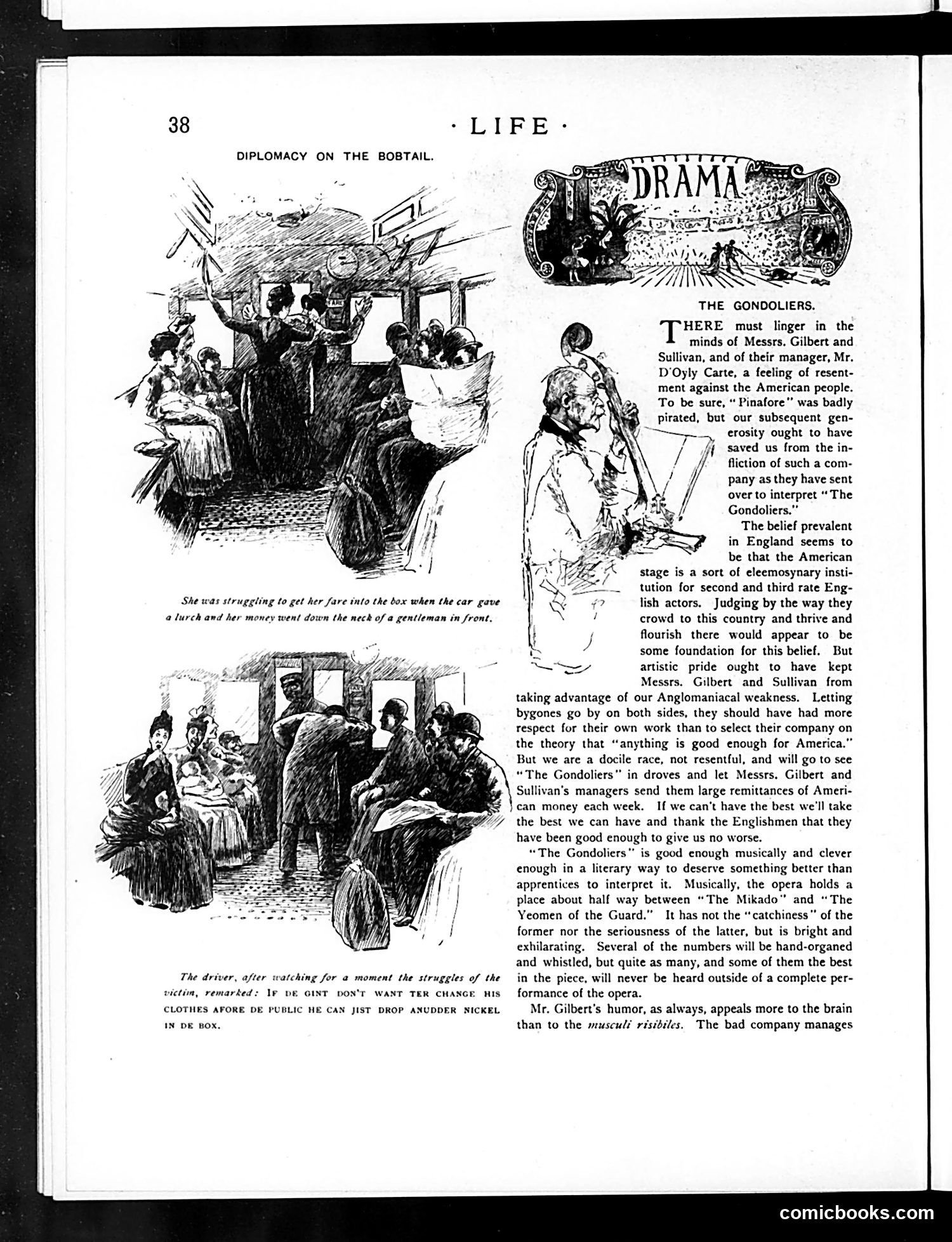
This page satirizes Gilbert and Sullivan's operetta "The Gondoliers" and its American production. The sketches show crowded streetcar scenes with the caption humorously noting a woman struggling to board while her money falls—"diplomacy" being needed in tight spaces. The text criticizes Messrs. Gilbert and Sullivan's manager, Mr. D'Oyly Carte, for licensing the opera to an American company despite "Pinafore" being badly pirated. The writer argues Americans should have more pride and not rely on English theatrical exports, suggesting the American stage should develop its own talent rather than serve as a dumping ground for second-rate English performers. The satire targets both theatrical management and American cultural deference to Britain.
📄 Transcribed text from this page (OCR, searchable)
Machine-transcribed from the original scan — historical spelling and the odd misread are preserved.
She was struggling to get her fare into the box when the car gave @ lurch and her money went down the neck of a gentleman in front. The driver, after watching for a moment the struggles of the victim, remarked: 1 DE GINT DON'T WANT TER CHANGE HIS CLOTHES AFORE DE PUBLIC HE CAN JIST DROP ANUDDER NICKEL IN DE BOX. THE GONDOLIERS. HERE must linger in the minds of Messrs. Gilbert and Sullivan, and of their manager, Mr. D'Oyly Carte, a feeling of resent- ment against the American people. To be sure, “ Pinafore” was badly pirated, but our subsequent gen- erosity ought to have fliction of such a com- pany as they have sent over to interpret “The Gondoliers.” The belief prevalent in England seems to be that the American stage is a sort of eleemosynary insti- tution for second and third rate Eng- lish actors. Judging by the way they crowd to this country and thrive and flourish there would appear to be some foundation for this belief. But artistic pride ought to have kept Messrs. Gilbert and Sullivan from taking advantage of our Anglomaniacal weakness. Letting bygones go by on both sides, they should have had more respect for their own work than to select their company on the theory that “anything is good enough for America.” But we are a docile race, not resentful, and will go to see “The Gondoliers” in droves and let Messrs. Gilbert and Sullivan’s managers send them large remittances of Ameri- can money each week. If we can’t have the best we'll take the best we can have and thank the Englishmen that they have been good enough to give us no worse. “The Gondoliers" is good enough musically and clever enough in a literary way to deserve something better than apprentices to interpret it. Musically, the opera holds a place about half way between “The Mikado” and “The Yeomen of the Guard.” It has not the “catchiness” of the former nor the seriousness of the latter, but is bright and exhilarating. Several of the numbers will be hand-organed and whistled, but quite as many, and some of them the best in the piece, will never be heard outside of a complete per- formance of the opera. Mr. Gilbert's humor, as always, appeals more to the brain The bad company manages than to the musculé risibiles. comicbooks.com