
Life, 1890-01-16 · page 6 of 14
Life — January 16, 1890 — page 6: what you’re looking at
What you’re looking at
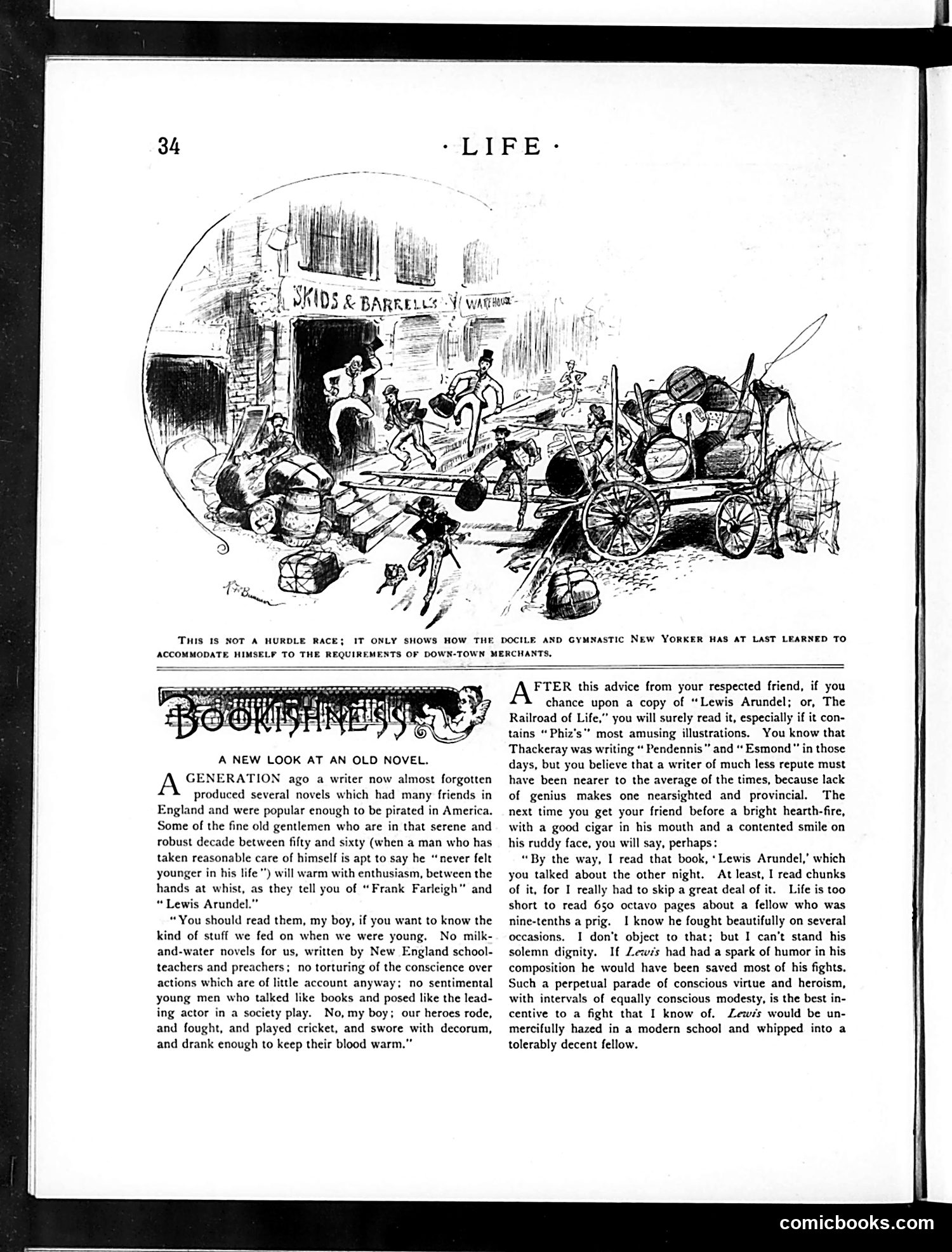
The cartoon depicts a chaotic street scene outside a "Skids & Barrels" shop, showing children engaged in rough play with wagons, boxes, and other street debris. The caption states this illustrates "how the docile and gymnastic New Yorker has at last learned to accommodate himself to the requirements of down-town merchants." The satire mocks how New York City children have adapted to urban, cramped conditions by turning street clutter into playgrounds. Rather than countryside pastimes, they've become resourceful—using available materials in congested downtown areas. The accompanying text discusses old adventure novels like "Lewis Arundel," contrasting genteel literary heroes with modern urban youth who are rough, practical, and unsentimental. The overall point critiques both industrialized city life and changing childhood experiences in early 20th-century America.
📄 Transcribed text from this page (OCR, searchable)
Machine-transcribed from the original scan — historical spelling and the odd misread are preserved.
THIS 18 NOT A HURDLE RACE; IT ONLY SHOWS HOW THE DOCILE AND GYMNASTIC NEW YORKER HAS AT LAST LEARNED TO ACCOMMODATE. HIMSELF TO THE REQUIREMENTS OF DOWN-TOWN MERCHANTS, A NEW LOOK AT AN OLD NOVEL. A GENERATION ago a writer now almost forgotten produced several novels which had many friends in England and were popular enough to be pirated in America. Some of the fine old gentlemen who are in that serene and robust decade between fifty and sixty (when a man who has taken reasonable care of himself is apt to say he “never felt younger in his life) will warm with enthusiasm, between the hands at whist, as they tell you of “Frank Farleigh” and “ Lewis Arundel.” “You should read them, my boy, if you want to know the kind of stuff we fed on when we were young. No milk- and-water novels for us, written by New England school- teachers and preachers; no torturing of the conscience over actions which are of little account anyway; no sentimental young men who talked like books and posed like the lead- ing actor in a society play. No, my boy; our heroes rode, and fought, and played cricket, and swore with decorum, and drank enough to keep their blood warm.” AFTER this advice from your respected friend, if you chance upon a copy of “Lewis Arundel; or, The Railroad of Life,” you will surely read it, especially if it con- tains “ Phiz’s” most amusing illustrations. You know that Thackeray was writing “ Pendennis” and “ Esmond” in those days, but you believe that a writer of much less repute must have been nearer to the average of the times, because lack of genius makes one nearsighted and provincial. The next time you get your friend before a bright hearth-fire, with a good cigar in his mouth and a contented smile on his ruddy face, you will say, perhaps: “By the way, I read that book, ‘Lewis Arundel,’ which you talked about the other night. At least, I read chunks of it, for I really had to skip a great deal of it. Life is too short to read 650 octavo pages about a fellow who was nine-tenths a prig. 1 know he fought beautifully on several occasions. I don’t object to that; but I can’t stand his solemn dignity. If Zezw7s had had a spark of humor in his composition he would have been saved most of his fights. Such a perpetual parade of conscious virtue and heroism, with intervals of equally conscious modesty, is the best in- centive to a fight that I know of. Lew#s would be un- mercifully hazed in a modern school and whipped into a tolerably decent fellow. comicbooks.com