
Life, 1890-01-16 · page 4 of 14
Life — January 16, 1890 — page 4: what you’re looking at
What you’re looking at
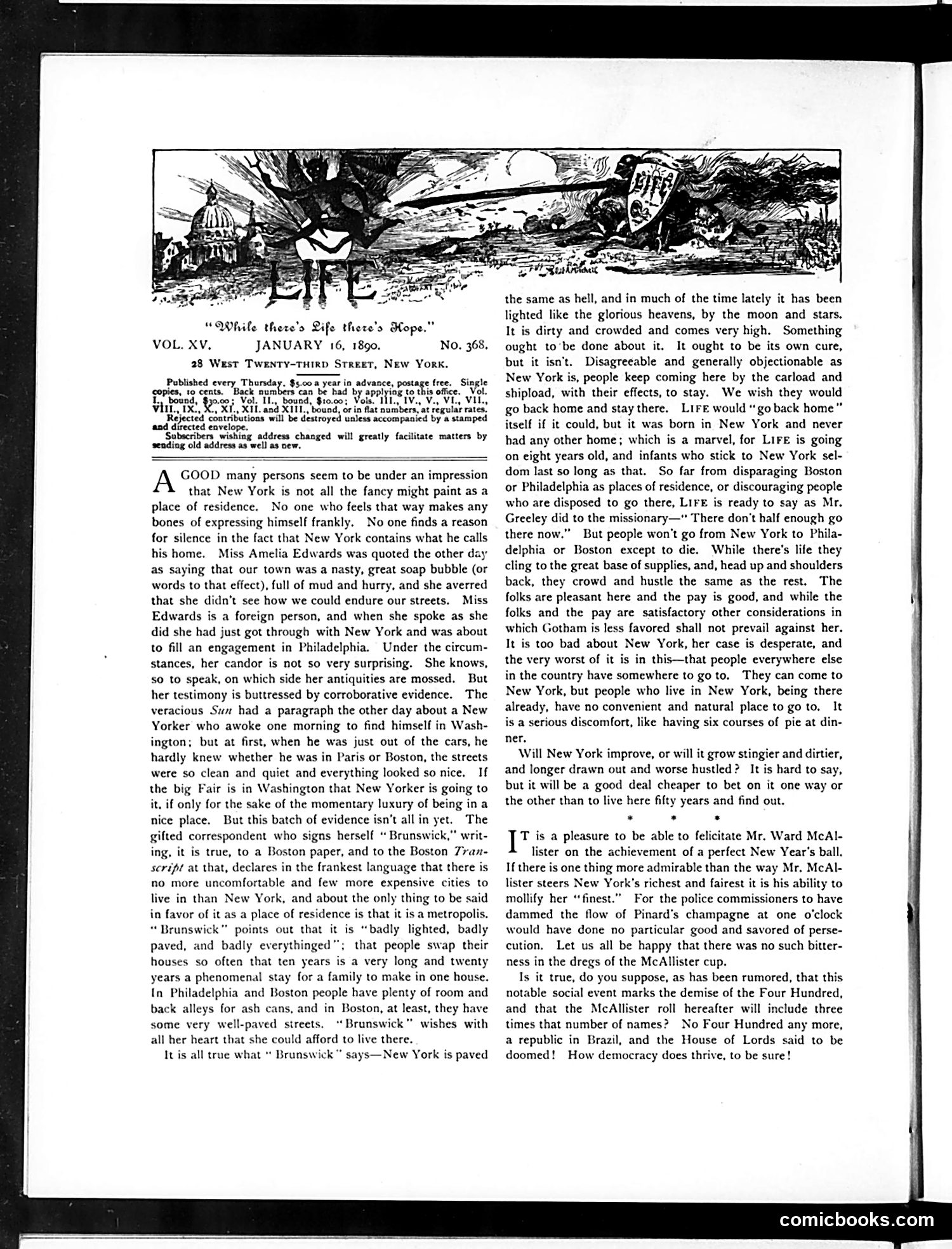
The masthead cartoon depicts a cityscape with classical architecture (dome visible left) and various urban scenes, illustrating the article's theme about New York City. The text is a satirical editorial criticizing New York as an undesirable place to live—dirty, crowded, and poorly maintained. The author argues that despite New York's reputation and status, people constantly leave for Boston, Philadelphia, and Washington, suggesting these cities offer superior living conditions. The piece references a specific incident: a New Yorker who woke in Washington unable to remember how he arrived, apparently having been intoxicated. The satire uses this anecdote to mock New York's chaotic nature. The final section mentions Mr. Ward McAllister and the McAllister Cup, referencing high society and New Year's celebrations, though the exact context remains unclear from this excerpt.
📄 Transcribed text from this page (OCR, searchable)
Machine-transcribed from the original scan — historical spelling and the odd misread are preserved.
“While there's Life there's Hope.” VOL. XV, JANUARY 16, 1890. 28 West Twenty: No. 368, p Street, New York. Poblished every, Thurda rin advance, postage free. Single copies, 10 cents numbers con be had 7 apolyiog te ta this office. Vol we, Yel. Ti bound, Sion: V., Vi, VIL, vite TH) 2°58F Ti. and NIT esuads oe to fe nasser at fegulat rates ted contributions will be destroyed unless accompanied by a stamped sod dected envelope. bacribers wishing address changed will greatly facilitate matters by seoding eld address an'well es ew. GOOD many persons seem to be under an impression that New York is not all the fancy might paint as a place of residence. No one who feels that way makes any bones of expressing himself frankly. No one finds a reason for silence in the fact that New York contains what he calls his home. Miss Amelia Edwards was quoted the other day as saying that our town was a nasty, great soap bubble (or words to that effect), full of mud and hurry, and she averred that she didn’t see how we could endure our streets. Miss Edwards is a foreign person, and when she spoke as she did she had just got through with New York and was about to fill an engagement in Philadelphia. Under the circum- stances, her candor is not so very surprising. She knows, so to speak, on which side her antiquities are mossed. But her testimony is buttressed by corroborative evidence. The veracious Sux had a paragraph the other day about a New Yorker who awoke one morning to find himself in Wash- ington; but at first, when he was just out of the cars, he hardly knew whether he was in Paris or Boston, the streets were so clean and quiet and everything looked so nice. If the big Fair is in Washington that New Yorker is going to it. if only for the sake of the momentary luxury of being in a nice place. But this batch of evidence isn’t all in yet. The gifted correspondent who signs herself “ Brunswick,” writ- ing, it is true, to a Boston paper, and to the Boston 7rax- script at that, declares in the frankest language that there is no more uncomfortable and few more expensive cities to live in than New York, and about the only thing to be said in favor of it as a place of residence is that it is a metropolis. “ Brunswi points out that it is “badly lighted, badly paved, and badly everythinged"; that people swap their houses so often that ten years is a very long and twenty years a phenomenal stay for a family to make in one house. In Philadelphia and Boston people have plenty of room and back alleys for ash c and in Boston, at least, they have some very well-paved streets. “Brunswick” wishes with all her heart that she could afford to live there. It is all true what “ Brunswick” says—New York is paved the same as hell, and in much of the time lately it has been lighted like the glorious heavens, by the moon and stars. It is dirty and crowded and comes very high. Something ought to‘be done about it. It ought to be its own cure, but it isn’t. Disagreeable and generally objectionable as New York is, people keep coming here by the carload and shipload, with their effects, to stay. We wish they would go back home and stay there. LiFe would “go back home” itself if it could, but it was born in New York and never had any other home; which is a marvel, for LIFE is going on eight years old, and infants who stick to New York sel- dom last so long as that. So far from disparaging Boston or Philadelphia as places of residence, or discouraging people who are disposed to go there, Lire is ready to say as Mr. Greeley did to the missionary—" There don’t half enough go there now.” But people won't go from New York to Phila- delphia or Boston except to die. While there's life they cling to the great base of supplies, and, head up and shoulders back, they crowd and hustle the same as the rest. The folks are pleasant here and the pay is good, and while the folks and the pay are satisfactory other considerations in which Gotham is less favored shall not prevail against her. It is too bad about New York, her case is desperate, and the very worst of it is in this—that people everywhere else in the country have somewhere to go to. They can come to New York, but people who live in New York, being there already, have no convenient and natural place to go to, It is a serious discomfort, like having six courses of pie at din- ner. Will New York improve, or will it grow stingier and dirtier, and longer drawn out and worse hustled? It is hard to say, but it will be a good deal cheaper to bet on it one way or the other than to live here fifty years and find out. T is a pleasure to be able to felicitate Mr. Ward McAl- lister on the achievement of a perfect New Year's ball. If there is one thing more admirable than the way Mr. McAl- lister steers New York's richest and fairest it is his ability to mollify her “finest.” For the police commissioners to have dammed the flow of Pinard’s champagne at one o'clock would have done no particular good and savored of perse- cution, Let us all be happy that there was no such bitter- ness in the dregs of the McAllister cup. Is it true, do you suppose, as has been rumored, that this notable social event marks the demise of the Four Hundred, and that the McAllister roll hereafter will include three times that number of names? No Four Hundred any more, a republic in Brazil, and the House of Lords said to be doomed! How democracy does thrive, to be sure! comicbooks.com