
A complete issue · 20 pages · 1889
Life — November 21, 1889
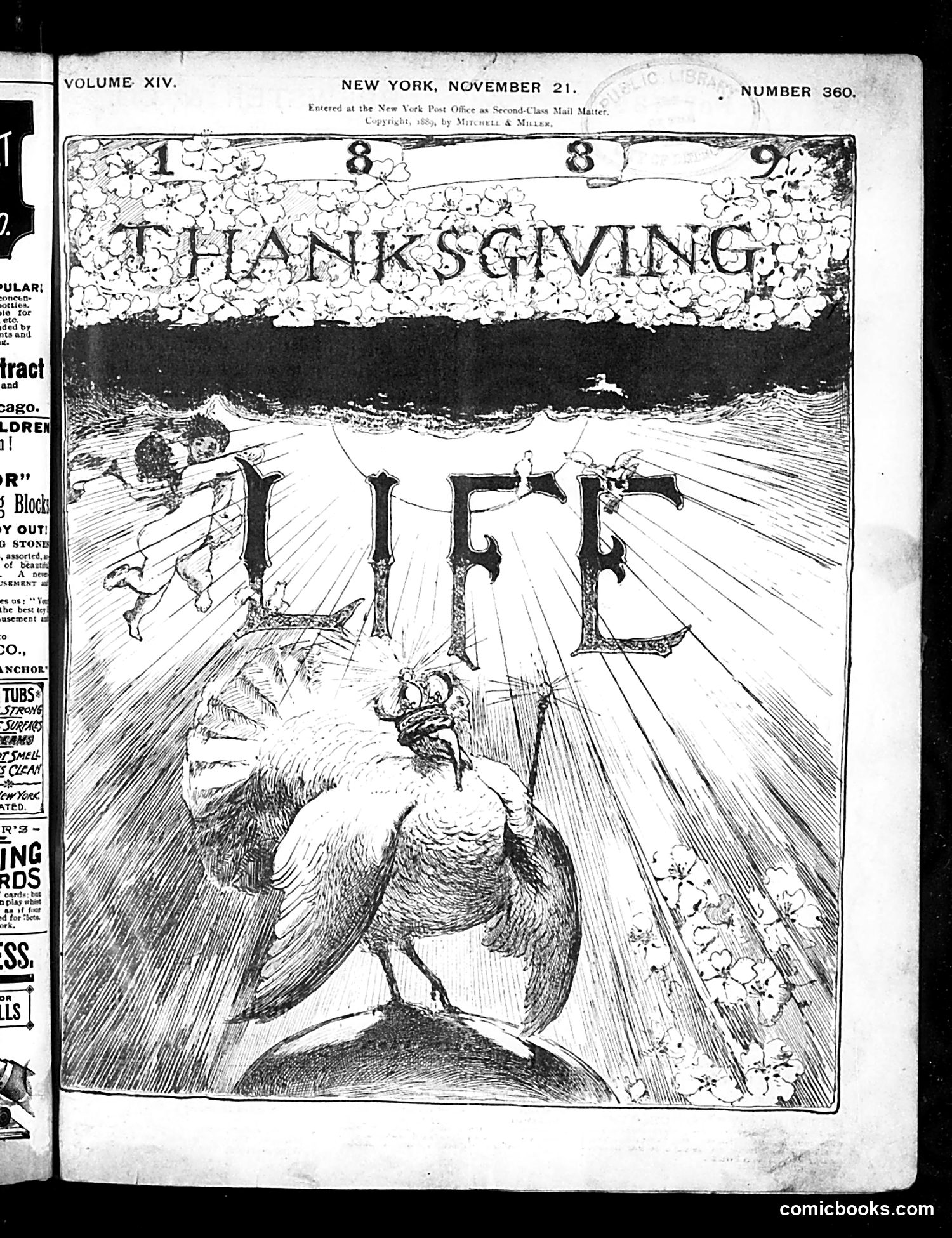
This is a **Thanksgiving-themed cover** from Life magazine (November 21, Volume XIV, Number 360). The illustration depicts a large turkey being roasted on a spit, positioned prominently in the center with the word "LIFE" integrated into the composition using decorative letters. The satire appears to be a visual pun: the turkey—traditionally the centerpiece of Thanksgiving dinner—is anthropomorphized and literally roasted, becoming the "life" of the holiday celebration. Small figures (hunters or diners) are shown pursuing or preparing the bird in the background landscape. The floral border at the top reinforces the harvest/Thanksgiving theme. This is primarily a **holiday-themed cover illustration** rather than political satire, using clever visual wordplay to celebrate the season.
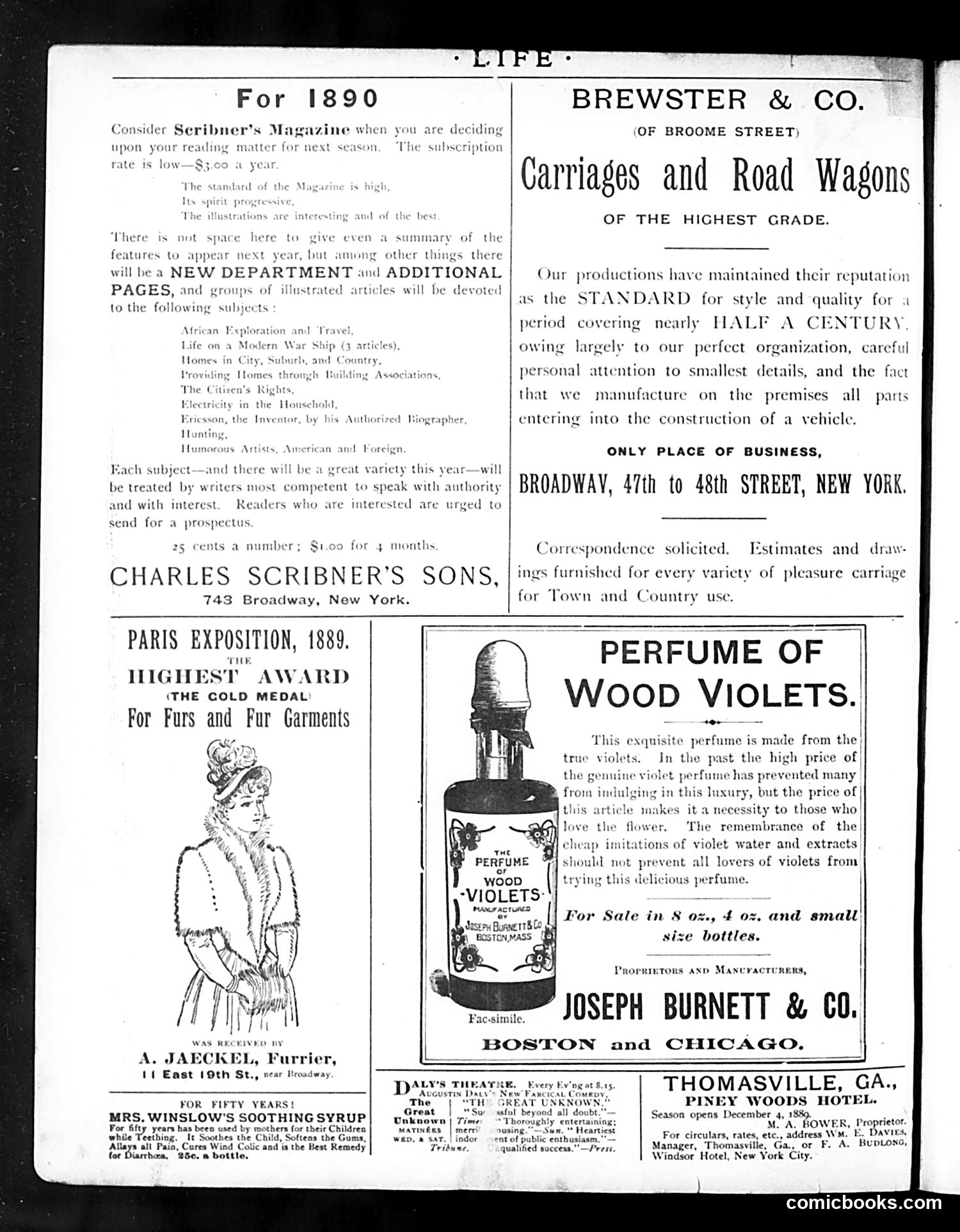
This page is primarily **advertising rather than satirical content**. It contains four distinct advertisements from 1890: 1. **Scribner's Magazine** - promoting upcoming editorial features on subjects like African exploration and modern warfare 2. **Brewster & Co.** - advertising carriages and road wagons manufactured on Broadway in New York 3. **Perfume of Wood Violets** by Joseph Burnett & Co. - highlighting an affordable violet perfume product 4. **A fur garment company** - displaying a woman in furs, noting a Paris Exposition 1889 award There is **no political cartoon visible**. The illustrated woman in furs is merely a product advertisement. This appears to be a typical magazine page mixing editorial promotion with commercial advertisements, with no satirical commentary intended.
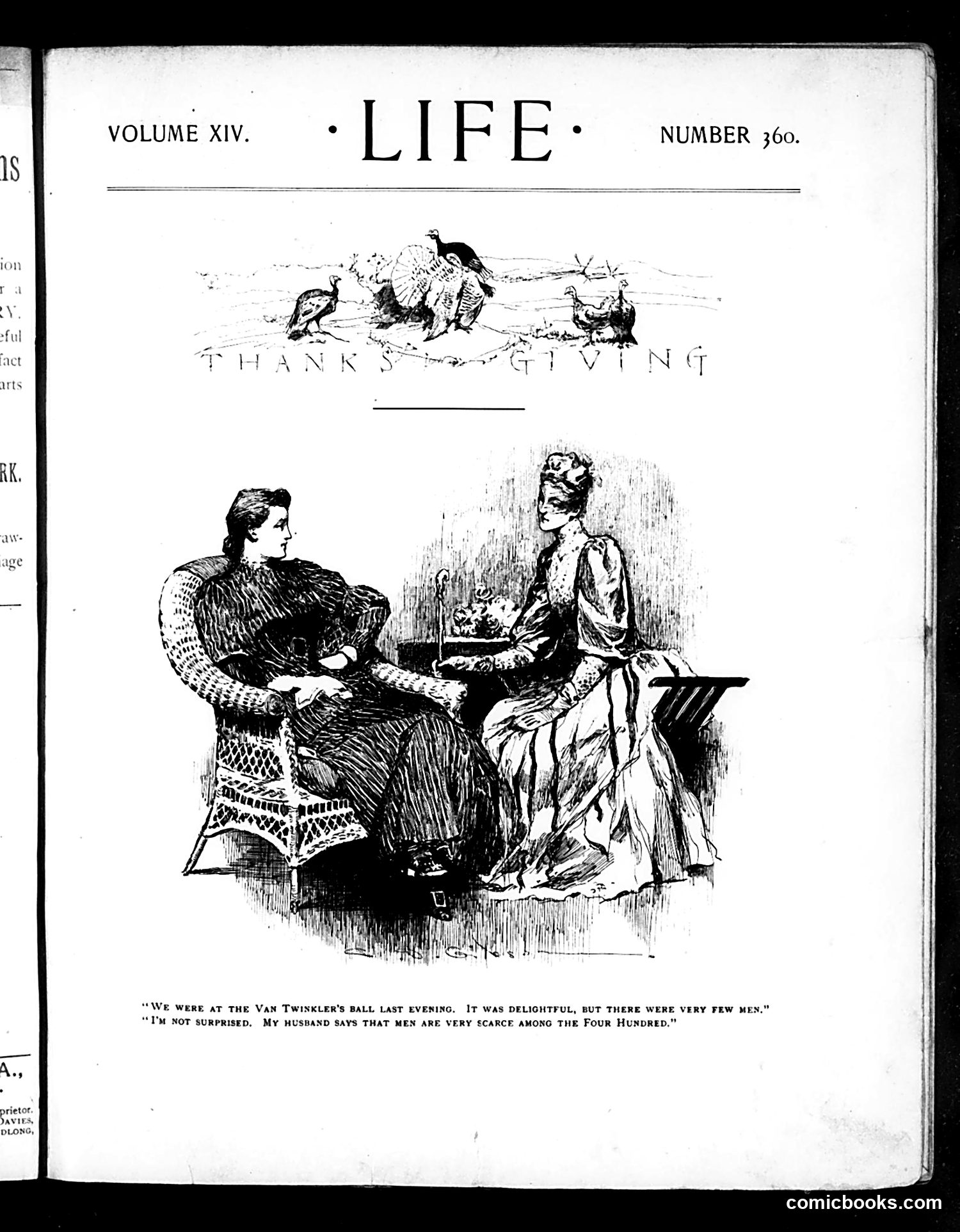
This *Life* magazine page contains two illustrations addressing the scarcity of men during an unspecified period (likely WWI era, given the context). **Top illustration:** A Thanksgiving scene with turkeys and pilgrims, labeled "THANKSGIVING." **Bottom illustration:** Two women in conversation. The caption reads: "We were at the Van Twinkler's ball last evening. It was delightful, but there were very few men. I'm not surprised. My husband says that men are very scarce among the four hundred." **The satire:** The joke targets wealthy society women of the "Four Hundred" (New York's elite social class). While the country faces a genuine shortage of men, these privileged women treat male scarcity as merely an inconvenience at their social balls—oblivious to or indifferent toward larger societal consequences. The humor derives from their self-centered perspective on a serious national issue.
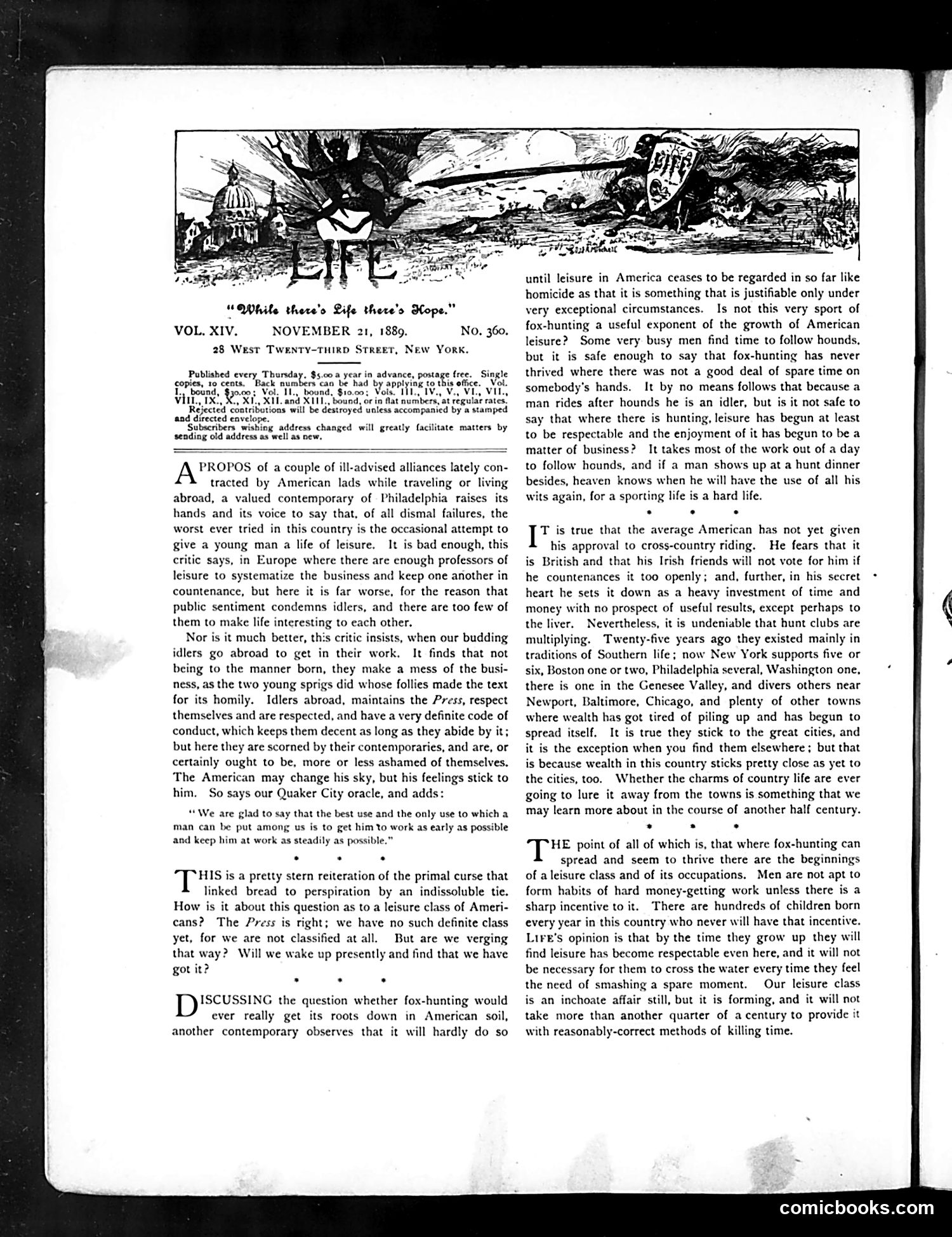
The masthead illustration depicts a satirical landscape combining symbols of American leisure and ambition—a domed capitol building, a sailing vessel, and various figures representing different classes of society. The editorial text debates whether fox-hunting should be considered a legitimate leisure activity for Americans. The author argues that fox-hunting represents a dangerous European aristocratic affectation that undermines American work ethic. The piece critiques wealthy Americans who adopt "idle" pursuits, suggesting this threatens the nation's character. The satire targets the anxiety of the 1880s-90s upper class adopting Old World pastimes, implying such leisurely pursuits are unpatriotic and unbecoming. The author contends that meaningful leisure—if any—requires purposeful activity, not mere imitation of British gentry traditions.
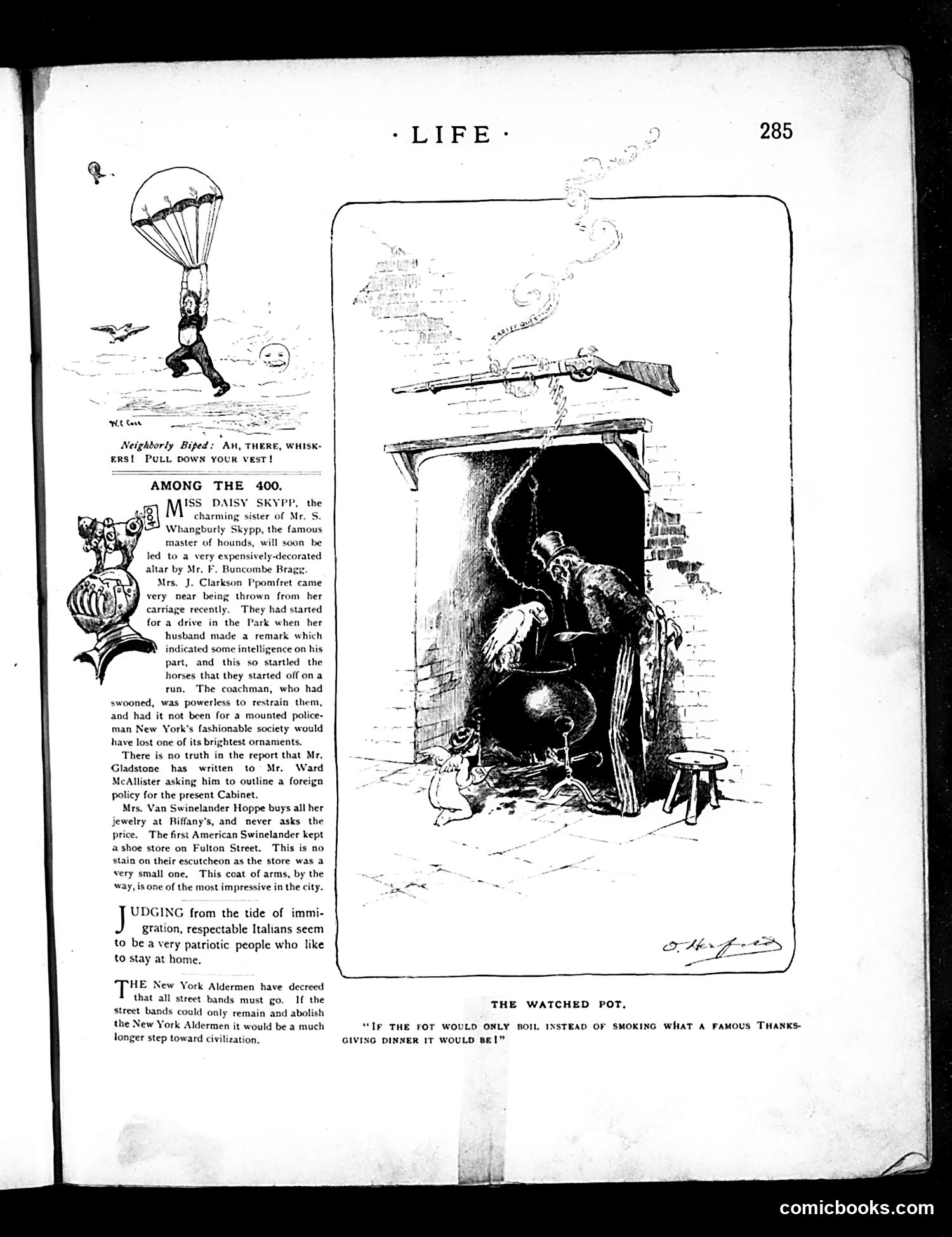
**Top Left Cartoon:** Shows a soldier descending by parachute with caption "NEARLY RIPPED: AH, THERE, WHISKERS! PULL DOWN YOUR VEST!" This appears to be WWI-era military humor about a soldier's close call during a parachute descent. **Main Illustration (Right):** Titled "THE WATCHED POT," depicting a man sitting in a doorway smoking a pipe, with rifles propped nearby and smoke rising. The caption reads: "If the pot would only boil instead of smoking what a famous thanksgiving dinner it would be!" This is likely wartime domestic humor—satirizing either rationing, food shortages, or the contrast between soldiers' hardships and home comforts. **Text Sections:** Brief anecdotes about New York society (Miss Daisy Skyrie) and Italian immigrants, suggesting the magazine's mix of gossip and social commentary typical of Life's satirical approach.
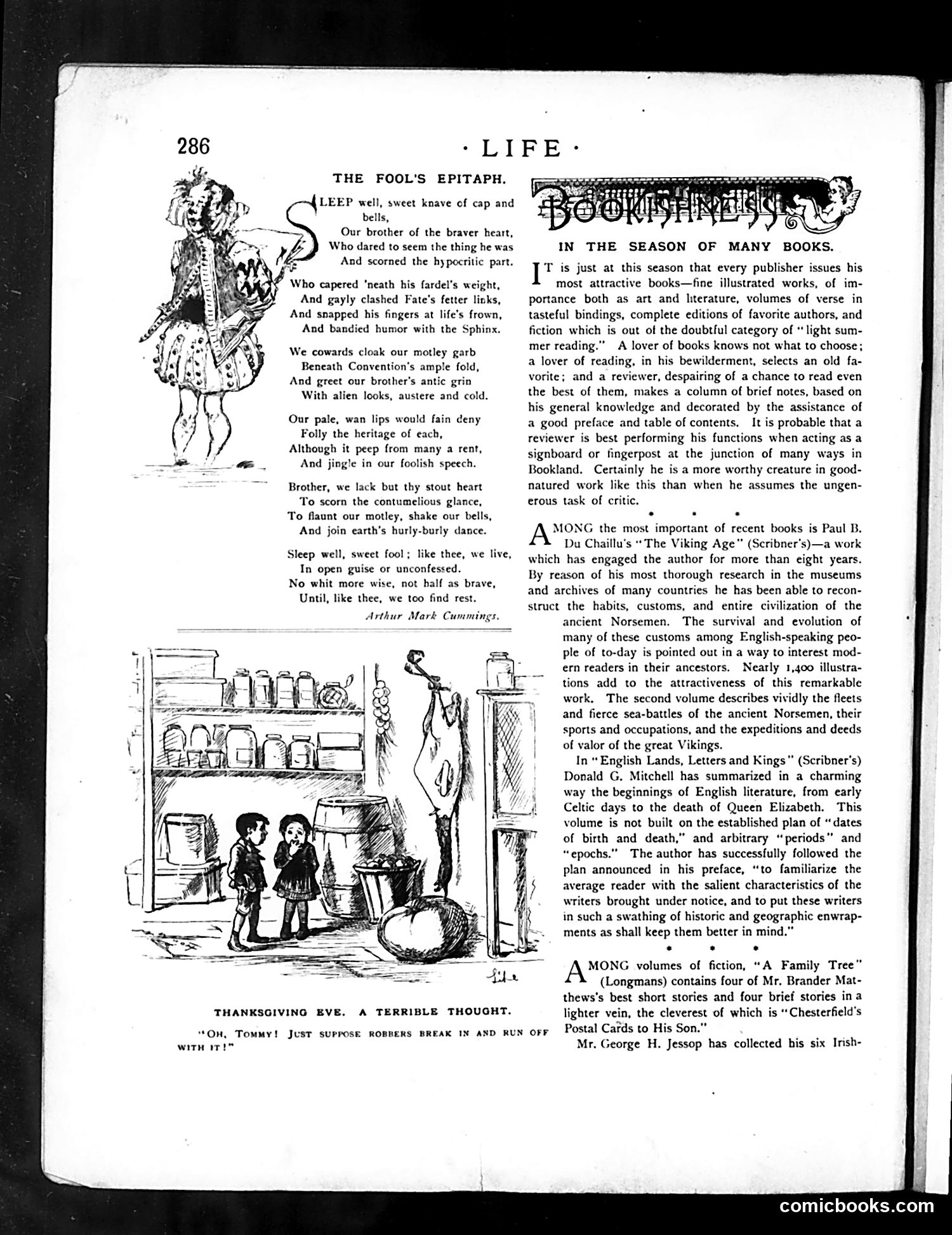
This page contains two distinct elements: **"The Fool's Epitaph"** (top left): A poem by Arthur Mark Cummings, illustrated with a jester figure. The verse satirizes a foolish character who mimicked conventional behavior and lacked genuine courage or insight. The specific references are unclear without additional context, though the jester costume suggests mockery of pretense or false wisdom. **"Thanksgiving Eve. A Terrible Thought"** (bottom): A sketch captioned "Oh, Tommy! Just suppose robbers break in and run off with it!" showing a mother and children in a kitchen. The joke appears to be anxious humor about holiday preparations—the implied punchline likely concerns what the family fears losing during a robbery (possibly food or presents). The right side consists primarily of book reviews under "Bookshelf," not political commentary.
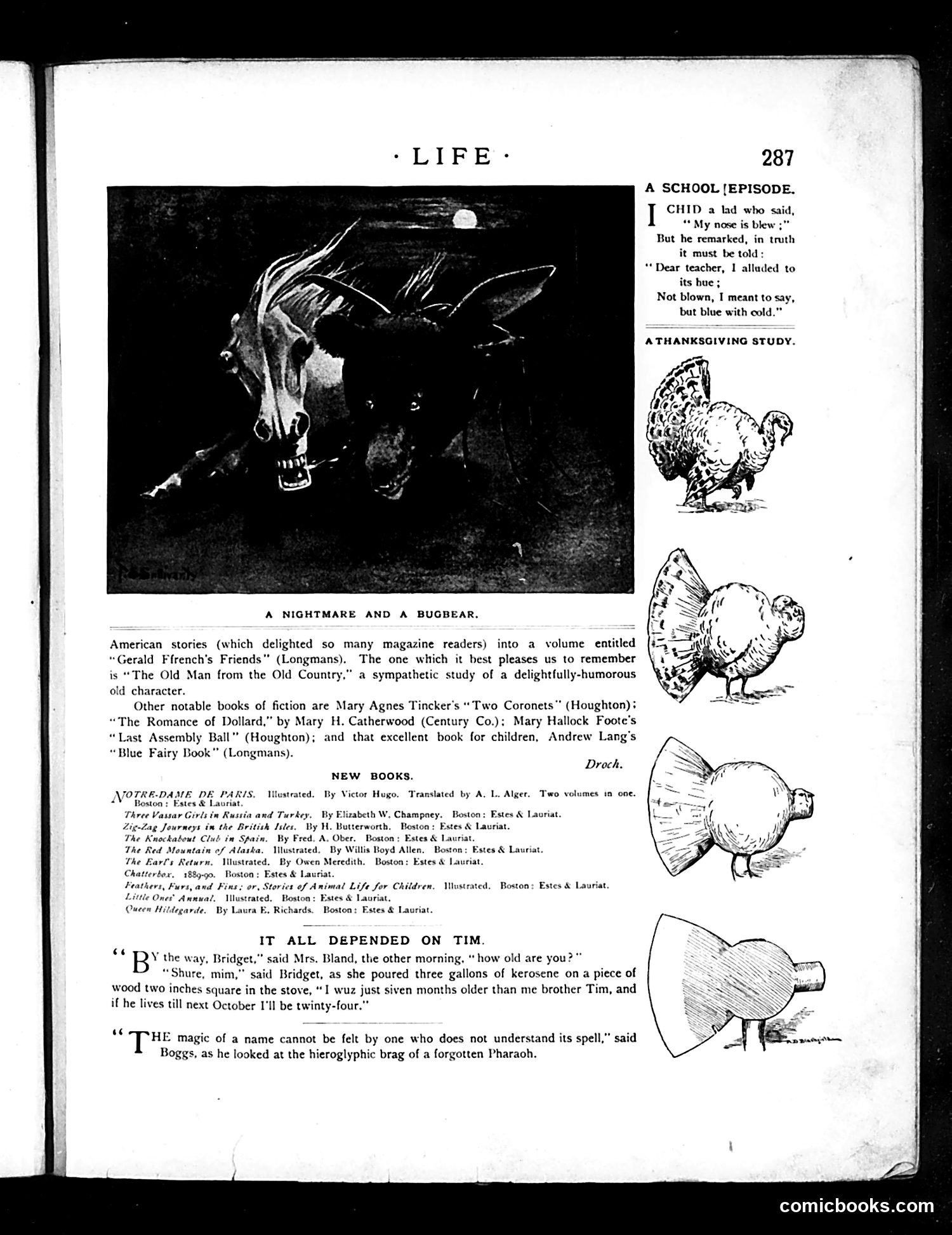
The page contains three separate satirical pieces: **"A Nightmare and a Bugbear"** (large illustration): A grotesque creature—appearing to be a skeletal or monstrous horse head—likely represents a cautionary or satirical image, though its specific political target is unclear from context alone. **"A School Episode"**: A humorous anecdote about a child claiming his nose is "blew" (blue from cold), not "blown," correcting his teacher's interpretation. **"A Thanksgiving Study"**: Decorative sketches of turkeys in various poses, presumably for holiday illustration purposes. **"It All Depended on Tim"**: A humorous domestic scene about age calculation between Mrs. Bland and Bridget regarding kerosene storage and age differences. The page represents typical Life magazine fare: a mix of humor, light satire, children's content, and book reviews rather than focused political commentary.
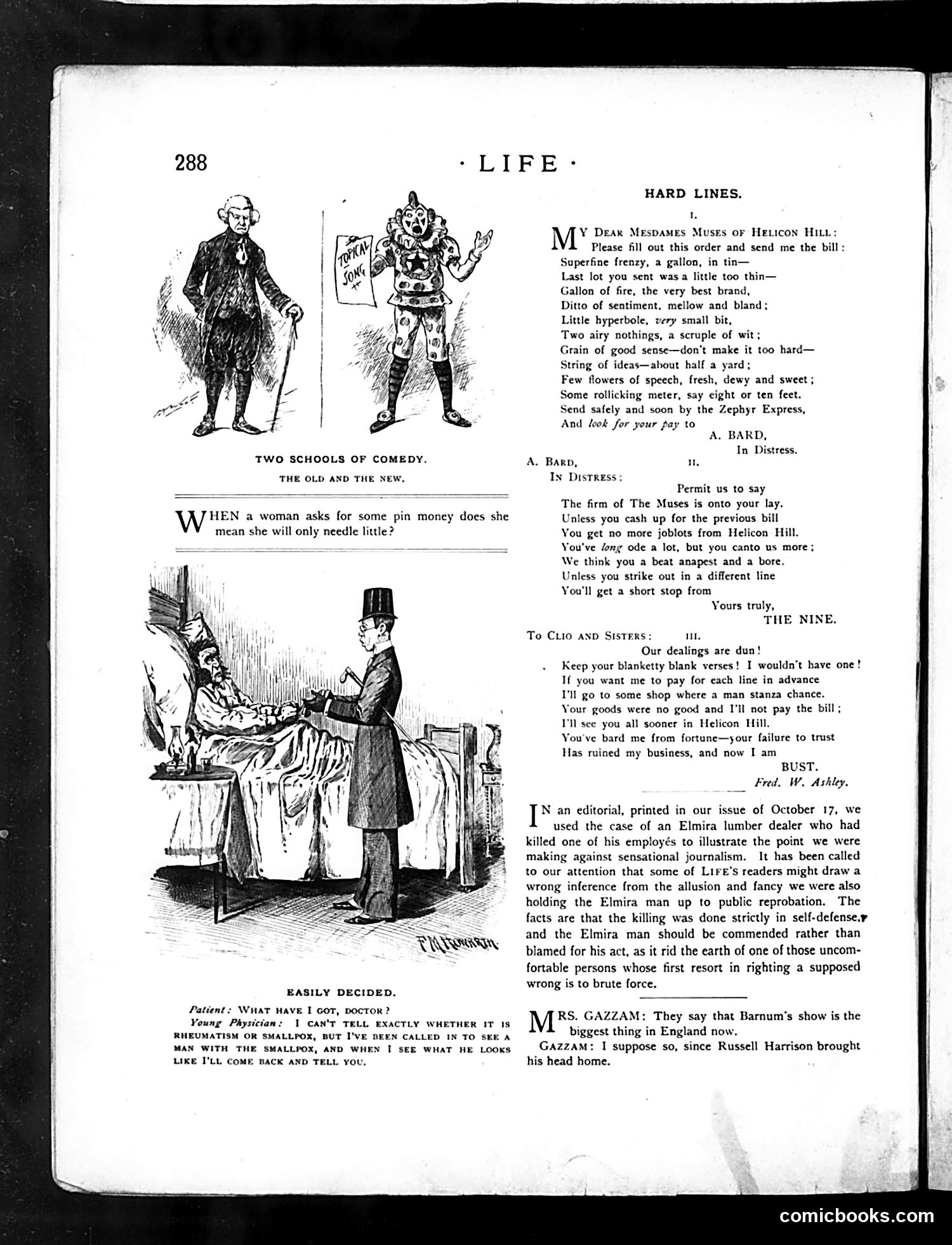
This page from *Life* magazine contains humorous complaint letters from readers ("Hard Lines") addressed to the publication's "Dear Mesdames Muses of Helicon Hill." **The cartoons** illustrate contrasting comedy styles: "Two Schools of Comedy—The Old and the New" shows a traditional gentleman versus a flamboyant performer. The lower cartoon, "Easily Decided," depicts a doctor's visit where a patient asks what ailment he has; the physician responds he cannot tell until seeing what the patient looks like in the smallpox, suggesting diagnosis depends on visual inspection. **The letters** contain witty complaints from readers, creditors, and performers about unpaid bills and business disputes with the magazine. One references Russell Harrison (likely the President's son), noting Barnum's show is "the biggest thing in England now." The page exemplifies *Life*'s satirical humor through reader complaints and visual gags about contemporary life.
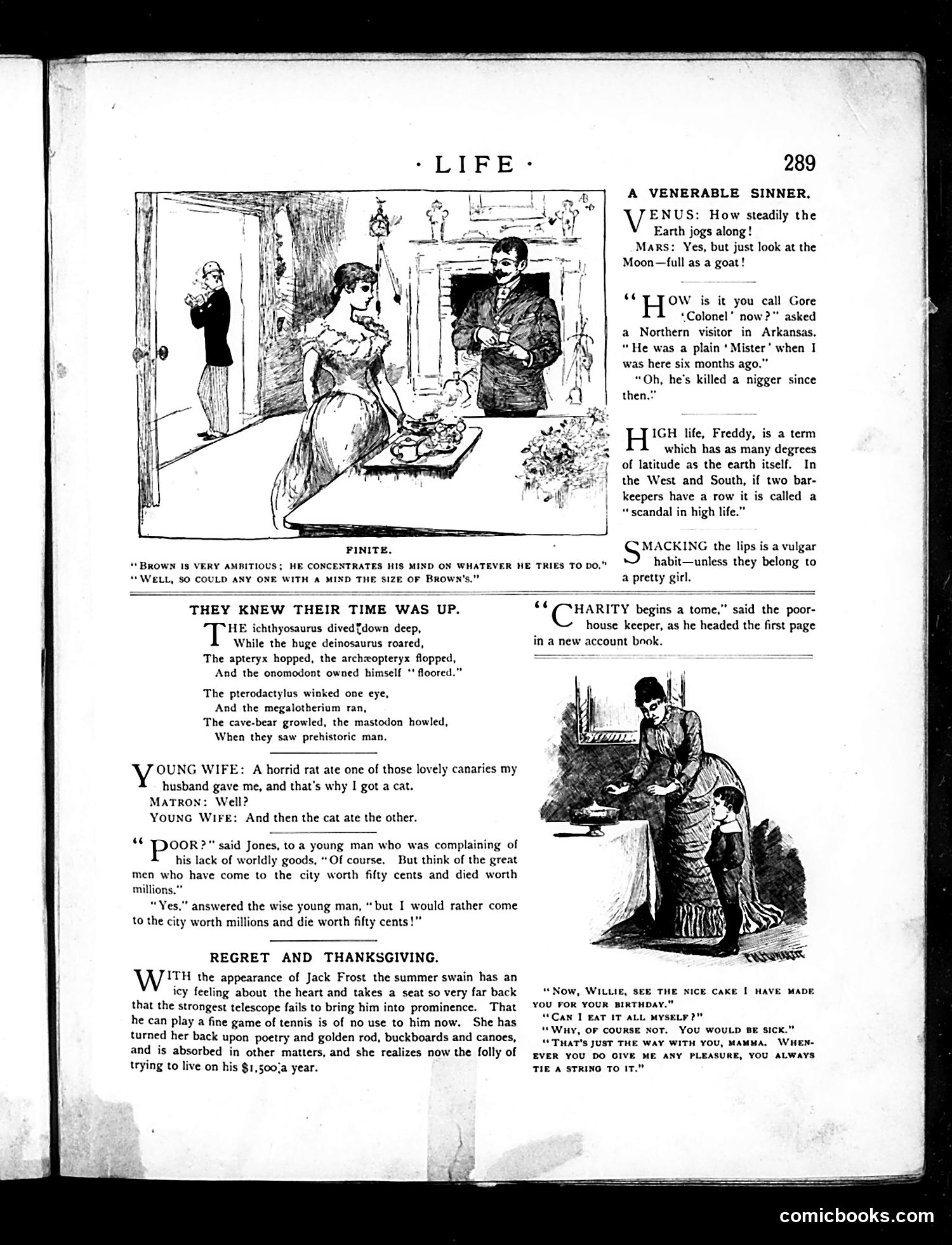
This page contains several humor pieces and a cartoon titled "Finite" depicting a domestic scene where a woman sits at a vanity while a man enters—likely satirizing marital dynamics or infidelity. The text sections mock various social types: a "venerable sinner" who has "killed a nigger" (reflecting period racist attitudes); commentary on "high life" scandals; and observations about social behavior like lip-smacking as vulgar habits. A poem "They Knew Their Time Was Up" uses dinosaurs as metaphor for prehistoric man facing extinction—possibly commenting on outdated social customs or old-fashioned behavior becoming obsolete. Additional brief dialogues joke about poverty, wealth, and domestic life. One cartoon shows what appears to be a poorhouse keeper with children, captioning about charity. The overall tone reflects turn-of-century American satirical humor targeting social pretension, domestic life, and class differences.
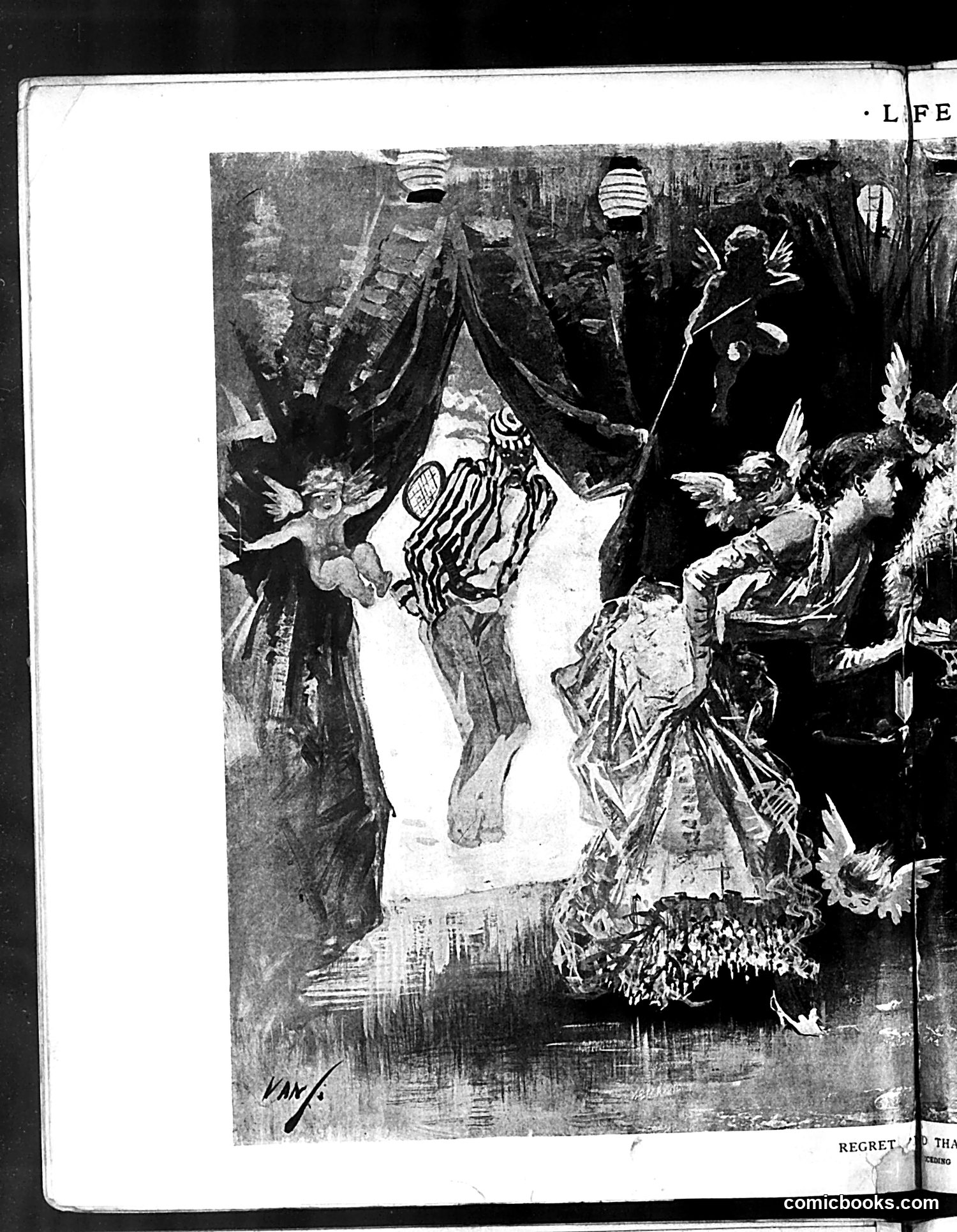
This appears to be a satirical illustration by Van (signature visible), likely from early 20th-century Life magazine. The image depicts an elaborate theatrical or operatic scene with elaborately dressed figures, angels, and dramatic drapery. The central focus is on figures in ornate costumes surrounded by cherubs and classical imagery, suggesting commentary on high society, opera culture, or theatrical pretension. The dramatic staging and heavenly iconography (angels, flowing robes) suggest the artist is mocking either the grandiosity of elite cultural institutions or perhaps romantic/sentimental excess in popular entertainment. Without clearer text identifying specific figures or dated context, the precise political target remains unclear, though the satirical tone indicates criticism of affectation or social pretense among the wealthy or culturally prominent.
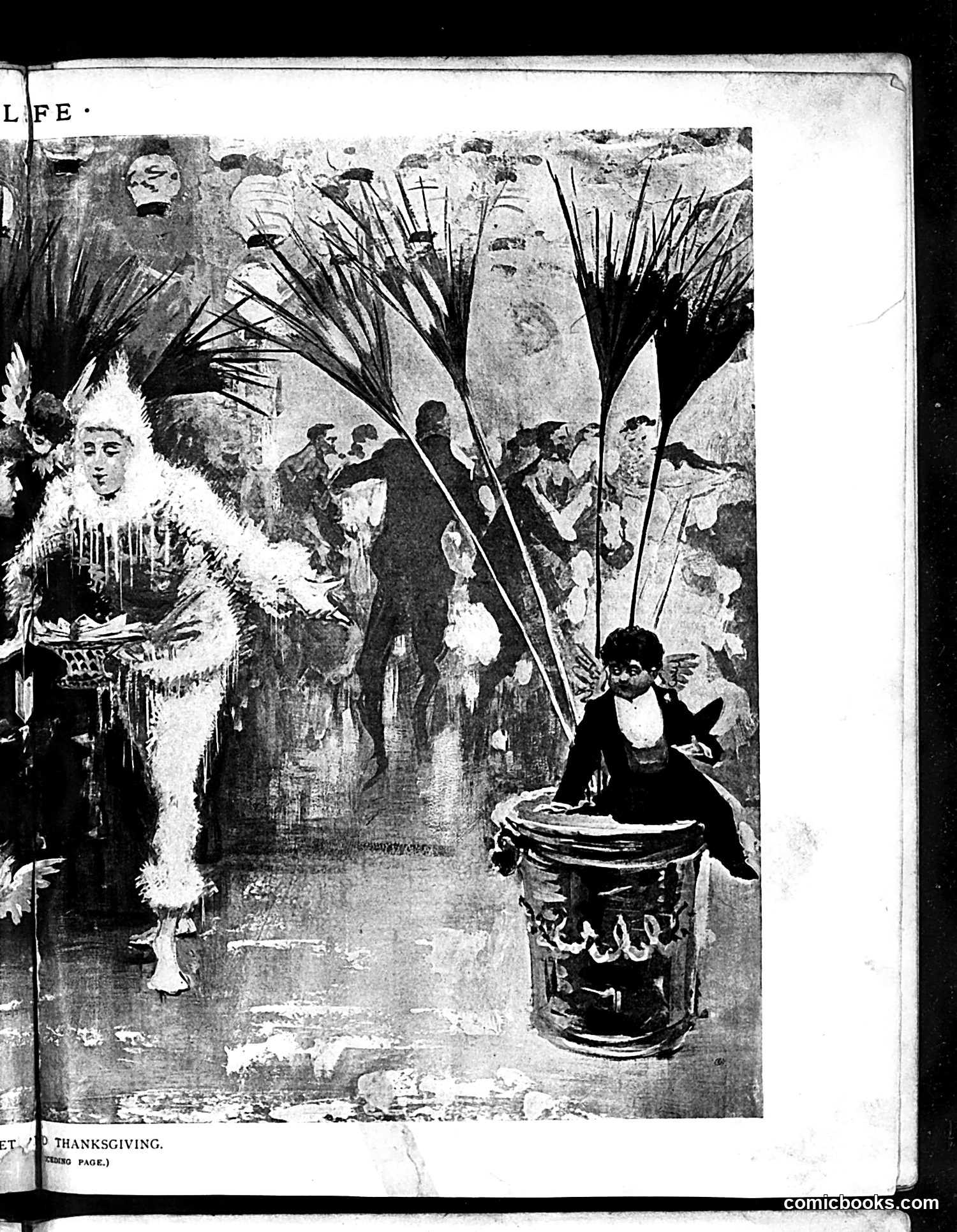
This appears to be a satirical illustration titled "A Thanksgiving" (text partially visible at bottom). The image depicts an elaborate, somewhat grotesque Thanksgiving scene with exaggerated figures in formal dress. On the left stands a woman in ornate clothing with feathers and furs. The central focus is a massive decorative vessel or urn, around which various figures gather. Tall palm fronds or similar vegetation frame the composition dramatically. The satire likely critiques wealthy Americans' ostentatious Thanksgiving celebrations—the elaborate dress, artificial decorations, and ornamental excess. The disproportionate scale of objects and figures creates a mocking effect. Without clearer identifying details or additional context text, the specific political targets remain unclear, though the image suggests mockery of upper-class pretension and materialistic holiday observance. The grainy black-and-white reproduction is consistent with early-to-mid 20th century magazine printing.
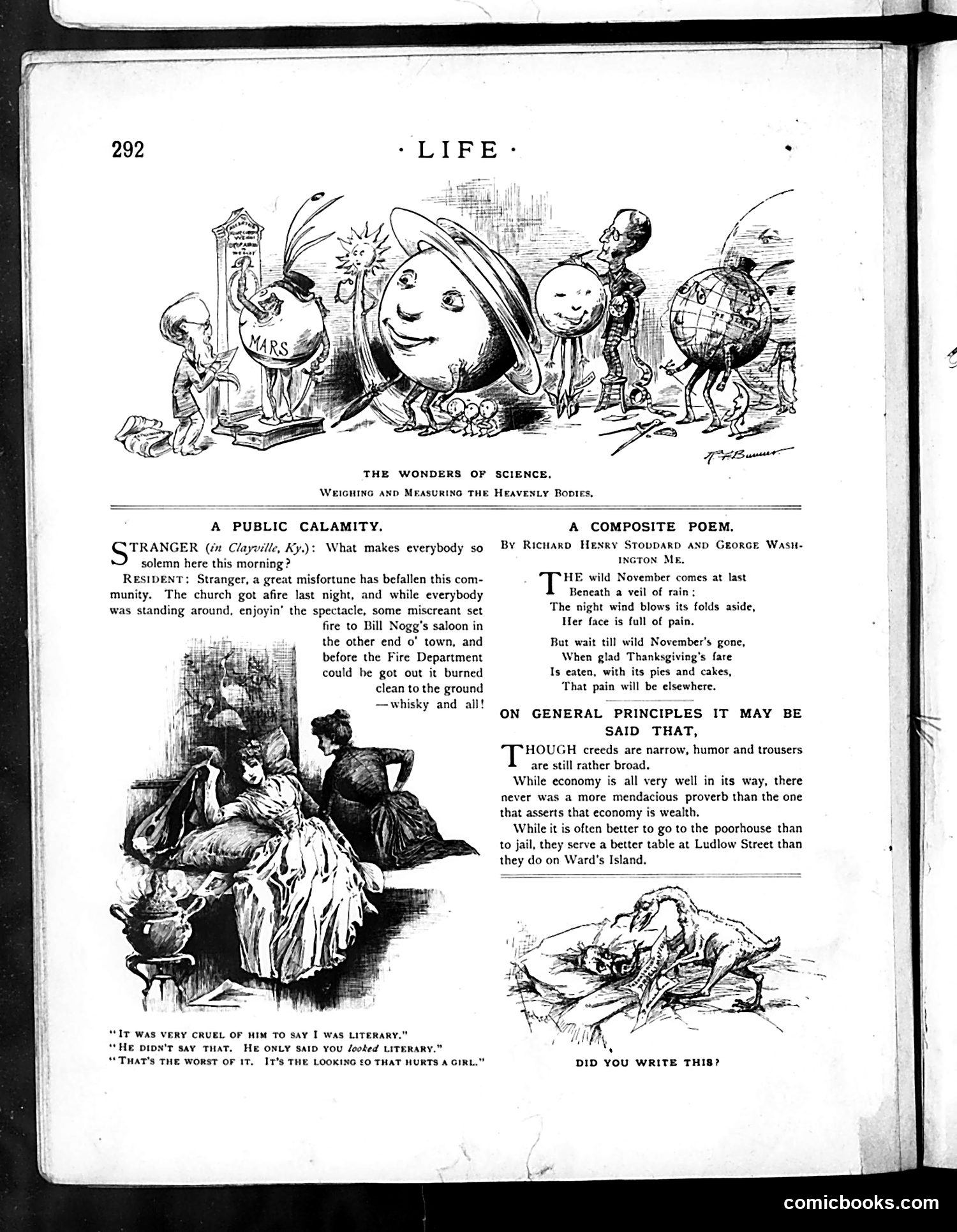
**Top Section ("The Wonders of Science"):** A whimsical illustration showing cherubs and figures weighing/measuring celestial bodies, satirizing scientific pretension—likely mocking contemporary astronomical or mathematical claims presented as grand discoveries. **"A Public Calamity":** A humorous dialogue between a stranger and resident of Clayville, Kentucky. The joke relies on misplaced priorities: while the church burns, onlookers are entertained. The real "calamity" is that Bill Nogg's saloon burned *afterward*—destroying whiskey. The satire targets rural priorities and drunkenness. **Bottom dialogues:** Two brief satirical exchanges. The first mocks how women fear appearing "literary" (intellectual) as unfeminine and socially damaging. The second ("On General Principles") offers cynical aphorisms mocking poverty relief—suggesting poorhouses offer better conditions than the real alternatives (jails, Ward's Island asylum). The page combines visual and textual satire typical of 19th-century American humor magazines.
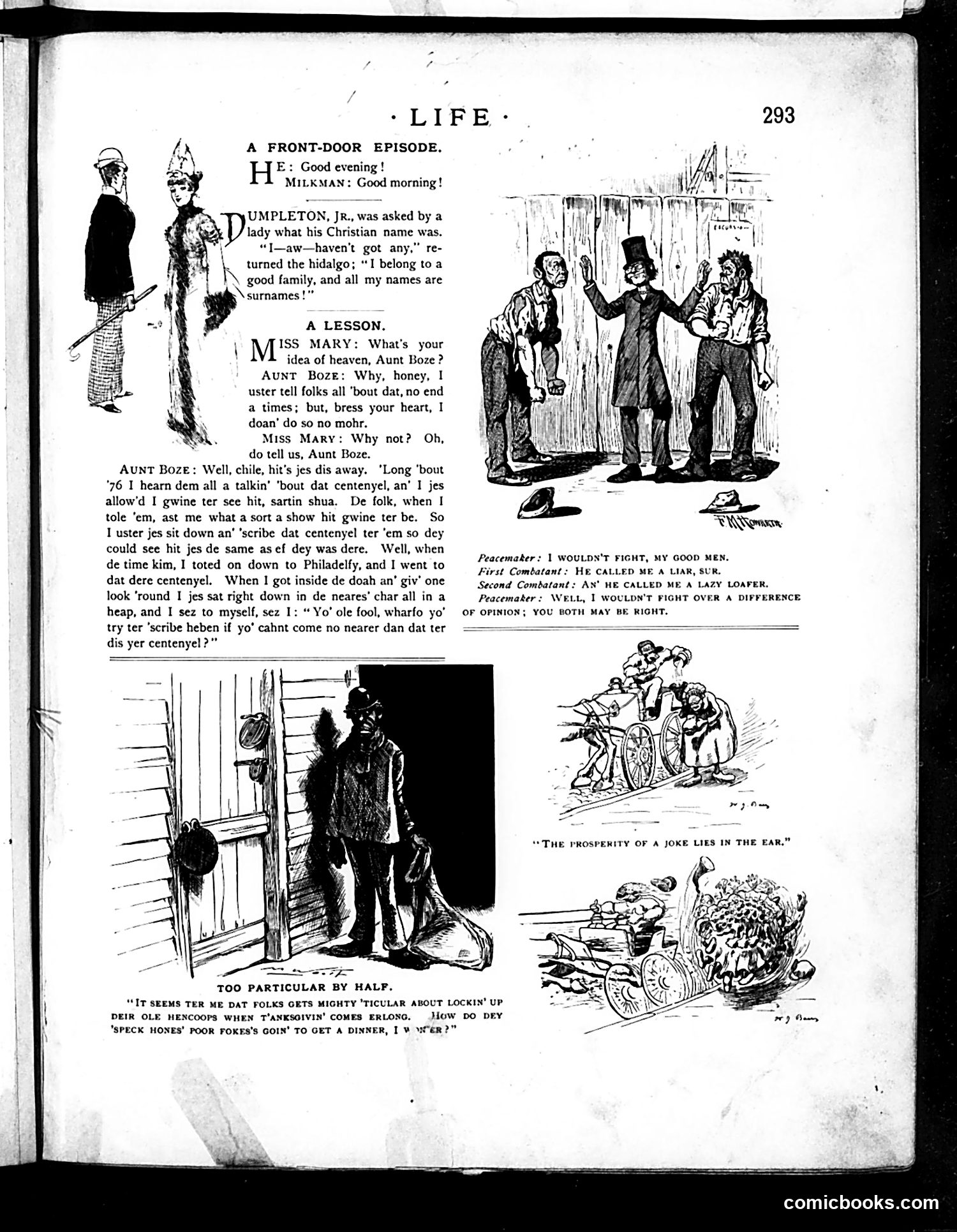
This page collects four humorous vignettes satirizing American social pretension and hypocrisy: **"A Front-Door Episode"** mocks class affectation—a gentleman claims to have only surnames because he belongs to a "good family," suggesting old money doesn't need Christian names. **"A Lesson"** features Aunt Boze (dialect-speaking, likely a Black character), who describes being disappointed by the 1876 Philadelphia Centennial Exposition after imagining it based on others' descriptions. The satire targets both inflated expectations and the gap between reality and hype. **"Too Particular by Half"** ridicules a peacemaker preventing a fight between men with legitimate grievances, prioritizing civility over justice—a critique of false neutrality. **The final caption** sarcastically questions how poor people are expected to obtain Thanksgiving dinners while society locks up resources (depicted as "hencoops"), exposing class hypocrisy about poverty and charity. The page uses dialect and working-class voices to expose upper-class absurdity and social inequality.
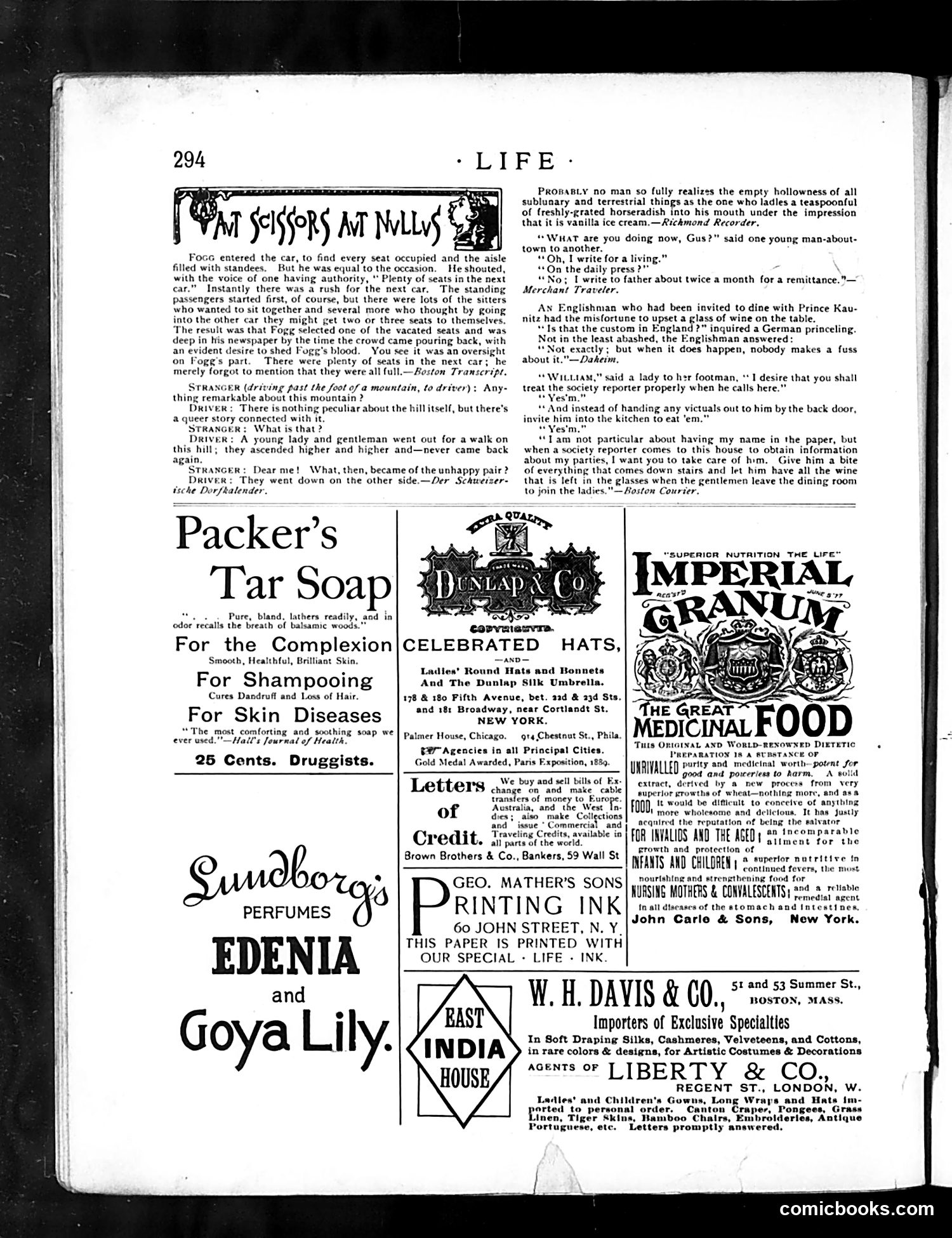
This page from *Life* magazine (page 294) contains several brief humorous anecdotes mocking human behavior and social pretense. The lead cartoon, "Scissors at Nullus," depicts a streetcar conductor who shouts that empty seats exist in the next car, causing a rush. He then claims a vacated seat himself—having "merely forgot to mention that they were all full." The satire mocks self-serving deception and public gullibility. Below are two additional jokes: one about a mountain where a couple "ascended higher and higher and—never came back" (a risqué suggestion they eloped), and another about a society lady instructing her footman to treat a gossip columnist properly—implying social climbers carefully manage their public image through press relations. The remainder of the page consists of period advertisements for soaps, perfumes, hats, banking services, and printing ink—typical of *Life's* commercial content circa the 1880s-1890s.
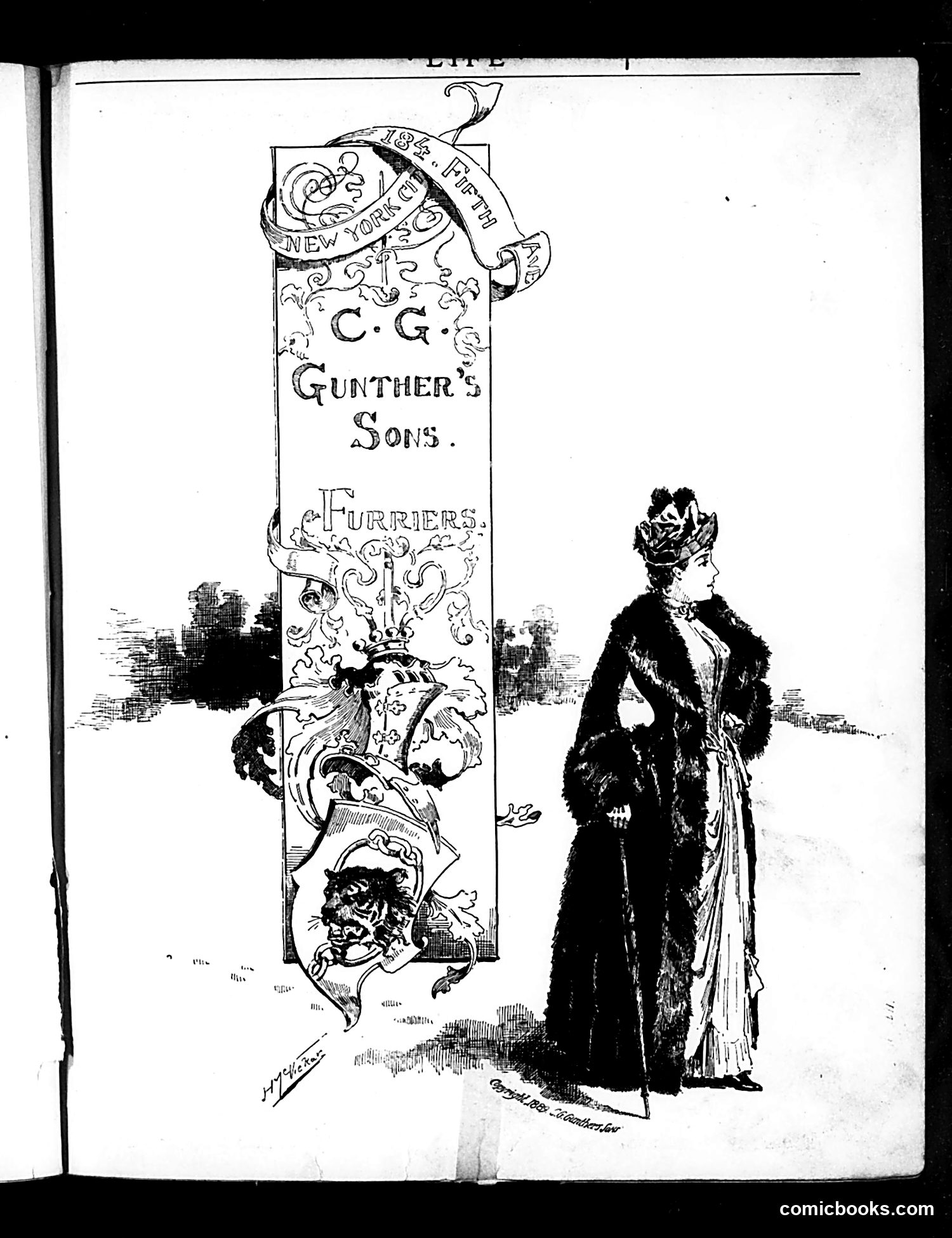
This appears to be an **advertisement or promotional page** for "C.G. Gunther's Sons, Furriers" (a fur business). The ornate vertical banner on the left displays the company name and location ("New York" visible at top, dated "1885" and "Fifth"). On the right stands a fashionably dressed woman in late 19th-century attire, wearing an elaborate fur coat and hat—precisely the type of luxury garment Gunther's would sell. The decorative banner features classical ornamental design with animal motifs appropriate to a furrier's business. This is **commercial advertisement rather than political satire**. It targets wealthy customers by depicting an elegantly dressed woman as an aspirational image of fashion and status, using the ornate banner as a prestigious business marker.
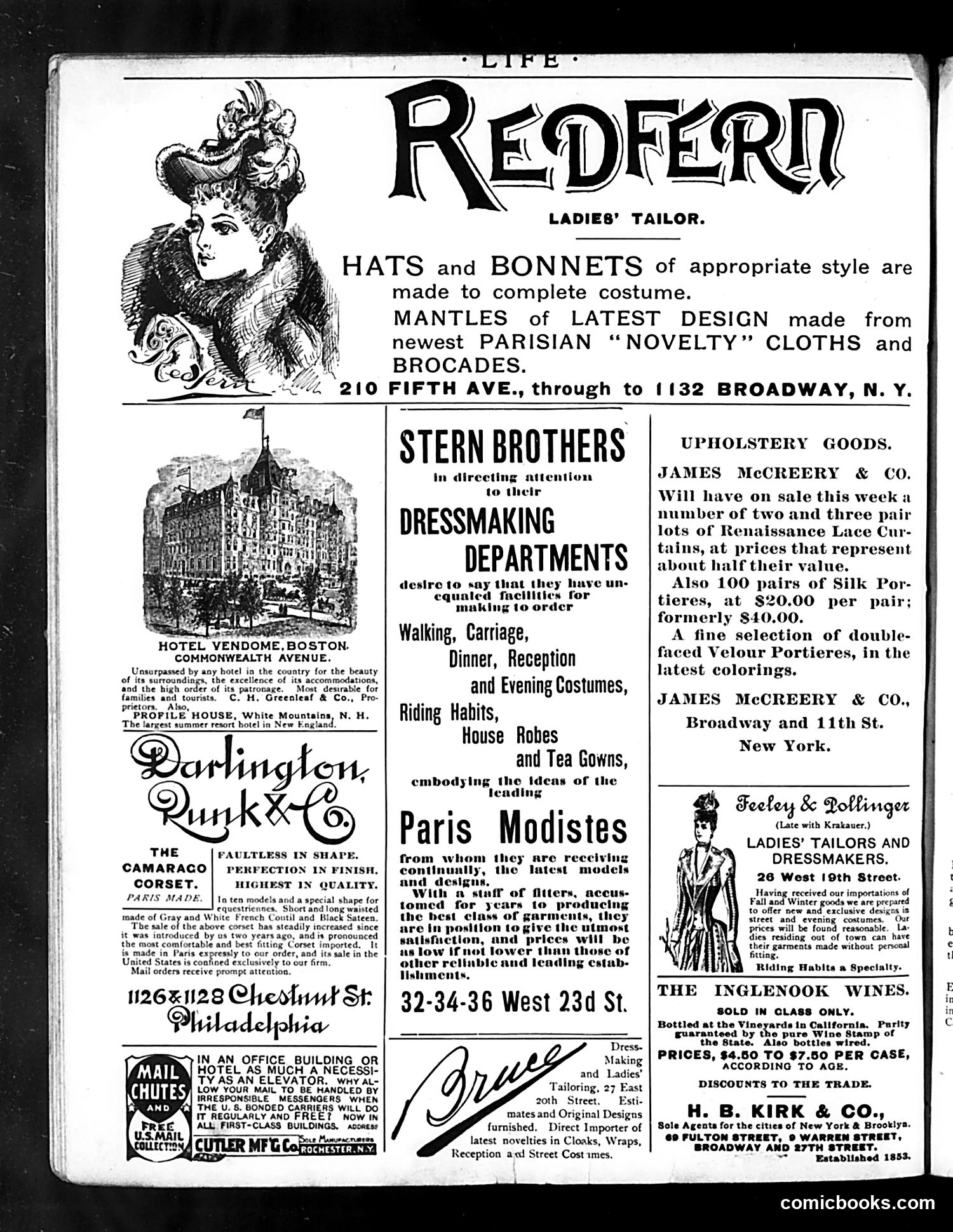
This is a commercial page from *Life* magazine containing no political cartoons or satire. It consists of period advertisements for upscale ladies' fashion services and goods targeting wealthy urban consumers in the late 19th or early 20th century. The ads showcase: - **Redfern** (ladies' tailor on Fifth Avenue/Broadway) - **Stern Brothers** (dressmaking departments for formal wear) - **Darlington Runk & Co.** (corsets made in Paris) - **James McCreery & Co.** (upholstery and curtains) - **Feeley & Pollinger** (ladies' tailors) - Various hotels, mail services, and wines The decorative illustrations are typical period graphics meant to convey elegance and refinement—a fashionable woman's profile, a Boston hotel building. These are commercial images, not satirical commentary. The page reflects *Life*'s business model of mixing advertising with editorial content.
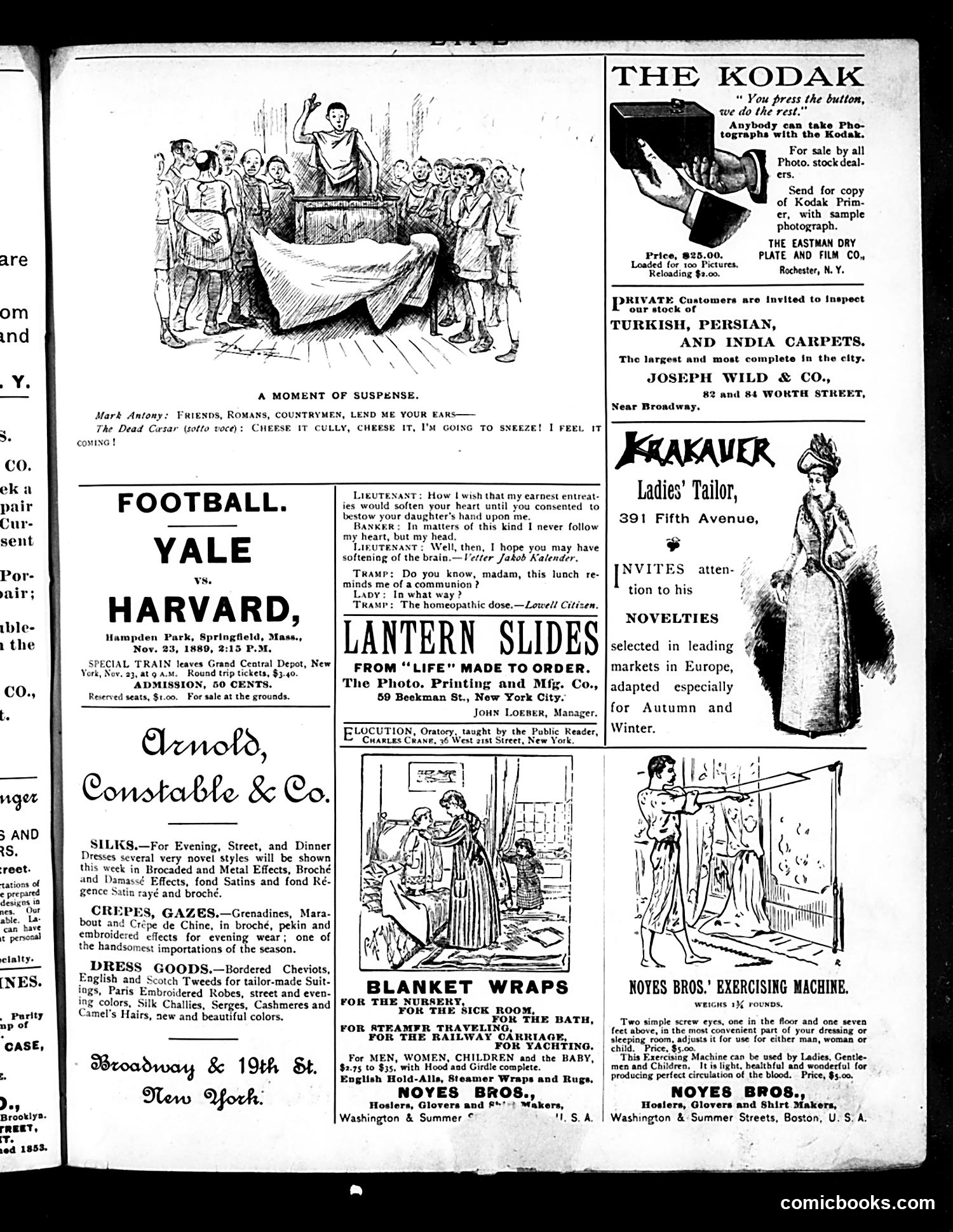
The main cartoon, titled "A Moment of Suspense," satirizes Shakespeare's *Julius Caesar*. It depicts Mark Antony delivering his famous funeral oration ("Friends, Romans, countrymen, lend me your ears") while the supposedly dead Caesar—shown in an aside—whispers a warning to "cheese it" because he's about to sneeze and give away that he's alive. The joke exploits the dramatic tension of the scene: Antony's stirring speech is being undercut by the mundane, embarrassing reality that a sneeze would ruin the assassination's cover-up. It's humor based on deflating high tragedy with bodily humor—the contrast between grand Shakespearean rhetoric and an involuntary physical act. The page is otherwise dominated by period advertisements for clothing, carpets, photography equipment (notably Kodak's "You press the button, we do the rest"), and other goods typical of 1889 consumer culture. Several humorous classified ads and jokes appear among the advertisements.
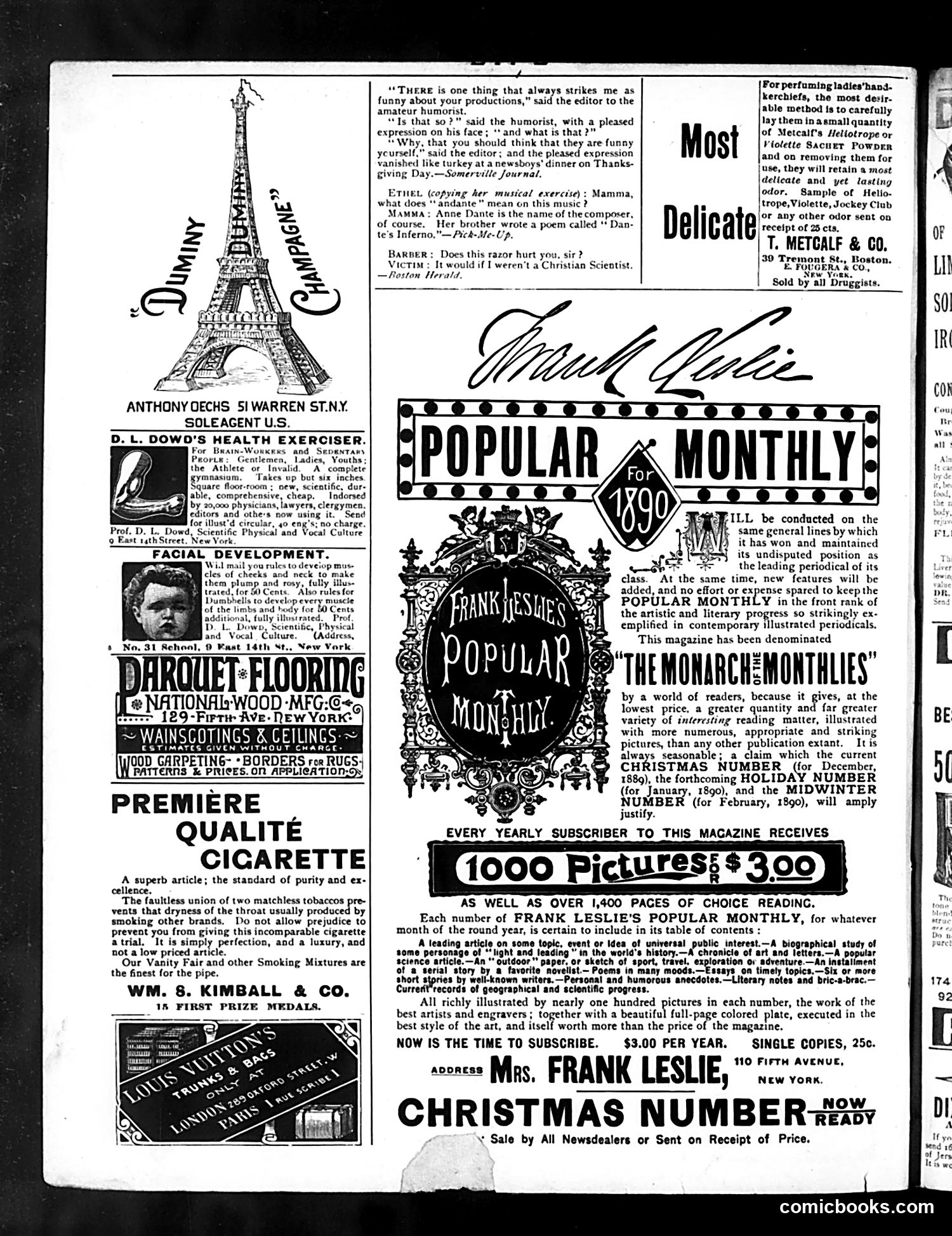
This page is primarily **advertising and promotional material** rather than political cartoons. The main content is a large advertisement for *Frank Leslie's Popular Monthly* magazine, promoting a subscription offer of 1,000 pictures and 1,400 pages for $3.00 yearly. The page includes three brief **humorous anecdotes** at top center: 1. An editor deflating an amateur humorist's ego—joke about self-deception 2. A child misinterpreting "andante" (musical term) as "Anne Dante" (composer)—a pun on misheard language 3. A Christian Scientist claiming razors don't hurt due to faith—satire of Christian Science beliefs The remaining content consists of **period advertisements** for various products: exercise equipment, flooring, cigars, facial development, and perfumed powder—typical late-19th-century commercial pitches targeting middle-class readers. This reflects *Life*'s mixed format: satirical journalism alongside commercial advertising supporting the publication.
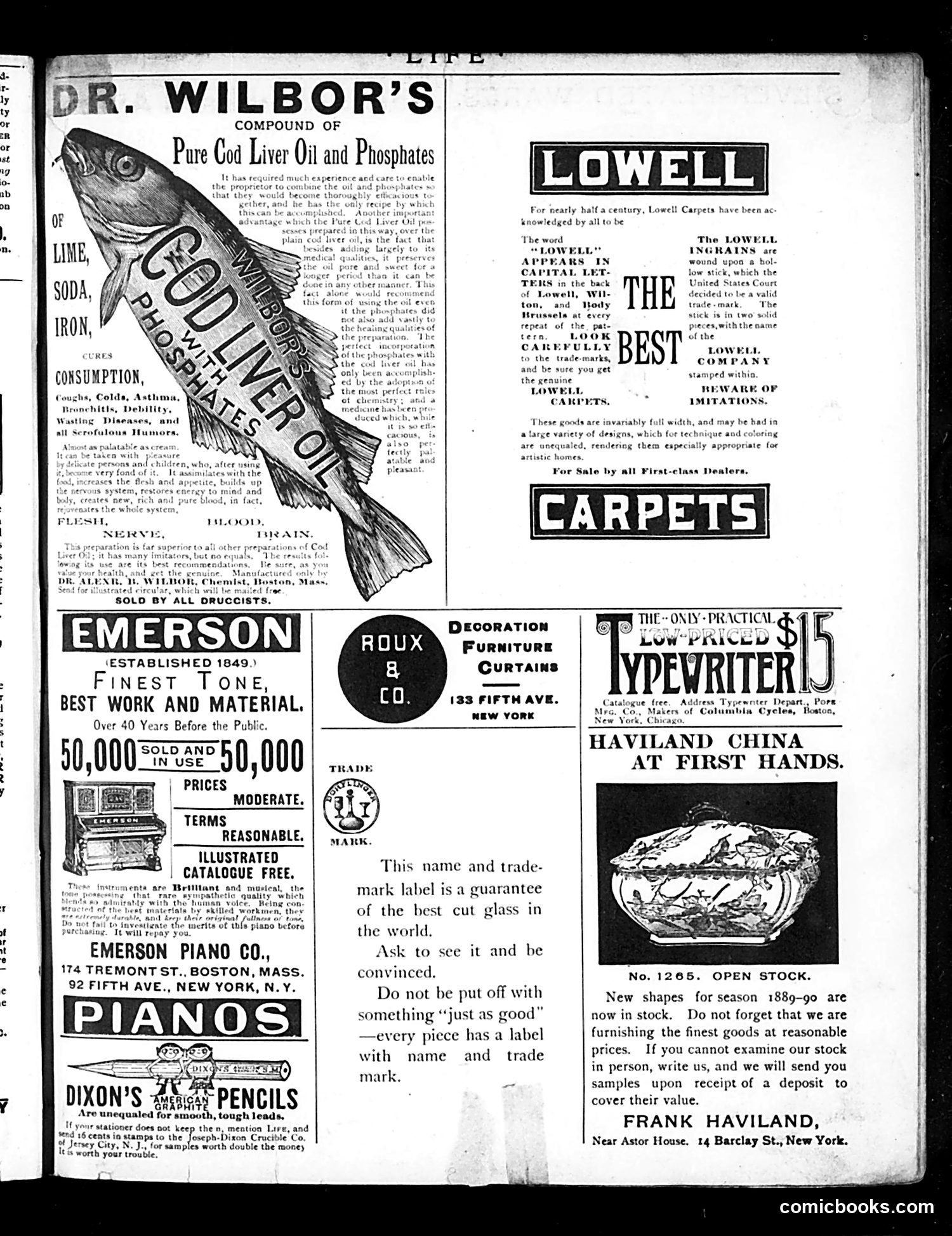
This is primarily an **advertising page**, not a political cartoon. It contains multiple product advertisements typical of late 19th-century American magazines: **Key ads include:** - **Dr. Wilbor's Cod Liver Oil**: A patent medicine claiming to cure consumption, coughs, and various ailments—a common nostrum of the era - **Emerson Piano Company**: Emphasizing 40+ years in business, 50,000 pianos sold - **Lowell Carpets**: Highlighting their trade-mark and warning against imitations - **Dixon's Pencils**: Claiming superiority in quality - **Haviland China**: Offering fine porcelain at "first hands" (direct from manufacturer) - **Roux & Co. Cut Glass**: Guaranteeing authentic quality through trade-marks The page reflects **consumer anxiety about authenticity and imitation goods**—advertisers repeatedly warn against counterfeits, suggesting widespread fraud. The emphasis on trade-marks and established reputations shows emerging modern advertising strategies targeting middle-class consumers concerned with quality and status.
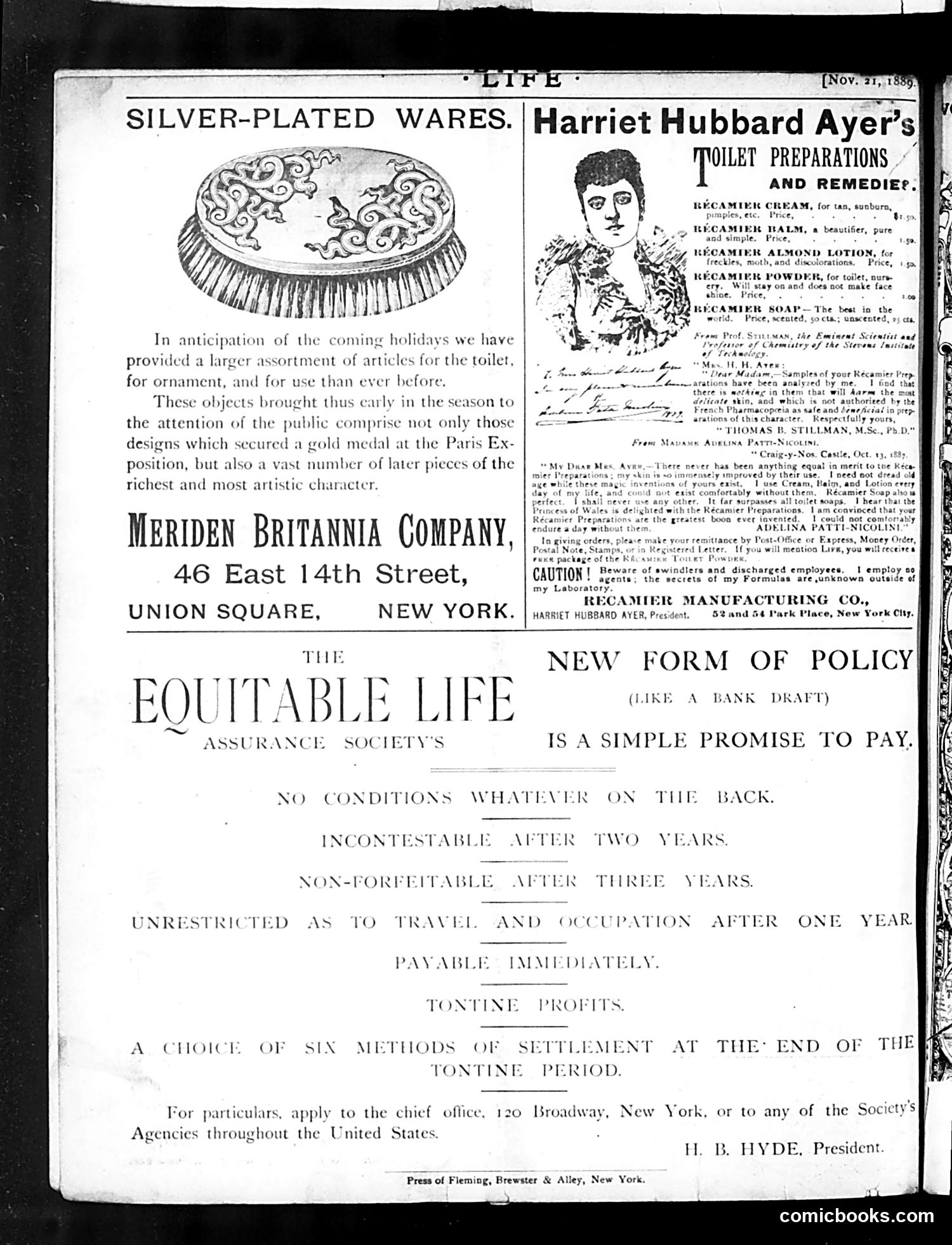
This page contains **no political cartoon**—it's primarily advertising. The content includes: **Silver-Plated Wares Advertisement**: Meriden Britannia Company promotes decorative household items, emphasizing holiday shopping and Paris Exposition awards. **Harriet Hubbard Ayer's Toiletries**: A prominent beauty products line featuring creams, balms, and soaps. The advertisement includes testimonials and a cautionary note warning against counterfeiters and dishonest employees—suggesting the product's popularity made it a target for fraud. **Equitable Life Assurance Society**: A detailed insurance policy advertisement describing a modern "tontine" policy (a form of life insurance investment popular in the era). It emphasizes simple terms: immediate payability, no travel restrictions after one year, and multiple settlement options. The page reflects late-19th-century consumer culture: holiday gift-giving, beauty industry expansion, and the growing sophistication of financial products. No satire or political commentary is evident.