
Life, 1889-11-21 · page 4 of 20
Life — November 21, 1889 — page 4: what you’re looking at
What you’re looking at
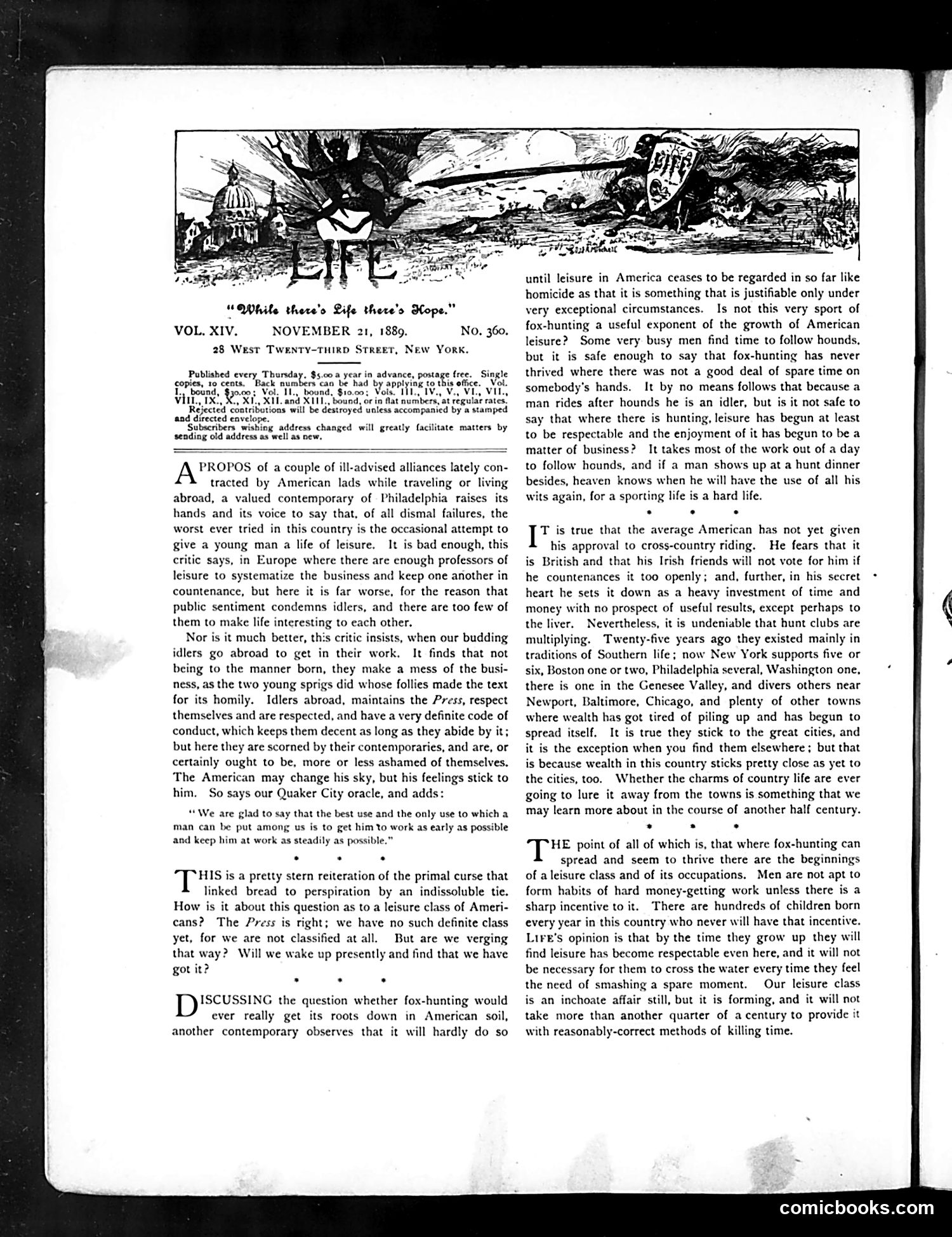
The masthead illustration depicts a satirical landscape combining symbols of American leisure and ambition—a domed capitol building, a sailing vessel, and various figures representing different classes of society. The editorial text debates whether fox-hunting should be considered a legitimate leisure activity for Americans. The author argues that fox-hunting represents a dangerous European aristocratic affectation that undermines American work ethic. The piece critiques wealthy Americans who adopt "idle" pursuits, suggesting this threatens the nation's character. The satire targets the anxiety of the 1880s-90s upper class adopting Old World pastimes, implying such leisurely pursuits are unpatriotic and unbecoming. The author contends that meaningful leisure—if any—requires purposeful activity, not mere imitation of British gentry traditions.
📄 Transcribed text from this page (OCR, searchable)
Machine-transcribed from the original scan — historical spelling and the odd misread are preserved.
“While there's Life there's Hope.” VOL, XIV. NOVEMBER 21, 1889. No, 360, y York. 28 West TWENTY-THIRD STREET, N Published every Thursday, $5.00 a year in advance, postage free. copies, 10 cents, Back numbers can be had by applying to this effice. Vol. e Vol, Il, bovnd, $1.00; Volts Whe IV. Vee Vie Vite, Vill, IX! 1, X1i. and XIII, bound, o in flat numbers, at regular rates. Rejected contributions will be destroyed unless accompanied by a stamped and directed envelope. ribers wishing address changed will greatly facilitate matters by sending old address as well as new. Single Vir ArRoros of a couple of ill-advised alliances lately con- tracted by American lads while traveling or living abroad, a valued contemporary of Philadelphia raises its hands and its voice to say that, of all dismal failures, the worst ever tried in this country is the occasional attempt to give a young man a life of leisure. It is bad enough, this critic says, in Europe where there are enough professors of leisure to systematize the business and keep one another in countenance, but here it is far worse, for the reason that public sentiment condemns idlers, and there are too few of them to make life interesting to each other. Nor is it much better, this critic insists, when our budding idlers go abroad to get in their work, It finds that not being to the manner born, they make a mess of the busi- ness, as the two young sprigs did whose follies made the text for its homily. Idlers abroad, maintains the Press, respect themselves and are respected, and have a very definite code of conduct, which keeps them decent as long as they abide by it; but here they are scorned by their contemporaries, and are, or certainly ought to be, more or less ashamed of themselves. The American may change his sky, but his feelings stick to him. So says our Quaker City oracle, and adds: “We are glad to say that the best use and the only use to which a man can be put among us is to get him to work as early as possible and keep him at work as steadily as possible.” HIS is a pretty stern reiteration of the primal curse that linked bread to perspiration by an indissoluble tie. How is it about this question as to a leisure class of Ameri- cans? The Press is right; we have no such definite class yet, for we are not classified at all. But are we verging that way? Will we wake up presently and find that we have got it? . . . ISCUSSING the question whether fox-hunting would ever really get its roots down in American soil, another contemporary observes that it will hardly do so until leisure in America ceases to be regarded in so far like homicide as that it is something that is justifiable only under very exceptional circumstances. Is not this very sport of fox-hunting a useful exponent of the growth of American leisure? Some very busy men find time to follow hounds, but it is safe enough to say that fox-hunting has never thrived where there was not a good deal of spare time on somebody's hands. It by no means follows that because a man rides after hounds he is an idler, but is it not safe to say that where there is hunting, leisure has begun at least to be respectable and the enjoyment of it has begun to be a matter of business? It takes most of the work out of a day to follow hounds, and if a man shows up at a hunt dinner besides, heaven knows when he will have the use of all his wits again, for a sporting life is a hard life. T is true that the average American has not yet given his approval to cross-country riding. He fears that it is British and that his Irish friends will not vote for him if he countenances it too openly; and, further, in his secret heart he sets it down as a heavy investment of time and money with no prospect of useful results, except perhaps to the liver. Nevertheless, it is undeniable that hunt clubs are multiplying. Twenty-five years ago they existed mainly in traditions of Southern life; now New York supports five or six, Boston one or two, Philadelphia several, Washington one, there is one in the Genesee Valley, and divers others near Newport, Baltimore, Chicago, and plenty of other towns where wealth has got tired of piling up and has begun to spread itself. It is true they stick to the great cities, and it is the exception when you find them elsewhere ; but that is because wealth in this country sticks pretty close as yet to the cities, too. Whether the charms of country life are ever going to lure it away from the towns is something that we may learn more about in the course of another half century. . . . e[PHE point of all of which is, that where fox-hunting can spread and seem to thrive there are the beginnings of a leisure class and of its occupations. Men are not apt to form habits of hard money-getting work unless there is a sharp incentive to it. There are hundreds of children born every year in this country who never will have that incentive. Lire’s opinion is that by the time they grow up they will find leisure has become respectable even here, and it will not be necessary for them to cross the water every time they feel the need of smashing a spare moment. Our leisure class is an inchoate affair still, but it is forming, and it will not take more than another quarter of a century to provide it with reasonably-correct methods of killing time. comicbooks.com