
Life, 1889-11-21 · page 6 of 20
Life — November 21, 1889 — page 6: what you’re looking at
What you’re looking at
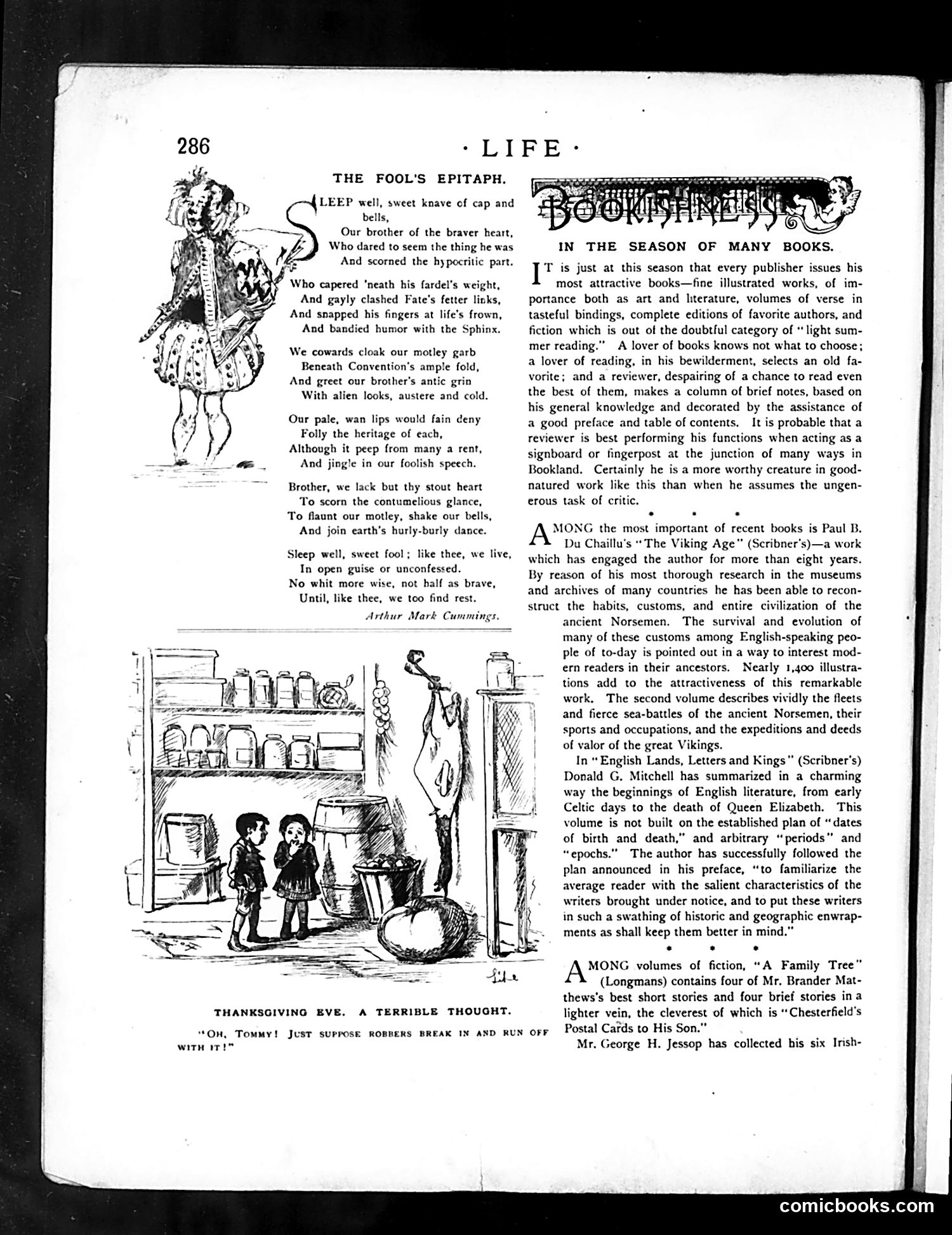
This page contains two distinct elements: **"The Fool's Epitaph"** (top left): A poem by Arthur Mark Cummings, illustrated with a jester figure. The verse satirizes a foolish character who mimicked conventional behavior and lacked genuine courage or insight. The specific references are unclear without additional context, though the jester costume suggests mockery of pretense or false wisdom. **"Thanksgiving Eve. A Terrible Thought"** (bottom): A sketch captioned "Oh, Tommy! Just suppose robbers break in and run off with it!" showing a mother and children in a kitchen. The joke appears to be anxious humor about holiday preparations—the implied punchline likely concerns what the family fears losing during a robbery (possibly food or presents). The right side consists primarily of book reviews under "Bookshelf," not political commentary.
📄 Transcribed text from this page (OCR, searchable)
Machine-transcribed from the original scan — historical spelling and the odd misread are preserved.
- LIFE: THE FOOL'S EPITAPH. LEEP well, sweet knave of cap and bells, Our brother of the braver heart, Who dared to seem the thing he was And scorned the hypocritic part. ? Who capered ‘neath his fardel’s weight, And gayly clashed Fate's fetter links, And snapped his fingers at life's frown, And bandied humor with the Sphinx. We cowards cloak our motley garb Beneath Convention's ample fold, And greet our brother's antic grin With alien looks, austere and cold. Our pale, wan lips would fain deny Folly the heritage of each, Although it peep from many a rent, And jingle in our foolish speech. Brother, we lack but thy stout heart To scorn the contumelious glance, To flaunt our motley, shake our bells, And join earth’s hurly-burly dance. Sleep well, sweet fool ; like thee, we live, In open guise or unconfessed. No whit more wise, not half as brave, Until, like thee, we too find rest. Arthur Mark Cummings. THANKSGIVING EVE. A TERRIBLE THOUGHT. “On, Tommy! JUST SUPPOSE ROBRERS BREAK IN AND RUN OFF with itt” IN THE SEASON OF MANY BOOKS. f is just at this season that every publisher issues his most attractive books—fine illustrated works, of im- portance both as art and literature, volumes of verse in tasteful bindings, complete editions of favorite authors, and fiction which is out of the doubtful category of “light sum- mer reading.” A lover of books knows not what to choose; a lover of reading, in his bewilderment, selects an old fa- vorite; and a reviewer, despairing of a chance to read even the best of them, makes a column of brief notes, based on his general knowledge and decorated by the assistance of a good preface and table of contents, It is probable that a reviewer is best performing his functions when acting as a signboard or fingerpost at the junction of many ways in Bookland. Certainly he is a more worthy creature in good- natured work like this than when he assumes the ungen- erous task of critic. MONG the most important of recent books is Paul B. Du Chaillu’s “The Viking Age” (Scribner's)—a work which has engaged the author for more than eight years. By reason of his most thorough research in the museums and archives of many countries he has been able to recon- struct the habits, customs, and entire civilization of the ancient Norsemen. The survival and evolution of many of these customs among English-speaking peo- ple of to-day is pointed out in a way to interest mod- ern readers in their ancestors. Nearly 1,400 illustra- tions add to the attractiveness of this remarkable work, The second volume describes vividly the fleets and fierce sea-battles of the ancient Norsemen, their sports and occupations, and the expeditions and deeds of valor of the great Vikings. In “English Lands, Letters and Kings” (Scribner's) Donald G. Mitchell has summarized in a charming way the beginnings of English literature, from early Celtic days to the death of Queen Elizabeth. This volume is not built on the established plan of “dates of birth and death,” and arbitrary “periods” and “epochs.” The author has successfully followed the plan announced in his preface, “to familiarize the average reader with the salient characteristics of the writers brought under notice, and to put these writers in such a swathing of historic and geographic enwrap- ments as shall keep them better in mind.” . . . MONG volumes of fiction, “A Family Tree” (Longmans) contains four of Mr. Brander Mat- thews's best short stories and four brief stories in a lighter vein, the cleverest of which is “Chesterfield’s Postal Cards to His Son.” Mr. George H. Jessop has collected his six Irish- comicbooks.com